Künstliche Intelligenz: Metas Avocado-Modell hinkt Konkurrenz hinterher
Metas neues Sprachmodell Avocado erreicht laut Berichten nicht das Niveau von OpenAI und Google. Der Release verschiebt sich nun auf Mai. (Meta, KI)
Quelle: Golem

Metas neues Sprachmodell Avocado erreicht laut Berichten nicht das Niveau von OpenAI und Google. Der Release verschiebt sich nun auf Mai. (Meta, KI)
Quelle: Golem

Der autonome R66 Turbinetruck von Sikorsky sieht aus wie ein normaler Transporthubschrauber, nur ohne Cockpit. (Luftfahrt, Mobilität)
Quelle: Golem

Ab Juni 2026 fließen Lootboxen, In-Game-Käufe und Onlinefunktionen stärker in die europäischen PEGI-Altersfreigaben ein. (Spiele, Jugendschutz)
Quelle: Golem

Mit dem Cosmos und dem Earth hat Lucid zwei Mittelklasse-Elektroautos angekündigt, die effizienter als die Konkurrenz sein sollen. (Lucid, Elektroauto)
Quelle: Golem
Building agents is now a strategic priority for 95% of respondents in our latest State of Agentic AI research, which surveyed more than 800 developers and decision-makers worldwide. The shift is happening quickly: agent adoption has moved beyond experiments and demos into early operational maturity. But the road to enterprise-scale adoption is still complex. The foundations are forming, yet far from fully integrated, production-grade platforms that teams can confidently build on.
Security continues to surface as a top blocker to agent adoption. But it’s not the only one. Technical complexity is rising fast as well. Vendor lock-in is a big concern for the vast majority of the respondents surveyed.
So how do teams cut through the complexity and prepare for a world of multi-model, multi-tool, and multi-framework agents, while avoiding vendor lock-in in their agent workflows? In this blog, we break down the key findings from our research: what teams are actually using to power their agentic workloads, and what it takes to build a more scalable, future-ready agent architecture.
Multi-model and multi-cloud are the new normal. And complexity is rising
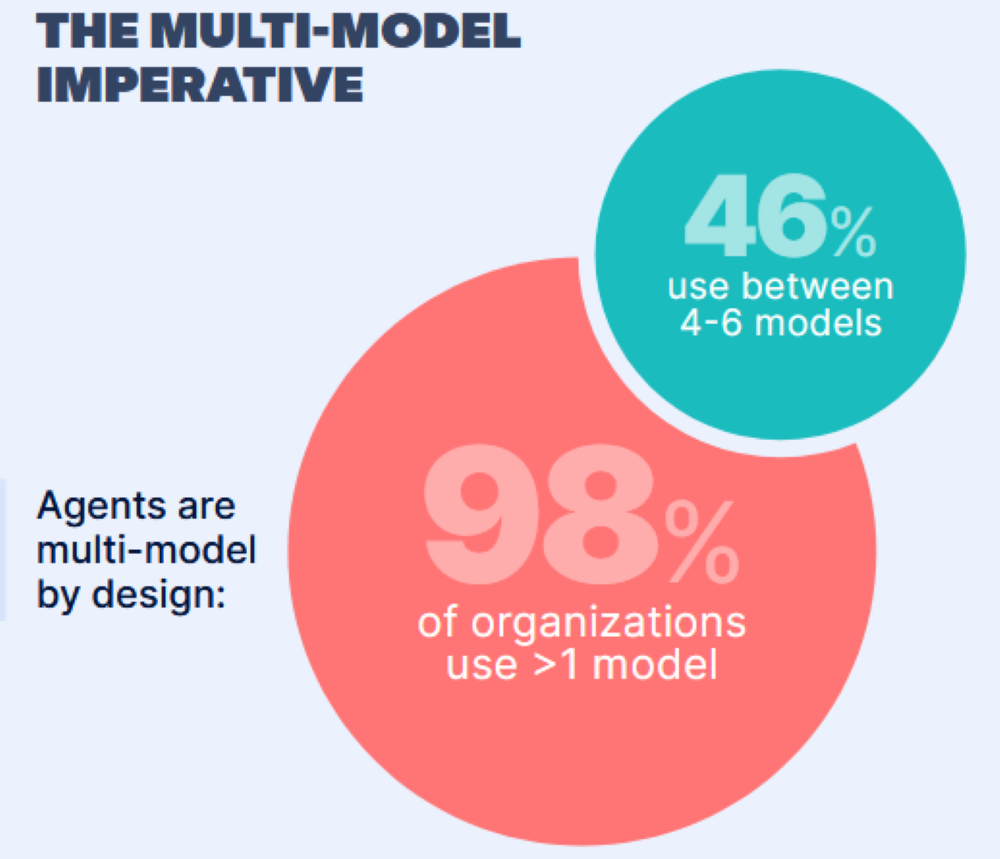
Our recent Agent AI study found that enterprises are embracing multi-model and multi-cloud architectures to gain greater control over performance, customization, privacy, and compliance. Multi-model is now the norm. Nearly two-thirds of organizations (61%) combine cloud-hosted and local models. And complexity doesn’t stop there: 46% report using between four and six models within their agents, while just 2% rely on a single model.
Deployment environments are just as diverse. 79% of respondents operate agents across two or more environments; 51% in public clouds, 40% on-premises, and 32% on serverless platforms.
This architectural flexibility delivers control, but it also multiplies orchestration and governance efforts. Coordinating models, tools, frameworks, and environments is consistently cited as one of the hardest parts of building agents. Nearly half of respondents (48%) identify operational complexity in managing multiple components as their biggest challenge, while 43% point to increased security exposure driven by orchestration sprawl.
The strategic shift away from vendor lock-in
As organizations double down on agent investments, concerns about supply chain fragility are rising. Seventy-six percent of global respondents report active worries about vendor lock-in.
Seventy-six percent of global respondents report active concerns about vendor lock-in
Rather than consolidating, teams are responding by diversifying. They’re distributing workloads across multiple models, tools, and cloud environments to reduce dependency and maintain leverage. Among the 61% of organizations using both cloud-hosted and locally hosted models, the primary drivers are control (64%), data privacy (60%), and compliance (54%). Cost ranks significantly lower at 41%, underscoring that flexibility and governance, not cost savings are shaping architectural decisions.
Containers power the next wave of agent adoption
Containerization is already foundational to agent development. Nearly all organizations surveyed (94%) use containers in their agent development or production workflows and the remainder plan to adopt them.
Nearly all organizations surveyed (94%) use containers in their agent development or production workflows and the remainder plan to adopt them.
As agent initiatives scale, teams are extending the same cloud-native practices that power their application pipelines such as microservices architectures, CI/CD, and container orchestration to support agent workloads. Containers are not an add-on; they are the operational backbone. In fact, 94% of teams building agents rely on them.
At the same time, early signs of orchestration standardization are emerging. Among teams building agents with Docker, 40% are using Docker Compose as their orchestration layer, a signal that familiar, container-based tooling is becoming a practical coordination layer for increasingly complex agent systems.
The agentic future won’t be monolithic
The agentic future won’t be monolithic. It’s already multi-cloud, multi-model, and multi-environment. That reality makes open standards and portable infrastructure foundational for sustaining enterprise trust and long-term flexibility.
What’s needed next isn’t reinvention, but standardization around an open, interoperable and portable infrastructure: the flexibility to work across any model, tool, and agent framework, secure-by-default runtimes, consistent orchestration and integrated policy controls. Teams that invest now in this container-based trust layer will move beyond isolated productivity gains to sustainable enterprise-wide outcomes while reducing vendor lock-in risk.
Download the full Agentic AI report for more insights and recommendations on how to scale agents for enterprise.
Join us on March 25, 2026, for a webinar where we’ll walk through the key findings and the strategies that can help you prioritize what comes next.
Learn more:
Get your copy of the latest State of Agentic AI report!
Learn more about Docker’s AI solutions
Read more about why AI agents challenge existing governance approaches and explore a new framework designed for agentic AI.
Quelle: https://blog.docker.com/feed/
AWS Backup logically air-gapped vault now supports Amazon EKS. Logically air-gapped vaults are a type of AWS Backup vault that allows secure sharing of backups across accounts and AWS Organizations, supporting direct restore to reduce recovery time from a data loss event.
You can now protect your Amazon EKS clusters in logically air-gapped vaults. A logically air-gapped vault stores immutable backup copies that are locked by default, and isolated with encryption using AWS owned keys or customer-managed keys. You can store your Amazon EKS backups in a logically air gapped vault either the same account or across other accounts and Regions. This helps reduce the risk of downtime, ensure business continuity, and meet compliance and disaster recovery requirements.
You can get started using the AWS Backup console, API, or CLI. Target Amazon EKS backups to a logically air-gapped vault by specifying it as the primary target or copy destination in your backup plan. Share the vault for recovery using AWS Resource Access Manager (RAM) or access it via Multi-party approval. Once available, you can initiate direct restore jobs from that account, eliminating the overhead of copying backups first.
AWS Backup logically air-gapped vault support for Amazon EKS is available in 24 AWS Regions. For more information and detailed regional availability, visit the AWS Backup documentation.
Quelle: aws.amazon.com
AWS announces availability of new bundles powered by Microsoft Windows Server 2025, offered for Amazon WorkSpaces Personal and Amazon WorkSpaces Core. With these bundles, customers can launch Windows Server 2025 WorkSpaces and take advantage of the latest Windows server operating systems features. Customers can run applications such as eligible Microsoft 365 Apps for enterprise that require newer Windows versions. While Windows Server 2016, 2019, and 2022 powered WorkSpaces bundles remain available, the Windows Server 2025 option brings enhanced security and modern capabilities such as Trusted Platform Module 2.0 (TPM 2.0), Unified Extensible Firmware Interface (UEFI) Secure Boot, Secured-core server, Credential Guard and Hypervisor-protected Code Integrity (HVCI) and DNS-over-HTTPS.
You can get started using the managed Windows Server 2025 WorkSpaces bundles or create your own custom bundle and image tailored to your requirements. For more information on Amazon WorkSpaces’ new Windows Server Bundles, visit Amazon WorkSpaces FAQs. The new WorkSpaces Windows Server 2025 support is available in all AWS Regions where Amazon WorkSpaces is available. For pricing information, visit Amazon WorkSpaces pricing page.
Quelle: aws.amazon.com
Starting today, Amazon EC2 M8i and M8i-flex instances are now available in Europe (Ireland) and Europe (London) Regions. These instances are powered by custom Intel Xeon 6 processors, available only on AWS, delivering the highest performance and fastest memory bandwidth among comparable Intel processors in the cloud. The M8i and M8i-flex instances offer up to 15% better price-performance, and 2.5x more memory bandwidth compared to previous generation Intel-based instances. They deliver up to 20% better performance than M7i and M7i-flex instances, with even higher gains for specific workloads. The M8i and M8i-flex instances are up to 30% faster for PostgreSQL databases, up to 60% faster for NGINX web applications, and up to 40% faster for AI deep learning recommendation models compared to M7i and M7i-flex instances. M8i-flex are the easiest way to get price performance benefits for a majority of general-purpose workloads like web and application servers, microservices, small and medium data stores, virtual desktops, and enterprise applications. They offer the most common sizes, from large to 16xlarge, and are a great first choice for applications that don’t fully utilize all compute resources. M8i instances are a great choice for all general purpose workloads, especially for workloads that need the largest instance sizes or continuous high CPU usage. The SAP-certified M8i instances offer 13 sizes including 2 bare metal sizes and the new 96xlarge size for the largest applications. To get started, sign in to the AWS Management Console. For more information about the new instances, visit the M8i and M8i-flex instance page or visit the AWS News blog.
Quelle: aws.amazon.com
AWS Elastic Beanstalk now provides a Deployments tab in the environment dashboard, giving customers a consolidated view of their deployment history and real-time deployment progress with step-by-step deployment logs. Previously, customers had to wait until a deployment completed before retrieving logs, and then correlate events across multiple sources to understand what happened. With this launch, customers can view deployment status, events, and detailed logs in a single interface directly from the Elastic Beanstalk console, even while a deployment is still in progress.
The Deployments tab displays a history of recent deployments for an environment, including application deployments, configuration updates, and environment launches. Each deployment includes a detailed view with deployment events and a new consolidated log that captures each step of the deployment process, including dependency installation, application builds, .ebextensions, platform hooks, and application startup output.
This feature is supported across all Elastic Beanstalk Linux-based platform branches. It is available in all AWS Commercial Regions and AWS GovCloud (US) Regions where Elastic Beanstalk is available. For a complete list of supported Regions, see AWS Regions.
To learn more, see the AWS Elastic Beanstalk Developer Guide. For additional information, visit the AWS Elastic Beanstalk product page.
Quelle: aws.amazon.com

Robust, schnell, preiswert: Die Crucial X10 mit 2 TByte ist bei Amazons Frühlingsangeboten wieder zum Sparpreis zu haben. (Solid State Drive, Speichermedien)
Quelle: Golem






