Statt USB-C: Apple arbeitet offenbar an iPhone ohne Anschluss
Statt irgendwann zu USB-C zu wechseln, will Apple beim iPhone ab 2021 angeblich auf drahtlose Lösungen setzen. (iPhone, Apple)
Quelle: Golem

Statt irgendwann zu USB-C zu wechseln, will Apple beim iPhone ab 2021 angeblich auf drahtlose Lösungen setzen. (iPhone, Apple)
Quelle: Golem

Obwohl am Forschungsreaktor nahe München gerade nicht gearbeitet wird, ist Radioaktivität ausgetreten. (Atomkraft, Internet)
Quelle: Golem
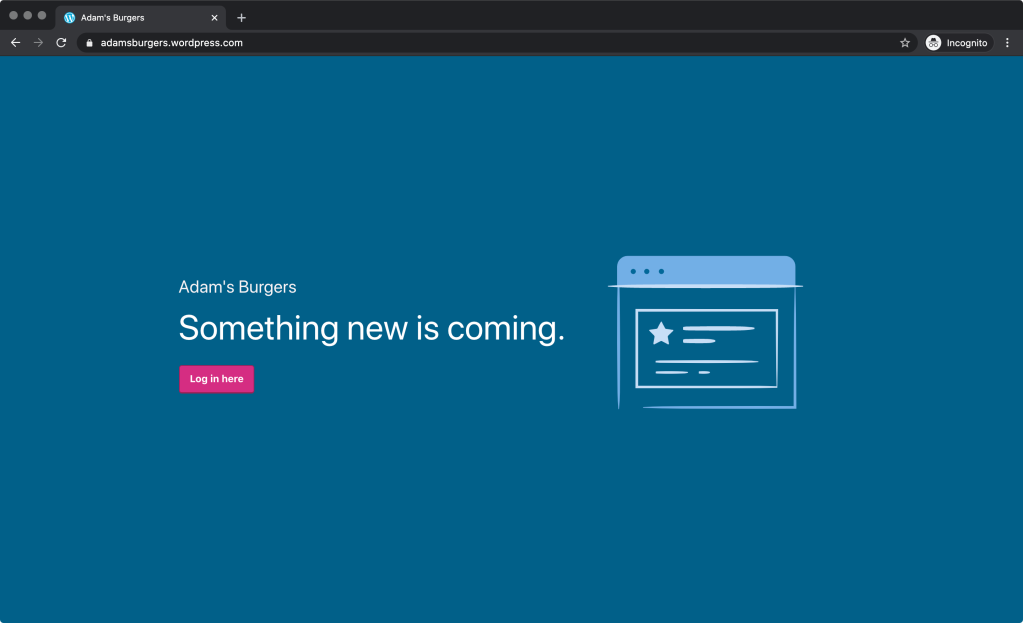
When you create a new site, you may want to personalize it before making it public. On WordPress.com, we give you a safe space where you can work on building and editing your site until you’re ready to share it with the world.
Until recently, this Coming Soon mode was limited to new sites without plugins or custom themes installed. We realize, however, that many users — regardless of how long they’ve had a website on WordPress.com — might want to make updates, change the design, or add new functionality without making these changes visible to the public until they’re complete. Now, all sites have this Coming Soon option, and you can toggle it on or off as you wish.
To set your site to Coming Soon, go to Manage in the sidebar, select Settings, scroll down to Privacy, and select the Coming Soon button. Be sure to click on Save settings for the change to take effect.
While in this mode, site visitors will see a landing page with your site’s title. You and other logged-in people that you invite will see the full website.
Logged-out viewLogged-in view
To invite people to view your site while in Coming Soon mode, add them as new users from the Manage → People → Invite button. Users will need to at least be a Contributor to view the site in this mode.
To make your site public again, go to Manage in the sidebar, select Settings, scroll down to Privacy, and select the Public button. Again, be sure to click on Save settings.
Private sites for all
If instead of sharing your site with everyone, you want to keep it private, and only available to invited members of the site — for instance, a private blog for your family, made up of photos and videos of your children or pets — you can use the Private option under Manage → Settings → Privacy.
In this mode, instead of the Coming Soon landing page, logged-out visitors will see a more discreet prompt to log in.
No matter what you want to do on your site — whether making a few tweaks, refreshing your site design, or building a fully fledged online store — use the Coming Soon feature to keep it private until you’re ready to unveil it to the world.
We hope you enjoy this new feature!
Quelle: RedHat Stack

In this period of uncertainty, businesses everywhere are facing increased pressures and rapid change. Multipharma is no exception. As Belgium’s largest pharmaceutical retailer, Multipharma is feeling the impact of change as much as anyone, now operating at the core of a global pandemic. While deeply focused on its core pharmacy business with warehouse and production centers for medicine preparation and repackaging, Multipharma is also a retailer. To thrive as a retailer while managing changing customer expectations and intense competition, Multipharma determined they needed to replace their legacy merchandising system with a modern, industry specific solution for their retail landscape. Multipharma chose SAP S/4HANA Retail, electing to deploy it in the cloud for elasticity and scalability it offers. In this blog post, we’ll explore how Mulitpharma have positioned themselves ready for change in the complex retail pharmaceutical market and why they chose Google Cloud as their hyperscaler partner for this critical transformation.The Need for ChangeWith over 270 retail outlets, 1,700 employees, a state of the art warehouse and three product packaging and preparation centers, Multipharma is the largest pharmaceutical retailer in Belgium. For Multipharma, providing excellent service to their diverse customer base is a top priority, and over their 60 year history, they’ve expanded their pharmaceutical offering to include a full set of services such as nicotine management, weight loss coaching, and other wellbeing, health and beauty services. To compete against new upstarts and industry disruptors with mail-order and online capabilities, Multipharma determined they need to rethink how they deliver complete care for their customers. They needed to be prepared with a comprehensive retail platform that could deliver on retail core processes end to end—from master data entry and product listing, through promotion execution and price maintenance, to point-of-sale accounting. For this task, Multipharma chose SAP S/4HANA for Retail. Where to run S/4 was the next question. Multipharma knew that managing their own SAP hardware was neither cost effective nor a good choice for the agility, security and availability they needed. When it became clear that their current private cloud provider was not up to the task, Multipharma kicked off an effort to find a better alternative. Why Google Cloud for SAPMultipharma’s executive and IT teams performed an extensive evaluation of the top three public cloud providers for their comprehensive SAP deployment. After careful review, Multipharma selected Google Cloud because it could deliver on all key criteria (see figure below).“Setting up SAP Test and Deployment environments on Google Cloud is really easy,” says Kevin Moens, Lead Enterprise Architect at Multipharma. “In terms of business impact, that means we can be more flexible and move fast when we need to, delivering new initiatives efficiently.” Moens also calls out Google Cloud’s security features: “Using Google Cloud supports us in meeting our European data storage regulatory requirements. Its encryption of data in transit and at rest was a decisive factor in our choice of cloud provider.” Ready for business challenges of the future The first step in Multipharma’s journey is to migrate its legacy retail system to SAP S/4HANA. Together, Google Cloud, SAP, and Multipharma’s IT teams architected a three-layered solution. The business layer will house S4/HANA Retail, SAP CAR (Customer Activity Repository) and BW on HANA for BI. The integration layer will house Process Orchestration, Data Services and SAP Landscape Transformation Replication Server (SLT). For the management layer, SAP Solution Manager and Landscape Management (LaMa) will be deployed. This complete architecture is expected to go live later in 2020. Running these key SAP applications in Google Cloud will afford them many strategic advantages:Reduced costs. The pay-per-use model offers Multipharma many ways to significantly reduce costs, such as the ability to turn off non production systems at night and on the weekends.Increased flexibility. Google Cloud’s fully virtualized infrastructure positions Multipharma to quickly adapt to changing business conditions such as a global health crisis as well as pivot to services like in-home medication delivery. Real-time inventory management. For both physical stores and omnichannel, Multipharma will have complete visibility into its stock positions. Security. Google Cloud encrypts data data in transit and at rest by default—a key consideration for Multipharma. High availability. Cloud Load Balancing lets Multipharma balance its compute resources over a single or multiple regions, and plus Live Migration which offers them zero downtime infrastructure maintenance.Additionally, Multipharma intends to take advantage of Google Cloud Pub/Sub, a fully-managed real-time messaging service that allows you to send and receive messages between independent applications. Along with Google App Engine, they will leverage Pub/Sub for message integration between point-of-sale systems and their new SAP landscape for custom integration monitoring. “We chose Google Cloud not only because it offers per-second billing, but also because of the investment Google is making in innovation,” says Kevin Moens, Lead Enterprise Architect at Multipharma. “We want the flexibility to access additional security and infrastructure services in the future.” By running SAP S/4HANA for Retail on Google Cloud, Multipharma will be well positioned to leverage their extensive retail footprint and customer proximity to explore new services such as at-home delivery. They also plan to deepen their omnichannel experiences (in-store and through digital customized patient coaching), as well as business and marketing activities around medication stock and inventory. Watch and learn more about how Multipharma transformed its retail processes with Google Cloud. Or hear from more customers innovating with SAP on Google Cloud.
Quelle: Google Cloud Platform

Cloud migration is one of the biggest organizational changes that technologists will go through this decade, with a profound impact on a business’s ability to innovate and its overall economics. Migrating to the cloud gives organizations an unique opportunity to not only improve their flexibility, reduce costs and focus on their core competencies, but ultimately, to fully transform how they operate. At a minimum, the business advantages of migrating to the cloud include:Purchasing and consuming resources on a pay-as-you-go basis, and increasing or decreasing them as needed for optimal utilizationConverting capital expenses into operating expensesEnabling rapid innovation without the expense and complexities of hardware procurement and infrastructure managementEnjoying faster time to marketWhen done right, it is a gradual migration of data, applications, infrastructure, and other business elements, resulting in business transformation. But cloud migration isn’t a one-and-done proposition. To succeed, it requires careful analysis, planning, and execution of a comprehensive organizational and technical strategy that meets your overall business goals. Working with customers, we here on the Google Cloud Professional Services team have developed a migration factory, a methodology for performing large-scale migrations to the cloud. Designed for migrating enterprise applications, migration factory offers an organizational structure and set of processes that helps you create a scaled team with the right skills and understanding of your organization, and set clearly defined goals that are closely measured through the life of the program. For each application that you want to move, the migration factory approach takes an end-to-end view of the project, including:Building the business case for migrating the specific applicationAssessing the current application and infrastructure estateDeveloping a migration planThis set of strategic activities helps inform the migration path for your applications, describes the migration execution, and helps establish post-migration operations principles. All of this makes your migration simpler and more effective.Click to enlargeIn our experience, a thoughtful and well-designed migration factory can help with several common challenges:Unclear goals: Lack of cohesive vision and cloud adoption strategy across the organization; these can be short-term, long-term or both.Lack of sponsorship: Not having the right level of investments of skills, talent, time and effort. Poor migration planning: Embarking on a cloud journey without understanding the complexity of your existing application estate.Wrong technology choice: A failure to properly review the workloads to be migrated and choose the right cloud product and service model. With the right technology choice, businesses can successfully migrate to the cloud to derive cost savings, competitive advantage along with rapid innovation.Unclear delivery and operational model: To be successful, you need the right mix of people, process and technology across the organization—before, during and after the migration.In addition, a migration factory model can help organizations derive a number of benefits:Velocity: With a mature operational model and plus automation, migration factory projects can proceed very quickly.Reduced costs: Having mature and efficient processes streamlines the actual migration. Google Cloud customers that follow a migration factory approach can see significantly lower costs. Reduced risk: Identifying the risk tolerance of the workloads being migrated up-front helps shorten overall downtime and/or unplanned downtime during the migration—so you can get back to software development sooner.Quality: Well-defined and automated processes result in more consistent and error-free migrations.A foundation for larger cloud-native initiatives: The learnings, best practices and standards you gain as a part of the migration process position your team to take on more complex and challenging cloud initiatives down the road.Migrating to the cloud can feel like a big undertaking, but with the proper preparation, it can be immensely rewarding. To learn more about how to design and build a cloud migration factory we’ve written a whitepaper ”Building a Large Scale Migration Program with Google Cloud,” filled with practical guidance, strategies and implementation details to help you get started. The Google Cloud Professional Services team or one of our Google Certified partners are also ready to help. Contact your Google Cloud account manager for more information.
Quelle: Google Cloud Platform

Es gibt Hinweise auf einen weiteres Far Cry. Möglicherweise kann man sich sogar schon einen Tag- und Nachtwechsel aus dem Spiel ansehen. (Far Cry, Ubisoft)
Quelle: Golem

Mit dem P40 Lite 5G bringt Huawei ein erschwingliches 5G-Smartphone in Deutschland auf den Markt – fehlt nur noch das passende Netz dazu. (Huawei, Smartphone)
Quelle: Golem

Mit Epyc- oder Ice-Lake-CPUs und Nvidias Ampere gehören die Supercomputer dann zu den weltweit schnellsten. (Supercomputer, Computer)
Quelle: Golem

Ein Großteil des Traffics auf Giphy kam bereits von Instagram und anderen Facebook-Apps. (Suchmaschine, Google)
Quelle: Golem

2Africa soll einmal um den afrikanischen Kontinent laufen. Auch Orange und China Mobile sind dabei. (Seekabel, Soziales Netz)
Quelle: Golem






