Signal: Kontaktanfragen beim Crypto-Messenger
Der Ende-zu-Ende verschlüsselnde Open-Source-Messenger bietet mehr Kontrolle, wer schreiben oder anrufen darf. (Signal, Instant Messenger)
Quelle: Golem

Der Ende-zu-Ende verschlüsselnde Open-Source-Messenger bietet mehr Kontrolle, wer schreiben oder anrufen darf. (Signal, Instant Messenger)
Quelle: Golem
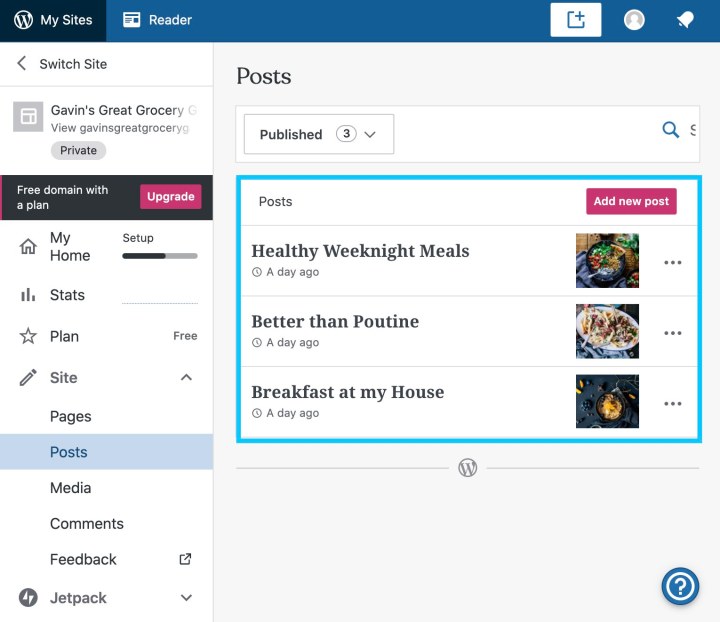
We wanted to make it easier to manage posts and pages when you’re working within the Block Editor. With the Block Editor Sidebar you can view, create, edit, and manage posts and pages right from the Block Editor!
Wait, another sidebar?
Have you ever finished editing something and then needed to make a quick edit to an existing post, or start a new one? Previously this meant navigating to your dashboard and to the posts list.
The Block Editor Sidebar allows you to view and access your site’s posts and pages — whether they’re drafts, published, or scheduled — and create new ones right from the editor.
Using the sidebar
The sidebar is available in the Block Editor when editing both posts and pages. For now, when editing a post you’ll only be able to see recent posts, and create new posts. Similarly, if you’re editing a page you’ll see a list of your recent pages and a link to create a new page.
The following steps refer to posts, but you can use the same steps to edit pages.
Open an existing post or create a new one to open the editor.
To view the sidebar, click on the WordPress.com logo at the top left of the editor.
To return to your posts list, select the View Posts link.
To load an existing post, select the post title in the list of recent posts. Unless it’s already been published, the post’s status will appear next to the title, for example “Draft” or “Scheduled.”
To create a new post, click on the Add new post link.
To dismiss the sidebar, click anywhere outside the sidebar or press the “Escape” key.
What’s next?
Now that we have the Block Editor Sidebar in place, we’ll extend its capabilities with more tools and shortcuts to help you manage your site’s content.
Do you have ideas for site-level features you’d like to see in the Block Editor Sidebar? Or suggestions about how we can improve this feature? Please let us know in the comments!
Quelle: RedHat Stack
Background
This is Docker’s first time publishing an incident report publicly. While we have always done detailed post mortems on incidents internally, as part of the changing culture at Docker, we want to be more open externally as well. For example, this year we have started publishing our roadmap publicly and asking our users for their input. You should expect to see us continue publishing reports for most significant incidents.In publishing these reports, we hope others can learn from the issues we have faced and how we have dealt with them. We hope it builds trust in our services and our teams. We also think this one is pretty interesting due to the complex interaction between multiple services and stakeholders.
Incident Summary
Amazon Linux users in several regions encountered intermittent hanging downloads of Docker images from the Docker Hub registry between roughly July 5 19:00 UTC and July 6 06:30 UTC. The issue stemmed from an anti-botnet protection mechanism our CDN provider Cloudflare had deployed. Teams from Docker, Cloudflare, and AWS worked together to pinpoint the issue and the mechanism in question was disabled, leading to full service restoration.
What Happened
At about 01:45 UTC on Monday July 6th (Sunday evening Pacific time), Docker was contacted by AWS about image pulls from Docker Hub failing for a number of their services and users. Both the Docker Hub and Infrastructure teams immediately started digging into the problem.The initial troubleshooting step was of course to try doing image pulls from our local machines. These all worked, and combined with our monitoring and alerting showing no issues, ruled out a service-wide issue with the registry.
Next, we checked pulls in our own infrastructure running in AWS. As expected by the lack of alarms in our own monitoring, this worked. This told us that the issue was more specific than “all AWS infrastructure” – it was either related to region or a mechanism in the failing services themselves.
Based on some early feedback from AWS engineers that the issue affected systems that used Amazon Linux (including higher level services like Fargate), the Docker team started spinning up instances with Amazon Linux and another OS in multiple AWS regions. Results here showed two things – both operating systems in AWS region us-east-1 worked fine, and in some other regions, Amazon Linux failed to pull images successfully where the other OS worked fine.The fact that us-east-1 worked for both operating systems told us the problem was related to our CDN, Cloudflare. This is because Docker Hub image data is stored in S3 buckets in us-east-1, so requests from that region are served directly from S3. Other regions, where we saw issues, were served via the CDN. Docker opened an incident with Cloudflare at 02:35 UTC.Because we only observed the issue on Amazon Linux, engineers from all three companies began digging into the problem to figure out what the interaction between that OS and Cloudflare was. A number of avenues were examined – was Amazon Linux using custom docker/containerd packages? No. Did the issue still exist when replicating a pull using curl rather than Docker Engine? Yes. It’s now pretty clear that the issue is some sort of low-level network implementation detail, and all teams start focusing on this.
At about 05:00 UTC, engineers from AWS examining networking differences between Amazon Linux and other operating systems discover that modifying a network packet attribute to match other systems makes the issue disappear. This info is shared with Cloudflare.
Cloudflare investigates given this new information and finds that some traffic to Docker Hub is being dropped due to an anti-botnet mitigation system. This system had recently had a new detection signature added that flagged packets with a certain attribute as potentially part of an attack.
The fact that packets from Amazon Linux matched this signature combined with the large scale of traffic to Docker Hub activated this mechanism in several regions. While Cloudflare had been monitoring this change for some time before enabling it, this interaction had not been uncovered before the mechanism was switched from monitoring to active.
Cloudflare then disabled this mechanism for Docker Hub traffic and all parties confirmed full resolution at about 06:30 UTC.
Conclusion
So what did we learn?
First, we learned that our visibility into end-user experience of our CDN downloads was limited. In our own monitoring, we’ve identified that we can track increases in 206 response codes to indicate that such an issue may be occurring; when downloads hang, the client often attempts to reconnect and download the partial content it did not previously receive. This monitoring is now in place, and this information will lead to much quicker resolution in future such incidents.Additionally, we will work with Cloudflare to increase our visibility into mitigations that are actively affecting traffic for Docker Hub.
Lastly – this reaffirmed that the internet is a complicated place. This issue involved details all the way up from low-level network implementation to higher-order services that abstract away such things. Never underestimate the impact of every layer of your stack and it’s dependencies on other parties.
We’d like to thank our partners at Cloudflare and AWS for their work in diagnosing the problem. It took all three parties working together to resolve this issue for our joint users. We know developers and operators rely on many different providers to power their systems, and the closer we work together, the better we can support you.
The post Docker Hub Incident Review – 5 July 2020 appeared first on Docker Blog.
Quelle: https://blog.docker.com/feed/

Der Cadillac Lyriq soll deutlich preiswerter angeboten werden als erwartet. Vermutlich hofft der Hersteller auf günstigere Akkus. (General Motors, Technologie)
Quelle: Golem

Etwa 100 Spezialisten werden künftig in chinesischen Konzernen arbeiten. Diese werden mit viel Regierungskapital unterstützt. (TSMC, Prozessor)
Quelle: Golem

Der Nettogewinn der Telekom fiel um rund 20 Prozent auf 754 Millionen Euro. Doch der Umsatz legte stark zu. (Quartalsbericht, Telekom)
Quelle: Golem

Ausgerechnet mit Gesichtserkennung will Am I in Porn gegen Rachepornos vorgehen und mehr Privatsphäre schaffen. Die Technik dafür dürfte rechtswidrig sein. Eine Recherche von Moritz Tremmel (Gesichtserkennung, Datenschutz)
Quelle: Golem

Wer sein Parkticket mit der App Park Now kauft, kann künftig auf einer Karte schauen, wie die Parkplatzsituation am Zielort ist. (Auto, Android)
Quelle: Golem
loft.sh – We’re proud to announce that loft is the first cloud-native technology that ships a stable implementation for virtualized Kubernetes clusters. With loft v0.3, users are now able to create virtual Kub…
Quelle: news.kubernauts.io

I am very inspired by creative podcasts. Entertaining guests and the unscripted nature of the conversations make me feel like I am right there, chatting about world affairs or the deep societal transformations of the connected age. I decided to start my own show with a group of friends — loosely about blogging, but delving into all sorts of things.
It took three hours, with a total cost of $5/month, including our own domain name. In this post, I’ll share my journey of launching a brand-new podcast on WordPress.com, and later promoting it on iTunes and Spotify.
Why start a podcast?
Podcasting has been hailed as “the new blogging.” According to Edison Research, 51% of Americans have listened to a podcast, and hosts have created over one million podcasts on iTunes Podcasts.
Starting a podcast comes with a lot of perks:
You can connect with your audience on a much deeper level, thanks to your voice and the unscripted nature of the conversation.It’s a fantastic excuse to reach out and meet interesting people.Podcasting pairs really well with other projects — blogging, writing, or even a corporate ”day job.”
A group of Polish bloggers and I had been dreaming of a foray into podcasting for a while. We created the Placebo podcast in hopes of meeting interesting people and, frankly, having fun.
The tagline in Polish reads: “Your dose of absolutely nothing. Confirmed clinical efficacy.”
How does it all work?
You may have listened to a podcast on iTunes, Spotify, or another app — but did you know the content you’re enjoying doesn’t originate there? The beating heart of every podcast is its RSS feed. It is a particular format for content that services like iTunes or Spotify can process and display in the appropriate apps — iTunes, Alexa devices, and other services.
When you upload an audio file to your blog (for example, an .mp3) and hit publish, the new post (including the file) shows up in your RSS feed. From there, iTunes, Spotify, Pocket Casts, or another podcast app downloads the file to play it to your listeners.
WordPress.com also has built-in podcasting tools to make that job easier. To upload audio files, you’ll need a paid plan — any plan, including the Personal plan at $5/month, will do.
What do you need to start?
The name
The name of your podcast helps listeners find you in their favorite podcasting app. With Placebo, our main concern was making it memorable; our secondary goal, humor. (Which is related — funny is memorable!) We came up with “Placebo — a podcast with a confirmed clinical efficacy.”
Other memorable name examples include therapist Esther Perrell’s podcast, Where Should We Begin, Matt Mullenweg’s podcast about remote work, Distributed, and Joe Rogan’s The Joe Rogan Experience. If you are still stuck, try out our recently launched business name generator to help you brainstorm.
Recording
We didn’t want to get expensive gear. It’s better to start simple with the equipment you already have. The Placebo podcast is recorded over Zoom, with video-call headsets. I recommend recording at least three episodes, so when you publish, your listeners will have a better taste of your style.
The Distributed podcast has a great walkthrough of the various recording options you can try.
Cover art
In addition to your name, there are other ways to stand out from all the other podcasts and voices: strong cover art and a succinct, solid summary. (You can add all three on WordPress.com in My Sites → Settings → Writing → Podcasting.)
The cover art should be easy to recognize. Since our podcast is named Placebo, we decided on a satirical medical vibe. We found a nice graphic, and after a few tweaks, tada!
Placebo podcast cover image
Pro tip: Cover art should be 1400×1400 px, so be sure to use an image that’s big enough.
The summary
When writing your summary on iTunes, you must distill the description of your podcast content to 250 characters or less. For Placebo, we wanted to give listeners a taste and encourage them to give us a try:
Placebo is a podcast with confirmed clinical efficacy. Artur, Agnes, and Michael chat about building your online home, technology, culture, business ideas, and being the best citizen of the Internet you can be. More on placebo.pro
We also included the link to our site, where listeners can learn more.
Here is where you upload your cover art and summary on WordPress.com
Light audio editing
Some podcasts (like Distributed) are edited to equalize audio levels or condense the episode. We opted to publish the raw audio — I only attach the pre-recorded intro music in GarageBand. I delve into details of audio editing on my blog Deliberate Internet.
Before I upload a new episode to iTunes Podcasts, I add relevant ID3 tags in the iTunes player (where you edit rather than publish). ID3 tags are used by the iPhone Podcasts app to display your cover image. Import each one of your recorded files in iTunes player and select “Information.” There, you can tweak the image, category, and title of the audio file.
After you edit the information in iTunes player, or wherever you are editing your podcast, upload your cover art and click “OK”; your episode will appear in the iTunes Player Podcast library on your computer. You can find this file in your Home Directory → Music → iTunes → Podcasts.
Your audio files are now ready for distribution! That’s where WordPress.com comes in.
Uploading to WordPress.com
Create a separate WordPress.com post for each episode of your podcast. This gives you a unique link to share with your audience, a way for them to listen to your episode without the app, and a place to add extra notes and links.
To publish a podcast post:
Create a new post. Add any extra notes or info you want to share with the podcast.Add the Audio block and upload your podcast file.Give the post the Podcast category.Publish the post.
This guide on the WordPress.com Support Site has more details.
Time to go live
You have your domain and a site for your podcast. You’ve recorded and uploaded a few episodes. Now it’s time to share your podcast with the world!
Your podcast is available on your WordPress.com site, but the majority of people consume podcasts through an app — iTunes podcasts, Spotify, Google Play, etc. Fortunately, they all work by checking your RSS feed. Once you submit your RSS feed to those services, new episodes will appear there automatically.
Spotify
Copy the RSS URL from the WordPress.com podcasting settings pageGo to Podcasters SpotifySubmit your RSS feedWait two to three days for your podcast to appear
iTunes
Copy the RSS URL from the WordPress.com podcasting settings pageGo to Podcasts ConnectSubmit your RSS feedWait about a week for them to review and approve your podcast
When the podcast is reviewed, approved, and appears in the Spotify and iTunes libraries, add those links to your site. That way, you can promote your nifty WordPress.com custom domain, and visitors can choose their preferred podcast consuming technology. We put these buttons right up at the top:
You can download these buttons here:
Apple Podcasts badgeSpotify badge
The lucky number seven
Recording new podcast episodes are plenty of fun, but can sometimes feel like work. Podcasts with seven or more episodes are likely to continue growing. The Placebo podcast crew has pledged to record at least eight.
And don’t forget to enjoy it! The conversations with interesting guests are why we do it.
I’ve published the full version of “How to Start a Podcast” on my personal website. There, I’ve expanded on my process to record episodes over Zoom, and how I later edited them in GarageBand. Dive deeper if you’re interested!
Cover Photo by The Teens Network Daytime Show Studios on Pexels.com
Quelle: RedHat Stack






