Expert Advice: Stay On Top of Your Business with Jetpack CRM

Customers are the heart of your business, and the best way to maintain your vital relationships with them is with a world-class CRM (customer relationship management) system.

Join us at our next free webinar on Thursday, September 17th, to learn how you can turn leads into customers, track business metrics, leverage data, and monitor activity profiles to better serve your customers—all by using Jetpack CRM.

Date: Thursday, September 17, 2020Time: 8:00 am PT | 10:00 am CT | 11:00 am ET | 15:00 UTCRegistration link: https://zoom.us/webinar/register/8015988855022/WN_ZMyGfL7dRsm_4yzwivSnzwWho’s invited: All are welcome, but this webinar is designed especially for small business owners, freelancers, consultants, and anyone else interested in learning how they can improve their sales process.

Jetpack CRM was built specifically for WordPress, so that you can manage your leads as they navigate your sales funnel, all on your WordPress dashboard. Mike Stott and Woody Hayday, the founding developers and lead engineers behind Jetpack CRM, will be co-presenting in the webinar, which will include a 15-minute live Q&A at the end of the 45-minute presentation.

Don’t worry if you can’t make it to the live webinar, though! A recording will be available on our YouTube channel a few days after the event.

Live attendance is limited, so be sure to register early. We look forward to seeing you!
Quelle: RedHat Stack

Start Taking Donations, Tips, and Contributions for Your Creative and Professional Pursuits

With our growing suite of payment features, we want to make it easier for you to earn money on WordPress.com. With the Donations block, you can now accept credit and debit card payments for all types of donations, earning revenue and growing your base of supporters. Collect donations, tips, and contributions on your website to fuel your creative and professional projects or to support and grow your business or organization.

Donations block example for an arts organization

What can you accept donations for?

You can collect financial contributions on your website for just about anything — the sky really is the limit. Here are examples of things people support through donations:

Creative pursuits for musicians, artists, designers, writers, and moreConcrete creations like podcasts, video games, music clips, and photographyBloggers and content creators of all shapes and sizesEveryday passions like news summaries and mindfulness exercisesProfessional endeavors including civic engagement and professional developmentNonprofits and community, religious, and political organizations

Donations block examples for a musician and radio station

Continue to build your community by engaging with your supporters in a unique and authentic way. People can opt to support you through one-time, monthly, or yearly contributions, and the Donations block lets you engage with each level for a more custom experience. For example, you might send your monthly supporters additional content and information on top of what you send your one-time supporters.

As you ask for support, we’ll handle the rest — the credit and debit card payment processing, sending receipts, reporting, and more.

Ask for your first donation

Above all, the first step in earning money on your website is to ask for it. You can add a Donations block to your website in a matter of minutes; watch this short video to learn how. Alternatively, a step-by-step guide follows below.

How to use Donations block to earn money on your WordPress.com website

To use the Donations block, you’ll need a WordPress.com website with any paid plan — Personal, Premium, Business, or eCommerce.On any page or post, add the Donations block.

To set up your first donation request, create a Stripe account if you don’t have one already. Stripe is the company we’ve partnered with to process credit and debit card payments in a safe, secure, and speedy way.After you’ve connected to Stripe, configure the block’s settings, like how often you’re asking for donations. It can be any combination of single (one-time), monthly recurring, or yearly recurring donations.

Set three donation amounts that you’d like visitors to choose from for any of the payment intervals. These are fully customizable. Be sure to set your currency as well.

You can also allow visitors to donate what they want — essentially a blank box for them to fill out how much money they would like to give.

Review all of the text in your Donations block — you can edit every single letter, so be sure to provide enough information for your visitors about their donation, why you’re asking for it, etc.

Publish your block!You can manage your supporters, see earnings, and keep an eye on other metrics in the Earn dashboard.

Last but not least, tell others about what you’re doing! Share on social media, email, and however you best communicate with people who might donate to your cause.

A suite of payment features to fit your needs

Looking to accept payments for something else? There are several other payment features on WordPress.com to suit your needs and help you make money with your website. In addition to the new Donations block, here are other features:

Payments block: Accept one-time or recurring payments on your website for physical items, digital downloads, services, memberships, subscriptions, and more.Premium Content block: Create one-time, monthly, or yearly subscription options to share select content with those who pay for it — text, images, videos, or any kind of content. Exclusive content can be sent to email inboxes or viewed on your website.Paid newsletters: Using the Premium Content block, you can share your site’s latest premium content via email newsletters in a fully automated way.eCommerce Store: Turn your website into an eCommerce store and sell products and services seamlessly.

If you’re interested in setting up a membership- or subscription-based website, learn more about getting started with memberships and subscriptions.

Add the Donations block and start earning money with your website today!
Quelle: RedHat Stack

Lens 3.6 Released — Kubeconfig Files as References, Additional Smart Terminal Options and More!

The post Lens 3.6 Released — Kubeconfig Files as References, Additional Smart Terminal Options and More! appeared first on Mirantis | Pure Play Open Cloud.
We’re excited to announce Lens — the Kubernetes IDE — version 3.6 is now available. This is the first release since Mirantis took over the lead in the project. The biggest new features are related to the way Lens manages Kubernetes cluster access using kubeconfig files and additional smart terminal configuration options. These features will greatly improve the overall user experience, enhance support for various Open ID providers and make it possible to use Lens in restricted enterprise environments. While working on these features, we also completed massive refactoring to unify the underlying frontend framework to support an extensions API in the future plus a lot of smaller fixes. See the entire changelog at the end of this post.

I’d like to thank all contributors to the 3.6 release: @aleksfront, @nevalla, @jakolehm, @ocdi, @ixrock, @jim-docker, @timurista, @Nox-404, @rand0me, @Nokel81, @jnummelin, @dan-slinky-ckpd

See below for more details about the new features and improvements.
Use Kubeconfig Files as References
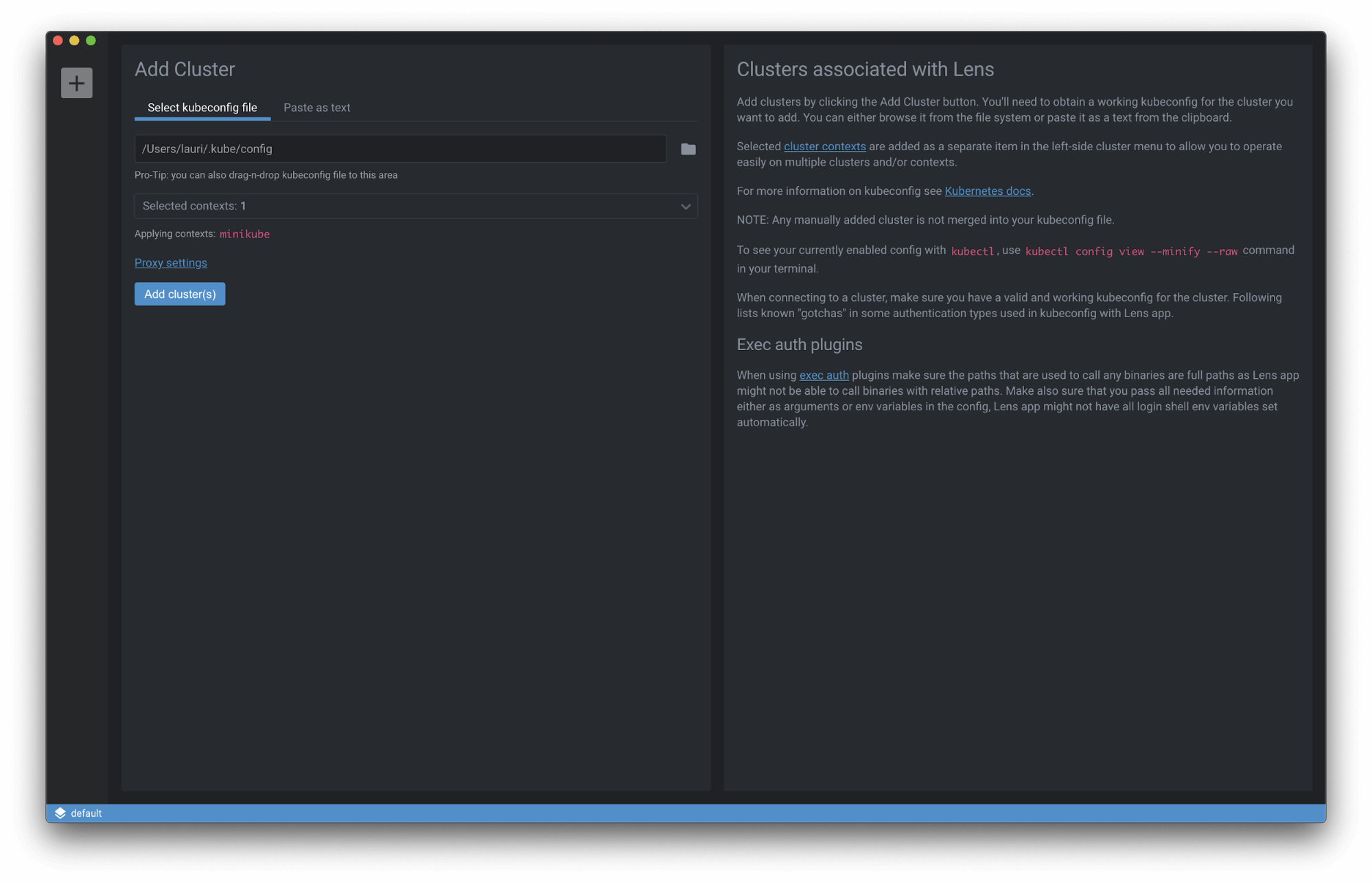
One of the key features of Lens 3.6 is the ability to use kubeconfig files directly as cluster references instead of copy-pasting the contents of those files. Simply choose the file from your filesystem.

Previously, this information was stored internally and it was working fine as long there was no need to update the kubeconfig file contents. However, many Lens users are using third party tools from managed Kubernetes service providers to generate their kubeconfig files. These tools not only generate those files but might also update them on the fly. This behaviour has caused a lot of confusion (even sadness) among our users and we are happy to say those days are now gone. Lens will automatically use the fresh data available from the kubeconfig files!
Additional Smart Terminal Options
The users of Lens have been able to enjoy the built-in Smart Terminal for quite some time. The Smart Terminal comes with kubectl and some other tools necessary to work with Kubernetes clusters. The terminal is smart because it will automatically switch the version of kubectl to match the currently selected cluster API version. It will also automatically switch the context to match that selected cluster.

While Smart Terminal is great and improves the quality of life for many of our users, users working in restricted enterprise environments have found it impossible to use due to restricted directory access where Smart Terminal bundled binaries may be executed and/or downloaded. You can now define the directory used with Smart Terminal

The Forrester Multi-Cloud Container Development Platforms Wave Report, Reimagined With Docker Enterprise Container Cloud

The post The Forrester Multi-Cloud Container Development Platforms Wave Report, Reimagined With Docker Enterprise Container Cloud appeared first on Mirantis | Pure Play Open Cloud.
It’s difficult to create a report defining the “state of the industry” for an industry that moves as fast as cloud computing.  For example, Forrester recently published its Multi-Cloud Container Development Platforms Wave Report, covering nine leading vendors in the category, and in order to make the report “fair”, every company was represented by the state of its offerings as of April 1, 2020.
Unfortunately, if you’re a company whose new product offering didn’t become generally available until, say April 2, 2020, those new offerings weren’t considered in the report.  For example, if this latest report were based on Mirantis’ current products, support offerings, and services, as well as the Mirantis strategy/vision Mirantis would clearly have been ranked a Leader — just as it was in the previous Forrester Wave Report.
Instead, because Forrester was (understandably) hamstrung by its rules it had to work with what was available on that date.
What the Forrester Wave report left out
For Mirantis, this means the report couldn’t take into account the following:

The Docker Enterprise Container Cloud release that will be available this coming week. Instead, it was based on Docker Enterprise 3.0, shipped back in 2019. Docker Enterprise Container Cloud key capabilities:

Multi-Cluster Management
Multi-Cloud: Public, Private, BM
Self-Service Clusters
Automated Full-Stack LCM
Centralized Observability
Add Existing Docker Enterprise Clusters to Fleet
Lens Kubernetes IDE

Our most recent support offerings ProdCare, a 24×7 follow-the-sun support offering, and OpsCare, a managed service offering with a 99.99% SLA and a cloud, tooling, and ops team 100% focused on the success of your organization.
Our acquisition and strategic integration of Lens, the world’s most popular Kubernetes IDE, one of the top 30 Kubernetes-related projects on GitHub, with over 8,200 stargazers, 52,000 users, and 600,000 downloads.

Why Mirantis Is a Leader
Obviously we can’t guarantee what the results would have been had the report been written today, but given our past experience, we’re fairly certain that we would have maintained our position as a Leader.  Inclusion of Docker Enterprise Container Cloud in the Mirantis profile would have significantly changed the score for each of the following Forrester Wave evaluation criteria:

Platform Operations

Docker Enterprise Container Cloud introduces groundbreaking multi-cluster, multi-cloud lifecycle operations capabilities. Operators and developers can easily create Kubernetes clusters via GUI or API, and the Container Cloud will automatically provision the underlying infrastructure, operating system, and cloud-native Kubernetes stack across public/private clouds and bare metal.
Container Cloud keeps its management clusters and associated child clusters up to date with full-stack continuous updates. Every cluster is automatically updated using Kubernetes rolling updates, ensuring that workloads remain operational. With a single click, child cluster owners can decide when to apply available updates.
Control plane configuration is managed by the Container Cloud. The management cluster is deployed via a bootstrap node and a YAML configuration file with details about the other management cluster nodes. Container Cloud takes care of the remaining deployment steps, with full-stack lifecycle management of the infrastructure, the operating system, and the cloud-native Kubernetes stack.
Container Cloud includes cloud-native logging and monitoring across the entire fleet of clusters. Child cluster owners can observe and monitor real-time Prometheus metrics, review logs, receive alerts, and more. Centralized IT Operations can view data for any cluster as well as aggregated data for the entire fleet.
Through built-in security features and policies, Container Cloud supports RBAC, IAM, LDAP and Active Directory. Container Cloud respects multi-tenancy policies and security permissions of underlying infrastructure when deploying child clusters. Container Cloud builds on industry-leading security features in Docker Enterprise, including FIPS 140-2 Validation and a DISA STIG, and built-in image scanning and signing in Docker Trusted Registry.

Platform Infrastructure

The distributed multi-cluster management capabilities in Docker Enterprise Container Cloud enable robust edge computing support. With a centralized management plane and centralized observability, coupled with automated full-stack lifecycle management and continuous updates, organizations can ensure their entire fleet of Kubernetes clusters are always consistent, available, and up to date, from the data center to the edge.
 
Based on the underlying infrastructure, Container Cloud automatically provisions container storage resources for each of its child clusters. Users don’t need to hassle with the complexity of attaching storage volumes to their VMs, leveraging a centralized Ceph cluster, or using mounted volumes on bare metal nodes.

Platform Experience

Docker Enterprise Container Cloud and Lens provide a developer experience that’s unparalleled in its ease of use and efficiency. By using an intuitive GUI to create and update self-service Kubernetes clusters, developers can deploy, observe and manage their applications without getting slowed down by complex infrastructure. 
By simply importing their clusters’ kubeconfig files into Lens, developers can easily navigate Kubernetes primitives such as deployments, pods, and nodes, with complete situational awareness and control. With a single click. developers can inspect logs, modify YAML files, or open a terminal to use kubectl.
Container Cloud, Docker Enterprise, and Lens also provide a consistent operator experience for platform operations across clouds, with automated full-stack lifecycle management and continuous updates, a centralized management plane, centralized observability, self-service clusters, and a secure software supply chain.
With the intuitive GUI included in Container Cloud, operators can manage an entire fleet of Kubernetes clusters across public and private clouds, as well as bare metal. A centralized cloud-native LMA toolchain provides observability for each cluster, and aggregated data for the entire fleet.
Mirantis is the only leading container platform vendor to offer real enterprise choice at every layer of the stack, from the infrastructure layer to the operating system to the cloud-native Kubernetes ecosystem. Enterprises no longer need to lock themselves into a single virtualization/cloud platform or operating system – with Mirantis they are free to choose the infrastructure and tools that best suit their needs.

Cloud-Native Application Development

With robust open standards-based integration support for RBAC and IAM platforms, DevOps toolchains, Kubernetes-native tooling, and more, Container Cloud enables development environments that are fully integrated across the entire software development lifecycle. Every open standards-based Kubernetes cluster in its fleet can be managed by its intuitive GUI or rich Kubernetes and Cluster APIs, unlocking application and DevOps portability across clouds. 
Container Cloud also provides enterprise-grade SSO, AD/LDAP integration, RBAC, multitenancy, DevOps integration, and policy customization features that integrate with Docker Docker Enterprise, Docker Trusted Registry, and 3rd-party systems, to create a unified and secure software supply chain.

Container Runtime and Registries

Docker Enterprise Container Cloud provides robust image and application lifecycle management features for comprehensive container image support. With Docker Trusted Registry, a private image registry with built-in image scanning and signing that’s included with Docker Enterprise, developers and operators can count on a secure software supply chain that integrates with their preferred CI/CD tooling. 
Container Cloud deploys Kubernetes clusters in HA configuration by default, so that applications can be updated or scaled without downtime. Using its intuitive GUI or through CI/CD automation leveraging the Kubernetes Cluster API, developers and operators can add or remove worker nodes to tune their clusters for application scaling and performance.

Market-Leading Innovation
With the launch of Docker Enterprise Container Cloud, enterprises can benefit from innovative new capabilities for automated full-stack lifecycle management with continuous updates, centralized management & observability, and an industry-leading secure software supply chain. Best of all, it’s free to download and use – give it a try today.
The post The Forrester Multi-Cloud Container Development Platforms Wave Report, Reimagined With Docker Enterprise Container Cloud appeared first on Mirantis | Pure Play Open Cloud.
Quelle: Mirantis

Docker Enterprise Container Cloud: Continuously updated, multi-cloud Kubernetes

The post Docker Enterprise Container Cloud: Continuously updated, multi-cloud Kubernetes appeared first on Mirantis | Pure Play Open Cloud.
Kubernetes is complicated. Leveraging multiple cloud platforms, providers, technology stacks, and flavors of Kubernetes is even more complex, demanding, risky, and expensive. 
That’s why today we are pleased to announce the release of Docker Enterprise Container Cloud, designed to help you ship code faster by providing choice, simplicity, and security.
Docker Enterprise Container Cloud is a multi-cloud management solution that gives you one set of APIs and tools to deploy, manage, and observe secure-by-default, certified, batteries-included Kubernetes clusters on any infrastructure: public cloud, private cloud, or bare metal. What’s more, they are continuously updated by Mirantis, with zero downtime.   
OK, that’s a lot, so let’s look at what it actually means.
Multi-cloud management
At the base of Mirantis offerings has always been freedom from vendor lock-in. In this case it means the ability to spin up Kubernetes clusters on a variety of different providers. For example, you might have some clusters on-prem, on your OpenStack cloud, and others on Amazon Web Services. You can even deploy on bare metal!
It works like this:

Deploy the management cluster.
The management cluster deploys regional clusters. 
Regional clusters deploy and manage child clusters.

For example, you might deploy a regional cluster (Cluster1) on the AWS us-east-1a region, and a second (Cluster2) on your internal OpenStack cloud. Each manages Docker Enterprise Kubernetes clusters in its own region. So Cluster2 would create and manage Kubernetes clusters that run on your local OpenStack resources, while Cluster1 manages Kubernetes clusters running on EC2 servers in the us-east-1a region.
The importance of a standard API
At first it may seem silly to even worry about this; after all, can’t you just use services like Amazon’s Kubernetes Service to create clusters?  Sure you can, but once you’ve done that, you’re locking yourself into the AWS management API, AWS deployment tooling, and thus the AWS cloud (and AWS bills).
By providing a common management API, Docker Enterprise Container Cloud provides a number of advantages:

Freedom to move among different providers as price, capability, and geography dictate
Freedom to stop maintaining multiple provisioning stacks, unique to each infrastructure or provider
The ability to see what’s going on overall from a single pane of management glass
The ability to see aggregated statistics using Stacklight, Mirantis’ Logging, Monitoring, and Alerting framework

This release also brings a few more advantages.
Automated upgrades and other release highlights
Docker Enterprise Container Cloud is a complete lifecycle management system, periodically checking for updates and applying them without disrupting user workloads. It also integrates with ActiveDirectory and other IAM management systems, enabling you to provide your users a public cloud experience right in your own environment.
And of course underlying all clusters, Docker Enterprise Kubernetes is hardened for enterprise production use, and its Docker Engine – Enterprise container runtime features content trust, STIG, OSCAL, FIPS 140-2 encryption, and other technologies required by Gov/Mil and regulated industries.
We also have three new service offerings:

LabCare includes business day support for non-production clusters, hardened software packages with regular maintenance updates and critical fixes, as well as remote incident resolution.
ProdCare includes 24x7x365 support for production, with enhanced SLA and escalation management.
OpsCare includes fully managed remote operations with up to 99.99% SLA, 15 minute initial response time, lifecycle and alert management, and customer advocacy and roadmap planning.

There’s also more for your developers this time around.
Developers, Container Cloud, and Lens
Most of the time, Docker Enterprise releases are all about operators, but not this time; in addition to our goal of providing the equivalent of the public cloud experience on your own infrastructure, we want to help you ship code faster by enabling you to deploy a cluster without having to think about it — or worse, get permission!
And don’t forget about Lens, the world’s most popular Kubernetes IDE, which enables you to work with any Kubernetes cluster, as long as you have the KUBECONFIG. Manage multiple clusters without losing your context, group clusters into workspaces to ease the pain of managing dozens or hundreds (or thousands!) of clusters.
So go ahead and try out both Docker Enterprise Container Cloud and Lens, and join us at Launchpad2020 for more information about both!
The post Docker Enterprise Container Cloud: Continuously updated, multi-cloud Kubernetes appeared first on Mirantis | Pure Play Open Cloud.
Quelle: Mirantis

Docker Enterprise Container Cloud Helps Kubernetes Developers Ship Code Faster on Public and Private Clouds

The post Docker Enterprise Container Cloud Helps Kubernetes Developers Ship Code Faster on Public and Private Clouds appeared first on Mirantis | Pure Play Open Cloud.
Mirantis reduces cloud complexity with real choice, simplicity, and security
MIRANTIS LAUNCHPAD VIRTUAL EVENT, (Campbell, CA) — September 16, 2020 — Announced at the inaugural Mirantis Launchpad 2020 virtual conference, Docker Enterprise Container Cloud offers enterprises unprecedented speed to ship code faster on public clouds and on premise infrastructure. It simplifies Kubernetes with one consistent cloud experience for developers and operators across public and private clouds, with complete app and devops portability.
“Docker Enterprise Container Cloud and Lens will enable businesses to streamline delivery of hundreds of daily deployments across thousands of apps, overcoming the complexity of Kubernetes development at enterprise scale,” said Mirantis customer Don Bauer, Docker Captain and VP Technology Services / DevOps Manager.
Docker Enterprise Container Cloud is available free of charge for up to 3 clusters totaling 15 nodes, without any limitations in functionality.
The launch follows the introduction of Docker Enterprise 3.1 and new 24×7 and managed operations support offerings, which launched in May 2020. The release builds on the Mirantis Kubernetes vision to deliver Your Cloud Everywhere and the recent announcement of Lens, the world’s most popular Kubernetes IDE. Lens greatly simplifies app development by consolidating more than a dozen Kubernetes tools into a single integrated development environment that provides dev and ops teams with situational awareness in their context. 
With Lens and Docker Enterprise Container Cloud, Mirantis empowers a new breed of Kubernetes developers by removing infrastructure and operations complexity through automated full-stack lifecycle management and continuous updates, and providing tools for insights and management that support cloud-native software development.
“Docker Enterprise Container Cloud breaks the mold with real choice at every layer of the stack,” said Adrian Ionel, CEO and co-founder, Mirantis. “Unlike lock-in solutions like IBM/Red Hat and VMware that force you to deploy their rigid stack, Container Cloud empowers you to deploy your own multi cloud everywhere, unlocking speed with freedom of choice, simplicity, and industry-leading security.”
New capabilities in Docker Enterprise Container Cloud include:

Multi-Cloud: Public, Private, and Bare Metal
Multi-Cluster Management
Self-Service Clusters On-Demand
Automated Full-Stack Lifecycle Management with Continuous Updates
Centralized Insights and Management

Container Cloud is the only independent container platform that provides a choice of operating system and virtualization software. Developers can benefit from a frictionless “managed Kubernetes” experience of self-service cluster provisioning across any infrastructure, while enterprise IT can ensure compliance with regulations and corporate policies. Developers can easily deploy and manage clusters via API, CLI, or UI, and can approve automated zero-downtime updates to their clusters as they become available from Mirantis.
Docker Enterprise Container Cloud enables companies to ship code faster with these key capabilities:
Cloud Choice – Provides choice at every level of the stack, from the virtualization layer to the OS to Kubernetes, so that organizations can build on open standards and use their favorite tools and frameworks to ship code faster that runs on any private, public, or hybrid cloud.
Cloud Simplicity – Simplifies Kubernetes for developers and operators with one cohesive cloud experience, built in security, a single pane of glass, and full lifecycle management.  
Cloud Speed – Increases developer velocity with a modern software supply chain for getting secured code to production faster and continuously. Container Cloud provides developers self-service access to Kubernetes clusters, complete app and devops portability, and built-in industry leading security.
Cloud Secured – Enhances the security of your Kubernetes clusters and modern apps through a secure supply chain that integrates security into every stage of the application lifecycle. Container Cloud provides the industry’s most secure container engine with FIPS 140-2 validation along with built-in image scanning and signing.
Cloud Scale – Enables organizations to achieve massive scale from the desktop to the data center, delivering consistent clusters everywhere. Operators benefit from complete observability and management across a fleet of automatically updated Kubernetes clusters.
Pricing and availabilityDocker Enterprise Container Cloud is available for download free HERE, without any limitations in functionality, for up to 3 clusters totaling 15 nodes. For larger-scale deployments requiring enterprise support, Mirantis provides annual subscriptions for LabCare 8×5 support, ProdCare 24×7 support and OpsCare 24×7 managed operations.
To learn more about Docker Enterprise Container Cloud, visit: https://www.mirantis.com/software/docker/docker-enterprise-container-cloud/.
About Mirantis
Mirantis helps organizations ship code faster on public and private clouds. The company provides a public cloud experience on any infrastructure to the data center to the edge. With Lens and Docker Enterprise Container Cloud, Mirantis empowers a new breed of Kubernetes developers by removing infrastructure and operations complexity and providing one cohesive cloud experience for complete app and devops portability, a single pane of glass, and automated full-stack lifecycle management with continuous updates.
Mirantis serves many of the world’s leading enterprises, including Adobe, DocuSign, Liberty Mutual, Nationwide Insurance, PayPal, Reliance Jio, Splunk, and STC. Learn more at www.mirantis.com.
###
Media Contact
Joseph Eckert for Mirantis
jeckert@eckertcomms.com
The post Docker Enterprise Container Cloud Helps Kubernetes Developers Ship Code Faster on Public and Private Clouds appeared first on Mirantis | Pure Play Open Cloud.
Quelle: Mirantis

Deutsche Bӧrse Group continues its journey to the cloud

The word “transformation” brings many things to mind, like innovation, agility, and change. Consistency and stability are probably not as high on the list of synonyms, but for regulated industries undergoing digital transformation initiatives, those characteristics are just as critical—in fact, they’re critically important for digital transformation to succeed.Deutsche Bӧrse Group, an international financial exchange organization offering products and services that cover the entire value chain, plays a role in contributing to the soundness of the global financial system. It is a prime example of how a large company in a highly regulated industry can achieve a delicate balance between innovation and stability. The company sees cloud as an important enabler, supporting its strategic focus on new technologies and helping to keep it on the forefront (of technology) while maintaining its own highly secure, resilient, trusted infrastructure. Under the leadership of CIO and COO Christoph Böhm, Deutsche Bӧrse started its cloud transformation journey more than three years ago, bringing on strategic partners like Google Cloud to advise and support it during the process. Midway through what has been a tumultuous year for organizations and people around the world, Deutsche Bӧrse has made significant progress in its growth strategy, most recently adopting Google Cloud VMware Engine to extend and migrate its on-premises workloads to Google Cloud. The best of all worldsA central part of Deutsche Bӧrse’s growth strategy is to maintain an agile, sophisticated IT infrastructure that spans a wide range of on-prem and cloud apps, as well as multiple cloud platforms. This multi-cloud, hybrid environment helps Deutsche Bӧrse keep the stability, resilience, and control required within a highly regulated environment—without sacrificing the scale, speed, and agility needed to stay ahead of the market and service evolving customer needs.Deutsche Bӧrse has a long list of on-prem VMware applications across its portfolio that have been customized over the years for the company’s unique processes. Many of these applications, especially in the business’s post-trading side, could benefit from the cloud. Using Google Cloud VMware Engine, Deutsche Bӧrse is now migrating these apps to the cloud without the cost or complexity of refactoring applications—in most cases, with just a few mouse clicks.The ability to run and manage workloads consistent with its on-prem environments reduces the team’s operational burden and enables staff to continue using existing skills, tools, policies, and processes that comply with the company’s stringent regulatory requirements. The exchange’s hybrid, multi-cloud approach also helps with choice and portability to avoid vendor lock-in and gives the IT team another option for disaster recovery. Deutsche Bӧrse’s developers are also benefiting from the company’s move to the cloud. According to Böhm, using cloud services has significantly sped up development and testing of new customer-facing services. Prior to this, the team had limited testing capabilities, but can now conduct thousands of tests across three or four environments in the same amount of time, allowing for earlier identification of errors in the development process. By moving VMware workloads to Google Cloud, Deutsche Börse can set up a new private cloud instance in minutes, while maintaining existing policies and tools, including existing cloud constructs such as networking interconnects—all while increasing business agility.In general, the use of cloud services has kept teams fully productive, especially during the peak of the global COVID-19 pandemic, when 95 percent of teams were working remotely. Böhm attributes many of these benefits to scaling in the cloud. He also highlights Google’s AI capabilities and comprehensive machine learning framework. Hyperscaling machine-learning services will enable Deutsche Börse to train data science models in a couple of hours rather than weeks, a huge improvement in supporting Deutsche Börse’s ambitions to further automate internal processes and provide new data-driven services to customers faster than before—in a secure way. For the company, ensuring the security of the data has always been a top priority: a powerful data privacy strategy is applied to all public cloud activities in place, enabling two layers of encryption. From the very beginning, the strict privacy and data security measures Google Cloud is offering and applying were a critical factor in deciding for Google Cloud.Like many companies on their paths to the cloud, Deutsche Bӧrse is not finished with its journey, proving that cloud transformation (or any transformation, for that matter) doesn’t happen overnight. However, the cloud’s productivity benefits and speed of innovation have already prepared the company for the future, without placing too many demands on the present.Learn more here about how Deutsche Börse Group is adopting Google Cloud to lay the foundations for scalability, resilience, and compliance.
Quelle: Google Cloud Platform

What you can learn in our Q3 2020 Google Cloud Security Talks

Cloud deployments and technologies have become an even more central part of organizations’ security program in today’s new normal. As you continue to evolve your strategies and operations, it’s vital to understand the resources at your disposal to protect your users, applications, and data. To help you navigate the latest thinking in cloud security, we hope you’ll join us for the latest installment of our Google Cloud Security Talks, a live online event on September 23rd. We’ll share expert insights into our security ecosystem and cover the following topicsSunil Potti and Rob Sadowski will open the digital event with our latest security announcements.Ansh Patnaik and Svetla Yankova will do a deep dive into threat detection and investigation with Chronicle, followed by a panel discussion with Matthew Svensson from BetterCloud, Ryan Ogden from Groupon and Sean Doyle from Paradigm Quest.Anoosh Saboori and Anton Chuvakin will talk about our new Certificate Authority Service (CAS) that automates the management and deployment of private CAs while meeting the needs of modern developers and applications.Nelly Porter will discuss our two new products in the area of Confidential Computing:  Confidential VMs and Confidential GKE NodesWe’ll look at security solutions such as Cloud Armor and reCAPTCHA Enterprise which can be deployed to protect online applications, preventing denial of service and stopping bots, fraud, and malware, with Cy Khormaee and Emil Kiner. You’ll get a walkthrough of our latest security best practices for Meet, Chat and Gmail with G Suite security experts Brad Meador and Vidya Nagarajan Raman.Finally, Sam Lugani will host the Google Cloud Security Showcase, a special segment where we’ll focus on security use cases. We’ll pick a few security problems and show how we’ve helped customers solve them using the tools and products that Google Cloud provides. We look forward to sharing our latest security insights and solutions with you. Sign-up now to reserve your virtual seat.
Quelle: Google Cloud Platform

Forrester names Google Cloud a Leader in Notebook-based Predictive Analytics and Machine Learning

Forrester Research has named Google Cloud a Leader in its latest report on Notebook-based Predictive Analytics and Machine Learning Solutions. Forrester’s analysis and recognition gives customers the confidence they need as they make important platform choices that will have lasting business impact. This recognition is based on Forrester’s evaluation of Google Cloud’s AI Platform that includes Notebooks, Explainable AI, and AutoML products, amongst a suite of predictive analytics and machine learning services used by data scientists, developers, and machine learning engineers. In the report, Forrester evaluated 12 notebook-based predictive analytics and machine learning solutions against a set of pre-defined criteria. In addition to being named a leader, Google Cloud received the highest possible score in eleven evaluation criteria including explainability, security, open source, and partners.Google offers one-stop AI shopping on Google Cloud Platform The Forrester Wave:™ Notebook-based Predictive Analytics and Machine Learning Solutions, Q3 2020Our AI Platform supports the entire ML lifecycle from data ingestion and preparation all the way up to model deployment, monitoring, and management. And we recently announced new MLOps services that unify ML systems development and operations, removing many of the challenges of scaling production ML workflows.  AI Platform Notebooks is a managed JupyterLab notebook service, with enterprise security features like CMEK, VPC-SC, shared VPC, and private IP controls built-in.  It also comes with deep integration to BigQuery (our serverless, multi-cloud data warehouse), Dataproc (managed Hadoop, Spark and Presto) and Google Cloud Storage (GCS). And with Dataproc Hub, you can use Notebooks to work with Spark and your favorite ML and data science libraries. This streamlines cost management for data science teams and reduces the overhead of managing different environments for IT administrators. AI for all interests and levels of expertiseAt Google Cloud, we think that AI can meaningfully improve people’s lives and that the biggest impact will come when everyone can access it. Between Kaggle Notebooks for enthusiasts, Colab for researchers and students, and AI Platform Notebooks for enterprise users, we are working hard to make sure that all users can build and use AI. Be it domain users, or seasoned data scientists, everyone has a part to play in mapping business objectives against key outcomes achieved through AI. We recently announced that AutoML technology will be integrated as a workflow within AI Platform supporting structured and unstructured data problems. With this integration, AI Platform will provide a unified workflow with no code and code-based options for model builders of all types and experiences. Our vision to empower every enterprise to transform their business with AI is inspired by Google’s mission of universal access to information and shows up in our Responsible AI practice and Explainable AI tools and services. Apart from providing the best-in-class tools for model understanding and evaluation, we are steering a path with best practices, design guides, and education that advocates for AI governance in organizations. Regardless of your experience and expertise, our platform is built with a purpose to help you achieve your business objectives with AI. To learn more about how to make AI work for you, download a complimentary copy of The Forrester Wave™ for Notebook-based Predictive Analytics and Machine Learning Solutions, Q3 2020 report.
Quelle: Google Cloud Platform




