Amazon Kendra fügt Benutzer-Token für die sichere Suche hinzu

Amazon Kendra ist ein hochpräziser und einfach zu bedienender intelligenter Suchdienst auf der Grundlage von Machine Learning. Ab heute können AWS-Kunden, die Amazon Kendra nutzen, die Identität einzelner Benutzer sowie von Benutzergruppen, die eine Suche durchführen, mit hinzugefügten Token für die sichere Suche leicht überprüfen.  
Quelle: aws.amazon.com

Neues Beratungsangebot von AWS-Lösungen: Aktivierungsdienst für offenes Banking

Der Aktivierungsdienst für offenes Banking ist ein Beratungsangebot von AWS-Lösungen, das über ein Beratungsengagement von Capgemini, einem Kompetenzpartner von AWS-Finanzdienstleistungen, bereitgestellt wird. Der Aktivierungsdienst für offenes Banking schafft ein starkes Fundament für den offenen Bankweg eines Finanzinstituts. Die Kunden, die dieses Beratungsangebot anfordern, nehmen an einem Engagement teil, das eine Transformationskarte für offenes Banking und eine priorisierte Liste von Anwendungsfällen, eine detaillierte Arbeitsanweisung, eine Sandbox-Einführung und ein kooperatives Bereitstellungsmodell liefert.
Quelle: aws.amazon.com

Nehmen Sie an der letzten Runde der DeepRacer League 2020 bei AWS re:Invent 2020 teil

Wir freuen uns heute ankündigen zu können, dass sich die Saison 2020 der AWS DeepRacer League mit der Meisterschaft bei AWS re:Invent 2020 der letzten Runde nähert. Vom 10. November bis zum 15. Dezember gibt es drei Möglichkeiten, sich am Rennspaß zu beteiligen: Lernen Sie in unseren Vorträgen, wie man ein wettbewerbsorientiertes Modell zum Reinforcement Learning entwickelt; nehmen Sie an der Renn-Action teil und messen Sie sich mit anderen Teilnehmer für eine Chance, Preise zu gewinnen; und feuern Sie als Zuschauer andere Entwickler beim Rennen um den Pokal an. Mehr als 100 Rennfahrer haben sich bereits für den Meisterschaftspokal qualifiziert, aber es bleibt noch Zeit, teilzunehmen. Indem Sie sich heute anmelden, haben Sie die Chance sich zu qualifizieren und den Meisterschaftspokal zu gewinnen, da Sie in die Wildcard-Runde einsteigen, in welcher die besten 5 Rennfahrer Plätze in den K.-o.-Run­den bekommen.
Quelle: aws.amazon.com

How APIs expand reach and drive ROI for content producers

Over the course of just a few years, the ways in which we consume content have changed dramatically. In order to compete in this new landscape and to adapt to the technological change that underpins it, media studios and other content producers should consider providing relatively open access to their proprietary content. This necessitates a cultural change across the industry. Cable television cancellation, or “cord cutting,” has increased significantly since 2010, and with the pandemic accelerating the trend, there are now more than 30 million cord-cutter U.S. households. The American digital content subscriber now watches streaming content across an average of more than three paid services. For several years, more video content has been uploaded to streaming services every 30 days than the major U.S. television networks have created in 30 years. With an abundance of content readily available across a growing number of platforms, each accessible from a plethora of different devices, media providers should invest in making it easier for consumers to find the video content they want to watch. If a viewer can’t access and stream something with minimal effort, they’ll likely move on to one of the countless alternatives readily at their disposal. Think about voice-based assistants and search services. When prompted to find a piece of content, these services sift through a multitude of third-party libraries, where access is permitted, and remove friction from the user experience. It’s important for media companies to evolve from siloed, closed-off content libraries to participation in digital ecosystems, where a host of partnership opportunities can precipitate wider reach and revenue opportunities. Ultimately, joining these communities facilitates the delivery of the right experience on the right device at the right time to the right consumer.Navigating a streaming jungle Legacy silos prevalent in the media and entertainment industry must be broken down to make way for richer viewing experiences. It’s critical that studios roll out content faster, distribute it more securely, and better understand their audiences so they can provide customers the content they want in the contexts they want. In order to achieve these goals, publishers must leverage technology that’s purpose-built for the demands of a more dynamic, competitive landscape.Publishers should consider embracing application programming interfaces, or APIs, to better connect with viewers and maximize return on content production. APIs, which facilitate interoperability between applications, allow publishers’ content to be consumed by more developers and publishing partners, who subsequently create more intelligent, connected experiences surrounding that content for the viewers.  This new content value chain should leverage an API management tool that resides on top of cloud infrastructure to manage the partnerships that ultimately ensure media can easily make its way to the consumer on their ideal viewing platform. APIs let content owners and distributors interact with partner technologies to drive value from social interactions and attract a wider audience via insights derived from data and analytics. Perhaps most important is the ability for APIs to allow content to follow users as they start watching on one device, stop, and transfer to another. Content is increasingly separated from the device. APIs enable experiential continuity to be maintained when devices are changed, facilitating more seamless experiences across devices of different form factors and screen sizes. Consumers expect content to follow them wherever they go. How APIs improve content creation and distribution Last year, streaming services produced more original content than the entire television industry did in 2005—so for many media producers, adjusting to consumers’ new media consumption habits involves not only making content available on more devices but also producing more content, faster. Studios should explore solutions that help them collaborate globally and produce great content more securely and efficiently. In the content value chain, APIs are used to seamlessly connect artists and production crews to necessary resources and assets across multiple production technologies and locations. For example, via APIs, a film crew in one country can record, encode, and collaborate and share content with another studio in another country. These cloud-based production environments can offer a single destination for all contributors to access the assets they need while also keeping those assets accessible only to the right people in the right contexts. In addition, creating and distributing content requires a complex supply chain. APIs let multiple parties, each responsible for a different core function (such as content purchasing, storage, payments, physical media delivery, customer service, etc.), meld into a seamless experience for the customer.  Rather than reimagining their strategy when it comes to these backend tasks, studios can leverage third-party APIs to expedite getting content in front of the right people and ultimately execute each of those functions more efficiently than they could on their own. Besides tapping into partner APIs, savvy media and entertainment companies can accelerate consumption of content by developing their own public APIs to securely provide access to their asset libraries, pricing, and other relevant information. This is important, as it lets media creators use the same API to serve content to a variety of services and device types, thus helping them scale content distribution without simultaneously having to scale security resources. Media companies’ APIs can also be implemented  to deliver better customer experiences. Because APIs are involved each time a customer streams a video and every time a developer integrates a media asset into a new app or digital experience, API usage analytics can provide powerful insights into where, when, by whom, and on what devices different types of media—from traditional movies to augmented reality and other interactive content—are being accessed. Bringing it all together with an API management tool In order for studios to quickly adapt to a content value chain and distribute their content across multiple platforms, it’s important that they implement an API management tool on top of the cloud environment that powers content creation and distribution. For instance, Google Cloud offers Apigee, which sits on top of its public cloud. This added layer facilitates the integration between a studio’s proprietary environment and the strategic partnerships that APIs make possible. The API lifecycle can be rather complex, especially when multiple APIs are leveraged. It can include:Planning, design, implementation, testing, publication, operation, consumption, maintenance, versioning, and retirement of APIsLaunch of a developer portal to target, market to, and govern communities of developers who leverage APIsRuntime managementEstimation of APIs’ valueAnalytics to understand patterns of API usageUsing a management layer such as Apigee increases the likelihood that media and entertainment companies can combine the ability offered by public clouds and APIs to adapt to the requirements of new devices and protocols. It brings next-generation technology together to ensure studios can scale, secure, monitor, and analyze digital content creation and distribution.Related ArticleHelping media companies navigate the new streaming normalAs media and entertainment companies evolve their future plans as a result of COVID-19, they should keep new audience behaviors top of mi…Read Article
Quelle: Google Cloud Platform

Filestore Backups eases migration of file-based apps to cloud

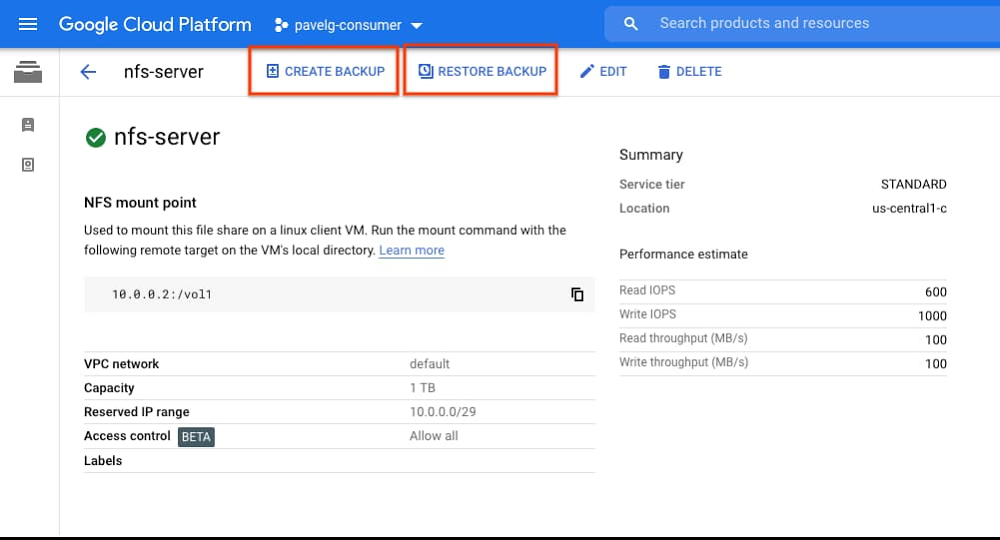
When you’re considering migrating mission-critical workloads to the cloud, it’s important to make it as easy as possible. We think maintaining your established, on-prem best practices can make a cloud migration a lot easier. Using established best practices reduces the need to rearchitect applications, and also helps ensure continuity as you migrate your infrastructure. We’re announcing the availability of Filestore Backups preview in all regions, making it easier to migrate your business continuity, disaster recovery and backup strategy for your file systems in Google Cloud.File system backups serve use cases such as disaster recovery, protection against accidental data changes, file system cloning and migration of data, all of which benefit from the ability to efficiently store a copy of data and metadata in a separate storage system. File system backups form a central component of any solid backup strategy, as they let you safely retain point-in-time copies of data shared across VMs and applications. While resiliency is an essential aspect of nearly every industry today, websites and ecommerce are one example where 24×7 uptime and reliability is critical. Downtime or lost data can mean a direct and immediate impact to a business. Google Cloud customer Liferay, one of the leading platforms for websites and ecommerce businesses, relies on Filestore backups to make sure they are supporting their customers with best-in-class reliability. “On Liferay DXP Cloud, we work with customers from all sizes and backgrounds with different storage and compliance needs,” says Eduardo Lundgren, CTO of Liferay Cloud. “Using Filestore allowed us to support all these needs while focusing on delivering new features instead of managing storage. Filestore Backups enable us to create daily snapshots of each customer, and if needed, restore their data quickly and safely.” Filestore backups can be used to restore a file system back to a previous state or to create a new Filestore instance whose data is identical to the original at the point in time the backup was taken. Filestore Backups features were designed to answer the requirements of enterprise file users. Here are a few of the benefits that Filestore Backups offers:Regional availability – Filestore backups are regional resources, which enables them to protect users against the rare case of inaccessibility of a given zone. If data in a zone is inaccessible, users can restore the data using the regional backup and continue working in any available zone. Cross-region creation – Filestore backups can also be created and stored to a region different from that of the origin file system. This enables users to protect their workloads against the inaccessibility of an entire region or to efficiently migrate file system data between regions. Compression and incremental data retention – To reduce costs, backups within a region are created incrementally based on previous backups and are automatically compressed. This means that the first backup you create is a compressed copy of the file share, and subsequent backups include only the new or modified data that is not contained in the previous backup.‘Create’ and ‘Restore’ functionality across Filestore Basic HDD and Filestore Basic SSD – Filestore backups can be created for either Filestore Basic HDD or Filestore Basic SSD instances and can be restored to either tier. This means that Filestore backups can be used to migrate data from Filestore Basic HDD to Basic SSD to increase performance or from Filestore Basic SSD to Basic HDD to reduce costs. Customers may use the backup feature to optimize cost and performance based on actual workload needs.Independent lifecycle of backup and filestore instance – Once a backup of a file system is created, the original instance may be safely deleted. As backups are stored on separate storage, the backup will be retained until it is deleted by the user. If access to the data in the backup is required a new filesystem can be created from the backup recreating the data and metadata of the deleted file system.These features let you use Filestore backups across multiple use cases, including:Backing up data for disaster recovery – Use Cloud Scheduler to regularly back up instances to a remote region. In the event of a disaster you can create a new instance in another location from any previous backup.Backing up data to protect against accidental changes – To protect your data against accidental deletions or changes due to human or software errors, back up your file system regularly and before major changes or upgrades. In the event of inadvertent loss or change to a file, you can identify the backup with the version of the file needed, create a new Filestore instance, and copy the original file over. Alternatively, you can do an in-place restore where the backup data is directly restored to the original Filestore instance.Creating clones for development and testing – If your Filestore instance serves production traffic and you want to run a test with the data in the file system as an input, simply create a clone Filestore instance from a backup to enable testing and development usage without interfering with production files systems.Migrating data – If you need to migrate a Filestore instance to another region, you can simply create a backup and restore the Filestore instance in the new region. This same method may also be used to create multiple copies of a file system across a collection of regions.Creating a backup or restoring from a backup is easy from the Google Cloud Console:The list of existing Filestore backups with more details is available in a separate “Backups” tab.Creation of a new instance from a backup details page is just a single click away:To get started, check out the Filestore Backup documentation or create a backup in the Google Cloud Console.This blog is dedicated to Allon Cohen, our colleague and friend who passed away this month. We want to thank Allon for his contributions to Filestore and Google Cloud.
Quelle: Google Cloud Platform