New undersea cable expands capacity for Google APAC customers and users

Posted by Brian Quigley, Director, Google Networking Infrastructure

Google’s mission is to connect people to the world’s information by providing fast and reliable infrastructure. From data centers to cables under the sea, we’re dedicated to building infrastructure that reaches more people than ever before.

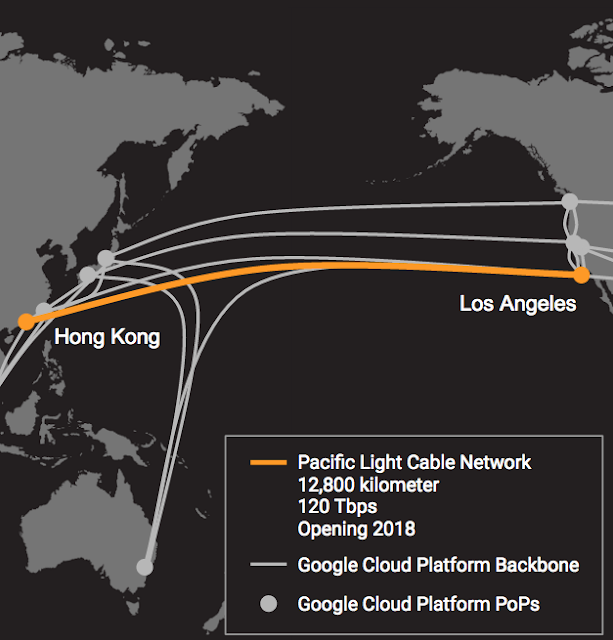
Today, we announced that we will work with Facebook, Pacific Light Data Communication and TE Subcom to build the first direct submarine cable system between Los Angeles and Hong Kong with ultra high-capacity.

The Pacific Light Cable Network (PLCN) will have 12,800 km of fiber and an estimated cable capacity of 120 Tbps, making it the highest-capacity trans-Pacific route, a record currently held by another Google-backed cable system, FASTER. In other words, PLCN will provide enough capacity for Hong Kong to have 80 million concurrent HD video conference calls with Los Angeles — an example of Google Cloud Platform having the largest network backbone of any public cloud provider.

This is the sixth submarine cable in which Google has an ownership stake — joining the ranks of the Unity, SJC, FASTER, MONET and Tannat projects. We anticipate that PLCN will be operational in 2018.

From the get-go, PLCN is designed to accommodate evolving infrastructure technology, allowing us to independently choose network equipment and refresh optical technology as it advances. Most importantly, PLCN will bring lower latency, more security and greater bandwidth to Google users in the APAC region. In addition to our existing investments in APAC cloud regions and the FASTER cable system, PLCN expands our ability to serve people in Asia, including Google Cloud and G Suite customers.

Nei Hou, Hong Kong! We can’t wait to link up with you!
Quelle: Google Cloud Platform

Transform your business; become a Google Certified Professional Data Engineer

Posted by Rochana Golani, Head of Curriculum and Certification

Increasingly, data drives decisions and there’s a huge demand for technical professionals who can support decision makers by helping them to gain new insights from their data, in the right context and at the right time.

Today, IT professionals program data pipelines, tune databases, create reports and carry out statistical analysis on the current generation of IT technologies. Google Cloud Platform (GCP), especially fully managed services like Google BigQuery, Google Cloud Dataflow and Google Cloud Machine Learning, offers a full set of tools for ingesting, querying, transforming and deriving insight from data.

Last week, we announced our Google Cloud Certification Program, which will connect people with these technical skills to the companies looking to transform their businesses with data. By becoming a Google Certified Professional – Data Engineer, you signal to companies that you’re skilled in our data technologies, and can help them tackle their challenging data problems.

Google Certified Professional – Data Engineer
We envision the Data Engineer as a key role in organizations of the future, helping to modernize the way they use data and infrastructure together to enable decision-making and business transformation. Data Engineers will build, maintain and troubleshoot data processing systems that are secure, reliable and scaleable, and this certification establishes a trusted standard of proficiency for the role.

The Google Certified Professional – Data Engineer can:

shape business outcomes by analyzing data
build statistical models that support smart decision-making
create machine learning models that automate and simplify business processes
design, build, maintain and troubleshoot data processing systems that are secure, reliable, fault-tolerant, scalable and efficient

How do I become a Google Certified Professional – Data Engineer?
First off, real-world, hands-on experience is the best preparation, so roll up your sleeves and start working with the GCP technologies. We also offer a number of educational resources and courses to help you on your journey.

To help you know where you may still need experience, we’ve developed the Google Data Engineer Certification Exam Guide. This lists all of the skills that we expect a Data Engineer to have.

Are you ready to show what you know? Sign up here and we’ll let you know when the beta exam launches for the Google Data Engineer Certification.

At Google Cloud, we’re seeing incredible growth as more businesses move to the cloud, coupled with increasing demand for people who fit the Data Engineer profile. Our customers are looking to solve existing and new problems with data using some of the same technologies, tools and techniques that Google has used in solving data problems. A qualified Data Engineer will make all the difference.

Quelle: Google Cloud Platform

Introducing a new era of customer support: Google Customer Reliability Engineering

Posted by Dave Rensin, Director of Google Customer Reliability Engineering (CRE)

In the 25 years that I’ve been in technology nearly everything has changed. Computers have moved out of the labs and into our pockets. They’re connected together 24/7 and the things we can do with them are starting to rival our most optimistic science fiction.

Almost nothing looks the same as it did back then — except customer support. Support is (basically) still people in call centers wearing headsets. In this new world, that old model just isn’t enough.

We want to change that.

Last week, we announced a brand new profession at Google: Customer Reliability Engineering, or CRE. The mission of this new role is to create shared operational fate between Google and our Google Cloud Platform customers, to give you more control over the critical applications you’re entrusting to us, and share a fate greater than money.

Reducing customer anxietyWhen you look out at organizations adopting cloud, you can’t help but notice high levels of anxiety.

It took me a while to figure out a reasonable explanation, but here’s where I finally landed:

Humans are evolutionarily disposed to want to control our environment, which is a really valuable survival attribute. As a result, we don’t react well when we feel like we’re losing that control. The higher the stakes, the more forcefully we react to the perceived loss.

Now think about the basic public cloud business model. It boils down to:

Give up control of your physical infrastructure and (to some extent) your data. In exchange for that uncertainty, the cloud will give you greater innovation, lower costs, better security and more stability.

It’s a completely rational exchange, but it also pushes against one of our strongest evolutionary impulses. No wonder people are anxious.

The last several years have taught me that many customers will not eat their anxieties in exchange for lower prices — at least not for long. This is especially true in cloud because of the stakes involved for most companies. There have already been a small number of high-profile companies going back on-prem because the industry hasn’t done enough to recognize this reality.

Cloud providers ignore this risk at their own peril and addressing this anxiety will be a central requirement to unlock the overwhelming majority of businesses not yet in the cloud.

The support mission
The support function in organizations used to be pretty straightforward: answer questions and fix problems quickly and efficiently. Over time, much of the entire IT support function has been boiled down to FAQs, help centers, checklists and procedures.

In the era of cloud technology, however, this is completely wrong.

Anxious customers need empathy, compassion and humanity. You need to know that you’re not alone and that we take you seriously. You are, after all, betting your businesses on our platforms and tools.

There’s only one true and proper mission of a support function in this day and age:

              Drive Customer Anxiety -> 0

People who aren’t feeling anxious don’t spend the time and effort to think seriously about leaving a platform that’s working for them. The decision to churn starts with an unresolved anxiety.

Anxiety = 1 / Reliability
It seems obvious to say that the biggest driver of customer anxiety is reliability.

Here’s the non-obvious part, though.

Cloud customers don’t really care about the reliability of their cloud provider — you care about the reliability of your production application. You only indirectly care about the reliability of the cloud in which you run.

The reliability of an application is the product of two things:
The reliability of the cloud provider
The reliability inherent in the design, code and operations of your application

Item (1) is a pretty well understood problem in the industry. There are thousands of engineers employed at the major cloud vendors that focus exclusively on it.

Here at Google we pioneered a whole profession around it: Site Reliability Engineering (SRE).

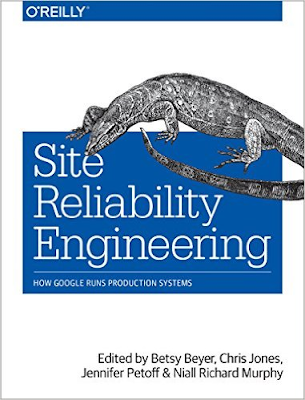
We even wrote a book!

What about item (2)? Who’s worried about the reliability inherent in the design, implementation and operation of your production application?

So far, just you.

The standard answer in the industry is:
Here are some white papers, best practices and consultants. Don’t do silly things and your app will be mostly fine.
As an industry, we’re asking you to bet your livelihoods on our platforms, to let us be your business partner and to give up big chunks of control. And in exchange for that we’re giving you . . . whitepapers.

No wonder you’re anxious. You should be!

No matter how much innovation, speed or scale your cloud provider gives you, this arrangement will always feel unbalanced — especially at 3am when something goes wrong.

Perhaps you think I’m overstating the case?

Just a few months ago Dropbox announced that it was leaving their public cloud provider to go back on-prem. They’ve spoken at length about their decision making process around this choice and have expressed a strong desire to more fully “control their own destiny.” The cumulative weight of their loss of control just got to be too much. So they left.

SRE 101The idea behind Google CRE comes from the decade-long journey of Google SRE. I realize you might not be familiar with the history of SRE, so let me spend a couple paragraphs to catch you up . . .
. . .  there were two warring kingdoms — developers and operations.

The developers were interested in building and shipping interesting and useful features to users. The faster the innovation, the better. In the developer tribe’s perfect world there would never be a break in the development and deployment of new and awesome products.

The operations kingdom, on the other hand, was concerned with the reliability of the systems being shipped, because they were the ones getting paged at 3am when something went down. Once the system became stable they’d rather never ship anything new again since 100% of new bugs come from new code.

For decades these kingdoms warred and much blood was spilled. (OK. Not actual blood, but the emails could get pretty testy . . . )

Then, one day this guy had an idea.

Benjamin Treynor-Sloss, VP, 24×7, Father of SRE

He realized that the underlying assumptions of this age old conflict were wrong and recast the problem into an entirely new notion — the error budget.

No system you’re likely to build (except maybe a pacemaker) needs to be available 100% of the time. Users have lots of interruptions they never notice because they’re too busy living their lives.

It therefore follows that for nearly all systems there’s a very small (but nonzero) acceptable quantity of unavailability. That downtime can be thought of as a budget. As long as a system is down less than its budget it is considered healthy.

For example, let’s say you need a system to be available 99.9% of the time (three nines). That means it’s OK for the system to be unavailable 0.1% of the time (for any given 30-day month, that’s 43 minutes).

As long as you don’t do anything that causes the system to be down more than 43 minutes you can develop and deploy to your heart’s content. Once you blow your budget, however, you need to spend 100% of your engineering time writing code that fixes the problem and generally makes your system more stable. The more stable you make things, the less likely you are to blow your error budget next month and the more new features you can build and deploy.

In short, the error budgets align the interests of the developer and operations tribes and create a virtuous circle.

From this, a new profession was born: Site Reliability Engineering (SRE).

At Google, there’s a basic agreement between SREs and developers.

The SREs will accept the responsibility for the uptime and healthy operation of a system if:
The system (as developed) can pass a strict inspection process — known as a Production Readiness Review (PRR)
The development team who built the system agrees to maintain critical support systems (like monitoring) and be active participants in key events like periodic reviews and postmortems
The system does not routinely blow its error budget

If the developers don’t maintain their responsibilities in the relationship then the SREs “offboard” the system. (And hand back the pagers!)

This basic relationship has helped create a culture of cooperation that has led to both incredible reliability and super fast innovation.

The Customer Reliability Engineering missionAt Google, we’ve decided we need a similar approach with our customers.

CRE is what you get when you take the principles and lessons of SRE and apply them towards customers.

The CRE team deeply inspects the key elements of a customer’s critical production application — code, design, implementation and operational procedures. We take what we find and put the application (and associated teams) through a strict Production Readiness Review (PRR).

At the end of that process we’ll tell you: “here are the reliability gaps in your system. Here is your error budget. If you want more nines here are the changes you should make.”

We’ll also build common system monitoring so that we can have mutually agreed upon telemetry for paging and tickets.

It’ll be a lot of hard work on your part to get past our PRR, but in exchange for the effort you can expect the following:
Shared paging. When your pagers go off, so will ours.
Auto-creation and escalation of Priority 1 tickets
CRE participation in customer war rooms (because despite everyone’s best efforts, bad things will inevitably happen)
A Google-reviewed design and production system

Additional Cost: $0

Wait . . . that’s a lot of value. Why aren’t we charging money for it?

The most important lever SREs have in Google is the ability to hand back the pagers. It’s the same thing with CREs. When a customer fails to keep up their end of the work with timely bug fixes, participation in joint postmortems, good operational hygiene etc., we’ll “hand back the pagers” too.

Please note, however, that $0 is not the same as “free.” Achieving Google-class operational rigor requires a sustained commitment on your part. It takes time and effort. We’ll be there on the journey, but you still need to walk the path. If you want some idea of what you’re signing up to, get a copy of the Site Reliability Engineering book and ask yourself how willing you are to do the things it outlines.

It’s fashionable for companies to tell their customers that “we’re in this together,” but they don’t usually act the part.

People who are truly “in it together” are accountable to one another and have mutual responsibilities. They work together as a team for a common goal and share a fate greater than the dollars that pass between them.

This program won’t be for everyone. In fact, we expect that the overwhelming majority of customers won’t participate because of the effort involved. We think big enterprises betting multi-billion dollars businesses on the cloud, however, would be foolish to pass this up. Think of it as a de-risking exercise with a price tag any CFO will love.

Lowering the anxiety with a new social contractOver the last few weeks we’ve been quietly talking to customers to gauge their interest in the CRE profession and our plans for it. Every time we do, there’s a visible sigh, a relaxing of the shoulders and the unmistakable expression of relief on people’s faces.

Just the idea that Google would invest in this way is lowering our customers’ anxiety.

This isn’t altruism, of course. It’s just good business. These principles and practices are a strong incentive for a customer to stay with Google. It’s an affinity built on human relations instead of technical lock-in.

By driving inherent reliability into your critical applications we also increase the practical reliability of our platform. That, in turn, lets us innovate faster (a thing we really like to do).

If you’re a cloud customer, this is the new social contract we think you deserve.

If you’re a service provider looking to expand and innovate your cloud practice, we’d like to work with you to bring these practices to scale.

If you’re another cloud provider, we hope you’ll join us in growing this new profession. It’s what all our customers truly need.
Quelle: Google Cloud Platform
How to authenticate users on Google App Engine using Firebase

Posted by Tristan Vanech, Technical Writer Intern

Google App Engine offers a variety of user sign-in options, but what if you need a full stack solution for authentication, including verifying access tokens on the server? Meet Firebase Authentication, a complete sign-in experience that provides a drop-in UI, powerful SDKs, and, yes, backend services for token verification.

Firebase, Google’s backend as a service offering for creating mobile and web applications, has Node.js and Java server SDKs for integrating your own servers with Firebase Authentication. The Firebase Java server SDK offers a built-in method for verifying and decrypting tokens that you can use for authentication in Java App Engine apps, but no such SDK currently exists for the rest of the backend languages in App Engine.

Because using third-party JSON Web Token (JWT) libraries to manage authentication for other languages can be difficult, we just published a solution for Firebase Authentication on App Engine with Python, the first in a series for App Engine languages.

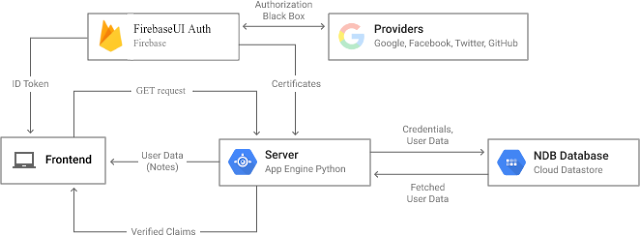
The tutorial walks you through a simple note-taking application called Firenotes that stores users’ notes in their own personal notebooks, which are identified by a unique user ID generated by Firebase. The application stores credentials in Google Cloud Datastore, but you can store them in any database, and even integrate your existing credentialing system with the user-ID-based method that Firebase uses.

(click to enlarge)

As the diagram above demonstrates, Firebase both mints the access tokens and provides public key certificates to verify them, so you need only to implement the verification code, which we have written for you.

We hope this solution helps you handle authentication quickly, so you can get back to writing the meat of the next great app!

Quelle: Google Cloud Platform

How to use Docker to run ASP.NET Core apps on Google App Engine

Posted by Ivan Naranjo, Software Developer

Ever wish you could run an ASP.NET Core app on Google App Engine? Now you can, by packaging it in a Docker container.

Google App Engine is a platform for building scalable web applications and mobile backends, and provides the built-in services and APIs common to most applications. Up until recently this infrastructure was only accessible from a handful of languages (Java, Python, Go and PHP), but that changed with the introduction of App Engine Flexible Environment, previously known as Managed VMs. App Engine Flexible allows you to use a Docker container of your choice as the backend for your app. And since it’s possible to wrap an ASP.NET Core app in a Docker image, this allows us to run ASP.NET Core apps on App Engine Flexible.

Step 1: Run your ASP.NET Core app locally
There have been NuGet packages for Google Cloud APIs in .NET for a long time, but starting with version 1.15.0.560, these NuGet packages have started targeting the .NET Core runtime. This allows you to write ASP.NET Core apps that use the Google Cloud APIs, to take advantage of services like Google Cloud Storage, Google Cloud Pub/Sub, or perhaps the newer machine learning APIs.

To show you how to deploy an ASP.NET Core app to App Engine Flexible, we’re going to deploy a very simple app (see the documentation for information about how to build an ASP.NET app that uses the GCP APIs). Of course to use ASP.NET Core, you’ll first need to install the .NET Core runtime and Visual Studio tooling, as well as Bower, which our ASP.NET Core app project uses to set up client-side dependencies.

Let’s start by creating a new ASP.NET Core app from Visual Studio. Open up Visual Studio and select “File > New Project…”. In the dialog, select the “Web” category and the “ASP.NET Core Web Application (.NET Core)” template:

Name the app “DemoFlexApp” and save it in the default “Projects” directory for Visual Studio. In the next dialog, select “Web Application” and press “OK”:

This will generate the app for you. Try it locally by pressing F5, which will build and run the app and open it in a browser window. Once you’re done, stop the app by closing the browser and stopping the debugging session.

Step 2: Package it as a Docker container
Now let’s prepare our app to run on App Engine Flexible. The first step is to define the container and its contents. Don’t worry, you won’t need to install Docker ⸺ App Engine Flexible can build Docker images remotely as part of the deployment process.

For this section, we’ll work from the command line. Open up a new command line window by using Win+R and typing cmd.exe in the dialog.

Now we need to navigate to the directory that contains the project you just created. You can get the path to the project by right clicking on the project in Visual Studio’s Solution Explorer and using the “Open Folder in File Explorer” option:

You can then copy the path from the File Explorer window and paste it into the command line window.

We’ll start by creating the contents of the Docker image for our app, including all its packages, pages, and client side scripts in a single directory. The dotnet CLI creates this directory by “publishing” your app to it, with the following command:

dotnet publish -c Release

Your app is now published to the default publish directory in the Release configuration. During the process of publishing your app, the dotnet CLI resolves all of dependencies and gathers them together with all other files into the output directory. This directory is what Microsoft calls a .NET Core Portable App; it contains all of the files that compose your app, and can be used to run your app on any platform that NET Core supports. You can run your app from this directory with this command:

cd binReleasenetcoreapp1.0publish
dotnet DemoFlexApp.dll

Be sure to be in the published directory when you run this command so that all of the resources can be found.

The next step is to configure the app that we’ll deploy to App Engine Flexible. This requires two pieces:

The Dockerfile that describes how to package the app files into a Docker container
The app.yaml file that tells the Google Cloud SDK tools how to deploy the app

We will deploy the app from the “published” directory that you created above.

Take the following lines and copy them to a new file called “Dockerfile” under the “published” directory:

FROM microsoft/dotnet:1.0.1-core
COPY . /app
WORKDIR /app
EXPOSE 8080
ENV ASPNETCORE_URLS=http://*:8080
ENTRYPOINT [“dotnet”, “DemoFlexApp.dll”]

A Dockerfile describes the content of the Docker image starting from an existing image and adds files and other changes to it. Our repo Dockerfile starts from the Microsoft official image, which is already configured to run .NET Core apps and adds the app files and the tools necessary to run the app from the directory.

One important configuration included in our Dockerfile is the port on which the app listens for incoming traffic ⸺ port 8080, per App Engine Flexible requirements. This is accomplished by setting the ASPNETCORE_URLS environment variable, which ASP.NET Core apps use to determine the port to listen to.

The app.yaml file describes how to deploy the app to App Engine, in this case, the App Engine Flexible environment. Here’s the minimum configuration file required to run on App Engine Flexible, specifying a custom runtime and the Flexible environment. Copy its contents and paste them into a new file called “app.yaml” under the “published” directory:

runtime: custom
vm: true

Step 3: Deploy to App Engine Flexible
Once you’ve saved the Dockerfile and app.yaml files to the published directory, you’re ready to deploy your app to App Engine Flexible. We’re going to use the Google Cloud SDK to do this. Follow these steps to get the SDK fully set up on your box. You’ll also need a Google Cloud Platform project with billing enabled.

Once you’ve fully configured the app and selected a project to deploy it to, you can finally deploy to App Engine Flexible. To do that run this command:

gcloud app deploy app.yaml

The command will take some time to complete, especially the first time since it has to perform all the setup. Once done, open a browser to the newly deployed app:

gcloud app browse

There! You’ve downloaded an ASP.NET Core app, packaged it as a Docker container, and deployed it to Google App Engine Flexible. We look forward to seeing more ASP.NET apps running on Google App Engine.

Quelle: Google Cloud Platform

Powering geospatial analysis: public geo datasets now on Google Cloud

Posted Peter Birch, Product Manager Google Earth Engine

With dozens of public satellites in orbit and many more scheduled over the next decade, the size and complexity of geospatial imagery continues to grow. It has become increasingly difficult to manage this flood of data and use it to gain valuable insights. That’s why we’re excited to announce that we’re bringing two of the most important collections of public, cost-free satellite imagery to Google Cloud: Landsat and Sentinel-2.

The Landsat mission, developed under a joint program of the USGS and NASA, is the longest continuous space-based record of Earth’s land in existence, dating back to 1972 with the Landsat 1 satellite. Landsat imagery sets the standard for Earth observation data due to the length of the mission and the rich data provided by its multispectral sensors. Landsat data has proven invaluable to agriculture, geology, forestry, regional planning, education, mapping, global change and disaster response. This collection includes the complete USGS archive of the Landsat 4, 5, 7 and 8 satellites, and the data is updated as new data arrives from Landsat 7 and 8. The collection is updated daily and contains a total of 4 million scenes and 1.3 petabytes of data covering 1984 to the present — over 35 years of imagery of our Earth ready for immediate analysis.

Sentinel-2, part of the European Union’s ambitious Copernicus Earth observation program, raised the bar for Earth observation data, with a Multi-Spectral Instrument (MSI) that produces images of the Earth with a resolution of up to 10 meters per pixel, far sharper than that of Landsat. Sentinel-2 data is especially useful for agriculture, forestry and other land management applications. For example, it can be used to study leaf area and chlorophyll and water content, to map forest cover and soils, and to monitor inland waterways and coastal areas. Images of natural disasters such as floods and volcanic eruptions can also be used for disaster mapping and humanitarian relief efforts. The collection currently contains 970,000 images and over 430 terabytes of data, updated daily.

Brisbane, Australia, as viewed by Sentinel-2

Here at Google, we have years of experience working with the Landsat and Sentinel-2 satellite imagery collections. Our Google Earth Engine product, a cloud-based platform for doing petapixel-scale analysis of geospatial data, was created to help make analyzing these datasets quick and easy. Earth Engine’s vast catalog of data, with petabytes of public data, combined with an easy to use scripting interface and the power of Google infrastructure, has helped to revolutionize Earth observation. Now, by bringing the two most important datasets from Earth Engine into Google Cloud, we’re also enabling customer workflows using Google Compute Engine, Google Cloud Machine Learning and any other Google Cloud services.

One customer that has taken advantage of the powerful combination of Google Cloud and these datasets is Descartes Labs. Descartes Labs is focused on combining machine learning and geospatial data to forecast global crop production. “For an early stage technology startup, satellite imagery can be impossibly expensive,” said Descartes Labs CEO Mark Johnson. “To make accurate machine learning models of major crops, we needed decades of satellite imagery from the entire globe. Thanks to Google Earth Engine hosting the entire Landsat archive publicly on Google Cloud, we can focus on algorithms instead of worrying about collecting petabytes of data. Earth observation will continue to improve with every new satellite launch and so will our ability to forecast global food supply. We’re excited that Google sees the potential in hosting open geospatial data on Google Cloud, since it will enable companies like ours to better understand the planet we live on.”

Humboldt, Iowa (Landsat 8, USGS)

Agricultural field edge boundaries and field segmentation from July 2016 of Humboldt, Iowa, generated using machine learning and Landsat data on Google Cloud.

Spaceknow is another company using Google Cloud to mine Landsat data for unique insights. Spaceknow brings transparency to the global economy by tracking global economic trends from space. Spaceknow’s Urban Growth Index analyzes massive amounts of multispectral imagery in China and elsewhere. Using a TensorFlow-based deep learning framework capable of predicting semantic labels for multi-channel satellite imagery, Spaceknow determines the percentage of land categorized as urban-type for a specified geographic region. Furthermore, its China Satellite Manufacturing Index uses proprietary algorithms to analyze Landsat 7 and 8 imagery of over 6,000 industrial facilities across China, measuring levels of Chinese manufacturing activity. Using 2.2 billion satellite observations, this index covers over 500,000 square kilometers, and it can be quickly updated when new images arrive from the satellites. According to Pavel Machalek, the CEO of Spaceknow: “Google Cloud provides us with the unique capability to develop, train and deploy neural networks at unprecedented scale. Our customers depend on the information we provide for critical, day-to-day decision making.”

   Fuzhou, China 2000 (Landsat 7, UCGS)                          Fuzhou, China 2016 (Landsat 8 USGS)

With over a petabyte of the world’s leading public satellite imagery data available at your fingertips, you can avoid the cost of storing the data and the time and cost required to download these large datasets and focus on what matters most: building products and services for your customers and users. Whether you’re using Google Cloud’s leading machine learning and compute services or Earth Engine for simple and powerful analysis, we can help you turn pixels into knowledge to help your organization make better decisions.

Learn more about these new geo imagery datasets at http://cloud.google.com/storage/docs/public-datasets/ and about the full range of public datasets at http://cloud.google.com/public-datasets/.
Quelle: Google Cloud Platform

Google Container Engine now on Kubernetes 1.4

Posted by David Aronchick, Senior Product Manager, Container Engine

Today, Kubernetes 1.4 is available to all Google Container Engine customers. In addition to all the new features Kubernetes 1.4 — including multi-cluster federation, simplified setup and one-command install for popular workloads like MySQL, MariaDB and Jenkins — we’ve also taken big steps to make Google Cloud Platform (GCP) the best place to run your Kubernetes workloads.

Container Engine has continued its rapid growth, doubling in usage every 90 days, while still providing a fully managed Kubernetes service with 99.5% uptime for applications large and small. We’ve also made a number of improvements to the platform to make it even easier to manage and more powerful to use:

One-click alpha clusters can be spun up as easily as a regular cluster, so testing Kubernetes’ alpha features like persistent application support is a one-click operation.
Support for AppArmor in the base image gives applications deployed to Container Engine multiple layers of defense-in-depth.
Integration with Kubernetes Cluster Federation allows you to add a Container Engine cluster to your existing federation, greatly simplifying cloud bursting and multi-cloud deployments.
Rich support for Google Cloud Identity & Access Management allows you to manage GKE clusters with the same multi-faceted roles you use across your GCP projects.
A new Google Container-VM Image makes upgrading a breeze and allows new upgrades to be automatically installed with a simple reboot.
Monitoring of all cluster add-ons ensures that all key functions for your cluster are available and ready to use — one less thing to think about when running a large distributed application.

From new startups to the largest organizations, we’ve seen tremendous adoption of Container Engine, here are a few unique highlights:

Niantic – creators of the global phenomenon Pokémon GO, relies on Container Engine to power their extraordinary growth.
Philips – smart connected lighting system Hue, receives 200 million transactions a day that are easily handled by Container Engine.
Google Cloud ML – the new Cloud Machine Learning service from GCP is also running fully on Container Engine.
And many more companies, from Box to Pearson, are choosing Kubernetes to manage their production workloads.

As always, if you’d like to help shape the future of Kubernetes, please participate in the Kubernetes community; we’d love to have you! Please join the google-containers mailing list or on the kubernetes-users or google-containers Slack channels.

Finally, if you’ve never tried GCP before, getting started is easy. Sign up for your free trial here.

Thank you for your support!
Quelle: Google Cloud Platform

Introducing Google Container-VM Image

Posted by Aditya Kali and Amey Deshpande, Software Engineers

This spring, we announced Container-VM Image as a beta product under Google Cloud Platform (GCP). If you’re a developer interested in deploying your application or a service provider on Google Compute Engine, we recommend taking a few moments to understand how it can help you.

Linux containers help developers to focus on their application without worrying about the underlying infrastructure. A secure and up-to-date base image is a critical building block of any container-based infrastructure. Container-VM Image represents the best practices we here at Google have learned over the past decade running containers at scale.

Container-VM Image design philosophy
Container-VM Image is designed from the ground up to be a modern operating system for running containers on GCP. Read on for more information about the design choices behind Container-VM Image and its attributes.

Build environment
Container-VM Image is based on the open-source Chromium OS project. Chromium OS is a reliable and vetted source code base for this new operating system. In addition, its allows us to use the powerful build and test infrastructure built by the ChromeOS team.

Designed for containers
The Docker container runtime is pre-installed on Container-VM Image. A key feature of containers is that the software dependencies can be packaged in the container image along with the application. With this in mind, Container-VM Image’s root file system is kept to a minimum by only including the software that’s necessary to run containers.

More secure by design
Container-VM Image is designed with security in mind, rather than as an afterthought. The minimal root file system keeps the attack surface small. The root file system is mounted as read-only, and its integrity is verified by the kernel during boot up. Such hardening features make it difficult for attackers to permanently exploit the system.

Software updates
Having full control over the build infrastructure combined with a minimal root file system allows us to patch vulnerabilities and ship updated software versions very quickly. Container-VM Image also ships with an optional “in-place update” feature that allows users to stay up-to-date with minimal manual intervention.

Getting started
The Container-VM Images are available in the “google-containers” GCP project. Here are a few commands to get you started:

Here’s how to list currently available images:

$ gcloud compute images list –project google-containers –no-standard-images

Note: All new Container-VM Images have “gci-” prefix in their names.

Here’s how to start a new instance:
$ gcloud compute instances create
–zone us-central1-a
–image-family gci-stable –image-project google-containers

Once the instance is ready, you can ssh into it:

$ gcloud compute ssh –zone us-central1-a

You can also start an instance using Cloud-Config, the primary API for configuring an instance running Container-VM Image. You can create users, configure firewalls, start Docker containers and even run arbitrary commands required to configure your instance from the Cloud-Config file.

You can specify Cloud-Config as Compute Engine metadata at the time of instance creation with the special `user-data` key:

$ gcloud compute instances create
–zone us-central1-a
–image-family gci-stable –image-project google-containers
–metadata-from-file user-data=

What’s next
We’re working hard on improving and adding new features to Container-VM Image to make it the best way to run containers on GCP.  Stay tuned for future blogs and announcements. In the meantime, you can find more documentation and examples at the Container-VM Image homepage, and send us your feedback at google-containers@google.com .
Quelle: Google Cloud Platform

Bringing Pokémon GO to life on Google Cloud

Posted by Luke Stone, Director of Customer Reliability Engineering

Throughout my career as an engineer, I’ve had a hand in numerous product launches that grew to millions of users. User adoption typically happens gradually over several months, with new features and architectural changes scheduled over relatively long periods of time. Never have I taken part in anything close to the growth that Google Cloud customer Niantic experienced with the launch of Pokémon GO.

As a teaser, I’ll start with a picture worth a thousand words:

Launch target and worst case estimates of player traffic. The game’s popularity surged to more than 50 times the initial target.

Our peers in the technical community have asked about the infrastructure that helped bring Pokémon GO to life for millions of players. Niantic and the Google Cloud teams put together this post to highlight some of the key components powering one of the most popular mobile games to date.

A shared fate
At our Horizon event today, we’ll be introducing Google Customer Reliability Engineering (CRE), a new engagement model in which technical staff from Google integrates with customer teams, creating a shared responsibility for the reliability and success of critical cloud applications. Google CRE’s first customer was Niantic, and its first assignment the launch of Pokémon GO — a true test if there ever was one!

Within 15 minutes of launching in Australia and New Zealand, player traffic surged well past Niantic’s expectations. This was the first indication to Niantic’s product and engineering teams that they had something truly special on their hands. Niantic phoned in to Google CRE for reinforcements, in anticipation of the US launch planned the next day. Niantic and Google Cloud — spanning CRE, SRE, development, product, support and executive teams — braced for a flood of new Pokémon Trainers, as Pokémon GO would go on to shatter all prior estimates of player traffic.

Creating the Pokémon game world
Pokémon GO is a mobile application that uses many services across Google Cloud, but Cloud Datastore became a direct proxy for the game’s overall popularity given its role as the game’s primary database for capturing the Pokémon game world. The graph opening this blog post tells the story: the teams targeted 1X player traffic, with a worst-case estimate of roughly 5X this target. Pokémon GO’s popularity quickly surged player traffic to 50X the initial target, ten times the worst-case estimate. In response, Google CRE seamlessly provisioned extra capacity on behalf of Niantic to stay well ahead of their record-setting growth.

Not everything was smooth sailing at launch! When issues emerged around the game’s stability, Niantic and Google engineers braved each problem in sequence, working quickly to create and deploy solutions. Google CRE worked hand-in-hand with Niantic to review every part of their architecture, tapping the expertise of core Google Cloud engineers and product managers — all against a backdrop of millions of new players pouring into the game.

Pokémon powered by containers
Beyond being a global phenomenon, Pokémon GO is one of the most exciting examples of container-based development in the wild. The application logic for the game runs on Google Container Engine (GKE) powered by the open source Kubernetes project. Niantic chose GKE for its ability to orchestrate their container cluster at planetary-scale, freeing its team to focus on deploying live changes for their players. In this way, Niantic used Google Cloud to turn Pokémon GO into a service for millions of players, continuously adapting and improving.

One of the more daring technical feats accomplished by Niantic and the Google CRE team was to upgrade to a newer version of GKE that would allow for more than a thousand additional nodes to be added to its container cluster, in preparation for the highly anticipated launch in Japan. Akin to swapping out the plane’s engine in-flight, careful measures were taken to avoid disrupting existing players, cutting over to the new version while millions of new players signed up and joined the Pokémon game world. On top of this upgrade, Niantic and Google engineers worked in concert to replace the Network Load Balancer, deploying the newer and more sophisticated HTTP/S Load Balancer in its place. The HTTP/S Load Balancer is a global system tailored for HTTPS traffic, offering far more control, faster connections to users and higher throughput overall — a better fit for the amount and types of traffic Pokémon GO was seeing.

The lessons-learned from the US launch — generous capacity provisioning, the architectural swap to the latest version of Container Engine, along with the upgrade to the HTTP/S Load Balancer — paid off when the game launched without incident in Japan, where the number of new users signing up to play tripled the US launch two weeks earlier.

The Google Cloud GKE/Kubernetes team that supports many of our customers like Niantic

Other fun facts

The Pokémon GO game world was brought to life using over a dozen services across Google Cloud.
Pokémon GO was the largest Kubernetes deployment on Google Container Engine ever. Due to the scale of the cluster and accompanying throughput, a multitude of bugs were identified, fixed and merged into the open source project.
To support Pokémon GO’s massive player base, Google provisioned many tens of thousands of cores for Niantic’s Container Engine cluster.
Google’s global network helped reduce the overall latency for Pokémon Trainers inhabiting the game’s shared world. Game traffic travels Google’s private fiber network through most of its transit, delivering reliable, low-latency experiences for players worldwide. Even under the sea!

Niantic’s Pokémon GO was an all-hands-on-deck launch that required quick and highly informed decisions across more than a half-dozen teams. The sheer scale and ambition of the game required Niantic to tap architectural and operational best-practices directly from the engineering teams who designed the underlying products. On behalf of the Google CRE team, I can say it was a rare pleasure to be part of such a memorable product launch that created joy for so many people around the world.
Quelle: Google Cloud Platform
Google Cloud Platform sets a course for new horizons

Posted by Brian Stevens, Vice President, Google Cloud

As we officially move into the Google Cloud era, Google Cloud Platform (GCP) continues to bring new capabilities to more regions, environments, applications and users than ever before. Our goal remains the same: we want to build the most open cloud for all businesses and make it easy for them to build and run great software.

Today, we’re announcing new products and services to deliver significant value to our customers. We’re also sharing updates to our infrastructure to improve our ability to not only power Google’s own billion-user products, such as Gmail and Android, but also to power businesses around the world.

Delivering Google Cloud Regions for all
We’ve recently joined the ranks of Google’s billion-user products. Google Cloud Platform now serves over one billion end-users through its customers’ products and services.

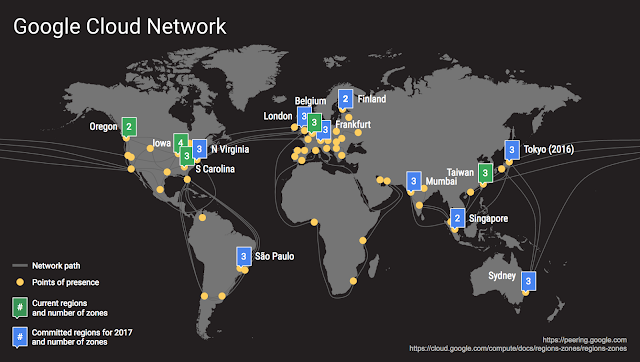
To meet this growing demand, we’ve reached an exciting turning point in our geographic expansion efforts. Today, we announced the locations of eight new Google Cloud Regions — Mumbai, Singapore, Sydney, Northern Virginia, São Paulo, London, Finland and Frankfurt — and there are more regions to be announced next year.

By expanding to new regions, we deliver higher performance to customers. In fact, our recent expansion in Oregon resulted in up to 80% improvement in latency for customers. We look forward to welcoming customers to our new Cloud Regions as they become publicly available throughout 2017.

Embracing the multi-cloud world
Not only do applications running on GCP benefit from state-of-the-art infrastructure, but they also run on the latest and greatest compute platforms. Kubernetes, the open source container management system that we developed and open-sourced, reached version 1.4 earlier this week, and we’re actively updating Google Container Engine (GKE) to this new version.

GKE customers will be the first to benefit from the latest Kubernetes features, including the ability to monitor cluster add-ons, one-click cluster spin-up, improved security, integration with Cluster Federation and support for the new Google Container-VM image (GCI).

Kubernetes 1.4 improves Cluster Federation to support straightforward deployment across multiple clusters and multiple clouds. In our support of this feature, GKE customers will be able to build applications that can easily span multiple clouds, whether they are on-prem, on a different public cloud vendor, or a hybrid of both.

We want GCP to be the best place to run your workloads, and Kubernetes is helping customers make the transition. That’s why customers such as Philips Lighting have migrated their most critical workloads to run on GKE.

Accelerating the move to cloud data warehousing and machine learning
Cloud infrastructure exists in the service of applications and data. Data analytics is critical to businesses, and the need to store and analyze data from a growing number of data sources has grown exponentially. Data analytics is also at the foundation for the next wave in business intelligence — machine learning.

The same principles of data analytics and machine learning apply to large-scale businesses: to derive business intelligence from your data, you need access to multiple data sources and the ability to seamlessly process it. That’s why GKE usage doubles every 90 days and is a natural fit for many businesses. Now, we’re introducing new updates to our data analytics and machine learning portfolio that help address this need:

Google BigQuery, our fully managed data warehouse, has been significantly upgraded to enable widespread adoption of cloud data analytics. BigQuery support for Standard SQL is now generally available, and we’ve added new features that improve compatibility with more data tools than ever and foster deeper collaboration across your organization with simplified query sharing. We also integrated Identity and Access Management (IAM) that allows businesses to fine-tune their security policies. And to make it accessible for any business to use BigQuery, we now offer unlimited flat-rate pricing that pairs unlimited queries with predictable data storage costs.
Cloud Machine Learning is now available to all businesses. Integrated with our data analytics and storage cloud services such as Google BigQuery, Google Cloud Dataflow, and Google Cloud Storage, it helps enable businesses to easily train quality machine learning models on their own data at a faster rate. “Seeing is believing” with machine learning, so we’re rolling out dedicated educational and certification programs to help more customers learn about the benefits of machine learning for their organization and give them the tools to put it into use.

To learn more about how to manage data across all of GCP, check out our new Data Lifecycle on GCP paper.

Introducing a new engagement model for customer support
At Google, we understand that the overall reliability and operational health of a customer’s application is a shared responsibility. Today, we’re announcing a new role on the GCP team: Customer Reliability Engineering (CRE). Designed to deepen our partnership with customers, CRE is comprised of Google engineers who integrate with a customer’s operations teams to share the reliability responsibilities for critical cloud applications. This integration represents a new model in which we share and apply our nearly two decades of expertise in as an embedded part of a customer’s organization. We’ll have more to share about this soon.

One of the CRE model’s first tests was joining Niantic as they launched Pokémon GO, scaling to serve millions of users around the world in a span of a few days.

The Google Cloud GKE/Kubernetes team that supports many of our customers like Niantic

The public cloud is built on customer trust, and we understand that it’s a significant commitment for a customer to entrust a public cloud vendor with their physical infrastructure. By offering new features to help address customer needs and collaborating with them to usher in the future with tools like machine learning, we intend to accelerate the usability of the public cloud and bring more businesses into the Google Cloud fold. Thanks for joining us as we embark toward this new horizon.
Quelle: Google Cloud Platform