Google BigQuery is a Leader in The 2021 Forrester Wave: Cloud Data Warehouse

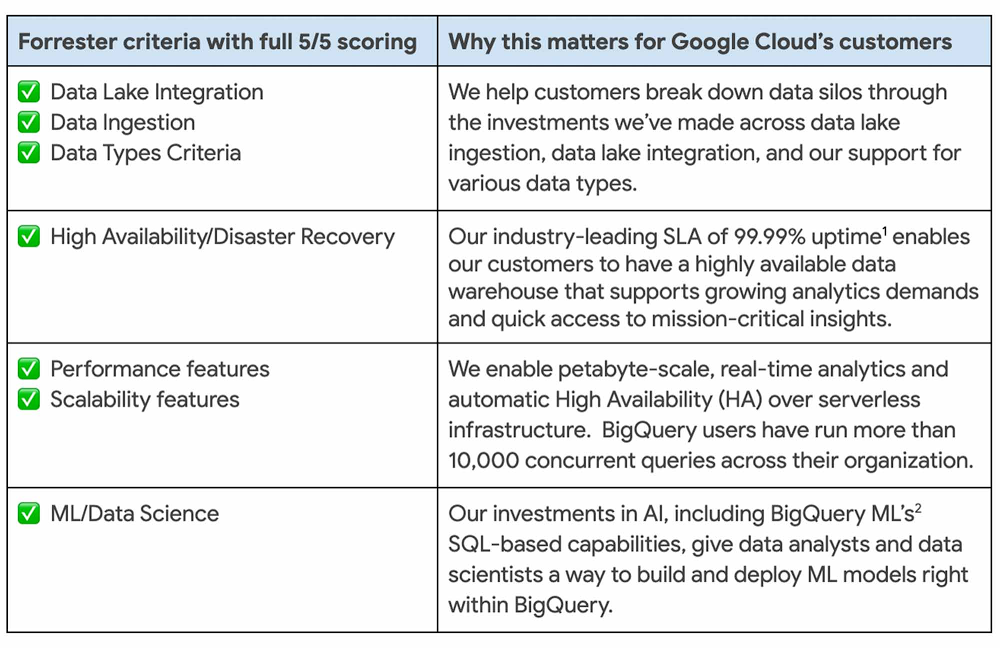
We are thrilled to announce that Google has been named a Leader in The Forrester Wave™: Cloud Data Warehouse, Q1 2021 report. For more than a decade, BigQuery, our petabyte-scale cloud data warehouse, has been in a class of its own. We’re excited to share this recognition and we want to thank our strong community of customers and partners for voicing their opinion. We believe this report validates the alignment of our strategy with our customers’ analytics needs.“Customers like Google’s frequency of data warehouse releases, business value, future proof architecture, high-end scale, geospatial capabilities, strong AI/ML capabilities, good security capabilities, and broad analytical use cases,” according to the Forrester report. Today’s data leaders require a data warehousing platform that provides both depth and breadth and with BigQuery, organizations are able to unlock deeper data science and machine learning capabilities while promoting data democratization and providing the highest levels of availability. Google BigQuery: 5 out of 5!Forrester gave Google BigQuery a score of 5 out of 5 across 19 different criteria, including:Today, customers across the globe use BigQuery to run business critical analytics workloads to enable BI acceleration, IoT analytics, customer intelligence, AI/ML-based analytics, data science, data collaboration, and data services. Customers such as Verizon, Wayfair, HSBC, Twitter, AirAsia, KeyBank, The Home Depot, and Vodafone have anchored their digital transformation efforts on BigQuery—unlocking deeper insights for their people. Customers use BigQuery across all industries, to solve issues like credit card fraud detection, predictive forecasting, anomaly detection, log analytics and many more. Forrester recognized this work and gave BigQuery a 5/5 score for supporting vertical and horizontal use cases. More BigQuery advantages Google is the first hyperscale provider to offer a multi cloud data analytics solution. With BigQuery Omni, customers can perform cross-cloud analytics with ease, and drive business outcomes they couldn’t achieve with the siloed approach offered by other vendors. We designed BigQuery to be highly scalable and more open and interoperable so that customers can join data across SQL databases, traditional unstructured data lakes in object storage, and even spreadsheets using any analysis tool. Recent innovations like BigQuery BI Engine lets us provide the best analytics experience by delivering sub-second query response times from any business intelligence tool, from Google’s Looker and Connected Sheets to Tableau, Microsoft Power BI, ThoughtSpot, and others. Our goal is to meet customers where they are rather than force them into a one-size-fits-all approach to data analysis. With BigQuery, organizations gain both breadth and depth of capabilities to transform their analytics strategy. Forrester also gave BigQuery 5 out of 5 in:Data-powered innovation These advantages enable our customers to accelerate their digital transformation and reimagine their business through data-powered innovation. Google’s leadership across AI, analytics, and databases comes together in a single data cloud platform that provides everyone with the ability to get value out of their data faster.We bring decades of research and innovation in AI to our customers through industry-leading AI solutions, that in turn helps our customers solve their biggest problems. Our support of open standards and APIs enables interoperability between a variety of services for ingestion, storage, processing and analytics across the data cloud platform. And finally, we believe our multi-layered security approach throughout the data stack ensures redundancy and reliability so that customers can have the peace of mind that their data is always protected. We are honored to be a leader in this Forrester Wave™ and look forward to continuing to innovate and partner with you on your digital transformation journey. Download the fullForrester Wave™ :Cloud Data Warehouse, Q1 2021 report. And check out these smart analytics reference patterns. To learn more about BigQuery, visit our website, and get started immediately with the free BigQuery Sandbox.1. https://cloud.google.com/blog/products/data-analytics/cloud-data-warehouse-bigquery-4-9s-sla2. https://cloud.google.com/bigquery-ml/docs/3. https://cloud.google.com/bigquery/pricingRelated ArticleGartner 2020 Magic Quadrant for Cloud Database Management Systems names Google a LeaderGartner’s first-ever database management systems (DBMS) Magic Quadrant (MQ) names Google Cloud a Leader.Read Article
Quelle: Google Cloud Platform

Meet the EMEA startups and scaleups redefining their industries with cloud technology

Be they technology, fintech, gaming, or retail, examples abound of industries being disrupted and redefined by startups and scaleups. EMEA has become a hub of innovation, and we’re proud to say that many of these movers and shakers are Google Cloud customers. At the Google Cloud Born-Digital Summit on 25 March, we will gather technology leaders from different industries across the region to offer practical guidance based on their experiences. From scaling up with leaner teams, to building future-proof, secure applications from scratch, these organizations have done it all. And they achieved this while maximizing their Google Cloud resources, accelerating production, and minimizing costs. At Google Cloud, we’re excited to support the next generation of startups at every stage of their journey with cloud technology. Today, we bring you some of their stories and hope that their success inspires yours too.Solving for smarter decisionsSince 2001, Danish-born Just Eat has been pioneering food delivery around the world. But to remain one step ahead, the company needed to view and use information in real time. While reporting double-digit growth year after year, scale and latency were becoming a problem, as growth means more data to handle. So in 2017, with a data engineering team collaborating on Google Workspace, Just Eat built a business intelligence and analytics solution with BigQuery at its core to serve restaurant partners and customers in a more efficient, data-driven way. Another company building its data ecosystem on top of technologies such as BigQuery, Looker, Dataflow, and Cloud AutoML is Trustpilot. The Danish consumer review website has evolved from startup to scaleup, but maintains its mission to help build trust online between consumers and businesses. The company is leveraging Google Cloud to support this mission by processing data efficiently and securely.With global headquarters in Berlin Germany, Market Logic Software develops enterprise software that helps world leading brands to leverage their own market and consumer data to run an insights driven business. As the business continues to grow, Market Logic requires more performance and flexibility than its original bare metal architecture could offer, so the company now runs almost 100% of its workload on Google Kubernetes Engine (GKE). The switch halved the costs of running its nodes while enabling the company to scale up and down according to demand. Market Logic is now looking to leverage AI on Google Cloud to continue helping companies to make sense of all their data to drive quality decisions.Another innovator investing in data analytics to help its customers is Israeli software company Wix. The website builder empowers 200 million users across 190 countries to create, manage, and grow their businesses online. Placing customer experience at its core, Wix now also provides an analytics solution for customers so they can access the kind of reports that helped Wix to succeed. Powering it is Looker, selected for its user-friendliness and cost-efficiency. Solving for global expansionBooksy is a Polish technology company supporting small traders in the health and beauty sector with an app designed to take care of admin tasks, so they can focus on their core business. But when this startup took off, its infrastructure struggled to scale at speed. So Booksy created a scalable architecture able to match its fast-growing, global reach using GKE to orchestrate clusters and meet surges in demand. Booksy now handles twice as much traffic and helps more than 10 million businesses in 25 countries to transform the way they work.In the UK, GoCardless offers a payment platform for businesses that have recurring revenues or accept one-off payments. But as it started to grow 50% year-over-year, GoCardless realized that its business units were losing valuable time looking for accurate data. To expand globally, its teams needed a better way to identify new opportunities, streamline processes, and maintain product quality and innovation. By leveraging Looker, 95% of GoCardless employees can access, trust, and act on the data they need to get their jobs done to help advance company growth, while the data team is free to focus on strategic projects. Now, the features that are most important to customers gain more attention, and the process of onboarding new clients has been streamlined, helping to accelerate global expansion.Solving for scalabilityBlaBlaCar is a French-born carpooling platform turned global community, with a mission to turn empty seats on the road into a new travel network. To make this possible, the company migrated its infrastructure from on-premises to Google Cloud to gain the scalability it needed to support 90 million drivers and passengers in 22 countries. The company is also branching out to different modes of transportation, leveraging cloud technology to test markets and products at scale with minimal investment. Also opting for a limitless cloud infrastructure is UK-based Arabesque AI. The financial services firm uses its proprietary artificial intelligence engine to analyze and predict financial market behavior and build customizable investment strategies. It selected Google Cloud to gain the elastic scaling it would need to meet rapidly increasing demand for AI solutions in financial markets. With GKE, the firm autoscales and smoothly deploys its solutions in multiple regions, while Cloud Run helps to automate more of its infrastructure management so the firm can work productively as a small team.SEBx, the innovation studio of 165-year-old SEB, is building its next-generation banking platform in Google Cloud to leverage the benefits of cloud technologies, including cost efficiency, flexibility, and scalability. Using GCP products, including GKE, allows SEBx to reap the benefits of managed services, improve workflows, and optimise resource allocation. All this helps SEBx to focus on designing a new bank in the cloud that is tailored to meet their customers’ needs.Solving for agility Gaming company King, headquartered in London and Stockholm, is succeeding in its competitive industry by validating its designs in an ingenious way. By using machine learning and AI capabilities, it determines the appropriate level of difficulty for a game without having to manually playtest it over a long period of time. With Cloud Deployment Manager to deploy GKE workloads, King creates and trains hundreds of virtual players. The resulting data is piped back to King’s data analytics modules with Cloud Pub/Sub, creating a feedback loop that lets King quickly optimize the design of its games based on a foundation of solid data.Google Cloud can help you go from startup to scaleup to unicorn. Learn how at the Born-Digital Summit on Thursday 25 March at 9:30 GMT by registering at the Born Digital summit website.
Quelle: Google Cloud Platform

Picture this: 10 whiteboard sketch videos that bring Google Cloud to life

If you’re looking for a visual way to learn Google Cloud products, we’ve got you covered. The Google Cloud Tech YouTube channel has a series of whiteboard (remember those?) drawing board videos that explain cloud tools for technical practitioners in about 5 minutes each.1. What is Cloud Storage?Cloud Storage is a global, secure and scalable object store for immutable data such as images, text, videos or any other file formats. In this video, learn how Cloud Storage can be used for building a data lake in the cloud and how you can utilize Cloud Storage for your developer projects. 2. What is Dataflow?Data flow is a serverless, fast and cost-effective service that supports streaming and batch processing. In this video, learn how you can use it for your data processing needs.3. What is Google Kubernetes Engine (GKE)?Google Kubernetes Engine (GKE) is a managed environment for deploying, scaling, and managing containerized applications in a secure Google infrastructure. In this learn how to use it to scale, manage and securely deploy your applications.4. What is Compute Engine?Compute Engine is a secure and customizable compute service that lets you create and run virtual machines on Google’s infrastructure. In this video, learn the different use cases, and how you can use it for your projects while managing costs.5. What is Cloud SQL?Cloud SQL is a fully managed relational database for MySQL, PostgreSQL, and SQL Server. In this video, learn how it reduces maintenance costs and automates database provisioning, storage capacity management and much more.6. What is BigQuery?BigQuery is Google Cloud’s enterprise data warehouse designed to help ingest, store, analyze and visualize big data with ease. In this video, learn how BigQuery can aid in your data-driven developer projects.7. What is Cloud CDN?Cloud CDN (Content Delivery Network) is a tool that  uses Google’s globally distributed edge points of presence to cache external HTTP(S) load balanced content close to your users. In this video, learn how you can use this tool to provide better delivery for your content, while reducing serving costs!8. What is Google Cloud Operations?Formerly known as Stackdriver, Google Cloud Operations Suite is a platform where you can monitor, troubleshoot, and improve application performance on your Google Cloud environment. In this video, learn how you can use it to gain greater observability over your applications. 9. What is Cloud Load Balancing?Cloud Load Balancing is a fully distributed, software-defined managed service, that balances user traffic to multiple backends to avoid congestion and ensure low latency. In this video, watch a demo of the Cloud Load Balancer and learn how you can utilize it to its fullest extent.10. What is High Performance Computing?High Performance Computing (HPC) can be thought about as an aggregation of computing power to solve complex problems and analyze extensive datasets. In this video, learn how you can build a high computing environment on Google Cloud.Stay updated with the latest videosThe Google Cloud Tech YouTube channel has new daily videos to help you build what’s next with secure infrastructure, developer tools, APIs, data analytics and machine learning. Subscribe to get notified of our newest content.Related Article21 Google Cloud tools, each explained in under 2 minutesNeed a quick overview of Google Cloud core technologies? Quickly learn these 21 Google Cloud products—each explained in under two minutes.Read Article
Quelle: Google Cloud Platform

Next-gen virtual automotive showrooms are here, thanks to Google Cloud, Unreal Engine, and NVIDIA

As people limit activities outside their homes in response to COVID-19, many organizations are looking to the cloud to create a new generation of engaging digital experiences that customers can access right from their personal screens. This is especially important for the automotive industry, where prospective buyers and fans are used to interacting with vehicles in-person at auto shows and the dealership. That’s why we’ve teamed up with Unreal Engine, the open and advanced real-time 3D creation game engine, and NVIDIA, inventor of the GPU, to launch new virtual showroom experiences for automakers. Taking advantage of the NVIDIA RTX platform on Google Cloud, these showrooms provide interactive 3D experiences, photorealistic materials and environments, and up to 4K cloud streaming on mobile and connected devices. The showroom solution runs on the NVIDIA T4 Tensor Core GPU on Google Cloud instance of a Quadro Virtual Workstation, enabling the latest advancements in computer graphics.Today, in collaboration with MHP, the Porsche IT consulting firm, and MONKEYWAY, a real-time 3D streaming solution provider, you can see our first virtual showroom, the Pagani Immersive Experience Platform, created for Italian Luxury Hypercar manufacturer Pagani Automobili—with many more to come.Each virtual showroom offers granular personalization options, and real-time ray tracing, or light ray simulation, sets all-new visual benchmarks for this medium. Within the virtual showroom, viewers have a highly customizable experience, with the ability to select dozens of different interior and exterior design features—from paint color to wheel anodization to interior finish, and more. Viewers can also explore cars through an expansive cinematic 3D experience, powered by NVIDIA RTX real-time ray-tracing technology in Unreal Engine. Each showroom can support thousands of concurrent users worldwide, thanks to the scalability of Google Cloud.  Specifically within the Pagani Immersive Experience Platform, viewers can customize the hypercar’s unique details, including a wide selection of tinted exposed carbon fibre options, stripes patterns, wheels, brake calipers, interior leather and stitching, instrument cluster’s dials and luggage set. Users can animate car features, including opening doors, rolling down windows, and removing the hardtop. In addition to changing time settings from day or night, there are four unique physical environments, including salt flats, a museum, a coastal road, and the exclusive showroom at the Pagani Automobili headquarters. And once you’ve perfectly custom configured your car, take it for a virtual drive on a real race track.”The Pagani virtual showroom is a glimpse at the future of online retail environments,” said Marc Petit, VP, General Manager, Unreal Engine, Epic Games. “The use of Unreal Engine pixel streaming and ray tracing in the cloud delivers an experience that is photorealistic, interactive, and personalized—and can reach customers with the highest level of quality on any type of device.” “These showrooms will be a game-changer for how consumers interact with their favorite products online, especially now during a pandemic,” said Sean Young, Director of Global Business Development, Manufacturing at NVIDIA. “Automakers can offer more personalized previews while potential buyers no longer have to wait in lines or worry about large crowds at physical showrooms. Most importantly, customers can interact with and customize a virtual car model at their leisure, any time of the day, and from any location.”“We’re always looking for new ways to engage and delight our clients, and today we are very proud to be able to extend this opportunity to our largest fan base, offering them a new insight into the Pagani products,” said Carlo Stola, Customer Relations Manager at Pagani. “Working with MHP, Google Cloud, Unreal Engine, and NVIDIA has enabled us to provide an even more sophisticated, yet incredibly simple, customization experience, and to show off our models’ state-of-the-art features.” Although we’ve started with the automotive industry, our goal is to expand these showroom experiences into other industries as well, such as retail, hospitality, and more. In the meantime, check out the virtual showroom here. Automakers interested in launching a virtual showroom can get started by engaging with the Google Cloud sales team.Related ArticleShifting gears: How the cloud drives digital transformation in the automotive industryMegatrends in the automotive industry like autonomous driving and ridesharing are driving digital transformation. Here how Google Cloud i…Read Article
Quelle: Google Cloud Platform

Getting Compute Engine resources for batch processing just got easier

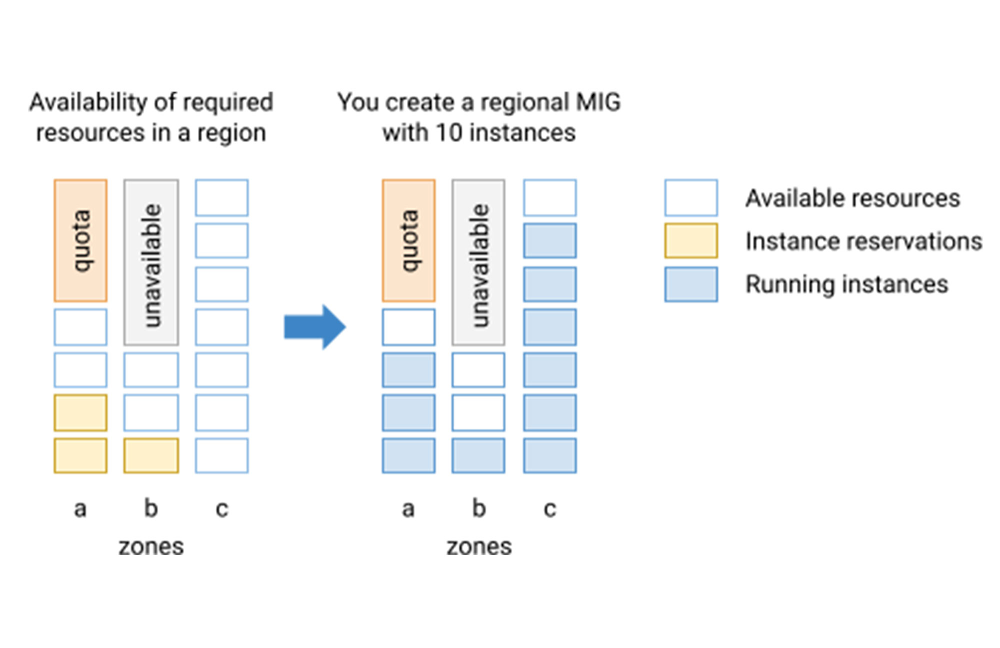
If you need to run an embarrassingly parallel batch processing workload, it can be tricky to decide how many instances to create in each zone while accounting for available resources, quota limits and your reservations. We are excited to announce a new method of obtaining Compute Engine instances for batch processing that accounts for availability of resources in zones of a region. Now available in preview for regional managed instance groups, you can do this simply by specifying the ANY value in the API.The capacity-aware deployment method is particularly useful if you need to easily create many instances with a special configuration such as virtual machines (VM) with a specific CPU platform or GPU model, preemptible VMs, or instances with a large number of cores or memory size.Now, when deploying instances to run embarrassingly parallel batch processing, such as financial modeling or rendering, you no longer have to figure out which zones support the required hardware and how many instances to create in each zone in a region to accommodate the requested capacity.Assuming that any distribution of instances across zones works for your batch processing job, and that the workload doesn’t require resilience against zone-level failure, you can now delegate the job of obtaining the requested capacity to a regional managed instance group. A regional MIG with the new distribution shape ANY automatically deploys instances to zones where resources are available to fulfill your request, accounting for your quota limits. This works both when you create a group or when you increase it in size.If you use reservations to ensure that resources are available for your computation, you should specify reservation affinity in a group’s instance template. A regional MIG with distribution shape ANY utilizes the specified reservations efficiently by prioritizing consumption of unused reserved capacity before provisioning additional resources.A regional MIG with distribution shape ANY automatically deploys instances to zones where capacity is available, takes quotas into account, and prioritizes consumption of a specified reservation.Depending on the availability of the requested resources, a regional MIG with ANY distribution might deploy all instances to a single zone or spread the instances across multiple zones. The distribution shape ANY is not suitable for highly available serving workloads such as frontend web services because a zone-level failure could result in all or most of the instances becoming unavailable if they happen to be deployed to the zone that failed. Getting startedTo configure the new distribution shape ANY when creating a regional MIG, look under the “Target distribution shape” setting on Create instance group screen in the Google Cloud Console:Configuring a regional managed instance group’s distribution shapeYou can also set the distribution shape to ANY for an existing regional MIG—for example, by running a gcloud command:Summing it upObtaining capacity to run an embarrassingly parallel batch processing workload is easier with a regional MIG’s new distribution shape ANY. When deciding how many instances to create in each zone, the regional MIG accounts for availability of resources in each zone, accounts for your quota limits, and prioritizes consumption of specified reservations.Visit the regional MIG documentation to learn more about creating instances using the new distribution shape ANY.Continue your learning at the Cloud Technical Series digital event, March 23-26, and go deeper into VM migration, application modernization, GKE, data analytics, AI/ML and more. Register here.Related ArticleIntroducing HPC VM images—pre-tuned for optimal performanceGoogle Cloud’s first pre-configured HPC VM image is a CentOS 7-based image optimized for tightly-coupled MPI workloads.Read Article
Quelle: Google Cloud Platform

Introducing Network Connectivity Center: A revolution in simplifying on-prem and cloud networking

As you shift to a cloud-first strategy, you have to manage the complexity of connecting resources across on-prem locations and the cloud to ensure access to all workloads from anywhere. This often means network teams have to configure and manage multiple networks while delivering consistent access, policies, and services across global cloud regions. To offer networking services everywhere, you need a simple programmatic model that seamlessly spans the cloud, on-prem data centers, and branch locations.   Today, we are announcing the preview of Network Connectivity Center, which delivers planet-scale network management to simplify complex networks for your on-prem and cloud connectivity needs. Network Connectivity Center provides a single management experience to easily create, connect, and manage heterogeneous on-prem and cloud networks leveraging Google’s global infrastructure. Network Connectivity Center serves as a vantage point to seamlessly connect VPNs, partner and dedicated interconnects, as well as third-party routers and Software-Defined WANs, helping you optimize connectivity, reduce operational burden and lower costs—wherever your applications or users may be.“As an industry leader, a fast & reliable network is essential to maintain our productivity across a large number of our globally distributed work centers,” said Miguel Mejia, WAN Engineering Lead, Colgate-Palmolive. “We understand Google Cloud’s Network Connectivity Center (NCC) could help us achieve broader access to Google’s global network and also enable us to connect our remote site users & applications in a consistent manner.”Network Connectivity Center offers an easy way to create, expand, and manage on-prem and cloud networks all in one place. Network Connectivity Center delivers the following: 1. Single connectivity modelNetwork Connectivity Center offers the unique ability to easily connect and manage VPNs, interconnects, and SD-WANs to enable users to access workloads seamlessly. Network Connectivity Center resources run on Google’s global infrastructure to deliver high performance, reliability, and security so enterprises can leverage the same benefits. 2. Flexible cloud connectivityNetwork Connectivity Center delivers a unified connectivity experience by allowing enterprises to use Google’s global infrastructure, leveraging new or existing partners and dedicated interconnects, Cloud VPN connections, and third-party routers/SD-WAN to transfer data reliably across on-premises sites and cloud resources. 3. VPN-based multicloud connectivity Network Connectivity Center unlocks VPN-based cloud connectivity directly and via a set of partners allowing enterprises the flexibility of choice to create, connect and consume resources spanning multiple clouds. These resources are reliably connected using Google’s infrastructure and can be operated directly via Network Connectivity Center or select partner solutions.4. SD-WAN Integration/Third-party router Network Connectivity Center can be used as the default landing point when integrating SD-WAN and other routing solutions with Google’s infrastructure. When doing so, enterprises get a simple and reliable way to consume connectivity on-demand while extending the benefits of their SD-WAN and routing solutions to Google Cloud.5. Real-time visibility for your global network Network Connectivity Center offers a single pane of glass for connecting your VPNs, partner and dedicated interconnects and on-prem networks. It also pairs seamlessly with Network Intelligence Center for end-to-end visibility so you can monitor, visualize, and troubleshoot the network. With Network Intelligence Center, you can monitor real-time performance and network health, view traffic flows, and verify connectivity intent. Cisco partnershipIn April 2020, Cisco and Google Cloud announced Cisco SD-WAN Cloud Hub with Google Cloud to help our customers create an end-to-end network that enables secure and on-demand connectivity.Our expanded partnership with Cisco brings the best of both Cisco and Google Cloud technologies together with a turnkey networking solution. Cisco and Google Cloud’s joint solution leverages Cisco SD-WAN Cloud Hub and Google Cloud Network Connectivity Center to connect branch sites and on-prem data centers to the cloud using Google’s high performance, global infrastructure  and Cisco SD-WAN’s vManage. Via Cisco Cloud OnRamp, users can also extend Cisco SD-WAN’s fabric through an automated process to Google Cloud. With tighter integrations between Cisco and Google Cloud, the availability of this solution brings a new set of capabilities that dramatically simplifies complex heterogeneous networks, protects mission critical applications, and minimizes operational burden and costs. “Google Cloud and Cisco continue driving innovation for our joint customers to enable secure and automated SD-WAN access from applications and services running on Google Cloud Platform,” said JL Valente, vice president, product management, for Cisco Enterprise Routing, SD-WAN and Cloud Networking. “Our latest integration not only extends the Cisco SD-WAN fabric to Google Cloud to automate provisioning of site-to-cloud connectivity effortlessly, but also gives customers the choice of using Google Cloud for providing a highly reliable, high performance global cloud network for site-to-site connectivity that can be deployed in minutes.”We are excited to simplify the management of on-prem and cloud networks with Network Connectivity Center. Google Cloud will be at Cisco Live!, visit our showcase to learn more about Network Connectivity Center.
Quelle: Google Cloud Platform

A Google Cloud VMware Engine cheat sheet

If you have VMware workloads and you want to modernize your application to take advantage of cloud services to increase agility and reduce total cost of ownership then Google Cloud VMware Engine is the service for you! It is a managed VMware service with bare metal infrastructure that runs the VMware software stack on Google Cloud—fully dedicated and physically isolated from other customers. In this blog post, I’ll take you through Google Cloud VMware Engine, its benefits, features, and use cases. Benefits of Google Cloud VMware EngineOperational continuity- Google offers native access to VMware platforms. the service is sold, delivered and supported by Google – no other companies are involved. The architecture is compatible with your existing applications, as well as operations, security, backup, disaster recovery, audit, and compliance tools and processes.No retraining – Your teams can use their existing skills and knowledge. Infrastructure agility – The service is delivered as a Google Cloud service, and infrastructure scales on demand in minutes.Security – Access to the environment through Google Cloud provides built-in DDoS protection and security monitoring.Policy compatibility- You can continue to use VMware tools and security procedures, audit practices, and compliance certifications.Infrastructure monitoring – You get reliability with fully redundant and dedicated 100 Gbps networking, providing up to 99.99% availability to meet the needs of your VMware stack. There is also infrastructure monitoring so failed hardware automatically gets replaced. Hybrid platform – The service enables high-speed, low-latency access to other  Google Cloud services such as BigQuery, AI Platform, Cloud Storage, and more.Low cost- Because the service is engineered for automation, operational efficiency, and scale it is also cost effective!How does Google Cloud VMware Engine work?Google Cloud VMware Engine makes it easy to migrate or extend your VMware environment to Google Cloud. Here is how it works… you can easily migrate your on-premises VMware instances to Google Cloud, using included HCX licenses, via a cloud VPN or interconnect. The service comprises VMware vCenter, the virtual machines, ESXi host, storage, and network on bare metal! You can easily connect from the service to other Google Cloud services such as Cloud SQL, BigQuery, Memorystore, and so on. You can access the service UI, billing, and identity and access management all from the Google Cloud console as well as connect to other third-party disaster recovery and storage services such as Zerto and Veeam. Google Cloud VMware Engine use casesRetire or migrate data centers – Scale data center capacity in the cloud and stop managing hardware refreshes. Reduce risk and cost by migrating to the cloud while still using familiar VMware tools and skills. In the cloud, use Google Cloud services to modernize your applications at your pace.Expand on demand – Scale capacity to meet unanticipated needs, such as new development environments or seasonal capacity bursts, and keep it only as long as you need it. Reduce your up-front investment, accelerate speed of provisioning, and reduce complexity by using the same architecture and policies across both on-premises and the cloud.Disaster recovery and virtual desktops in Google Cloud – High-bandwidth connections let you quickly upload and download data to recover from incidents.Virtual desktops in Google Cloud – Create virtual desktops (VDI) in Google Cloud for remote access to data, apps, and desktops. Low-latency networks give you fast response times — similar to those of a desktop app. Power high-performance applications and databases – In Google Cloud you have a hyper-converged architecture designed to run your most demanding VMware workloads such as Oracle, Microsoft SQL Server, middleware systems, and high-performance noSQL databases. Unify DevOps across VMware and Google Cloud – Optimize VMware administration by using Google Cloud services that can be applied across all your workloads, without having to expand your data center or re-architect your applications. You can centralize identities, access control policies, logging, and monitoring for VMware applications on Google Cloud.ConclusionSo there you have it! Google Cloud VMware Engine, its use cases, benefits, and how it works. If this has piqued your interest, check out the Google Cloud VMware Engine documentation and demo for more details.  Here is a video on Google Cloud VMware Engine: What is Google Cloud VMware Engine? #GCPSketchnote​For more #GCPSketchnote, follow the GitHub repo and for similar cloud content follow me on twitter @pvergadia and keep an eye out on thecloudgirl.devRelated ArticleGoogle Cloud VMware Engine explained: Integrated networking and connectivityLearn about the networking features in Google Cloud VMware Engine to let you easily and deploy workloads across on-prem and cloud environ…Read Article
Quelle: Google Cloud Platform

Road to recovery: How Google Cloud is helping states get the COVID-19 vaccine to more people

Since the beginning stages of the pandemic, state and local governments have turned to technology to help deliver essential services to their residents, whether it’s unemployment assistance or access to COVID-19 testing. Now, state and local leaders are shifting their focus to getting vaccines to more people through mass vaccination initiatives. In February, we announced our Intelligent Vaccine Impact solution (IVIs) to help communities rise to the challenge of getting vaccines to more people quickly and effectively.Many states have deployed IVIs, and have found it able to meet demand and easily integrate with their existing technology infrastructures. In some states and localities, we’re assisting with vaccine information, scheduling, distribution and analytics. In other states, we’re solving discrete issues like enabling data sharing and analytics from multiple vaccine sites or providing key metrics back to individual sites. Google Cloud is proud to partner with a number of states across the U.S., including Arizona, the Commonwealth of Massachusetts, North Carolina, Oregon, and the Commonwealth of Virginia to support vaccination efforts at scale.Assisting Arizona in getting its citizens vaccinatedIn December 2020, Arizona’s Department of Health Services engaged Google Cloud and our partner MTX to build an end-to-end vaccine management distribution system that would allow its 4 million citizens to schedule and receive a COVID-19 vaccine. In just a few weeks, Google Cloud built a centralized solution, provided information for a dashboard, that provides counties and tribes across Arizona with a consistent approach to managing and monitoring the vaccine administration process. And, with the help of predictive analytics, public health departments in the state can forecast the trajectory of the virus, as well as other potential infectious disease outbreaks. As of today, Arizona has administered 2.6 million vaccines, and the Google Cloud system has booked almost 1.5 million appointments. In fact, in the first two hours of the site launch, the system booked more than 150,000 appointments, proving the system was scalable to meet the demands of residents. Helping the Commonwealth of Massachusetts ramp up its vaccination effortsIn mid-March, Google Cloud signed on to help the Commonwealth of Massachusetts launch a new vaccine pre-registration system to help ramp up its vaccination efforts quickly. The newly deployed system enables residents to quickly complete an online form with their personal details, contact information, and eligibility criteria. The Commonwealth then provides a notification via text messages, e-mail, or voicemail to alert residents when they can book an appointment at nearest vaccination sites.  This new pre-registration system eliminates the need for users to repeatedly search to find appointments throughout the state at vaccination sites. Google Cloud built out a waiting list that allows the Commonwealth to proactively provide notices and weekly status updates confirming that users are pre-registered. This provides residents with some peace of mind that they are properly registered. As appointments become available, the pre-registration system sends a link to book an appointment. Users have 24 hours to select their desired appointment time. If the appointment time is not reserved, the system will automatically alert the next resident in line. On day one of the state’s launch, more than 400,000 citizens pre-registered for their vaccine, and at the height of activity the site was registering 19 pre-registrations per second. Streamlining vaccine information for North CaroliniansIn late January, North Carolina and the North Carolina Department of Health and Human Services announced they were working with Google Cloud to develop online tools to help North Carolinians determine eligibility for the COVID-19 vaccine and then locate the closest vaccine provider. TheFind My Vaccine Group site allows local citizens to answer a series of questions related to their occupation, age, and other risk factors to determine which vaccine group they are in. TheFind a Vaccine Location site was deployed to help users find participating vaccine provider locations across the state. It uses Google Maps Platform APIs to enable users to search by zip code, current location, or current map view, and is updated regularly with the latest available provider information. To date, more than 2 million North Carolinians have leveraged both sites, with a major uptick expected as the vaccine rollout continues. Helping Oregonians increase vaccination ratesIn February, Oregon prepared to increase the number of residents eligible to get vaccinated and needed a way to better communicate with its community. The Oregon Health Authority (OHA), in partnership with Google Cloud and SpringML, built Get Vaccinated Oregon, a vaccine eligibility screening and scheduling solution to help increase the vaccine rate in Oregon. Oregonians can now create an online profile for themselves and their families to determine eligibility for the vaccine, and receive push notification as their eligibility status changes. OHA and Google Cloud have also partnered with local healthcare providers who can now share information on mass vaccination events in their local communities. Eligible Oregonians in those communities will automatically receive a notification that there is an event, and they then have the opportunity to schedule a vaccine appointment. To date, more than 400,000 Oregonians have registered to receive communication about their eligibility, and get connected to local vaccine events.Centralizing vaccine management for the Commonwealth of Virginia In February, the Virginia Department of Health (VDH) launched its COVID-19 vaccine pre-registration campaign, Vaccinate Virginia. Initially, Virginia localities had implemented individual COVID-19 vaccine pre-registration data collection systems, providing little insight into priority groups and allocation strategy. VDH knew they needed an auto-scaling, resilient platform, and selected Google Cloud and partner SpringML to build it. VDH also wanted to import all of the previously collected data so any user from one of the participating localities could check the central site and find their information in the system. VDH needed everything built, tested, and ready in days—not weeks. Today, Virginia has 8 million residents and more than 1 million who are currently vaccine-eligible, either as a resident or an eligible non-resident who work in the state. On launch day, more than 180,000 pre-registrations have been successfully made, with that number increasing to more than 200,000 in the first 24 hours. More than 400,000 people were in the state’s system by the end of the first week it went live. By the end of February, the state had more than 1.9 million records in the new system, all managed with Google Cloud’s IVI. Getting back to a safe and healthy world Google Cloud is committed to doing our part to stop the spread of the virus and get vaccines to more people quickly. We’re continuing to work with state and local governments, public health officials, and healthcare institutions to provide the scalable, secure infrastructure, applications and services needed to support a safer, healthier future for everyone. We are looking forward to a day when everyone is vaccinated and COVID-19 fades into a distant memory.Related ArticleGetting vaccines into local communities safely and effectivelyIntroducing: Google Cloud’s Intelligent Vaccine Impact solutionRead Article
Quelle: Google Cloud Platform

Pega: Optimizing business operations with SAP on Google Cloud

For Pegasystems, a leading provider of cloud software for customer engagement and intelligent automation, success depends on being able to provide highly scalable systems for its customers. But with its core SAP systems in a traditional data center, the IT department found it was spending too much time on day-to-day maintenance and less on strategic projects that generated value for customers. In 2020, Pega chose to deploy its SAP environment, including SAP ERP Central Component (ECC) and SAP HANA data warehousing, to Google Cloud. The move has helped Pega overcome many of the challenges it faced with the previous deployment. It also made Pega’s SAP systems more reliable and offered powerful new data capabilities to support the business in making the right decisions.The challenge: A lack of agilityAlthough Pega ran its SAP suite in a third-party data center, it was architected with traditional servers and storage and lacked the scale and agility necessary to keep up with Pega’s needs. Adding more capacity, for example, required too much work and coordination with the hosting provider, which often led to unacceptable levels of downtime. Instead of focusing on the transformational initiatives that Pega required for growth, the company’s IT team was putting time and resources into making sure its SAP systems were running correctly. The solution: Less maintenance for IT, more insights for the businessPega considered several public cloud providers with a particular focus on enterprise architecture, flexibility, and operating costs before settling on Google Cloud. “SAP on Google Cloud is a repeatable and proven architecture. We were confident that we would be in good hands and have a smooth transition,” says David Vidoni, Vice President of information Technology, Pega. Working with Managecore, an SAP on Google Cloud Specialization partner, it took Pega just  nine weeks to move 30 servers onto Google Cloud. Managecore helped Pega manage changeover, testing, and integration of the customer-facing solutions that run internally and integrate with the SAP environment. Additional assistance came from the Cloud Acceleration Program (CAP) from Google Cloud, a critical enabler for Pega, offering SAP customers tools to simplify the migration process and financial incentives to defray infrastructure costs. For Pega, the move to Google Cloud is allowing them to deliver better service to their customers. According to Vidoni, “Google Cloud enables us to provide a higher level of service by minimizing downtime and outages. As we grow, adding capacity to meet our clients’ needs is a lot simpler.” Other benefits of the SAP on Google Cloud migration include reliability, scalability, and agility:Reliability: Google Cloud infrastructure has significantly reduced the strain on Pega’s IT resources. Pega has found that since moving to Google Cloud, the IT team has cut the time it spends on SAP operational maintenance by two-thirds. New analytical capabilities: Having fewer maintenance tasks means getting more time to analyze data that reveals customer needs and how to fulfill them. The move to Google Cloud has made it easy to connect data from SAP HANA. Richer data integration makes for faster and better-informed decisions. Per Vidoni, “Data is our lifeblood. We are making it easier to find the information we’re looking for to get actionable insights and to gain an edge over our competition.”Scalability and performance: Pega has benefitted from improved performance and a new ability to scale up and scale down resources as needed. For example, Pega will now be able to provide field teams with sandbox SAP HANA environments where they can test out new integrations with its software development platform. Spinning up these development environments is much easier and faster than it was before migration. Security and compliance: Google Cloud has helped provide a much stronger security posture for SAP HANA implementation. Pega’s disaster recovery processes are now more streamlined, and compliance testing is easier as well.What’s next for Pega Now that Pega’s SAP applications are up and running on Google Cloud, the company is setting its sights on moving its SAP ERP environment from ECC to S/4HANA, which will allow it to take advantage of entirely new, cloud-centric capabilities within the suite. In the meantime, however, Vidoni continues to explore the opportunities that Google Cloud offers to transform the way it provides systems and services to customers at scale. “Running SAP in a future-ready environment means that we can deliver the best possible service to employees and customers today and tomorrow.”  Hear directly from Pegasystems about their SAP on Google Cloud deployment and also how other SAP customers are having similar success.Related ArticleRémy Cointreau drives customer centricity with SAP on Google CloudRémy Cointreau moved to Google Cloud to gain flexibility in its SAP systems and gain easy access to valuable data for business decision m…Read Article
Quelle: Google Cloud Platform

Introducing the latest Slurm on GCP scripts

Do you use the Slurm job scheduler to manage your high performance computing (HPC) workloads? Today, alongside SchedMD, we’re announcing the newest set of features for Slurm running on Google Cloud, including support for Terraform, the HPC VM Image, placement policies, Bulk API and instance templates, as well as a Google Cloud Marketplace listing. Note that Slurm’s support for the Bulk API is in Beta at the time of this release.Slurm is one of the leading open-source HPC workload managers used in TOP500 supercomputers around the world. Over the past four years, we’ve worked with SchedMD, the company behind Slurm, to release ever-improving versions of Slurm on Google Cloud. Here’s more information about these new features:Support for TerraformIn this release, Terraform support is now generally available. The latest scripts automatically deploy a SchedMD-provided Virtual Machine (VM) image based on the Google Cloud HPC VM image, a CentOS 7-based VM image optimized for HPC workloads that we announced in February. This new image-based deployment reduces the time to deploy a Slurm cluster to just a few minutes.Placement policiesYou can now create a set of nodes on demand, per job, in a placement policy. With the previous version of our Slurm on GCP scripts, you were only able to enable placement policies at a cluster-level. Now you can configure placement policies per partition, enabling you to achieve significant improvements in latency and performance for your tightly coupled workloads.Bulk APISlurm is now able to use the Bulk API to create instances. This allows for faster and more efficient creation of VM instances than ever before by collecting up to 1,000 in a single API call. The Bulk API also supports “regional capacity finding,” and can create instances in whichever zone within a region that has the necessary capacity, improving the speed and likelihood of getting the resources requested.Instance templatesYou can now specify instance templates as the definitions for creating Slurm instances.Cloud Marketplace listingLast but not least, we’re excited to share that the Slurm on Google Cloud scripts are now available through our Cloud Marketplace. From the Google Cloud Console, you can locate and launch the latest version of Slurm on Google Cloud in just a few clicks. The Cloud Marketplace listing also provides more information about how to access additional managed services from SchedMD, helping you expand and deepen your HPC workloads on Google Cloud using Slurm. Research organizations are taking advantage of Google Cloud’s capacity with Slurm scripts to meet increased demand for their HPC compute clusters. “When it comes to supporting cutting-edge research requiring advanced computing, there are never enough resources on-prem. Driven by the application of Artificial Intelligence in a wide spectrum of research areas, the undertaking of urgent COVID-19 research, and the increasing popularity of AI, ML and Data Science academic courses, the job wait times on our HPC cluster have been increasing. To address the increasing job wait times, and to allow researchers to evaluate the latest CPUs and GPUs, the HPC team had been evaluating the viability of bursting jobs to Google Cloud. With additional features from the Slurm on Google Cloud, and offerings such as preemptible virtual machines, we decided to burst jobs that have been submitted to our on-prem cluster to GCP, enabling us to reduce job wait times and produce research results faster.” – Stratos Efstathiadis, Director, Research Technology Services at NYUGetting startedThis new release was built by the Slurm experts at SchedMD. You can download this release in SchedMD’s GitHub repository. For more information, check out the included README. If you need help getting started with Slurm check out the quick start guide, and for help with the Slurm features for Google Cloud check out the Slurm Auto-Scaling Cluster codelab and the Deploying a Slurm cluster on Google Compute Engine and Installing apps in a Slurm cluster on Compute Engine solution guides. If you have further questions, you can post on the Slurm on GCP Google discussion group, or contact SchedMD directly.Related ArticleIntroducing HPC VM images—pre-tuned for optimal performanceGoogle Cloud’s first pre-configured HPC VM image is a CentOS 7-based image optimized for tightly-coupled MPI workloads.Read Article
Quelle: Google Cloud Platform



