Sorry, Celebs, Using #Sp On Instagram Ads Isn’t Gonna Cut It

The Federal Trade Commission, the government organization that regulates advertising, just announced that it has started a crackdown on Instagram sponsored posts. It sent 90 letters to various influencers brands reminding them the FTC guidelines for social media endorsements. Basically: or “Thanks [@BRAND]” doesn’t cut it.

This is the first time the FTC has sent this kind of letter, which is not an official warning but rather a sort of nudge-nudge educational message, reminding them of the rules. The letters were sent in response to the advocacy group Public Citizen, which had sent a petition to the FTC about celebrities, athletes, and models doing ambiguously labeled Instagram .

The FTC has not released the names of who got these letters, and Public Citizen does not know who exactly received a letter, either. Some of the people mentioned specifically in the complaint from Public Citizen include Bella Thorne, David Beckham, Mark Wahlberg, Scott Disick, Jenny McCarthy, Chris Pratt, Kendall Jenner, and Gigi Hadid.

Instagram: @markwahlberg

According to the FTC’s announcement today, the letters reminded people what does NOT meet their requirement for a clear disclosure, including…

These commonly used visual tricks that hide the disclosure:

  • Putting the disclosure at the end of a long caption, so that it’s cut off and you have to click “more” to read the full thing. Most people won’t ever click and see it.
  • of and saying

And these three common tricks that are half-assed disclosures that simply aren’t clear to the average person that the person either got paid or got a freebie:

Instagram: @emrata

The FTC is careful to say that it doesn’t have specific wording requirements. If you use sp, you’re not going to jail immediately, but let’s just say there’s a good chance that this is not what the FTC considers a full, transparent disclosure to your audience of a material connection between you and a brand.

The idea here is that a normal person should be able to immediately understand that someone was paid (that includes getting free shit&;) to post. I’ve been doing a column for BuzzFeed where I investigate whether various celebrity social media posts are ads or not, and one thing that’s clear is that even those of us who are pretty savvy about this kind of stuff are often truly confused about celebrity Instagram posts.

For now, Bachelor contestants hawking teeth whiteners don’t have to worry about getting arrested for not using the right hashtag. The FTC historically only goes after the brands, not the influencers, for cases of unclear social media ads. And there have only been a few of these actually brought to lawsuits – the most recent one was last summer, when the agency charged Warner Bros. for paying PewDiePie to review their latest video games without proper disclosure. But these reminder letters mean that the FTC is taking Instagram more seriously — and that pressure from consumer advocacy groups can be effective.

Quelle: <a href="Sorry, Celebs, Using Sp On Instagram Ads Isn’t Gonna Cut It“>BuzzFeed

Sorry, Celebs, Using #Sp On Instagram Ads Isn’t Gonna Cut It

The Federal Trade Commission, the government organization that regulates advertising, just announced that it has started a crackdown on Instagram sponsored posts. It sent 90 letters to various influencers brands reminding them the FTC guidelines for social media endorsements. Basically: or “Thanks [@BRAND]” doesn’t cut it.

This is the first time the FTC has sent this kind of letter, which is not an official warning but rather a sort of nudge-nudge educational message, reminding them of the rules. The letters were sent in response to the advocacy group Public Citizen, which had sent a petition to the FTC about celebrities, athletes, and models doing ambiguously labeled Instagram .

The FTC has not released the names of who got these letters, and Public Citizen does not know who exactly received a letter, either. Some of the people mentioned specifically in the complaint from Public Citizen include Bella Thorne, David Beckham, Mark Wahlberg, Scott Disick, Jenny McCarthy, Chris Pratt, Kendall Jenner, and Gigi Hadid.

Instagram: @markwahlberg

According to the FTC’s announcement today, the letters reminded people what does NOT meet their requirement for a clear disclosure, including…

These commonly used visual tricks that hide the disclosure:

  • Putting the disclosure at the end of a long caption, so that it’s cut off and you have to click “more” to read the full thing. Most people won’t ever click and see it.
  • of and saying

And these three common tricks that are half-assed disclosures that simply aren’t clear to the average person that the person either got paid or got a freebie:

Instagram: @emrata

The FTC is careful to say that it doesn’t have specific wording requirements. If you use sp, you’re not going to jail immediately, but let’s just say there’s a good chance that this is not what the FTC considers a full, transparent disclosure to your audience of a material connection between you and a brand.

The idea here is that a normal person should be able to immediately understand that someone was paid (that includes getting free shit&;) to post. I’ve been doing a column for BuzzFeed where I investigate whether various celebrity social media posts are ads or not, and one thing that’s clear is that even those of us who are pretty savvy about this kind of stuff are often truly confused about celebrity Instagram posts.

For now, Bachelor contestants hawking teeth whiteners don’t have to worry about getting arrested for not using the right hashtag. The FTC historically only goes after the brands, not the influencers, for cases of unclear social media ads. And there have only been a few of these actually brought to lawsuits – the most recent one was last summer, when the agency charged Warner Bros. for paying PewDiePie to review their latest video games without proper disclosure. But these reminder letters mean that the FTC is taking Instagram more seriously — and that pressure from consumer advocacy groups can be effective.

Quelle: <a href="Sorry, Celebs, Using Sp On Instagram Ads Isn’t Gonna Cut It“>BuzzFeed

Tesla Settles Lawsuit Against Former Head Of Autopilot

Reuters/Alexandria Sage

Tesla settled a lawsuit against its former head of Autopilot, Sterling Anderson, on Wednesday, after alleging he breached his contract by poaching engineers for his new self-driving startup and downloading confidential company information to personal devices.

Anderson was head of Autopilot, the company’s driver assistance technology team that is working on self-driving cars, for more than a year. He led the unit as it dealt with a federal investigation over whether the technology was at fault for a fatal Model S crash last June. But after he left to start a company called Aurora Innovation with Chris Urmson, the former head of Google’s self-driving unit, Tesla sued him in January.

Tesla said in its complaint that Anderson recruited three Autopilot engineers to join Aurora, though one later changed his mind and remained at Tesla.

According to the terms of the agreement, neither party will admit to the validity of either’s claims, and Aurora will pay Tesla $100,000 as reimbursement for legal expenses related to the lawsuit. Anderson and Aurora agreed to not recruit any Tesla employees for one year following February 1, 2017. Aurora also agreed to do an audit to determine whether its employees have any confidential Tesla information, and send the results of that audit to Tesla within 30 days.

“Under the settlement, Mr. Anderson’s contractual obligations to Tesla will remain in place and will also be extended to Aurora, with additional specific protections being added to ensure there are no further violations,” a Tesla spokesperson said. “The settlement also establishes a process to allow Tesla to recover all of the proprietary information that was taken from the company, and it provides for Aurora’s computer systems to be subject to ongoing audits to monitor for any improper retention or use of Tesla’s property.”

Tesla confirmed it had received the $100,000 payment for legal expenses from Aurora. In Tesla’s original complaint, its prayer for relief asked for the company to abide by the one-year time frame before Aurora recruits Tesla employees, and return or cease use of proprietary Tesla information.

Aurora did not provide a comment by publication time.

Quelle: <a href="Tesla Settles Lawsuit Against Former Head Of Autopilot“>BuzzFeed

Alex Jones And The Dark New Media Are On Trial In Texas

Infowars / Getty

AUSTIN, Tx — Halfway through the second official day of his 10-day civil custody trial, Alex Jones reclined in his chair and mopped sweat from his brow while watching a shirtless, pantsless version of himself hawk male vitality supplements on a courtroom television screen. It was hardly the most outlandish moment of the afternoon.

Indeed, the first full day of Jones’ battle to retain custody of his three young children was filled with bizarre allegations — claims that Jones took his shirt off during a joint family counseling session and once blamed his inability to recall basic facts about his children during a pre-trial deposition on having “had a big bowl of chili for lunch.”

The news from the Travis County courtroom — breathless tweets from a gaggle of journalists covering the trial — bled across the internet instantly. Since Sunday evening, when the Austin American Statesman broke the news that Jones’ attorneys planned to defend his custody on the grounds that his two-plus decades of conspiracy theorizing has been “performance art,” Alex Jones&; name and reputation have unexpectedly become one of the biggest stories in the country.

And while it’s unusual for a contentious family custody case to end up as fodder for late night television hosts (the Jones case got the extended Colbert monologue treatment on Monday evening), Jones’ trial is far larger than his painful and in some ways ordinary family dispute. For the millions on either side who both adore and revile Jones, the case offers the hope of answering a near-impossible question: where does Alex Jones the character end and Alex Jones the person begin?

But the herculean task of untangling Jones from his political views has put the 43 year-old broadcaster at the center of something bigger than himself. Unexpectedly, Jones is now the star of a courtroom drama that feels less like a quotidian family law case and more like a referendum on politics, the internet, and the media in the post-Trump ecosystem.

And that’s because at present Jones and his Infowars media empire sit at the intersection of the thorniest issues across the media landscape. Jones, depending on who you ask, is either a participant in, defender of, or the driving force behind everything from fake news, online harassment and conspiracy theories to the toxic, hyper-partisan politicization of seemingly innocuous events.

Which is what makes Jones’ trial — and his impending trip to the witness stand — so alluring. Perhaps less interesting than knowing exactly what Jones truly believes is the prospect of watching legal experts compel earnest testimony from one of the nation’s top exporters of loose facts, untruths, and partisanship. Jones’ unenviable position then — disavow your lucrative professional views or risk losing your family — feels like a rare shot at the truth at a time when disinformation and professionalized trolling are staples of both sides of the political spectrum.

And while Jones’ verdict will likely set few precedents when it comes to internet conspiracy theorizing, the national scrutiny is bound to imbue even the smallest rulings with added meaning. Jones’ performance art defense resonates deeply during a month in which CNN’s President Jeff Zucker prompted outrage by comparing political news coverage to a sporting event. Similarly, Judge Orlinda Naranjo’s decisions to admit or disallow Jones’ rants into evidence seem — perhaps unfairly — referendums on fake news. Mix in the trial’s custody element and the case’s rulings grow unanswerable and near-existential to an outside observer: can someone who trafficks in fake news simultaneously be a good father? Just how amoral are conspiratorial thoughts when they’re published for a wider audience?

And because Jones and the Infowars empire are creatures of the internet, the trial stands to put the engines and platforms of information distribution on trial in unexpected ways. On Tuesday there was confusion in the court as to whether Jones’ impromptu Facebook Live streaming videos — which depict him shouting at protesters and slurring words ahead of Donald Trump’s inauguration — should be classified as part of Jones’ professional life or if they were videos of a more personal nature, given that they weren’t shot in studio. There’s even a debate to be had over the legal sincerity of certain online threats. Jones’ parenting, for example, was called into question Tuesday by the opposing counsel for bringing his 14 year-old son onto his streamed radio after having received death threats online during his broadcasts.

And if you’re looking to understand how alternative political and factual universes respond to news about polarizing figures, the first two days of Jones’ trial have been highly instructive. Jones’ attorney’s performance art defense was met by the mainstream media as an ideological checkmate of sorts while his defenders reflexively blamed the claims on a deeper, more sinister conspiracy. Jones himself denied the rumors and claimed that the media was doing to him what they claim he does: take a kernel of truth and spin it to fit a convenient fake news narrative. Jones’ critics react incredulously while his fans argue it’s unfair to politicize what should be a private family matter. All sides talk past each other, ignoring the other and assuming they&039;ve won.

This local custody trial is not supposed to be about Alex Jones. And yet his centrality to the proceedings is unavoidable. Still, despite the fact that this is at its core a family matter and an examination of Jones’ dueling personae, it is hard to shake the feeling that there’s something greater looming over the 10 days. This is the 21st century media’s century’s Scopes Monkey Trial (we are the lower primates here, not the earnest schoolteacher), and the trial’s symbolic meaning will overshadow its subjects, litigants, and even its verdict. Instead, it standing in as a referendum on a divisive moment, to be interpreted differently by all who follow along. Trials with media personalities highlight this further. Last year’s Hulk Hogan lawsuit against Gawker Media was largely viewed as a condemnation of a bygone era of sensationalist online writing and reporting. And in its own overdetermined way, Jones’ trial, coverage, and fallout feels a bit like a trial for the media — with all its attendant volatility and uncertainty and toxicity — in the year 2017.

We are riveted to our olive green, cushioned seats in the gallery of the Travis County Courthouse this week because of Jones’ profound influence — both intentional and unintended — on our politics, culture, and on a conspiratorial ideology of fear that transcends party lines. The case of Jones v. Jones resonates so deeply at this moment because we are living in a moment that Alex Jones himself ushered in.

Quelle: <a href="Alex Jones And The Dark New Media Are On Trial In Texas“>BuzzFeed

Facebook’s New Camera Could Make It Even Harder To Tell What’s Real

Stephen Lam / Reuters

Onstage this morning at Facebook’s annual developer conference, Mark Zuckerberg used the image of an ordinary coffee cup — displayed on the gigantic screen above him — to demonstrate Facebook’s new in-app camera, which uses superior artificial intelligence to recognize objects and then seamlessly manipulate them. Facebook’s software will know it’s a mug — just tap on the coffee and a toolbar will pop-up with relevant effects like a cloud of steam. Or, said Zuckerberg, “you can add a second coffee mug, so it looks like you’re not having breakfast alone.”

Without naming his muse — Snapchat — Zuckerberg told the crowd of thousands that Facebook is ready to take augmented reality mainstream, to make it accessible to anyone with a smartphone. On stage, Zuckerberg ran through the primary use cases for Facebook’s camera, including adding digital objects, a la Pokemon Go, or the ability to “enhance digital objects like your home or your face.” Facebook CTO Mike Schroepfer, chief technology officer, offered a more seasonal example: “Let’s say I took a wonderful vacation photo and a windsurfer rudely interrupted my view.” With Facebook’s camera, the offending surfer could be easily edited out, Schroepfer explained, using a slide screen to show just how easy it was rewrite vacation history.

The examples sounded as innocuous as could be, until you considered how they might play out in the real world. In the keynote, Facebook floated right past questions like: Can Facebook’s camera erase a man on dry land from a photograph as easily as it can a windsurfer? Are there realistic-looking items can Facebook instantly insert into a photo? In other words, just how much will people be able to doctor the photos that appear in their feeds? And will the people who see them know they’ve been manipulated?

Facebook didn’t demonstrate this trick on stage, but during an earlier interview, the company showed BuzzFeed News how its radical camera could take an ordinary photo of a person and manipulate their facial expression to make the person smile, or frown, or display whatever other emotion the smartphone-holder desired. Back in December, the Verge warned that artificial intelligence was already making it easy to make fake images and fake videos, pointing to a startup called SmileVector that can make any celebrity smile.

To be clear, many of the effects available now — like breakfast sharks flying around Zuckerberg’s cereal bowl — are clearly cartoons. Facebook declined to comment on the record, but the company&;s Camera Effects Platform is still in closed beta: effects have to be submitted and reviewed by Facebook before being shared. Each effect also has to adhere to Facebook’s policies and terms governing what’s offensive or illegal. The company monitors how effects are being used and will update accordingly.

But soon enough, these tools will soon be distributed to nearly two billion users, with frictionless ease. And, as Zuckerberg said many times on stage, they’re still primitive. That&039;s an interesting posture for a company with a major fact-checking problem that has seen time and again the way its products can be used to foster hate speech, violence, and division. It&039;s worth noting that a recent report about Silicon Valley reengineering journalism, traced fake news opportunists back to Zuckerberg’s (seemingly benign-sounding) goal from 2014 to build a personalized paper.

We don’t know how Facebook Camera and the products built on it will be used in the real world until they&039;re, well, out in the real world, in the pockets of a billion-plus people — some of whom are assholes (or Macedonian teens). The people who use technology are, all too often, more creative than those who make it: They find new and ingenious ways to hack the algorithm, evade the censors, further their agendas, and make certain topics go viral. Facebook’s new camera effects could very well end up being an innocuous way to make breakfast fun and fix your vacation pictures — or it could mean we’ll soon be a nation divided over fake photos instead of fake news. In the meantime, that steam sure is cool.

Quelle: <a href="Facebook’s New Camera Could Make It Even Harder To Tell What’s Real“>BuzzFeed

We Tried Out Facebook's New Social VR App At F8

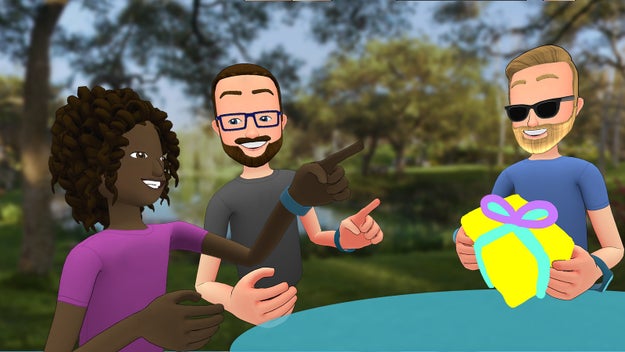
SAN JOSE — Facebook announced a new social virtual reality app for its Oculus Rift headset today at F8, the company&;s annual conference for software developers. It&039;s called Facebook Spaces, and you can download the beta version from the Oculus Store now.

In her keynote address, Rachel Rubin Franklin, Facebook&039;s head of social VR, said that Spaces signaled “the very beginnings of social VR.” People on Twitter said it looked a lot like Second Life and The Sims. Perhaps not coincidentally, Franklin previously worked as vice president at Electronic Arts managingThe Sims game.

Oculus Rift already supports the social game Altspace VR, made by an independent game publisher of the same name, where people can gather in virtual rooms via human or robot avatars and host events, play games, make art, watch 2D videos, or socialize.

Here&039;s how Spaces works:

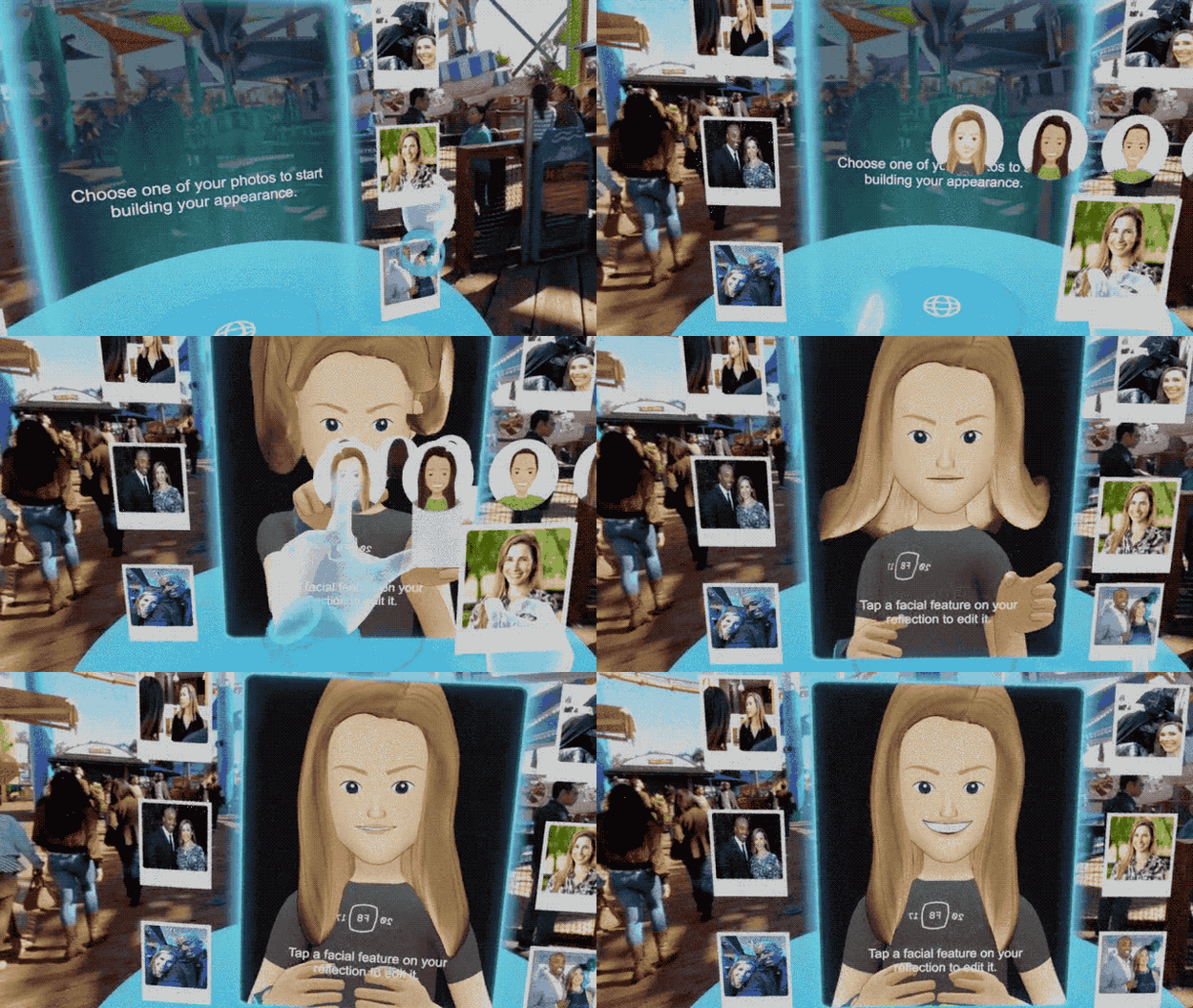
First, you connect your Facebook account to Spaces in the “Devices Requests” tab of the Facebook mobile app. Then you&039;ll strap on your Rift headset and navigate to the Spaces app, which will appear in your library. You&039;ll need the Rift Touch controllers, which retail at $100 a pair, to use Facebook Spaces.

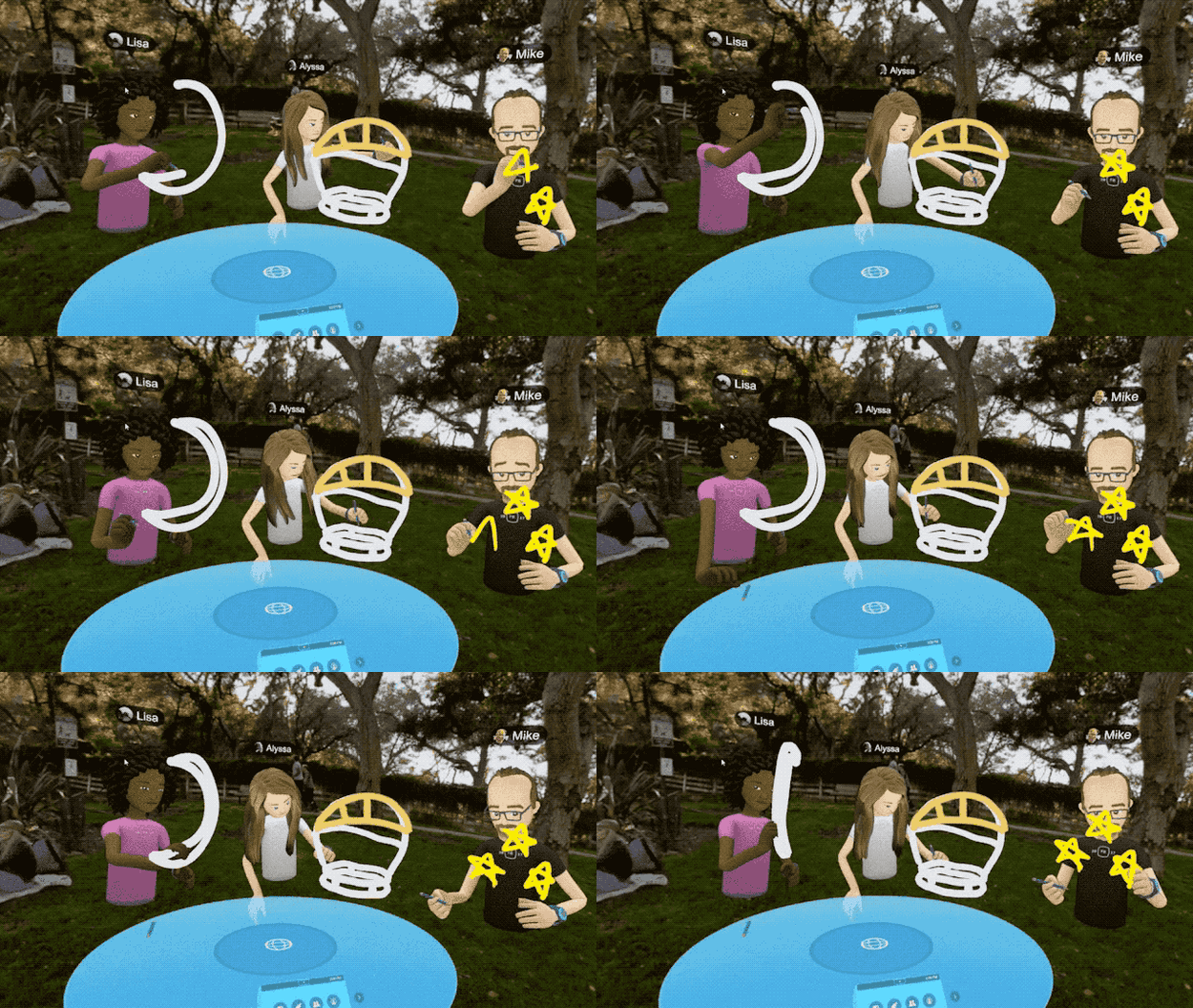
To create your virtual self, you choose from several versions of an avatar whose features are drawn from scans of your Facebook photos. You can customize some features, like hair, eye color, and glasses. The majority of the avatars seem to have large foreheads.

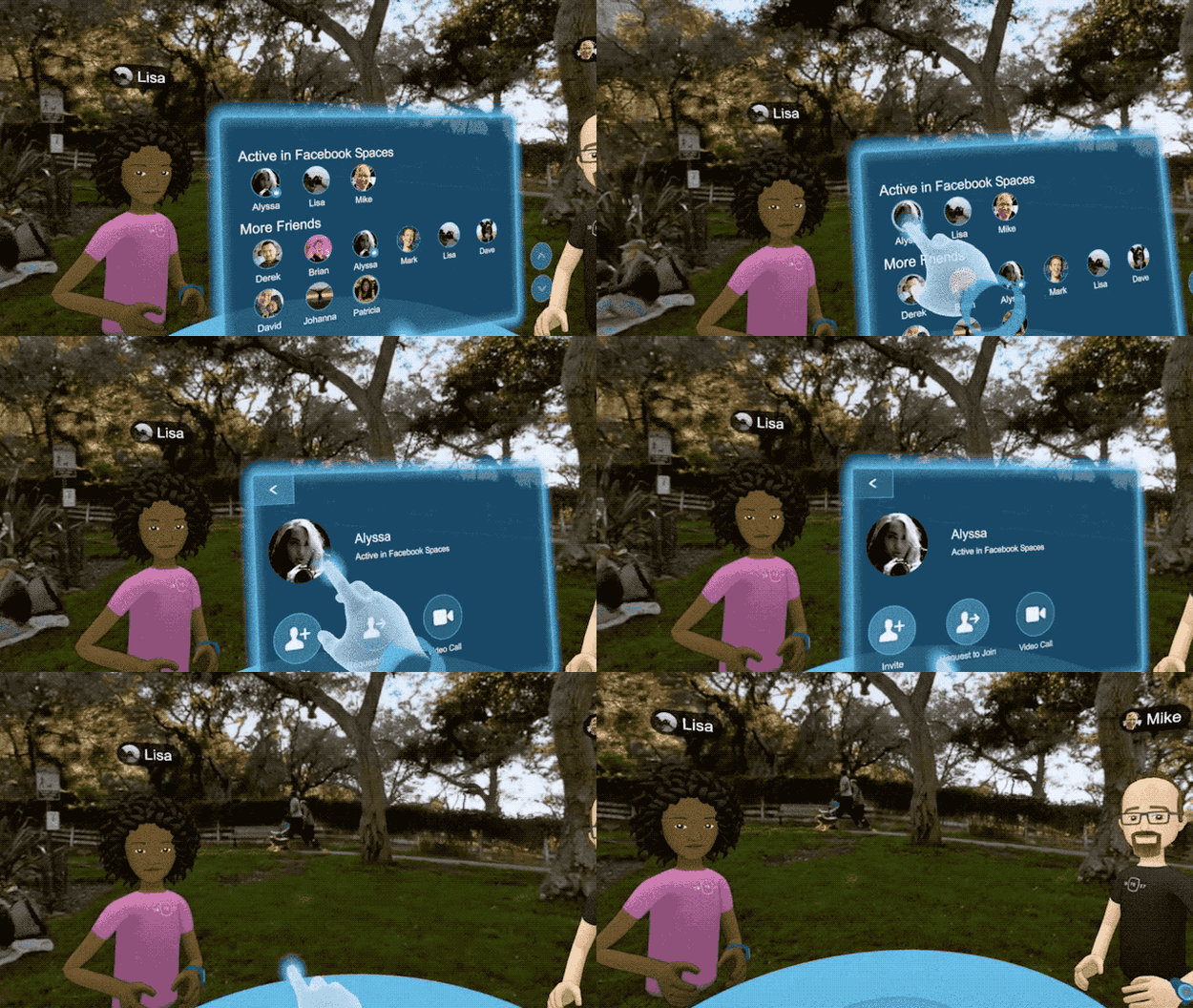
You can invite up to three friends to your space.

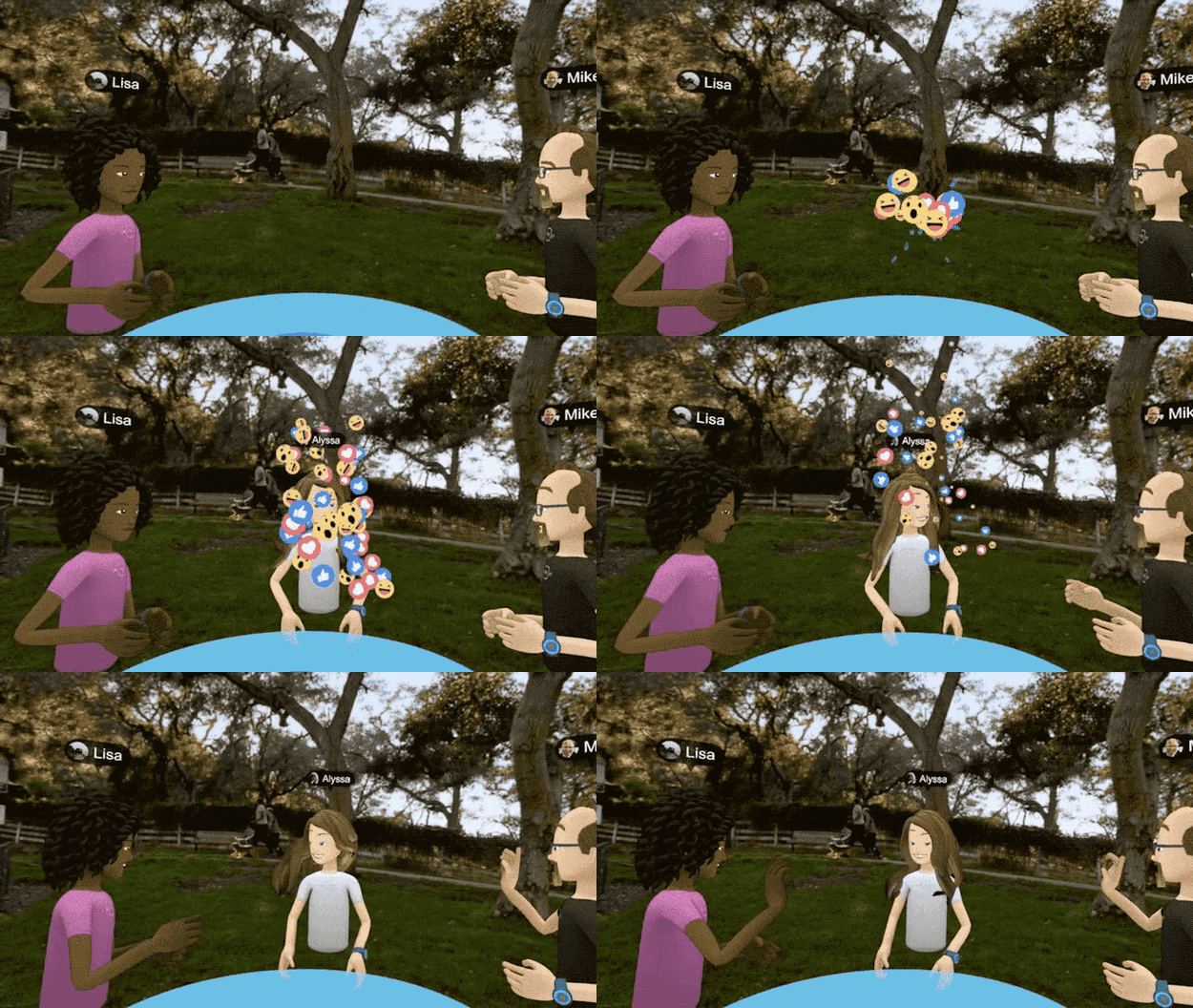
If they accept, you&039;ll find yourselves sitting around a virtual table. They&039;ll see your virtual avatar and the backdrop behind it. (You can choose from default backgrounds or use your own 360 pictures.) Your avatar can also video call friends via Messenger, which you can pull up as a flat menu in the virtual space. The video will appear as a 2D screen that you&039;ll be able to grab and move around. If they&039;re not in Facebook Spaces when you call, you&039;ll see their IRL face and surroundings, and they&039;ll see your avatar and your virtual setting.

If you get tired of your friends, Facebook included the ability to mute them or wholesale remove them from your virtual space. Gurl, bye.

Here&039;s a friend appearing&;

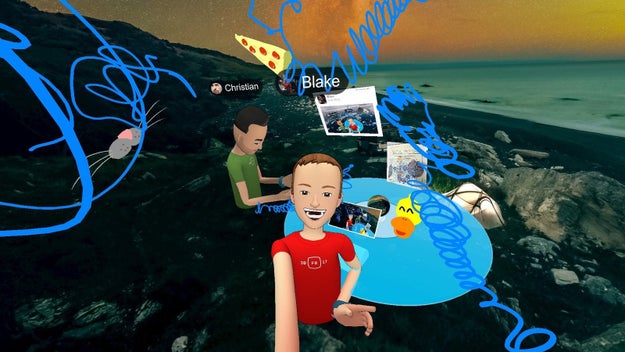
To entertain yourselves, you can draw in 3D and take selfies.

Here&039;s my virtual selfie with Christian, who works at Facebook.

I was really into the 3D marker. He was unamused.

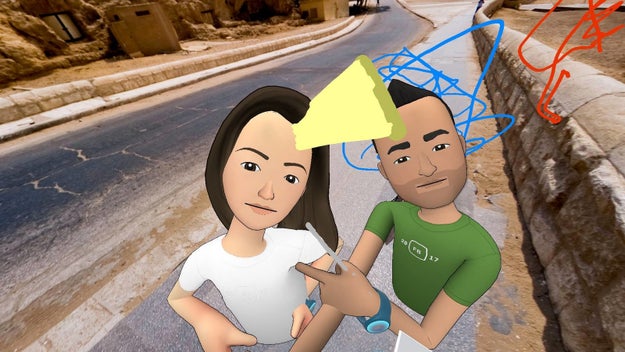
And here&039;s BuzzFeed video producer Allyson Laquian&039;s selfie, where she has a piece of pizza in her head.

The background is a 360 video of the Pyramids of Giza in Egypt.

360 videos can totally change your environment

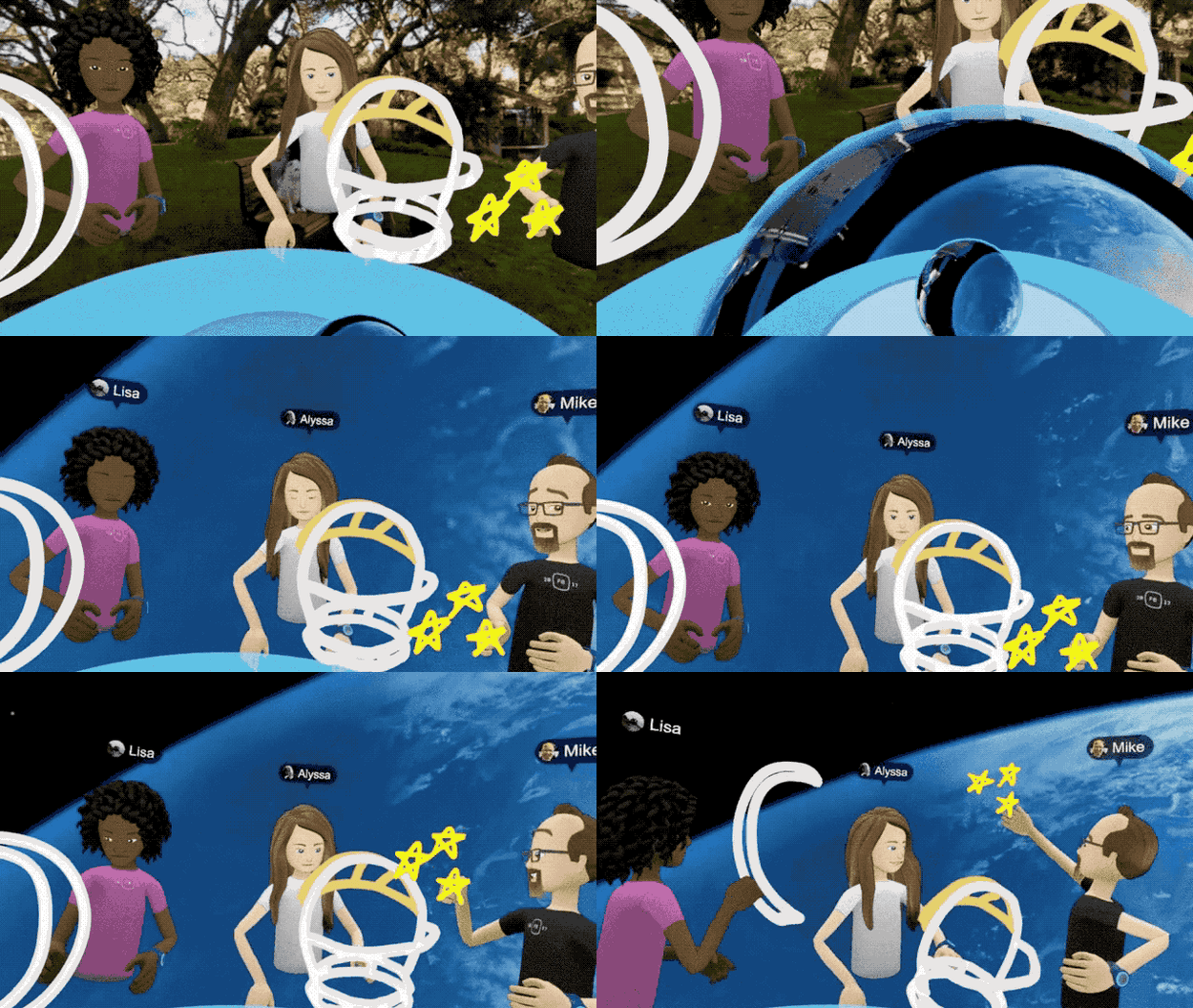
To play a 360 video, you&039;ll open a menu of options using the virtual control interface, and you select from content Facebook publishers have made or that you&039;ve recorded. When you grab a video from that menu, it&039;ll appear as a small orb in your virtual hand. To play it you can either put it in your avatar&039;s mouth or in the center of the communal table.

The videos will play all around you, turning your virtual environment into the video. You&039;ll also be able to view two-dimensional videos and pictures from Facebook publishers and your own timeline within Spaces as movable flat screens.

Facebook said in a statement that it&039;s hoping to bring the app to more platforms in the future but didn&039;t specify which ones.

Quelle: <a href="We Tried Out Facebook&039;s New Social VR App At F8“>BuzzFeed

Climbing Out Of Facebook's Reality Hole

Getty Images

SAN JOSE — It is spring in California and the rains have finally returned after years of absence. The grass is green, the hillsides are coated in yellow and orange and blue flowers, and the reservoirs are full again, hallelujah. Yet while the Spring rains may have washed away the drought, they have done nothing to alleviate the sense of existential dread — especially pervasive here in the techno-utopia of California —that the world we built has perhaps gone badly awry.

The proliferation of fake news and filter bubbles across the platforms meant to connect us have instead divided us into tribes, skilled in the arts of abuse and harassment. Tools meant for showing the world as it happens have been harnessed to broadcast murders, rapes, suicides and even torture. Even physics have betrayed us&; For the first time in a generation, there is talk that the United States could descend into a nuclear war. And in Silicon Valley, the zeitgeist is one of melancholy frustration and even regret — except for Mark Zuckerberg, who appears to be in an absolutely great mood.

The Facebook CEO took the stage at the company&;s annual F8 developers conference a little more than an hour after news broke that the so-called “Facebook Killer” had killed himself. But if you were expecting a somber mood, it wasn&039;t happening. Instead, he kicked off his keynote with a series of jokes.

It was a stark disconnect with the reality outside, where the story of the hour concerned a man who had used Facebook to publicize a murder, and threaten many more. People used to talk about Steve Jobs and Apple’s reality distortion field. But Facebook, it sometimes feels, exists in a reality hole. The company doesn’t distort reality — but it often seems to lack the ability to recognize it.

You have to build for the reality we live in, not the one we hope to create.

The problem with connecting everyone on the planet is that a lot of people are assholes. The issue with giving just anyone the ability to live broadcast to a billion people is that someone will use it to shoot up a school. You have to plan for these things. You have to build for the reality we live in, not the one we hope to create.

While Zuckerberg has charted a statesmanlike evolution over the years, he and the company he helms too often have a blind spot for the way the world will react to products it unleashes on them. Certainly, that seemed the case at F8 today where a slightly rain-soaked audience groaned through Zuckerberg’s dad jokes and listened in anticipation as he teased what was to come. Then, abruptly, he shifted gears.

“Our hearts go out to the family and friends of Robert Godwin Sr.,” Zuckerberg said, referring to the 74 year-old victim. “We have a lot of work and we will keep doing all we can to prevent tragedies like this from happening.” Then, as quickly as he hit the somber tone, Zuckerberg returned to platform optimism.

Todays news was largely about the company’s push into AR – augmented reality. Think: digital layers we can place atop the real world. Facebook says there will be three main ways this will play out: The ability to display information on top of the world in front of you, the ability to add digital objects, and the ability to enhance or alter existing objects.

Executive after executive took the F8 stage to show off how these effects will manifest themselves in the real world. Deborah Liu, who runs Facebook’s monetization efforts, encouraged the audience to “imagine all the possibilities” as she ran through demos of a cafe where people could leave yelp style ratings tacked up in the air and discoverable with a phone, or a birthday message she generated on top of an image of her daughter, while noting that with digital effects “I can make her birthday even more meaningful.”

And yet the dark human history of forever makes it certain that people will also use these same tools to attack and abuse and harass and lie. They will leave bogus reviews of restaurants to which they’ve never been, attacking pizzerias for pedophilia. If anyone can create a mask, some people will inevitably create ones that are hateful.

“With augmented reality,” Zuckerberg said, “you’re going to be able to create and discover all sorts of new art around your city.” Yes, someone can create a virtual painting, meant to beautify the city, or a leave virtual note to a loved one that reaches them at just the right moment, in just the right place. But someone else will probably leave a swastika. Because if there is anything to be learned about the modern internet, it is that if you build it, the Nazis will come.

But Facebook made no nods to this during its keynote — and realistically maybe it’s naive to expect the company to do so. But it would be reassuring to know that Facebook is at least thinking about the world as it is, that it is planning for humans to be humans in all their brutish ways. A simple “we’re already considering ways people can and will abuse these tools and you can trust us to stay on top of that” would go a long way.

Instead Facebook went into the reality hole. It touted Facebook Spaces, a new social virtual reality thing that helps you escape the world while experiencing it, too. As Rachel Rubin Franklin, who used to be executive producer of Electronic Arts’ “The Sims” game and now runs Facebook’s Social VR efforts, said of Spaces: “When your friends and family join your space, it’s just like really being together.”

But it is not. Your avatar is not human, no matter how real it looks. The digital world is not flesh or blood, but it can have a tremendous effect on things that are.

When Facebook announced live video almost exactly one year ago, Zuckerberg touted its ability to tap into the raw and visceral moments of life. But it didn’t take long for those moments to become too raw, and too visceral. When Zuckerberg released a 6,000 word open letter in February, and sought to overtly inject values into the company’s mission, he said he had been moved by a suicide broadcast on Facebook Live. But of course, the suicides keep happening. Facebook can’t stop this, of course, any more than it can stop murder or mayhem or death.

But the company can acknowledge that these things will happen, and it can do a far better job of planning for them. It can make it harder to use its platforms to harass others, or to spread disinformation, or to glorify acts of violence and destruction. As it rolls out this slew of new tools to augment reality, here’s hoping that Facebook will also climb out of its reality hole and face the world we actually live in.

Quelle: <a href="Climbing Out Of Facebook&039;s Reality Hole“>BuzzFeed

Trump's "Hire American" Order Could Be Good News For Silicon Valley

Brendan Smialowski / AFP / Getty Images

President Trump plans to sign an executive order on Tuesday, dubbed “Buy American, Hire American,” that will call for a rethink of the visa system that brings skilled foreign workers into the United States.

The administration argues the existing H-1B visa system lowers wages for American workers by allowing businesses to hire foreigners who will accept lower salaries. “About 80% of H-1B workers are paid less than the median wage in their fields,” a senior administration official said in a briefing on Monday.

Trump plans to call for a system that prioritizes visas for highly-paid workers, the official said. A limit of 85,000 H-1B visas are made available each year, and the government is typically flooded with more than 200,000 applicants. Successful applicants are currently chosen via a lottery; Tuesday&;s order will call for a new system that selects the highest skilled and highest paid candidates.

The program “is supposed to be a means for bringing in skilled labor,” the official said. Currently, outsourcing firms snap up large numbers of the limited supply of visas, leading to complaints that the system is being abused. As part of Tuesday&039;s order, agencies will be told to prioritize enforcing the rules of the current system, which requires employers to pay the prevailing local wage to foreign employees.

The order is planned to be announced by Trump as he visits the headquarters of Snap-on Tools, a manufacturer based in Kenosha, Wisconsin, senior administration officials said during a briefing on Monday.

Silicon Valley giants like Google and Facebook, along with many others in the US tech industry, have complained that they can&039;t recruit sufficient numbers of highly-skilled engineers using the current H-1B lottery system. Reforms that prioritize the highest-paid applicants could be good news for companies that pay generously.

“In some sense these changes could benefit companies who use the H-1B to fill highly skilled jobs,” immigration attorney Sam Adair, of the firm Graham Adair, told BuzzFeed News. “Not having to rely on the lottery system will be a benefit. It will be a pain point to many companies, but some employers will benefit from this.”

While the coming changes to the visa program could be a boon for major tech companies, outsourcing firms could suffer. When rumors of the order first circulated in January, the three biggest Indian outsourcing firms lost billions in market value.

The administration plans to release a fact sheet and guidance on what exactly will change following the order. Already, an announcement from the US Citizen and Immigration Services in April indicated the administration would be cracking down on abuse of the system; it set up an email hotline for reporting fraud and said it would “continue random and unannounced visits” to workplaces with high numbers of H-1B holders.

The “Buy American” portion of the order will ask the U.S. Trade Representative and Commerce Department to increase America-based production and to reduce the number of waivers and exceptions to existing Buy American laws in international trade agreements.

“It will be interesting to see how Congress reacts to this and whether there is broad support for it,” said Adair.

Caroline O&039;Donovan and Adrian Carrasquillo contributed reporting to this article.

Quelle: <a href="Trump&039;s "Hire American" Order Could Be Good News For Silicon Valley“>BuzzFeed

Facebook Just Added A Bunch Of New Features To Messenger

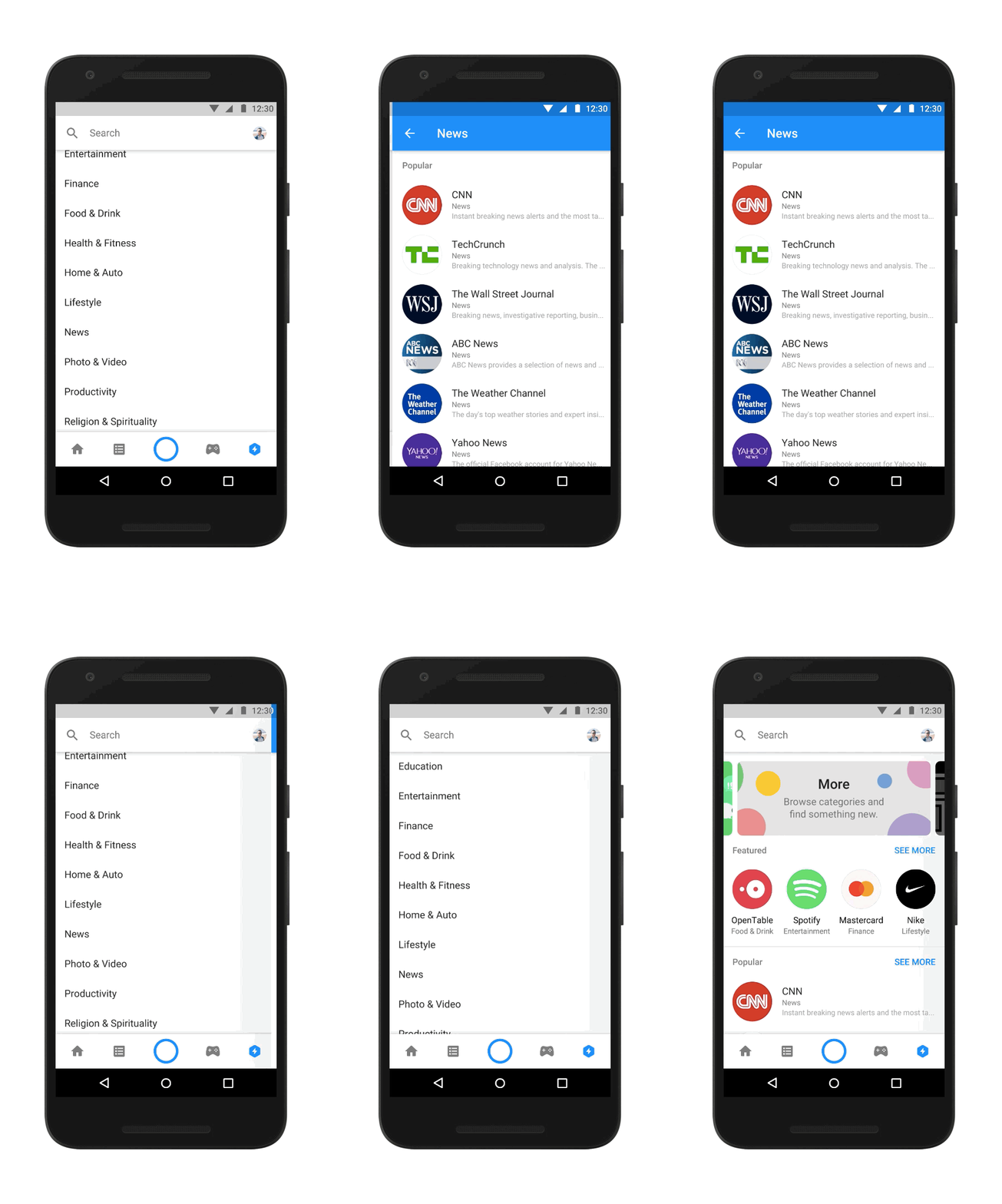
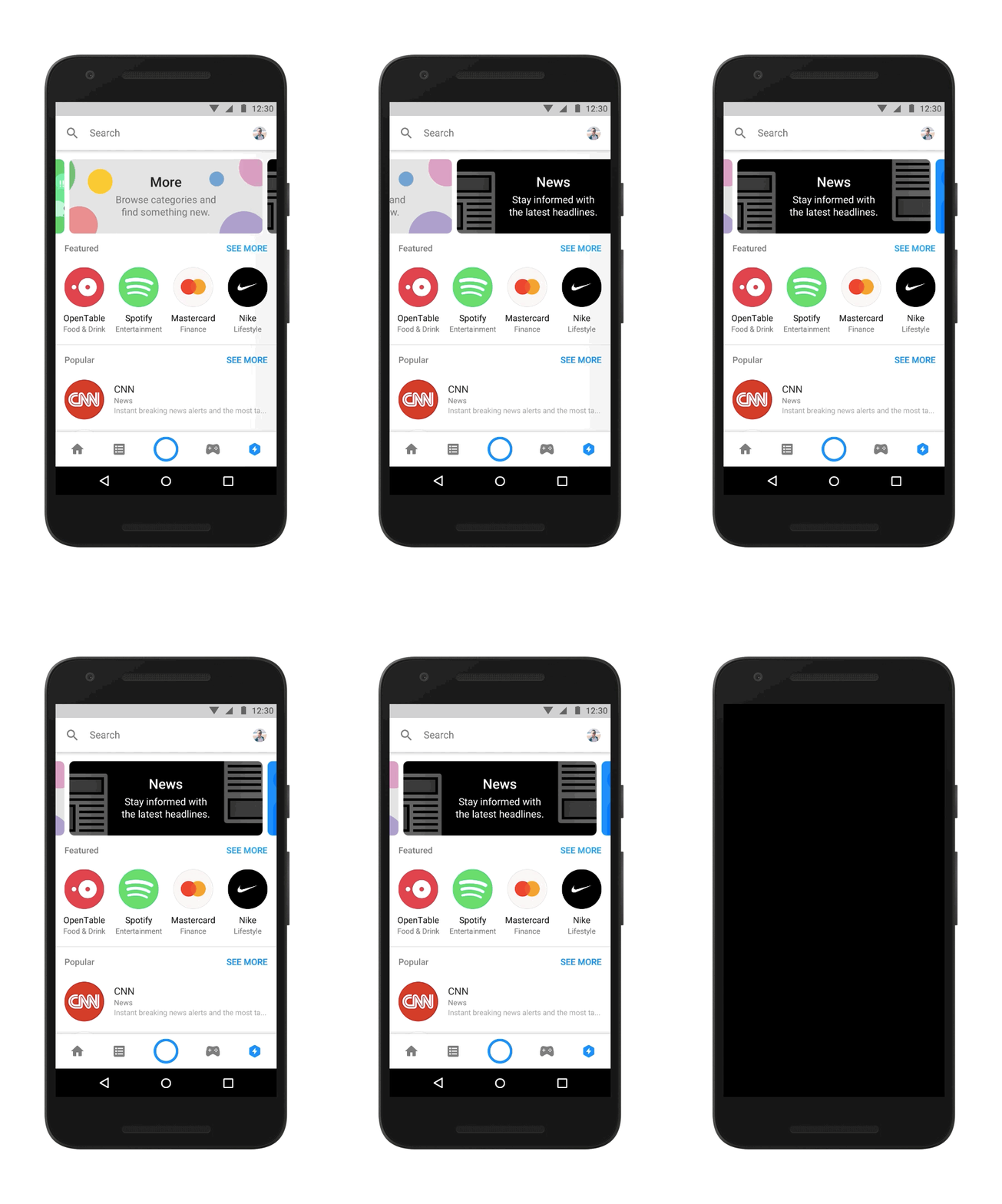
Facebook just announced a slew of updates for Messenger, including a “Discover” tab, more games, and lots of bot integrations.

The direct messaging app is used by 1.2 billion people each month.

The Discover tab will feature content and bots from businesses and publishers, and you&;ll be able to search for specific bots as well.

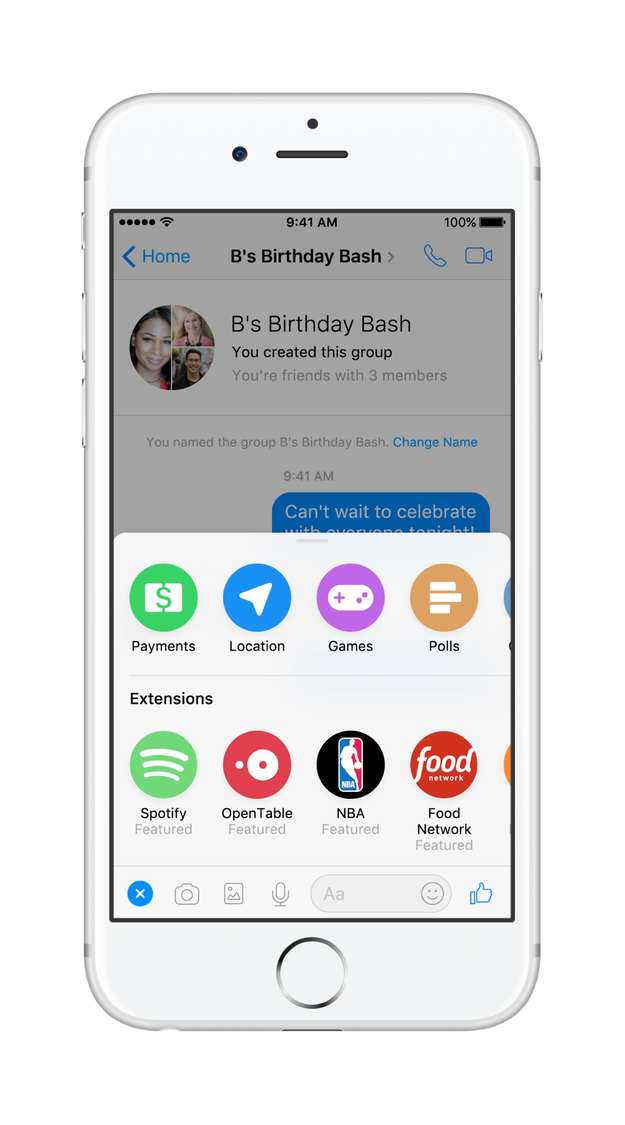
Those bots are apps inside the Messenger app. Facebook calls them “chat extensions” when they integrate into your messages.

For example: You can send songs via Spotify and play them within Messenger. (You can already send Spotify links to people, but the bot makes it a lot more seamless and keeps you in the Messenger app even while you&039;re listening to the song.) The NBA, Food Network, and others have also made bots.

The Discover tab strongly resembles Snapchat&039;s identically titled Discover tab. Facebook has also mimicked another signature Snapchat feature, Snapchat Stories, in all its social apps: WhatsApp, Instagram, the Facebook app, and Messenger.

David Marcus, vice president of messaging at Facebook, said that the company developed the Discover page within the app to help with recommending relevant bots to users, something both developers working with Messenger and users have repeatedly asked for.

There&039;s also a QR code reader for the Messenger camera that will allow you to jump to bots by scanning a code, much like Snapchat&039;s Snapcodes allow you to jump to individual users.

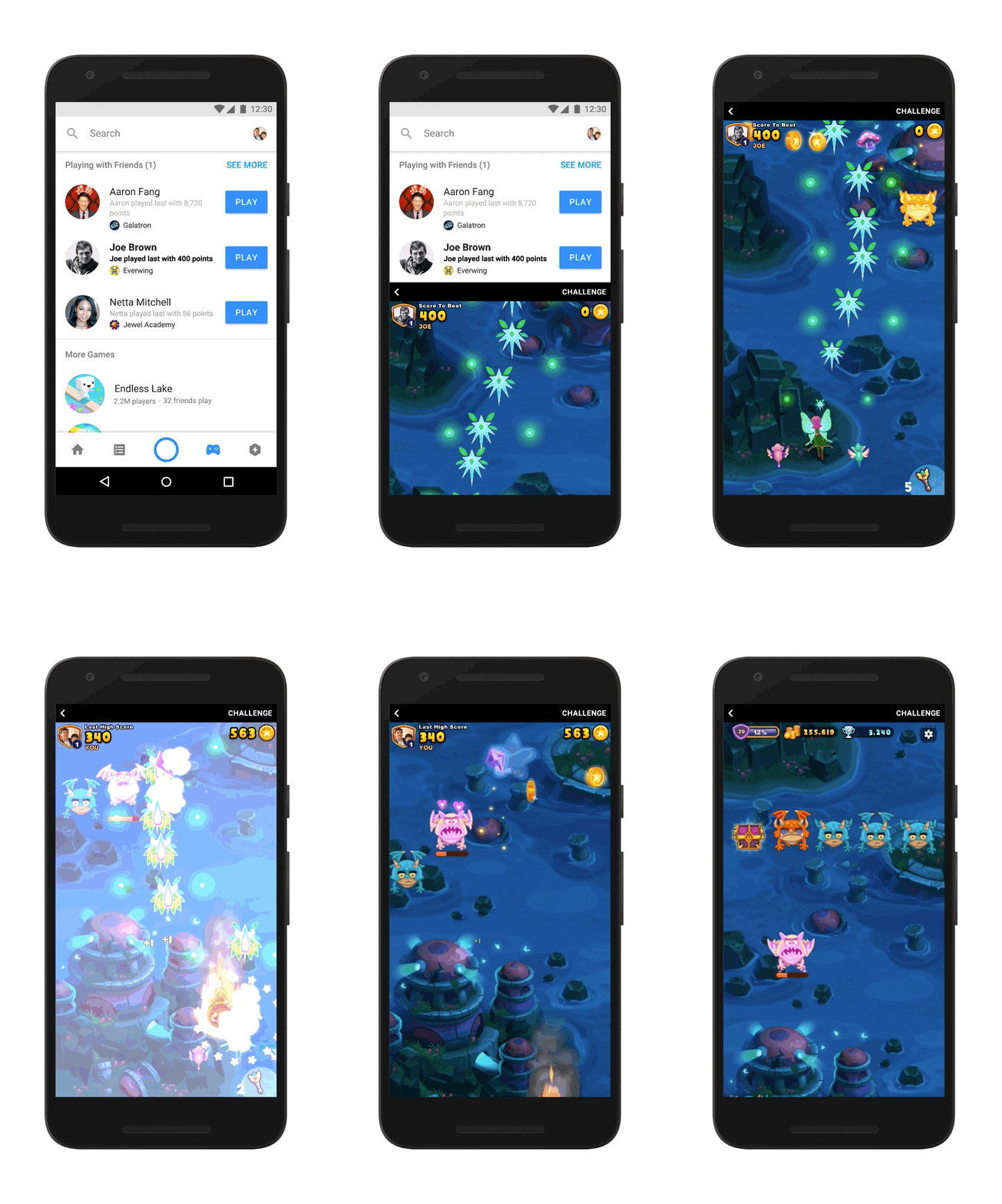
There&039;s also a lot more games.

In fact, there&039;s a whole new games tab, and you can now play turn-based games like Words With Friends within the app. The Messenger games before now were live-action games like Galaga or Pac-Man.

M, Facebook&039;s virtual assistant, will be a lot more powerful.

Giphy

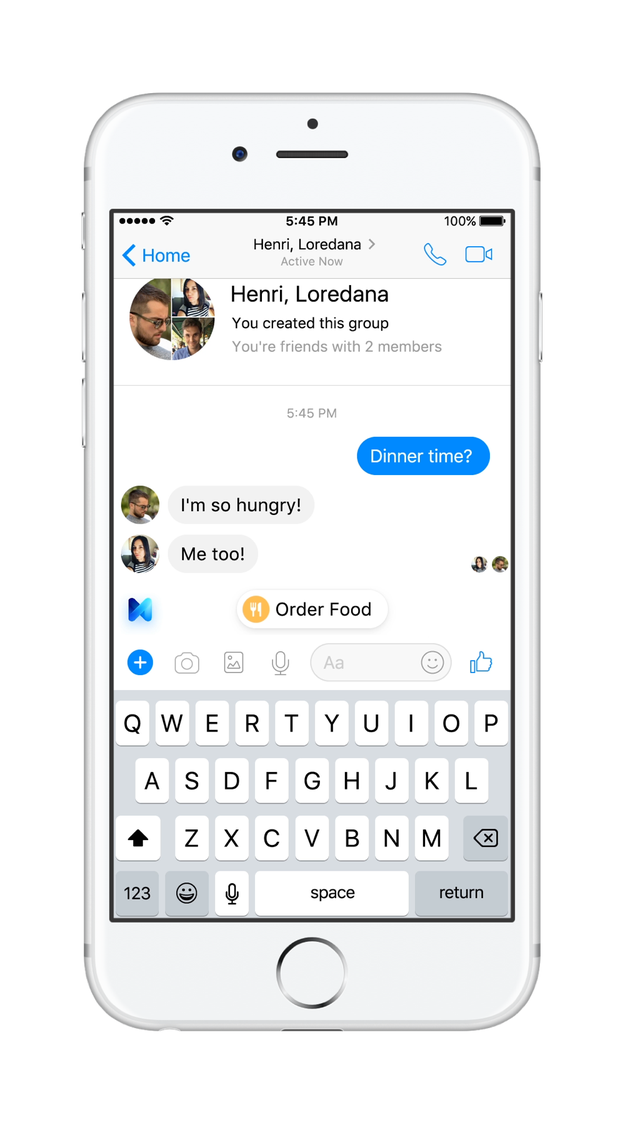
It&039;ll now play a bigger role in your messages. Facebook says the virtual assistant will recognize when you&039;re talking about specific tasks like meeting up at a certain time or picking a dinner spot. In response, M will offer suggestions like calendar reminders or food delivery options, which will be created by Facebook partners.

The 60 million businesses on Messenger will now have the ability to automate replies to frequently asked questions.

Think easy-to-answer questions like “What are your business hours?” or “Where are you located?” and other basic information.

According to Marcus, if the AI-powered business replier doesn&039;t have an answer to a question, it will respond with “Let me get you someone who can help you” and alert the business&039;s owners of the request. When the owners reply, Marcus said, the bot will digest the reply text and use it to reply to similar questions in the future.

Alex Kantrowitz contributed to this report.

Quelle: <a href="Facebook Just Added A Bunch Of New Features To Messenger“>BuzzFeed

Mark Zuckerberg’s Next Big Bet: Making The Real World An Extension Of Facebook

Facebook

At F8 today, Facebook is announcing a bunch of utterly crazy shit that we&;ll soon be able to do to the pictures we take. That includes Facebook, WhatsApp, Facebook Messenger, and Instagram and affects, oh, somewhere approaching 2 billion people. But while the company is talking a lot about cameras, it would be a mistake to look at what it is rolling out as a mere photography tool. Yes, there are cool picture effects. But what Facebook is really trying to do is to fully insert itself in the real world. Facebook’s augmented reality camera effects are an early attempt to let the digital infiltrate the physical, a way for the company to become the conduit between everything you see in the world around you, and all the information that exists, via your smartphone.

“Facebook is so much about marrying the physical world with online,” the company’s CEO Mark Zuckerberg told BuzzFeed News in an interview late last week. “When you can make it so that you can intermix digital and physical parts of the world, that&039;s going to make a lot of our experiences better and our lives richer.”

“Facebook is so much about marrying the physical world with online.”

It is certainly going to make life weirder. At an earlier demo, when a group of 18 Facebook engineers gathered to show their work to an outsider for the first time, they were clearly nervous. One pointed his phone at a table, and a 3D propeller plane popped up on screen, circling around a water bottle that rested on the tabletop. Another used his phone’s camera to turn the room into a planetarium, with planets and stars hewing across the ceiling as shooting stars fired from side to side. Still another took a normal photo of a face — and then made it smile, frown, and gape with the push of a button. Little wonder they seemed on edge: The stuff they were showing off was wild and largely unprecedented.

This new Camera Platform, as the company calls it, is a major bet that the camera isn’t simply a tool used to capture images. It’s something you’ll use when you want to share photos and videos, sure, but also when you want to overlay digital experiences on the real world. Imagine, Zuckerberg urged, using Facebook’s camera to view pieces of digital art affixed to a wall. Or to play a digital game overlaid on a tabletop. Or to leave a digital object in a room for someone to later discover — perhaps even future generations. Imagine using your phone to take a 2D photo, and then transform that photo into a 3D space. Imagine manipulating a friend’s expression to make them smile, or frown, or, well, whatever. Imagine changing your home into Hogwarts for a Harry Potter-obsessed daughter. That’s what Facebook is doing. “We see the beginning of an important platform,” Zuckerberg said. Onstage at F8 Tuesday morning, he reiterated this point: “The camera needs to be more central than the text box in all of our apps. … We’re making the camera the first augmented reality platform.”

And you thought this was just about Snapchat.

AI at War

It’s easy to draw comparisons to Snapchat. And certainly the camera platform’s Snapchat-like effects are likely to grab the most attention early on. But the more interesting stuff that Facebook is trying to pull off involves layering the digital and physical worlds on top of each other — bringing the former into the latter, and vice versa. There will be three big augmented reality areas Facebook is pushing into. The ability to display information on top of the world in front of you, the ability to add new digital objects to your environment (think: Pokemon Go), and the ability to enhance existing objects.

For example, Facebook’s Camera can map out two-dimensional photographs in 3D. The company hopes developers will someday build digital products that behave and interact in those formerly 2D spaces, just as they would in the rich three-dimensional world we live in. Picture this: In one demo, Facebook showed off various 3D scenes created entirely from a handful of 2D photos. The scenes had real depth to them — you could peer around a tree in a forest, or tilt your head to see behind a bed in a room. With a few clicks, the lights went down in the room. The forest flooded with water. It was magic.

The demo was on an Oculus headset, but Facebook’s ambition is to bring these kind of scenes directly into the News Feed itself, no Oculus required. It wants people to be able to create and interact with them directly on their phones.

The ultimate idea here is to turn the real world into an extension of Facebook itself. “There&039;s all these different random effects which are fun, but also foundational to a platform where people can create 3D objects and put them into the world,” Zuckerberg explained.

To pull off these radical camera effects, the company turned to an unexpected source: its AI team. When Zuckerberg began setting plans in motion for his company’s camera platform more than a year ago, he tapped Facebook’s Applied Machine Learning group (AML) to lead it. That put the technology in the hands of team artificial intelligence geeks, not the graphic designers or 3D artists you might otherwise expect.

Facebook

While not a traditional imaging team, Facebook’s AML group does work extensively in visuals. Much of what the team does is in the AI discipline of computer vision, the science of training computers to analyze and extract information from images, the same way humans do (Think about the way Facebook or Google can identify a face or a landmark in pictures uploaded to them). The group’s computer vision expertise made it an ideal fit for a project predicated on understanding what’s appearing before and beyond a camera lens.

As Facebook’s AML group went to work on Camera last summer, it waded into a thicket of wildly popular rival camera products. Snapchat’s beloved selfie filters, for instance, had inspired hundreds of millions of shares and put the company on the fast track to a multibillion-dollar IPO. Meanwhile, Prisma, a photo app for iOS and Android, was using AI-powered effects to break down images and redraw them in the style of famous paintings.

Facebook promptly put its AML group on lockdown, a drop-everything-and-work-on-only-this measure the company sometimes uses when developing products it sees as highly competitive. Facebook famously went into lockdown to improve its site performance and user experience in 2011 following the debut of Google+.

Yet by the end of lockdown, the camera team had pulled off a significant feat: It had neural net–powered AI software working directly on people’s phones — not remotely on servers where this kind of stuff has traditionally operated. That meant Facebook now had the ability to read and manipulate images very quickly, and could create powerful camera effects that were previously infeasible due to computing limitations.

The first effect the team developed was one called “style transfers.” Like Prisma, it redrew photos as artwork, but unlike the app, it could do so almost instantly. The AML team created a green-screen effect that could pick out a person’s body and put all sorts of backgrounds behind it live in camera. It built filters that automatically identified common objects that might appear in images and created specialized effects for more than 100 of them: a heart-shaped cloud of steam that rises from a cup of coffee, a propeller plane that circles household objects, starscapes that transform a bedroom into a planetarium, and more.

The centralized camera team quickly became the de facto hub for camera effects across Messenger, Instagram, WhatsApp, and Facebook proper. Build once; deploy everywhere. “This is heaven,” Joaquin Candela, the head of AML, told BuzzFeed News. “We have this massive release channel and we’re just going to keep putting stuff in there.”

And Facebook won’t be alone in “putting stuff in there” — at least not if things go the way it hopes. Over the coming months, Zuckerberg said, the company plans to give developers (and to a more minor extent the public at large) a chance to use its tools to create their own filters and effects for Facebook’s cameras. Developers who want to build their own apps, games, and art will be able to do so, opening up a wide array of creative possibilities that Zuckerberg himself admits — and perhaps even hopes — will take Camera in unanticipated directions.

And in opening its platform, Facebook will give developers access not only to AML’s tools, but also to its multi-app, billion-plus-person release channel. “Even though they&039;ll feel a little bit different in terms of features between Instagram and WhatsApp and Messenger, all the stuff that developers are going to build is going to be fundamentally compatible with cameras in all of these,” Zuckerberg said.

Snatch That

But, okay, remember when we said it’s not about Snapchat? Well, it’s also more than a little bit about Snapchat. Or at least, it’s certainly heavily Snapchat influenced.

Facebook

In the past few months, Facebook has gone hard at its neighbor in Southern California, adding Snapchat-style ephemeral stories to Facebook, WhatsApp, Instagram, and Messenger. Snapchat, for its part, isn’t standing still, today releasing its own set of augmented reality effects, albeit underwhelming compared to Facebook’s. When BuzzFeed News asked Zuckerberg if he was happy with Stories’ performance in Facebook, and showed him an utterly barren Stories section on an account with more than 700 friends, the Facebook CEO swallowed, paused, and replied “it’s still early.”

True&;

While Zuckerberg may urge patience, it’s likely his new camera platform will be judged in the early going by whether it can help Stories take off inside all Facebook products — not just Instagram, but Messenger, Facebook and WhatsApp as well. And the seeming failure of stories to gain traction inside places like the main Facebook app, or Messenger, raises the question of what truly belongs there. Because Facebook’s real power is in its network.

The same social graph Mark Zuckerberg talked about at F8 some 10 years ago — the one that connects you to your old friends, new acquaintances, high school teachers, and probably a lot of co-workers — remains its defining characteristic. The lesson of Snapchat seems to be that some things make sense on the big social graph, and some things don’t. And what will that mean for all this augmented reality? Are we really going to want to see flooded forests in our feeds?

And yet there is also this: A year ago, the social giant was in the midst of a small crisis, fending off a challenge from Snapchat which seemed to now own the fun, raw moments that originally gave social media its charm. Meanwhile Facebook proper was experiencing a decline in orignal sharing. In response, Facebook ruthlessly copied Snapchat Stories into all its products. And while Stories may seem like a wasteland in the main Facebook App, last week, daily users of Instagram Stories surpassed Snapchat as a whole (at least based on the latest numbers Snapchat provided). There are a lot of ways Facebook can use its network to win.

So, yes it’s still early. And yes, this may be a shot at Snapchat. But the war is for something much bigger. It’s about using the thing in your hand to analyze, interpret, explain, and fundamentally alter the way you experience the world around you. “We just view this of part of the first round of what a modern camera is,” Zuckerberg said.

Zuckerberg recalled telling his team a year ago that the path ahead of them wouldn’t necessarily be smooth. That they’d ship products missing many of the capabilities the company intended to develop down the road. And that they’d have to deal with whatever criticism came at them. “We&039;re going to go through a period where people don&039;t understand what we&039;re doing. And don&039;t understand the full vision,” Zuckerberg explained. “But, hey, that&039;s the cost of entry to doing anything interesting.”

Quelle: <a href="Mark Zuckerberg’s Next Big Bet: Making The Real World An Extension Of Facebook“>BuzzFeed