The Galaxy S8 Is A Gorgeous Phone. Too Bad It’s Made By Samsung
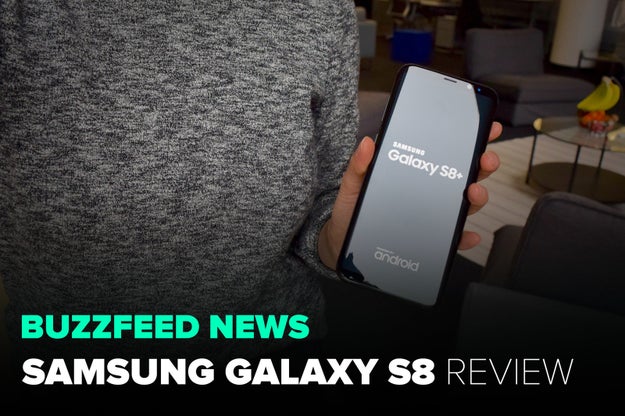
Nicole Nguyen / BuzzFeed News

No company was closer to being a trash fire in the past year than Samsung. There were the exploding Note7 batteries, then the exploding Note7 battery replacements, then the exploding washing machines, and then, finally, the exploding Samsung battery factory.

Needless to say, the Korean conglomerate, which recently lost its 1 smartphone maker ranking to Apple for the first time in eight quarters, is looking for a win.

Enter the Galaxy S8, the headliner of Samsung’s Redemption Tour.

During my five days of testing, the Galaxy S8 did not catch fire. In fact, the S8 turned out to be exactly what I had expected after my first hands-on: a gorgeous device with great technology inside. Samsung crammed as much screen into this phone as possible. The Galaxy S8 hardware is 83% glass slab and 17% everything else — and it has all the promise of an iPhone/Pixel killer.

The only problem? Like all Samsung phones, it’s pre-loaded with redundant apps and features you don&;t need. And, though the Galaxy S8 ships with the latest version of Android (7.0 Nougat), eventually the phone will be about five months behind Google’s future operating system updates.

All that aside, the S8 is a *really* good phone, and Samsung devotees with contract renewals coming up are going to want to upgrade ASAP. But those looking to switch will have a lot more to consider.

There’s nothing else on the Android market quite like it.

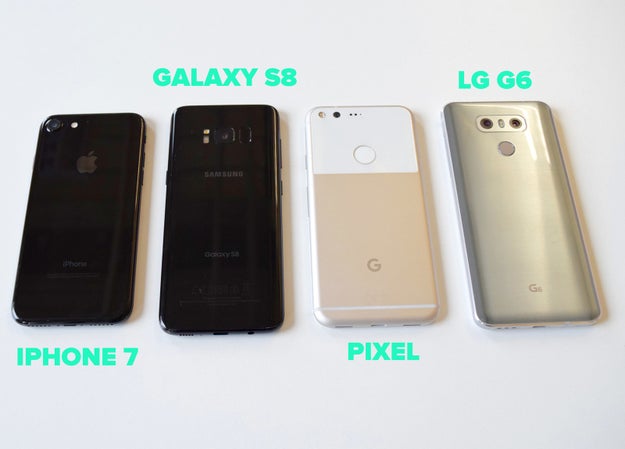
If you’re looking to get a new high-end Android phone right now, here are the three phones I think you should be considering: the Google Pixel, the LG G6, and the Galaxy S8. (For the purposes of this review, I’m not looking at Motorola, Sony, HTC, or Huawei. Don’t @ me.)

Aesthetically, it’s clear which one is the standout: the Galaxy S8. In my initial review, I loved everything about the Pixel, except its uninspired hardware design. LG’s G6 and its small, display-maximizing borders are, in many ways, similar to the Galaxy S8, but it’s a heavy phone that feels bulky.
Nicole Nguyen / BuzzFeed News

The S8, on the other hand, is wrapped in a slick, polished case. This is especially true of “Midnight Black.” It is Posh Spice wearing an all-leather catsuit and Samsung&039;s other color offerings (“Arctic Silver” and the purplish “Orchid Gray”) pale in comparison. The S8 looks modern and clean, and you’d be hard-pressed to find another Android phone with its looks.

The mind-bogglingly good edge-to-edge wraparound display is crisp and saturated, which we&039;ve come to expect from Samsung. The blacks are extra dark and text appears sharp, pixel-less. The display bleeds into the surrounding hardware, and it’s hard to tell where the screen ends and the phone begins.

The only “bezel” is a centimeter-ish border at the top and bottom. There are no physical buttons on the front of the phone, just a pressure-sensitive, virtual home button area. Every other leading Android phone maker has already removed the home button, and Samsung finally followed suit. To maximize the immersive screen experience, the home button is sometimes invisible (like when you’re watching a video full-screen or playing a game) and you can simply press down on the bottom of the screen to return to the main page.

These screens are huge. There are two models: the S8 with a 5.8-inch display and an S8+ with a 6.2-inch display; both are at 2,960×,440 resolution. The viewing area has been increased by 36% from the previous versions, the S7 and S7 Edge.

But it doesn’t feel like you’re toting around a mini tablet. The nearly half a million extra pixels were added to the S8’s height, and its edges are curved on all four sides, so the phone is surprisingly grabbable.

The curved edges do, however, make texting with two hands in portrait feel a little cramped. When turned on its side, the phone is too wide for my hands to reach the keys in the middle. Perhaps big-handed users will have better luck.

It’s a very tall phone (nearly 6 inches for the S8 and slightly over 6 inches for the S8+), so enabling the phone’s “one-handed mode” has proven very useful for me. You can swipe your thumb diagonally from either bottom corner to use a mini, more manageable version of the software. Although, my frequent use of this feature reveals that perhaps I don’t need a big screen at all?&;?&033;

Nicole Nguyen / BuzzFeed News

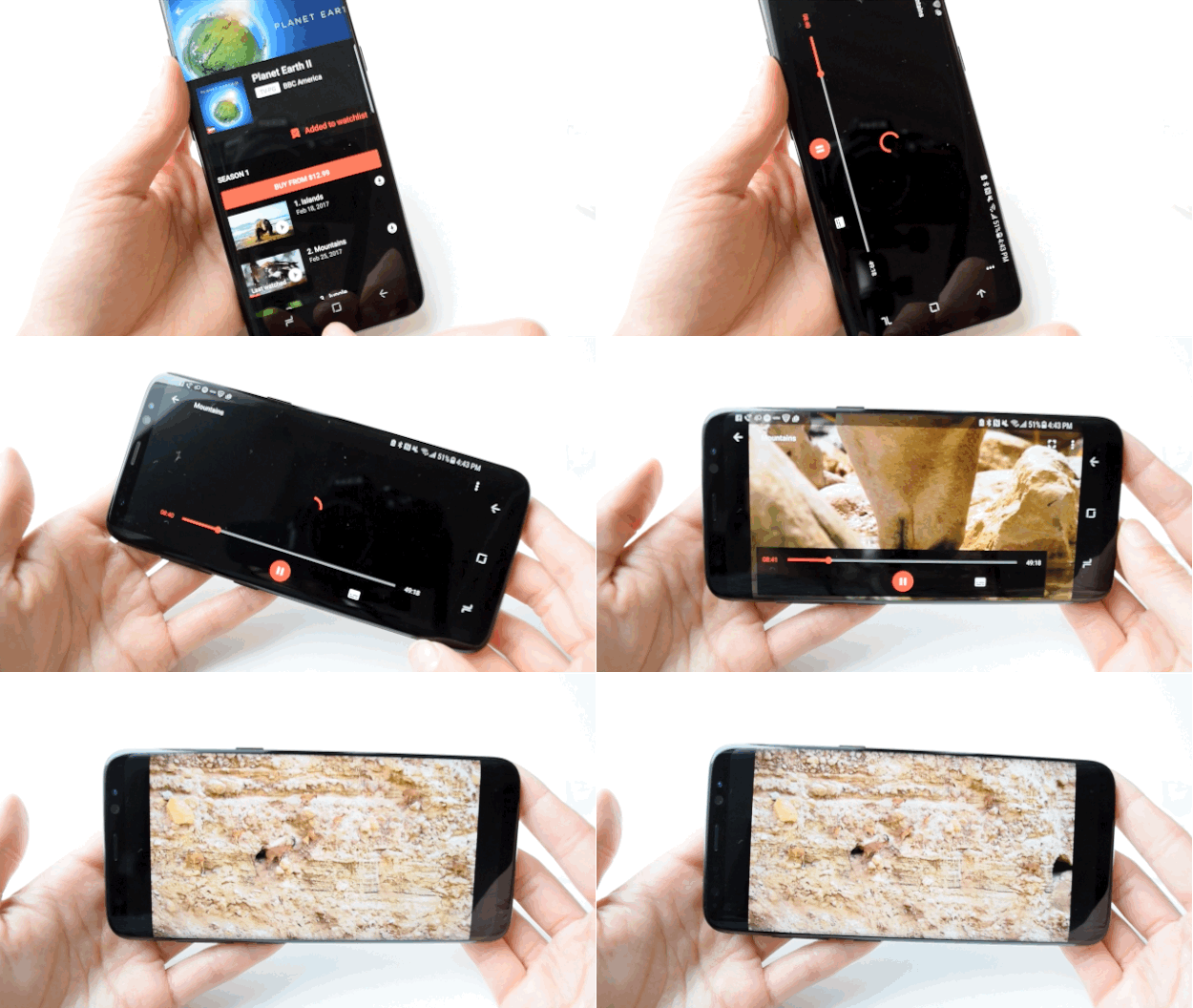
Apparently the S8 is “mobile HDR premium certified,” which means that when you watch shows or movies, you see the same colors and contrasts “that filmmakers intended,” according to Samsung. So I did what any other reviewer would do “for journalism”: I bought the Planet Earth II “Mountains” episode and poured myself a glass (or three) of wine (spoiler alert: ibex goats are badass AF). The display is very bright and vibrant — good for getting into Planet Earth, but ultimately worrisome because I fear it will eventually burn my eyeballs to a crisp.

The S8 is 83% screen, so it’s only fitting that this review is also almost 83% about the screen. Here comes the other 17%.

I tried my hardest to trick the S8’s face recognition unlock, but to no avail.

Reports that Samsung’s face recognition technology had been defeated with a photo surfaced last month. I tried to replicate this with a printed-out photo, with a photo onscreen, and with a Photobooth video of me staring at the camera and blinking. The phone was unfazed. I will never be a hacker.

Trickery aside, face recognition is more a matter of convenience than security. It makes up for the awkwardly placed fingerprint sensor and I found myself relying on it quite a bit.

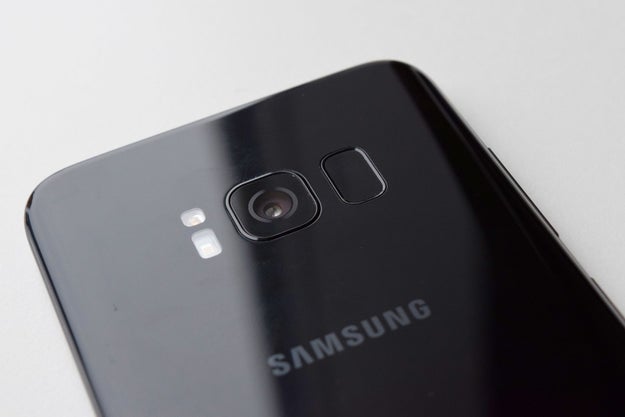
The fingerprint sensor has moved to the back, much to my chagrin.
Nicole Nguyen / BuzzFeed News

The fingerprint unlock feature has traditionally been programmed into the device’s home button. Seeing as the S8 ditched the button, it’s now on the back of the phone. The S8’s fingerprint sensor and the camera feel basically the same, which means I kept smudging the camera lens and unlocking the phone at the same time. It’s really too bad because, minus the finger smears, the camera is quite good.

Speaking of the camera, it’s the same as the Note7’s and the Galaxy S7 before it.

The phone’s rear camera hasn’t changed. It’s a 12MP lens with f/1.7 aperture, and it notably does not have the “dual lens” setup (a camera with two lenses) that Apple, LG, and Huawei introduced with their most recent flagship devices. But I didn’t really miss it in the S8.

Samsung likes to tout its primary camera’s low-light capabilities and fast auto-focus, even with motion. At full zoom, it handled capturing this surfer fairly well (in the rain&033;):

And this darting newt:

Nicole Nguyen / BuzzFeed News

And this amazing lemon poppyseed bundt cake my friend Lauren made:

Nicole Nguyen / BuzzFeed News

The real news is the S8’s upgraded front-facing camera, which is now 8MP (up from 7MP in the Note7) with the same f/1.7 aperture. Here’s an unedited Samsung selfie:

Nicole Nguyen / BuzzFeed News

And an iPhone’s (the iPhone’s camera is just 7 megapixels):

Nicole Nguyen / BuzzFeed News

The main difference is that, because it’s a higher-resolution image, you can zoom in more on the Samsung selfie. I&039;ve showed these photos to multiple people — and votes are split right down the middle. The look of a photo is ultimately a matter of preference and I will let you, Internet, be the final judge.

There are also new Snapchat-style stickers built-in, which…sigh.

Nicole Nguyen / BuzzFeed News

Bixby, the S8’s artificially intelligent assistant, is kind of…dumb right now.

Samsung created its own version of Alexa, Siri, and Google Assistant. It’s called Bixby, and it’s really an umbrella term for three different “intelligent” features: computer vision/image recognition software, a voice-enabled assistant, and a namesake app called Bixby that shows you different personalized “cards” that offer information like weather and upcoming flights (essentially this Google app feature).

Bixby Voice
What makes Bixby different from other assistants is that anything you can do on your phone with touch, it can allegedly do it with your voice instead. You can say things like, “Set display brightness to maximum” and more contextual requests like, “Rotate this photo to the left.” Unfortunately, Bixby Voice doesn’t launch until later this spring and I didn’t get to test it out myself.

Bixby Vision
I was, however, able to try Bixby’s vision recognition software, which uses the phone’s camera to “see.” For example, you can hold up a QR code and Bixby can take you directly to the link, or you can scan a business card and Bixby will isolate the text, then automatically add a contact from the camera app. It does those two things perfectly fine, but it’s not exactly groundbreaking tech. There are plenty of apps that can do the same thing.

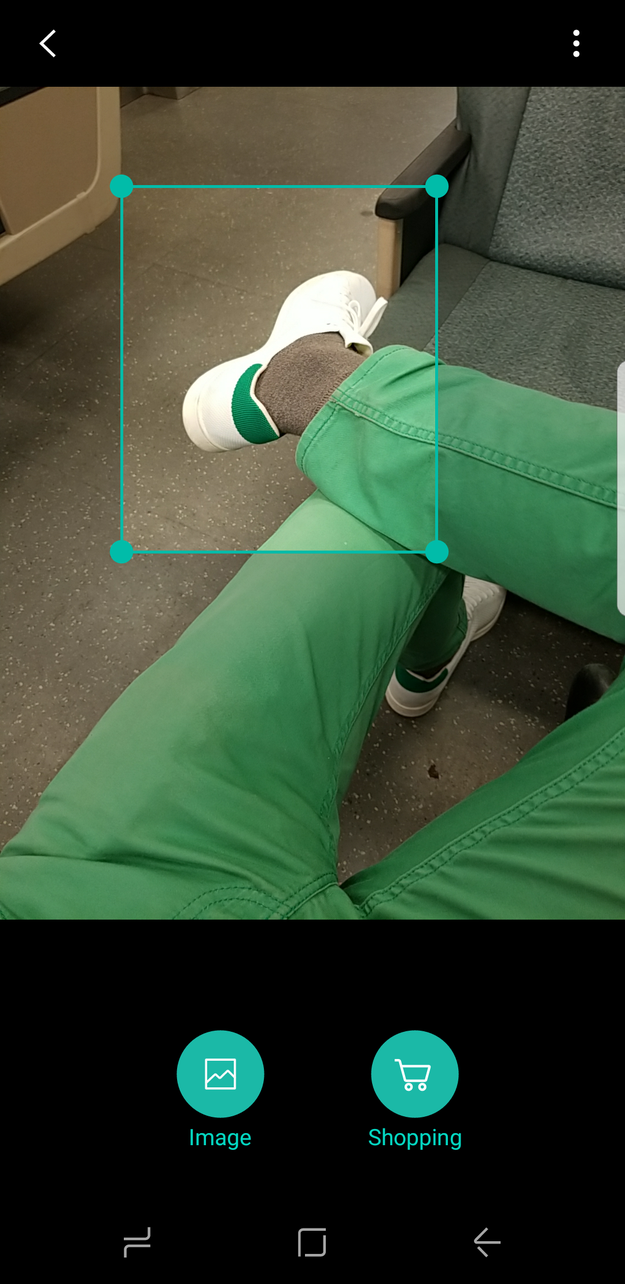
One of the seemingly cooler features is being able to point your camera at a piece of furniture or clothing so Bixby can use use Pinterest-powered computer vision to find out where to buy it. I was excited to try this and hoped it would eliminate “where did you get that” small talk with more stylish ladyfriends.
Nicole Nguyen / BuzzFeed News

But when I tried it out (on my boyfriend’s white Adidas shoes and a pair of amazing culottes), Bixby showed me Amazon results that matched the general shape/generic version of what I was trying to search for — and nothing else. In fact, for the culottes, Google reverse image search fared much better and found a Pinterest pin with the specific brand in the description (they are Oak+Fort, btw). I then tried taking a pic of the pin with the hopes that the Pinterest-powered software would pick it up. Nada.

Bixby Vision results are like asking your mom for a custom American Girl doll that’s designed to look just like you, and getting a Secret Hero Mulan from a KB Toys closeout sale instead.

Bixby App
I didn’t find the Bixby app too helpful. It showed me details for an upcoming flight and the week’s weather, plus trending topics on Facebook, which was cool. There was a random puppy napping GIF from Giphy as well, though I’m not sure if that was personalized content.

Right now, it’s hard to assess whether Bixby is a success, because so much of the technology is still in development. As it stands, Bixby is a gimmick that’s fun for showing off to friends but not smart enough to actually be useful. Plus, Google Assistant, which ALSO comes with the S8, can do just about everything Bixby can do and then some.

The battery didn’t explode.

The 3,000 mAh battery in the S8, the version I tested rigorously, performed well. The phone, as I’ve previously mentioned, is all screen, so it isn’t surprising that the display was my 1 battery suck for three days in a row.

The phone’s battery takes about an hour and 40 minutes to fully charge via USB-C cable, and has lasted me about a day and a half on average. This is with reading articles in an hour-long round-trip commute, watching 30-minute videos, followed by 30 minutes of gameplay, and with the usual slew of Facebook and email notifications enabled. Batteries, of course, decay over time, so I’m not sure how long that’ll last. I’ll update this review if that changes.

It feels fast enough.

The Galaxy S8 is the first device to ship with the newest Qualcomm processor: the Snapdragon 835, which is faster than its predecessor (the Snapdragon 820) but uses less power than other chips. The phone felt zippy during this first week of testing, but, like batteries, its processor will decay over time.

I played Super Mario Run, a casual sidescroller, and CSR Racing 2, a 3D graphics-intensive racer, a LOT during the testing period. They played smoothly and didn’t significantly drain the battery.

The processor is apparently robust enough to power a computer, using the new Samsung Dex portable dock accessory (price TBD) that can be hooked up to a monitor, keyboard, and mouse. The dock essentially turns the phone into an instant, lightweight Chromebook — in the demo I saw, the phone ran two apps simultaneously. I didn’t get to test the Dex out either, but once I do, I’ll update this review.

And now, a rant.

As gorgeous as the hardware is, the S8 is a Samsung phone, and I can’t review this device without noting this disclaimer: Samsung phones are (still) filled with so much crap. Samsung’s OS (called “TouchWiz”) looks cleaner than ever before, and it’s getting better. But it remains full of bloatware.

For example, I tested a T-Mobile version of the device. Right off the bat, there are four T-Mobile apps on the homescreen that I’ll likely never use, including “T-Mobile TV.” Then there are Samsung apps, like the mobile browser aptly named “Internet,”plus the Google versions of those exact same apps, like Chrome, already installed. There’s Android Pay, and Samsung Pay. There’s Gallery, and Google Photos.

Then there are Galaxy apps (which are apps made by Samsung or special “themes” to customize how your phone looks), in addition to apps you choose to download from the Google Play Store. There’s a dedicated side button for Bixby Voice, and OK Google can be activated by longpressing the home button. It’s a hot mess.

All of this is pre-loaded on the phone — and I know it can be removed from the home screen or uninstalled, but…ugh&033;

Samsung deeply alters the Android experience, down to the way windows scroll in the app switcher. You’ll see on the Pixel that there’s a smooth, continuous scroll and on the S8, a clunkier unit scroll.

Quelle: <a href="The Galaxy S8 Is A Gorgeous Phone. Too Bad It’s Made By Samsung“>BuzzFeed
David Karp Talks About Tumblr’s New Video App

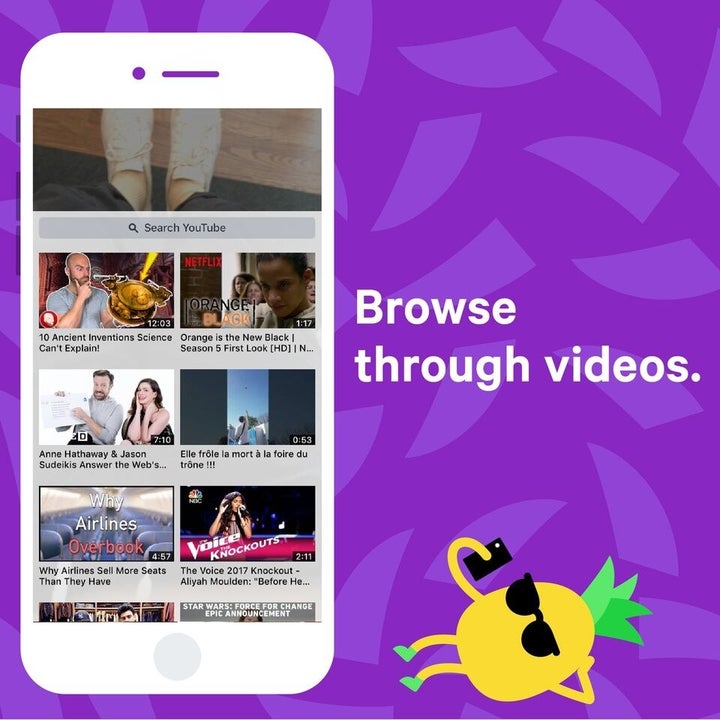
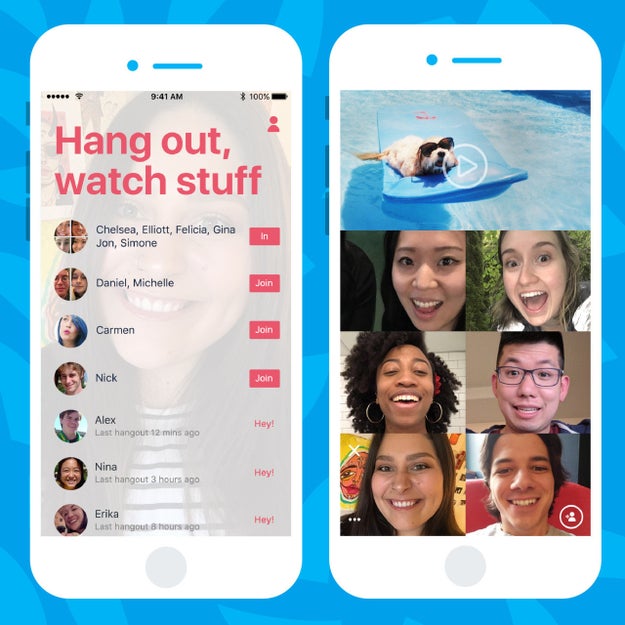
Today, Tumblr, the social network for teens and people who like erotica of Sherlock Holmes as a fawn, is launching Cabana, a group video chatting app where you can watch YouTube videos with up to six of your friends. It’s fairly straightforward – you can just chat as you watch videos and see your buddies’ faces as they react.

Watch YouTube videos with up to 6 other people:

Watch YouTube videos with up to 6 other people:

Cabana is currently iPhone only, but an Android version will come soon. It also supports YouTube but plans on adding other video partners.

Tumblr

It’s the first standalone app that Tumblr has made, and it’s pretty different from Tumblr. Tumblr is mostly for consuming and sharing stuff in a community of strangers – often anonymous – who share the same interests (say, the same Korean boy band, or drawings of Sherlock with antlers). Cabana is for talking face to face with 5 of your friends.

Tumblr and Polyvore Labs, which are both owned by Yahoo, developed Cabana. Right now, the app doesn’t have ads or monetization, but Tumblr CEO David Karp says that will happen further down the line. Which means that Cabana isn’t just a fun thought experiment with the Labs team — it’s meant to be a much-needed stream of revenue.

Tumblr has had some trouble since Yahoo bought it for a billion dollars in 2013.v Last year, Yahoo wrote down Tumblr as a $482 million loss. A a report last week showed that teens are dropping smaller social platforms like Tumblr and consolidating their activity on bigger platforms like Facebook, Instagram, Twitter, and Snapchat. All these networks have made video their priority, particularly live streaming video. The Verge points out that Facebook is losing interest in Instant Articles [other people’s text content] and their latest mantra is “the camera is the platform”. Tumblr does have a live video, but it’s not part of the core Tumblr experience.

BuzzFeed News talked to Tumblr’s David Karp and Jason Lee of Polyvore Labs, the team at Yahoo that created the app. [This interview has been edited and condensed for clarity.]

Tumblr


Tumblr has always been a little anonymous and a way to reach people you don&;t know in real life. Cabana’s different — it&039;s for a small group of people who want to see each others&039; faces. Do you see a shift from anonymous people blasting their stuff out, to small groups of people privately sharing stuff? Is this a new thing, where you want to hang out with six people instead of 600?

David Karp, founder and CEO of Tumblr: Tumblr is not about you going into a room with people that you know in real life and talking. It&039;s about whole communities of people who don&039;t know each other yet coming around the things that they both care about tremendously and getting to know each other. So Cabana is a different approach and way to think about social networking.

I think why Cabana felt so close to the Tumblr community and experience is that so often you&039;re discovering stuff on Tumblr, and you want to reach out to all your buddies and show them this thing that you found. Sometimes a reblog is enough – you just want to put it out there to your followers. But every so often, you find something where you&039;re like, “oh my god, my girlfriend or my buddy at work or school has to see this, like, right now,”

Sure, you can share a video over text or email. But the [better] experience [is] finding that extraordinary video that&039;s fascinating or hilarious or profound, and dragging your friends over to your computer to watch, or pulling it up on your phone and putting it in their faces so they see it. Being there while they watch it for the first time – that experience of watching them experience it for the first time – that&039;s a human experience that everybody&039;s gone through at this point.

That’s not really captured anywhere else in any other app on your phone right now. This just gives you a place to do that with all of your best buddies, even when you&039;re not there in person sitting next to each other.

Why a separate app?

Karp: Cabana is really an experience based around groups of people who know each other already that are coming together around a thing one of them might be obsessed with but the rest of them haven&039;t found yet. They get to bring their buddies into the know on, or be there when their buddies experience it for the first time. That is a pretty differently shaped network than Tumblr is today.

Jason Lee, director of product management, Polyvore Labs: We were doing user testing for Cabana on Tumblr users, and it resonated really well them. When I shared this with David, we both looked at the product and at each other and said, “well this is really cool and would fit well under the Tumblr brand and audience,” and it snowballed from there.

When Yahoo wrote down Tumblr last year, how did that feel on a personal level?

Karp: I think more than anything, I used that as an opportunity with the team to look forward to everything that we still had to do, [that] we’re still excited to do and we’re working on. Those moments are obviously always frustrating and bruising; we&039;ve had plenty of those in our 10 year career here, but not enough to slow us down or discourage us from everything that gets us up every morning and gets us excited to be working on this product and community.

Do you think that enough time has passed since 2 Girls 1 Cup that a whole new generation is ready to experience it on Cabana?

Karp: Well, I think that&039;s a pretty weird example. I can happily say I was never on the giving or receiving end of that video at any point. But yes, it’s that broader experience of wanting to see how your friends react to a thing that&039;s hilarious or hugely profound. Or if a video is going viral, and you want to be the person who shows your friends first.

Lee: One of the first videos I showed David when we were testing this was one of those “fail” compilations, and we just sat there laughing together. We&039;re on different coasts, but we&039;re synchronistically

watching this video, and we&039;re laughing at the same times. It was no different than if we were in a room together and watching something on a bigger screen.

Quelle: <a href="David Karp Talks About Tumblr’s New Video App“>BuzzFeed

Furious Indians Are Leaving Snapchat One-Star Reviews In The App Store Because They're Mad At The CEO

A former Snap Inc. employee has claimed that CEO Evan Spiegel allegedly said that he didn&;t &;want to expand into poor countries like India and Spain.&;

A former Snap Inc. employee has claimed in a lawsuit that CEO Evan Spiegel said that Snapchat was “only for rich people”, and that he didn’t “want to expand into poor countries like India and Spain.”

A former Snap Inc. employee has claimed in a lawsuit that CEO Evan Spiegel said that Snapchat was “only for rich people”, and that he didn’t “want to expand into poor countries like India and Spain."

Lucas Jackson / Reuters

The news was reported by Variety earlier this week.

In a statement provided to BuzzFeed News, a Snap Inc. spokesperson said: “This is ridiculous. Obviously Snapchat is for everyone&; It&;s available worldwide to download for free.”

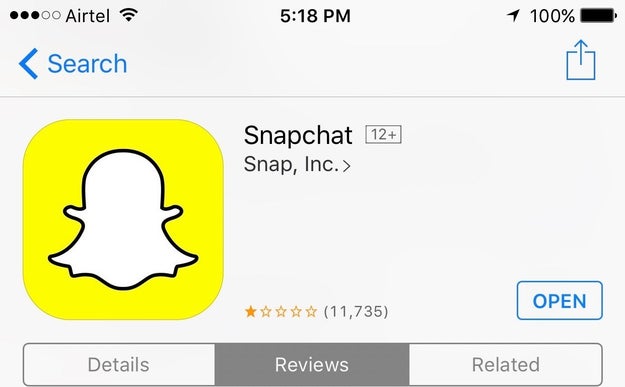
Over the weekend, however, Indians battered the Snapchat app with angry reviews and poor ratings in the Indian App Store.

Over the weekend, however, Indians battered the Snapchat app with angry reviews and poor ratings in the Indian App Store.

BuzzFeed News screenshot

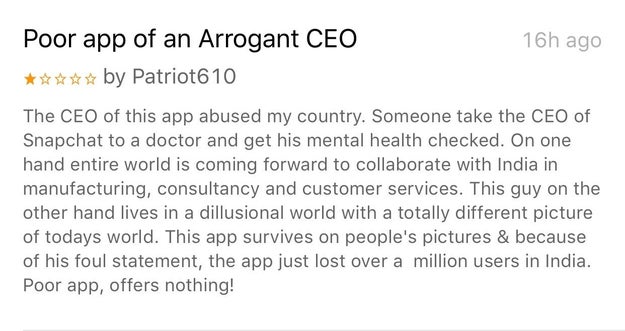
They called Spiegel “delusional”…

They called Spiegel "delusional"...

App Store


View Entire List ›

Quelle: <a href="Furious Indians Are Leaving Snapchat One-Star Reviews In The App Store Because They&039;re Mad At The CEO“>BuzzFeed

Airline Tech Keeps Melting Down But Nobody Knows Why

Joshua Roberts / Reuters

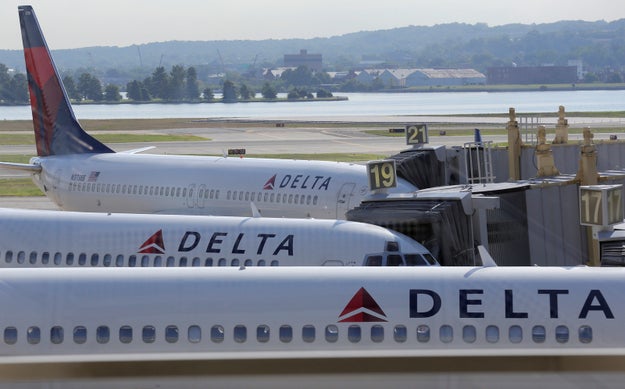
Last week, a severe thunderstorm in Atlanta forced Delta to begin canceling flights out of its major hub. But that storm quickly spiraled into a five-day fiasco that resulted in 4,000 canceled flights and plenty of angry customers. The culprit? A failure of technology.

When airlines cancel flights, schedulers play musical chairs behind the scenes to redirect crew members and pilots to where they’re needed. In Delta’s case, as the company delayed and canceled thousands of flights, its systems couldn’t handle the pressure.

This wasn’t the first time Delta experienced a meltdown of this kind. Back in August, after a power outage in Atlanta knocked its systems down worldwide, forcing the company to cancel more than 800 flights. The company canceled another 300 flights in January, citing another “system outage.” And it’s not just Delta: United grounded some flights in January, and Southwest delayed more than 930 flights in December – with both airlines blaming computer problems.

So why are airlines’ computer systems consistently crashing, and why couldn’t Delta’s keep track of its crews during a crisis?

In the case of Delta’s recent incident, the issue was that its crew management system was overwhelmed – not that its computers crashed outright. In a memo to staff on Monday, Delta CEO Ed Bastian said “Our recovery was hampered by a lack of available seats to accommodate customers as well as a failure of crew tracking systems to adequately position our people to do their jobs.” On an earnings call on Wednesday, Bastian said Delta plans to invest more heavily in technology that will help the airline track crew members. The airline also said in a presentation to investors in December that it plans to invest $450 million in technology in 2017.

Bob Edwards, a former chief information officer for United Airlines, said it appears from Bastian’s comments that Delta’s crew tracking systems “don’t have the ability to rapidly optimize and reschedule” staff after flights are canceled, particularly at the large scale Delta faced last week.

“It’s a system that’s not designed to handle that magnitude of chaos,” Edwards said. “Because Atlanta is a weather-friendly hub, Delta doesn’t have the need to practice major weather recovery…I don’t know if Delta has made the same investment in technology to help the airline recover and recover quickly when something like this occurs.”

Maybe they should&;ve made the investment, but they haven&039;t,” speculated Edwards, who left United in 2014 and worked on IT systems at Continental Airlines before the two airlines merged. He called it “a failure of a business to give their employees the tools to handle an event like this.”

Part of the problem is also that nobody knows how often computer systems cripple an airline – or compound a disaster like in the case of Delta’s Atlanta issue. The Department of Transportation tracks domestic flight delays in five categories: late aircraft arrival, weather, security, air carrier delays and delays caused by the National Aviation System.

Delays caused by glitches or other airline tech issues fall into the “air carrier” bucket of problems, which caused 5.1% of national flights from January 2016 through January 2017 to be delayed. (That figure was 5.56% in 2015. When the DOT first began collecting data on the causes of flight delays in June 2003, that percentage was 4.3%.) But that category is broad and includes everything from late-arriving crews to delays loading baggage and meals or cleaning and maintenance of the airplane.

“Without data, it’s really difficult to study this,” Vikrant Vaze, an assistant professor of engineering at Dartmouth who has researched airline-caused delays, told BuzzFeed News. “Nobody tracks it.”

Still, headlines suggest that airlines are struggling as a result of computer-related issues, Vaze said. “Anecdotal evidence suggests that the resiliency is lower than what it should be.”

The Department of Transportation doesn’t track delays or cancellations that result from computer outages because they do not affect safety, a spokesperson told BuzzFeed News. Airline computer systems that manage reservations or check-ins are separate from those that run the aircraft and communicate with the Federal Aviation Administration.

“Airlines are already highly motivated to avoid computer glitches, which can cost airlines millions of dollars in grounded aircraft and crews, and services, compensation, and refunds to passengers,” a DOT spokesperson told BuzzFeed News in November, during the Obama administration. (The Trump administration’s DOT did not return a request for comment.) “Reduced on-time performance totals could also impact future bookings. Avoiding such costs is likely a more effective incentive than detailed regulations concerning the carriers’ IT systems.”

In August, US Senators Ed Markey of Massachusetts and Richard Blumenthal of Connecticut, both Democrats, sent a letter to 13 major airlines, asking for information about recent technology-related outages, and a list of all the instances in the last five years. Airlines’ responses to their questions have not yet been released.

Many argue that airlines have little incentive to improve their operations — after all, a series of mergers in recent years have led to little competition for business.

“The airlines aren’t necessarily forced to innovate in certain ways,” said Megan Ryerson, assistant professor of city and regional planning and electrical and systems engineering in transportation at the University of Pennsylvania. “This meltdown that happened to Delta would not stop me from flying them if I lived in Atlanta. What is incentivizing them to improve their systems?”

Quelle: <a href="Airline Tech Keeps Melting Down But Nobody Knows Why“>BuzzFeed

Instacart Is Testing A New Interface For Tipping

Instacart is testing an interface that makes the ability to tip delivery workers more obvious.

For now, the test hasn&;t been spotted in the app itself, but in the receipts emailed to customers. So far, only customers in Chicago and Boulder, Colorado have reported seeing it.

The new look — which features more prominent tip buttons and larger photos of what Instacart calls “shoppers,” the workers who deliver your order — follows a $4.6 million legal settlement in which Instacart promised to make the difference between its service fee (which is collected by the company) and tips (which go directly to workers) more clear.

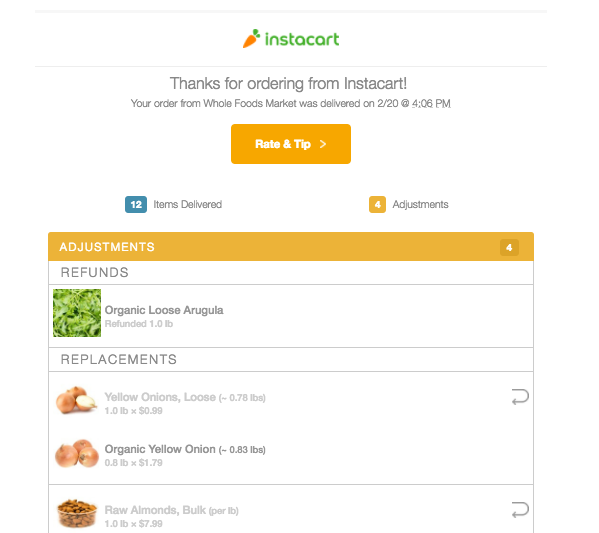
Here’s how email receipts from Instacart usually look, with a small button that says “Rate & Tip”:

Here's how email receipts from Instacart usually look, with a small button that says "Rate &amp; Tip":

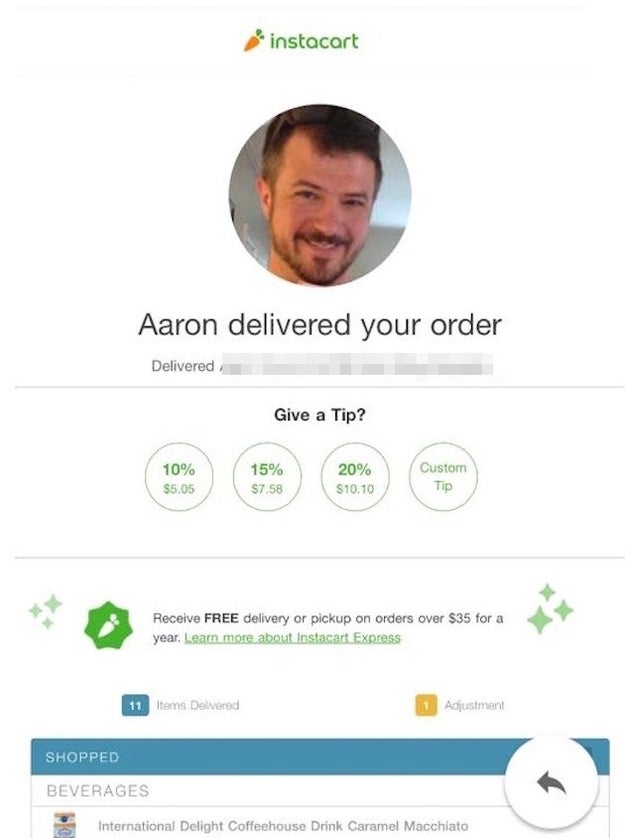
And here’s how they look in the tests, with a big photo of the delivery person who’s getting the tip, and much more prominent tipping options.

And here's how they look in the tests, with a big photo of the delivery person who's getting the tip, and much more prominent tipping options.

Instacart says the test is unrelated to the conditions of the legal settlement.

Delivery workers who shop for Instacart have been frustrated with the company since six months ago, when it replaced tips with a service fee collected by the company. It&039;s still possible to tip on Instacart, but workers say changes to the app interface made it harder for customers to figure out how; as a result, they say their earnings have taken a permanent hit.

This dispute became a factor in a class action lawsuit workers brought against Instacart in December. According to the terms of the settlement Instacart reached last month, here&039;s what the company promised to do:

As soon as is practical after the effective date, and following product review and testing, Instacart will modify the existing user interface related to the service fee to provide additional information to customers regarding the nature of the service fee, and the difference between the service fee and tip.

Some shoppers who saw screenshots of the new email receipt interface in a Facebook group for Instacart workers said they were hopeful that it would lead to higher tips. Many said they&039;d be updating their profile pictures, based on the size of the photo in the email.

But others, including Chicago shopper Matthew Telles, were worried that the test doesn&039;t go far enough; he said only restoring tips as the default option in the app will be satisfactory. “The only thing that&039;s going to get tips back to an adequate level is putting the tip in place of the service fee at checkout,” he said.

Quelle: <a href="Instacart Is Testing A New Interface For Tipping“>BuzzFeed

Here’s How Hackers Used Airbnb To Rob Hosts’ Homes

Nurphoto / Getty Images

Airbnb says that its rating and review system builds trust between people and accomplishes the impossible — convincing people to let complete strangers sleep in their homes.

Well, some scammers found a way to use Airbnb’s ratings system to rob people. Airbnb calls the problem “account takeovers,” which, it said in a blog post published Thursday, has been “receiving increased attention” lately. But the company said it has been working for months on new security solutions.

Basically, account takeovers are when people hack into the profiles of guests who have built up good ratings and reviews on Airbnb, and use those accounts — with some minor tweaks to the personal details — to book stays in the homes of hosts that they then burglarize. The BBC spoke to at least three people who said they’ve been robbed this way.

Takeovers can also work in the reverse — hackers take over host profiles, and try to get unwitting guests to send them money.

“Our model is effective at stopping most account takeovers, but unfortunately there have been some incidents where hosts and guests have suffered. This is not acceptable to us, therefore we’re working around the clock to do everything we can to improve our detection and prevention method,” Airbnb CTO Nathan Blecharczyk wrote in the blog post.

Blecharczyk said the top three ways accounts get hacked is through malware, phishing, and password dumps. Going forward, users will get text-message notifications if details on their profile are changed, and they will be required to use two-factor authentication when logging in to Airbnb on a device that hasn’t previously been used to access their account.

Airbnb offers hosts a $1 million insurance policy, and a spokesperson said hosts whose homes are burgled via account takeovers are reimbursed by the company.

Quelle: <a href="Here’s How Hackers Used Airbnb To Rob Hosts’ Homes“>BuzzFeed

Blue Apron Has Been Fined For Safety Violations. Again.

Bree Fowler / AP

A little over a year after being cited for a “serious” safety violation, the $3 billion meal-kit delivery startup Blue Apron again failed to comply with regulations.

The first “serious” violation for Blue Apron’s Richmond, California facility came after an August 2015 inspection; per California Division of Occupational Safety and Health (CalOSHA) standards, a “serious” violation means the inspector thought “death or serious physical harm” was a “realistic possibility.” For that violation alone, Blue Apron was levied a proposed penalty of $9,000, which it contested.

That citation was surfaced in an October 2016 BuzzFeed News investigation into the history of health and safety violations at the Richmond facility. At the time, the company said it was committed to “creating the best possible workplace experience for all of our employees” and had “learned from the operational challenges during its early days in Richmond.”

But BuzzFeed News has learned that in September 2016, a little more than a year after the 2015 inspection, following an anonymous complaint, CalOSHA inspected Blue Apron’s facility again, and the company was once again cited for a “serious” violation. Inspectors found that Blue Apron had violated the same exact statute for which it was previously cited — a failure to install emergency shower stations near forklift battery charging stations — and proposed a penalty of $3,825. (The findings of the inspection were not made public until February 2017.)

In addition to the “serious” violation, Blue Apron’s California facility was also cited for an additional five safety violations; the total proposed penalty is $6,580.

In a statement emailed to BuzzFeed News on Wednesday, Blue Apron said it “promptly addressed” the initial 2015 citation, and that the new citation is in regards to a new forklift battery charging station that was constructed during an expansion of the facility. When CalOSHA inspected the Blue Apron facility post-expansion in September 2016, inspectors found that while Blue Apron had installed an eyewash station near the new charging station, they had not installed an emergency shower.

“We promptly installed a shower at this location as well to address their concern,” said a Blue Apron spokesperson via email. “However, we believe both citations were issued in error, and Cal/OSHA is currently reviewing them.” Specifically, Blue Apron is arguing that, because the company doesn’t change out forklift batteries at the charging stations in question, per CalOSHA’s standards, the emergency showers were not necessary.

The appeal for the 2016 citation is set for July 2017; the appeal for the 2015 citation is currently scheduled for May.

Blue Apron has also recently run into trouble with health and safety regulators outside California. According to a public OSHA database, Blue Apron’s Jersey City, New Jersey facility — which has been plagued by some of the same internal violence among employees as its California counterpart — was most recently inspected in December 2016, following an anonymous complaint. According to its website, OSHA found one violation at that time, and issued a proposed penalty of $2,000. Blue Apron says it’s not contesting the citation in New Jersey, but added that it was actually fined $1,000; the higher fine listed online, it says, reflects a paperwork error.

Blue Apron is reportedly hiring bankers in preparation to go public, despite reports in December that its IPO would be delayed. The company also recently acquired an organic cattle ranch in California, in hopes of owning and controlling more aspects its meal-kit production system.

Quelle: <a href="Blue Apron Has Been Fined For Safety Violations. Again.“>BuzzFeed

This Guy Built A Working iPhone Out Of $300 In Spare Parts

This Guy Built A Working iPhone Out Of $300 In Spare Parts

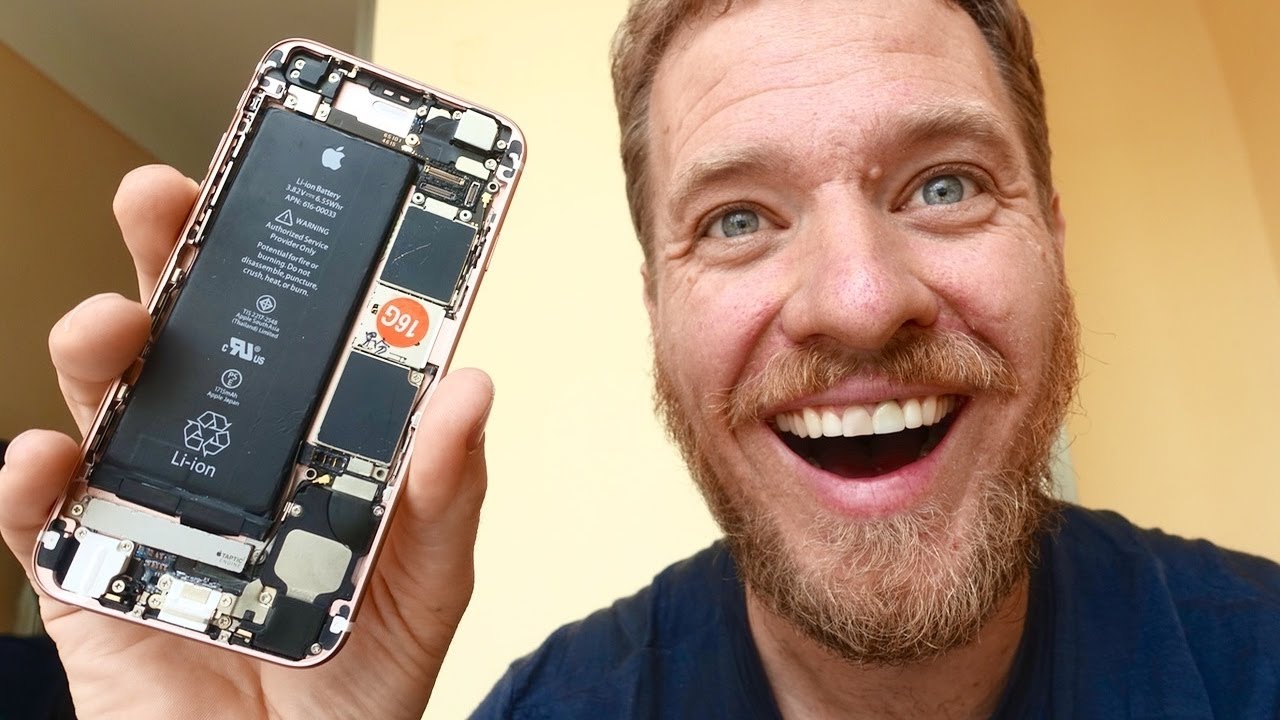
This is Scotty Allen, an entrepreneur. He said he&;s built an almost-new iPhone 6S 16GB with parts he bought from markets in Shenzhen, China, where he often travels.

He said he&039;s spent at least half of the last 18 months in Shenzhen learning about the electronics industry.

He said he already owns an iPhone 6S but wanted to understand how it was made. So he made one, with help from street markets in Shenzhen, a hub of global electronics manufacturing where a lot of spare and knockoff phone parts seem to end up. He documented the process in a YouTube video called “How I Built My Own iPhone.”

“I don&039;t think this would have been possible outside Shenzhen in the same way that I did it,” Allen told BuzzFeed News. “In the US you could probably have eventually done it, but it would’ve been a painstaking process buying all those separate parts from eBay.”

Apple did not respond to BuzzFeed&039;s request for comment.

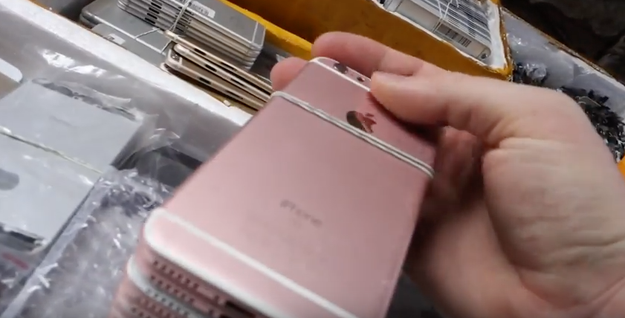
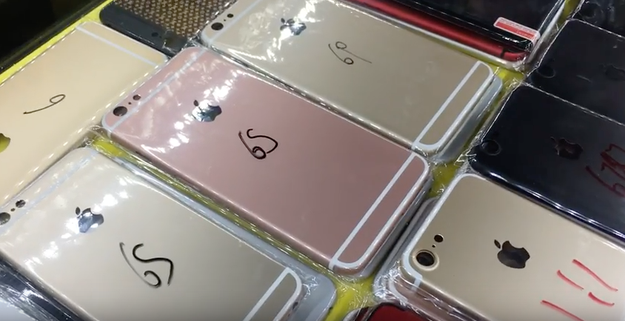
He started by going to an alley behind one of the main electronics markets in Shenzhen, where you can buy iPhone shells by the bundle.

Inside the market, he found more Apple-branded parts, and bought one.

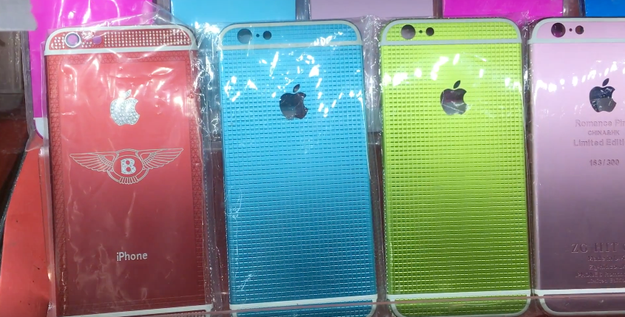
Turns out there&039;s a small universe of knockoff iPhone parts out there.

Allen then got the back engraved with lasers to provide guides for where the parts will go. Apparently, it&039;s as easy as telling the guys in the shop to “do whatever [Apple] normally does.”

Then he enlisted friends and several vendors to get everything else.

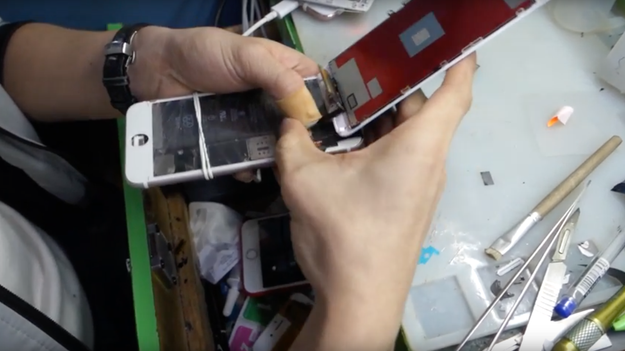
From the markets, Allen got a working screen (which the vendors put together), a battery, a logic board (the computational brain of the iPhone, preloaded with iOS) and all the screws and cables that make up the innards of an iPhone.

He even went to a cell phone repair school.

“The biggest problem I had,” Allen said, “was fitting everything together. I banged my head on the volume buttons not working for about four or five hours.”

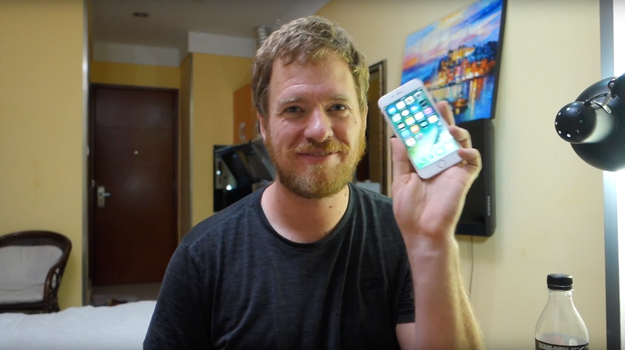
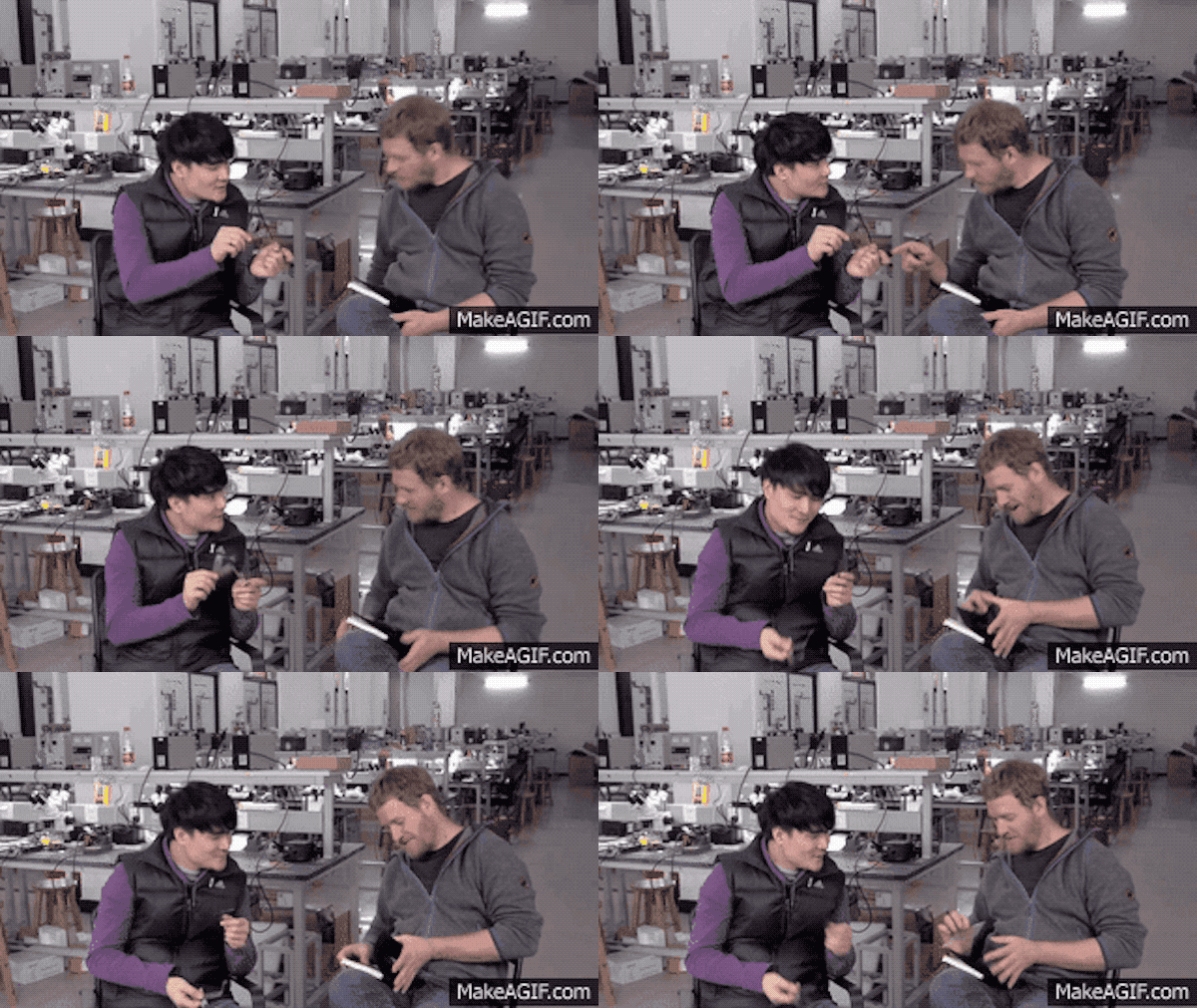
And finally, there you have it: a working iPhone 6S.

Nice.

Nice.

Overall, Allen said it took him about two months to gather the components and put together the phone and that the parts for it cost roughly $300, though he spent over $1000 on parts and tools he didn&039;t end up needing. He said he ended up with five extra phone backs, two screens, several batteries, bare logic boards, chips, and soldering stations from when he tried to make his own logic board. The base price for an iPhone 6S is $550.

He said Apple has not contacted him.

Watch the whole video here:

youtube.com

Quelle: <a href="This Guy Built A Working iPhone Out Of 0 In Spare Parts“>BuzzFeed

Nintendo Has Discontinued The NES Classic Reboot And People Are So Mad

Nintendo will stop shipping the reboot of its Nintendo Entertainment System console in North America this month.

The company wouldn&;t say what the cancellation meant for shipments of the console outside North America. The reboot, dubbed the NES Classic Edition, launched on November 10, 2016, and even though stores were plagued by severe shortages, Nintendo sold 1.5 million individual units by January 2017. News of the discontinuation was first reported by IGN.

Nintendo of America said in a statement to BuzzFeed News, “Throughout April, NOA territories will receive the last shipments of Nintendo Entertainment System: NES Classic Edition systems for this year. We encourage anyone interested in obtaining this system to check with retail outlets regarding availability. We understand that it has been difficult for many consumers to find a system, and for that we apologize. We have paid close attention to consumer feedback, and we greatly appreciate the incredible level of consumer interest and support for this product.”

The company elaborated, “At this time, we have no plans to produce more NES Classic Edition systems for NOA regions.”

People were confused and angry.

And they wondered what the decision was really about.

Some people on Twitter speculated that the move was meant to protect Nintendo&039;s other consoles like the Switch and its virtual console, where you can buy digital versions of the same classic cartridge games that were available on the NES classic.

But mostly they were crushed.

Goodbye for now, NES. You will be missed.

But you still could get one, maybe&; They&039;re shipping till the end of April&033;

Quelle: <a href="Nintendo Has Discontinued The NES Classic Reboot And People Are So Mad“>BuzzFeed

Google Will Oppose A Shareholder Push To Publish Its Gender Pay Data

Beck Diefenbach / Reuters

For the second year in a row, Google&;s parent company Alphabet will oppose a shareholder plan that would commit the business to evaluate and disclose whether it has a pay gap between female and male employees.

Arjuna Capital, the investment firm advancing the proposal on behalf of stockholders, told BuzzFeed News that Alphabet sent them a statement of opposition ahead of the company&039;s annual shareholders meeting this summer. Google declined to comment on the plan.

Last week, as part of an ongoing investigation against Google, an official with the Department of Labor said the agency “found systemic compensation disparities pretty much across the entire workforce.”

Natasha Lamb, Arjuna&039;s director of shareholder engagement, said there is a difference between paying lip service to gender pay equity and actually being transparent about it.

“They have been unwilling to do that,” Lamb said. “That&039;s unsettling given how proactive their tech peers have been, and also given what we just saw with the Department of Labor accusing them of extreme gender pay disparity. It makes one question what&039;s really going on here, when there isn&039;t full transparency and accountability.”

On Monday, Google&039;s vice president of people operations, Eileen Naughton, said in a blog post that “we were quite surprised” by the Labor Department&039;s accusations. “We were taken aback by this assertion, which came without any supporting data or methodology,” Naughton said. She went on to explain Google&039;s pay equity auditing policies, which she described as scientific and rigorous. The company claims that “there is no gender pay gap at Google.”

But Arjuna Capital says the gender pay gap and employee compensation data in the US have been unfairly hidden from public view for decades, and wants companies to do more to increase their accountability. “This is not only the right thing to do from a social justice standpoint and a broad economic standpoint, it&039;s simply good business for companies to be paying women a fair wage and to attract and retain top talent,” Lamb said.

Like several other big tech companies, Google releases annual diversity reports, sketching the ethnic and gender breakdown of their workforce. In 2015, detailed in Google&039;s most recent report, Google&039;s overall staff was 31% women and 69% men. 59% of Googlers were white, 3% were Hispanic, and 2% were black. “We’re still not where we want to be when it comes to diversity, but last year, we made progress in our efforts to build a more diverse Google,” the company said.

Google&039;s diversity reports, however, do not include gender pay data; the company shares how many women work there, but not how they are paid relative to men working in similar roles.

Last year, Arjuna led a campaign to pressure nine big tech companies— including Apple, Amazon, Intel, and Microsoft — to release their gender pay data. Of the nine targeted companies, only two have not disclosed their data: Alphabet and Facebook, although both companies claim to maintain gender pay equity.

Apple&039;s study, for example, found that women there made 99.6 cents for every $1 men earned; Microsoft said its female employees earned 99.8 cents for every dollar men took in; and Amazon found women&039;s compensation to be 99.9% of men&039;s, in equivalent roles. But even with these seemingly slight compensation discrepancies, annual diversity reports for many of tech&039;s biggest companies continue to reveal lopsided workforces, with higher-paying and leadership positions dominated by men.

Facebook did not respond to a request for comment.

According to Alphabet&039;s 2016 proxy statement, the board of directors told stockholders that they did not believe a proposal to disclose a possible gender pay gap “would enhance Alphabet’s existing commitment to fostering a fair and inclusive culture.” The board cited Google&039;s existing diversity reports and Google&039;s pay equity audits as safeguards against discrimination.

The Department of Labor&039;s lawsuit against Google, announced in January, stemmed from the company&039;s alleged failure to provide the government with employee compensation data. But Google maintains that the government&039;s records requests are overbroad and would reveal sensitive information about their employees.

Quelle: <a href="Google Will Oppose A Shareholder Push To Publish Its Gender Pay Data“>BuzzFeed