Facebook Messenger Is Testing "Add Contact" Request

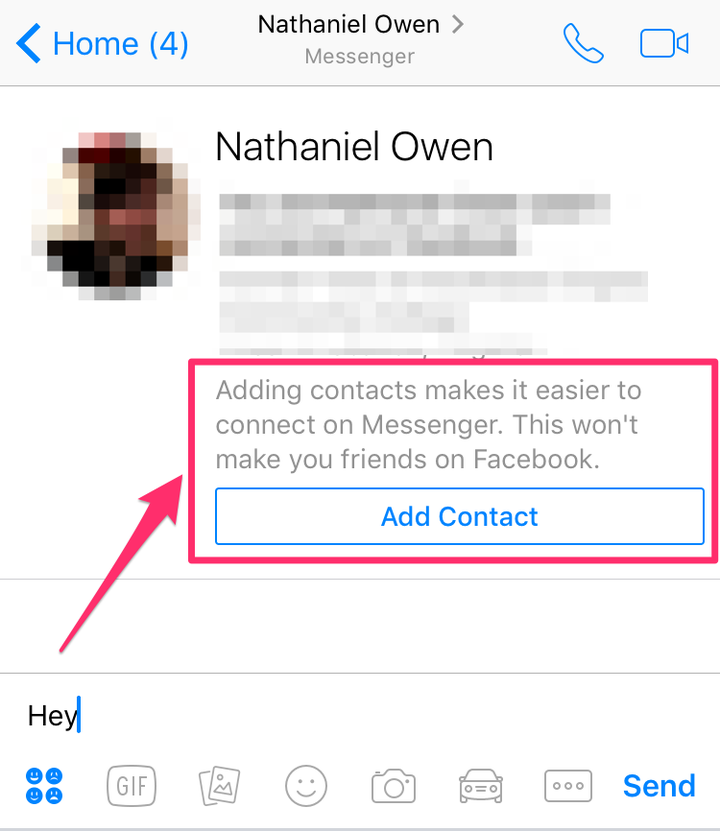
Facebook is testing an “Add Contact” feature in its Messenger app, the company confirmed to BuzzFeed News today.

The feature allows people to connect on the popular messaging app, used by more than 1 billion people, without becoming friends on Facebook itself. Facebook already allows non-Facebook friends to message each other on Messenger, via message requests, but if the company rolls out Add Contact broadly it could lead to a new network forming on Messenger and outside of the main Facebook product.

Messenger, though still behind Facebook&;s monthly active user count of 1.7 billion, is growing faster than the main product, and will likely increase in importance to the company now with original sharing down on Facebook proper and its ad load nearing capacity. In an April earnings call, Facebook CEO Mark Zuckerberg was clear about the importance of Messenger to his business: “A lot of people want to share messages privately, one-on-one or with very small groups.”

With Messenger on the rise, Facebook is clearly thinking about how it help develop the app into its own ecosystem, untethered in some respects to the Big Blue App. And the “Add Contact” request is one more tool to help accomplish that.

Quelle: <a href="Facebook Messenger Is Testing "Add Contact" Request“>BuzzFeed

Facebook Says Suspension Of Libertarian Groups Was An “Error"

View Video ›

Facebook: OccupyDemocratsLogic

Another controversial Facebook takedown, another muddy explanation for an erroneous removal.

Last week, Facebook mistakenly removed two big libertarian groups from its pages — Being Libertarian and Occupy Democrats Logic. Both claim over 100,000 members each. After the groups protested, Facebook restored them both on Monday, offering a vague explanation for the takedowns, one that&;s become increasingly common following the sudden, temporary disappearance of political speech and or contentious content from its platform.

“The pages were taken down in error,” a Facebook spokesperson told BuzzFeed News. “Both have been reinstated with any posts that violated our community standards removed.” Facebook did not say what posts it determined to be in violation of those standards, though Occupy Democrats Logic believes it was targeted for showcasing a meme on “progressive liberal logic.”

If Facebook&039;s statement sounds familiar, it&039;s because the company provided similar explanations when it temporarily removed a video showing the aftermath of the shooting of Philando Castile (that was “technical glitch”) and disappeared a handful of Bernie Sanders support groups (“one of our automated policies was applied incorrectly”).

What policies and protocols determined or informed these removals of political speech? Facebook isn&039;t saying. Asked to explain the “error” that removed Being Libertarian and Occupy Democrats Logic from Facebook, a company spokesman declined to do so.

An administrator for Occupy Democrats Logic told BuzzFeed News that Facebook did not provide a detailed explanation for the group&039;s takedown. And he insisted that the group was not forced to remove certain posts as a condition of reinstatement. “I didn&039;t remove jack shit,” the admin said. “I was confident nothing I posted violated standards.”

A cursory search of the restored Occupy Democrats Logic page no longer displays the “progressive liberal logic” meme post.

An administrator for Being Libertarian has not yet responded to a request for comment.

Facebook now boasts 1.7 billion monthly active users. It&039;s a massive network that for many is the extent of the internet itself. When political speech is removed from the platform, even temporarily, it&039;s a big deal. And Facebook is giving no indication that it&039;s ready to address these removals in more depth.

Quelle: <a href="Facebook Says Suspension Of Libertarian Groups Was An “Error"“>BuzzFeed

Dissent And Distrust In Tor Community Following Jacob Appelbaum's Ouster

The Tor Project, Inc.

When Shari Steele joined the Tor Project as executive director last December, she thought the job would resemble the start of her previous stint as the executive director of the digital civil liberties group Electronic Frontier Foundation: getting down to the hard work of turning a scrappy online privacy group with a reputation for chaos into a mature organization.

“I expected there were operational things I’d have to clean up,” Steele said. “Setting up bank accounts, and making sure contractors are treated properly, that kind of thing.”

Instead, the first eight months of Steele’s tenure have been defined by a scandal that has rocked the Tor Project, the nonprofit organization that administers and promotes Tor, the widely used and controversial software that conceals the online identity and location of its users. In June, anonymous accounts appeared online alleging that Jacob Appelbaum, a prominent developer and activist who was the Tor Project’s best-known member, had sexually assaulted several women.

In the two months after the allegations, Appelbaum resigned and the Tor Project replaced its entire board, following a BuzzFeed News report that it had known of allegations against Appelbaum for more than a year before they became public (and well before Steele came on). Last month, the group announced that a seven-week private investigation had confirmed the allegations. (Appelbaum, who lives in Berlin, has not been charged with any crime.)

Now, as Steele tries to pivot the organization past the scandal and toward the restructuring she was brought on to do, she faces the awkward task of handling a group of Tor community members and associates who are angry about the way she dealt with Appelbaum’s exit and its aftermath, some of whom are actively hostile toward the people she has empowered to make the organization more welcoming to women.

Last week, Marie Gutbub, a Tor Project core member and a former romantic partner of Appelbaum’s, announced she was quitting Tor in an email in which she accused Steele of “purging” those within the Tor community who signed an open letter in support of Appelbaum — and claimed to speak for many others.

“I know that there are others in the community who feel like something is not right about this,” she wrote. “And I assume that they only haven&;t spoken up because they are afraid.”

David W. Robinson, a Tor volunteer who gained fame in the community when police raided the Seattle home where he ran a Tor exit relay, published a letter last week calling the Appelbaum allegations “character assassination … with management’s collusion.” And over the weekend, an anonymous post appeared calling for a 24-hour boycott of Tor and demanding Steele’s resignation. (And add to all this a throng of anonymous Twitter commenters.)

The proposed boycott has been widely criticized, even by Robinson and Gutbub, as counterproductive and potentially harmful to people who rely on Tor to communicate safely. But as these loud and angry voices have made clear, the Appelbaum scandal has revealed fissures within the broader Tor community. That matters more than it might otherwise seem, because the Tor Project relies on its community for advocacy, code improvements to its software, and the donated bandwidth that facilitates the spread of its anonymous traffic. And it suggests that Steele’s job, for the time being at least, may be as much about managing changes to that community as it is expanding Tor’s user base, increasing its funding, and squashing its reputation as a high-tech cover for Dark Web criminals.

“It’s sad and unfortunate that we’re losing people like Marie and David,” Steele said. “We appreciate all that they’ve done. Hopefully more people are going to come based on the changes that we’re making.”

Among those changes: new anti-harassment, conflict of interest, complaint submission, and internal review policies, which Steele announced in a blog post last month. The new policies, Steele wrote, will be rolled out in time for Tor’s upcoming developer meeting in Seattle at the end of the month.

But that meeting, which Steele said will be the best-attended in the organization’s history, has itself become a flashpoint for controversy. In her open letter, Gutbub claimed that she and others had not been invited because of their public support for Appelbaum.

“There is this conspiracy that people were omitted because they were supporters of Jake,” Steele told BuzzFeed News. “Marie wasn’t invited because she hasn’t been working on Tor recently. She hasn’t been contributing.” Gutbub had been a Tor core member only since May of this year — a month before the allegations against Appelbaum came to light.

Still, an email sent by Steele to an internal Tor mailing list and obtained by BuzzFeed News supports Gutbub’s claim: “I initiated this meeting’s list a bit differently than we’d been doing it in at least the recent past, in that instead of simply reinviting people who had been invited in the past, I made an effort to build a list of people who were actively working with and for the Tor Project … Things worked differently with Marie. She was suggested on tor-internal, but then off-list I received a couple of people expressing discomfort with her attendance. I followed what I believed to be protocol and did not add her to the invitation list for this reason.”

Another contentious issue for Gutbub, Robinson, and the people behind is Alison Macrina’s role. Macrina is a librarian and privacy advocate who heads Tor’s new Community Team. The Community Team has been charged with writing a set of membership guidelines, a code of conduct, and a social contract. Macrina is also one of the members of the Tor Community Council, a small body that is in charge of enforcing rules established by the Community Team and resolving disputes within the Tor community.

One of those disputes: how to integrate two unnamed Tor employees back into the unpaid Tor community after they were fired as a result of the Appelbaum investigation. In June, Macrina came forward as one of Appelbaum’s accusers — a fact that Gutbub argues makes her unfit to be part of the council making the decision.

Macrina told BuzzFeed News that she will recuse herself from the process — the council decides by consensus — after another core member told her he was concerned that she had a conflict of interest. She said that the Community Council does not have access to the results of the internal investigation, which pertains to Tor employees and not the unpaid community. And she added that frequent insinuations that she has grabbed power in the vacuum of the past several months are off base because she is a volunteer. “I’m the lead of the Community Team mostly because no one else wanted to do it,” she said. “There is a vocal minority of people who are very angry, and a lot of them have the wrong information.”

Just how serious the discord within the Tor community is may not be clear until the Seattle conference, held the last week of September, when its most influential members will meet in person for the first time since the Appelbaum allegations came to light. Macrina and Steele both said a significant amount of time will be set aside to clear the air. There will be anti-harassment training, according to Steele. And after that, Steele said, talk will turn to the nuts and bolts of improving the organization and the community supporting a piece of technology that may be the safest way to get online without being surveilled.

“I came in here with the sole purpose of trying to make Tor strong and healthy,” Steele said. “Purging is not one of the things I’m trying to accomplish.”

Quelle: <a href="Dissent And Distrust In Tor Community Following Jacob Appelbaum&039;s Ouster“>BuzzFeed

Is This An Ad? Beyoncé And Her Super Bowl Airbnb

Welcome to our weekly column, “Is This an Ad?”, in which we strap on our reportin&; hat and aim to figure out what the heck is going on in the confusing world of celebrity social media endorsements. Because even though the FTC recently came out with rules on this, sometimes when celebrities post about a product or brand on social media, it&039;s not immediately clear if they were being paid to post about it, got a freebie, or just love it, or what.

THE CASE:

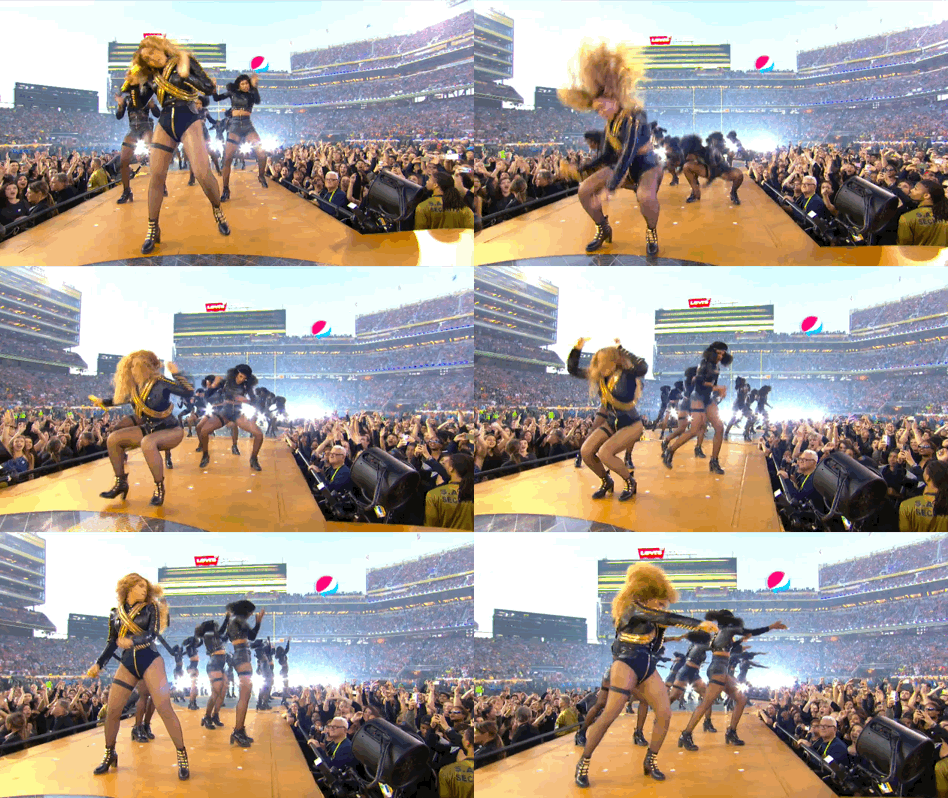
Remember, if you can, back to Super Bowl 2016. It was the Denver Broncos versus the Carolina Panthers, held in San Fransisco&039;s Levi&039;s Stadium. The halftime show was Coldplay featuring Bruno Mars and Beyoncé. You will probably not remember Coldplay, but you will remember this amazing moment where Beyoncé *almost* fell, but miraculously righted herself:

NFL / Via giphy.com

Beyoncé showed up in San Fransisco a few days before the Super Bowl, presumably to rehearse the show, which involves some complicated elements (Chris Martin&039;s tight henleys, unusual set designs, lots of dancers, etc…) She clearly needed a nice place to stay while she&039;s there. Some place nicer than just an anonymous hotel room… a comfortable place for her family to stay for a while.

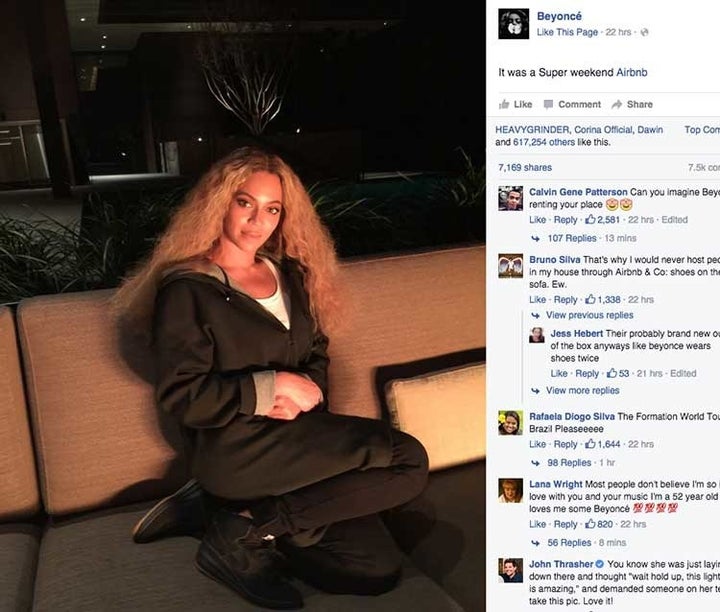
On her Facebook, Beyonce posted this photo with the caption, “it was a Super weekend @Airbnb”:

On her Facebook, Beyonce posted this photo with the caption, "it was a Super weekend @Airbnb":

Beyonce’s Facebook (now deleted)

It was quickly reported that the particular Airbnb that Beyoncé was staying at was this one, which rents for $10,000 per night. The house is just outside San Fransisco in the town right next to Mountain View, and it looks super nice.

THE EVIDENCE:

Beyoncé is too classy to shill for stuff on her social media, right? She&039;s no Scott Disick, she&039;s fucking Beyoncé. She&039;s not posting crap like teeth whitening lights or hair growth gummies on Instagram. Why would she start now, with Airbnb?

Perhaps she just loved this particular rental, and wanted to shout it out. And isn&039;t the term “Airbnb” kind of almost like Kleenex at this point —a generic term to describe “rental home”? So maybe it&039;s not so weird she&039;d tag the company.

But do we think she paid for it? The place is 10 G&039;s a night – something that basically ONLY a Beyoncé can afford. That&039;s chump change to her, but it&039;s still … a lot of money&;

On the other hand, does the NFL pay for her accommodations as part of her performance fee for the Super Bowl? It&039;s not unusual for travel and accommodation fees to be added onto a musician&039;s performance fee. Or sometimes a large flat fee is offered, and any travel/hotel costs are built into that.

The halftime show is sponsored by Pepsi, a company that Beyoncé has done ads for and in 2012 made a $50 million deal with. Perhaps part of the deal is that Pepsi paid for her stay.

Or do we believe that Beyoncé isn&039;t posting anything about any company for free? If she&039;s tagging them, she&039;s getting paid?

THE VERDICT:

It was a freebie&033; According to reps for Airbnb, Beyoncé was not paid to post about her stay. However, a source familiar with the situation told BuzzFeed News that her rental fee was comped by Airbnb (the host got paid).

“We’re huge fans of Beyoncé and we’re thrilled to see her Facebook post and hope she was crazy in love with her Airbnb listing,” Airbnb wrote in a statement at the time. This is, you&039;ll notice, doesn&039;t indicate whatsoever that Beyoncé wasn&039;t a paying Airbnb customer — to me, this statement implies the opposite, that she is a paying customer.

The FTC has rules – lots of rules – about how bloggers or social media stars are supposed to disclose if they&039;re getting paid to post about a product or company. But these are confusing, especially if it&039;s not a paid ad, but a free gift like a comped hotel room – something that celebs get all the time. The general rule of thumb, though, is that the average person should be able to tell if something is an ad or not.

I consider myself pretty knowledgeable on this kind of stuff, and I couldn&039;t really tell. Bobby Finger, host of the Who? Weekly celebrity gossip podcast, wrote in Jezebel that he wasn&039;t sure if it was an ad, either. If someone whose job is writing and podcasting about celebrity gossip can&039;t tell if this was an ad or not, then how is the average person supposed to know? Especially when Airbnb PR&039;s statement to the press at the time was so ambiguous. Airbnb did not respond to several requests for comment from BuzzFeed News, and when the Washington Post wrote about how the lack of clarity may be an FTC violation of advertising rules, Airbnb did not respond their request for comment on wither or not it was actually an ad.

Getting a comped hotel doesn&039;t obviously feel the same as, say, a $50 million contract with Pepsi to do TV ads. So it&039;s very possible Beyoncé probably didn&039;t think of her post about Airbnb the same way she does about doing a TV ad for Pepsi.

But the FTC maybe does, based on its own rules. Last week, Bloomberg reported that the agency plans on cracking down on confusing celeb ads on social media. But how it plans on actually doing this isn&039;t really clear, and Bloomberg talked to many people in the advertising industry who said that the rules themselves aren&039;t even that clear.

The FTC&039;s moves so far have been to only dole out violations to the brands or ad agencies, not the individuals. This means if the FTC decided that Beyoncé&039;s post violated the rules, then it&039;s Airbnb who is on the hook for the misdeed, not the singer. (The agency does not comment on individual cases to the press.) And even then, the FTC doesn&039;t act on this often — in only been a handful of cases so far has it gone after a company for social media violations (most recently Warner Bros. for having video game vloggers doing positive reviews without disclosure).

Would the FTC have preferred it if Beyoncé had written “I was gifted a free vacation rental by Airbnb, but not paid to post about it”? Yes, I&039;m sure they would have liked that. But are they going to go after Beyoncé or Airbnb for not doing that? Who knows&033;

EPILOGUE:

A few months later, Justin Bieber stayed at that same Airbnb. While he Instagramed photos from inside the house, he didn&039;t give an Airbnb shoutout like Beyoncé did. Did he also get it for free? Who knows&033; Stay tuned for future installment of Is This An Ad?

Quelle: <a href="Is This An Ad? Beyoncé And Her Super Bowl Airbnb“>BuzzFeed

Is This An Ad? Beyoncé And Her Super Bowl Airbnb

Welcome to our weekly column, “Is This an Ad?”, in which we strap on our reportin&; hat and aim to figure out what the heck is going on in the confusing world of celebrity social media endorsements. Because even though the FTC recently came out with rules on this, sometimes when celebrities post about a product or brand on social media, it&039;s not immediately clear if they were being paid to post about it, got a freebie, or just love it, or what.

THE CASE:

Remember, if you can, back to Super Bowl 2016. It was the Denver Broncos versus the Carolina Panthers, held in San Fransisco&039;s Levi&039;s Stadium. The halftime show was Coldplay featuring Bruno Mars and Beyoncé. You will probably not remember Coldplay, but you will remember this amazing moment where Beyoncé *almost* fell, but miraculously righted herself:

NFL / Via giphy.com

Beyoncé showed up in San Fransisco a few days before the Super Bowl, presumably to rehearse the show, which involves some complicated elements (Chris Martin&039;s tight henleys, unusual set designs, lots of dancers, etc…) She clearly needed a nice place to stay while she&039;s there. Some place nicer than just an anonymous hotel room… a comfortable place for her family to stay for a while.

On her Facebook, Beyonce posted this photo with the caption, “it was a Super weekend @Airbnb”:

On her Facebook, Beyonce posted this photo with the caption, "it was a Super weekend @Airbnb":

Beyonce’s Facebook (now deleted)

It was quickly reported that the particular Airbnb that Beyoncé was staying at was this one, which rents for $10,000 per night. The house is just outside San Fransisco in the town right next to Mountain View, and it looks super nice.

THE EVIDENCE:

Beyoncé is too classy to shill for stuff on her social media, right? She&039;s no Scott Disick, she&039;s fucking Beyoncé. She&039;s not posting crap like teeth whitening lights or hair growth gummies on Instagram. Why would she start now, with Airbnb?

Perhaps she just loved this particular rental, and wanted to shout it out. And isn&039;t the term “Airbnb” kind of almost like Kleenex at this point —a generic term to describe “rental home”? So maybe it&039;s not so weird she&039;d tag the company.

But do we think she paid for it? The place is 10 G&039;s a night – something that basically ONLY a Beyoncé can afford. That&039;s chump change to her, but it&039;s still … a lot of money&;

On the other hand, does the NFL pay for her accommodations as part of her performance fee for the Super Bowl? It&039;s not unusual for travel and accommodation fees to be added onto a musician&039;s performance fee. Or sometimes a large flat fee is offered, and any travel/hotel costs are built into that.

The halftime show is sponsored by Pepsi, a company that Beyoncé has done ads for and in 2012 made a $50 million deal with. Perhaps part of the deal is that Pepsi paid for her stay.

Or do we believe that Beyoncé isn&039;t posting anything about any company for free? If she&039;s tagging them, she&039;s getting paid?

THE VERDICT:

It was a freebie&033; According to reps for Airbnb, Beyoncé was not paid to post about her stay. However, a source familiar with the situation told BuzzFeed News that her rental fee was comped by Airbnb (the host got paid).

“We’re huge fans of Beyoncé and we’re thrilled to see her Facebook post and hope she was crazy in love with her Airbnb listing,” Airbnb wrote in a statement at the time. This is, you&039;ll notice, doesn&039;t indicate whatsoever that Beyoncé wasn&039;t a paying Airbnb customer — to me, this statement implies the opposite, that she is a paying customer.

The FTC has rules – lots of rules – about how bloggers or social media stars are supposed to disclose if they&039;re getting paid to post about a product or company. But these are confusing, especially if it&039;s not a paid ad, but a free gift like a comped hotel room – something that celebs get all the time. The general rule of thumb, though, is that the average person should be able to tell if something is an ad or not.

I consider myself pretty knowledgeable on this kind of stuff, and I couldn&039;t really tell. Bobby Finger, host of the Who? Weekly celebrity gossip podcast, wrote in Jezebel that he wasn&039;t sure if it was an ad, either. If someone whose job is writing and podcasting about celebrity gossip can&039;t tell if this was an ad or not, then how is the average person supposed to know? Especially when Airbnb PR&039;s statement to the press at the time was so ambiguous. Airbnb did not respond to several requests for comment from BuzzFeed News, and when the Washington Post wrote about how the lack of clarity may be an FTC violation of advertising rules, Airbnb did not respond their request for comment on wither or not it was actually an ad.

Getting a comped hotel doesn&039;t obviously feel the same as, say, a $50 million contract with Pepsi to do TV ads. So it&039;s very possible Beyoncé probably didn&039;t think of her post about Airbnb the same way she does about doing a TV ad for Pepsi.

But the FTC maybe does, based on its own rules. Last week, Bloomberg reported that the agency plans on cracking down on confusing celeb ads on social media. But how it plans on actually doing this isn&039;t really clear, and Bloomberg talked to many people in the advertising industry who said that the rules themselves aren&039;t even that clear.

The FTC&039;s moves so far have been to only dole out violations to the brands or ad agencies, not the individuals. This means if the FTC decided that Beyoncé&039;s post violated the rules, then it&039;s Airbnb who is on the hook for the misdeed, not the singer. (The agency does not comment on individual cases to the press.) And even then, the FTC doesn&039;t act on this often — in only been a handful of cases so far has it gone after a company for social media violations (most recently Warner Bros. for having video game vloggers doing positive reviews without disclosure).

Would the FTC have preferred it if Beyoncé had written “I was gifted a free vacation rental by Airbnb, but not paid to post about it”? Yes, I&039;m sure they would have liked that. But are they going to go after Beyoncé or Airbnb for not doing that? Who knows&033;

EPILOGUE:

A few months later, Justin Bieber stayed at that same Airbnb. While he Instagramed photos from inside the house, he didn&039;t give an Airbnb shoutout like Beyoncé did. Did he also get it for free? Who knows&033; Stay tuned for future installment of Is This An Ad?

Quelle: <a href="Is This An Ad? Beyoncé And Her Super Bowl Airbnb“>BuzzFeed

Trump Family Connection Raises Questions For Tech Investor Josh Kushner

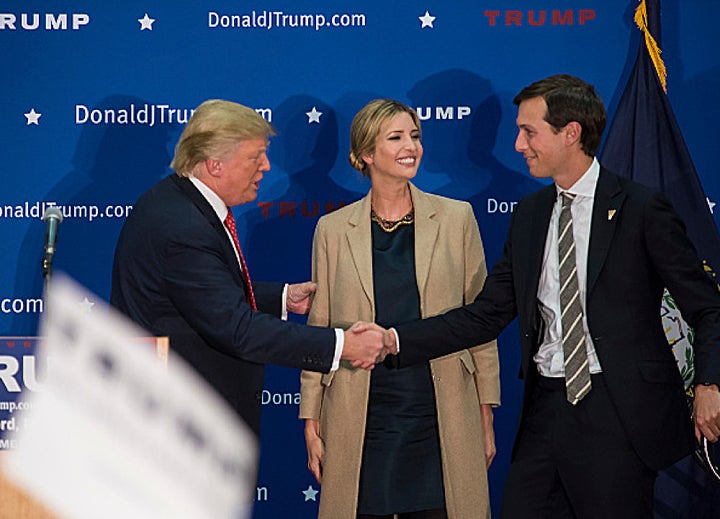
Donald Trump, Ivanka Trump, and her husband Jared Kushner (right)

Rick Friedman / Getty Images

For months Josh Kushner’s relationship to Donald Trump’s presidential campaign was an open question in startup circles. But this week the notoriously press-averse venture capitalist finally gave them an answer: Kushner — whose firm, Thrive Capital, has backed companies like Instagram, Slack, ClassPass, and Warby Parker — won’t be voting for Donald Trump, according to a recent Esquire profile of his brother Jared, husband to Ivanka Trump and “de facto campaign manager” to her father.

A spokesperson for the tech investor told BuzzFeed News: “Josh is a lifelong Democrat, but has remained silent during the election out of respect for his brother. His family means everything to him.”

And a source with knowledge of the fund said, “Neither Mr. Trump nor anyone in the Trump family is an investor in Thrive.”

These are not outright disavowals of Trump’s policies, but for an industry increasingly vocal in its antipathy for the Republican presidential nominee, they may have to suffice. And this leaves Kushner in an awkward position in Silicon Valley, where coming out against Trump has practically become a litmus test, and where just last month, 145 tech industry leaders signed an open letter condemning Trump.

Under ordinary circumstances, tech industry titans can stay on the sidelines, but Trump poses an extraordinary political threat, Sam Altman, president of Y Combinator, a prestigious Silicon Valley incubator, told BuzzFeed News.

“Everyone has to make a personal decision. I personally think, in this case, there is a moral imperative to take a side,” he said. “There’s such a clear cut decision between right versus wrong.”

Altman, who has supported some Republicans in the past, is also linked to high-profile tech startups, including Reddit, Instacart, Airbnb, and Dropbox, either through personal investment or through Y Combinator. In June he wrote a blog post calling Trump a demagogue and comparing the Republican presidential nominee to Hitler.

“I personally think, in this case, there is a moral imperative to take a side”

Altman said he liked Josh Kushner during the few times that the two investors have met.

“It’s always hard to have strong opinion [without] knowing someone’s full context and life,” Altman said in response to a question about whether Kushner should be more vocal about not supporting Trump, “but I will say in general I think people should be should be doing more and not less in this election.”

“Look I think that in a normal election there’s a long precedence for business leaders not taking a side for a lot of good reasons, but in this particular election,” Altman emphasized, “it’s in conflict with a very real chance of something happening that many people feel goes against everything they believe.”

Andy Weissman, a managing partner at Union Square Ventures who routinely communicates with Kushner about tech deals, not politics, said the current election has put startup financiers in an unprecedented situation.

“VCs are so weird — you’re just an investor, you’re not a political activist, you don’t have a political take one way or another,” Weissman said, “but some VCs are definitely becoming more active and vocal, and more are thinking [about whether they should take a stand].”
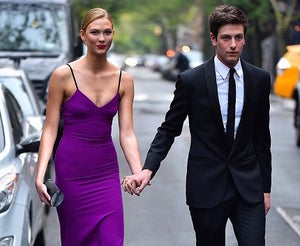
Joshua Kushner (right) and his girlfriend, supermodel Karlie Kloss

Alo Ceballos / GC Images

Sources who requested anonymity speculated to BuzzFeed News that the Trump connection was affecting Thrive&;s deal flow among startup founders who overwhelmingly oppose Trump. One investor mentioned a young company seeking funding who crossed Thrive off its list. But Kushner’s relationship with Trump doesn’t seem to have impacted Thrive Capital’s ability to close deals, based on the public track record. A month ago, Thrive announced that it had raised $700 million for its fifth fund, almost double the $400 million fund the firm raised in 2014. (Thrive launched in 2010 with a smaller $10 million.) In February, Oscar Health, the health insurance startup cofounded by Kushner, announced a $400 million investment from Fidelity

Stewart Butterfield, the CEO of Slack, arguably the hottest company in Thrive’s investment portfolio right now, said that Kushner’s connection to the presidential campaign was not a concern.

“Josh has always struck me as a genuine, thoughtful, and intellectually curious person,” he said in an email to BuzzFeed News. “It never even occurred to me that he would support Trump. I have a lot of sympathy for his position though. Family is complicated.” (Butterfield’s father was a military deserter who fled to Canada during the Vietnam War.)

“Family is complicated.”

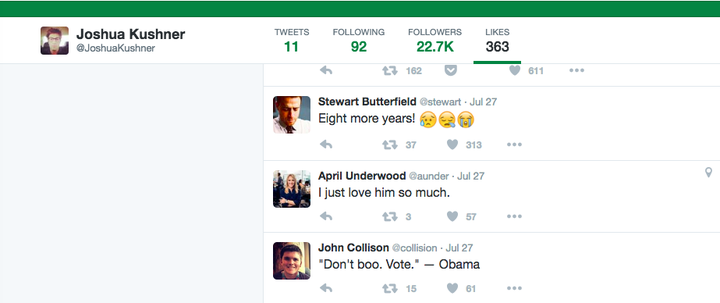
Prior to the Esquire article, the only way for outsiders to parse Josh’s position on Trump was to look at his Twitter history, including favoriting Butterfield’s anti-Trump and pro-Obama tweets and recently retweeting President Obama and Vice President Joe Biden.
Chris Sacca, a well-known investor in Uber and Twitter who bundled money for Obama, has been unrelenting in his censure of Trump. In his view, speaking out is easier for this strata of the tech industry.

“Most investors don&039;t have a boss to offend and are already living pretty comfortably,” he said in an email to BuzzFeed News.” [Therefore] investors have a higher responsibility than most to speak up and take advantage of their relative immunity from the public blowback that otherwise might impact the rank and file or those workers and students living check to check who dare take a public stand.”

Sacca said Kushner was “a very thoughtful and progressive guy,” and he admired him for “making clear that, despite what must be enormous family pressure to do so, he is not supporting Trump.” Without Kushner’s clarification about his voting preference, Sacca said the Trump connection might have affected Thrive directly. “For example, Peter Thiel&039;s speech at the RNC certainly didn&039;t help his Silicon Valley dealflow.”

Quelle: <a href="Trump Family Connection Raises Questions For Tech Investor Josh Kushner“>BuzzFeed

Facebook’s New App Is All About Getting Teens To Share Videos Of Themselves

Facebook is introducing a stand-alone, camera-first app that it hopes will spur teens to share short video about themselves. Sound familiar?

The app, called Lifestage, is not a Snapchat clone; it does not support messaging, a key Snapchat feature, and Facebook says it&;s not planning to change that any time soon. But after Facebook copied Snapchat twice in the past month — with Instagram Stories and its new video composer experiment — the similarities between the two are bound to raise some eyebrows.

Both apps are camera-first (meaning the start screen is a camera), both feature fun overlay filters, both encourage video sharing, and both are designed to appeal to teens.

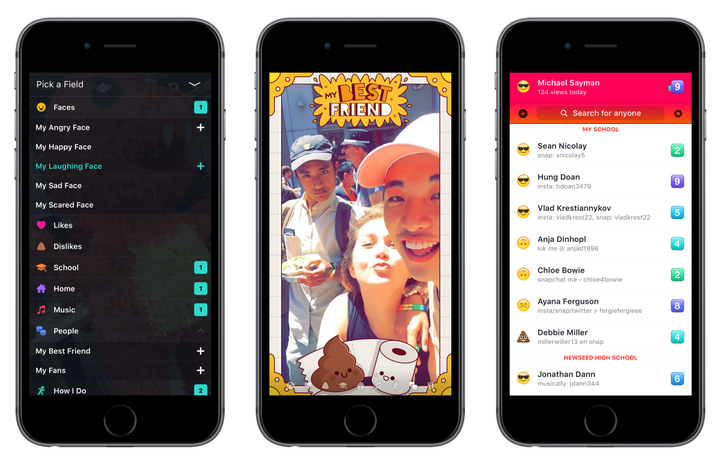
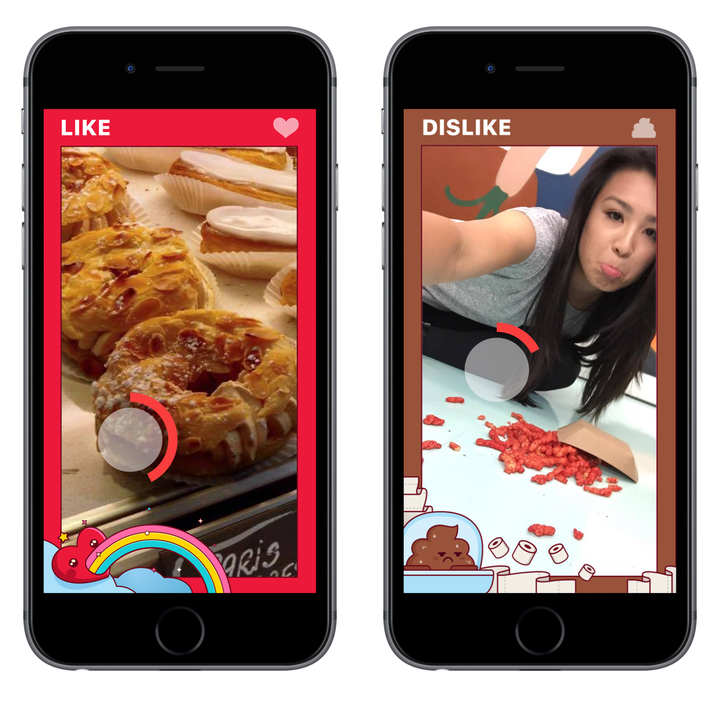
Lifestage is essentially a reimagined version of the early Facebook profile with short videos replacing photos and written descriptions. Instead of a Facebook profile picture, Lifestage features profile videos showcasing your happy face, angry face, laughing face, and sad face. Instead of the traditional set of textual Facebook likes, Lifestage will feature videos of things you like.

Michael Sayman, the 19-year-old Facebook product manager behind Lifestage, told BuzzFeed News that he wanted to create what the old Facebook experience would look like if it were to be built from scratch today. The app opens up with a camera screen, a key Snapchat similarity that Facebook admits is a more natural starting point for people looking to share video, which the company believes will soon become its primary content type.

Though Facebook is now a $350 billion company with 1.7 billion monthly active users, that evolution has dulled some elements that drove its early success. Original sharing, for instance, is declining on its platform. These days, the goofy candids and personal posts that defined Facebook&039;s first iteration are increasingly crowded out by posts from brands, celebrities, and professional media outlets. In June, Facebook changed its News Feed algorithm to emphasize stories from friends and family, a clear move to restore balance and a throwback to its early days. Lifestage is geared to bring back some of that early magic too.

Facebook is pitching Lifestage at high schoolers: When 20 or more students from the same school register for the app, they&039;ll be able to start browsing through their classmates&039; profiles. The app, which debuts today, will initially be available only in the United States and on Apple&039;s iOS platform.

While Facebook has released a number of stand-alone apps, only one has truly succeeded at market — Facebook Messenger, which debuted as a forced download for existing Facebook users. Meanwhile, the poor performance of experimental apps like Slingshot, Riff, Rooms, and a disappointing Snapchat clone called Poke led Facebook to shut down the Creative Labs division responsible for making them last year.

So launching an app like Lifestage after a string of stand-alone app failures seems a daunting prospect indeed. But creator Sayman is confident the app&039;s camera-first design will resonate with its intended audience. And if it doesn&039;t make a huge splash, there&039;s always version 2. “More than anything, I&039;m really curious to see what will happen and how will people react to this kind of experience,” he said. “It&039;s really an exploration of that [camera-first] world.”

Quelle: <a href="Facebook’s New App Is All About Getting Teens To Share Videos Of Themselves“>BuzzFeed

Instagram's Stories Is An Example Of Tech's Disgusting Anti-Lefty Bias

TBH, I think Instagram&;s new Snapchat-clone feature, “Stories”, is pretty good. There was a little bit of skepticism at first, but now that it&039;s been out for two weeks, people seem pretty into it. It&039;s fun to see people use Instagram in a more loose way without the pressure of feeling like you have to pick the perfect image for your feed. And Instagram has a big advantage for me over Snapchat stories: I follow way more people on Instagram already, so its stories are more fun since it&039;s a weird mix of people: celebrities, friends, randos, weird funny accounts.

But there is one thing that is FAR FAR FAR inferior to Snapchat:

It sucks for lefties.

I&039;ll explain: One of the cool features on Instagram stories is that you can easily go “back” to re-watch the previous person&039;s story as you&039;re tapping through. Snapchat doesn&039;t let you re-watch as easily – you have to go back to the homescreen and pick out the person you want to see again.

This maneuver is accomplished by tapping on the left-hand side of the screen. Left side tap means back, right side tap means forward.

A lefty tends to tap on the left side, which is “BACK”:

A lefty tends to tap on the left side, which is "BACK":

And herein lies the problem. If you&039;re a lefty, you&039;re more likely to be holding the phone in your left hand, tapping with your left thumb.

Since the left thumb is naturally closer to the left edge, you&039;re used to doing most general scrolling or tapping on the left edge. This means that you&039;re constantly accidentally hitting “back” and having to re-watch stories you don&039;t want to see again. If you want to go forward, you have to stretch your thumb across the screen, obscuring the visuals, or use another hand.

On Snapchat, you can only skip forward, but you can tap anywhere you please on the screen to skip ahead — no problem for lefties.

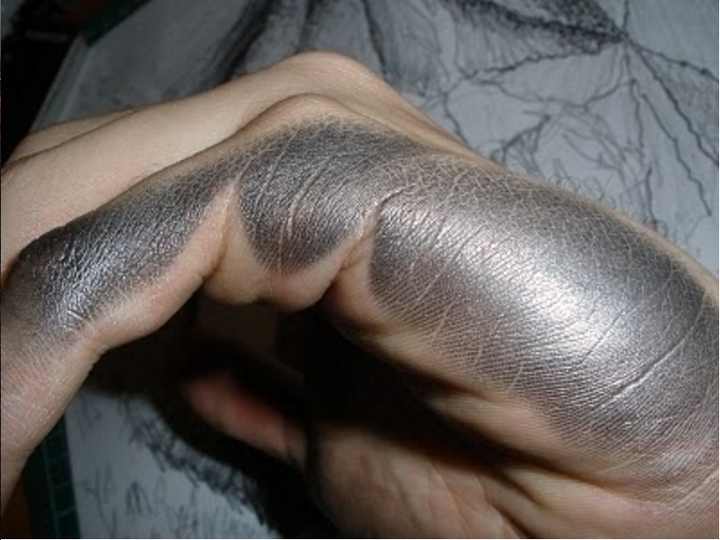
Silver pencil hand: the lefty&039;s curse in life.

Plenty of everyday objects have been inconvenient for the 1 out of 9 of the population who are lefties: can openers, spiral notebooks, school desks, scissors. We&039;ve learned to adapt (maybe that&039;s why we&039;re so much smarter).

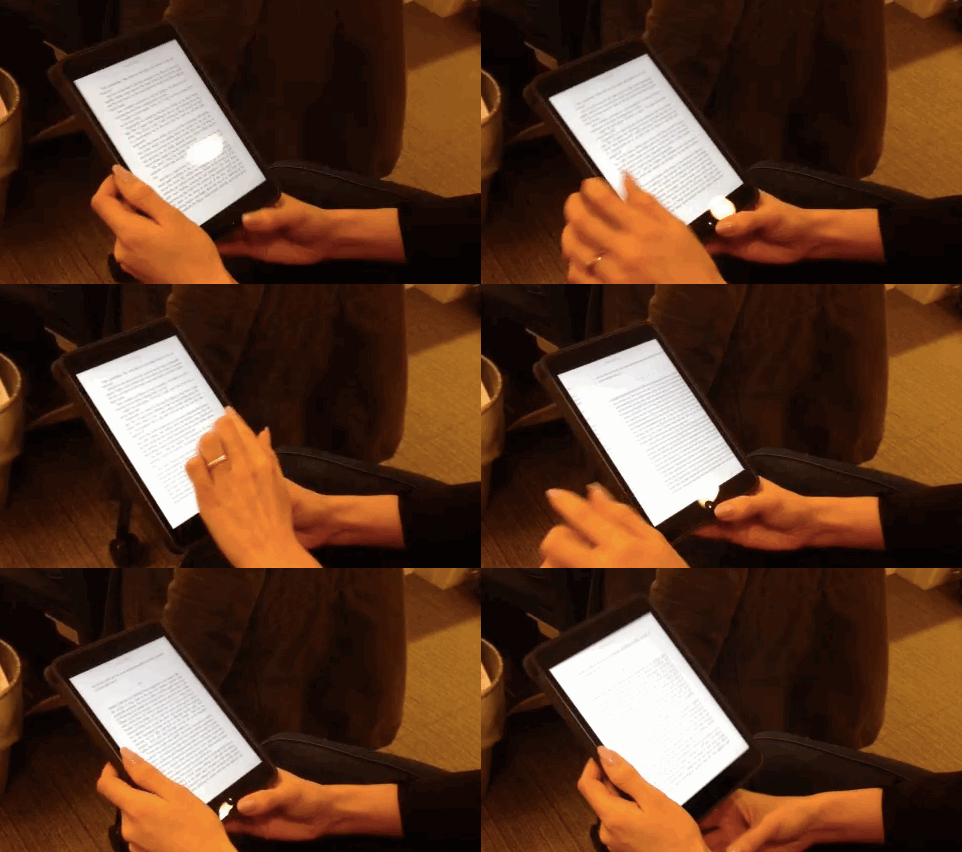
Technological devices have added a new layer of inconvenience. Basic things like computer mice are designed for righties. Certain devices have their own built-in bias: Kindle Paperwhite wants you to “turn” the page by tapping on the right side of the screen (left is “back”). Only older models are ambidextrous page turners. I mean, it&039;s FINE, you can still turn a page, but it&039;s far less comfortable and convenient for someone who wants to mostly hold the device in their left hand.

And the Kindle app for iPad also has the same page-turning bias:

Look, it&039;s not like lefties can&039;t use Instagram. This isn&039;t life threatening or dangerous or anything like that. Accidentally hitting “back” a few times while thumbing through your friends&039; pics isn&039;t the worst thing in the world.

But left-handed people account for 1 out of 9 of us&; For a service like Instagram with an estimated 500 million users, that means something like 55 million lefties are now accidentally bonking the “back” button on Stories.

Product designers and user interface designers should be considering left-handed users when they&039;re designing these new features.

Listen up, Instagram: we demand lefty rights&033;

Quelle: <a href="Instagram&039;s Stories Is An Example Of Tech&039;s Disgusting Anti-Lefty Bias“>BuzzFeed

Chatbots Have Yet To Live Up To Hype, Says Kik CEO

The bot revolution isn’t exactly taking off as planned, and that could mean trouble for the social businesses betting on it.

In a Medium post published earlier this week, Ted Livingston, CEO of messaging app Kik, looked back on the four months since his company and Facebook Messenger introduced chatbot platforms, and conceded they were off to a disappointing start. “So far, there has been no killer bot,” he wrote. “This is not yet the world that the early hype promised.”

For anyone who’s suffered through a stilted chatbot interaction, Livingston’s sigh of disappointment will hardly come as a surprise. What is surprising is that it&;s being made publicly — by the leader of a prominent company that&039;s placed a big bet on chatbots. Livingston does note that he&039;s still bullish on bots. But that seems a caveat to a longer expression of uncertainty. It&039;s clear that if the chatbot experiment continues along its current low-altitude trajectory, it could cause some headaches — especially for Facebook, it&039;s biggest proponent.

Original sharing is declining on Facebook, per reports, and the company is seeing more action in its messaging apps, making them, and bots by extension, more critical to its ambitions. “A lot of people want to share messages privately, one-on-one or with very small groups,” Mark Zuckerberg said in an April earnings call. Given this, Facebook will likely need to get more revenue out of Messenger and WhatsApp in order to keep growing at the same pace — especially since its main platform’s ad load is nearing capacity.

That’s where bots are supposed to come in. On Facebook proper, the company connects advertisers with their customers via ads that take them to the advertisers’ websites, or show them a video on Facebook itself. On Messenger, the company plans to connect advertisers with their customers via Sponsored Messages that take them to the advertisers’ bots. If people don’t want to use bots, though, advertisers won’t want to shell out cash to promote them.

“I think there’s opportunity,” said Jess Bahr, director of paid promotion and strategy at SocialFlow, a social media management software company. But she said she sees more value in an engaged user. “It’s almost like a more qualified audience.”

Still only four months in, it’s too early to write bots off. And now the platforms are starting to learn and adjust. As Livingston pointed out, maybe the “chat” part of the chatbot needs to be rethought. “Part of the misfire with the conversational aspect of bots has to do with the fact that natural language processing and artificial intelligence are not yet accomplished at managing human-like conversations,” he said. Tapping through interactions, as users of China-based WeChat’s users do, could be one alternative.

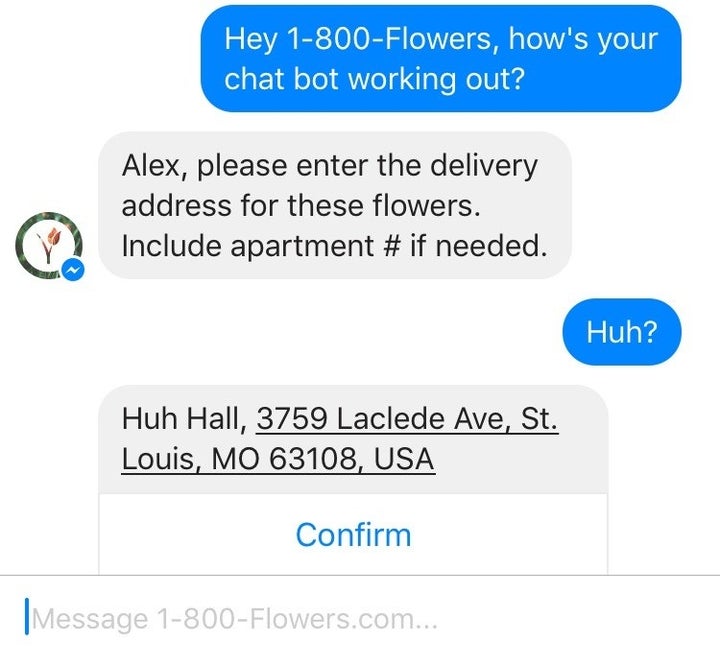
Asked if they would continue to invest in the bots, early Facebook Messenger partners 1-800-FLOWERS.com and Poncho (a weather bot) said they would. And Kik investor Fred Wilson wrote in a blog post Wednesday that he still believes in bots too. “The hype phase is over and we are now into the figuring it out phase,” he said. “That’s usually when interesting stuff starts to happen.”

For Facebook and its ilk, it’s important that he’s right.

Quelle: <a href="Chatbots Have Yet To Live Up To Hype, Says Kik CEO“>BuzzFeed

Cybersecurity Is Broken And The Hacks Are Going To Just Keep Coming

Ahmet Haluk Torun / Getty Images

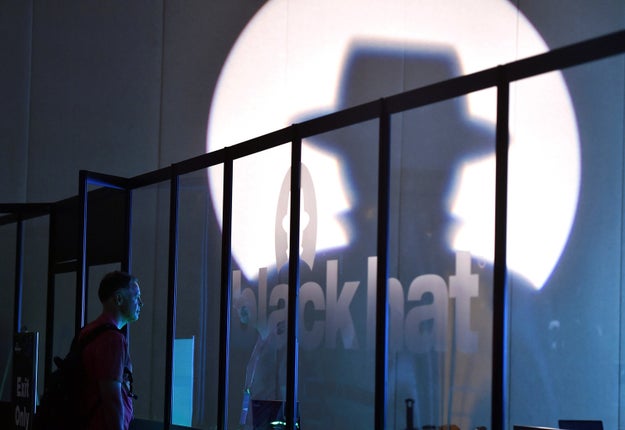
LAS VEGAS — The three CEOs sharing fruity cocktails are at the head of cybersecurity companies that bring in roughly $2 billion a year. But despite all the money their companies’ services bring annually, not one of them blinked an eye when presented with this statement: “Cybersecurity is a broken industry.”

“Sure, it’s broken, but it is also too big to break, you know?” one said. All three were enjoying their drinks at an off-record social event held during the Black Hat cybersecurity conference in Las Vegas. “Cybersecurity is really just security, in today’s world. And people will always spend money on security.”

Cybersecurity as an industry has grown by more than 20 times in the past decade, going from being valued at $3.5 billion in 2004 to $78 billion in 2015. Experts say this is only the beginning, and project it will nearly double its value again by 2017. Yet the digital world has never been less secure. The number of hacks, ranging in size and scope — from ransomware attacks that can be carried out by the most novice cybercriminal to sophisticated breaches carried out by state-sponsored hackers in China, Russia, and the United States — increase each year. And despite the rapid increase in dollars spent on cybersecurity, those leading the industry say they are less sure than ever if it is even possible to stop the attackers.

“The first thing we do is tell our customers that the hackers are already in their system,” Kevin Mandiant, CEO of the FireEye cybersecurity firm, told BuzzFeed News in an interview last year. But despite a boom in cybersecurity spending in 2016, FireEye reported earlier this month that its revenue is down, and has since seen its stock plummet. The company attributed it to the fact that simple ransomware attacks had increased, while the type of advanced, state-sponsored attacks that FireEye specialized in had not.

FireEye, along with a half dozen other companies, including Kaspersky, Trend Micro, Palo Alto, Fidelis and CrowdStrike, regularly publishes reports naming new hacking groups and the type of malware they use. But the reports, which are widely cited by cybersecurity experts and journalists alike, rarely attribute the attacks to a specific country or group, largely because they say that today’s technology makes it almost impossible to definitely say who was behind most cyberattacks (even if those attacks are on a major political party in the midst of a heated election).

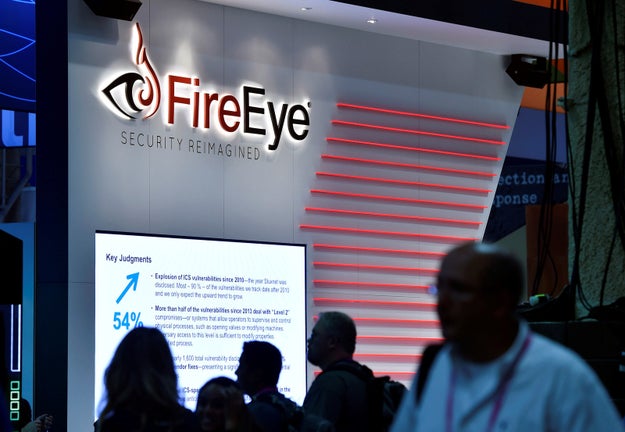
Attendees walk by the FireEye booth during the 2016 Black Hat cybersecurity conference.

David Becker / Reuters

If any evidence was needed for cybersecurity’s growing importance as an industry, you wouldn’t need to look much farther than the overcrowded booths on the stage floor at Black Hat and the VIP parties thrown by various corporations, ranging from Nike to Microsoft, that surround the event. The annual conference began as the more formal, industry-focused, sister to the unruly DefCon, or as it is sometimes called, hackers’ summer camp. If it seems weird that a conference for security professionals would be held back-to-back with the world’s largest hackers conference, then you don’t understand just how symbiotic the two groups are. Cybersecurity companies need hackers like defense companies need former army generals. At DefCon and Black Hat, cybersecurity companies compete with each other, throwing lavish parties at mansions and flashy Vegas nightclubs to draw the industry’s most notorious hackers into their boardrooms.

“Customers don’t know what cybersecurity advice or product to buy any more, the field is just so crowded, ” said Jeff Moss, a hacker also known as Dark Tangent. “This is the boom right now, we are [at] the peak of cybersecurity companies on the market.” Yet some of the biggest cybersecurity companies, including Symantec, Kaspersky, McAfee, and Trend Micro, had to make the embarrassing announcement last year that programs they were selling to their own customers actually contained vulnerabilities that would let hackers in.

“Half of all Americans are backing away from the net due to fears regarding security and privacy,” said cybersecurity expert Dan Kaminsky in his Black Hat keynote speech, citing a July 2015 study by the National Telecommunications and Information Administration. “We need to go ahead and get the internet fixed or risk losing this engine of beauty.”

The situation is even more dire in the developing world, where cybersecurity companies say ransomware attacks are running rampant. According to a recent report presented to journalists in San Francisco by the Helsinki-based F-Secure cybersecurity firm, the Philippines, Oman, and Malaysia rank among the top countries hacked each year. Considering the relatively low percentage of people in those countries who currently have access to the internet, what will happen in 10 to 20 years, as billions of new users in those countries come online?

An attendee looks on during the 2016 Black Hat cybersecurity conference.

David Becker / Reuters

Danny Rogers, CEO of the Terbium cybersecurity firm, told BuzzFeed News that problems that face the average internet user are going unaddressed. Instead, many of the top minds in cybersecurity are working for the government on programs looking for vulnerabilities within systems, which are then exploited to carry out intelligence work. The most valuable vulnerabilities are those known as zero-days: Those are the types of bugs that could allow a hacker to access every iPhone or Android on the planet. (To an intelligence agency, zero-days are worth millions of dollars, making the news this week that an unknown group had decided to make public a trove of zero-days linked back to the National Security Agency even more surprising.)

“The incentives are backwards,” Rogers said. “No one in the industry is incentivized to actually fix it.”

“The truth is, the bad guys are winning,” Samuel McKinley, a freelance cybersecurity researcher, said during a talk at Black Hat about a new mobile hacking technique. “Between the government not sharing what it knows, to companies hoarding what they know, the good guys are in the dark. While the bad guys, well, they trade ransomware and tips on the Dark Net.”

Moss, the hacker, said that what kept him up at night was what would happen in just a couple years from now, when the millions being made off of ransomware had been funneled back into criminal organizations looking to come up with ever more sophisticated hacks.

“Last year, $40 million was paid out to ransomware. This year, it is $200 million. Where is all that money going?” said Moss. “Some of it is going back into their R&D, and in a few years we might see really scary stuff.”

Quelle: <a href="Cybersecurity Is Broken And The Hacks Are Going To Just Keep Coming“>BuzzFeed