The Algorithm That Predicts What The Ultra-Wealthy Want

The pool at the Beverly Hills Hotel.

The Dorchester Collection

A computer told Ana Brant that the ultra-rich care deeply about their breakfast options. This came as a surprise.

Brant is the director of guest experience and innovation for the Dorchester Collection, a hotel group that counts among its properties the Beverly Hills Hotel, the Hotel Eden in Rome, and Le Meurice in Paris, where rooms start at $780 a night and wind their way up to over $16,000 for the Belle Etoile (“beautiful star”) suite. Her job, which she describes on LinkedIn as “the science of luxury service,” is to listen to the very wealthy people who stay in her company&;s hotels, so they keep staying there instead of, say, the Peninsula, the St. Regis, or the Mandarin Oriental.

Hotels of this kind throw mountains of money at celebrity chefs to build fine dining destinations. Dinner is the main event. Breakfast is often an afterthought. And yet here was big-data proof — delivered by machine learning software called Metis, which analyzes online customer reviews — that Dorchester Collection guests write way more about breakfast in their reviews than dinner.

The algorithm found that the ultra-wealthy actually do like the idea of a buffet — but only if it comes in the form of a waiter who says he can make anything.

Metis also found that guests loved to customize their breakfasts; they were, as Brant put it, “looking at breakfast menus as an inspirational list of ingredients.” So she went to her chefs. It turned out Metis was right: Dorchester kitchens reported that somewhere between 80 and 90% of breakfast orders are modified.

So today, when you sit down to breakfast at the Beverly Hills Hotel (which has 1,019 reviews on TripAdvisor, 298 on Booking.com, 235 on Yelp, and 294 on Expedia), a waiter comes up to you and asks what you want — they&039;ve got everything. No menu.

“Guests love it,” Brant said. “It&039;s a Hollywood crowd. Everyone has their own diet.”

And it&039;s all because of an algorithm, one that could signal a new way for customer service businesses to study their clientele: through the collection and analysis of their own words.

In the past, luxury businesses have had to rely on “secret shoppers” and customer feedback forms to improve their service. Now, Metis is taking the massive trove of consumer data on customer review sites like TripAdvisor and Booking.com and turning it into market research that will tell businesses what their elite clients want, before they know they want it. It began with a little bit of customer feedback. Around five years ago, as review sites started to flourish, David and Kyle Richey, who for nearly four decades have run the luxury consulting firm Richey International, noticed that their clients were aghast.

“Hotels that we were dealing with were starting to feel overwhelmed by the amount of data that was coming at them,” said Kyle Richey.

Hotels didn&039;t know how to handle the sheer volume of feedback on the sites and saw it as a headache. But the Richeys — whose clients include the Ritz Paris, Viking River Cruises, and the NFL — saw it as a potential source of value. “We realized that there is rich content within the reviews, but everyone was using them for PR value,” Kyle Richey said. “No one was using them for operational value or strategy, because it&039;s hard to read thousands of reviews and find the trends.” In other words, businesses were slapping positive Yelp reviews on their windows, not using the feedback to improve.

The Hotel Bel Air&039;s Swan Lake.

The Dorchester Collection

In 2013, the Richeys started meeting with text analytics firms in the Bay Area, where they&039;re based, to develop a way to turn reviews into advice. But all of the firms&039; proposals were overly complex. So they hired their own engineers to write machine learning software that could look for words and phrases that correlate with important customer service metrics like emotional bond and loyalty. Then they turned that software over to Werner Koepf, the senior vice president of engineering at Conversica, which makes AI for marketing and sales, to build a web app that their clients could use.

Finally, after two years and several million dollars of their own money, the Richeys were ready to demo Metis. Brant, their first client, was bowled over.

“I thought, Oh my goodness,” Brant said. “This is going to be the most amazing thing ever.

In June 2015, Brant took a Metis demo comparing six ultra-luxury hotels in New York to a meeting of Dorchester Collection general managers in LA. The managers were impressed, particularly by a finding that a “super iconic and amazing hotel had a serious issue with leadership — people were running away when a customer complained.” They approved a Metis study on the spot.

So the Richeys ran Metis on over 8,000 TripAdvisor reviews, some on Dorchester hotels and some on competitors. That&039;s what led Brant to the realization that the ultra-wealthy actually do like the idea of a buffet — choosing exactly what they want — but only if it comes in the form of a waiter who says he can make anything.

“If you want to continue to be a true luxury, you have to figure out a way to draw insights that no one has ever had.”

Metis&039;s findings went further than breakfast. The analysis found that words related to relaxation and unwinding were closely correlated with words related to emotional bond and loyalty (words like “recommend” and “return”). In reviews of the Dorchester-owned Hotel Bel-Air, the software found that guests frequently mentioned words like “relaxation,” “unwinding,” and “pampered” alongside descriptions of patios, terraces, and fireplaces. Brant realized that photos on the hotel website didn&039;t emphasize the rooms&039; outdoor features — a situation she quickly changed. Now the Dorchester Collection places Google keyword bids on words such as “fireplace” and “terrace.” (Companies pay Google for ads to show up next to search results for certain words.)

If the changes prompted by Metis seem granular — some music in the hotel bar here, an easily selfied vantage point there (“If the customer can’t insinuate himself into the view, it doesn’t exist,” said David Richey) — that&039;s sort of the point. The hidden desires of ultra-high-end hotel customers, who are used to an extraordinarily high standard of service, come down to the details. Differentiation happens at the margins.

“If you want to continue to be a true luxury,” Brant said, “you have to figure out a way to draw insights that no one has ever had.”

Yes, luxury hotels now have at their disposal a computer program that can divine the small details to lure the, as Brant put it, “C-suite executives, A-list celebrities, fashion executives, politicians, and notable businessmen” away from their competition.

The red carpet at the Beverly Hills Hotel.

The Dorchester Collection

And who, exactly, will be drawing these insights and adjusting these details? So far, the Richeys have used Metis for about 15 clients, including Viking River Cruises and a “major sports league.” That&039;s not for lack of demand: Kyle Richey said Metis has received “strong interest from major brands, including a very well-known Swiss jeweler.” The Richeys stressed, though, that the tool is in its early days and that they want to proceed slowly.

That said, their goals are huge. “My hope is that it will change the nature of market research,” Kyle Richey said.

That would mean, presumably, broadening Metis&039;s use past luxury industries and into the larger world of customer service. Could we one day soon see major changes to the Cheesecake Factory and Foot Locker based on an algorithm&039;s analysis of thousands of online reviews?

Perhaps, but don&039;t ask Ana Brant.

“I&039;ve always been in luxury,” Brant said. “I&039;m not sure what triggers the masses.”

Quelle: <a href="The Algorithm That Predicts What The Ultra-Wealthy Want“>BuzzFeed
EU’s Antitrust Chief Rejects Claims Of Political Bias In Apple Tax Ruling

John Thys / AFP / Getty Images

One CEO’s anti-American “political crap” is another regulator’s equal-opportunity enforcement.

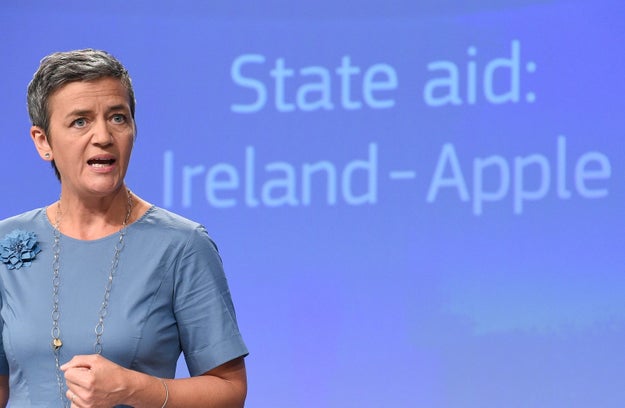
Margrethe Vestager, the European Union’s Competition Commissioner, defended a massive tax ruling against Apple Tuesday, swatting away criticism that EU actions against US companies are politically motivated.

“There are no numbers to back up any kind of bias.”

“I must admit I know that it is tempting and I register the feelings and the concerns too, but there are no numbers to back up any kind of bias,” Vestager said during an antitrust conference at the Georgetown University Law Center. “We make sure that the market works no matter the ownership, private or public, the size, or the nationalities of the companies.”

Last month the executive arm of the EU ordered the Irish government to collect $14.5 billion in unpaid taxes from Apple. Following a two year investigation, European officials concluded that Apple had received undue tax benefits not offered to other companies, a sweetheart deal it had determined to be illegal under European law. “We have rules to stop governments from giving out favors to a handful of companies at the expense of everyone else,” Vestager said.

Josh Edelson / AFP / Getty Images

Soon after the ruling was made public, Apple CEO Tim Cook slammed the decision as “political crap.” Cook rejected the figures used to generate the dollar amount owed and cited anti-American bias as one reason behind the adverse decision. “[W]hat I feel strongly about is that this decision was politically based, of that I’m very confident. There is no reason for it in fact or in law,” he told the Irish Independent. Apple did not immediately respond to a request for comment.

But in her remarks at Georgetown, Vestager defended the EU’s record as a neutral enforcer of antitrust rules. She said that in the past 15 years, the EU has brought about 150 illegal state aid decisions, but only a fraction of them were made against US companies. “I know that you do not have this concept in the states, that it’s a common thing for companies to negotiate their tax regime in the state that they locate, this is the difference of opinions of looking at what is fair and reasonable,” she said. “But when we are in Europe we have European rules and everyone is to play by European rules.”

Like Cook, government officials and lawmakers in the US have not been persuaded by Vestager’s assurances. The Treasury Department said the decision against Apple could threaten the “important economic partnership between the US and the EU.” The agency has also raised criticism of ongoing investigations into other American companies operating in Europe, including Amazon and Starbucks.

And after meeting with Vestager on Monday, Sen. Orrin Hatch, the chair of the Senate Finance Committee described the European ruling as running “roughshod over an American firm,” in a statement sent to BuzzFeed News. “Though our meetings were cordial, the Commissioner failed to build an effective case for this highly politicized ruling rooted in an erroneous interpretation of law, underscoring the need for additional action in international courts.”

Quelle: <a href="EU’s Antitrust Chief Rejects Claims Of Political Bias In Apple Tax Ruling“>BuzzFeed

The Federal Government Releases Standards For Autonomous Vehicles

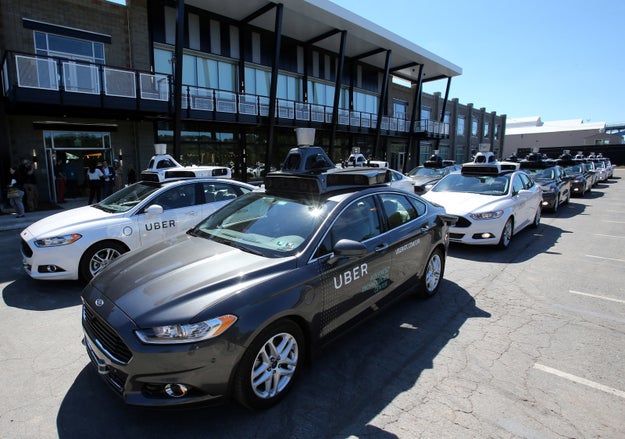
A fleet of Uber&;s Ford Fusion self driving cars are shown during a demonstration of self-driving automotive technology in Pittsburgh, Pennsylvania, U.S. September 13, 2016.

Aaron Josefczyk / Reuters

The federal government released 116 pages of guidelines for self-driving cars on Tuesday, outlining broad goals and questions companies must answer for regulators on the safety of their technology and how it handles ethical dilemmas.

The guidelines, which are more of a set of recommendations than a rulebook with specific benchmarks, list a 15-point safety assessment and several other expectations: Companies should record and share data on crashes and near-misses, and be prepared to reconstruct them. They should be programmed to deal with somewhat common road scenarios, such as direction of traffic by a police officer, or disabled vehicles in a lane. And they should include fallback plans for when the technology is malfunctioning, such as directing the vehicle to a safe place and stopping.

“We believe we have struck the right balance between safety and innovation,” US Department of Transportation Secretary Anthony Foxx said on a call with reporters.

In “several months,” the agency will move toward turning the recommendations into rules, Foxx said at a press conference. The framework comes at a time when companies are racing to put self-driving vehicles on the road. Uber launched a pilot program in Pittsburgh last week, becoming the first company in the US to let people hail rides in self-driving cars, and Google has been testing its autonomous vehicles in several states for years.

“We believe we have struck the right balance between safety and innovation.” — US Department of Transportation Secretary Anthony Foxx

The industry has been waiting for the Department of Transportation to release standards for autonomous vehicles, particularly since the federal government opened two investigations into a fatal Tesla crash earlier this year to determine whether its semi-autonomous technology played a role. Tesla has called Autopilot, its advanced driver assist system, an incremental step toward self-driving cars. At the same time, Autopilot doesn’t fulfill the promise implied by that term – by definition, a technology that can drive itself in place of a person.

The new federal guidelines also address “highly automated vehicles,” including technology like Tesla’s that expects humans to remain on guard to take the wheel at any time, and note that manufacturers should account for both misuse and the fact that people could become complacent if technology has taken over some of their duties. (Earlier this month, Tesla said it plans to update Autopilot to put limits on how long people can go hands-free. If people don’t heed warnings to keep their hands on the wheel, the car will disable Autosteer until it is parked and reengaged.)

Companies already testing vehicles will be given a period of time to send the DOT their responses to the new guidelines and the safety assessment.

Regulators pointed out that they won’t hesitate to crack down on vehicles if they find a company is putting unsafe technology on the road. “Our enforcement authority stands strong and it will be used to its full effect as needed,” Mark Rosekind, head of the National Highway Traffic Safety Administration, told reporters on a conference call. “We have defect recall authority, and we’ll use that to its full effect.”

The policy also asks states to write laws that allow for the safe testing of self-driving vehicles, but to otherwise leave these vehicles’ regulation to the federal government. For fully autonomous vehicles, states won’t need to regulate licensing because the software would be the driver.

When asked for comment, Uber directed BuzzFeed News to a statement released by the Self-Driving Coalition For Safer Streets, an industry group that the company is part of. Google did not return a request for comment.

“We support guidance that provides for the standardization of self-driving policies across all 50 states, incentivizes innovation, supports rapid testing and deployment in the real world,” the coalition, which also includes Google, Lyft, and Ford, among others, said in a statement. Joe Okpaku, vice president of government relations at Lyft, which is developing self-driving cars with General Motors, called the guidelines “a step in the right direction” in a statement.

Quelle: <a href="The Federal Government Releases Standards For Autonomous Vehicles“>BuzzFeed

Anti-Defamation League Boosting Presence In Silicon Valley

WASHINGTON — The Anti-Defamation League is placing a representative in Silicon Valley to work on cyber hate and harassment issues, BuzzFeed News has learned.

The move comes after significant trolling, particularly on Twitter, of Jewish journalists and other public figures, amounting to a wave of anti-Semitic expression not seen in the American conversation for decades — and as tech companies struggle to reckon with their role in regulating abusive speech.

“As a leading civil rights advocacy organization, ADL was early to recognize the burgeoning issue of cyberhate and how extremists were exploiting online platforms to spread antisemitism and target Jews as well as other minorities,” said Brittan Heller, who will become the group’s first Director of Technology and Society, in a statement. “From its first report on these cyberhate more than 30 years ago to this year’s work tracking the harassment of journalists on social media, ADL has demonstrated its commitment to ensuring our online communities are a safe and just place for all.”

Heller is a former cyber crime and human rights investigator and prosecutor, has also been a high-profile victim of online harassment. While she was at Yale Law School, she was subjected to sexual harassment on a law school messaging board. She and another student sued the board’s administrator as well as anonymous commenters for invasion of privacy and defamation. Heller and the other plaintiff settled with the defendants in 2009.

“We&;ve really doubled down on the work that we&039;re doing to deal with this new emerging and metastasizing trend of online harassment and cyber hate,” said ADL director Jonathan Greenblatt in an interview with BuzzFeed News, calling what has been happening on social media “breathtaking and downright scary.”

The 103-year-old ADL has traditionally focused on combating anti-Semitism, an issue that has been in the spotlight this year as Donald Trump’s candidacy has had the effect of empowering online trolls. The organization conducted an online harassment survey of journalists over the summer.

“We&039;ve had some wins with companies,” Greenblatt said, citing its participation in Twitter&039;s Trust and Safety Council and its working with Google to take down the Chrome extension which enabled users to place parentheses around Jewish names, a common device employed by the alt-right. The ADL declared the parentheses used in this way to be a hate symbol.

The group has been vocal during this election cycle about highlighting the issue of online harassment, forming a task force to investigate bigoted harassment of journalists in June and participating in SXSW’s Online Harassment Summit.

Quelle: <a href="Anti-Defamation League Boosting Presence In Silicon Valley“>BuzzFeed

Twitter Just Made Your Tweets A Little Longer

It’s official: Images, GIFs, videos, polls, and quoted tweets no longer count against your tweet’s 140-character limit.

Back in May, amid rumors that it would extend the character limit to 10,000 characters, Twitter announced that it planned to lengthen tweets by excluding media from the character limit. That change is now live. One exception: linking to another tweet still uses up your precious characters, since links still count against the limit.

The Verge reports that handles contained within replies will not count towards character limits, including replies with multiple handles. This specific feature is not live for all users yet, according to Recode.

Quelle: <a href="Twitter Just Made Your Tweets A Little Longer“>BuzzFeed

Your Voice Can Control GoPro's New Hero 5 Camera

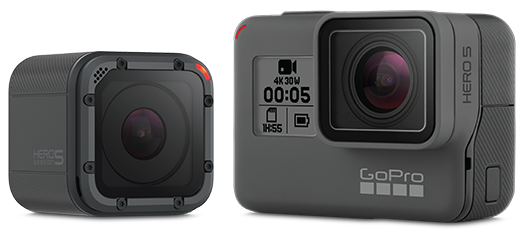
GoPro just unveiled two new cameras: the Hero 5 Black ($400) and the *slightly* more affordable Hero 5 Session ($300).

GoPro just unveiled two new cameras: the Hero 5 Black ($400) and the *slightly* more affordable Hero 5 Session ($300).

GoPro

GoPro is known for its rugged, outdoor sports-friendly cameras and its newest releases are no different. Both cameras also come something a little extra: voice control. Here&;s what you need to know about GoPro&039;s latest.

Both cameras are waterproof and can shoot 4k footage at 30 frames per second.

The Hero 5 Black and Hero 5 Session have the same water-resistance rating: submersion up to 10 meters (or 33 feet) without a separate housing case. Previously, GoPro&039;s most advanced camera, the Hero 4 Black, needed a protective case to protect it from water exposure.

The cameras also have the same video recording capabilities at 4K resolution and stereo microphones. GoPro has also dropped micro USB ports in favor of USB-C. The Hero 5 Black also has a micro HDMI port.

GoPro is introducing two new features: voice control and digital image stabilization.

Voice control offers hands-free control of the cameras. You&039;ll be able to say, “GoPro, take a photo” or “GoPro, start recording” in English, as well as German, French, Italian, Spanish, and Chinese.

The cameras also have video stabilization built-in for the first time. The software can produce smoother video capture than previous models.

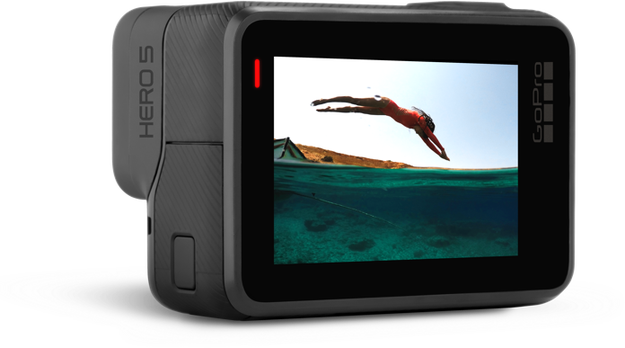
The Hero 5 Black has a two-inch touchscreen and more advanced photo/video capabilities than the Session.

The Hero 5 Black has a two-inch touchscreen and more advanced photo/video capabilities than the Session.

GoPro

The Hero 5 Black has a touch display for changing settings, editing footage, and reviewing stills and clips, while the screen-less Session has a dedicated button for recording and is controlled through the companion GoPro mobile app.

The Hero 5 Black has the same photo/video capabilities of its predecessor, the Hero 4 Black: 12 megapixels for stills and, in addition to 4K at 30fps, 1440p video at 80 frames per second, and 1080p video at 120 frames per second – but is $50 less than the Hero 4 Black&039;s original $450 price.

Additionally, the camera also includes GPS for location capture and the ability to take photos in RAW or WDR mode.

It can capture 10 megapixel photos (vs. 8MP), and 1440p at 60 fps (vs. 30) and 1080p at 90 fps (vs. 60), as well as 4K video, which was not available in the first-generation Session.

GoPro

The drone, which can fly up to 400 feet high, 1000 feet away, can fold up and fit into a backpack that GoPro includes with the flying gadget. It costs $799 on its own.

The Hero 5 Black and Hero 5 Session will be available starting October 2 on GoPro.com.

Quelle: <a href="Your Voice Can Control GoPro&039;s New Hero 5 Camera“>BuzzFeed

How A Failed Hospital Algorithm Could Save Lives

Thomas Northcut / Getty Images

Sepsis is one of the biggest hospital hazards you’ve maybe never heard of. When the body overreacts to an infection, it can trigger widespread inflammation that can in turn cause tissue damage and organ failure. It causes one-third to one-half of all deaths in US hospitals.

But because sepsis’ symptoms, like fever and difficulty breathing, sometimes look a lot like other illnesses, it can be hard to detect, especially in the early stages. So a team at Banner Health, a hospital system in Phoenix, Arizona, turned to computer science for a solution. Maybe they could develop an algorithm that constantly monitored electronic health records and warned hospital staff in real time when patients were at high risk for sepsis.

It didn&;t work. At least, not in the way Banner had hoped for.

Five years after Banner put the alert in place, it turns out to not have done a very good job of diagnosing sepsis. But the team behind it, led by Dr. Hargobind Khurana, discovered it had an unexpected upside: It was good at identifying patients who were generally much sicker than average, even if they didn&039;t have sepsis. Although the alert mostly failed at its main goal, it ended up having a different, perhaps even more powerful potential: steering clinicians to their most vulnerable patients.

Compared to patients who didn’t set off the alert, those who triggered it had four times the chance of dying the next day.

Algorithms have infiltrated almost every part of our lives, quietly yet deftly shaping both the mundane — calendar alerts, Facebook ads, Google predictions — and the vital. One of the most critical roles algorithms play is in electronic medical record software, which hospitals and doctor’s offices use to track and manage patients’ health and illnesses. Algorithm-based alerts are supposed to point out important information hidden in mountains of data — things like when someone’s medication needs to be refilled, or when a patient has an unusually high heart rate.

At their best, these alerts save busy doctors and nurses precious decision-making energy and draw attention to dangers that would otherwise go unnoticed. Too often, however, they dilute their usefulness and urgency by beeping, buzzing, and flashing tens of thousands of times a day, often without a good reason.

Banner Health’s experiment demonstrates some of the core challenges of merging health care with 21st-century digital automation. It’s a continuing struggle despite the fact that the US government has poured billions into digitizing medical records in hopes of making them safer over the past few decades.

“It’s hard to create a good alert. And it’s hard to get buy-in from doctors and nurses because it’s ‘just another thing’ to do,” Khurana, Banner’s director of health management, told BuzzFeed News. “How do we keep that balance of not just expecting them to do more and more work, but how do we make sure the patient is taken care of? … How good do the alerts need to be? … Everybody in the health field is trying to figure out the answer to this.”

Moodboard / Getty Images

Banner Health started working on the alert in 2009; Khurana joined two years later. At first, they looked at the common criteria for sepsis and organ dysfunction, like high breath and heart rates, unusually high or low body temperature, and off-balance chemical levels in someone’s blood and organs. Then they used this criteria to design an alert that continuously analyzed electronic medical record data from medical device sensors and other sources. The alert would fire whenever a patient showed two of four symptoms for sepsis and at least one of 14 symptoms for organ dysfunction — if both of those things happened within eight hours of each other.

Khurana added the alert to Banner Health’s Cerner electronic medical record software, which, like other programs, comes with its own built-in alerts (but did not at the time have a sepsis alert). From April 2011 to June 2013, the sepsis algorithm monitored more than 312,000 patients across the emergency department, inpatient, and intensive care units of Banner Health’s 24 hospitals.

Weary, overworked staff are prone to ignore even alerts that point out signs of danger.

Not everyone was thrilled, Khurana recalls. Some nurses and doctors complained that not every patient flagged by the algorithm actually had sepsis — but the caregivers still had to evaluate the patients, override the alerts, and document it. Those steps may take just a few minutes, but the many false alarms made some staff members doubt if the algorithm was working at all.

A colleague who helped develop the alert, Dr. Nidhi Nikhanj, recalls similar sentiments. “There was certainly was a lot of skepticism, especially from those who had to actually answer the alerts, because of the extra workload it would bring on our shoulders,” he said.

These clinicians were grappling with a widespread phenomenon in health care dubbed “alarm fatigue.” In a 2013 report, the Joint Commission, a health care accreditation nonprofit, found that several hundred of alerts can fire per patient per day, which amounts to tens of thousands of buzzes or beeps throughout an entire hospital every day. But 85% to 99% of these warnings don’t actually require clinicians to intervene, often because the alerts&039; settings are too narrow or broad to correctly identify patients in need. Weary, overworked staff are then prone to ignore even alerts that point out signs of danger.

Alerts are best when they “continually tell physicians what they’re really not aware of,” said Lorraine Possanza, a risk management analyst at the ECRI Institute, a nonprofit that studies patient safety issues. “If you’re continuing to give them info they already know, the likelihood of them bypassing that alert, or ignoring the alert, or becoming overwhelmed by the number of alerts, is just much more likely.”

This May, nearly five years after the experiment started, Khurana’s team crunched the data and published the results in the American Journal of Medicine. His colleagues’ complaints had been partly accurate: The alert didn’t always flag patients with sepsis. More precisely, only about one-quarter of patients the alert flagged had the condition.

The patients identified by the alert did turn out, however, to be much sicker than average in general. This correlation wasn’t completely surprising, given how sepsis symptoms are known to overlap with other severe illnesses.

The algorithm identified a small minority of patients who accounted for nearly 90% of all deaths in the hospital.

But Khurana was taken by just how sick this group was by virtually every measure. The algorithm identified a small minority of patients — about one-fifth — who accounted for the overwhelming majority — nearly 90% — of all deaths in the hospital. Compared to patients who didn’t set off the alert, those who triggered it had four times the chance of dying the next day. They were also more likely to suffer chronic medical conditions, such as chronic kidney disease and obstructive pulmonary disease, and to stay in the hospital twice as long.

“We expected it would be sicker patients, and the rates would be higher, but not this high,” Khurana said. In other words, the data showed that the alert had the potential to bring sick, in-need patients to clinicians’ attention — just not quite the patients that the Banner Health team had first set out to find.

Since the initial data analysis of the alert in early 2014, clinicians at Banner Health have come to perceive the algorithm in a new light, Khurana said. The question it used to prompt, as he put it, was: “‘Does a patient have sepsis?’ If not, move on.”

Now, he said, the alert inspires clinicians to take a second look and ask themselves, “Is the patient sicker than what I expected? Is there anything I can do to look at a patient’s care plan and do things differently?” Khurana said those things include moving a patient to an intensive care unit, checking in on them more frequently, and re-evaluating their diagnosis and treatment.

Brianajackson / Getty Images

The team hasn’t crunched the numbers yet to definitively know how, or if, these interventions are improving patient health. But after seeing the first set of results, staff members are more willing to embrace the algorithm’s potential. “Because of a new enthusiasm and renewed interest in this, we were able to get a lot more buy-in,” Khurana said.

Electronic health record alerts are near-perpetual works-in-progress — as unnerving as that might be to hear.

While his team still wants to create a fully functioning sepsis alert, their main focus at the moment is refining the original algorithm to better identify the sicker-than-average patients. One insight from the first time around, for example, was that patients who triggered the alerts and had elevated lactic acid levels were likelier to die than alert-triggering patients with normal levels. (High levels can mean that the body is not getting enough blood supply.)

Taking this into account, their revamped alert doesn’t fire if a patient has normal lactic acid levels, and generally has stable vital signs. It’s too early to know if the tweak has made the algorithm more accurate or helped save more lives; answers to those questions will be revealed in future studies. But there are promising signs so far. “This has helped us filter out a lot of the false negatives,” Nikhanj said.

What Banner learned is that electronic health record alerts are near-perpetual works-in-progress — as unnerving as that may be for patients to hear. It’s likely that no one will ever come up with a set of algorithms that saves patients’ lives 100% of the time, but clinicians and programmers can’t stop trying to get there.

Depending entirely on algorithms was never the point, anyway. The goal, says John Gresham, a vice president at Cerner, the company making Banner Health’s electronic health record software, is to “guide the clinicians to make a different decision or to intervene more quickly. Not [to] take care out of the hands of the physician, but guide them to make a better clinical outcome.”

Quelle: <a href="How A Failed Hospital Algorithm Could Save Lives“>BuzzFeed

Backseat Driving With The Head Of Uber's Autonomous Car Team

Backseat Driving With The Head Of Uber's Autonomous Car Team

View Video ›

Facebook: video.php

PITTSBURGH — Anthony Levandowski, head of Uber&;s self-driving car team, folds his 6-foot-7-inch-frame into one of Uber’s new self-driving Ford Fusion hybrids for another ride-along through downtown Pittsburgh, Pennsylvania. He&039;s just finished up a trip with city Mayor Bill Peduto, and he&039;s visibly tired. Settling himself in the car&039;s backseat, he jokes that he&039;s looking forward to the rollout of Uber&039;s autonomous Volvo XC90 SUVs: Soon, he’ll actually fit comfortably inside one of the cars in his fleet.

Last week, Uber became the first technology company in the US to let people hail rides in self-driving cars. That&039;s quite a feat, considering Uber only opened the Pittsburgh Advanced Technologies Center that birthed the project about 18 months ago.

For Levandowski, the transition has been even quicker. He officially joined Uber last month, when the company acquired his autonomous truck startup, Otto. In a past life, Levandowski was the guy who built Google&039;s very first self-driving car. Now he&039;s quarterbacking Uber’s bet on autonomous vehicles.

It&039;s a big bet. But there&039;s still a lot of work to be done. Each self-driving car in Uber&039;s Pittsburgh pilot is manned by a safety driver (ready to take the wheel or hit the brakes during emergencies) and a co-pilot (to monitor the car and its route on a laptop).

“We still have a long way to go before the technology’s truly ready to take over, before nobody’s in the car,” Levandowski says.

Uber is looking at two core metrics to evaluate its self-driving cars’ performance: how long they can go before a human driver intervenes for any reason, and how long they can go without a “critical intervention” — basically, without having an accident.

“You have a number for both of those before you feel like the product is ready for launch without a safety driver,” Levandowski explains. “I’m not going to tell you where we’re at on those metrics or what the goals are, but that’s how we think about it.”

Regardless of where Uber currently stands on those goals, it’s clear that a fully autonomous future — or even a more autonomous one — is quite a ways off. Indeed, Levandowski says human drivers and human Uber drivers will be around for a long time.

“In a world where car ownership kind of goes away and you use Uber for all your transportation needs, you’re going to need more drivers than you have today on the Uber platform,” he explains. “The fraction of drivers might change over time, but we anticipate having a huge need as far as maintaining and servicing the vehicles, as well as driving vehicles.”

Quelle: <a href="Backseat Driving With The Head Of Uber&039;s Autonomous Car Team“>BuzzFeed

Early Data Suggests Twitter's NFL Live Stream Increased Fan Engagement

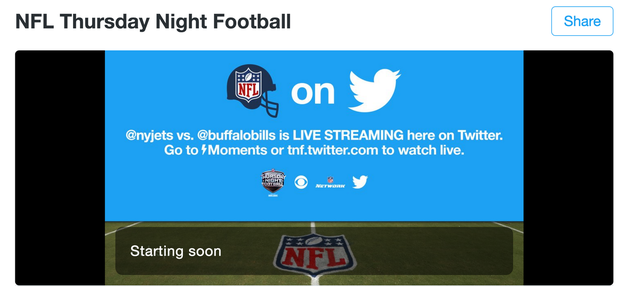
Twitter&;s rationale for spending $10 million for the rights to stream a package of 10 NFL games this season was simple: it believed airing live sports broadcasts on its platform, where people enthusiastically discuss the games, could help catalyze more of that behavior, and bring in some TV advertising dollars in the process. After streaming its first NFL game last night, the early fan engagement results look like Twitter made a good bet, according to data from the social analytics company SocialFlow.

Use of the Bills&039; emoji-generating hashtag on Twitter increased from 11,039 mentions in Week 1 to 22,216 for last night&039;s Week 2 game, counting game day and the day following, an increase of 101%. The Jets&039; hashtag went from 11,968 mentions to 24,742 in the same time span, a bump of 107%. Because the Thursday night game ended close to midnight eastern time, chatter spilled over into Friday — hence the metrics&039; two-day time span. SocialFlow has access to Twitter&039;s full firehose, so the numbers are global.

“The Twitter Live Stream of the New York Jets and Buffalo Bills positively and largely contributed to increasing the GoBills and JetUp hashtags,” Kleida Martiro, sr. analyst at SocialFlow, told BuzzFeed News.

The NFL streams are critical for Twitter, which is currently making a very large bet on premium, live content. Twitter has also struck streaming deals with the NHL and MLB, and is airing original live content from the upstart financial TV network Cheddar, and others. This week, Twitter released a handful of smart TV apps featuring premium live content and curated tweets from its Moments tab, which seems to show that they&039;re prioritizing this feature over its long-ago announced plan to expand Tweet character length, and even its reported goal to develop anti-harassment tools like keyword filtering.

“This may be [management&039;s] last opportunity to reignite growth in users, engagement and monetization,” Cantor Fitzgerald analyst Youssef Squali said of Twitter&039;s premium live-streaming efforts in a research note this week. “Failure to do so is likely to embolden shareholders to pressure the board to evaluate alternatives to maximize value, incl. [mergers and acquisitions] and taking the company private.”

For the first night at least, the results appeared promising for Twitter.

Quelle: <a href="Early Data Suggests Twitter&039;s NFL Live Stream Increased Fan Engagement“>BuzzFeed

Revenge Porn Facebook Page Returns As Private Facebook Group Chat

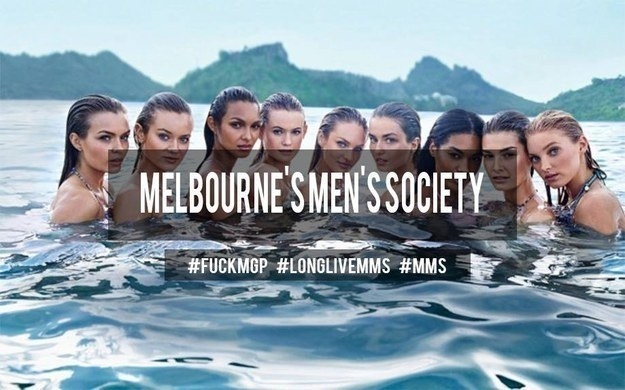
The Melbourne&;s Men&039;s Society Facebook page, used by Melbourne-based men to share revenge porn, has been moved to a series of private Messenger group chats after the page was shut down by Facebook for a second time.

facebook.com

facebook.com

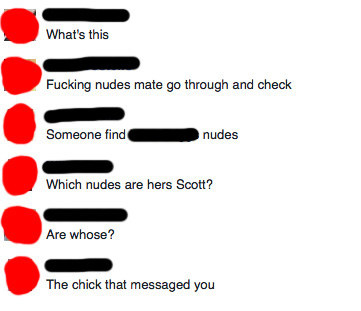
The group chats, which BuzzFeed News has seen, have a 24-hour lifespan before a new chat is formed. Members of the group are required to submit a naked photo of a girl before “naming and shaming” if they wish to be invited to the next day&039;s group chat.

facebook.com

facebook.com

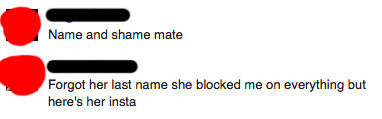
The Messenger chats are full of men asking others to identify the women in the photographs and to share videos.

facebook.com

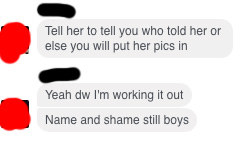
In one instance, members of the chat encourage another member to threaten a girl with the possibility that her pictures would be shared within the group if she didn&039;t confess who had told her about the group chat.

Facebook.com

The men in the group acknowledge that some of the women pictured are under 18.

facebook.com

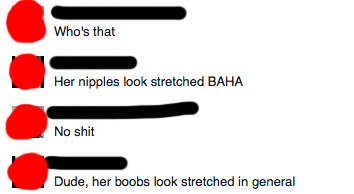
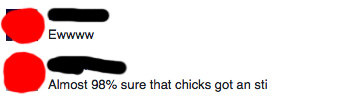
The chat has also become a forum for members to ridicule the bodies of the women in the pictures.

facebook.com

facebook.com

facebook.com

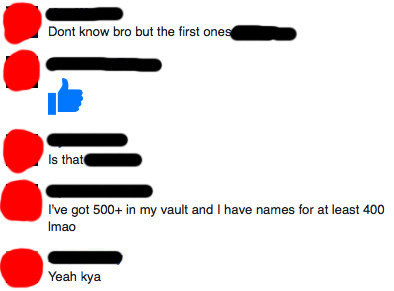
Some of the men boast about having their own personal “vault” of photos saved to their phone and that they have names for the women in hundreds of the photos.

facebook.com

The men believe the group chats are a safer option for sharing images than a private Facebook group, because it is much more difficult to report private group chats to Facebook. Users are required to fill out a form to report a Messenger conversation.

A Melbourne woman who knew of the group chat&039;s existence told BuzzFeed News she had tried to research how to report a group chat and had found that you can&039;t.

“There is an option to report as &039;abuse&039; but it&039;s an old feature,” she said. “It doesn&039;t work when you click it.

“It really is disgusting. I felt sick reading some of the messages.”

facebook.com

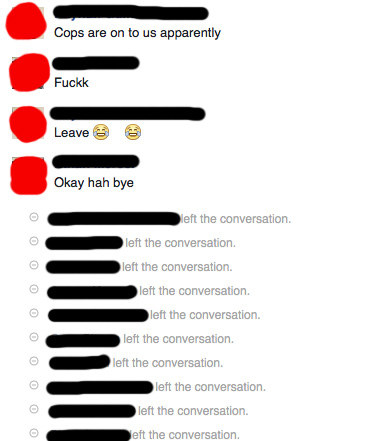
Members of the group can be seen rapidly fleeing one of the conversations when a user says “the cops are on to us”.

facebook.com

BuzzFeed News has contacted Victoria Police for comment and reported the activity to Facebook.

Quelle: <a href="Revenge Porn Facebook Page Returns As Private Facebook Group Chat“>BuzzFeed