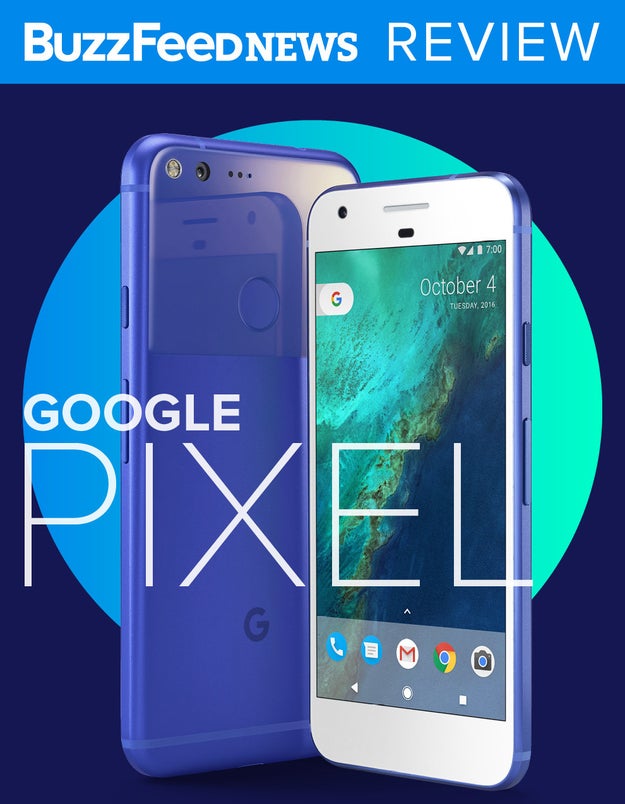
Google's Pixel Is The Most Pleasant Android Phone I’ve Ever Used

The first phone designed entirely by Google looks uninspired, but the software inside is powerful as hell.

BuzzFeed News / Google

Of the tens of thousands of Android devices to choose from, I have always preferred the Nexus phones, which were made by Google and a rotating cast of partners like Samsung, Huawei, and LG. Nexus devices ran Android the way Google intended, without third-party “skins” and other feature gimmicks that afflict so many other brands that take advantage of Android’s free, open-source platform.

This year, Google broke free of their Nexus partnerships, opting instead to strike out on their own. While they are built in HTC’s factories, the Pixel and Pixel XL are the first phones designed entirely by Google. They hit shelves on Oct. 20 around the world.

After spending four-ish days poking, prodding, and reviewing the Pixel, it’s clear Apple, Nexus, and Samsung’s flagship phones heavily influenced it. And that’s not a bad thing.

If you’re looking at display, processor, battery, and camera specs alone, the Pixel is fairly average when compared to the most premium devices. But maybe that’s the point. Google doesn’t need to be the best.

With its new phone, Google proves that it can (mostly) keep up with big players like Samsung and Apple – and offer customers something only Google can offer: exclusive, killer features built for the online services that they already use, and direct access to an artificially intelligent personal assistant powered by the company’s massive knowledge graph.

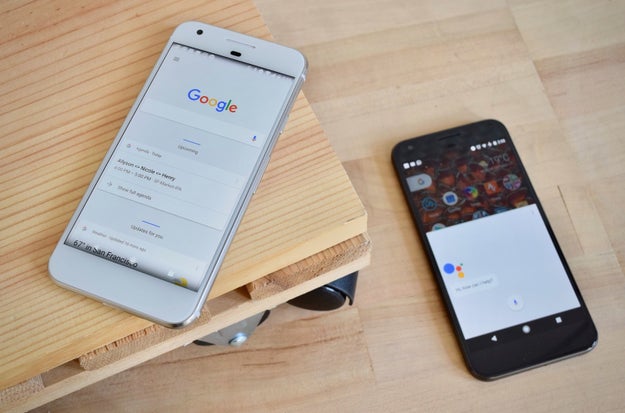
Its hardware is nothing spectacular. But I found the Pixel to be the most pleasant, playful, and user-friendly Android device I’ve ever used. It’s an impressive first effort by Google as the architect of the Android platform and its vessel.

Nicole Nguyen / BuzzFeed News

Set up is less painful with a little help from Google.

Set up is less painful with a little help from Google.

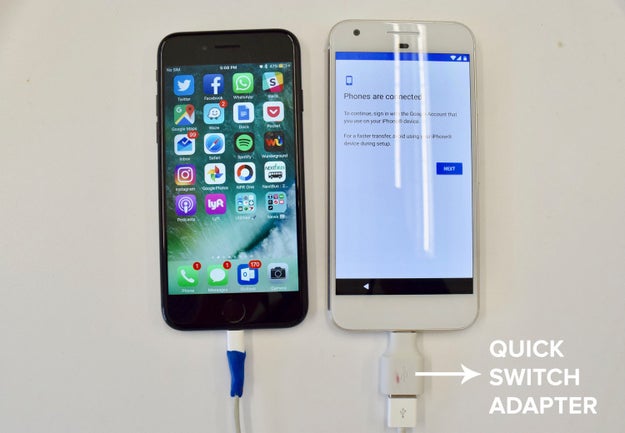
The Pixel comes with a handy “quick switch adapter” accessory that helps users sync data from their old iPhone or Android device.

I transferred text messages (even the iMessage ones), music, podcasts, photos, and videos in under 10 minutes from my iPhone 7 to the Pixel. Because I use a Google account for most things anyway (email, calendar, reminders, etc.), the transition was fairly seamless. When I opened Google Maps, and my starred locations were already there.

My apps, however, most of which have Android versions, didn’t make it onto the new Pixel, which was deeply annoying. I had to manually search for and install 30-ish apps which, I already know, is way too many.

At first, switching from an Android device to the Pixel XL was a little tricky. Since both the Nexus 6P and Pixel have USB-C ports, the order in which they were plugged was important. I also needed to use the USB-A to USB-C cable with the adapter, instead of the USB-C to USB-C cable.

Eventually the issue sorted itself out, and the data transfer was quick and easy. Unlike with the iPhone, the Pixel automatically downloaded my purchased apps and even logged me into apps like Strava.

Nicole Nguyen / BuzzFeed News


View Entire List ›

Quelle: <a href="Google&039;s Pixel Is The Most Pleasant Android Phone I’ve Ever Used“>BuzzFeed

Delivery Workers For Instacart, Postmates And Uber Are Teaming Up For A Better Deal

Neil Hall / Reuters

On the steps of New York&;s City Hall tomorrow morning, a group bike messengers will launch the New York Messengers Alliance, a first-of-its-kind organization for couriers who work for on-demand apps like Instacart, Postmates and Uber.

While not a formal union, the alliance aims to build power and solidarity among the labor force that supports the delivery-app economy, its organizers say. They want to use this power to negotiate for better working conditions, and their first priority is worker safety — specifically a demand for company-provided safety gear like helmets, and workers&039; compensation when they&039;re injured on the job.

Of the half dozen workers who attended an organizing meeting for the alliance earlier this month, two wore casts, and a third rolled up his sleeves to show grisly scabs from a recent crash. Sadio Bello, an Uber Rush courier who has worked as a bike messenger for 17 years, rode and made deliveries with a fractured ankle this past summer, he told BuzzFeed News, because he didn&039;t want to lose money.

Bike messengers working for the on-demand apps are classified as independent contractors, rather than employees, just like Uber drivers. They don&039;t receive any paid leave or medical cover.
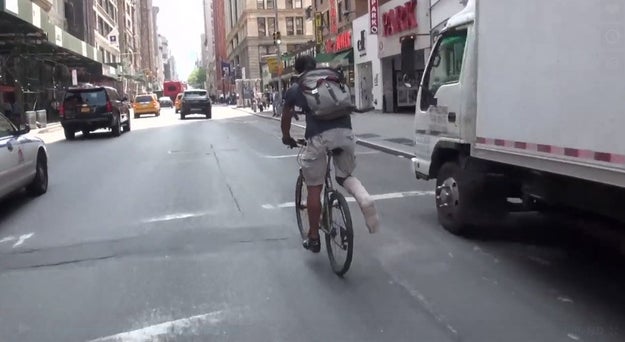
Uber Rush courier Sadio Bello making a delivery while injured in New York.

Zishun Ning / Via vimeo.com

“Never in 20 years have I had a paid vacation,” courier Kurt Boone told BuzzFeed News. After two decades in the field “with nothing to show for it — no pension, no 401(k),” Boone said he sees an opportunity for the next generation of messengers in the alliance.

“Generally most messengers don’t work together. They’re individuals,” he said. “Collectively, I think we can go further.”

While little formal data exists on injury rates for bike messengers, a 2002 Harvard study of the profession in Boston found a rate comparable to that of professional football or the meatpacking industry, noting that “most injuries go unreported and that most couriers do not carry health insurance.”

Messengers say their experiences support those findings, and the danger comes with the territory. But they also insist companies could do more to protect and support them, and take issue with the apps&039; unpredictable pay and all-hours work-schedules. It combines, they say, to pressure couriers to do dangerous amounts of work just to earn as much as they used to with more regular schedules and rates.

“Initially, it was a fantastic deal,” said Harrington Día, who delivers for Uber&039;s Rush service, as well as for other companies. Día said he was initially drawn to the work by the $25 an hour wage Uber advertised. “I saw it as a way where I could live out this utopian fantasy of biking for a living,” he said. “That shattered when they began cutting wages.”

Día and others watched guaranteed pay steadily drop over the past two years for Uber Rush jobs, from $25 an hour to $20 to $15 and lower. When the company changed the delivery rate from $4 for a hand-off and $5 per mile to $3 for a hand-off and $4 a mile this past November (which meant workers could make as little as $7 per delivery), some couriers began showing up to protests by Uber drivers, who had also been dealing with pay cuts.

“The truth is they’ve been taking too much of the pie and we baked that pie and now we’re getting crumbs of it,” said Día.

Uber says couriers sign up for its service because of its flexibility. “Since couriers can and do use many other apps, we have to work every day to make Uber more rewarding for couriers, and we’re focused on just that, including by listening to feedback and making improvements,” the company told BuzzFeed News.

Instacart declined to comment on the new worker alliance, and Postmates did not respond to a request for comment.

The couriers have made a video to spread the word of their new alliance

vimeo.com

Elsewhere, organizing efforts by workers for these same on-demand companies are already racking up results. Even without the support of the new alliance, independent contractors for Instacart successfully won concessions from the company with the threat of a strike last week. After the contractors planned to “boycott” working for the platform for two days, the company agreed not to change its base pay and tip structure.

And independent contractors for Postmates received a boost from a complaint filed by the National Labor Relations Board against the company in Chicago, in which the board&039;s lawyers found Postmates couriers are employees, according to The New York Times, which received a copy of the complaint via a Freedom of Information Act request.

The protests also have an international element. In August, London-based couriers on the platform Deliveroo, an Uber Eats competitor, went on strike for seven days over a proposed new working contract. Deliveroo “subsequently backed down and said the new contract was an optional trial, although anyone who stayed on the old contract had to change to a zone where the new contract has not yet been implemented,” BuzzFeed News reported.
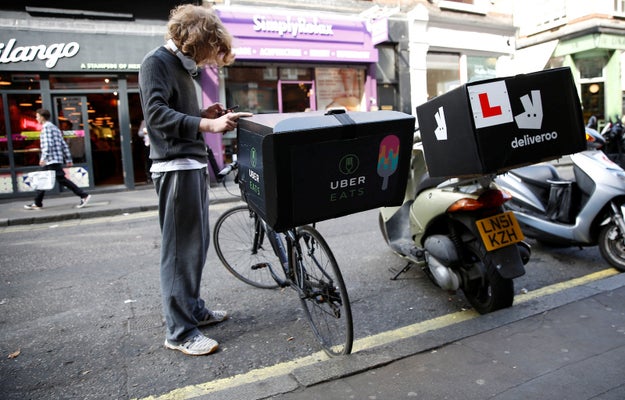
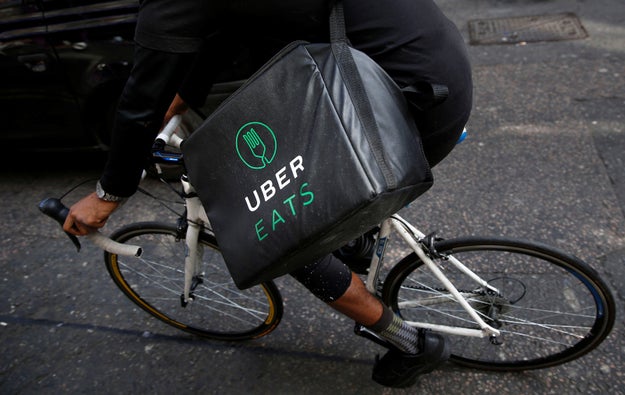
An UberEATS food delivery courier waits for an order in London, Britain September 7, 2016.

Neil Hall / Reuters

Last week also saw a new ruling related to the employee status of Uber drivers in New York (which the company is appealing), which found the workers qualify for unemployment benefits. And a bill being considered by the New York City Council would mandate on-demand companies like Uber provide safety equipment and training to couriers, despite their status as independent contractors.

The delivery workers in the messengers alliance, most of whom accept jobs from more than one app to make a living, are affiliating with the National Taxi Workers Alliance, an AFL-CIO-member union of taxi drivers that prides itself on its militancy. (In a flyer publicizing the launch event, the NYTWA calls itself “the only union to take Uber to court on behalf of workers.”) Founded in 1998, the NYTWA represents 19,000 yellow cab, green car, and black car drivers, including Uber and Lyft drivers.

“There are unions out there that don’t want to fight for employee status,” said Bhairavi Desai, executive director with the NYTWA. “They have articulated that position for themselves. To us, it&039;s clear that the role of the union is not to tactically make concessions to protect the business model, but to uncompromisingly elevate the power of the workers.”

Quelle: <a href="Delivery Workers For Instacart, Postmates And Uber Are Teaming Up For A Better Deal“>BuzzFeed
Apple Hires Director Of Artificial Intelligence To Ramp Up AI Recruitment

Compared to Silicon Valley giants like Facebook and Google, Apple&;s AI research projects have been largely inscrutable. But now, that looks like it&039;s about to change.

Apple has hired esteemed Carnegie Mellon computer science professor Russ Salakhutdinov as its director of artificial intelligence research, with plans to build a team of researchers for the company in the coming months. Salakhutdinov will remain in his post as an associate professor at CMU, Apple confirmed to BuzzFeed News.

And in a move uncharacteristic of Apple&039;s historically secretive approach to its AI efforts, Salakhutdinov tweeted news of his hiring along with a link to his new team&039;s job listings.

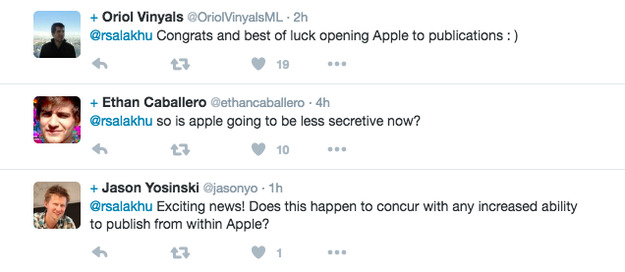
Researchers replied to Salakhutdinov expressing skepticism about whether or not Apple, which is typically quiet about its artificial intelligence and machine learning efforts, would open itself up to the larger, more collaborative AI research community. The unexpected tweet seems to be part of Apple&039;s plan for recruiting for AI researchers — who are so hot right now in Silicon Valley.

All three of these men are artificial intelligence researchers. Vinyals works at Google, Caballero at Talla, and Yosinski at Geometric Intelligence.

Siri, Apple&039;s big public-facing AI technology, has faced widespread criticism for not being smart enough, especially compared to rival AI assistants. Just last week, Walt Mossberg, executive editor of the Verge and editor at large of Recode, asked, “Why does Siri seem so dumb?” in a recent column.

And Apple&039;s competitors have made very public strides into artificial intelligence, including being aggressive about hiring AI experts to take their research further. Google has been publishing hundreds of papers on machine learning. It&039;s also created a suite of products for varying levels of engagement: the Go champion DeepMind, the Siri-esque Google Now, the open source TensorFlow for developers, and the new texting bot Allo, to name a few. Amazon&039;s Echo speaker, whose key features rely the voice-controlled AI assistant Alexa, is rapidly reaching customer demographics outside of traditional smartphone markets. Facebook introduced its own personal assistant, M, in late 2015, just a year after Microsoft debuted Cortana.

Meanwhile, Apple has kept a low profile at the annual Neural Information Processing Systems Conference, which is the event of the season for researchers and companies developing and studying artificial intelligence. Google, Microsoft, Facebook, and IBM have all been active participants.

But Apple is racing to catch up. Before hiring Salakhutdinov, the company acquired three machine learning companies in the past year: Perceptio, Turi, and Tuplejump. And just this week, CEO Tim Cook told Nikkei Asian Review that Apple plans to open an AI research center in Yokohama, Japan later this year. “There is an incredible future ahead for AI and the iPhone,” Cook said.

Quelle: <a href="Apple Hires Director Of Artificial Intelligence To Ramp Up AI Recruitment“>BuzzFeed

Russian Hackers Faked Gmail Password Form To Invade DNC Email System

Hillary Clinton with Russian President Vladimir Putin in the background

Saeed Khan / AFP / Getty Images

SAN FRANCISCO — Russian hackers used emails disguised to look as Gmail security updates to hack into the computers of the Democratic National Convention (DNC) and members of Hillary Clinton’s top campaign staff, according to a report by the SecureWorks cybersecurity company.

The emails, which were sent to DNC and Clinton staff from March 10, appeared almost identical to the standard warnings Gmail users get asking them to reset their passwords, the report found. Once clicked, the links took users to a page that imitated a Google login page, but which was stealing their password information — and downloading malware — designed by a group of Russian hackers known as Fancy Bear.

The emails were sent to 108 members of Democratic presidential nominee Hillary Clinton’s campaign and 20 people clicked on them, at least four people clicking more than once, Secureworks’ research found. The emails were sent to another 16 people from the Democratic National Convention (DNC), and four people clicked on them, the report said.

Researchers found the emails by tracing the malicious URLs set up by Fancy Bear using Bitly, a link shortening service. Fancy Bear had set the URL they sent out to read accounts-google.com, rather than the official Google URL, accounts.google.com, the report said.

“We were monitoring bit.ly and saw the accounts being created in real time,” said Phil Burdette, a senior security researcher at SecureWorks, explaining how they stumbled upon the the URLs set up by Fancy Bear.

“They did a great job with capturing the look and feel of Google,” said Burdette, who added that unless a person was paying clear attention to the URL or noticed that the site was not HTTPS secure, they would likely not notice the difference.

Once Democratic Party officials entered their information into the fake Gmail page, Fancy Bear had access to not just their email accounts, but to the shared calendars, documents, and spreadsheets on their Google Drive. Among those targeted, said Burdette, were the Clinton’s national political director, finance director, director of strategic communications, and press secretary. None of Clinton’s staff responded to repeated requests for comment from BuzzFeed News.

Quelle: <a href="Russian Hackers Faked Gmail Password Form To Invade DNC Email System“>BuzzFeed

Airlines Will Confiscate Your Samsung Galaxy Note7 If You Try To Fly With It

Airlines Will Confiscate Your Samsung Galaxy Note7 If You Try To Fly With It

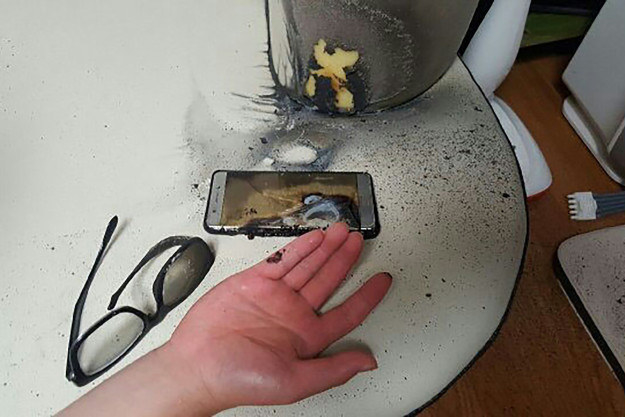
A photo showing a blown-up Samsung Galaxy Note 7 smartphone in Gwangju, South Korea.

STR / Gwangju Bukbu Police Station / AFP

The Federal Aviation Administration, Department of Transportation, and the Pipeline and Hazardous Materials Safety Administration have issued an emergency order banning all Samsung Galaxy Note7 smartphones, even ones that have been powered off, from commercial and cargo US aircraft. The ban goes into effect October 15.

According to the order, passengers who attempt to board flights with a Note7 on their person or in their bags may have their phones confiscated. If an airline representative sees a passenger attempting to board with a Note7, the order authorizes them to bar that passenger from boarding. And passengers who try to sneak their Note7 phones on planes may face fines and criminal charges, the order states. However, exactly how airlines intend to enforce this ban is still unclear. The FAA previously advised passengers to power off the devices and refrain from charging them on flights.

The smartphone is now considered a forbidden hazardous material under the Federal Hazardous Material Regulations. FedEx and UPS previously told Bloomberg they would not be shipping the phones by air.

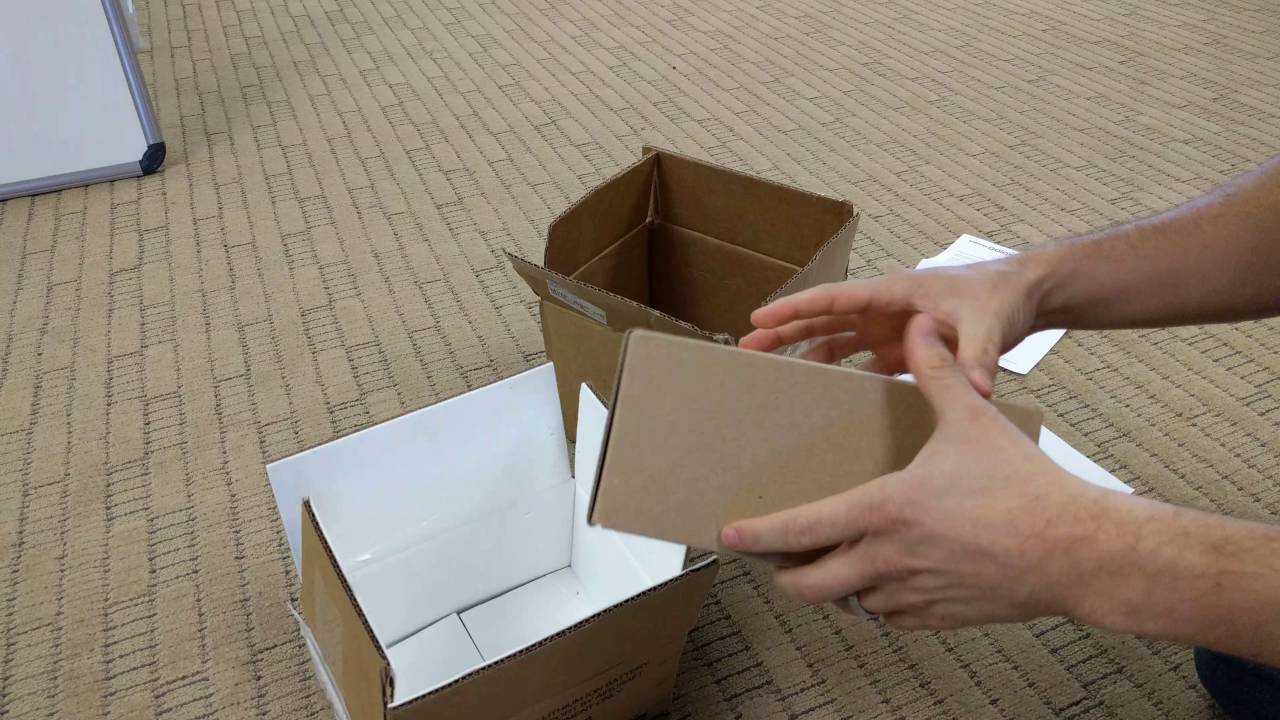
Samsung and the US Consumer Product Safety Commission have recalled the phones, which are linked to nearly 100 reports of overheating, catching fire, and exploding because of faulty batteries. Samsung sold nearly 2 million of them in the US, but after initial reports that the phones were exploding and smoking, it offered replacement Note7s with safe batteries. Several consumers reported, however, that these replacement phones showed the same problems as their predecessors. Notably, a Southwest Airlines flight was grounded because of a smoking replacement Note7. Samsung has stopped sales, shipping, and production of the phone and has sent explosion-proof boxes to customers to return their phones for refunds.

youtube.com

The company has slashed its operating profit projections for the third quarter of 2016 by 33 percent. It estimates the recall will cost $5.3 billion in total.

Samsung did not immediately respond to a request for comment on the FAA&;s announcement. In an October 13 statement about the CPSC&039;s expanded recall, the company said it was working with the government, and that “Customers’ safety remains a top priority and we ask consumers with an original or replacement Galaxy Note7 to power down and take advantage of the remedies available.”

If you have a Galaxy Note7, you can start the return process by clicking here. Now would probably be a good time to get around to it.

Quelle: <a href="Airlines Will Confiscate Your Samsung Galaxy Note7 If You Try To Fly With It“>BuzzFeed

Instacart Cancels Plans To Scrap Tips Amid Threats Of Strikes

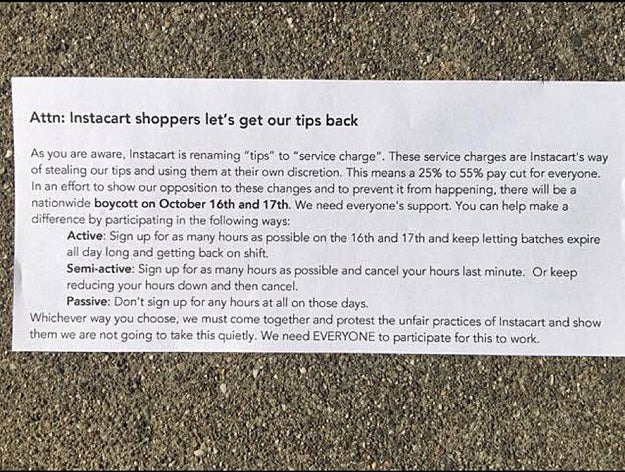
Instacart is adjusting planned changes to its pay structure for full-service shoppers, following threats of a boycott by the independent contractors who were outraged over the $2 billion grocery delivery startup’s plans to replace tips with an optional 10% service fee collected by the company.

“After announcing this change we heard from shoppers that they liked most of the changes but wanted to retain the ability for customers to tip online,” Instacart explained in a Friday blog post. “We understand their concern and have decided to continue to accept tips.”

Instacart&;s move comes just two days ahead of a threatened October 16/17 strike organized around a “Let&039;s get our tips back” call to action.

Instacart had maintained that planned changes to its pay rate for independent contractors — which involved raising their base pay rate and replacing tips with an optional 10% “service amount” paid directly to Instacart — were intended to benefit workers by reducing reliance on tips.

“I get a lot of big tips. That’s what I rely on.”

But shoppers who did some back-of-the-envelope math following the company’s announcement worried that the changes would reduce their overall income. “I get a lot of big tips. That’s what I rely on,” said Matt, a shopper in Chicago who planned to boycott Instacart on Sunday and Monday. “I knew it wasn’t going to be in my best interests.”.”

Josh, a shopper on the East Coast, agreed. “Right now on an average week I make about $750, and I&039;ve made up to $1100 if I really work hard all week and things aren&039;t slow,” he told BuzzFeed News via email. “So, with the changes I’m looking at making between $500 and $700 for the same amount of work.”

As independent contractors working in different cities, Instacart shoppers don’t have a central method of communicating. But by sharing their frustration on social media —via Facebook groups, Instagram accounts and on Twitter — the beginnings of a movement started to congeal. Over email, Instacart shoppers in different cities orchestrated a plan to on October 16 and 17, the day the pay changes were set to roll out, hoping to slow service on what are typically two of the company&039;s busiest days.

When a widely shared blog post critical of Instacart&039;s plan to scrap tips fueled further outrage online, Instacart published a rebuttal on its blog. But some shoppers were even more frustrated by the way that post was written, arguing it intentionally clouded the issue of just who collected the “service amount.” While it’s true that 100% of the fee does go to shoppers it won’t necessarily be given to the person doing the shopping and the delivery. Instead, the service amount is pooled and redistributed by Instacart, which is where some in-store shoppers had a problem.

“Instacart is not being fully transparent to shoppers or customers,” said Liz Temkin, a shopper in Los Angeles, who isn’t planning to participate in the boycott. “They are telling customers that the service charge goes directly to the shopper, but that&039;s not the truth. It goes into a general pot, so that Instacart can pay us a higher delivery charge. It makes no sense to pay me the same for a small order of groceries versus the same number of items from Costco. And what about my mileage & loading stuff up from the car to deliver to an office building?”

Some Instacart shoppers who spoke with BuzzFeed News said they were worried about participating in the strike for fear of being removed from the platform for “reliability issues.” Many declined to share their names fearing Instacart might deactivate their account.

But some felt taking a risk was the only way to have an impact on Instacart’s policies. “Fear is going to keep [shoppers] from doing much outside of social media and talking. What we want is action,” said Matt, who estimated as many as forty shoppers in Chicago were prepared to join the boycott. “The only thing that’s going to get us what we want is what affects customer service and profit.”

The threat of a strike has had an impact. Following Instacart’s announcement today, the changes to base fare and addition of a service amount, charged by default when customers checkout, will remain as planned. But customers will have the option to add a tip on top of that in app if they so choose.

Given the adjusted rate and new fee, it’s unclear how many customers will be willing to also add a tip. Though Instacart says 20% of customers already don’t tip at all, and 40% of tips average around $2, top shoppers say big orders or deliveries that involve heavy lifting or lots of stairs can earn them much more than that. Whether the October 16/17 strike will still occur also remains to be seen. But if shoppers have something to say about the update, it seems that — for now at least — Instacart is willing to listen.

Quelle: <a href="Instacart Cancels Plans To Scrap Tips Amid Threats Of Strikes“>BuzzFeed

What To Do If Comcast Caps Your Internet Data

What To Do If Comcast Caps Your Internet Data

Comcast, the largest Internet provider in the US, is rolling out a one terabyte data cap on internet use for customers in 18 different states on November 1.

Via giphy.com

What does that mean?

If you&;re a Comcast subscriber and you live in one of the states getting the cap (comprehensive list here), you will be limited to 1TB of internet data per month. For some customers, this is actually a boost — Comcast has been slowly rolling out data caps across the US for a while. Some states had a 300GB cap, but they&039;re getting 1TB now, since, according to Ars Technica, some customers were exceeding the lower limit.

What this likely means in the long run is that data caps are officially a part of how Comcast plans to do business. In a world where people are connecting more devices with more and more data-hungry services (Netflix and chill, for example), this could bring the internet service provider in conflict with its subscribers.

Comcast insists 99% of its customers use less than 1TB a month, telling Wired that the average Comcast subscriber uses 75GB per month and that only 10% of its customers even exceeded the previous 300GB cap. There seems to be a group of data 1 percenters: Last year the ISP told Ars Technica that 10% of its subscribers use 80 percent of all the data Comcast provided.

Take those numbers with a grain of salt, though.

Ars also found that the accuracy of Comcast&039;s data meters is widely disputed; some users allege that the meters are off by full terabytes. The FCC also just fined Comcast $2.3 million—the biggest fine to a cable company ever—for charging customers for things they did not buy. In some cases, people declined the specific services they were later billed for. This all suggests Comcast isn&039;t always precise about these kinds of things.

Some see Comcast&039;s expanding data caps as a move against video streaming services like Netflix and Amazon Prime, which have been upping the quality of their videos in recent months. Higher quality video, including 4K video, means more data usage. And Comcast, in direct competition with streaming services, also sells cable set top boxes, though it recently announced a deal that lets subscribers stream Netflix from their set tops.

So even if you&039;re an average internet user, Comcast&039;s data cap has big implications for the future. Back in 2012, experts were predicting that our demand for data would only increase, while the capacity to provide it could plateau. With the proliferation of high-intensity applications like VR, video conferencing, and 4K streaming, it&039;s possible that we&039;ll all be using a terabyte a month soon enough.

TBH, the data cap probably won&039;t affect you right now. But take precautions…

1. Set your Comcast account to remind you.

Know when you&039;re at 50%, 75%, 100%, and 125% of your monthly data usage. Knowledge is power.

1.5. Figure out how much data you typically use.

Use Comcast&039;s data estimator. If you have a Comcast account, view your monthly usage.

via Giphy / Via giphy.com

2. Don&039;t beat yourself up about it.

Comcast allows for two months in a 12-month period to be over the 1TB limit. For the third month, Comcast will charge $10 for an additional 50GB of data, with a price cap of $200 for overages.

3. If you&039;re mad pressed about your data, you can buy more.

You can purchase an unlimited data plan for $50 on top of your current subscription. Otherwise you&039;ll pay overages when you max it out after your two grace months.

Via Giphy / Via giphy.com

4. Watch Comcast&039;s “What Can You Do With a Terabyte?” video.

Note the like to dislike ratio on the video. Note that Comcast has disabled comments. Laugh.

youtube.com / Via youtube.com

5. Recall that in many places, people have no option for Internet service besides Comcast. You can find community in complaining.

Via Giphy / Via giphy.com

The company consistently ranks among the worst across the US in customer satisfaction, so there are plenty of people kvetching along with you, even if it&039;s just in principle. If you&039;re angry about the data cap, you&039;re not alone.

Quelle: <a href="What To Do If Comcast Caps Your Internet Data“>BuzzFeed

General Motors Expands Its Carsharing Service To San Francisco

Priya Anand/BuzzFeed News

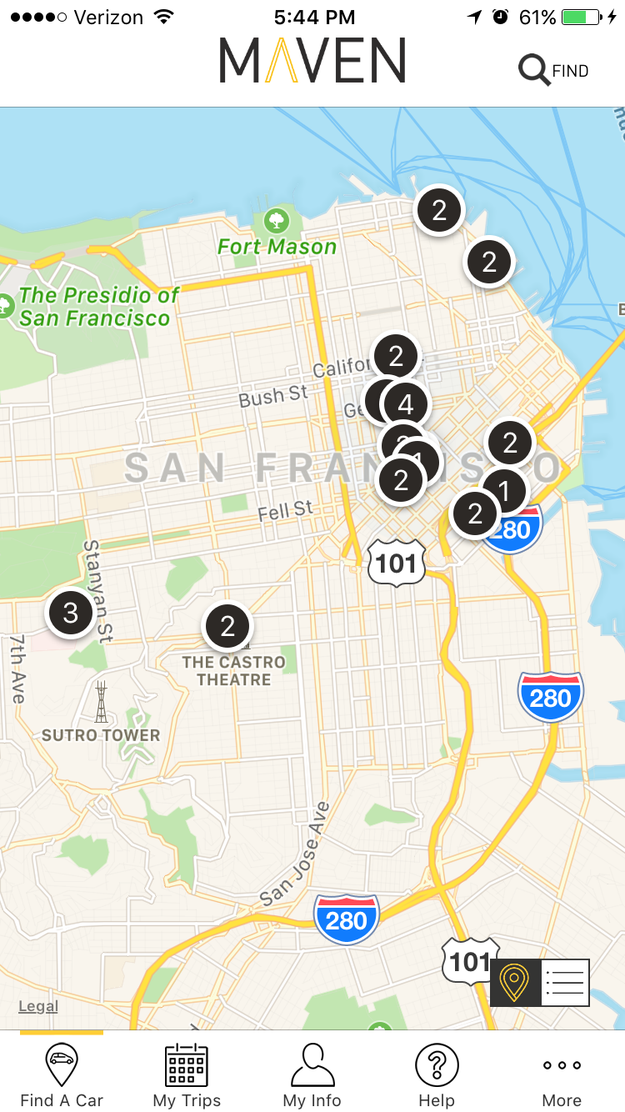
General Motors is expanding its new carsharing business Maven to San Francisco, its tenth city, after launching in February.

With the Maven app, people can rent GM vehicles starting at $8 an hour. The automaker introduced the Zipcar-like car rental app in Ann Arbor, Michigan, in January. Maven has since expanded to Baltimore, Boston, Chicago, Washington, DC, Detroit, Los Angeles, and New York City. Its growth shows how General Motors is preparing for upheaval in the transportation industry, and a future in which the company needs to do more than just manufacture cars.

“When I joined GM a year ago, it was a company that just sold cars,” said Dan Grossman, chief operating officer of Maven. “What are other mechanisms to produce revenue? GM could either…spend all this money in marketing to convince people to keep buying our cars, or they could take money and invest. When GM sells a car, it produces revenue. When somebody rents a car, it produces revenue.”

Maven has more than 10,000 members, the company said, who have collectively driven 15 million miles. There are about 60 cars on the Maven platform in each of its cities. In San Francisco, those 60 vehicles will be spread across 30 locations in the city. The rates, starting at $8 an hour, include gas.

GM President Dan Ammann told BuzzFeed News in April that he looks at his company and thinks, “the whole foundation of how your business has operated for the last 100 years is up for discussion.” Of course, GM isn’t the only old-school automaker to explore other business models. Ford purchased Chariot, a San Francisco based shuttle service, in September.

Grossman, who came to Maven from Zipcar, said GM is trying to distinguish itself by offering cars with more features. “We’re not the cheapest option. We’re not fighting for the lower end of the spectrum,” he said.

“It’s the closest thing to ownership,” Grossman said. “You’ve got your leather [interiors], you’ve got your satellite radio, you’ve got the ability to use your phone with Apple CarPlay and Android Auto.”

Maven will likely expand into additional markets in the coming months.

“You’ll see more activity out here in the west,” Grossman said. “We’re really calling San Francisco, our tenth market, our first real stake in the ground out here.”

Quelle: <a href="General Motors Expands Its Carsharing Service To San Francisco“>BuzzFeed

Chicago Disability Advocates File Lawsuit Against Uber Over Wheelchair Accessibility

Robert Galbraith / Reuters

A disability rights group in Chicago filed a lawsuit Thursday against Uber, alleging that Uber is “now a significant part of our national transportation system” and that the company should provide more wheelchair-accessible vehicles.

The complaint, filed by Access Living of Metropolitan Chicago and three plaintiffs who use wheelchairs and said they cannot access Uber vehicles, alleges that Uber gave just 14 accessible rides in Chicago from 2011 to August 2015. It says that when the plaintiffs tried to use the app and requested accessible vehicles, they found only one vehicle was available, or none.

“Uber claims its services are not subject to the ADA, and its service to people who require wheelchair accessible vehicles ranges from token to non-existent,” the complaint filed in federal court reads. “That position threatens a return to the isolation and segregation that the disability rights movement has fought to overcome.”

Disability rights advocates have criticized Uber in the past for allegedly discriminating against people with disabilities. In August, a Brooklyn woman filed a lawsuit against Uber, citing a scarcity of UberWAV, or wheelchair-accessible vehicles, as well. In 2015, United Spinal Association, a nonprofit that advocates for people with spinal cord injuries, protested Time magazine’s consideration of Travis Kalanick for Person of the Year. A few weeks later, the group filed a lawsuit against Uber, claiming a driver rejected a rider after being unable to accommodate his wheelchair.

The Chicago lawsuit points to Uber’s decimation of the taxi industry to support the argument that the company has become a significant transportation service. It notes that the number of taxis operating in Chicago went down from 6,899 in 2013 to 6,222 in January 2016, compared to 1.9 million Uber rides provided in June 2015.

Uber said in May that it planned to bring more wheelchair-accessible options to Chicago. In April, the company reached a settlement in a San Francisco case with advocates for the blind. Uber agreed to require drivers to confirm they understand they are legally obligated to accept riders with service animals.

Uber, which has not yet responded to the complaint in court, did not immediately return a request for comment.

Quelle: <a href="Chicago Disability Advocates File Lawsuit Against Uber Over Wheelchair Accessibility“>BuzzFeed

Soylent Recalls Its Bars After Reports They Made People Violently Ill

Soylent, a Silicon Valley startup that makes powdered and liquid meal replacement supplements like Soylent 1.6 and 2.0, has temporarily stopped selling and shipping its Soylent Bars after reports that the bars made people violently ill.

Soylent said customers can receive a full refund by contacting the company; if you have any remaining bars, you should discard them. The company is investigating the bars&; safety but told BuzzFeed News it had not determined a cause yet.

In a prepared statement, Soylent wrote, “We are deeply sorry if any customer had any negative experiences after eating a Soylent Bar.” The company called the recall a “precautionary measure.” Soylent previously told BuzzFeed News that it was “very confident in the safety of the bars.”

The bar, introduced in August 2016 (coincidentally, the same month as Samsung&039;s recalled, exploding Galaxy Note7 phone), provides 12.5% of a person&039;s recommended daily nutrients, according to Soylent. It may also provide nausea, vomiting, and diarrhea, according to complaints from people who have eaten it.

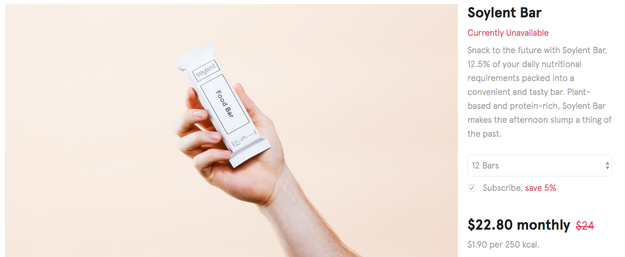
The bars are currently unavailable on Soylent&039;s website

Image from Soylent

Soylent has faced quality control issues before. As recently as October 2016, it delayed shipments of Soylent 2.0 because of mold. The facility that produces Soylent Bars, Betty Lou’s in McMinnville, Oregon, has not undergone a Foodborne Biological Hazards inspection since 2014, two years before the Bar was launched, according to the FDA’s online inspection database. This facility is separate from the ones that manufacture Soylent 1.6 and 2.0. Back in 2014, the FDA for the first time classified the Oregon facility as VAI, Voluntary Action Indicated — meaning an inspection found “objectionable conditions or practices,” but not ones serious enough to require mandated action. (The FDA&039;s database covers inspections from October 1, 2008 to March 31, 2016.) But Soylent says the facility&039;s last FDA inspection was as recent as March 2016. BuzzFeed News has reached out to the FDA and Betty Lou&039;s for comment on this discrepancy.

FDA

Sources close to Soylent&039;s manufacturing process previously told BuzzFeed News that the complaints about the bars might be due to a sensitivity to sucralose, an artificial non-caloric sweetener commonly found in products like Quest Nutrition Protein Bars and Powerbar Reduced Sugar Bars. There is three times as much Sucralose in Soylent’s bar (about 30 milligrams) compared to the Soylent 1.6 drink powder. At this time, Soylent has no plans to dial back the amount of sucralose in the bar, but it may re-formulate in the future.

Philip Neustrom, who experienced two bouts of nausea and vomiting after eating the bars, told BuzzFeed News that he regularly eats Quest Protein Bars, which also contain sucralose, with no negative effects.

In a previous statement, Soylent told BuzzFeed News, “After these reports, we have retrieved remaining bars from our consumers and have personally consumed many of the remaining bars without adverse effects. We have also sent them for further microbiological testing and all tests have come back negative.”

Reports of illness first emerged on Soylent&039;s own community discussion board on September 7, 2016, when user Raylingh started the thread “Nausea and vomiting several times after eating food bars.” Soylent consumers piled in on the thread, including two who had reportedly needed trips to the emergency room after eating the bars. All told, 57 people reported troubling experiences with the food bars. Soylent users on the Soylent subreddit also complained of the same symptoms.

Raylingh told BuzzFeed News he consumes Soylent 2.0 every day and has never had an adverse reaction to it. He also said that daily reports of Soylent-Bar-induced illness started appearing on Soylent&039;s forums in late September. He said he had to “chase down” Soylent customer support for three weeks after his initial complaint for Soylent to start investigating the bars. He&039;s kept a spreadsheet of the complaints.

Quelle: <a href="Soylent Recalls Its Bars After Reports They Made People Violently Ill“>BuzzFeed