Read Tim Cook's Email To Apple Employees After Donald Trump's Election

Justin Sullivan / Getty Images

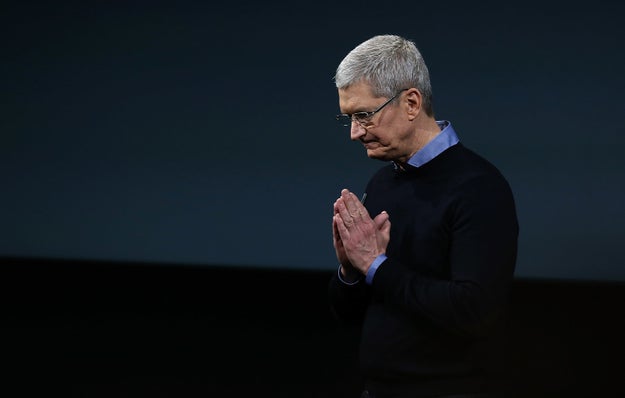
Apple CEO Tim Cook broadcast an all-hands memo to U.S. Apple employees Wednesday evening calling for unity amid the uncertainty inspired by Donald Trump&;s upset presidential win.

In the memo, obtained by BuzzFeed News, Cook — in a nod to one of the most divisive presidential races in American history — tells Apple employees that “the only way to move forward is to move forward together.” And he reasserts Apple&039;s commitment to social progress and equality.

Cook does not mention Trump — who has publicly threatened Apple over the course of the past year — by name. Nor does he write that Trump&039;s behavior during his presidential campaign was antithetical to Apple&039;s position on diversity and equality. Instead, he simply says: “Our company is open to all, and we celebrate the diversity of our team here in the United States and around the world — regardless of what they look like, where they come from, how they worship or who they love.”

You can read Tim Cook&039;s full memo below.

Team,

I’ve heard from many of you today about the presidential election. In a political contest where the candidates were so different and each received a similar number of popular votes, it’s inevitable that the aftermath leaves many of you with strong feelings.

We have a very diverse team of employees, including supporters of each of the candidates. Regardless of which candidate each of us supported as individuals, the only way to move forward is to move forward together. I recall something Dr. Martin Luther King, Jr. said 50 years ago: “If you can’t fly, then run. If you can’t run, then walk. If you can’t walk, then crawl, but whatever you do you have to keep moving forward.” This advice is timeless, and a reminder that we only do great work and improve the world by moving forward.

While there is discussion today about uncertainties ahead, you can be confident that Apple’s North Star hasn’t changed. Our products connect people everywhere, and they provide the tools for our customers to do great things to improve their lives and the world at large. Our company is open to all, and we celebrate the diversity of our team here in the United States and around the world — regardless of what they look like, where they come from, how they worship or who they love.

I’ve always looked at Apple as one big family and I encourage you to reach out to your co-workers if they are feeling anxious.

Let’s move forward — together&;

Best,

Tim

Quelle: <a href="Read Tim Cook&039;s Email To Apple Employees After Donald Trump&039;s Election“>BuzzFeed

Gathering Of Tech Elites Reacts To Trump’s Election With Shock And Cautious Optimism

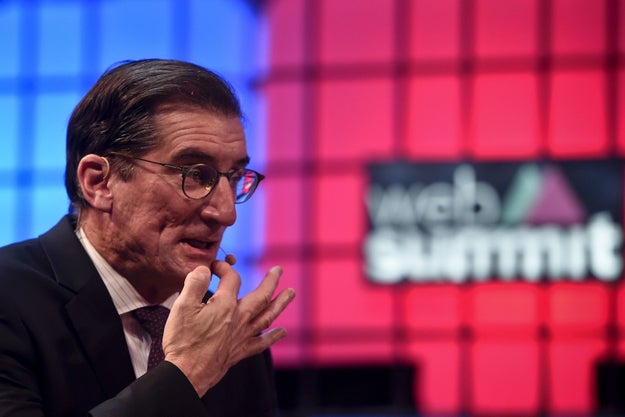
NASDAQ CEO Bob Greifeld talks on the main stage of the Web Summit at Parque das Nacoes, in Lisbon on November 9, 2016.

Patricia De Melo Moreira / AFP / Getty Images

Before venture capitalist Patrick Lord left Paris to attend Web Summit, a gathering of 50,000 global tech executives and enthusiasts taking place in Portugal this week, he warned his family that Trump’s election would mean disaster. When he awoke to the results Wednesday and called home to check in, he found out his daughter, worlds away from the vote, was already in tears.

“I was really quite shocked to see the result,” Paris-based venture capitalist Patrick Lord told BuzzFeed News in Lisbon. “It was not what I expected and it was not what I was hoping for.”

The same shock was palpable today across Web Summit. Attendees everywhere could be heard saying words like “unbelievable,” “fear,” “sad,” and “shocking.” A man walked across one pavilion shouting “Fuck everything. Fuck Trump. Fuck everything.” The speaker prep room, at times, felt like a wake. But this dread, or discussion of it, was also often coupled expressions of optimism about America’s future under Trump, and a belief that business would continue as usual despite some dire predictions. Thousands of miles from the US, this contrast gave the day after Trump’s election a surreal feel.

Bernard-Louis Roques, a colleague of Lord’s at the French VC firm Truffle Ventures, said he too was shocked by Trump’s election, but expressed cautious optimism because of the President-elect’s extensive business experience and the tenor of the victory speech. “He was very calm, polite, using the right words about uniting and tolerance, which I thought are critical when you are President,” Roques said. “From a pragmatic standpoint, I was somewhat comforted.”

And on a panel in front of thousands, NASDAQ CEO Robert Greifeld said he too would like to remain optimistic, even as markets dropped in response to the election results. “We can see possible good things out of this,” he said. Greifeld’s fellow panelists were similarly optimistic, or at least stayed away from doomsaying. Tony Conrad, partner at the venture capital firm True Ventures, said the election of Trump could be concerning for some companies, such as hardware startups working with China, but stopped at that. “There’s a lot of stuff that’s in play, it doesn’t mean it’s necessarily a bad time to be an entrepreneur,” he said. “It’s probably just as good a time as any time.”

Backstage, Groupon CEO Rich Williams said he believed pragmatism and checks and balances would keep the country out of harm’s way and spoke positively of the Americans’ desire for change. “Trump managed that beautifully as a marketer,” he said. “If you believe in the country’s willingness to adapt, to accept and embrace change, and push it hard, then you got to be optimistic. You get pessimistic when you say people just want the status quo, they’re not willing to change anymore.”

Kik CEO Ted Livingston said he hoped a serious conversation about economic inequality would emerge following Trump’s election, calling it a possible silver lining. Trump detractors have two options, he said; they could call his supporters dumb, or they could explain that they misunderstood how bad their lives were and try to start a conversation about how to improve the situation. “If it’s the former, we’re in big trouble, because the reality is the Trump supporters are now the majority,” he said. “It’s Donald Trump who is in charge; it’s Donald Trump who is president, so we better start a conversation.”

Digesting It All

Not everyone was so positive. Others were just plain shocked and struggling to figure out the implications of a Trump presidency.

At a private conference called “The Forum,” which aimed “to tackle the world’s most pressing issues,” speakers and participants sat and stared with amazement (and maybe a hint of bemusement) as Trump campaign manager Kellyann Conway appeared on Squawk Box to discuss the victory. It was one of the largest crowds The Forum drew all week.

A group of three Turkish female entrepreneurs with business in the US wondered aloud what the news meant for them. “He hates Muslim people; he hates us,” one said. “We were in the process of applying for green cards and now we have to reconsider,” said another.

An Iranian entrepreneur said he was worried that sanctions from a President Trump could deal his Iran-based startup a huge setback. He said he was also worried about what could happen should Iran elect its own right winger, like former Iranian President Mahmoud Ahmadinejad. “If someone like Ahmadinejad comes up, I don’t think war would be that far away,” he said.

Mykhaylo Lazor, a startup CEO from Lviv, Ukraine, said he had mixed feelings on Trump’s election, adding: “If Russia’s going to invade us, he won’t give a fuck.”

And Marcos Santos, a Portuguese media executive, said he was open to seeing what Trump would do. “Nobody is prepared for this,” he said. “But we’ll see how it goes. Give it a chance.”

Patrick Lord, the Paris-based CEO, wasn’t so forgiving. But as he described his pessimism, his colleague Roques pointed out that unlike Brexit, a similarly unexpected conservative vote in the UK, Trump’s presidency would not be permanent. “I hope it’s not a catastrophe, but it’s only going to be one mandate.” His body language conveyed the overriding sentiment here in Lisbon: How bad could it be?

Quelle: <a href="Gathering Of Tech Elites Reacts To Trump’s Election With Shock And Cautious Optimism“>BuzzFeed

Silicon Valley Is Worried That Trump Is Going To Grab Them By The Data

Denis Balibouse / Reuters

NEW YORK — Silicon Valley was reeling Wednesday from the implications of what a Trump presidency might mean for tech companies that collect and store the data of private citizens across the world.

Two people who run smaller tech companies in San Francisco catering to groups marginalized by Trump told BuzzFeed News that they have begun quietly considering moving their servers, and potentially company headquarters, to outside the US because of fears that Trump might force them to hand over data they store on their clients.

“The types of people who use the services of our company are the sort of people Trump would want data on,” said one, who developed an app largely used by minority communities in the US. He asked not be named for fear of drawing attention to his company. Another, whose company largely runs analytics, told BuzzFeed News that there had already been a flurry of emails since the election from customers asking what sort of data the company stored on them. Representatives of both companies stressed, however, that any plans were “in their infancy” and “being created in a climate of anxiety.” More broadly, companies in Silicon Valley expressed concern over demands Trump might make on their resources, and panic over what could be done in two months before he assumes office to protect themselves.

“I have to take Trump at his word, I have to take his campaign promises seriously,” said Maciej Ceglowski, owner of Pinboard, a bookmarking site. “He said he would find and deport illegal immigrants. He said he wanted aggressive vetting of Muslims. If you are making those policies, and you are serious about pursuing them, you can force Facebook to do a lot of the work for you. You can have them detect users with languages set to Spanish or Arabic.” Facebook, Apple, and Twitter did not reply to requests for comment from BuzzFeed News, nor did Google or Microsoft.

During the course of his campaign, Trump expressed disgust at Apple, for refusing to create a backdoor that would let the FBI unlock an iPhone used by the attackers in San Bernardino. (The phone was ultimately unlocked with the help of a third-party private company that the FBI refused to name.) Trump told CNN during a debate that he would “penetrate the internet” to prevent ISIS from using it to recruit fighters and “close down parts of the internet.” Trump has, at times, expressed an interest in enhancing surveillance of Americans, saying at times that government should be tasked with with monitoring mosques and that police should create “demographics units.”

“We ought to start [surveillance] up again, and we ought to start it up this morning,” he told the Breitbart News Daily radio show last year.

Sen. Ron Wyden, who recently won re-election in Oregon, told BuzzFeed News that he would “fight government mandates to build backdoors in Americans’ personal devices. “

“Encryption is about more security versus less security and I’ll do everything in my power to stop any bigger administration action to undermine this cornerstone of cybersecurity,” said Wyden. Though he remains one of the few members of Congress to openly support better encryption by tech companies as a means of safeguarding privacy.

Former NSA contractor Edward Snowden has warned that the surveillance tools he revealed could one day be inherited by White House even more eager to spy on its citizens than previous administrations.

Tim Edgar, who served as the first data privacy officer for the White House before leaving for Brown University, where he now works as Academic Director for Law and Policy, said that Trump had raised a number of privacy changes that would be “a real concern to people who care about civil liberties and privacy.”

“Trump doesn’t seem to do well with limits of any kind. We’ve heard a lot about the policies he would like the enact, whether boycotting Apple or shutting down the internet, but not how he would do them,” said Edgar. “ Once in office, we don’t know how he will stretch the powers of the NSA of the FBI to harass his political opponents… or if there is resistance by the professional intelligence community it’s possible to imagine him using his political aides to put pressure on companies to do something they don’t want to be doing.”

Companies that hold the kind of data Trump might be interested in accessing have several options, cybersecurity experts told BuzzFeed News. They could simply erase the data they keep, or chose to store it for a finite period of time, rather than the decades-long caches that are currently stored by many companies. Companies could also rush to encrypt their data, in a way which would it make it impossible for even their own cryptographers to break, such as the type of encryption that Apple has recently implemented on their phones. Companies could, lastly, choose to relocate or at least move their servers to other countries, though it is unrealistic for larger companies, given the size of existing servers in the US and the population they serve, as well as the concern that, once abroad, the NSA has far greater powers of surveillance onto a company, exposing it to new concerns.

“There are always people who consider leaving but the question is where are they going? Right wing populism is sweeping a lot of countries,” said Edgar. “Relocating outside of the US won’t help you with direct government surveillance, and you are more vulnerable outside the US, given the NSA.”

Matthew Prince, CEO of Cloudflare, a company that provides a content-delivery network (CDN) with security features said he was “an outlier” in Silicon Valley, in that he didn’t think that anything would change, at least in the short term.

“We were worried that we would be going from a slightly more tech savvy administration to a slightly less tech savvy administrations,” said Prince, though he added that they would have been equally concerned had Clinton won as Trump. “Both Hillary [Clinton] and Donald [Trump] seemed like they were less tech savvy and more pro surveillance than what we lived with under the Obama admin. So we were concerned for any outcome.”

Ceglowski, however, said that everyone should be concerned. On Wednesday, he made a plea on Twitter for companies such as Facebook and Google to reconsider the data they collected and stored on individuals.

“We have no reason to believe that Trump is not going to do what he said he was going to do. It’s no longer, a distant dystopian future,” said Ceglowski.

LINK: Tech Is Freaking Out Over Trump’s Victory

Quelle: <a href="Silicon Valley Is Worried That Trump Is Going To Grab Them By The Data“>BuzzFeed

Instagram Keeps Forcing People To Relive Election Day

Instagram: @dacyyee

For some Instagram users, scrolling through their feeds after the election results felt a bit like time travel.

When some people opened the app last night and this morning, they saw optimistic posts about casting historic votes for Hillary Clinton with their daughters by their sides at the top of their feeds — at the same time as or even after the election was being called in favor of Donald Trump.

Instagram introduced a new algorithm in March to organize feeds according to what people might be most interested in looking at, rather than chronological order.

The scenario shows how Instagram&;s algorithm left it behind on the news on a day when people were glued to social media as election results poured in. It also reflects how social media has increasingly become a partisan echo chamber that affirms it users&039; beliefs while shielding them from opposing viewpoints.

Quelle: <a href="Instagram Keeps Forcing People To Relive Election Day“>BuzzFeed

Twitter COO Adam Bain Is Leaving The Company

Twitter COO Adam Bain announced his departure today, dealing a major blow to a company whose business is already weathering serious turbulence.

Bain, a six year Twitter veteran, said in a tweet, “I let Jack know that I am ready to change gears and do something new outside the company,” adding: “I have nothing but love for this unbelievable company & product.”

Twitter last week laid off around 350 people — about 9% of its workforce — following an unsuccessful attempt to sell itself to a list of suitors that includes the likes of Disney and Salesforce. Bain&;s organization, which includes sales and marketing, suffered the worst of it.

Despite Twitter&039;s trouble growing its user base, Bain built a sales organization that now brings in over $2 billion a year in the face of intense competition. Once considered a top candidate for the CEO job, Bain is so admired at Twitter that employees rallied around him in 2015 using the hashtag .

Anthony Noto, Twitter&039;s chief financial officer, was appointed COO. He will serve in both positions until the company finds a new CFO.

Developing …

Quelle: <a href="Twitter COO Adam Bain Is Leaving The Company“>BuzzFeed

Alt-Right Internet Trolls Are Already Emboldened By Trump's Victory

Paul J. Richards / AFP / Getty Images

Despite relatively small numbers, by most estimates, the alt-right, a group of almost entirely anonymous posters without a leadership structure, emerged as a potent online force over the past year. As the presidential campaign wore on and minorities, journalists, and Clinton supporters were subjected to an unending campaign of insults, harassment, false information, and horrifying images — it was hard to know how much worse it could get.

Well, if the first few hours of Donald Trump as president-elect are any indication, the answer is: A lot.

The coalition of trolls and white supremacists that turned many of the internet’s social spaces into toxic cisterns of abuse is showing signs it was emboldened by last night’s historic results. Already, evidence is everywhere that they are now in the process of making the internet an even nastier and crueler place.

Just have a look around:

  • On the Daily Stormer, the neo-Nazi website that is one of the many substations of the movement, editor Andrew Anglin compiled a list of tweets expressing fear about Trump&;s presidency, including some by rape survivors and minorities. The dek: “You can definitely troll these people into suicide.” (Another post on Daily Stormer: “Dear Liberals: This is the Era of Revenge.)
  • On 8chan/pol, one of the kaleidoscopically hateful image boards where the alt-right focus-tests its memes, a poster wrote, “Any Hill-shills you know IRL you should encourage to kill themselves. Everyone and anyone supporting Hillary who crosses your path, and who is in an emotionally fragile state…We need to make mass suicide a thing. We won the battle, now it is time to chase down our enemies and hack them apart. Make it trend, you fucking cuckholds&; .”
  • On the Twitter timeline of the mainstream liberal commentator Peter Beinart, hardly a Twitter warrior, where he has been retweeting responses to his anodyne observations about Trump&039;s low support among Jews. Among them: “Jews are always jews first, in whatever host Nation they are parasitising,” and “you don&039;t have a home nobody wants you. In the ovens u go.”
  • On the jubilant subreddit r/the_donald, a trending post crowed, contra rueful liberals, “WE WOULD HAVE CRUSHED BERNIE TOO, YOU CRYBABY CUCKS&033;
  • On Twitter, the popular and frequently banned alt-right account Ricky Vaughn appeared to hold something of a coming out party, instructing “mainstream media faggots” to DM him for interviews.
  • Also on Twitter, Mike Cernovich — possibly the closest thing the alt-right has to a breakthrough figure — threatened to “do journalism on journalists” and continued to excoriate Ben Shapiro, the former Breitbart editor who the Anti-Defamation League found to be the single most harassed Jewish journalist in the world. “Millions of people want to stay involved. This is a movement. I am not going anywhere, am in discussions on creating something permanent,” he wrote.

Etc, etc, ad nauseam.

In its exuberant escalation of offense-giving, the alt-right seems to feel that its outrageous behavior has been rewarded with a mandate thanks to Trump&039;s victory. The alt-right, which values offensive speech — about race, immigration, religion and gender — as a virtuous assault against polite neoliberal consensus, found an avatar in the president-elect, who ran a successful campaign against the movement&039;s boogeyman, political correctness. Even though the alt-right may not have done all that much to help Trump become the most powerful man in the free world in terms of number of voters it turned out, his victory will — has already — validated its worldview and poured fresh fuel onto its fire.

Given the renewed energy, it&039;s hard to imagine how the situation will do anything but further devolve. Twitter, where the vast majority of nastiness takes place, has shown itself to be as incompetent at managing abuse as it is competent at spreading hate. In a Twitter thread last night, former employees bemoaned creatingTrump&039;s campaign vehicle“; “a machine that turns polarization into $“; and “a gigantic shouting machine. the best there ever was.” And the incubators of this nastiness, places like 4chan and 8chan and smaller forums like therightstuff.biz (which is hosting a live call-in broadcast called the “Daily Shoah” tonight to celebrate “liberal tears”) will simply always exist in some form or another.

And it can probably get worse. Reports leading up to the election found that a relatively small, hyperactive group of alt-right accounts were responsible for most of the abuse attributed to the group. But the most mainstream website to nurture the alt-right, Breitbart.com, gave Donald Trump his campaign&039;s chief executive. And that campaign convinced nearly 60,000,000 Americans to vote for Trump. The trolls have been fed, and fed well. Now they&039;re coming back for more.

Quelle: <a href="Alt-Right Internet Trolls Are Already Emboldened By Trump&039;s Victory“>BuzzFeed

Uber Pushes Hard To Influence Policy In Emerging Markets Because It Can Afford To

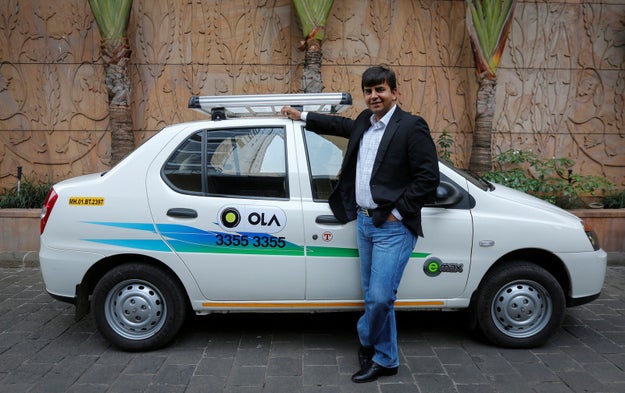
Bhavish Aggarwal, CEO and co-founder of Ola, poses in front of an Ola cab in Mumbai on March 3, 2015.

Shailesh Andrade / Reuters

For the last few weeks, anytime people launched the Uber app on their smartphones in Mumbai&;—&x200A;India’s financial capital located in the western state of Maharashtra and one of Uber’s most important markets in the world&x200A;—&x200A;they were blasted with a full-screen notification.

It urged them to sign a petition to protest against new rules that the government of Maharashtra had proposed last month for ride-hailing apps like Uber. If passed, read Uber’s warning darkly, these new rules would “mean the end of the Uber you know today.” In contrast, Uber&;s homegrown Indian rival Ola, which counts Mumbai among its top three markets in India, didn’t seem to do much besides send suggestions about the proposed rules to the government.

Screengrab / Via Uber

The rules, prescribed in a soporific 14-page draft, seek to regulate taxi apps like Uber and its homegrown Indian rival, Ola, to placate local taxi drivers in Mumbai who have seen business nosedive ever since the two competing companies entered the the city. It’s a story that has played out hundreds of times around the world ever since Uber,&x200A; &x200A;valued at $68 billion&x200A;, charged into 73 countries in just a few years.

The Maharashtra government’s new rules, however, threaten to fundamentally change how ride-hailing apps work in Mumbai. They ban surge-pricing in favor of a government-mandated fare cap, make it mandatory for thousands of drivers to buy cars with more expensive, higher-capacity engines, and, finally, require drivers to pay the government up to Rs. 2.61 lakh (about $3,000) for a permit before they can sign up to drive with an aggregator, depending on what kind of vehicle they own. The companies themselves will also need to pay Rs. 50 lakh (about $75,000) for every 1,000 cars registered on their platforms.

What was just as interesting as the proposed rules, however, was how the two companies reacted to them. Both companies want the same thing: to coax local and federal authorities to step into a brave new world and revise India’s archaic transportation laws. But while Uber went all out and asked its riders to rally around its cause, Ola barely flinched.

“Look, honestly, we don’t follow a global template like the one they [Uber] have, where if there’s something that’s not favorable to you, you create a public petition,” an Ola employee who wished to remain anonymous told BuzzFeed News.

Uber, of course, is no stranger to hostile policies or less-than-friendly governments. The company has plenty of experience muscling its way into even the toughest markets by playing fast and loose with the rules, then relying on its customers to put political pressure on those who would seek to regulate it out. While this strategy fails on occasion, as it did in Austin Texas, it’s worked in a number of places in the United States, including Las Vegas, where it faced exceptionally strong opposition both from the local governments and cab companies. And its in-app petition, like the one it just showed users in Mumbai, is a well-worn template it uses globally each time it needs to rally public support (Support Uber London&033; Keep Uber in PA&033; Keep Chicago Uber&033;).

“We think the proposed rules not only create a barrier for entry for our driver partners to get on to our platform, but they also make our service less reliable for consumers,” Shailesh Sawlani, Uber’s General Manager in Mumbai who recently appealed to customers to support the company on Uber’s India blog, told BuzzFeed News.

Uber can afford to cry foul, whereas Ola needs to be a lot more cautious.

In the weeks leading up to the Maharashtra government’s November 5 deadline for sending feedback about the new rules, Uber sent a letter to the state’s Chief Minister (India’s Governor equivalent) Devendra Fadnavis. The company wrote that while it agreed that existing taxi drivers were feeling the pressure from ride-hailing services, “the answer is to level the playing field by reducing today’s burdensome regulations&x200A;—&x200A;not to introduce rules that will be bad for riders, drivers and Maharashtra.” Uber’s India head, Amit Jain, also made an impassioned pitch for deregulating India’s app-based transport industry at a panel discussion. In the end, more than 100,000 people had signed Uber’s petition.

Meanwhile, Ola didn’t ask users in Mumbai to sign a petition each time they launched its app, nor did the company say anything to the press besides issuing a statement on November 5 summing up the problems it had with the government’s proposed rules&x200A;— including&x200A; the ban on surge-pricing, the choice of car, and the exorbitant permits — which were the same complaints that Uber had.

“We think that besides the few things that we have issues with, the government’s proposed policy is actually forward-looking and inclusive,” Pranay Jivrajka, Ola’s Chief Operating Officer, told BuzzFeed News. “The rules the government has proposed are just a draft, which means that they are willing to listen to you and understand you, so we think that working with them closely is the simplest way to get what we want… At some point, we are confident that the government will come up with a solution that’s fair to everyone. That doesn’t mean you start opposing them and collecting petitions from your users.”

The difference in the two companies&039; stances isn&039;t entirely surprising. “Uber has tons of global experience dealing with tough laws and authorities who lack regulatory imagination, so they can afford to take a long-term, more principled stand on regulations that directly affect their business in a strategic market like India,” a Mumbai public policy official who did not wish to be named told BuzzFeed News. “On the other hand, Ola chooses to focuses on more immediate problems like not getting hit with huge permit fees to stay in the market.”

In other words, Uber can afford to cry foul, whereas Ola needs to be a lot more cautious. “If Ola’s business gets affected or shut down in India, they have nowhere else to turn to because they don’t have a global footprint like Uber,” said the official.

According to a report by The Ken (paywall), both Uber and Ola have been ramping up their public policy departments for the last few years, but Uber spends twice as much on lobbying in India as Ola does. (Uber spends a lot on lobbying in the US, too.) Among other things, this includes surge-free rides for Indian government officials, and junkets for Indian politicians to Uber’s San Francisco campus.

“I don’t really see a moral or a principled problem with Uber’s approach,” said Pavan Srinath, head of strategy and programs at the influential Bengaluru-based public policy think tank, the Takshashila Institution. “India’s local transport systems like taxis and autorickshaws are very, very entrenched, more so than in any other country, and Uber decided to take them head on. So they’re doing what they have to do to survive.”

Quelle: <a href="Uber Pushes Hard To Influence Policy In Emerging Markets Because It Can Afford To“>BuzzFeed
Bitcoin Surges Following Trump Win

Anthony Wallace / AFP / Getty Images

While the market meltdown some feared following a Donald Trump win in the presidential election hasn&;t taken place — the major US indices are hovering down less than 1 percent this morning — one currency has seen a major bounce since it became clear last night that Trump was likely to be the country&039;s next President:

Bitcoin.

The seven-year-old cryptocurrency shot up $30 to $738 per BTC, before settling back down around $722, where it sits right now. That&039;s up nearly 2 percent today. The reason? According to Chris Burniske, blockhain products lead at the investment house ARK Invest, money floods to bitcoin in times of market instability.

“In many ways, people are treating it as gold 2.0.”

“In many ways, people are treating it as gold 2.0,” Burniske said. “Time and again over the past year, whether it was during the yuan devaluation or Brexit, whenever we have these shocks to capital markets, you see people turning to Bitcoin. It&039;s a disaster hedge.”

Bitcoin is relatively small. Its market cap — around 11.5 billion dollars — makes it slightly less valuable than Twitter. It&039;s largely free from capital controls, and is driven by an independent group of investors from around the world. According to Burniske, these factors leave the currency uncorrelated with other capital markets. In other words, it&039;s an attractive asset to buy when larger global assets are volatile. (It&039;s worth noting that the price of gold is also up more than a percentage point today.)

While many previous Bitcoin spikes have been driven by investment from China, the money flowing into the cryptocurrency last night and today seems to be coming from US-based investors. According to Burniske, the volume on the five biggest Bitcoin-US Dollar exchanges is triple today what it was Monday.

What a Trump presidency will mean for bitcoin and cryptocurrencies in general is unclear. The policies section of the Trump/Pence website makes no mention of digital currencies. But if Trump governs with the capriciousness that he campaigned, it stands to reason that the markets could follow. And that will ultimately be good for whatever asset is most insulated from that volatility.

And today, that seems to be bitcoin.

Quelle: <a href="Bitcoin Surges Following Trump Win“>BuzzFeed

Tech Is Freaking Out About A Possible Trump Win

Mandel Ngan / AFP / Getty Images

As some analysts begin projecting a Trump win, tech&;s bigwigs are panicking on Twitter and in interviews with BuzzFeed News.

Aside from Peter Thiel, a major Trump backer, tech has almost universally favored Clinton this election. In fact, opposing Trump became a cause that united a large portion of Silicon Valley.

Pishevar, a high-profile venture capitalist who cofounded Sherpa Capital, is also a cofounder of the transportation startup Hyperloop One.

Y Combinator&039;s Sam Altman, who cofounded a civic engagement nonprofit called VotePlz this election to encourage young people to vote, told BuzzFeed News that “I am officially very worried.”

Dennis Crowley, cofounder of Foursquare, also Tweeted his anxieties.

“People were very active trying to support Hillary for president, but I don&039;t think they&039;ve chewed on the prospect of a Trump presidency as imminent,” Keith Rabois, an investment partner at Khosla Ventures, told BuzzFeed News, explaining the anxiety. “So like everybody else, they&039;re probably processing it in real time right now.”

“Just look at your Twitter feed or look at my Twitter feed, which is mostly Silicon Valley people. It was totally divorced from reality,” Rabois said. “Everyone I know in Silicon Valley is in shock.”

Bordetsky works in business development at Uber.

Catherine Bracy, co-founder and executive director of the Oakland-based TechEquity Collaborative, told BuzzFeed News there are “still lots of votes out and paths to victory.”

“I think people need to stop freaking out (even though I am definitely freaking out),” said Bracy, who worked as a program manager for Tech4Obama in 2012.

Paul Graham, cofounder of the incubator Y Combinator, struck a slightly different tone.

“I have a board meeting at 9AM,” Stewart Butterfield, chief executive of Slack, said. “I do not anticipate sticking to the original agenda is Trump wins.”

This is a developing story. We will update as we get more reactions.

Quelle: <a href="Tech Is Freaking Out About A Possible Trump Win“>BuzzFeed

The Origin Of Twitter's Election Site

Ryan Carver / Via Flickr: 47882233@N00

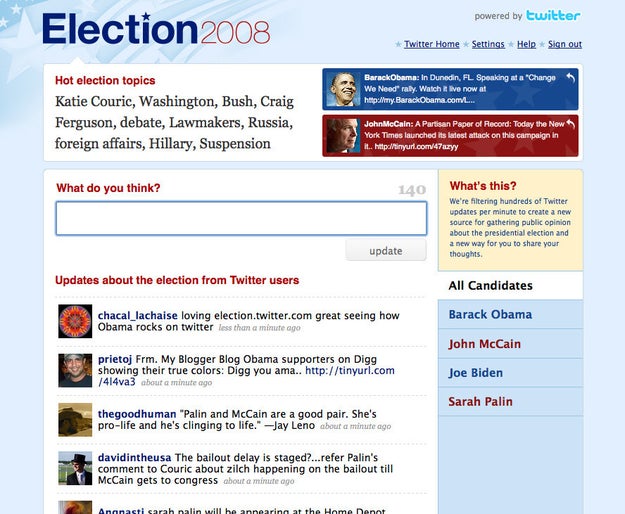
In September 2008, Twitter was at a tipping point and a time of great transition. Once a plaything of techies and bloggers, it was now a tool that was being rapidly adopted by corporations, celebrities, politicians, and the media. Twitter had 2.5 million users, according to the company at the time, and was growing rapidly — so rapidly that its Fail Whale icon had become a monument to its struggle to keep up. Meanwhile, Twitter was transitioning from desktop to mobile. It was trying to figure out how to monetize, and how to tap into the already-vast river of information flowing through its servers.

One way Twitter thought it might do that was by surfacing conversations taking place around key current events. And in the Fall of 2008, no conversation was hotter than the one occurring around the US Presidential election. For Twitter, that election was a big deal and, in many ways, a defining moment. The company had record traffic day on election day — 1.8 million tweets — and the mood at its headquarters as returns rolled in on November 4 was electric.

This is the story (taken from a larger feature written for WIRED that never ran) of how Twitter first built out a site to take advantage of those election-related conversations, and to showcase them in a way that would let anyone —Twitter user or not — see what people were saying. The URL for that site — election.twitter.com — will go live again tonight; it&;s where BuzzFeed News will broadcast our live election news show (a first for us).

Within just a few weeks of the events described below, Twitter would oust then CEO Jack Dorsey, and replace him with another co-founder, Ev Williams. And with that, Twitter&039;s first era — one defined by the desktop, Dorsey, and a historic election —would come to a close. Tonight, as Twitter is again helmed by Dorsey and we stand on the precipice of another historic election, it seemed like a good time to look back at where it all began.

Ev Williams is bored out of his shoes. The 37-year-old cofounder of Twitter is sitting at the head of a table in his San Francisco offices, clad in a T-shirt, blue jeans, and striped socks. He is surrounded by seven Twitter employees — techies, engineers, support staff. It has been two long years since launching the microblogging tool that lets users broadcast 140-character messages to networks of followers, and during that time the service has grown from a curiosity to a full-fledged communications platform. It has been an exciting process, but it has also led to some not-so-exciting usability issues, the kind that need to be hammered out in long, dull meetings. Meetings like this one.

The subject today: spam. Mass marketers and search engine optimizers are signing up for accounts, duping users into following them and then sending out barrages of useless links. Twitter staffers dive eagerly into the intricacies of the problem. They discuss how to freeze accounts that add too many followers too rapidly. They weigh whether they should enable people to rank one another by reputation. And they toss around the best ways to identify and filter out links that lead to known spam sites. “We could also use that as a freedom-and-democracy filter when we expand into China,” a product manager named Jason Goldman jokes.

The room fills with laughter, but Williams remains silent. As the meeting pushes past the hour mark, he folds his legs beneath him and squats in his chair. He plunges his face into his hands, rubs his eyes, and sighs loudly. He checks his BlackBerry. After about 90 minutes, he abruptly announces he has another meeting and hustles out.

Williams pops into a conference room next door, where Jeffrey Veen awaits. It’s early September, and everyone’s minds are on the upcoming election. Twitter, aiming to capitalize on the excitement, has contracted Veen, a storied Web architect, to build election.twitter.com. Veen and his team have been at it for a couple of days, and now he is ready to show some mock-ups. The idea is to filter election-related posts from Twitter’s raw feed, and display them in a real-time stream.

A constantly updated flow of political posts will cascade down the center of the screen, while tables and graphs will show which candidates are generating the most chatter. Ultimately, the site could be hugely useful for tracking how the news of the day affects what people are saying about the candidates in real time; an immersive CAT scan of the political hive mind. It’s very slick stuff.

Williams is not bored anymore; quite the opposite. His eyes bulge, and a goofy grin spreads across his face. He jumps up to sketch ideas on the whiteboard. And this time, when Veen tries out a rather bland joke (“One thing we found: No one talks about Joe Biden”) Williams laughs uproariously.

You can’t blame Williams for preferring Veen’s gee-whiz performance to the plodding anti-spam meeting. It is much more fun to ponder Twitter’s potential to reshape modern communication than to deal with the nuts-and- bolts details of creating a safe and secure platform.

In the 2016 election cycle, instead of spam and Fail Whales, Twitter found itself struggling with sluggish growth and online harassment. Yet, despite that, it remained at the center of the election, driving news of the day and serving as a vital information hub. This evening, election.twitter.com is live once again, home to BuzzFeed News and Twitter&039;s live Election Night special – “We Did It, America.”

Quelle: <a href="The Origin Of Twitter&039;s Election Site“>BuzzFeed