Mark Zuckerberg Says Fake News On Facebook Didn’t Change The Election

Paul Sakuma for Techonomy

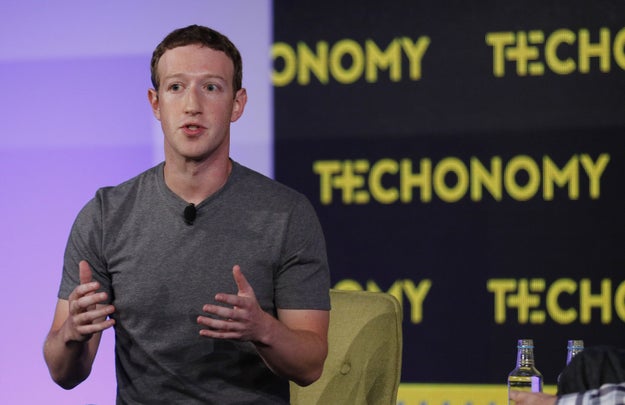
Facebook CEO Mark Zuckerberg Thursday rejected charges that the social network&;s promotion of false pro-Trump news articles could have affected the outcome of the presidential election.

“I think the idea that fake news on Facebook — of which it&039;s a very small amount of the content — influenced the election in any way is a pretty crazy idea,” he said.

In the months leading up to November 8, fake news traveled far and wide on Facebook. Its algorithm-driven Trending feature repeatedly promoted untrue stories. Hyperpartisan political pages racked up hundreds of thousands of comments and likes on sensational and misleading stories about Hillary Clinton and Donald Trump. And many of those viral claims were made by Macedonian teens who profited handsomely by gaming the social network, as BuzzFeed News has found.

Zuckerberg was speaking onstage at Techonomy, a science, business, and technology conference held on Thursday, two days after Election Day. It was held at the Ritz-Carlton Hotel in Half Moon Bay, a picturesque seaside town between San Francisco and Silicon Valley, where many liberal-minded tech executives and employees were still coming to grips with the fact that America had voted to send Trump to the White House.

“Part of what I think is going on here is people are trying to understand the results of the election,” he said. “I think there is a certain profound lack of empathy in asserting that the only reason why someone could have voted the way they did is because they saw some fake news.”

Zuckerberg noted that hoaxes aren’t a brand-new phenomenon, either. “There have been hoaxes on the internet, there were hoaxes before,” he said. “We do our best to make it so that people can report that, and as I said before, we can show people the most meaningful content we can.”

He added, “Voters make decisions based on their lived experience. One part of this that I think is important is we really believe in people. You don’t generally go wrong when you trust people that understand what they care about and what’s important to them, and you build systems that reflect it.”

The CEO also argued that, compared to traditional media, Facebook&039;s newsfeed exposes people to a variety of opinions — and is not an echo chamber, as many have criticized the social network of being.

“The media diversity and diversity of information that you&039;re getting through a social system like Facebook is going to be inherently more diverse than what you would have gotten from watching one of three news stations and sticking with that and having that be your newspaper or your TV station 20 years ago,” he said.

Earlier in the day, a Facebook spokesperson had told BuzzFeed News: “While Facebook played a part in this election, it was just one of many ways people received their information – and was one of the many ways people connected with their leaders, engaged in the political process and shared their views.”

Quelle: <a href="Mark Zuckerberg Says Fake News On Facebook Didn’t Change The Election“>BuzzFeed

Women Take Stock Of Silicon Valley In Trump’s America

Bill Holmes / Flickr / Via Flickr: flaneur

With a Donald Trump presidency now imminent, women in tech, a lucrative industry that’s already rife with unconscious bias and other challenges for non-white men, are concerned that the barriers of entry to their field may grow even higher.

The 53 million Americans who voted Trump into office were able to accept or at least ignore the president-elect’s comments on women — “fat,” “slob,” — and allegations from half a dozen women who have accused him of sexual harassment or assault. But female leaders in Silicon Valley are worried about what a national leader with this track record means for women and people of color in their industry.

“Electing a President that is openly hostile to women is a threat for women in every industry,” wrote Andreessen Horowitz partner Kim Milosevich in an email, though she added that past battles have made progress, and doesn’t “think women in this country will easily give up those gains, and I hope that we will fight harder than ever for our future.”

On Twitter, younger women are voicing concerns about what a Trump victory means for the number of women entering into STEM fields.

Trump’s campaign has flip-flopped on the question of equal pay, and he made no statements about creating STEM jobs, or STEM education, facts that Donna Harris, startup CEO and co-founder of DC-based accelerator 1776, finds worrisome in and of itself. But she’s also concerned that the things Trump did say on the campaign trail could impact the number of women choosing to enter into a male-dominated field like tech.

“We’ve seen high profile incidents of harassment [in tech], and we’ve now elected a president who has been very vocal as to his attitudes about women, and his attitudes about harassment,” she said. “Locker room talk, or boys will be boys — that’s what causes a lot of women to decide this field is not for them. They see it as offensive, and it creates an atmosphere where they feel they’re not welcome.”

“Locker room talk, or boys will be boys — that’s what causes a lot of women to decide this field is not for them.”

Joanne Chen, a partner at Foundation Capital whose career has taken her from engineering to Wall Street to venture capital, said she hopes Trump’s election won’t reverse the incremental improvements gender diversity advocates in Silicon Valley have achieved so far.

“It&;s a wake up call to take action in big and small ways,” Chen, who organizes Female Founders events in Silicon Valley, said. “I’m an immigrant, I’m an engineer, and I’m a woman. What does that mean for me? For female entrepreneurs? For investors? … I’m wondering what Trump as president means for things like that.”

What Comes Next

Of course, while female venture capitalists, technologists, engineers, and executives do face barriers, especially if they’re women of color, they tend to have more political capital (and capital capital) to exert than other Americans. Catherine Bracy, director of community organizing at Code for America, said women in tech should be thinking about how to leverage that privilege “to prevent as much damage to our nation and our most vulnerable residents as possible from a Trump presidency.”

Heather West, director of public policy at Mozilla, echoed that sentiment on Twitter.

Some in Silicon Valley are already thinking about what can be done to ensure that Trump’s win doesn’t discourage members of underrepresented populations from working in tech. Redoubling commitments to diversifying staff, to include both women and people of color, seems like an obvious first step.

Citing Ebay’s CEO as one example, Project Include founder Ellen Pao, an outspoken advocate for diversity in Silicon Valley, said she’s hopeful tech firms will take Trump’s win as an opportunity to reexamine their commitment to diverse hiring.

“The election was a wake-up call about the amount of work we have to do to give everyone a fair chance to succeed in tech, in STEM education, in all kinds of businesses, and across all areas of the United States,” Pao wrote in an email. “I&039;m hopeful to see people are ready to roll up their sleeves and do the work that still needs to happen.”

Karla Monterroso is director of programming for Code 2040, an organization aimed at achieving total equality in the tech industry in the next 34 years. The organization’s founder, Laura Weidman Powers, is currently a senior policy advisor in the White House; it seems inevitable that Code 2040 won’t have the same kind of access to the Trump administration. But Monterroso is hopeful nonetheless.

“Our goals — we have a conviction around them happening regardless of this election,” she said. Specifically, Monterroso pointed to Pandora, a Code 2040 partner and tech company based in Oakland that’s just released ambitious diversity goals — the company plans to employ a staff that is 45% people of color by 2020, or the year of the next presidential election.

“The election was a wake-up call about the amount of work we have to do to give everyone a fair chance to succeed.”

Meanwhile, in Boston, engineer Brianna Wu, whose life was threatened during Gamergate in 2014, is talking seriously about running for political office. Wu said she wants to be a positive model for members of underrepresented groups who feel like a career in tech, or access to capital, or a role in politics, is out of their reach.

“What did Donald Trump show on Tuesday? You can be the most qualified woman in the world, and the man that abuses you is still going to win that office and be taken more seriously. And I think that&039;s a disastrous message,” she said. “It’s clear the system as it’s working isn’t working for a lot of us, not for black people, Muslim people, or LGBT people, and it’s definitely not working for women. And I think the only way to get past that is to get more people with that lived experience into these roles.”

Wu said, if she became an elected official, one of her first priorities would be bringing more tech jobs to her constituency, and advocating for tax credits for companies that hit diversity and inclusion goals.

An essential part of improving diversity at tech companies goes beyond simply hiring — it’s making sure people of color and women feel like their fears and concerns are being heard and addressed by their colleagues and employers. Cristina Cordova, who leads partnerships at Stripe, had advice for tech companies that want to foster environments of inclusion.

“Many women and people of color in tech have told me about the emails/talks they received from their company leadership post this election,” Cordova wrote on Twitter. “To those who work at companies with leadership that hasn&039;t addressed this INSANE election, maybe it&039;s time to consider a job somewhere else.”

Quelle: <a href="Women Take Stock Of Silicon Valley In Trump’s America“>BuzzFeed

Facebook And Twitter Didn’t Fail Us This Election

Drew Angerer / Getty Images

In the rush to make sense of President-elect Donald Trump, one of hundreds of seemingly logical conclusions is that the social platforms we live on — the newest, most powerful tools of media, discovery, and expression — didn’t live up to their promise. That after years of promoting themselves as tools to connect the world and elevate all voices, what we got instead was a sharp public increase in ideological division, fake news, and harassment. All this makes makes it easy to point toward the Facebooks and Twitters of the world and say that they failed. But the truth is more unsettling: they really didn’t fail at all.

In fact, throughout the fifteen month election slog, Facebook, Twitter and the social platforms we live on functioned exactly as designed — rapidly disseminating information, providing a real-time look into the pulse of the nation. Throughout the cycle and almost without exception, they were reflective of the national mood and elevated a political movement by giving voice to a previously unheard constituency — just as the companies had hoped they would. Argument, opinion, ideology — all these things were amplified widely and powerfully across Twitter, Facebook, and places like Reddit. In the end, these platforms worked exactly as their founders intended — just on behalf of a group they didn&;t see coming with views that many who worked on their development are now struggling to come to terms with.

Coming as it does after Trump’s unexpected election win, this kind of reckoning feels fresh and raw. But it’s nothing new. For the last ten years, the crash of utopian idealism against the rocks of human reality has arguably been the defining story of the internet.

And the heart of this tension is a theoretically admirable commitment to free speech. You see it with Reddit, a social news site conceived to be the front page of the internet — the pulse of a democratized medium. In 2013, Reddit co-founder Alexis Ohanian explained his thoughts on the internet’s promise to Forbes, noting that “ideas spread faster and further than ever before, whether they’re yours to learn or to share. To join in the industrial revolution you needed to open a factory, in the internet revolution you need to open a laptop.”

Three years later, and two days after the recent presidential election, Leslie Miley, Twitter’s former engineering manager, offered a similar analogy. “The impact of Twitter and Facebook — their ability to rapidly disseminate information without a chance to process it — is analogous to building out factories or automobiles in the early part of the 20th century and not realizing the environmental and health effects,” he said. “In this rush to build and to acquire users and money, [some of the information] getting spread is not accurate and you [don’t have] time to react in any way but emotionally.”
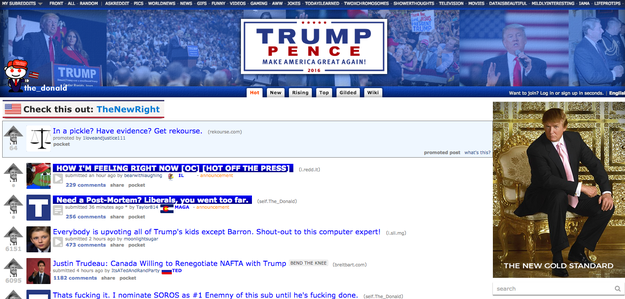
As a megaphone for political discourse, Twitter was vital to the campaign of President-elect Donald Trump, who used 140 character missives to bypass the press, rake in earned media, program cable news talking points, and rally supporters. As a flat platform, Twitter did what it was supposed to. The result was the empowerment of the insurgent political movement of the alt-right who, through a coordinated effort of trolling and online organization, drove enthusiasm and momentum against the establishment and for Trump. Trolling and ideologies aside, the mechanics of this weren’t much different than those of the Iranian Revolution protestors, or the Arab Spring, or even Black Lives Matter, all of which Twitter was lauded for empowering.

“I remember conversations we had at Twitter while watching the Arab Spring and the Boston Bombing,” Miley said. “At some point I said, ‘don&039;t we have a responsibility not to distribute certain information? At what point are we going to see some user use our platform to spread wrong information and people die from it?’” And Miley had good reason to ask that question: “I could see this happening at twitter and no one else was asking that — it’s just a rush to build and a rush to &039;disrupt.’ There’s no fact-checking on the information our platform spreads. Twitter, Facebook, Snapchat — they could give a goddamn about facts.”

Facebook, in response to earlier election related questions from BuzzFeed News, said the platform was “one of many ways people received their information.” A spokesperson for Twitter provided the following statement: “… Scapegoating social media for an election result ignores the vital roles that candidates, journalists, and voters play in the democratic process.” Facebook responded to an additional request for comment, noting that Zuckerberg would be speaking at the Techonomy conference later today; Twitter has not responded to an additional request for comment.

As the reality of a Trump administration sinks in, the reckoning has just begun for many who’ve helped to build platforms like Twitter and Facebook. In a conversation yesterday, one former senior Twitter employee, present in many of the company’s crucial strategy meetings, said that Twitter’s failure to define itself helped provide the structure that embraced, amplified and extended Trump’s message to an audience keenly attuned to hearing it.

“The company&039;s inability and unwillingness to choose what it needed to be and defaulting into this anything goes state — having it be the ‘honeypot for assholes’ — is haunting us today,” the source said, noting that Twitter is President-elect’s platform of choice to amplify perhaps his most coherent message.

“Twitter, Facebook, Snapchat — they could give a goddamn about facts.”

“If you&039;re Donald Trump and you say, ‘God, if we could just scare people enough and make them feel sufficiently insecure; if we could play upon their deepest apprehensions and worries and just have a platform to effectively distribute that message then we’d be in good shape,”” the source said. “Well, we got it. …If alienated, lesser-educated, disproportionately white men and white women needed a digital platform to validate their alienation and apprehensions, well, you&039;d build them the retweet.” It’s worth noting, the source said, how Trump used Twitter’s retweet feature to amplify the voices of white supremacists and professional trolls as part of his message to the American people, all without saying it himself. “The retweet allowed a prominent public figure like Donald Trump to share with his millions of followers, in the absence of a full on endorsement, a kind of winking attaboy with the most vile people in the world.”

Instagram: @donaldjtrumpjr

For Vivian Schiller,the former CEO of NPR who once headed up Twitter’s news operation, Twitter isn’t so much a filter bubble as a platform for weaponizing ideology. “The fact that Twitter is often instant and relentlessly reverse chronological and unfiltered means it&039;s very hard to hide from ideas,” she told BuzzFeed News “That comes with some nasty byproducts, like trolls and abuse, but it&039;s nearly impossible to be in denial on twitter. It&039;s the opposite of a space safe from uncomfortable ideas.” The rawness, which can often manifest in surfacing the worst humanity has to offer, in other words, is baked into the platform’s DNA.

Twitter wasn’t drawn up this way, As with Reddit, enabling hatred, misogyny, xenophobia, and abuse was not the founders intent. But like Reddit, Twitter’s idealistic, maximalist free speech origins lacked a clear thesis and definition to define its evolution. As one former Twitter employee told me back in August, homogenous leadership at Twitter was at the heart of the company’s struggle with abuse; simply put, the straight white leadership didn’t adequately envision how their platform could be used for evil. “They were often tone-deaf to the concern of users in the outside world, meaning women and people of color,” the former employee said.

“It&039;s the opposite of a space safe from uncomfortable ideas.”

Ethan Zuckerman, the Director for Civic Media at MIT’s Media Lab cites the platforms’ exponential scaling as part of the problem. “These platforms were designed as villages and then became cities and continents and there just wasn’t that kind of long-term planning involved,” he said.

Zuckerman cited the backlash in recent days against Facebook News Feed, for its algorithmic approach to its News Feed. “I don’t think somebody sat at Facebook sat down and said, ‘let’s create an amazing propaganda machine to delegitimize mainstream media as a whole,’” he said of News Feed’s share and like based incentive structure that has exacerbated filter bubbles and the sharing of fake news. Schiller echoed this point as well.. “Don’t blame Facebook,” she wrote. “They could not have been clearer when they released this statement on June 29th [which read,] ‘Our top priority is keeping you connected to the people, places and things you want to be connected to — starting with the people you are friends with on Facebook’. With this blog post, they quite literally declare themselves in the filter bubble business.”

“What all platforms ought to be doing now is studying themselves as aggressively as all of us are studying them,” Zuckerman said. “They need to be asking, ‘is this where we want our technology to go?’ And these companies have to think of an abuse department as a community management department that’s constantly asking, ‘what do we want to be?’”

That sort of self-introspection has, historically, been rare at the big platforms. Twitter’s response to its ten years of amplifying harassment has rarely produced more than a tacit acknowledgement of the problem and a resolve not to stray from its free speech foundings while Facebook’s commitment to news is consistently overshadowed by its ambition to connect the world and to show users what they want. In both cases, like Reddit, the arduous process of examining their roles and course correcting often loses out to the idealistic promise of the original vision.

“I wouldn’t say that Twitter and the platforms did what they were supposed to do, but they definitely did what they&039;re presently set up to do,” the senior former Twitter employee said. “And that’s because nobody has ever really intervened to fix them in ways that were quite fixable if you just had a thesis for what it was supposed to be. We&039;ve built our own weapon of social destruction and haven&039;t handled it with care. I think that’s a fair conclusion.”

Miley echoed the thought. “Black Lives Matter used Twitter with ruthless effectiveness. So did Gamergaters. And guess who else learned to use it with ruthless effectiveness? Trump and the alt-right — few did it better.”

“We&039;ve built our own weapon of social destruction and haven&039;t handled it with care.”

In the aftermath of the 2016 presidential election, there’s a reckoning occurring among Silicon Valleys rank and file.But it’s not at all clear if it extends to the founders of Twitter and Facebook, who continue to shape those platforms. For now, these leaders seem more apprehensive to acknowledge their role and more willing to discuss the internet we wanted and thought was possible than the internet of our current reality.

Last night, Twitter’s CEO Jack Dorsey tweeted vaguely about politics and the role that his companies (Dorsey is also CEO of Square) might play in the future. But he stopped short of acknowledging Twitter’s role in the months and years leading up to the election. “I commit to using the privilege I currently have to always speak this truth to power, and to ensure the common good leads everything we do,” he said. Similarly, a statement from Facebook founder, Mark Zuckerberg, was sober, hopeful and ambitious, but did not acknowledge questions of media responsibility that have dogged the social network for the past 15 months.

In response to a Bloomberg article about Facebook’s role in the election, a Facebook spokeswoman also shied away from any culpability saying, “while Facebook played a part in this election, it was just one of many ways people received their information – and was one of the many ways people connected with their leaders, engaged in the political process and shared their views.”

There are two ways to interpret that statement. The first, as a defensive abdication of responsibility. The other? The platform worked just as it was supposed to do.

Quelle: <a href="Facebook And Twitter Didn’t Fail Us This Election“>BuzzFeed
Grubhub CEO Suggests That Employees Who Agree With Trump's Rhetoric Should Resign

Via pinterest.com

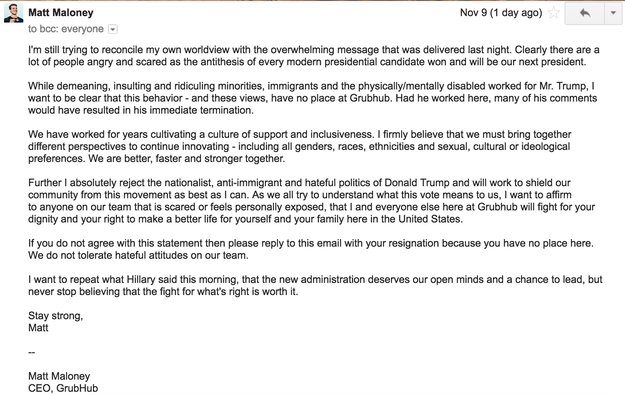
The CEO of Grubhub, a publicly traded food delivery company that also includes Seamless and Menupages, sent a company-wide email on Wednesday inviting employees to resign if they agreed with the some of the demeaning and hateful rhetoric that marked Donald Trump&;s presidential campaign.

Matt Maloney, CEO and co-founder of the Chicago-based company, which has a $3.16 billion market capitalization and more than 1,000 employees, is a Hillary Clinton supporter. In the email, Maloney noted his shock and concern for the safety of his employees during Trump&039;s presidency.

“Further I absolutely reject the nationalist, anti-immigrant and hateful politics of Donald Trump and will work to shield our community from this movement as best as I can. As we all try to understand what this vote means to us, I want to affirm to anyone on our team that is scared or feels personally exposed, that I are everyone else here at Grubhub will fight for your dignity and your right to make a better life for yourself and your family here in the United States.

If you do not agree with this statement then please reply to this email with your resignation because you have no place here. We do not tolerate hateful attitudes on our team.”

Earlier in the email, Maloney wrote that Trump would have been fired for some of his comments on the campaign trail if he had been a Grubhub employee. “While demeaning, insulting and ridiculing minorities, immigrants and the physically/mentally disabled worked for Mr. Trump, I want to be clear that this behavior — and these views, have no place at Grubhub. Had he worked here, many of his comments would have resulted in his immediate termination,” Maloney wrote.

The subject of the email, which was obtained by Fox News, was: “So…that happened…what’s next?” Maloney previously told Fox News that “almost 20 percent” of his employees personally thanked him for the message. “I am not embarrassed by it,” he said.

Via Grubhub

In response to questions from BuzzFeed News about the legality of the email and whether Maloney was concerned about alienating employees who may be among the 59.9 million voters who cast their ballot for the Republican nominee, a spokesperson for Grubhub pointed to a recent blog post from Maloney explaining his intentions.

“I want to clarify that I did not ask for anyone to resign if they voted for Trump,” he said in the blog post, pasted in full below. “I would never make such a demand. To the contrary, the message of the email is that we do not tolerate discriminatory activity or hateful commentary in the workplace, and that we will stand up for our employees.”

Inclusion and Tolerance in the Workplace

This year’s presidential election was undoubtedly divisive and left many of our employees feeling concerned. In response, I wrote a company-wide email that was intended to advocate for inclusion and tolerance — regardless of political affiliation — during this time of transition for our country.

Some of the statements in my email have been misconstrued. I want to clarify that I did not ask for anyone to resign if they voted for Trump. I would never make such a demand. To the contrary, the message of the email is that we do not tolerate discriminatory activity or hateful commentary in the workplace, and that we will stand up for our employees.

Grubhub welcomes and accepts employees with all political beliefs, no matter who they voted for in this or any election. We do not discriminate on the basis of someone&039;s principles, or political or other beliefs.

I deeply respect the right of all citizens to vote for the candidate of their choice. In fact, I offered extra flexibility on Tuesday and encouraged all our employees to go vote. There is a place for all points of view at Grubhub. We value diverse perspectives and believe those perspectives help to create a better product and a better workplace culture.

Grubhub’s leadership team has worked for years to create a culture of support and inclusiveness. I firmly believe that we must bring together different perspectives to continue innovating. We are better, faster and stronger together, and so is America.

Posted by Matt Maloney, Grubhub CEO

Quelle: <a href="Grubhub CEO Suggests That Employees Who Agree With Trump&039;s Rhetoric Should Resign“>BuzzFeed

Unicode Approves Breastfeeding And Hijab Emoji

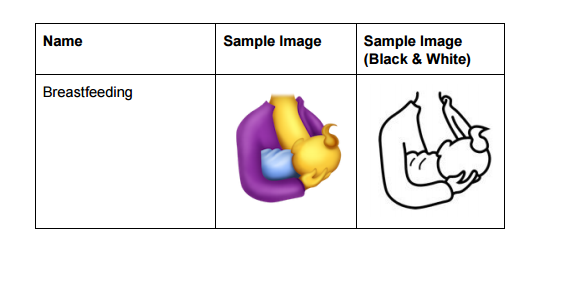
This afternoon, during its 149th meeting, the Unicode Consortium approved 56 new Emojis for the Unicode 10 release. The new emojis are based on proposals submitted to the consortium over the past year and include a hijab emoji, a breastfeeding emoji, a cut of meat emoji, a sandwich emoji, and a T-Rex emoji, and a man with a monocle emoji.

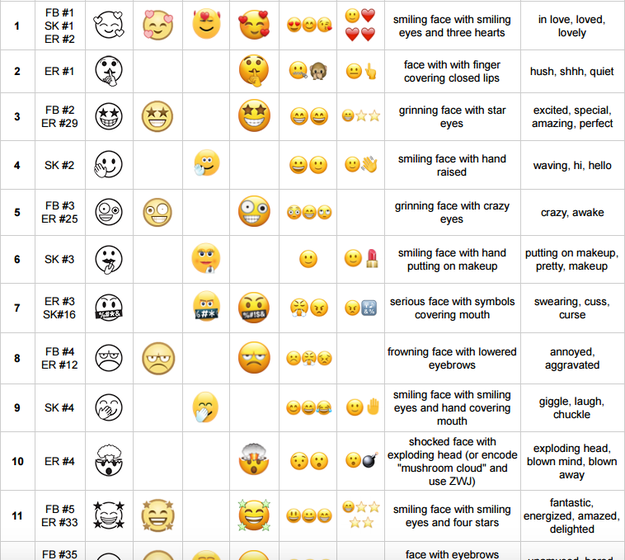
Also included in the mix, 36 new emoji faces which should come in handy post-election. Among them, “face with hand covering face,” “shocked face with exploding head,” and “face with open mouth vomiting”

You can view the full list here. Here are a few of the proposed pictures:

Hijab emoji

Hijab emoji

Breastfeeding emoji

Breastfeeding emoji

Pie, Pretzel, and Sandwich emojis

Pie, Pretzel, and Sandwich emojis

Quelle: <a href="Unicode Approves Breastfeeding And Hijab Emoji“>BuzzFeed

The AT&T Merger Will Be A Big Test Of Trump’s Promises

Jim Watson / AFP / Getty Images

Donald Trump was clear when he promised to block the proposed AT&T-Time Warner merger last month, describing the purchase as “a deal we will not approve in my administration because it&;s too much concentration of power in the hands of too few.” But without knowing who President-elect Trump will choose to lead the Justice Department and the agency’s antitrust division, it’s unclear if the campaign pledge will serve as a negotiating tactic or the deal’s death knell.

This spring, former Trump Campaign Chair Paul Manafort explained that Trump’s proposal to ban Muslims from entering the country was a negotiation tool rather than an earnest plan. “He operates by starting the conversation at the outer edges and then brings it back towards the middle,” Manafort said in May. “Within his comfort zone, he’ll soften it some more.” Some of Trump’s supporters have absorbed that logic too, expecting from the next President not so much a literal wall between the United States and Mexico as the spirit of tougher immigration enforcement.

And so with the AT&T merger, President Trump’s words on the campaign trail will be tested against his deeds in the White House. BTIG analyst Rich Greenfield told BuzzFeed News that it’s an open question whether Trump’s stance on the deal was a politician’s posturing or a hard and fast policy position. “Is he a traditional Republican — laissez-faire — or is he a populist?” Greenfield said. “Politicians often say things on the campaign trail that never pan out in reality. I don’t think we have any way of knowing.”

“Politicians often say things on the campaign trail that never pan out in reality. I don’t think we have any way of knowing.”

As part of the proposed deal, AT&T must pay Time Warner $500 million if regulators halt the marriage. Analysts will closely watch for who Trump will appoint to lead the Department of Justice and the Federal Communications Commissions, which is the government’s chief telecom regulator.

One source who has worked on previous media mergers pointed to Trump’s professed pragmatism to predict how he might evaluate the acquisition; he is all about the “the Art of the Deal,” the person said, referring to Trump’s 1987 best selling book. Rather than take Trump’s unequivocal rejection of the merger as a sign of things to come, the source noted that his aggressive stance could force AT&T to cut a better deal for American consumers.

But critics of mega-mergers like Sen. Elizabeth Warren have criticized the government’s approval of such deals, even when companies agree to special conditions in order to minimize harm to customers. Advocates and lawmakers say firms can violate these conditions, which are generally difficult to enforce.

Todd O’Boyle, director of the Media and Democracy Project at Common Cause, told BuzzFeed News that even if you take Trump’s comments at face value, the Justice Department would still have to build its own legal case to challenge the AT&T merger. “On the one hand, Mr. Trump was very critical of the merger when it was announced; on the other hand, regulators will still have to go through a process and come to a conclusion,” he said.

Other observers have suggested that Trump’s opposition to the AT&T deal has more to do with a vendetta against the news media (Time Warner owns CNN) than with a reinvigorated approach to antitrust enforcement. In his opposition to network neutrality, and his clashes with some of the tech industry’s biggest players like Amazon’s Jeff Bezos and Apple’s Tim Cook, analysts have suggested that the Trump presidency could swing in favor of incumbent telecom giants over the tech titans of Silicon Valley, a group seen as largely untouched under Obama’s watch.

While the Clinton campaign joined Congressional Republicans in saying AT&T’s proposed merger deserves a close look, the Democratic nominee did not vow to block it, as Trump did.

AT&T tried to make the best out of Trump’s unexpected victory. The company referred BuzzFeed News to a statement from its CFO John Stephens. “From a company perspective, we really look forward to working with President-elect Trump and his transition team,” he said.

Quelle: <a href="The AT&T Merger Will Be A Big Test Of Trump’s Promises“>BuzzFeed

Nobody Is Sure What Trump's $1 Trillion Transportation Plan Will Actually Look Like

Bryan R. Smith / AFP / Getty Images

Donald Trump is, if anything, a builder – of hotels, casinos, golf courses, apartments. He campaigned on introducing a 10-year, $1 trillion infrastructure plan. And in his acceptance speech Tuesday night, he promised to “rebuild our highways, bridges, tunnels, airports, schools, hospitals.”

Who he will tap to lead that effort remains unclear, after presidential his win Tuesday against Hillary Clinton stunned the country. Reports have circulated speculating several cabinet picks; BuzzFeed News obtained a list of 41 candidates shortlisted for top positions. Noticeably absent: a name for transportation slot. Sources in the industry and policy circles in DC said they aren’t even sure if that position is on the radar yet. A staffer for a House Republican told BuzzFeed News that people are “still processing the results of the election” and “haven’t gotten to names yet.”

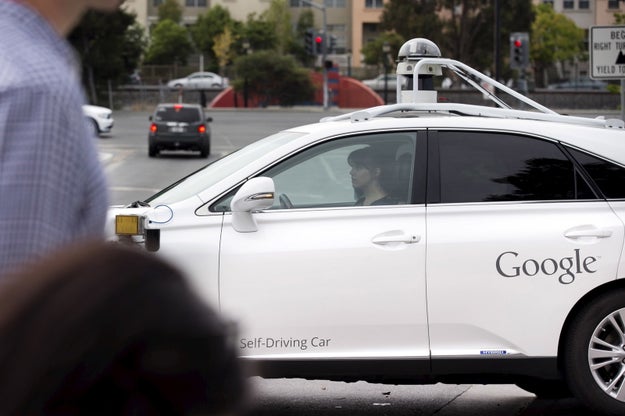
Trump’s transportation secretary will shoulder the role during a crucial point for the transportation industry — a period in which automakers and tech companies are racing to put self-driving cars on the road, and regulators are determining how to deal with them. Cash-strapped local governments are also grappling with uncertainty and underinvestment in public transportation infrastructure.

“The whole issue of autonomous vehicles is just at the starting gate.”

In September, the Department of Transportation released guidelines for autonomous vehicles. Anthony Foxx, who President Obama named transportation secretary in 2013, has done several Silicon Valley tours and met with companies developing self-driving cars, including Google. He told BuzzFeed News he expects self-driving cars to start becoming mainstream in about five years, and has prioritized preparing the department to deal with the dramatic shift they herald. The guidelines released in September, though, are voluntary. They outline safety points for the technology and seek to gather information from companies about how they are dealing with cybersecurity, technical failures and ethical dilemmas – should the car save the passenger or a pedestrian in the event of a crash? It may fall to Trump’s transportation secretary to finalize those rules.

“The whole issue of autonomous vehicles is just at the starting gate…we’ll have to wait to see who gets in that job and what priority they place on it,” Ray LaHood, an Illinois Republican who served as President Obama’s transportation secretary during his first term, told BuzzFeed News. “I don’t think anybody knows really who’s going to get picked for any of these positions.”

The next transportation secretary will play a key role in determining whether the US encourages a broad shift to self-driving vehicles or adopts a more tempered approach. Foxx’s five-year timeline matches up with industry expectations about when companies will begin testing self-driving technology at a greater scale. Ford plans to mass-produce self-driving vehicles for ride-hail use by 2021. And in September, Uber launched a pilot program to put passengers in self-driving cars in Pittsburgh. Outside the US, Volvo is preparing to launch programs to give 100 people in London, Sweden, and China self-driving vehicles. How a Trump Department of Transportation sets ground rules for automated vehicle technology – or if it choses to take a back seat and let states make their own rules – could alter the trajectory and pace of both automakers and tech companies’ efforts.

A self-driving Google car.

Elijah Nouvelage / Reuters

In the Obama administration, that enthusiasm for autonomous car technology trickled down from the president himself. Obama created the US Digital Service, described as a technological “SWAT team” to improve government IT, for example, by digitizing the refugee admissions process. He penned an op-ed calling self-driving cars “an emerging reality with the potential to transform the way we live.”

One potential Trump pick for secretary of transportation could be Rep. Bill Shuster, the Pennsylvania Republican who chairs the House transportation and infrastructure committee. Shuster endorsed Trump in April. Prior to running for Congress, he worked on his family’s farm in Bedford County, Pennsylvania, and owned an automobile dealership – experience that could resonate with Trump’s populist base. He’s been a member of the transportation committee since 2001 and previously chaired a subcommittee on railroads, pipelines, and hazardous materials, and another one on economic development, public buildings, and emergency management.

That said, for the transportation secretary post, president-elects often look to mayors and governors, given their day-to-day experience managing local infrastructure, transportation and traffic. Trump, who has no prior government experience himself, also could pluck his transportation secretary from the private sector.

On Wednesday, Trump’s team launched GreatAgain.gov, its transition website. The site includes “transportation & infrastructure” under its section for “getting America back to work again.”

“Americans deserve a reliable and efficient transportation network and the Trump Administration seeks to invest $550 billion to ensure we can export our goods and move our people faster and safer,” the page reads, offering few other details. In a 100-day plan on his campaign website, Trump said he would spur $1 trillion in infrastructure investment over the next 10 years.

“Trump has to get that through Congress,” LaHood said. “Probably what he’ll be doing is he and [Vice President-elect Mike Pence] will be sitting down with Paul Ryan and figuring out what the agenda will be, and hopefully infrastructure will be right at the top.”

LaHood now co-chairs a coalition called Building America’s Future, a bipartisan infrastructure advocacy group, with ex-New York City Mayor Michael Bloomberg and Ed Rendell, who was one of Clinton’s advisers on infrastructure issues.

The infrastructure page of Trump’s campaign website says he plans to “…incorporate new technologies and innovations into our national transportation system such as state-of-the-art pipelines, advancements in maritime commerce, and the next generation of vehicles.”

“Just looking through Trump’s plan, it just looks like there’s a lot of blanks that need to be filled in.”

The website also notes that Trump plans to make broader use of public-private partnerships, something local governments, looking to cut costs, have increasingly done by inking contracts with Uber and Lyft. “This is particularly telling when thinking about the continued growth of transportation technology – much of its development has hinged upon pilot programs between public and private organizations,” said Ann Henebery, a spokeswoman for the Eno Center for Transportation, a nonprofit, nonpartisan think tank. But, she added, “what is key to remember from a political perspective is that Trump’s campaign platform stands against everything that [automated vehicles] are: automated machines that could eventually replace low-skilled labor, that are products of largely white-collar workers, and that are most useful to those who live in urban centers.”

Given the lack of specifics, transportation experts are struggling to uncover policy takeaways from Trump’s “half-written, cryptic talking points,” Michael Sargent, who researches transportation issues at the conservative think tank The Heritage Foundation, told BuzzFeed News.

“Just looking through Trump’s plan, it just looks like there’s a lot of blanks that need to be filled in,” Sargent said. “It seems to me like there has not been very much thought put into this. He doesn’t really mention technology.”

Quelle: <a href="Nobody Is Sure What Trump&039;s Trillion Transportation Plan Will Actually Look Like“>BuzzFeed

After Trump, Soul-Searching In Silicon Valley

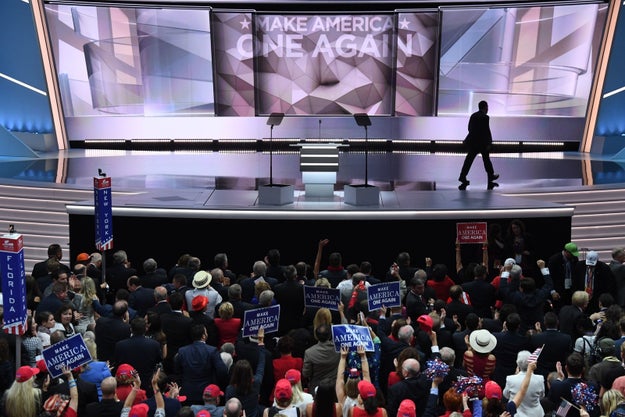
Peter Thiel walks off stage at the Republican National Convention

Jim Watson / AFP / Getty Images

Venture capitalist Dave McClure was sitting before a crowd at a tech conference Wednesday morning trying to act as though Donald Trump hadn’t just been elected President of the United States.

But in the midst of a panel on whether ego is the biggest reason for failure, McClure, a founding partner at 500Startups, jumped out of his seat to talk about the election results. When the moderator asked McClure to tie it back to technology, he pivoted from anger to something closer to anguish, calling social networks built by Silicon Valley “a propaganda medium” that “assholes like Trump” use to get in office. “We provide communication platforms for the rest of the fucking country and we are allowing shit to happen just like the cable news networks, just like talk radio,” he said. By the time McClure asked the crowd to stand up and “make a goddamn difference,” they gave him a standing ovation.

“Sometimes I feel like we’re just a bunch of nerds who don’t know how to play the game,” McClure said later in an interview with BuzzFeed News, sounding quieter and more circumspect than he had on the conference stage.

That kind of self-flagellation doesn’t always go over so well with technocrats. But Trump’s victory has forced a moment of reckoning for Silicon Valley, where luminaries overwhelmingly supported Clinton. Two of the industry’s most successful products, Twitter and Facebook, were harnessed by a leader who has stood against their creators’ professed values of tolerance and inclusion. As the electoral votes began stacking up Tuesday night, Silicon Valley stalwarts publicly grappled with the disconnect between boom times in their own backyard and backlash from Trump’s voter base.

Former employees of Twitter and Facebook, in posts on those platforms, had candid — and even regretful — conversations about the role these technologies played in Trump’s victory. “What did we build?” a former Twitter engineer asked. “A machine that turns polarization into $,” another former Twitter engineer replied. A third Twitter alum tweeted, “At bare minimum, I regret not knowing about the extent of harassment problem during my time + not doing enough to stop it.”

In a post on Facebook, Bobby Goodlatte, a former product designer for Facebook who left the social network in 2012, sparked a similar discussion. He said Facebook’s news feed had fueled “highly partisan, fact-light media outlets” that “propelled Donald Trump into the lead.” As BuzzFeed News has reported, Facebook during the election cycle became a hotbed for highly partisan fake “news.”

Sam Altman, president of the parent company behind Y Combinator, also said that social media had contributed to the sense that there are two parallel countries “that each think the other side is completely crazy and wrong and dangerous. This is something that tech makes worse and not better” by allowing people to “segregate into a shared-view universe and read what they want to read.” Altman explained, “I bet many of those Trump voters view [the opposition] with the same repulsion.”

Before Tuesday, when the possibility of a Trump presidency seemed more like a thought experiment than an impending reality, Silicon Valley had already begun to acknowledge some self-doubt. The spectre of Trump’s popularity clouded the stage at Vanity Fair’s recent New Establishment summit, for example. “You have an energized base who feels their future is being robbed from them by technology, by innovation,” Aaron Levie, the CEO of the data storage company Box, told BuzzFeed News between panels a couple weeks ago. “I am starting to think the Valley has more responsibility to think about these issues.” On the sense of fear that surrounds automation, he added, “We certainly don&;t experience it in the Valley.”

But as Clinton’s concession became an inevitability, engineers and tech investors — usually a self-assured bunch — turned grave. Ben Matasar was the former Twitter engineer whose question hit a nerve among some of his former colleagues.

In response to questions from BuzzFeed News, a Facebook spokesperson said: “While Facebook played a part in this election, it was just one of many ways people received their information – and was one of the many ways people connected with their leaders, engaged in the political process and shared their views.” A spokesperson for Twitter offered the following statement: “We believe that everyone on Twitter should feel safe expressing diverse political opinions, but behavior that harasses, intimidates, or uses fear to silence another person’s voice should have no place on our platform. Scapegoating social media for an election result ignores the vital roles that candidates, journalists, and voters play in the democratic process.”

The internet, of course, has long provided a safe haven for hate and harassment. Ellen Pao, the former interim CEO of Reddit, told BuzzFeed News that the creators behind social networking platforms sometimes segregate users as a way to manage conflict that arises from clashing world views. But that approach has bred dangerous echo chambers. “There are never any alternative ideas that are considered and so the opinions shared get stronger and stronger and more radical,” she explained.

Pao has been a champion for diversity in Silicon Valley ever since her high-profile gender harassment lawsuit against the venture capital firm Kleiner Perkins. Before she resigned from Reddit in July 2015, Pao fought a similarly uphill battle trying to foster positive interaction on the site, where she hoped to eventually host a presidential debate. Her idea was to set up debates between the most reasonable voices from groups with opposing world views, such as atheist and religious sub-Reddits. “The goal was to start to bridge these communities, so there was less of an ‘I hate you, let me start shit-posting and making your sub-reddit unable to function then you’re going to come after my sub-reddit’ dynamic.” The idea never got off the ground.

Karla Monterroso, vice president of programs for the nonprofit Code 2040, blamed online radicalization on the industry that builds the platforms, not its users. It’s “a direct result of a lack of diversity in the creation of those spaces. If you do not have people who have levers of power within your company that would be impacted by spaces in which people are getting radicalized, then you&039;re not going to get that kind of feedback,” she told BuzzFeed News. Code2040 is dedicated to fostering opportunities for Black and Latino engineers in tech and has received donations from corporations like Google, whose workforce this year was only 2 percent black, 3 percent hispanic and 31 percent female.

Monterroso described the state of political discourse online as both a symptom and consequence of the industry’s homogeneity. “It reinforces to me why it&039;s so important that these companies be places where inclusion lives — because they&039;re creating the rules by which people engage in the 21st century.”

This narrative of soul-searching and doubt was not what many tech titans expected to wake up to — especially considering that 2016 was the year the industry broke with tradition to publicly flex its political muscles.

Hours before last night’s election results started pouring in, Altman told BuzzFeed News that he would be wracked with regret, “if there was anything I could have done and didn’t and then Trump won tomorrow morning.” Altman, in addition to railing against Trump in blog posts and on Twitter, co-founded a nonprofit called VotePlz to help young people figure out the voting process.

In some cases, tech’s sense of culpability was short-lived, quickly replaced by defensiveness as introspection became less contrarian and more commonplace. “I don’t think [Twitter or Facebook are] to blame at all,” Keith Rabois, an investor at Khosla Ventures, told Bloomberg TV on Wednesday. “What technology does and has done for 30 years is remove the role of gatekeepers and intermediaries.”

Even McClure, the venture capitalist who spoke out at the tech conference Wednesday, shrugged off the idea that Silicon Valley was feeling guilty, per se, despite bearing some responsibility. “I don’t think I sat idly by,” he said, noting that he raised $80,000 for his group Nerdz 4 Hillary, which pledged to “defeat Emperor Palpatine (Donald Trump).” Altman told BuzzFeed News that he raised “single digit millions” from about six or seven donors for VotePlz.

McClure, for his part, is an industry stalwart. Before launching 500Startups, a globe-trotting early-stage investment firm that has backed more than 1,500 companies, including Twilio and MakerBot, he worked for Founders Fund, the rarified Silicon Valley venture capital firm started by Peter Thiel, where he invested in Lyft and Twilio.

“We’ve been building a set of tools for humans to play around with and use and those tools are pretty widely adopted,” said McClure, but despite the fact that some platforms have more users than most countries, businesses are not held the same scrutiny as politicians. “So maybe there does need to be a little more accountability. How are the tools being used for the good of humanity, not just how they’re being used to make a buck?”

Caroline O&039;Donovan contributed reporting to this post.

Quelle: <a href="After Trump, Soul-Searching In Silicon Valley“>BuzzFeed

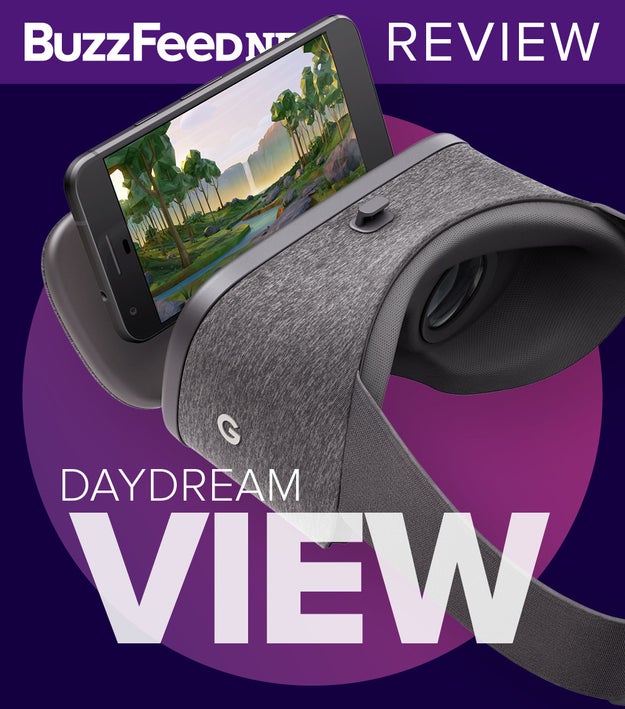
Daydream View Is A Lovely – But Lonely – Way To Entertain Yourself

Google’s new phone-based headset is a comfortable, affordable way to immerse yourself in virtual reality.

Google really wants to make virtual reality A Thing — even with regular nongaming folk — and the company hopes that its new affordable, smartphone-based VR headset, Daydream View, will do just that.

Daydream View, which begins shipping on Nov. 10 for $80, is a fabric-covered virtual reality headset that requires a Daydream View–ready smartphone. Right now, the only Daydream-compatible devices are the Pixel and Pixel XL, the Google-branded Android smartphones launched in October.

I’ve spent nearly a week with a Daydream View review unit and a Pixel running Daydream software. After visiting virtual museums, pseudo-skydiving, exploring far-flung planets, and hunting demon overlords, I think that the View is a great introduction to VR and what it’s capable of, but its success is contingent on whether or not more content will come to it.

While Daydream is not nearly as immersive as premium hardware like the HTC Vive or Oculus Rift, the headset goes beyond what other phone-based VR experiences can offer, thanks to one killer feature: its handheld controller, with which one can tilt, swivel, and move around in their virtual world.

It’s a good start, but like other VR experiences, it’s lonely in Daydreamlandia. There isn’t a ton of stuff available yet, so it gets boring fast.

BuzzFeed News; Google

Google is no stranger to phone-based, alternative-material VR headsets.

Google is no stranger to phone-based, alternative-material VR headsets.

View is not the company’s first VR product — that’s Cardboard, a $15 viewer made quite literally of cardboard — but it is their first VR hardware that’s built to last and runs its own platform, Daydream.

Daydream View elevates the Cardboard experience in many ways. It’s more comfortable, it doesn’t need to be held up with your hands, and, most importantly, it has a controller that makes the platform infinitely more interactive.

But View is also limiting in other ways. Cardboard is compatible with both iOS and Android, while View requires the Daydream app, which is only compatible with devices running Android 7.0 and up.

Google

Nicole Nguyen / BuzzFeed News


View Entire List ›

Quelle: <a href="Daydream View Is A Lovely – But Lonely – Way To Entertain Yourself“>BuzzFeed