Trump Digital Director: Twitter Killed Ad Buy Critical Of Hillary Clinton

John Locher / AP

President-elect Donald Trump&;s campaign had a major Twitter ad buy paid for and ready to go this fall. But a day before it was set to go live, Twitter pulled the plug.

Brad Parscale, Trump&039;s digital director, relayed this story in an interview Monday after he and another member of Trump&039;s digital team publicly criticized Twitter for being “restrictive” during the campaign. Both used Twitter to air their grievances.

The ad buy in question was a sponsored emoji package that criticized Hillary Clinton and was scheduled to run on a debate day during the campaign. Parscale said he believed the ad buy, for which he claimed the campaign paid hundreds of thousands of dollars, was killed because Twitter “thought the emoji would be too damaging to Hillary.”

Twitter, for its part, told BuzzFeed News it decided against running any politically branded emoji ad campaigns.

Social media&039;s role in the 2016 presidential election has drawn increasingly probing scrutiny following Trump&039;s surprise-to-some win. Facebook in particular has been criticized heavily for failing to rein in a flood of partisan fake news that some fear may have influenced public sentiment toward the candidates. The notion that such news swayed the election was referred to by Facebook CEO Mark Zuckerberg as a “pretty crazy idea,” last week. But not all Facebook employees feel that way. As BuzzFeed News reported Monday, a group of renegade Facebook employees have formed a secret task force to address the issue.

Some details of the Trump campaign&039;s run in with Twitter emerged last month in a story in the Washington Examiner. Reached by BuzzFeed News, a Twitter spokesperson pointed to the following statement, shared at the time. “We have had specific discussions with several political organizations, including the Trump campaign, regarding branded emojis as part of broad advertising campaigns on Twitter,” the statement reads. “We believe that political advertising merits a level of disclosure and transparency that branded political emojis do not meet, and we ultimately decided not to permit this particular format for any political advertising.”

Parscale said he found Twitter&039;s approach towards the emoji campaign frustrating. “Why sell it to us,” he asked.

According to Parscale, Twitter was one of a few big digital platforms that made his life difficult during the campaign. “Companies just didn’t like how we were using their platforms in a way that might be negative to [Clinton] or show messaging that they didn’t like,” he said.

That said, Parscale also emphasized that Google, Facebook and Twitter were otherwise “good supporters” of Trump&039;s campaign. “I feel like those platforms helped us win the campaign,” he said. “Twitter was obviously crucial, Facebook was crucial, Google was crucial. Those were the three main mediums that help us digitally to win the election.”

In an interview with 60 Minutes last night, President-Elect Trump praised Twitter when asked about his use of the platform. “It’s a great form of communication,” he said. “I think I picked up yesterday 100,000 people. I’m not saying I love it, but it does get the word out.”

Quelle: <a href="Trump Digital Director: Twitter Killed Ad Buy Critical Of Hillary Clinton“>BuzzFeed

The Future Of Organized Labor Could Be This Artificially Intelligent Bot

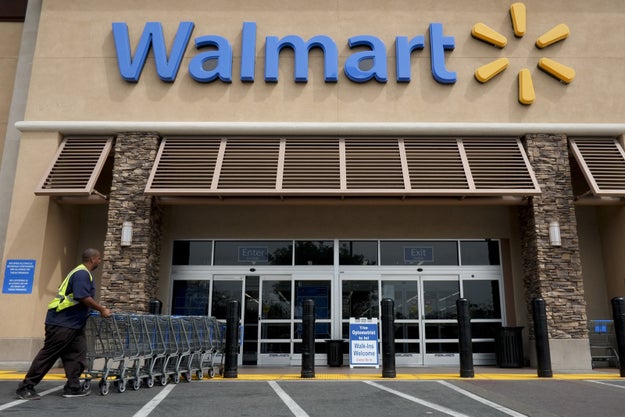
A worker pushes shopping carts in front of a Wal-Mart store in La Habra, Calif.

Jae C. Hong / AP

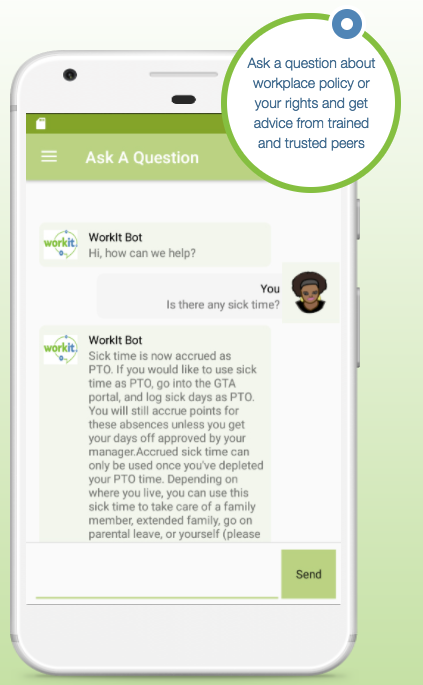
OUR Walmart, a digital labor network of more than 100,000 Walmart employees, is using an artificially intelligent chatbot called WorkIt to spread information among workers ahead of the holiday shopping season.

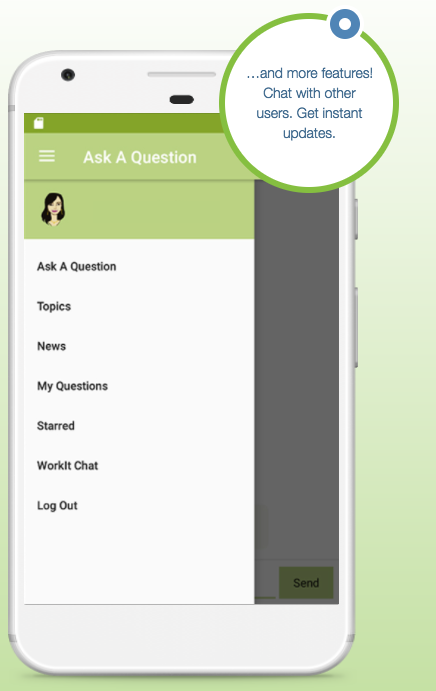
According to Walmart workers asked to speak on an OUR Walmart press call, employees are only able to access information on company policies at work if they use a manager’s computer using a system called “the wire.” As a result, they said it was sometimes difficult to research company policy on issues like sexual harassment and sick time. The WorkIt app, which includes discussion forums as well as a Watson-powered AI chatbot, is intended to address this problem by allowing employees to seek out answers to HR questions via their smartphones. Currently, the app is available only on Android devices, but OUR Walmart plans to bring it to iOS later this year.

“Being unable to access policy online when you are at work makes difficult to know when you are breaking policy — or understand how managers are using policies against you,” said Mississippi Walmart worker Joanna Chambers. “Through the WorkIt app, we’re amplifying the strength of OUR Walmart networks.”

Initially funded by the United Food and Commercial Workers union and managed by labor organizers Andrea Dehlendorf and Dan Schlademan, OUR Walmart subsequently broke off on its own. It now manages a 44,000 plus member Facebook page that isn’t controlled by a traditional labor organization. But if Walmart employees embrace WorkIt, the app could supplant Facebook as a nexus of worker communication, putting control more squarely in the hands of those running the OUR Walmart organization.

“What we’ve seen with discussion happening online — on Facebook and on Reddit — are conversations that are jumbled and disorganized,” Dehlendorf said on the press call today. “They don&;t allow people to get the answer quickly and efficiently, and from someone they trust.”

In contrast, WorkIt’s algorithm is designed to draw from hundreds of pages of company policies and employee guidelines to deliver accurate and reliable answers to worker questions. The tool is being trained by “experts,” employees who volunteered to teach WorkIt how to provide the most accurate and useful questions to employee queries.

Walmart disputed the notion that its workers do not have unfettered access to the employment documentation they need. “Our associates already have anytime-access online to the company’s most current and accurate Paid Time Off policies and there is no way to know if the details this group is pushing are correct,” Walmart spokesperson Kory Lundberg wrote in a statement provided to BuzzFeed News. “Our people are smart and see this for what it is, an attempt by an outside group to collect as much personal and private information as possible.” OUR Walmart told Bloomberg that it doesn’t collect location-based data and won’t sell user information to third parties.

Catherine Huang, OUR Walmart’s chief technology officer, said the group is currently using Watson&039;s natural language processing abilities to match employee queries with material in an existing training database. Going forward, she said she&039;d like to expand those capabilities and is considering a Spanish language version for early 2017.

OUR Walmart will be taking WorkIt on the road over the next two weeks, visiting stores in over a dozen cities in an effort to get workers to sign up. Traditional unions require things like membership and fees, but OUR Walmart is defined by a looser structure. That makes WorkIt — an app that’s a central hub for communication and independent silo of user data, including contact info and most frequent questions and complaints — especially valuable if it works.

Though OUR Walmart created the app, Walmart workers are only a test case for the technology (albeit a major one — Walmart is the second largest employer in the United States). For a price, WorkIt can be repurposed by any organization looking to connect workers to each other and information. Troy Burton, a labor organizer in Australia who said unions there are looking forward to using WorkIt, suggested that some data gathered in the app could even be used at the bargaining table when it comes time for workers to negotiate new contracts.

For Burton, the project is a blend of the mechanics of collective bargaining that undergird the “philosophy of unions” and “the long held promise of the internet to democratize information and overcome the barriers of geography and cultural separation that people face.”

Quelle: <a href="The Future Of Organized Labor Could Be This Artificially Intelligent Bot“>BuzzFeed

Trump Fundraiser: Facebook Employee Was Our "MVP"

While Facebook grapples both internally and externally with its role in the election&;s outcome, the Trump campaign is publicly singing the social network&039;s praises.

Saturday afternoon, Gary Coby, an RNC staffer and Trump campaign fundraiser tweeted that Facebook was instrumental in the Trump campaign&039;s fundraising success. Coby singled out James Barnes, a client solutions manager for Facebook in Washington, D.C. as an “MVP” of the election.

Coby&039;s tweets suggest that Facebook&039;s “multivariate” ad targeting for fundraising allowed the campaign to identify the best messaging for Trump — a tactic that ultimately resulted in more policy-focused speeches on the trail.

“Facebook provided a critical role of finding new potential donors and moving them over to our donor database,” Trump campaign digital director, Brad Parscale, told BuzzFeed News. “Facebook was the single most important platform to help grow our fundraising base.”

Advertising targeting services for political campaigns are not a new offering for Facebook — the company provided similar services for the Clinton campaign this election cycle and does not discriminate against political parties or organizations that approach the social network. The Trump campaign&039;s ad buys are public and were touted by Coby this August, when the campaign used Facebook to help raise $90 million that month.

When asked to elaborate on Barnes&039; role in the company, a Facebook spokesperson confirmed that Barnes is an employee.

However, the Trump campaign&039;s public embrace of Facebook comes at a tense moment for the social network, which has come under fire for its involvement in the 2016 campaign.

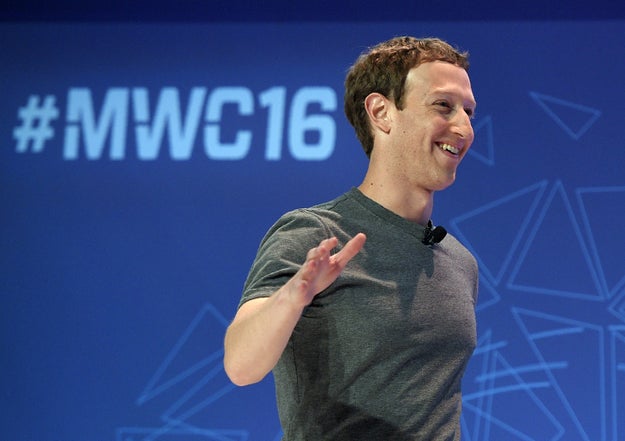
Allegations that a flood of fake, pro-Trump news helped influence the electorate and contribute to Trump&039;s victory forced CEO, Mark Zuckerberg, to defend the network&039;s role. “I think the idea that fake news on Facebook — of which it’s a very small amount of the content — influenced the election in any way is a pretty crazy idea,” he told a crowd at the Techonomy conference on Thursday evening.

Inside Facebook, the reckoning is more nuanced; according to the New York Times, employees were “dissatisfied” with Zuckerberg&039;s statement following a company meeting on Thursday. Meanwhile, former employees have publicly voiced their concern about Facebook&039;s influence. On Wednesday a former product designer at the company called argued that the election “must be a wake up call” and “is a clear mandate to act.”

When it comes to its business though, Facebook refuses to draw lines. When asked if the company would allow fringe and nationalist political parties like the British National Party, the Front National in France, or a neo-Nazi political organization, the company said that the it would not discriminate as long as the campaign&039;s activities did not violate Facebook’s published community standards.

Quelle: <a href="Trump Fundraiser: Facebook Employee Was Our "MVP"“>BuzzFeed

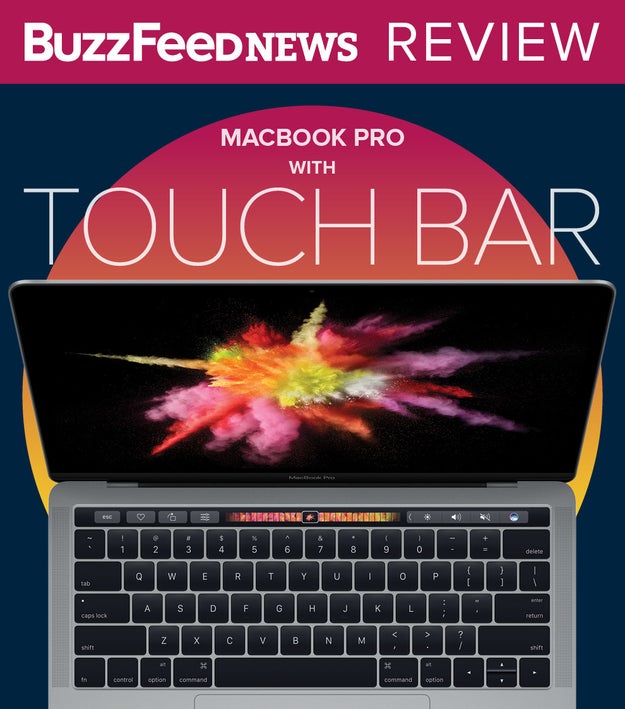
The New MacBook Pro: A Perfectly Fine Laptop For No One In Particular

Apple&;s new top-of-the-line laptop is impressively lightweight, but it may not be the home run longtime MacBook Pro users were hoping for.

BuzzFeed News; Apple

The all-new MacBook Pro is the laptop that loyal MacBook Pro users have been waiting for since 2012. But it might not be the one they were expecting.

Apple’s new laptop, which starts shipping in mid-December, is lighter and thinner than its predecessor. There’s a model with a tiny touchscreen called the Touch Bar, and a 13-inch model without, aimed at replacing the MacBook Air.

When the fourth-generation Pro offering was announced in October, the first major redesign for the premium laptop line in four years, the Maclash was very strong.

Gone is the strip of physical function keys, MagSafe charger, SD card reader, HDMI, mini DisplayPort, and USB ports. It&;s all been replaced with multiple USB-C ports and a headphone jack (OMG&;&033;), which is the only legacy input that remains.

Apple has removed the ports that some thought made the MacBook deserving of its Pro moniker.

“I’m out of apologia juice for defending Apple,” tweeted David Heinemeier Hansson, creator of the Ruby on Rails web development framework. “Those complaining about Apple’s current Mac lineup are not haters, they’re lovers. They’ve spent 10+ years and 5+ figures on Macs,” tweeted @lapcatsoftware, a self-described longtime Mac developer.

Meanwhile, some Mac users complained that the the new MacBook Pro appears to be underpowered for its price. The machine runs on last year’s Intel Skylake chip, and not the more recent, slightly more powerful Kaby Lake (which the chipmaker claims is about 12% faster in raw performance).

So, were the complaints warranted?

In my week and a half-ish with the new MacBook Pros, I found the laptops to be impressively fast and lightweight, but perhaps not quite the home run for which diehard MacBook Pro users had hoped. I tried both Touch Bar and non-Touch Bar models. The 13-inch non-Touch Bar laptop is clearly a win for those looking to upgrade aging Airs, as it’s lighter, thinner, and more powerful than the Air line.
But it’s not clear who exactly the MacBook Pro with Touch Bar is for — other than early adopters who won’t mind toting around a handful of dongles in order to push USB-C, the port of the future, forward.

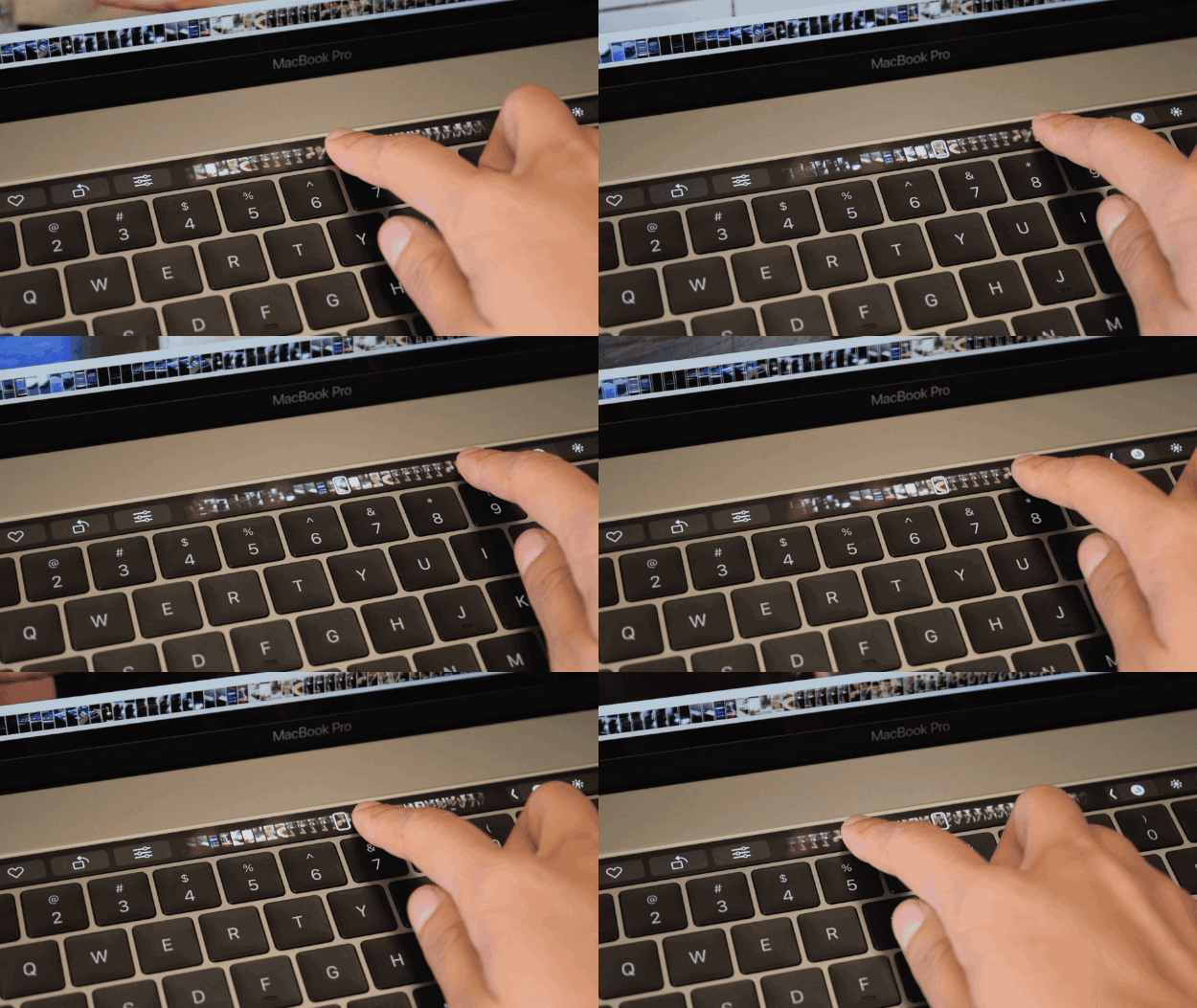
The MacBook Pro’s marquee feature is the Touch Bar, a new Retina, multi-touch screen that displays a set of additional controls that change according to what apps you have open.

The MacBook Pro’s marquee feature is the Touch Bar, a new Retina, multi-touch screen that displays a set of additional controls that change according to what apps you have open.

The Touch Bar is so slick and smooth, it feels frictionless. It’s a virtualization of the keys you’d typically find at the top of the keyboard, with some more bells and whistles.

The whole gang’s still there: the ESC key, music controls, volume control, the Launchpad shortcut that I’ve literally NEVER seen anyone use, a dedicated Siri button, etc. Touch Bar can be customized in a number of ways with actions like Screenshot and Show Desktop (my favorite *hide everything* trick for when people creep up from behind).

As one might expect at this early stage, the only apps with Touch Bar support right now are Apple-designed ones like Photos and Mail, and some applications make better use of Touch Bar than others.

My favorite is viewing PDFs in Preview, which you can quickly highlight with a single tap. The bar also allows you to stay in full screen longer in the Photos app by placing a menu of touch-based editing tools right at your fingertips. In Final Cut Pro, you can precisely trim clips with your finger, which feels more ergonomic than using your trackpad. In QuickTime, being able to scrub videos backwards and forwards with precision is pretty sweet, too.

Finger input feels easier, faster, and more precise than clicking and dragging on a trackpad. Another neat feature is that adjusting volume and brightness only requires a single swipe: Instead of multiple key taps, you can press and hold the volume icon and then move your finger back in forth to adjust.

Nicole Nguyen / BuzzFeed News

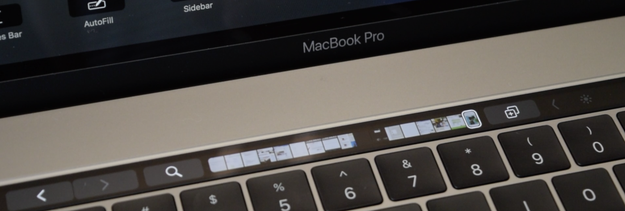
Other Touch Bar functions, like tab preview in Safari, seem more forced.

Other Touch Bar functions, like tab preview in Safari, seem more forced.

As you can see here, Touch Bar&039;s Safari tab previews are insanely small and difficult to read; It’s hard to imagine anyone would select a tab using the Touch Bar instead of the control + tab shortcut. That said, it is fun to swipe through all 123,801,293 of your open tabs.

Another is the emoji bar in Messages, which, at first, seemed great for quickly selecting frequently used emoji. However, to find something specific, you have to scroll and scroll and scroll, which seems silly when there’s already a great keyboard MacOS shortcut for it (control + command + spacebar = emoji heaven).

Nicole Nguyen / BuzzFeed News


View Entire List ›

Quelle: <a href="The New MacBook Pro: A Perfectly Fine Laptop For No One In Particular“>BuzzFeed

Bill Mitchell's Revenge

Via Twitter: @BluegillRises

Last Thursday, just after 11 a.m., I got a text from Bill Mitchell.

“Hi Charlie. Will BuzzFeed be doing a &;post-truth&039; follow-up article on me :),” it read. It was unexpected and my heart sank just a little bit. I screenshot his initial text and sent it to my editor with a note: “Ugh, Bill Mitchell just owned me so hard.”

Late Tuesday night, when Trump’s victory became all but certain, Mitchell was the among the first people I thought of. Last month, I’d interviewed him for a profile in which I quoted pollsters and journalists calling him “the dumbest motherfucker on the internet” and “fascist Jack Handey”; I dubbed him “the Trump movement’s post-truth, post-math anti-Nate Silver” and gestured incredulously at his tweets.

Bill Mitchell was home alone, holed up in his makeshift studio, when Donald Trump finally silenced the haters. He’d had been invited to a couple of election night parties, but Mitchell preferred to be alone with his 148,000 Twitter followers to watch the phenomenon that he’d predicted for the last 15 months — with 100% certainty, no less — come to fruition. First, Indiana and Kentucky came in strong. Then, there was a surge in Pinellas County in Florida — Mitchell’s personal bellwether and a heartening sign. Almost all at once, the blue firewall in the northern states began to crumble, revealing a wide Trump path to victory. At 10:51 p.m., the AP called Florida for Trump. Seven minutes later, victory in his sights, Mitchell took to Twitter:

For Mitchell, Trump’s victory was the ultimate vindication. After a year and a half of scornful taunts and mocking retweets from liberal mainstream journalists and pollsters; after constant Twitter arguments and unflattering, condescending stories about his lack of experience and expertise; after 15 months of unfaltering certainty in the face of endless criticism, Bill Mitchell — a strong-jawed, silver-haired executive recruiter from North Carolina with a Twitter account, a gift for “word images,” and no prior political experience — was no longer the butt of anyone’s smug joke.

Quite the opposite, in fact. Trump’s ground game, it appears, was actually in our hearts. And Mitchell was one of the few pundits to get it right. So what happens now? If Trump&039;s win was a victory for everyone who&039;s ever doubted the establishment and the old media and its experts and their numbers, then Mitchell is arguably that movement’s most enthusiastic voice. To hear Mitchell tell it, “new media prevailed,” and he wants a seat near the head of its table.

Mitchell, of course, didn’t have any special access to facts that the liberal media didn’t. Despite his claim of “diving into the internals” of polls — a standard practice of professional pollsters as well — Mitchell’s true success came from his gut: Intuition suggested Trump was the man for the moment and for the movement that captured his own imagination. As he presciently suggested last month in our first interview: “It has nothing to do with audio tapes or Hillary scandals or any of that. Donald Trump will win because this is a change election and Donald Trump is change candidate. At the end of the day that’s all that will matter.” He was right.

Mitchell is far from a professional analyst, which will serve him well as a member of the new right media in Trump’s America. Mitchell’s gut — his intuition as a member of an unseen voting class that came out at the polls for Trump — is what has set him up, perhaps more than anyone else, as the face of this very real mainstream media-refuting world. As a nationalist voice, Mitchell could very well be — no matter how unofficial — the voice of this administration: enthusiastic, unflinchingly loyal, and more pleasant and palatable than its more racially charged alt-right counterparts.

“Even though I expected a win, I’ll admit when Pennsylvania dropped, it was a little surreal,” he told me over the phone Saturday morning. “I felt just so alive — I think it’s a bit like being around when World War II was declared over. I just felt very fortunate to be around to see it.” On the phone, Mitchell took pains not to gloat but was clearly reveling in the win — he’d just bought a 70-inch TV and planned to break it in over the weekend. When I asked what we’d all missed in his Twitter punditry, Mitchell suggested that his haters had made him into a caricature rather than divining the kernel of truth hidden behind his often-bombastic language. Exhibit A: yard signs and rally attendance.

The media mocked him ruthlessly for putting undue weight behind rallies over polling — a fatal error, according to Mitchell. “Rallies equal newly engaged voters,” he said. In 2008 Obama had tens of thousands who stand in line for six hours because they want to experience and taste and feel all this.” Mitchell refers to them as the “monster vote” and suggests that it’s these perhaps previously disenfranchised voters who aren’t on pollster call lists. “And so the big question was, will the 20 million who didn’t vote in 2012 come out for Trump? I kept saying it’s going to happen, no question — it’ll be something like 2008 where the previously quiet black vote came out for Obama. And it did.” It’s also worth noting — while his predictions were overly enthusiastic — that Trump would do better with Latino and black voters, and there&039;d be a low black voter turnout.

“I’m more interested in trying to become a Sean Hannity type, though … it would take a long time to reach his excellence.”

As a result of his 15-month loyalty to the , election night was good to Mitchell. By his own (unconfirmed) estimate, his Twitter page racked up 80 million impressions and 400,000 retweets that evening. When victory was certain, he claims to have received thankful direct messages from Trump’s two sons, Eric and Donald Jr., as well as campaign manager Kellyanne Conway, thanking him for his enthusiasm and analysis over Twitter. “I won&039;t tell you what they said, but it was very nice and appreciative.”

According to Mitchell, Conway and the Trump sons had been in “very casual, infrequent communication” with Mitchell during the last month of the campaign. “I would update them on my take on polling and they&039;d get back to me and maybe they&039;d say how they felt about it,” he said. He stressed that his relationship to the Trump campaign was at arm’s length and mostly just cordial, mutual admiration: “If I were to describe Trump’s kids, I’d say they’re just really nice and pleasant normal folks, which is remarkable considering how rich they are.”

When asked if he’d take a job in a Trump administration, if offered, he said he’d decline, denying the world a glimpse at White House press secretary Bill Mitchell. “I don&039;t want to be a politician. I’m more interested in trying to become a Sean Hannity type — though to be anywhere near that level would be a miracle since it would take a long time to reach his excellence.”

Starting Monday, Mitchell’s going to set out to make his dreams of professional punditry a reality. He’s hopeful that Trump’s son-in-law Jared Kushner will start up a Trump TV and would be interested to find a role in that. For now, he’s successfully raised over $10,000 for his radio and YouTube show, which is syndicated on an AM radio station in Cleveland, and he hopes to grow that out across the country, like conservative media scions Rush Limbaugh or Alex Jones. He says he’d be willing to move from his home in suburban Charlotte to DC or maybe even New York for the right kind of job in broadcasting.

“I think the wall will become the next new great American monument. Like the Statue of Liberty, the wall is a monument to our sovereignty.”

Whatever his role, Mitchell would like it to be part of an insurgent, new media movement. Like many Trump supporters, Mitchell felt betrayed by the spin of the CNNs and legacy outlets of the world and wants to usher in a new era of media for the swath of voters the mainstream media didn’t see coming. “It’s been so gratifying to get messages and tweets saying, &039;You got me through this — you were my lifeline,&039;” he said, adding, “I don&039;t think Trump could’ve won without social media and our movement.”

Now, as one of many self-proclaimed leaders of that movement, Mitchell hopes to help its voice grow louder, and doesn’t see much of a home for the mainstream. “If I got my news only from CNN I’d have hated Trump, too,” he said, noting that CNN was spin and that people are craving “the facts” more than ever. “I don&039;t think the media can come back from this. They don’t learn their lesson and a tiger doesn&039;t change its stripes,” he lectured. “The only way the majority of media gets it right in the future is if they get replaced by the new media.”

Though we’re just days in, Mitchell is energized by President-elect Trump. And talking to Mitchell, you get a sense for the type of punditry to expect from Mitchell and even a new media. Odds are it will be fawning (“Trump just wins — trust his judgment”); suspect of so-called political correctness (“CNN sees racism EVERYWHERE. It gets pretty damned old”); and confident (“This win feels like a cool breeze across my heart on a hot day”).

On Trump’s suggestion that he’ll keep certain tenets of Obamacare: “Trump realizes life isn&039;t black and white — it&039;s always a shade of gray. Obamacare is a crap sandwich camouflaged in a nice bun. He’ll keep the bun and get rid of the crap.”

On “the wall”: “I think the wall will become the next new great American monument. Like the Statue of Liberty, the wall is a monument to our sovereignty. That&039;s what I&039;d say if I were on his marketing team.”

On bringing aboard legacy politicians to “drain the swamp”: “History will look back to the Trump presidency as the Era of Good Ideas. They’ll realize this was a ‘good idea presidency’ as opposed to the Obama era of ideology. If Dems present good ideas to President Trump he&039;d put them in the mix. You have a good idea, you’ve got a seat at the table.”
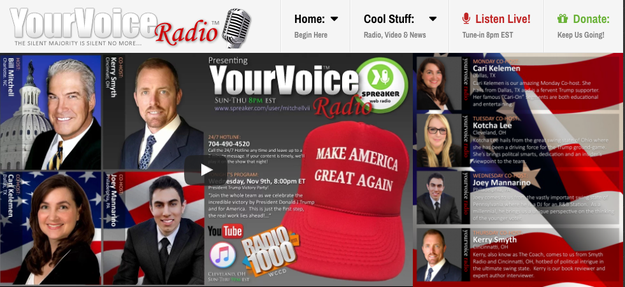
Via yourvoiceradio.com

His bet paid off, but still I wondered how he’d been able to be so certain in the face of withering criticism. As usual, Mitchell had a saying to describe his strategy.

“My philosophy is that fortune favors the bold,” he said, practically smiling through the receiver. “If you&039;re going to predict, do it 100%. Think about it — you&039;re right and they’ll never forget you. If you’re wrong, you’re wrong. But if you make your prediction and say, ‘Oh, I’m only 60% certain,&039; then nobody’s going to remember.” So Mitchell trusted his gut and went all in. As for the haters and the trolls? Mitchell described it like a war video game. “If you’re walking around and nobody is shooting at you then you&039;re not going the right way. The closer you get to the goal, the more intense the fire becomes,” he said. “The media always attacks the people they&039;re the most afraid of — so they must be afraid of my message.”

Still, it’s unclear, even after being blindsided by the Trump’s victory, what to make of the liberal media’s response to Mitchell’s analysis. As Ezra Klein — by his own admission, a conventional liberal pundit the likes of which Mitchell now holds gloating rights over — wrote for Vox following my profile, Mitchell’s influence was less about any kind of fear and more about identity-confirming. “Mitchell makes liberals look good, and he confirms their worst stereotypes about anti-science conservatives. Mitchell makes the press look good, and he confirms their worst stereotypes about blind partisans believing whatever they want to believe,” he wrote. Looking back in hindsight now, there may be more to it than that; as one reporter put it to me, “It feels like we were all making fun of him for weaknesses present in our side, too.”

It’s possible that Mitchell then didn’t just confirm his detractors’ worst stereotypes but also acted as a blank Twitter avatar on which to project our worries about partisan group-think and confident, data-free punditry. Which is why, in the wake of Trump’s victory, reckoning with Mitchell’s accurate prediction cuts deep. Sure, Mitchell saw a silent voting class and an enthusiasm few deigned to recognize, but margins were slim and what feels like a monumental defeat for many could have easily been a win if 1 out of 100 voters shifted their vote to Clinton. It might be less that Mitchell is an oracle and knew what we didn’t and more that nobody really knows anything, despite everyone thinking they did.

Quelle: <a href="Bill Mitchell&039;s Revenge“>BuzzFeed
Survey Question Indicates Facebook Getting Nervous About Fake News

Lluis Gene / AFP / Getty Images

Is Facebook getting nervous about the proliferation of fake news on its platform? Sure seems so.

A Facebook survey question spotted Sunday night by Tom Warren, an editor at The Verge, offers “fake information” as a possible reason why respondents don&;t see Facebook as being good for the world.

Facebook surveys its users all the time — and it&039;s unclear how long this survey has been running — but was shared at a time when Facebook is under heavy criticism for allowing fake news spread throughout its platform and in the run up to the election.

Facebook CEO Mark Zuckerberg has publicly defended his platform&039;s approach to fake news on two occasions since Nov. 8, initially calling the notion that fake news swayed the election a “pretty crazy idea,” and then saying it was “extremely unlikely.”

Asking “which of the following is the most important reason why you disagree or strongly disagree that Facebook is good for the world,” Facebook offers a number of responses, including: “Facebook has too much fake information or too many fake people on it.”

As some users have pointed out, Facebook seems to be taking an approach to fake news inconsistent with how it has previously described the influence of its platform.

“Facebook and Twitter cannot take credit for changing the world during events like the Egyptian Uprising, then downplay their influence on elections,” said Columbia student Karen K. Ho in a tweet Saturday. Entrepreneur Anil Dash, also in a tweet, offered a similar argument: “Everyone who buys advertising should listen to Zuckerberg saying that Facebook is ineffective at influencing people.”

Asked if the survey means Facebook sees fake news as a significant problem, the company did not immediately respond.

Quelle: <a href="Survey Question Indicates Facebook Getting Nervous About Fake News“>BuzzFeed

Trump-Supporting Startup CEO Kicked Out of Y Combinator

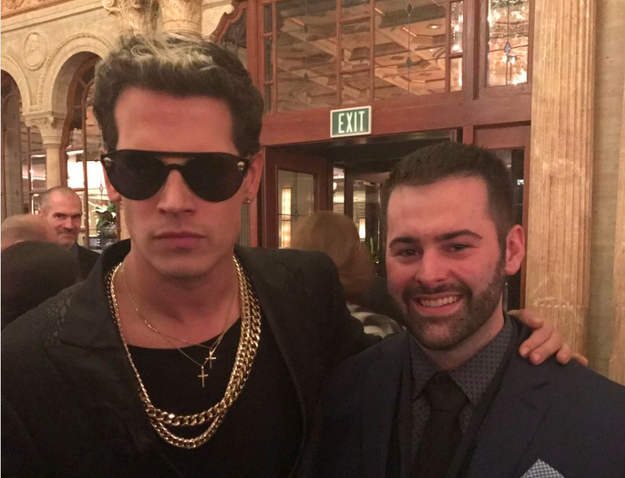
Milo Yiannopoulos and Gab.ai CEO Andrew Torba

Via Twitter: @torbahax

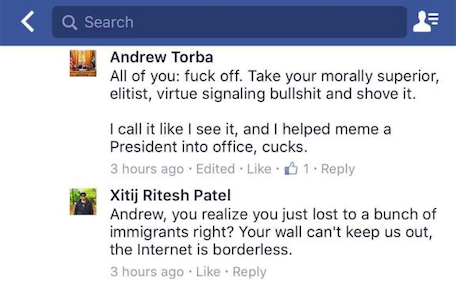
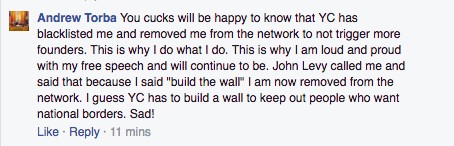
On the Friday after the US Presidential election, Andrew Torba, CEO of Gab.ai, a social network favored by conservatives, was kicked out of Y Combinator, the influential Silicon Valley startup accelerator, for violating its harassment policy. Torba, a fervent Trump supporter, called members of the Y Combinator community “cucks” and told them to “fuck off” earlier that day in a heated Facebook discussion about racism after the election. “I am actually surprised it took them this long to excommunicate me,” Torba told BuzzFeed News, “Y Combinator doesn’t accept conservatives and they don’t accept Trump supporters.”

Torba was speaking from Restoration Weekend, a right-wing political conference in Palm Beach, Florida, attended by alt-right figurehead Milo Yiannopoulos, Trump campaign CEO Steve Bannon, and Brexit leader Nigel Farage.

In the Facebook thread, before he was booted from Y Combinator, Torba wrote:

“All of you: fuck off. Take your morally superior, elitist, virtue signaling bullshit and shove it.

I call it like I see it, and I helped meme a President into office, cucks.”

Via Facebook

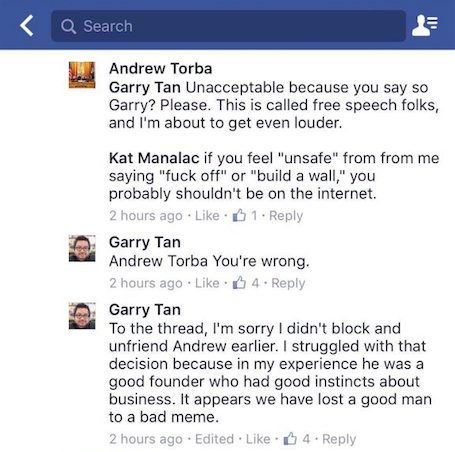
Over the phone and in the conservative press Torba has been claiming that he was removed from Y Combinator because he tweeted “build a wall,” a reference to President-elect Donald Trump. Y Combinator partner Kat Malanac, who was part of that Facebook thread, said the tweet brought Torba’s actions to Y Combinator’s attention but thatTorba was removed “for speaking in a threatening, harassing way toward other YC founders,” which violates its ethics policy,” she said by email.

After he was kicked out of Y Combinator, Torba addressed Malanac on the same Facebook thread:

“if you feel ‘unsafe’ from from [sic] me saying ‘fuck off’ or ‘build a wall,’ you probably shouldn’t be on the internet.”

Via Facebook

Torba&;s version of events will likely be well-received by the crowd at that Restoration Weekend, where he is scheduled to give a talk on free speech on Saturday. Torba’s narrative has already been embraced by right-wing media like Chuck Johnson&039;s GotNews, which said he was “PURGED” from Y Combinator “for a tweet” supporting Trump.

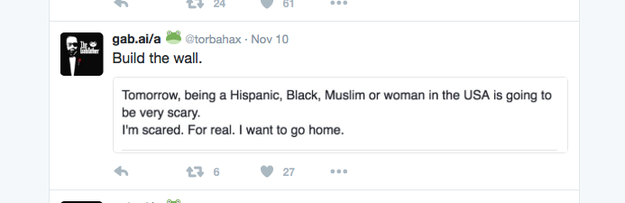
After the election, Torba reactivated his Facebook account. “I was looking at what people were posting and taking screenshots… just them whining about losing the election,” he told BuzzFeed News, emphasizing that names were removed from the screenshots. One of the screenshots was from a Latino startup founder who posted a status update expressing fear for minorities after the election: “Tomorrow, being a Hispanic, Black, Muslim or woman in the USA is going to be very scary.” Torba tweeted that screenshot with the words “Build the wall.”

Torba referred to his tweet as a meme and got upset when he saw “an indirect reference to the meme” on a Facebook post from Garry Tan, a former Y Combinator partner.

Via Facebook

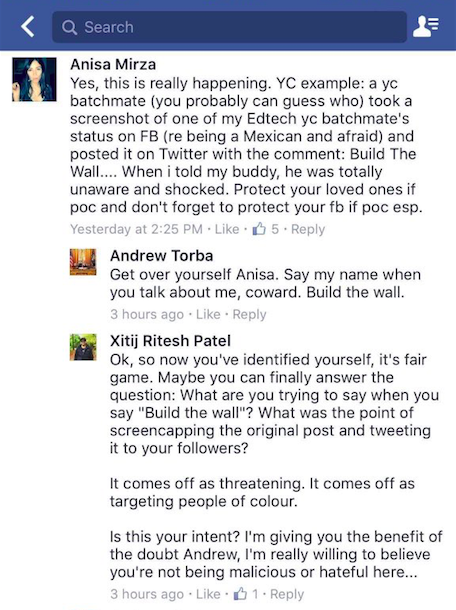
Tan had posted a link to a story about increased incidents of aggression towards minorities and asked if anyone had seen it happen first-hand. Y Combinator alum Anisa Mirza, the CEO of Giveeffect, offered Torba as an example of that behavior, but without using his name. Mizra is friends with the Latino founder whose status Torba screenshot and tweeted. She wrote that a member of her Y Combinator batch “(you can probably guess who)” took a screenshot of her friend’s Facebook status about “being a Mexican and afraid” without the friend knowing.

On the phone with BuzzFeed, Torba said he got upset that they were talking about him, so he jumped into the thread. “Get over yourself Anisa. Say my name when you talk about me, coward. Build the wall,” he wrote. According to Torba, his response resulted in a “massive pile on,” so he said, ‘You know what, fuck you all. Just leave me alone.’”

As the argument in the Facebook thread intensified, Torba began posting screenshots of it on Twitter with the names of Y Combinator alumni visible. While he was in Palm Beach for the conference, Torba received a phone call from Jon Levy, Y Combinator&039;s in-house counsel, telling him that he had been “banned,” said Torba. His log-in for Bookface, a private social network for the Y Combinator community was disabled.

“[F]ree speech is of course allowed,” Sam Altman, the president of Y Combinator’s parent company, told BuzzFeed News by email, “harassing, which [Torba] did to several members of our community, is not. have a look through his twitter/fb.”

Manalac told BuzzFeed News that Y Combinator has removed founders from its network before, but never publicized the move. “We didn&039;t plan on publicizing this either, but Andrew chose to be vocal about it, likely to get more attention for his site.” Gab.ai was not a part of Y Combinator. Torba was accepted into the program’s winter 2015 batch for another startup called Kuhcoon, a Facebook ads management platform.

Torba claimed that he was being treated him differently than Peter Thiel, a part-time investor at Y Combinator and another outspoken Trump supporter, because Thiel is a billionaire. In the last leg of the campaign, Thiel, who is also on Facebook’s board of directors, donated $1.25 million to support Trump’s presidential bid. At the time, activists pressured Altman and Mark Zuckerberg) to sever ties with Thiel. Altman and Zuckerberg both refused, citing the importance of diversity of opinion.

Y Combinator, however, stressed that the issue was harassment. Tan, who left the firm a year ago, said alumni and partners have been trying to keep dialogue open. “I see everyone, at least on this side of reality, try to be really reasonable with [Torba]. I’ve seen other interactions that were really personable,” Tan told BuzzFeed News, calling the discussion “a tempest in a teapot.”

“This is the kind of Facebook interaction that ends up happening,” said Tan, who noted that yesterday was the first time he had been “directly targeted” by Torba. “It probably helped to get more right-wing members to sign up.”

“ There are legitimate reason to support Trump,” Tan said, but posting threats “if you have more or less a troll army behind you, to me that’s too far.”

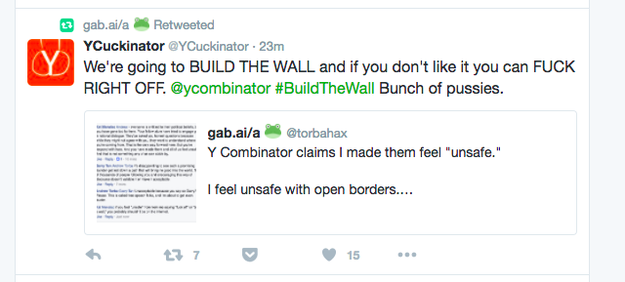
The troll army Tan is referring to is Gab.ai, which has been described by some as an alt-right social network. “Imagine a 4chan that is basically all alt-right Trump supporters and he’s their leader of sorts. He created the site. Imagine a sort of like Bizarro Zuck or Bizarro Jack,” said Tan, referring to the founders of Facebook and Twitter, respectively. “He has a social network of people who will basically validate whatever he says.”

According to Tan, Torba’s advertising startup had been making money and doing fine. “He just reached this boiling point,” as rhetoric around Trump intensified, particularly on Facebook. Torba “got a lot deeper in this alt-right world and he just went all the way when he made Gab.ai,” said Tan.

On the phone, Torba rejected the idea that he or Gab.ai were part of the alt-right. “I do not identify as alt-right. I am a conservative Christian, I am a Republican,” he said. “I don’t know why people label me.”

Torba said he had been “facing this backlash” for six months, ever since he came out as a Trump supporter. “It is pretty sad that I have to say ‘came out’ in 2016,” said Torba, who claimed he was called a racist, bigot, “and every whine in the book.”

The response prompted Torba to relocate to Austin, Texas this fall, he claimed. “I didn’t feel safe anymore in Silicon Valley as a conservative. I felt like such a minority that I just didn’t feel safe being there anymore.”

Torba said that he had been introduced to Thiel last week by conservative blogger Michelle Malkin. Torba met Malkin because she has an account on Gab. Thiel hasn&039;t responded yet, but Torba told BuzzFeed News, “I would put him on the board on in a heartbeat.”

Quelle: <a href="Trump-Supporting Startup CEO Kicked Out of Y Combinator“>BuzzFeed

Facebook Acquires Key Software Tool Used To Keep It Accountable

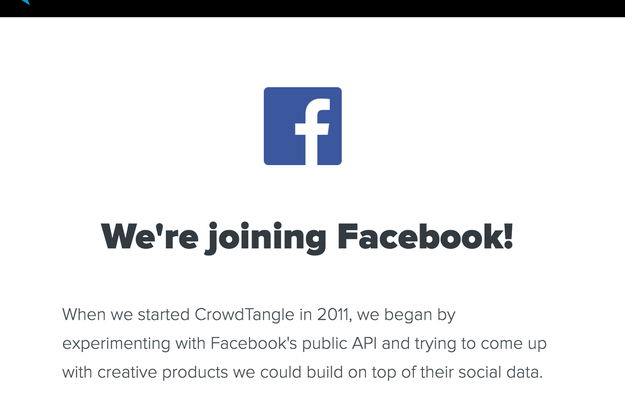
As questions swirl about the relationship between the dissemination of misinformation on Facebook and the outcome of Tuesday&;s election, the company announced it was acquiring a software company whose product is used by outsiders to understand how content spreads on the network, and hold it accountable.

The company, Crowdtangle, monitors engagement (likes, comments, and shares) on on Facebook posts via data pulled from Facebook&039;s API. Crowdtangle&039;s software can help its users understand how content spreads on Facebook through reports that span many months and thousands of posts.

I&039;ve used Crowdtangle to examine whether Facebook was keeping to its pledge to fight fake news on its platform (no clear victory) and whether publishers using Instant Articles were gaining an edge over their competitors (yes). The New York Times also used Crowdtangle to report on massive political meme pages on Facebook, and how the information they publish moves around on the social platform. Other journalists used it to track the proliferation of misinformation that flooded Facebook in the months leading up to the election.

Facebook&039;s acquisition of Crowdtangle does not necessarily mean reporters&039; access to this important data will be revoked, but it inevitably will lead to challenging moments. What will Facebook do when Crowdtangle reveals data that Facebook isn&039;t ready to release (as it did with my Instant Articles story)? Or when the story Crowdtangle&039;s data tells doesn&039;t jive with Facebook&039;s official line?

Asked if Facebook will preserve reporters&039; access to Crowdtangle&039;s data, even if that data tells an unflattering story about Facebook, a Facebook spokesperson pointed me to its official statement: “Publishers around the world turn to CrowdTangle to surface stories that matter, measure their social performance and identify influencers. We are excited to work with CrowdTangle to deliver these, and more insights to more publishers.”

Crowdtangle&039;s existence was of course always dependent on Facebook, since Facebook could have cut off Crowdtangle&039;s access to API if it felt the company was causing more grief than good. But now questions like “I&039;m seeing something weird on Facebook, can you help me look into it?” will be much harder for Crowdtangle&039;s team to answer. How they respond will be a critical test of Facebook&039;s willingness to be transparent with reporters and by extension, the public.

Quelle: <a href="Facebook Acquires Key Software Tool Used To Keep It Accountable“>BuzzFeed