10 Very Important Tips For Surviving Black Friday And Cyber Monday

Not every deal is what it seems.

Black Friday and Cyber Monday are supposed to be two of the best shopping days of the year. But many prices during this sales onslaught are actually inflated or laced with fine print, so shoppers should be extra vigilant about checking *actual* prices. I asked some experts on how to separate the good deals from the bad. Here are a few important tips and tricks for surviving the post-Thanksgiving shopping extravaganza.

BuzzFeed News

The best items to buy this Black Friday are the usual suspects: electronics and kitchen appliances.

The best items to buy this Black Friday are the usual suspects: electronics and kitchen appliances.

According to Courtney Jespersen, a retail and shopping expert at NerdWallet, the retailers with the best deals are Best Buy, Target, and Walmart, who complete on high-demand items like iPads and PlayStation consoles.

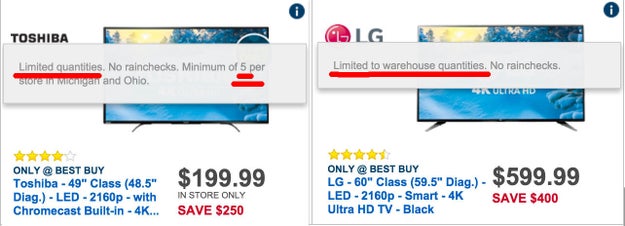
She conducted an analysis of 41 retailers’ Black Friday ads from 2015 and 2016, and found that Black Friday is a better bargain “especially on gaming consoles, printers, TVs, and kitchen appliances,” compared to other times of the year. But most of the products with the best discounts are only available in *very* limited quantities. For example, a 49-inch 4k Toshiba TV at Best Buy is $250 off on Thanksgiving Day, but this ad cites “limited quantities” and only a minimum of “5 per store.”

Best Buy

“If you wait even closer to Christmas, you’ll get a better deal. Retailers want to empty their shelves before the holiday comes and goes,” Jespersen advised.

Additionally, if you’re willing to take the risk, toys will get huge discounts on Super Saturday, the Saturday before Christmas Day. “There will be a lot of last-minute sales for procrastinators, but shoppers will have to weigh the fact that inventory may be picked over,” according to Jespersen.

Invisible Hand


View Entire List ›

Quelle: <a href="10 Very Important Tips For Surviving Black Friday And Cyber Monday“>BuzzFeed

Tidal Fired A New Mom Over Breast-Pumping, Lawsuit Alleges

Theo Wargo / Getty Images

A lawsuit filed in US district court yesterday alleges that Tidal, Jay-Z&;s troubled streaming music service, fired a female employee who recently returned to work after giving birth, one day after the employee asked for a private room to breast pump.

The lawsuit alleges sexual discrimination (based on breast-feeding), intentional infliction of emotional distress, as well as violation of fair labor standards, violation of New York State labor laws, and violation of the Patient Protection and Affordable Care Act, among other claims.

In her complaint, the ex-employee, Lisette Paulson, claims that after asking Tidal&039;s chief operating officer, Desiree Perez, for a private room, Perez told Paulson to use a bathroom to pump. Paulson said that would not be feasible. At that point, Perez allegedly pressed the plaintiff, asking if Paulson “had to do this.”

In response, Paulson explained “in no uncertain terms that she had to pump.” According to the lawsuit, Perez then got frustrated and asked Paulson if she “had to give her an office” to pump, eventually telling the new mom that she “needed to speak to human resources and figure it out.” The next day, five minutes into a team meeting, Tidal&039;s chief financial officer Joe Burrino allegedly told Paulson to leave the meeting and explained that he didn&039;t know if she would be coming back.

The alleged termination happened last September. According to the lawsuit, Paulson was only working as a full-time employee for one week at that point.

Paulson began as a consultant for Tidal, but returned as a full time employee, on the request of interim CEO Vania Schlogel, the lawsuit claims. Paulson says she was careful to verbally confirm her full-time employment status with Perez because she was hiring a nanny for her child, who was about four months old when she went back to work at Tidal. In response to her concerns, Perez allegedly told Paulson, “don&039;t worry, we&039;ll take care of you.”

Tidal did not immediately respond to questions from BuzzFeed News. We will update this post if we hear back.

Quelle: <a href="Tidal Fired A New Mom Over Breast-Pumping, Lawsuit Alleges“>BuzzFeed

A Man Found An iPhone 4 At The Bottom Of A Lake — And It Still Works

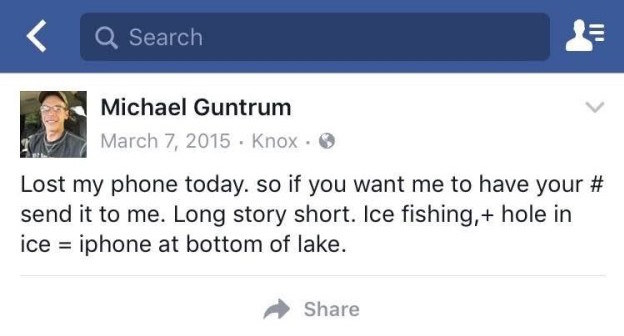
Michael Guntrum, a resident of Knox, Pennsylvania, lost his iPhone 4 in March 2015 while he was ice fishing.

“We were having negative 25-degree weather, so me and two buddies went ice fishing,” Guntrum told BuzzFeed News. “We were sitting in our portable shanty, and I got a bite on my rod. I laid the phone on my lap, and it slipped off. Instead of landing flat in the snow, it hit its edge and rolled into the hole. I caught the fish — it was a blue gill — but it wasn&;t worth it.”

Normally, losing your iPhone at the bottom of an icy lake would be the end of this story.

But there&039;s more.

Kyle Lake, where Guntrum was fishing, ended up being drained in September 2015 because of structural deficiencies in its dam.

And…someone found his phone&;

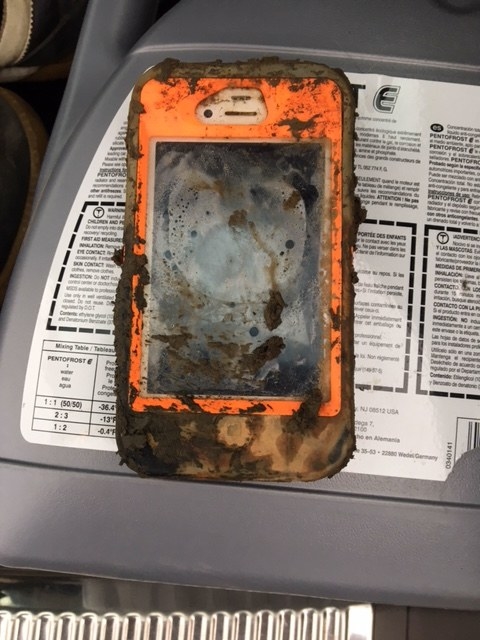
Daniel Kalgren, a mechanical engineer who lives in western Pennsylvania, told BuzzFeed News he was treasure hunting with his metal detector in the empty lake basin this October when he found Guntrum&039;s iPhone under six inches of mud and clay. He was there “to find what people dropped off of boats,” he said.

Daniel Kalgren

“I took the phone home, cleaned it, and put it in rice — just out of curiosity to see if it would still work,” Kalgren told BuzzFeed News.

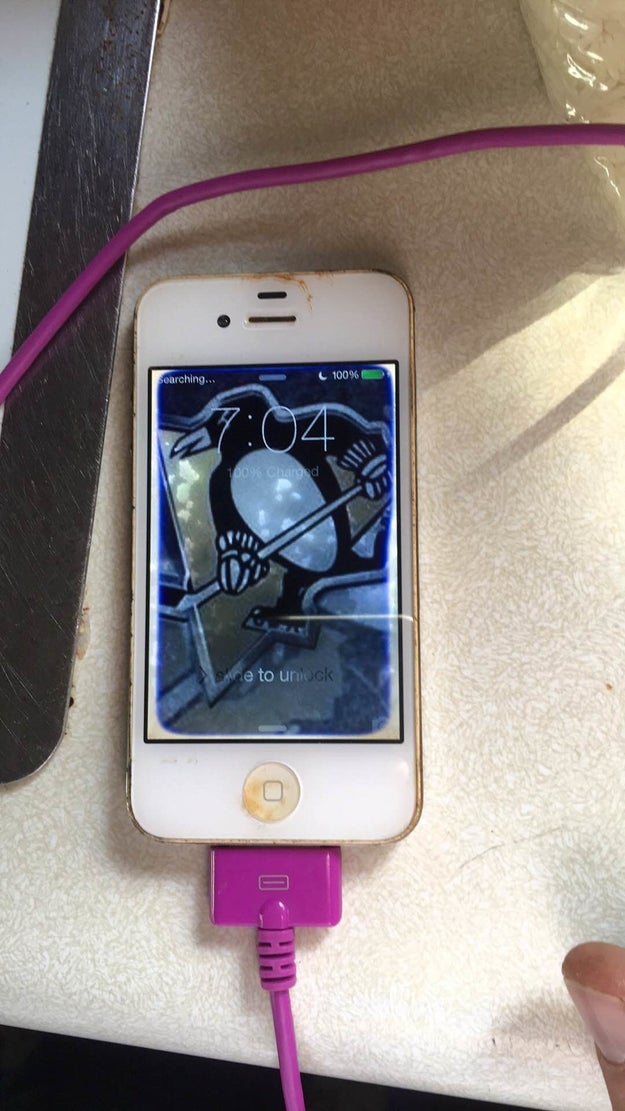
After two days, it turned on.

“It was the only thing I found that day. I was able to turn it on and use it to look up his number. He knows I have it now, and I&039;m going to mail it to him,” Kalgren told BuzzFeed News.

When Kalgren found Guntrum&039;s phone number on the recovered iPhone and contacted him, Guntrum said he didn&039;t believe it at first.

“I had just been talking about that lake early that day. It was eerie,” Guntrum said. “He sent me a picture and asked, &039;Does this look familiar?&039; and I recognized the screensaver.”

What kind of case is that?

The phone&039;s survival may have as much to do with its housing as it does with the phone&039;s hardiness. Kalgren&039;s said that Guntrum&039;s phone was in an Otterbox iPhone 4 case. Kalgren himself owns an iPhone 6S and keeps it in a Lifeproof case.

“I don&039;t know if my current phone would survive at the bottom of a 30-degree lake through a full winter. I&039;d like to think it would,” Kalgren said.

“I&039;m an Apple person, and this adds to the reasons why I only buy Apple devices,” Kalgren told BuzzFeed News.

“It&039;s pretty impressive it still works,” Kalgren said.

An Apple spokesperson said this isn&039;t the first time the company&039;s gotten this kind of report. “It never ceases to amaze us, all the incredible iPhone survival stories our customers have shared with us.”

So what&039;s Guntrum going to do with his long-lost phone when it arrives in the mail? He said he plans to have it repaired.

“My mom needs smartphone, so I&039;ll give it to her.”

Quelle: <a href="A Man Found An iPhone 4 At The Bottom Of A Lake — And It Still Works“>BuzzFeed

Labour Is Promising A Long Campaign Against Fake News

Christopher Furlong / Getty Images

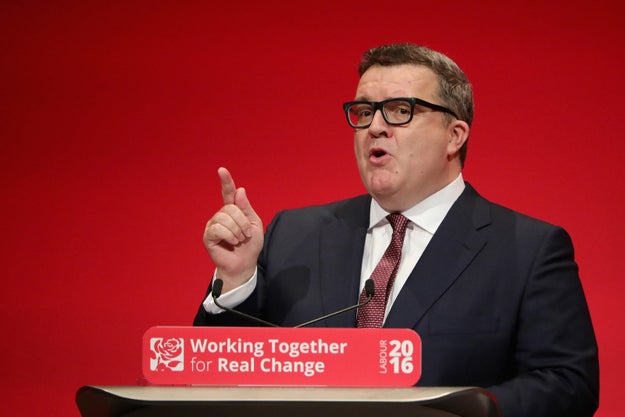
Labour&;s Tom Watson has drafted in fellow MP Michael Dugher to work on an inquiry into fake news on social media – partly prompted by concerns about what the spread of inaccurate information could do to the left-wing party&039;s own support base.

BuzzFeed News understands that Dugher, who previously served as shadow culture secretary until he was sacked by Jeremy Corbyn in January, will now help run the project, which hopes to tackle fake news stories created for profit and purposefully fake stories published in order to discredit political opponents.

Watson, the party&039;s deputy leader and shadow culture secretary, announced the inquiry on Monday and although its final form has yet to be decided, it could involve public evidence sessions with interested individuals called to testify.

In article for The Independent, which cited BuzzFeed News&039; research on fake news during the 2016 US presidential election, Labour&039;s deputy leader said fake news “cannot be healthy for democracies, which operate on the assumption that voters make choices based on facts and information that are for the most part accurate and truthful”.

Watson, who spent years campaigning against Sun owner Rupert Murdoch and attacking newspapers involved in the phone hacking scandal, is also understood to be keen to avoid the inquiry being dragged into a dispute between old and new formats of media.

The inquiry will also enable Labour to publicly back responsible journalism, positioning the party away from the sources of unverified information such as the array of Facebook groups and new websites that have built up since Corbyn became Labour leader. Many have influential readerships among the Labour support base thanks to their going viral despite sometimes having loose editorial standards.

“It&039;s not about online and offline news, it&039;s about people who are actual journalists and people who are just making shit up,” said one source working on the project, who insisted it was not an opportunistic intervention but would instead be a long-running campaign run by the Labour deputy leader.

They highlighted how The Canary, one fast-growing pro-Corbyn site, recently ran a story on Watson appearing at an event held by the centrist Labour First group under the headline “A launch date for the Corbyn coup 2.0 has just been fixed, and guess who’s leading the charge?”

Watson will seek to challenge the government in parliament on the issue, while also trying to work with the likes of Facebook and Twitter to find a solution rather than attacking them directly for the problem of fake news going viral.

“It can be tempting to share a meme showing &039;what the mainstream media won’t tell you&039;, but sometimes the much-derided &039;MSM&039; won’t tell you something because it checked it out and it wasn’t true. That&039;s why we need good journalists and good journalism,” Watson said.

“I&039;ve never been afraid to take on the mainstream media when it abuses its power or acts illegally or unethically – by hacking phones, bribing public officials, or going through people&039;s bins. And complaints about the &039;biased MSM&039; are sometimes justified. But the solution does not lie in the creation of a form of pseudo-journalism that is even more biased, less rigorous, and often based on downright lies.”

Quelle: <a href="Labour Is Promising A Long Campaign Against Fake News“>BuzzFeed

This Is What Happens When Millions Of People Suddenly Get The Internet

YANGON, Myanmar — The internet brought Donald Trump to Myanmar. Or, at least that’s how Shar Ya Wai first remembers hearing about the Republican president-elect.

“One day, nobody knew him. Then, everyone did. That’s what the internet is. It takes people who say crazy things and makes them famous,” the 19-year-old student said.

Like most people in this country of 50 million, which only recently opened up to the outside world, Shar Ya Wai is new to the internet. And on this day, she had walked purposefully into a phone shop in central Yangon to buy her first smartphone, a simple model by China’s Huawei that is popular among her friends. “Today I’ll buy this phone,” she said. “I guess I’ll find out how crazy [the internet] really is.”

It’s not that she’d never seen the internet before. She’d tried to stalk ex-boyfriends through a friend’s Facebook page and caught glimpses of the latest Thai pop bands on her uncle’s old tablet, which he bought secondhand a year ago. But her forays into the internet have been brief and largely left her perplexed. Here was a public space where everyone seemed to have so much to say, but it was disorganized, bombastic, overwhelming. It felt like the polar opposite of the quiet, sheltered life she’d lived until recently.

“My father is a measured person. He speaks carefully and always wanted us to speak carefully too,” she said, smoothing down her waist-length black hair, betraying her nerves. “I’m more energetic, like my mom. We speak a lot more, but it is nothing like what I see on the internet.”

It was her father who wanted her to put off buying a phone until she was old enough to “use it safely,” though she wasn’t really sure what that meant. She thought he might be referring to the men who post crass and vulgar photos online. Or he might be worried about the various scammers who are increasingly targeting the nascent internet in Myanmar. She wasn&;t sure because no one had ever told her how to stay safe online — what to do, or say, or write.

Still, on this day in mid-July, Shar Ya Wai pushed herself out of a crowded store in central Yangon, holding the cellophane-wrapped cell phone as though it were an injured bird. Her fingers cradled the top and felt for the button that would turn it on, but then hesitated.

“Maybe I should wait until later. I should wait until I’m with my family,” she said, and then admitted, “I’m scared.”

She has reason to be afraid. For nearly five decades, Myanmar lived under military dictatorships that suppressed all forms of dissent and limited free speech, leading to US and European sanctions that largely cut off the country from the rest of the world. That changed in 2011, when the military junta was officially dissolved and a nominally civilian government was established. In 2015, in the first national election since the military eased its hold, Aung San Suu Kyi’s National League for Democracy Party was voted into power. Of the changes to hit the largely Buddhist country since then, few have been as drastic — and as rapid — as the sudden arrival of the internet to the general public. It revolutionized everything, from how people interact with one another to how they get their news, once the exclusive purview of hyper-regulated state-sanctioned media.

“People don’t talk about the normal news they see on Facebook. They talk about the crazy stuff. I never knew about Trump and then everyone was talking about him.”

Today, news sites have become so popular that print magazines called Facebook and The Internet regurgitate stories spotted online for stragglers who have not yet joined the internet revolution. Many of them feature sensational and salacious tales, cribbed from Facebook pages with a very loose definition of facts. Drinking ice-cold water while eating hot food will give you a stomach ache&; Angelina Jolie has secretly adopted a Burmese baby but is keeping it locked away due to a deformity&033; A Thai cabinet minister is secretly dating an Olympic gymnast&033;

These stories, at least, do little harm. But there has also been an increase in articles that demonize the country’s minority Muslim community, with fake news claiming that vast hordes of Muslim worshippers are attacking Buddhist sites. These articles, quickly shared and amplified on social media, have correlated with a surge in anti-Muslim protests and attacks on local Muslim groups.

Violence against Myanmar’s minority Muslim community has plagued the country for decades; in the last month, 70 Rohingya Muslims were killed in a wave of violence so intense that Human Rights Watch says the burned-down villages can be viewed from satellites in space. Mobilized by the sudden freedom of online platforms like Facebook, groups that once lived on the fringes of the political landscape, such as radical Buddhist anti-Muslim groups, have suddenly found supporters across the country. And, what’s more, those supporters have found solidarity in extreme movements around the world, including the more radical, nationalist American groups, like the Ku Klux Klan, that have supported Trump.

If fake news had the power to influence people’s minds during the US elections, in a country with a well-established mainstream media landscape, what could it do in Myanmar, with a nascent news media, only recently freed from the military’s stranglehold?

“People don’t talk about the normal news they see on Facebook. They talk about the crazy stuff. I never knew about Trump and then everyone was talking about him,” Shar Ya Wai said. She remembered getting into a fight with one friend who suggested that a Muslim family living in his middle-class suburb should be evicted, because Trump was going to ban Muslims and that it seemed like a good idea. “My friend was saying, ‘That is a good idea. We should do like America and do it here too. No more Muslims&033;’”

Her friend, like many in Myanmar, had gone online, discovered an extreme point of view, and then used it to reaffirm his own ideology within his country’s political ecosystem. Today’s internet was built for that sort of sharing. It is often the voices that shout the loudest, and tell the most outlandish stories, that are most likely to make it to the top of the News Feed — whether the news itself is real or fake. Despite debate in the US over the role that fake news played in the recent presidential elections, Facebook has maintained that it did not play a large role. Mark Zuckerberg initially argued that it was “extremely unlikely” that fake news affected the vote, although he later said he did take the issue seriously. Facebook employees who spoke to BuzzFeed News have suggested that content should be marked as verified, if it comes from trusted news sources.

Facebook’s influence in Myanmar is hard to quantify, but its domination is so complete that people in Myanmar use “internet” and “Facebook” interchangeably. According to Amara Digital, a Yangon-based marketing agency, Facebook has doubled its local base in the last year to 9.7 million monthly users. That number is likely to spike again, after Facebook launched its Free Basics program, a free, streamlined version of Facebook and a handful of other sites.

There was this idea, Shar Ya Wai said, that Facebook was for saying anything you wanted.

And that’s what’s been happening — from extremist monks to political cartoonists. Dozens of people have been jailed for what they’ve written on Facebook, though human rights groups say the exact number is unknown as many arrests go unreported, especially outside the city centers, where the legal system is not as closely monitored.

For many in Myanmar, the internet and Facebook brought with it the banner of free speech and American values — but no one had told them what would happen if they tested the values of free speech under a government still feeling its way out of military control. Was it the responsibility of Facebook, or their own government, to teach them how to safely use the internet? Would Facebook protect them for what they wrote online? How do you give people the internet they crave while keeping them safe? And given how many Americans, including Trump, fell for fake news during the elections, how were people in Myanmar expected to judge what was real and what was fake?

Shar Ya Wai did, eventually, turn the phone on, after a stall next to the mobile store told her they couldn’t activate the SIM card and data plan without activating the phone and dialing in to one of Myanmar’s local carriers, MTN. As she left the store, her phone was on, though Facebook and other apps remained closed. “I will use Facebook. I have to … that is the world.”

She agreed to keep in touch over the next few weeks as she got used to life with the internet in her pocket.
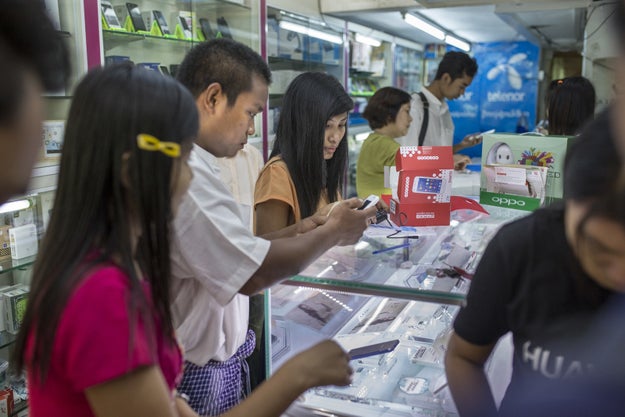
Customers inside a mobile phone shop in Yangon.

Minzayar Oo / BuzzFeed News

Back in 2011, a SIM card for a mobile phone could cost upwards of $3,000, and was available only to those with high-level government connections. A handful of internet cafés existed, most of them in the capital, but were far too expensive for the average person. Less than 0.2% of the country was online, according to the International Monetary Fund.

In the years immediately following the easing of military&039;s rule, internet use climbed slowly. Laptops were rare and desktops rarer still. It wasn’t until 2014, when the country opened its doors to international telecom companies, that the floodgates really opened. Suddenly, mobile towers were everywhere.

“In 2011, our subscribers were in the thousands. Now, we are at 35 million in a country of 50 million,” said Elaine Weidman-Grunewald, vice president of sustainability and corporate responsibility at telecoms giant Ericsson. She visited the country earlier this year to check in with a program Ericsson is running to provide internet access and tablets to 31 schools in rural Myanmar, reaching roughly 22,000 students. In many cases, the tablets were the student’s first, and only, access to the internet. “The rate of mobile use in Myanmar is unbelievable. The first six months of this year, Myanmar was in the top three countries globally with new mobile subscriptions.”

The World Bank estimates that roughly 20% of Myanmar is now online, most of that in just the last two years. In comparison, internet use in the United States, where commercial providers began to offer the internet access in late 1989, took seven years to reach a point where 20% of the US was online. In India, which is one of the fastest growing internet markets in the world, internet use took off in 2000, but didn’t reach 20% of the population until mid-2015.

Myanmar, said Weidman-Grunewald, was unique in that its isolation from the internet was so complete for so long, and then, just as quickly, it opened up its whole country to the whole, unfiltered internet.

Nowhere is the sudden growth as evident as in the shops underneath the golden peaks of the Sule Pagoda in downtown Yangon. Sheltered beneath the awning of the pagoda, shops that once sold stamps and watches have disappeared, replaced by storefronts crammed with mobile phones and accessories.

“This is all anybody buys,” said Mai Thu Sien, a 19-year-old salesman. He didn’t seem bothered to be squeezed onto a street bustling with other shops selling exactly the same thing. “There are many customers for phones. People buy and buy.”

For the equivalent of $3, Mai Thu Sien sets up an email address, opens up a Facebook account in any name the customer wants, and sends them on their way. When asked whether customers choose their own email address, Mai Thu Sien looked confused. “Nobody asks, they don’t care about the email,” he said, explaining that most don’t know that creating an email address is free, and easy. “No one is using that. They have Facebook.”

If they forget their login information, or get signed out, they simply come in for a new Facebook account. Of the dozens of people interviewed by BuzzFeed News in Myanmar, all said they had more than one Facebook account. None knew about Facebook’s policy that users must use their real names.

Two days after she bought her phone, Shar Ya Wai sent a text message saying that she’d opened up an account and was adding friends.

“I only have 12 right now,” she said, adding that a friend of her brother’s had set up the account and that she too had no idea it was linked to email address. “Everyone is really nice. My friend put up photos of a trip together to Mandalay.”

“It’s not as bad as I thought,” she said.
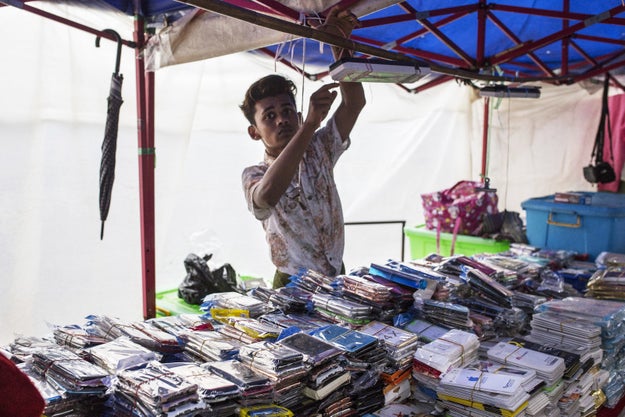
A street vendor selling mobile phone accessories in Yangon on July 17.

Minzayar Oo / BuzzFeed News

The taxi raced down a slip road to the airport and then juddered to a halt in front of a small shack with chickens pecking outside. Ashin Wirathu, a monk whose hardline anti-Muslim positions have earned him the nickname “the Burmese Bin Laden,” smiled as he rolled down his window to chat with a journalist he recognized. Wirathu — who has been imprisoned for sermons calling for the persecution of the Muslim Rohingya minority — was heading off to the airport for a vacation, but couldn’t resist one more chance to get his name in the news.

Wirathu rose to prominence as part of a group of extremist monks once known as the Association for the Protection of Race and Religion, and then the “969” movement. Today, they are called Ma Ba Tha, after their Burmese acronym. Since the end of military rule, monks have assumed an increasingly public role in the largely Buddhist country. Wirathu, and the Ma Ba Tha movement, have denied any role in the Buddhist lynch mobs, which, in recent years, have killed more than 200, and displaced more than 150,000 of the country’s Muslims, who make up roughly 4% of the total population. Civil society groups allege that the state&039;s security forces have fomented recent outbreaks of violence against the Rohingya. But there is no denying that Ma Ba Tha&039;s bashing of Muslims as “cruel and savage” is often repeated by those who want to see all Muslims expelled from Myanmar — and they admit that their anti-Muslim stance has gained its largest following through Facebook.
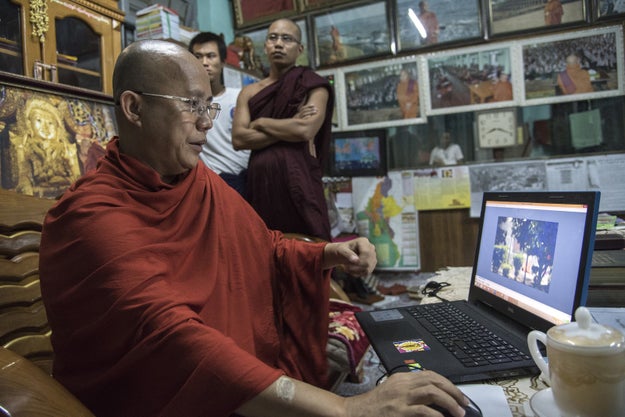
The controversial Buddhist monk Wirathu.

Thierry Falise / Getty Images

This week, following news that Trump’s administration was being staffed with hardliners, Wirathu released a statement hailing Trump’s White House as a victory in the fight against “Islamic terrorism.”

“May US citizens be free from jihad. May the world be free of bloodshed,” Wirathu wrote in a public statement. It was one of many Trump received from figures across the world who appeared to feel emboldened by his win.

It was not the first time Wirathu had taken to Facebook to bolster his position globally. Following his release from jail in January 2012, where he had served a seven-year prison sentence for inciting anti-Muslim pogroms in 2003, Wirathu immediately took to the platform.

“If the internet had not come to [Myanmar], not many people would know my opinion and messages like now,” Wirathu told BuzzFeed News, adding that he had always written books and delivered sermons but that the “internet is a faster way to spread the messages.”

His first account was small, he said, and almost immediately deleted by Facebook moderators who wrote that it violated their community standards. The second had 5,000 friends and grew so quickly he could no longer accept new requests. So he started a new page and hired two full-time employees who now update the site hourly.

“I have a Facebook account with 190,000 followers and a news Facebook page. The internet and Facebook are very useful and important to spread my messages,” he said.

On the dozens of Facebook pages he runs out of a dedicated office, Wirathu has called for the boycott of Muslim businesses, and for Muslims to be expelled from Myanmar. He said he has a hard time keeping the pages open, since Facebook keeps shutting them down. He manages, nonetheless, to maintain an ever-growing online following.

“I’m glad blocking exists.”

Quelle: <a href="This Is What Happens When Millions Of People Suddenly Get The Internet“>BuzzFeed
Here's How Much Uber Drivers Make, According To A New Uber Report

Aaron Fernandez / BuzzFeed News

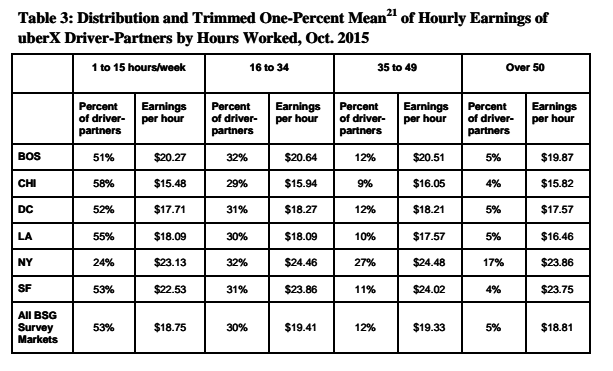
On Monday, Uber released a report on driver earnings, conducted by the company&;s head of economic research Jonathan Hall and Princeton economist Alan Krueger. Hall and Kreuger used data from a diverse group of drivers in 20 markets. They found that the majority of Uber drivers drive 15 hours or fewer per week, and that the average Uber driver, earns an average wage of $18.75 an hour, before expenses.

(Krueger was previously a paid consultant for Uber, but the company says he was not paid for his work on this study.)

Jonathan V. Hall and Alan B. Krueger / National Bureau of Economic Research

Uber released a survey of driver earnings in 2015; this new report is an update of that survey, revised to include estimations of driver expenses — how much drivers spend on gas, car maintenance, insurance, and taxes. It also looks at whether the amount of time drivers spend working per week influences their hourly earnings, and how driver earnings change over time, especially following price cuts.

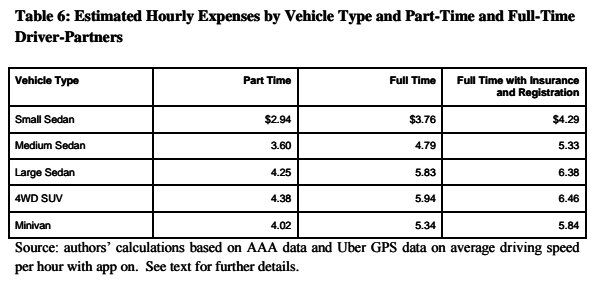
According to the report, which used data from AAA, a full-time Uber driver driving a small sedan would have about $3.76 in expenses per hour, while the same person driving an SUV with four-wheel drive would have expenses of around $5.94 per hour. These conclusions about driver expenses are similar to those made in a June BuzzFeed News investigation, which found that in late 2015 in three cities, working for Uber cost drivers $3.50 to $5 an hour, and which didn&039;t take car size or full versus part-time into account. However, this report doesn&039;t take geographical location into account, which is important because the amount of rain or snow a vehicle experiences can impact the cost of maintaining it.

Jonathan V. Hall and Alan B. Krueger / National Bureau of Economic Research

Despite the fact that Uber was able to estimate driver expenses for the first time in this report, its authors chose not to publish estimates of driver net earnings, instead publishing estimates of drivers&039; earnings before expenses.

However, it&039;s possible to draw an illustrative hypothetical using Uber&039;s estimations. For example, a part-time driver of a minivan in Chicago earning an average $15.48 an hour would, based on Uber&039;s model, incur $4.02 an hour in expenses, for a net hourly earning of roughly $11.46 an hour. A full-time driver in Washington DC earning an average $18.21 an hour driving a four-wheel drive SUV would have expenses of around $5.94 per hour, for net hourly earnings of $12.27.

In June, BuzzFeed News found that Uber drivers in late 2015 earned approximately $13.17 per hour after expenses in Denver, $10.75 per hour after expenses in Houston, and $8.77 in Detroit.

It&039;s interesting to note that while the report does look at how driver earnings change over time, it doesn&039;t look at how driver expenses change over time. Specifically, the report addresses the issue of fare cuts and driver utilization, and ultimately supports Uber&039;s argument that even when customers are paying more, lower prices increase demand meaning drivers earnings remain stable.

While that may be true — and Uber&039;s data suggests it is — it doesn&039;t take into account the fact that a driver&039;s expenses will increase as he or she is driving more. So, although the report does measure the rise and fall of driver earnings as prices fall and demand increases, it doesn&039;t measure the impacts of that increase in demand on how much a driver is spending.

Quelle: <a href="Here&039;s How Much Uber Drivers Make, According To A New Uber Report“>BuzzFeed

Now You Can Post Live Video On Instagram

Once you stop recording, the live video is gone for good. *Poof*

Instagram is the latest social platform to embrace live video, following Twitter, YouTube, and its parent company, Facebook. It&;s an attempt to make Instagram a place for both permanent and ephemeral sharing.

This is Instagram&039;s latest attempt to drive more kinds of usage — beyond just posting highly-curated photos — by introducing features that focus on what’s happening in the moment. Live video is the second video product Instagram has launched this year. Stories, a string of Snapchat-style photos and videos that disappear after 24 hours, was announced in August.

It&039;s also something Instagram CEO Kevin Systrom has previously hinted at. Earlier this month, Systrom told the Financial Times, “If I’m trying to strengthen relationships with someone I love, them streaming video to me live would be an amazing way to be closer to them.”

Last month, in an interview with BuzzFeed News, Systrom said, “I agree, the video format in our viewer does feel similar to what a lot of other people are doing. I think that’s fine for now, but it’s not where we want to end up. We want to innovate and improve the experience.”


View Entire List ›

Quelle: <a href="Now You Can Post Live Video On Instagram“>BuzzFeed

These Are The Most Retweeted Tweets Of The Election

Donald Trump may be a prolific Twitter user, and the president-elect. But Hillary Clinton beat him out for the most retweeted election-related tweet, according to Twitter.

Clinton&;s tweet, coming the day of her concession speech, urged girls disheartened by the election outcome to not get discouraged. The tweet has received over 600,000 retweets so far.

Trump&039;s most retweeted tweet, an Election Day play on his “Make America Great Again,” slogan, registered over 350,000 retweets.

Interestingly, both of these tweets were text-only updates at a time when seemingly every social platform is moving toward a future dominated by video and photos.

The most retweeted tweet of the 2012 election did contain a photo, one of President Barack Obama embracing the first lady. That tweet was retweeted more than 500,000 times in the day following the election. It&039;s added hundreds of thousands more retweets since.

Quelle: <a href="These Are The Most Retweeted Tweets Of The Election“>BuzzFeed

You Can Now Book Guided Tours And Local Meetups On Airbnb, Too

Caroline O’Donovan / BuzzFeed News

With Airbnb&;s new service, Trips, even people who don&039;t have a bed or room or home to rent can offer services like local tours or home-cooked meals to travelers — for a fee.

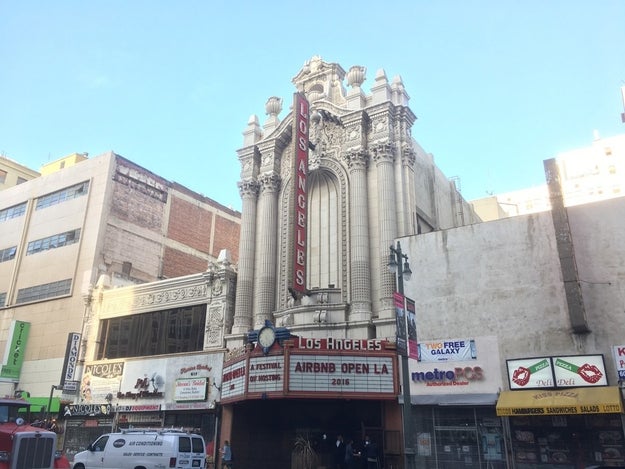
CEO Brian Chesky announced the news Thursday morning at Airbnb Open, its annual hosting conference, which attracted more than 7,000 people and had a tech conference-meets-Coachella vibe.

“You can spend as much time planning your trip as on your trip,” Chesky said on stage at the LA&039;s Orpheum Theater. “We want to fix this, We don&039;t think there should be a trade-off. We think travel can be magical and easy.”

Starting today in twelve cities — Detroit, London, Paris, Nairobi, Havana, San Francisco, Cape Town, Florence, Miami, Seoul, Tokyo and LA — Airbnb&039;s offerings will be divided into three categories: homes, experiences and places.

“Homes” what Airbnb has offered all along: short-term rentals. What&039;s new is “experiences” — “handcrafted activities designed and led by local experts” — and “places” —a resource clearinghouse with in-depth guidebooks, self-guided audio tours, and information on local meetups. For example, a trip to Nairobi could now include a reservation at a local cafe made or a meetup with other travelers at a local bar made through the “Places” tab, and a lesson in cleaning a cookstove (an “experience”), in addition to a place to stay — all booked without leaving Airbnb.

Experiences are advertised like films, with movie posters and video trailers. Half of these “immersive” experiences, often three-day itineraries, cost less than $200, Chesky said. For example, a three-day photography experience that involves a studio tour and snack on one day, a photoshoot and dinner the next day, and post-production lesson with tea costs $199, and can be booked instantly. A single-day “experience” might be a show, an afternoon shopping at a marketplace with a food anthropologist or, for $31 dollars in L.A., a living room concert by local artists. The company has set a target that10 percent of the experiences be aimed at social partnerships, with proceeds going to local nonprofits, not Airbnb.

Hosts can apply today to lead experiences in 51 cities globally, and even guests who aren&039;t staying in an Airbnb can book them.

Chesky was clear to differentiate the Airbnb experiences from more typical tours. “You immerse,” he said. “You join the local communities.”

“Places,” meanwhile, offers online guidebooks, with tips for local dining, music, and more that are “curated” by locals, but are activities travelers can undertake on their own.

Airbnb also announced an audio tour partnership with Detour, maps that highlight local favorites based on where you&039;ve booked, and a partnership with Resy that will allow guests to book tables at local restaurants without leaving the Airbnb app. Those partnerships are live now in the launch cities; Chesky said Airbnb is working on partnerships with other services, including airlines, in the near future.

“If you have a passion, if you have an interest, or if you have a hobby, you can share your community with others in the world, because travel has never really been about where you go, it&039;s about who you can become,” Chesky said. “And this is something that we would love to be able to build together.”

Chesky didn’t address on stage the question of who’s responsible if your guided river tour kayak springs a leak, or if the home-cooked meal you booked makes you queasy. Whether these entrepreneurial locals will be regulated as small business owners or allowed to operate as free agents remains to be seen. Like so much of Airbnb&039;s regulatory situation, it&039;s likely the answer will be decided by local authorities on a city-by-city basis.

Quelle: <a href="You Can Now Book Guided Tours And Local Meetups On Airbnb, Too“>BuzzFeed

The Anti-Defamation League Has New Demands For Twitter And Facebook

ADL

This week, Twitter began taking steps to address the harassment problem that has plagued its platform for years. On Tuesday, it rolled out new anti-abuse tools, including an expanded mute feature and a more streamlined system of abuse reporting; later in the day, it controversially banned a number of notable alt-right accounts from the service.

But as Twitter navigates the precarious territory of trying to police its platform while holding true to its free speech roots, one of the country&;s best-known civil rights groups is pushing for it to do more. Today, roughly one month after its initial report on the rise anti-semitism on Twitter, the Anti-Defamation League published its recommendations for addressing internet harassment. Its conclusion: social platforms need better harassment reporting options; they need to improve their response times to those reports; they need to invest in new tools to curb harassment; and they need to be more transparent about their abuse and harassment review processes.

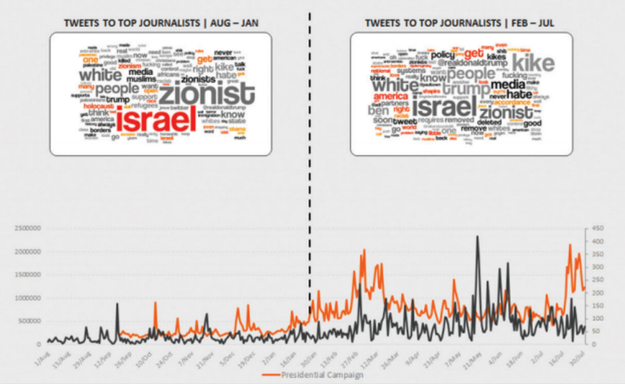
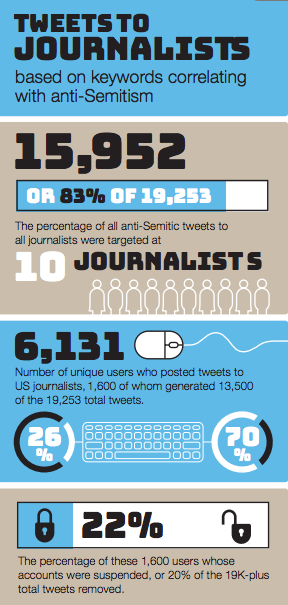
Last month&039;s ADL report found that between August 2015 and July 2016 roughly 2.6 million anti-Semitic tweets were broadcast on Twitter, creating more than 10 billion impressions across the web. Of those tweets, 19,253 were directed at journalists. Among its concerns, the Anti-Defamation League report suggested hate speech targeting journalists was creating a chilling effect that could hurt their freedom to report and investigate.

“We’re already seeing this spread into the real world and mainstreaming in a way we’ve never seen in our over–100-year history as an organization,” Anti-Defamation League CEO Johnathan Greenblatt told BuzzFeed News.

For social media platforms — the ADL singles out Twitter in particular — the report suggests the mechanisms for reporting must be more efficient and clear for users. This includes cultural context training to allow reviewers to keep up with the ever-changing tactics of trolls and better reporting systems that allows users to flag offensive content once, rather than every time it pops up. To Twitter&039;s credit, it has tackled both these issues in its most recent anti-abuse update, though critics still feel the mute filter is primitive and mostly cosmetic.

The report also recommends an appeals process, which would allow users to protest a denied hate speech or harassment report. Such a feature that would be welcomed: In September BuzzFeed News surveyed over 2700 users, with 90% of respondents saying Twitter didn’t do anything when they reported abuse.

The ADL report says platforms like Twitter invest in research and innovation and stress the need for “natural language processing and machine learning” that allow accounts to stay anonymous but also. Failing that, the ADL suggests that the platforms, most notably Twitter, “privilege” verified identities. This approach, which has been suggested before, would allow Twitter to expand verification and create a two-tiered system of verified accounts with accountability alongside a more lawless, mostly likely anonymous group of accounts.

Listed throughout the Anti-Defamation League report is a call for more transparency from platforms, including better explanation of internal abuse review processes as well as the guidelines for moderation “so they can better participate in the system.” Twitter, for example, has come under sharp criticism for its opaque reporting processes and policies, and while the company has clear and specific rules, users complain they are haphazardly enforced.

Pepe the Frog, a meme co-opted by white supremacists and the Alt-rRght

The company has been criticized for being slow to respond to cases unless they go viral or are flagged by celebrities, public figures, or journalists. And in an alarming number of cases, reports of clear rules violations are met with responses from Twitter suggesting the reported tweet or account was not in violation. This week, when Twitter user Ariana Lenarsky found what appeared to be promoted tweet in her timeline from a prominent Neo Nazi account with the hashtag, , Twitter banned the account but refused clarify whether the tweet was paid for by the account, suggesting instead that it may have been “photoshopped.” The confusion surrounding the promoted tweet, as well as Twitter’s reluctance to clarify the event, only complicate reporting processes for users. And as Twitter potentially begins the fraught process of banning accounts associated with a particular political movement (in this case, the alt-right as well as white nationalists), a lack of transparency may only serve to stoke the fires of hate speech and abuse on the platform.

For lawmakers, the ADL report suggests more research as well as new laws covering emergent forms of cyber abuse like “doxxing” (the unwanted publishing of personal information in public) and “swatting” (calling police to a residence on behalf of someone else when there is no problem). The report calls on policymakers to establish funding for better training of state and local law enforcement to handle online harassment, and urges funding of a “single national reporting center (along the lines of the Internet Crime Complaint Center)” that could collect and siphon serious reports to the proper authorities.

This second half of the ADL&039;s report comes at a pivotal moment in the tech industry&039;s handling of online harassment. Just days into Trump’s victory, alt-right trolls across the internet are gearing up for an ideological war, fought with false information and aggressive harassment on Twitter. ““We must do everything we can to ensure that the Internet remains a medium of free and open communication for all people,” Greenblatt said of its new report. “We look forward to working with the social media platforms, policymakers, and others to implement these recommendations as quickly as possible.”

You can read the full report here.

Quelle: <a href="The Anti-Defamation League Has New Demands For Twitter And Facebook“>BuzzFeed