Privacy Advocates Want Uber To Stop Tracking Users After Rides End

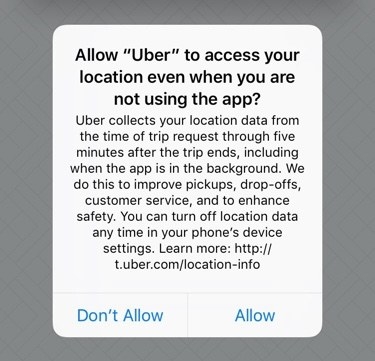
After Uber introduced a controversial app update that tracks users’ locations even when they’re not using the app, the Electronic Frontier Foundation, a leading privacy group, has asked the company roll it back.

In the updated version of its app, Uber offers users two options: you can either allow Uber to always track your location (though the company says it will only track users for five minutes after a ride ends), or you can turn off the app’s tracking entirely. That means you’d have to manually enter your pickup location when requesting rides.

The Electronic Frontier Foundation has asked Uber to return to an option that allows users to only share their location while using the app – not afterward, Kurt Opsahl, deputy executive director and general counsel at EFF, told BuzzFeed News.

“Tracking you five minutes after you have been dropped off — some people might have very legitimate reasons why they don’t want a record about that,” Opsahl said. “They may be concerned about getting into some database about their location and may get dropped off across the street. It’s sad to take that away.”

An Uber spokeswoman told BuzzFeed News that by offering the option of manually entering pick-up locations, the company is giving users a choice to be tracked or not. But Opsahl says this “takes away a lot of the usability.” Part of Uber’s appeal is how easy it is to open the app and let GPS pinpoint your location for a driver.

“As you’re trying to get picked up by the side of the road, you might not know what address you’re at,” Opsahl said. “I guess you could turn it on and off again…but that’s pretty clunky as well.”

Opsahl said EFF’s conversation with Uber is still ongoing, but he hopes “Uber sees that looking out for the customers first and considering their privacy needs and preferences is a better way to be a good company.” Earlier this year, the EFF praised Uber for “taking steps to facilitate transparency and user privacy” in an annual review comparing how companies respond to government requests for user information.

An Uber spokeswoman told BuzzFeed News that tracking users for five minutes after their rides end would provide data that could improve the pickup and drop-off experience. Do people get dropped off on the opposite side of the street from their destinations and have to cross through traffic after exiting the car? Can people be given better directions to faster pickup locations to speed up an UberPool ride? The company also says that knowing where exactly riders are when they exit cars could also help customer service representatives investigate complaints or safety issues.

“If Uber wants to make a case to its customers that they stand to benefit from additional uses of data, it should make that case and let customers opt in.”

Jay Stanley, a senior policy analyst for speech, privacy, and technology at the American Civil Liberties Union, called the change “a fairly aggressive use of a customer’s data.”

“If Uber wants to make a case to its customers that they stand to benefit from additional uses of data, it should make that case and let customers opt in,” he said. “The five-minute thing is disturbing. Obviously that’s not 24/7 tracking, but they are reserving themselves the ability to do that, which is even scarier.”

An Uber spokeswoman said the company would tell users if it decides to extend collection of data beyond the five-minute mark. But users who opt to share location data have technically already given Uber permission to do so.

Uber has been the target of privacy complaints in the past. Last year, the Electronic Privacy Information Center filed a complaint about Uber’s privacy policy with the Federal Trade Commission. The privacy rights group argued that Uber has a history of abusing riders’ location information. “Consumers are led to believe that they retain control over their personal data, when in fact they do not,” the complaint read. EPIC did not return a request for comment from BuzzFeed News about Uber’s latest location-tracking efforts.

And in January, Uber paid a $20,000 fine as part of a settlement with the Federal Trade Commission over failure to report unauthorized third-party access to drivers’ personal information and after BuzzFeed News reported that the company used an aerial tracking tool called “God View” to identify riders. As part of that settlement, the company also agreed to limit access to rider geolocation data to employees who needed it for “legitimate business purposes.”

Quelle: <a href="Privacy Advocates Want Uber To Stop Tracking Users After Rides End“>BuzzFeed

Silicon Valley's Most Popular Forum Bans Stories About Politics

Earlier today the moderators on Hacker News, an influential online discussion forum run by Y Combinator, the startup incubator, announced that this will be “Political Detox Week” on the forum, and encouraged commenters to flag both political stories and political threads in non-political stories. “We&;ll kill such stories and threads when we see them,” wrote Daniel Gackle, head of community for Hacker News, who goes by the handle “dang” on the site.

In response to questions from BuzzFeed News, Gackle said the experiment in moderation was prompted by “an increase in accounts that have been using HN primarily for political purposes.”

In a post outlining the rules of Political Detox Week, Gackle wrote said this experiment was meant to honor Hacker News values of “intellectual curiosity and thoughtful conversation,” instead of the flame wars that happen “when political conflicts activate the primitive brain.”

When commenters asked about how the moderators intended to judge what was “political,” Gackle elaborated: “The main concern here is pure politics: the conflicts around party, ideology, nation, race, gender, class, and religion that get people hot and turn into flamewars on the internet.”

But many Hacker News community members objected to both the idea of censorship and the impulse to secede from politics, especially given the tech industry&039;s inextricable role in national debates over job loss and automation, the way that social media can amplify political propaganda, and the fact that Silicon Valley is stilllargely dominated by white male gatekeepers.

The most upvoted comment on the site, from a user who goes by the handle tarikjn, who found the experiment troubling:

I find this experiment a bit strange/disturbing, avoiding political subjects is a way of putting the head in the sand. HN is a community of hackers and entrepreneurs and politics affects these subjects one way or another wether we want to avoid it or not, and are an important component of entrepreneurial and technical subjects. It might be fine if HN was a scientific community, but it is not the case, and even then politics do interact with science, as one can conduct scientific experiments on government decisions, or politics can attack scientific community positions (e.g. climate change).

Hacker News was first launched by Y Combinator founder Paul Graham back in 2007 and still functions as the tech industry’s very own Reddit.

Y Combinator took a much different position on politics this year, when billionaire investor Peter Thiel, a part-time partner at YC, wanted to promote his views. In response to calls to cut ties with Thiel, who is now helping to run the transition team for President Elect Donald Trump, Sam Altman (president of Y Combinator&039;s parent company) wrote, “Diversity of opinion is painful but critical to the health of a democratic society.”

On Twitter, some commenters called bullshit on the idea of banishing the political as the best way to promote more thoughtful discussion:

Matthew Garrett, a security developer, pointed out that the detox diet silenced discussion around important topics, like a story about why diversity has stalled in major tech corporations:

Other Hacker News users, like commenter chrissnell, commended the experiment as an effort to promote objectivity.

I&039;d rather see HN go politics-free forever. Political discussions do not enjoy the same level of objectivity that technical and business discussions do. Frankly, it may be impossible to expect objectivity within political discussion because our political feelings are so deeply-held and tied to our individual upbringings, culture, and locale.

Another commenter, who goes by the handle ben0x539, noted that “racist, misogynist, fascist hackers” already feel safe on Hacker News, so this detox would end up marginalizing minority voices:

I feel like trying to ban discussion of these conflicts will lead to the same outcome that reddit&039;s weird “free speech” policy had, if more subtly. If Hacker News is the place where racist, misogynist, fascist hackers can feel particularly safe, that&039;s going to be the kind of people you attract, at the expense of marginalized hackers.

There is no neutral option around this kind of politics and I&039;ll be sad to see HN throw marginalized people under the bus to ensure the comfort of the privileged.

Danilo Campos, a software engineer who has been documenting abuse on Hacker News under for years, had little patience for forum members who argued that Political Detox Week was designed to keep out hate speech on the site:

When BuzzFeed asked Campos if Hacker News had ever responded to his campaign, Campos sent this interaction with Altman from 2014:

Here is the full text of the statement sent to BuzzFeed from Hacker News:

What prompted it was an increase in accounts that have been using HN primarily for political purposes. Politics are inextricably mixed with a lot of the topics that get discussed on the site, but it&039;s important that HN not turn into just another a political battlefield. We thought a one-week abstention from politics might be an interesting thing to try. Our hope is that it will help clarify what kind of site Hacker News is/isn&039;t. On HN, most flagging of stories is done by users, not moderators. For the purposes of this week, the idea is to flag all stories that are mostly political and to err on the side of flagging rather than not. But that&039;s just for this week. In general, we encourage users to err on the side of not flagging.

Quelle: <a href="Silicon Valley&039;s Most Popular Forum Bans Stories About Politics“>BuzzFeed

Facebook, Microsoft, Twitter And YouTube Team UP To Target Terrorist Content

Some of the biggest internet companies in the world are partnering to identify and remove terrorism-promoting content across their networks.

The companies — Facebook, Microsoft, Twitter and YouTube — will partner to share identifying information about terrorist content when they find it. Once a participating company identifies a terrorist video or image, it will pass along a hash — a sort of digital fingerprint that can be used to identify it on any platform, giving other participating companies an easy way to find and remove it themselves.

“Our companies will begin sharing hashes of the most extreme and egregious terrorist images and videos we have removed from our services — content most likely to violate all of our respective companies’ content policies,” the companies explained in a joint blog post. “Participating companies can then use those hashes to identify such content on their services, review against their respective policies and definitions, and remove matching content as appropriate.”

Similar partnership agreements around hash-sharing are being used to fight the spread of child porn.

The partnership does not mean content cited by one company will automatically be removed by others. “Content that violates one company&;s policies may not necessarily violate another&039;s,” one participating company said in an email.
“The hash-sharing provides a way for each company to more efficiently review content against its own independent policies.”

In recent years, terrorists have become skilled users of social media for recruitment and propaganda purposes. Twitter alone has suspended more than 360,000 accounts for making violent threats or promoting terrorism.

Many of the companies involved in this partnership own platforms that are essentially the modern day town squares; places that host easy to access public dialogues. Removing any content on these platforms is therefore a serious matter, as the companies note in their joint blog post.

“We are committed to protecting our users’ privacy and their ability to express themselves freely and safely on our platforms,” the blog post said. “We also seek to engage with the wider community of interested stakeholders in a transparent, thoughtful and responsible way as we further our shared objective to prevent the spread of terrorist content online while respecting human rights.”

Quelle: <a href="Facebook, Microsoft, Twitter And YouTube Team UP To Target Terrorist Content“>BuzzFeed

Uber Just Bought An AI Startup To Make Its Self-Driving Cars Smarter

An Uber car outfitted with self-driving technology in Pittsburgh, Pennsylvania.

Afp / AFP / Getty Images

Uber is doubling down on self-driving cars. The company said Monday that it has acquired an artificial intelligence startup called Geometric Intelligence and tapped the company&;s founders as co-directors of its new in-house AI research lab. Terms of the deal were not disclosed.

Dubbed Uber AI Labs, Uber’s new artificial intelligence research arm is intended to explore AI applications beyond self-driving car efforts, the company said in a blog post announcing the acquisition. Machine learning could improve routing algorithms, or the process of matching up riders for UberPool.

Geometric Intelligence&039;s approach to artificial intelligence is unique in that it focuses on developing AI that “learns” by extrapolating from a palette of rules, rather than crunching vast piles of data. Uber told The New York Times it found this “evolutionary” method of developing AI particularly compelling because it aims to mimic how the human mind learns.

Most members of the 15-person team, who are scattered at universities around the US, will move to San Francisco, where Uber is based, to form the AI unit’s “initial core.”

In September, Uber began a pilot program that allows passengers in Pittsburgh to hail self-driving cars, which carry both a safety driver (ready to take the wheel during emergencies) and a co-pilot (to monitor the car and its route on a laptop). The company entered the self-driving car race later than some other tech companies and automakers, but got a jumpstart by poaching about 40 researchers from Carnegie Mellon University’s robotics unit.

Speaking at Vanity Fair’s New Establishment Summit this past October, Uber CEO Travis Kalanick said the ridehail juggernaut is at the “very beginning stages of becoming a robotics company.” The acquisition of Geometric Intelligence, a 15-person artificial intelligence startup founded by three academics, nearly two years after the company opened up its Advanced Technologies Center in Pittsburgh, shows how that evolution has progressed.

Silicon Valley companies have recently been competing to hire AI researchers. Apple, for example, has in the past year acquired three AI companies, and brought on a director of artificial intelligence in October. Uber is now joining the recruitment rush.

Quelle: <a href="Uber Just Bought An AI Startup To Make Its Self-Driving Cars Smarter“>BuzzFeed

Amazon's "Just Walk Out" Will Kill Supermarket Checkout Lines

Amazon's "Just Walk Out" Will Kill Supermarket Checkout Lines

Today, Amazon announced a brand new technology that promises to eliminate waiting in lines at your local supermarket checkout register. In fact, it will eliminate registers themselves.

The tech is called “Just Walk Out”, and it’s part of Amazon Go, an app that will launch in beta this year to Amazon employees at an 1,800 square foot location in Seattle.

Customers enter the store by scanning a barcode on the Amazon Go app on their phones. According to a promotional video released by the company, once inside, customers simply pick what they want from the store shelves. Amazon uses a combination of sensors, computer vision, and deep learning, much like you would find in self-driving cars, to figure out what they picked out.

Once you walk out of the store, the app automatically bills your purchases to your card on file with Amazon and sends you a receipt.

Check out the video for Amazon Go right here:

youtube.com

Quelle: <a href="Amazon&039;s "Just Walk Out" Will Kill Supermarket Checkout Lines“>BuzzFeed

Zenefits CEO David Sacks To Step Down

Steve Jennings / Getty Images

David Sacks, the CEO of Zenefits, plans to step down as head of the embattled human resources startup after less than a year on the job, he told BuzzFeed News Friday evening.

Zenefits is currently conducting a search for a new CEO and does not yet know who will take over, or when the handover will happen, Sacks said. He said he plans to stay on as CEO until that time, at which point he will take on the role of chairman, working alongside his successor.

Going forward, Sacks is open to the possibility of working in the administration of President-elect Donald Trump, even in an informal role, according to a person close to him who insisted on anonymity. Peter Thiel, the billionaire tech investor who is a member of Trump&;s transition team, is an old friend of Sacks&039;s and sits on Zenefits&039; board. The two men, who met as students at Stanford University, once co-wrote a provocative book critiquing “multiculturalism” on college campuses and later were early executives at PayPal. (Both recently apologized for the book.)

The shakeup at Zenefits caps a turbulent year for the startup health insurance broker, which ousted its founding CEO, Parker Conrad, in February after revelations that it flouted state insurance laws. Under Sacks, Zenefits has shed hundreds of staff, struck settlements with state regulators that were investigating the company, and released a new software platform called Z2, all in an effort to remake itself.

Sacks said on Friday that he felt he had “accomplished everything I set out to accomplish,” and that he had been discussing with the board for a few weeks the possibility of his stepping down as CEO.

“It&039;s not a job I sought,” said Sacks, who had been the chief operating officer before the board asked him to take the helm. “I had a responsibility to the investors and employees to guide the company through this crisis, and we&039;ve done that.”

Sacks, who rose to prominence as chief operating officer of PayPal and later sold his software startup Yammer to Microsoft for over $1 billion, added, “This is the hardest thing I&039;ve done as an entrepreneur, effectively re-founding the company.”

“You saw how tired I was at Z2,” he said, referring to the October conference where Zenefits unveiled its new software platform. “This took everything I had.”

The Wall Street Journal reported Friday that Sacks planned to join Trump’s transition team, but Sacks refuted this, and told BuzzFeed News, “I have no plans to join the transition team.”

The Information earlier reported that Zenefits was searching for a candidate to possibly replace Sacks as CEO.

Even as it cleans up its legal mess, Zenefits is awash in red ink. BuzzFeed News reported on Friday that the company lost $204.5 million in its last fiscal year, on revenue of $43.5 million, though its revenue is growing and it has reduced its monthly cash burn.

Here is the full text of an email Sacks sent to his employees Friday night, which was obtained by BuzzFeed News:

All-

Ten months ago, the Board asked me to step into the CEO role at Zenefits amidst a regulatory crisis. This is not a job I sought, but I felt a responsibility to our investors, employees, and customers to help the company through the crisis.

I accepted no compensation to do this, even though it was offered to me. I wanted to make sure there was more for all of you. (One of the accomplishments I’m most proud of is that employee ownership has more than doubled since I became CEO.)

This week, we successfully resolved the issues that gave rise to the crisis, signing a deal with our lead regulator, the California Department of Insurance (CDI). We’ve also settled with 19 other states, including Washington. (Far from being a setback, the Washington deal provides an answer on the rebating question for a handful of states, helping to resolve all of the existential issues that faced the company just a year ago.)

One of the most remarkable features of the California settlement is that CDI reduced its fine 50% in recognition of the remediation and cultural transformation that we accomplished.

In fact, regulators across the country have praised the New Zenefits for resetting our values, culture, mission, leadership, and governance. Because of that, the company will pay less than 1% of invested capital for a clean bill of health with regulators.

This is due to all of your hard work. Each of you chose to embrace the new values of the company and make great decisions for the business and our customers. Ten months ago, when we were facing headlines like this, most outside observers would have said this outcome was not possible. But you did it.

And not just that. You kept building. You didn’t let the headlines distract you. You launched our new Z2 product that customers love. As a result, we’ve seen a huge increase in leads on the heels of Z2, causing Sales to hire again.

We&039;ve refocused on our core small business market and customer success. We’ve restored our relationship with all of our key stakeholders, including investors and our industry. We took tough but necessary steps to cut burn, including reducing headcount 35%.

In short, we&039;ve achieved every goal set forth in my Day 1 memo, which outlined the turn-around plan for this company.

With that turn-around complete, now is the time to start planning for the next phase of Zenefits. While there will be no immediate changes, I want to be transparent about my plan, which is to transition into a Chairman role and lead a search for the permanent CEO of the company.

The Chairman role will allow me to focus on what I do best — product and strategy — while working with a great operator who can help build our small business pipeline. I feel it is best to be public about this search so that we can attract the best candidates.

Zenefits has an amazing team, hundreds of millions of dollars in the bank, and years of runway to keep building. We are also the best All-in-One HR product for small businesses, a huge greenfield category. The company is spring-loaded for success, and I’m excited about partnering with a great operator to take Zenefits to the next level.

Looking back over the past year, I am extremely proud of the work that we did together to address the crises facing the company and turn the corner towards a better future, in which our success will be based solely on the quality of our product and service. In fact, of all the things that I’ve done in my career, and all the teams I’ve worked with, I couldn’t be more proud of this team and what we accomplished.

I told you on Day 1 that you were all co-founders with me in the New Zenefits. That is still true. I still love this company and our mission to make entrepreneurship and small business ownership easier and more accessible to everyone. I look forward to the work that we will continue to do together. This is not an end on any level, it is the next chapter.

LINK: Zenefits Lost $200 Million Last Year

Quelle: <a href="Zenefits CEO David Sacks To Step Down“>BuzzFeed

Facebook Scammers Are Profiting From Standing Rock By Stealing Native Artwork

Getty Images / SunFrog

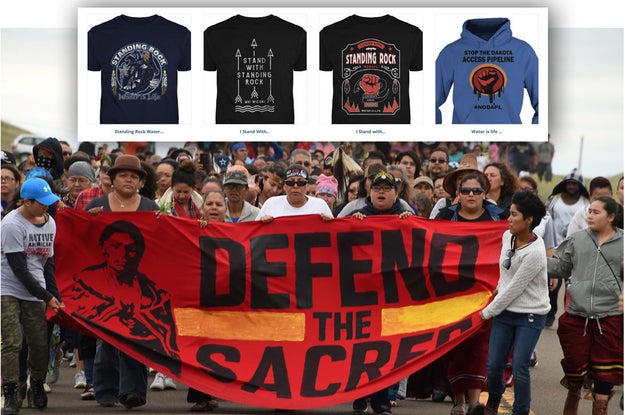
As pipeline protesters at Standing Rock prepare to dig in for the winter, a growing network of dubious Native American Facebook pages is cashing in on the movement by selling stolen No DAPL T-shirt designs and by driving traffic to dubious clickbait websites, a BuzzFeed News investigation has found.

The owners of these pages and websites reside in faraway countries such as Vietnam and Kosovo, and they are capitalizing on online interest in Standing Rock, and Native American culture in general, to make money. BuzzFeed News identified more than 60 Facebook pages with more than 6 million fans that are generating money either by selling counterfeit Native American merchandise, or by driving traffic to ad-filled websites that in some cases have little or nothing to do with Native American issues.

Native designers say their work is being stolen and resold, and that some pages falsely claim to donate proceeds to the protesters at Standing Rock.

“They’re just capitalizing on struggle — it’s really crazy,” said Jared Yazzie, a Navajo who runs Oxdx, Native American clothing company in Arizona. He said some Facebook pages have even taken photos of his models and photoshopped different clothing on them.

“When they use my models I think that makes me the most angry,” he said.
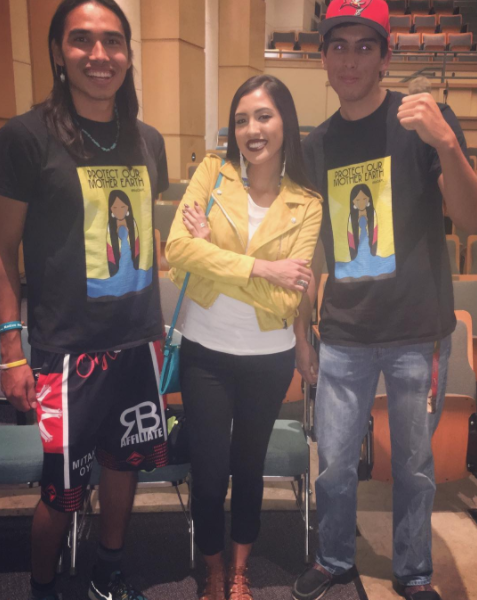
Erica Moore with two people wearing one of her Standing Rock T-shirt designs.

Erica Moore / Via instagram.com

Erica Moore is a 23-year-old Native American who designed a series of T-shirts to help raise funds for the pipeline protesters. She said copies of her designs soon began showing up on Facebook and elsewhere.

“It&;s a different story if they would ask our permission to use the design, but I&039;ve seen my designs being sold without my consent, and I&039;ve seen people trying to re-design my design in some way to make it their own,” she said. “It just isn&039;t right.”

BuzzFeed News tracked some of the worst offending Facebook pages to owners in Vietnam. Like If You Love Native Americans has almost 190,000 fans and is connected to a website registered to “Hoai Thu Ngo Thi” in Vietnam. It promotes its T-shirts by photoshopping them on celebrities such as The Rock, Johnny Depp, Mark Wahlberg, and others. Many of its recent posts about clothing comment on the Standing Rock protest, though there is no evidence that the people running the page donate any proceeds to the protesters.

BuzzFeed News messaged the page on Facebook and the person who replied introduced themselves as a woman in Michigan named Maria Torres who claims to be Native American on her Facebook profile. The profile appears to only have been created in March of this year and primarily shares merchandise being promoted by the Like If You Love Native Americans page. The account also reposts content and merchandise from a page called Wolves In Native American Culture which points to a domain name registered to the same person in Vietnam.

Asked how the page gets its designs, the person running the page responded, “The clothing and fashion design industry is highly competitive; it is full of individuals.”
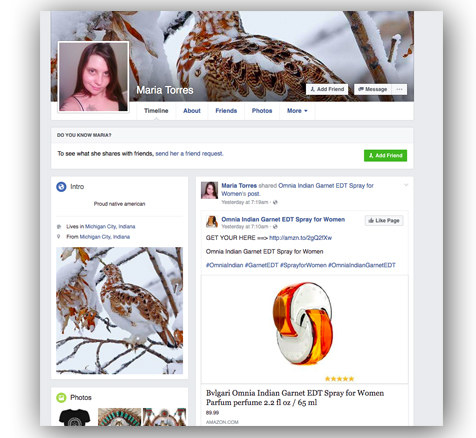
The fake Maria Torres profile on Facebook.

Facebook

After being told records show they are in fact located in Vietnam, the person admitted that’s where they are based, meaning the Maria Torres account is a fake created to promote its content and products. The person then denied stealing designs from Native artists.

“No steal their work,” they wrote in all caps. “I am an affiliate marketer search designs on that site an [sic] sell.”

The person said they simply find Native American T-shirts that have already been uploaded to SunFrog and collect them on one page, earning a commission each time they sell. SunFrog is one of several websites that enable anyone to to upload a design and then offer print-on-demand ordering for a range of clothing.

Kirk Yodzevicis, SunFrog’s general counsel, confirmed that people can create collections of existing designs uploaded to SunFrog, and said the company takes down any infringing designs and closes the related account. He pointed to a form on its website that anyone can use to make a claim.

“When we find out somebody stole a design they get their account shut down,” he said. He also said anyone who falsely claims to sell clothing in support of a cause will have their account closed and SunFrog will donate their earnings to charity.

Yodzevicis said SunFrog has seen an increase in infringing designs and false charity claims related to Standing Rock.

“Absolutely, no question about that,” he said. “Anytime there is any kind of an issue in the news that has some kind of passion about it you are gonna see people that are going to try and game the system.”

One of the bigger pages identified by BuzzFeed News is called Indigenous People of America and has over 750,000 fans. It shares a steady stream of news related to events in Standing Rock, but under many of its posts it also promotes the sale of a knockoff of a shirt created by actor Shailene Woodley to raise funds for Standing Rock. The page also regularly posts content from a website called TheIndigenousPeoples.com, which was only registered in early November and has its owner’s name hidden.

The only official seller of the Woodley shirt is Omaze, yet the design can be found for sale on many other online clothing sites as well as on Amazon. SunFrog removed a version of the shirt for sale on its site after being alerted to it by BuzzFeed News, though other copies of the design remain for sale on the site.

There is no evidence that any of these sellers donate money to Standing Rock, or that they had permission to sell Woodley’s shirt. (A rep for Woodley did not respond to a request for comment.)

Another big Facebook page hawking inauthentic Native American goods is Native American Indians, which has over 360,000 fans and promotes merchandise from a store called NativeThing.com. That website is registered to “Hoang Trung Hieu” of Vietnam. It’s the subject of a litany of online complaints from people who bought boots and other items under the impression that they were authentic Native designs and craftsmanship. Once they receive their order people realize it was made in China, gives off a noxious odor, and that the company subsequently refuses to accept returns.

“You get stuck with the smelly product you can&039;t wear,” wrote one woman on Facebook. “How many ways can you spell ‘screwed.’”

Many other pages pursue a similar strategy of building up an audience with Native content and then trying to sell them shirts and other items that are often rip-offs of Native designs. One newer page is called I Stand with Standing Rock Sioux Tribe and shares a steady diet of news about the protest mixed with constant pleas for people to show their support by buying shirts for the cause. The page did not respond to a question about whether it donates any money to the tribe.

Along with stealing the work of Native artists, and the likenesses of models and celebrities, some scammers even used a photo of the first Native American federal judge to create fake profiles to help spread their content.
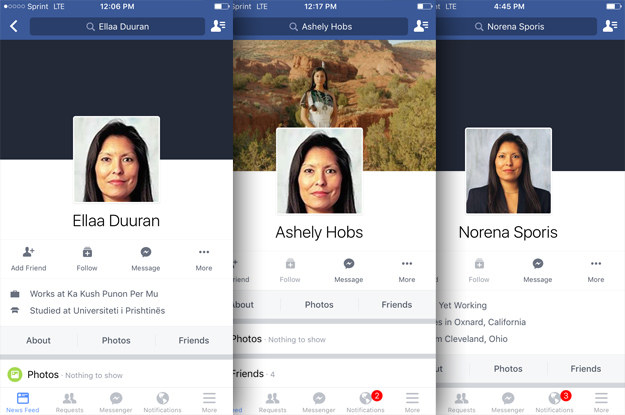
Fake profiles featuring the photo of Judge Diane Humetewa.

Facebook

Judge Diane Humetewa serves as a United States District judge of the United States District Court for the District of Arizona. Her photo has been used on at least three fake Facebook profiles, one of which lists its two only friends as two young men in Kosovo. One of the men did not reply to an interview request from BuzzFeed News, and the judge’s chambers declined to comment, citing the Code of Conduct for US Judges.

One of the largest networks of Native American Facebook pages initially identified by BuzzFeed News belonged to two young men in Kosovo. One of the men, a 25-year-old named Dardan, said in a Skype interview that he only owns “two or three” Native American Facebook pages. But when asked if it’s possible that he in fact owns 13 pages as well as a Native American group with more than 15,000 members, he smiled and said, “Maybe. It could be.”

At the time of the interview, their pages had close to 2 million fans. However, after speaking to BuzzFeed News all of their pages were taken offline.

Rather than selling Native American designs, the pages has been used to promote links to a single website, BuzzDuzz.net, where Dardan and a partner publish clickbait articles about a wide variety of topics, though rarely about Native Americans.

“Lately most of the content [on the Facebook pages] is not about Native Americans,” he said. “It’s hard to get content just about Native Americans and I don’t have time for that.”

Dardan did not respond to a subsequent Facebook message from BuzzFeed News asking why they had removed their Native American Facebook pages. BuzzDuzz is still publishing as of this writing.

Some of the Native American designers who spoke to BuzzFeed News said the non-Natives running the pages and selling stolen designs are making more money than they are.

Aaron Silva, a Native American and the co-founder of The NTVS clothing brand in Minnesota, said the dubious Native American sellers often have one or several large Facebook pages to use to promote the merchandise. Silva also said these pages spend money to create sponsored Facebook posts that promote the item for sale to large numbers of people.

“These pages are taking our work and paying for the sponsored posts on Facebook and making tons of money off of us,” Silva said. “Just from the sponsored posts we do we’ll get maybe 1,000 to 2,000 likes and maybe generate 1,000 in sales off of like a $200 ad.”

He said he’s seen sponsored posts from dubious Native American pages that receive tens of thousands, or even hundreds of thousands, of likes and a large number of shares as well. “It tells me tons of people are seeing [the ad], and you can see in the comments that many people are buying,” he said.

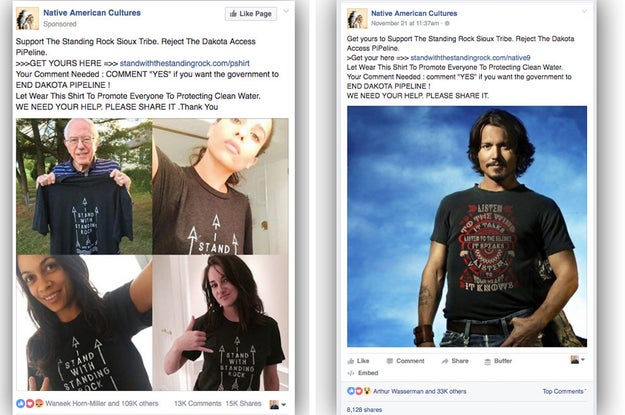
BuzzFeed News found sponsored Facebook posts from the Native American Cultures page, which appears to only have been created in September, that fit Silva’s description. One of its current sponsored posts shows photos of Bernie Sanders and celebrities with the Shailene Woodley shirt. It asks people to “Support The Standing Rock Sioux Tribe” and to buy the shirt, but the link does not send people to her official sales page. This sponsored post for a stolen design has received over 125,000 reactions, 15,000 comments, and close to 18,000 shares as of this writing.
Facebook

Another sponsored post from the page shows Johnny Depp with a Native shirt design photoshopped onto him. It had over 33,000 reactions, nearly 4,000 comments, and over 8,000 shares. These sponsored posts also help grow the number of fans for that page: When BuzzFeed News first found the Native American Cultures page roughly two weeks ago, it had just over 57,000 fans. It now has over 72,000.

To put this into perspective, the engagement for that page’s sponsored posts is significantly better than a legitimate sponsored Facebook post currently running from Woodley herself. It has close to 12,000 reactions, just over 500 comments, and 2,100 shares as of this writing. (It’s possible the other sponsored posts have been running longer, or have been backed with more money, in order to accrue more engagement.)

“Facebook prohibits advertisements, which includes boosted posts, that are deceptive, false, or misleading, including deceptive claims, offers, or business practices,” a Facebook spokesperson told BuzzFeed News. “We are looking into these claims and will take appropriate action.”
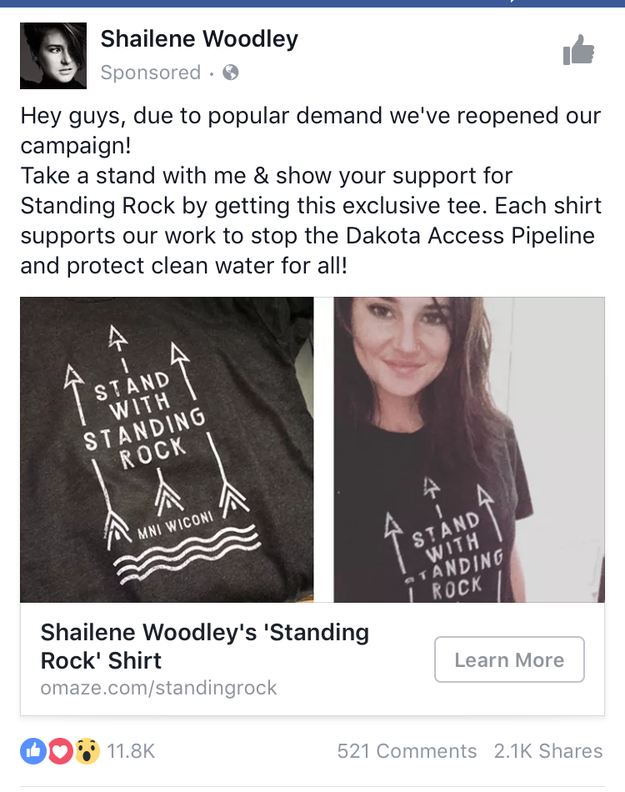
Facebook

Silva tried to raise awareness about the fake Native pages by listing some of the worst offenders in a post on his company’s Facebook page. The comment thread was soon filled with people sharing other examples of suspect pages, and of designers talking about how they too had their work stolen.

Silva and others have also tried to contact T-shirt sites such as SunFrog and TeeChip to get their designs removed. They said the takedown forms and procedures take up a lot of their time.

“I’ve gotten a few of them removed that way but it’s so tedious,” he said.

Yodzevicis from SunFrog said their reporting form has only a few fields to complete and submissions are checked roughly every hour. He said anyone whose work has been stolen could simply email legal@sunfrog.com if they find the form too time consuming. He also said the company is working to implement a procedure whereby any money earned from a stolen design will be sent to the original artist.

“We are currently in the process of implementing a system wherein such funds, rather than being redirected to charity, can be claimed by an actual rights holder so they are actually compensated for their work and the use of their property,” he said.

Silva said Facebook is easier to deal with, but that it only removes the offending post rather than an entire page. (The company told BuzzFeed News it will remove an entire page in some circumstances.)

Yazzie has also tried directly contacting the Facebook pages that promote his stolen designs for sale. But at most he says they will delete the post with his design and just upload it again later.

“I’ve tried to send messages to one of the pages and at first I just got this automated message back, and then they replied with a lot of smiley face emojis back, which is kind of annoying,” he said. “They eventually blocked me from commenting on their page.”

It’s not lost on Yazzie and others that Native American culture and goods are yet again being appropriated by others for profit.

“It weighs heavy,” he said. “I hope people understand there is a livelihood behind [the designs]. The meaning that goes along culturally with the work is something we study and try to put out correctly.”

For his part, Silva is amazed at how so many people in different parts of the world have discovered that dubious Native American Facebook pages, websites, and merchandise can be a moneymaker.

“I wonder how they came across that working for them,” he said. “Did they try different ethnicities and cultures and see which one really hit?”

Quelle: <a href="Facebook Scammers Are Profiting From Standing Rock By Stealing Native Artwork“>BuzzFeed

A Lab Accidentally Released The Medical Reports Of 43,000 People, Including HIV Patients

BuzzFeed News was able to access the folder containing the reports via a simple search.

Google

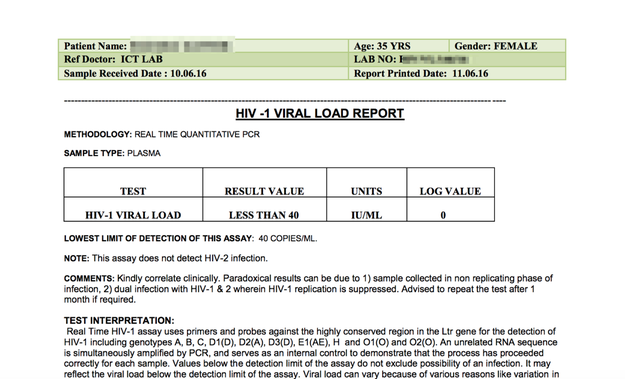
The medical records of over 43,000 people have been accidentally made public after being put online by a pathology lab in Mumbai. The reports contain confidential details like names, addresses, dates of birth, and blood test results. They also include details of patients who have had blood tests done for HIV detection. Some included in the breach are as young as 17.

The reports, which the pathology lab Health Solutions was storing in an unprotected folder on its website, were accessible to anyone with the right URL. Worse, since the reports were exposed, they have already been indexed by Google and likely other search engines too. BuzzFeed News was able to access the folder via a simple search.

The confidential blood test reports included this one, which was done for HIV determination, from the Health Solutions website.

BuzzFeed News screenshot

The breach was first discovered by web security expert Troy Hunt, who told BuzzFeed News that reports were stored in a folder with directory listing enabled. “What this meant was that there was literally a folder describing all the 43,000-plus files,” said Hunt. “This also means we have no idea of how many people have seen the files — they could have been viewed within cache.” Hunt was also able to find out that the reports were sitting on a server located in Provo, Utah.

None of the reports were password protected or had any kind of access control on them, which means that anybody could download anybody else’s pathology reports. “It’s about as bad as it gets, security-wise,” Hunt said.

When BuzzFeed News contacted Rodrigues Kustas, administrator at Health Solutions, he denied any knowledge of the breach before disconnecting the call. Kustas called BuzzFeed News back 30 minutes later, saying he was now aware of the breach. He said Health Solutions was moving to a new website in January because its current one had been “hacked” several times. Due to the move, he said there wasn’t any way the lab could fix the problem right now.

“Look, we are not the doctors, we merely do blood tests for patients. We also have more than 250 franchisees all over Mumbai who do tests for us,” Kustas said. “So maintaining doctor–patient privacy is not something that we as the lab are concerned with.”

Kustas also said that the lab’s website was built by a third-party developer who he described as a personal friend, but refused to provide any more details.

The pathology reports are organized by folder. BuzzFeed News blurred every entry in the folder for privacy reasons.

BuzzFeed News screenshot

Unlike the United States, where the Health Insurance Portability and Accountability Act (HIPAA) mandates doctor–patient confidentiality, India does not have a strong legal framework around medical privacy or even a privacy law in general.

Doctors who BuzzFeed News spoke to said that each hospital follows its own guidelines around maintaining patient privacy in the absence of an umbrella framework.

The only reference to privacy comes in the Code of Ethics and Regulations published by the Medical Council of India (MCI), a statutory body that enforces medical standards in the country.

It says: “Confidences concerning individual or domestic life entrusted by patients to a physician and defects in the disposition or character of patients observed during medical attendance should never be revealed unless their revelation is required by the laws of the State.”

BuzzFeed News has reached out to all nine members on the executive committee of the MCI for comment.

A Google spokesperson pointed BuzzFeed News to the search engine’s page for removal policies, and provided the following statement: “Google Search generally reflects what’s on the web, so we ask that if people want content removed from the web, they start by contacting the site hosting the content. After the content is taken down, it will drop out of search engines’ web results.”

“This serves as a reminder that once we digitize anything, there’s a far greater risk of it being inadvertently disclosed,” Hunt said. “It&;s another case like so many others we&039;ve seen where there&039;s large amounts of sensitive data exposed and the owner is totally unaware.”

A screenshot taken on Friday of the URL that previously led to the directory of medical reports.

HSPPL

Quelle: <a href="A Lab Accidentally Released The Medical Reports Of 43,000 People, Including HIV Patients“>BuzzFeed

Zenefits Is Losing $200 Million A Year

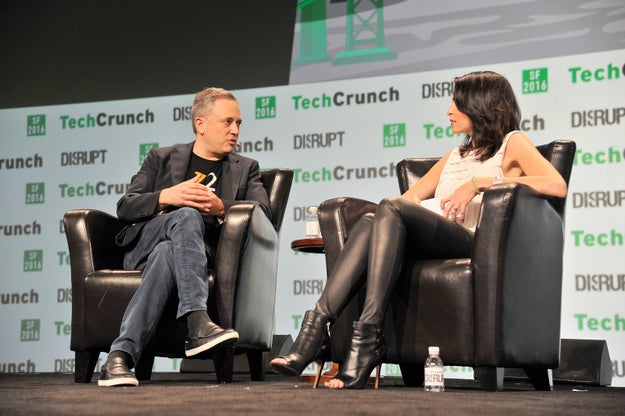
Zenefits CEO David Sacks speaks at TechCrunch Disrupt SF on September 13.

Steve Jennings / Getty Images

Zenefits, the $2 billion health insurance startup seeking to recover from a scandal that brought down its founding CEO, has racked up nine-figure losses that are eroding its store of cash, a confidential document reviewed by BuzzFeed News shows.

Zenefits lost $204.5 million in its last fiscal year, which ran through the end of January, on revenue of $43.5 million, the document shows. In the first half of its current fiscal year, Zenefits lost money at about the same pace, with a $100 million loss on revenue of $35.3 million.

The startup health insurance broker, which raised $512.6 million of venture capital in May 2015, saw its total amount of cash dwindle to $272.4 million as of July 31 this year, the document shows. Companies generating large losses generally burn cash quickly and have to seek additional capital if they fail to become profitable.

At the same time, Zenefits&; revenue is increasing more quickly than its costs, though not at the explosive rate its venture capital backers might like. Its revenue in the six months from February through July equates to $70.6 million on an annualized basis — which would represent a 62% increase from the prior year. Its costs and expenses, annualized for the same period, would increase by just 12%.

The financial details, contained in a message sent to shareholders in November, show Zenefits continues to face financial challenges even as it cleans up a legal mess that nearly sank the company this year.

Zenefits — which gives away human resources software to small businesses and makes money by selling those businesses health insurance — ousted its founding CEO, Parker Conrad, in February after revelations that it flouted state insurance laws. The new CEO, David Sacks, has overseen a string of regulatory settlements, including a $7 million deal with California regulators announced this week, and has overhauled the company&039;s approach toward compliance.

In spite of the red ink, Zenefits&039; deep-pocketed investors are unlikely to let it run out of cash. The company is backed by some major investment firms, including TPG and Fidelity, and prominent venture capital shops including Andreessen Horowitz (which also is an investor in BuzzFeed).

Once considered among the most promising startups in Silicon Valley, with a $4.5 billion valuation, Zenefits slashed its valuation to $2 billion in a deal with its investors in June. It also laid off hundreds of staff this year, in a broad reorganization and cost-reduction effort. The company unveiled a new software platform, called Z2, at a sold-out conference in October.

Last year, the company fell short of its targets for a metric called “annual recurring revenue,” according to a Wall Street Journal report at the time. That metric refers to expected annual revenue based on commissions at a given point in time. It remained roughly flat this year, just above $60 million, according to a Bloomberg News report in October.

“We are proud of what we have accomplished this year,” a Zenefits spokesperson told BuzzFeed News in a statement. “We became an industry leader in compliance, cut costs through greater focus on our core market, and maintained a customer base with over $60 million of [annual recurring revenue]. Today, Zenefits has hundreds of millions of dollars in the bank, plenty of runway, and an amazing new version of our product. There is still more work to do, but on the heels of Z2, we are seeing a return to growth that is very encouraging.”

A detailed picture of Zenefits&039; financial performance has never previously been made public. Here is a selection of the numbers, according to the document reviewed by BuzzFeed News:

Fiscal year 2017, First Half (Feb. — July 2016)
Revenue: $35.3 million
Total costs and expenses: $133.5 million
Net loss: $100 million

Fiscal year 2016 (Feb. 2015 — Jan. 2016)
Revenue: $43.5 million
Total costs and expenses: $237.6 million
Net loss: $204.5 million

Fiscal year 2015 (Feb. 2014 — Jan. 2015)
Revenue: $7.8 million
Total costs and expenses: $51.5 million
Net loss: $43.7 million

Quelle: <a href="Zenefits Is Losing 0 Million A Year“>BuzzFeed