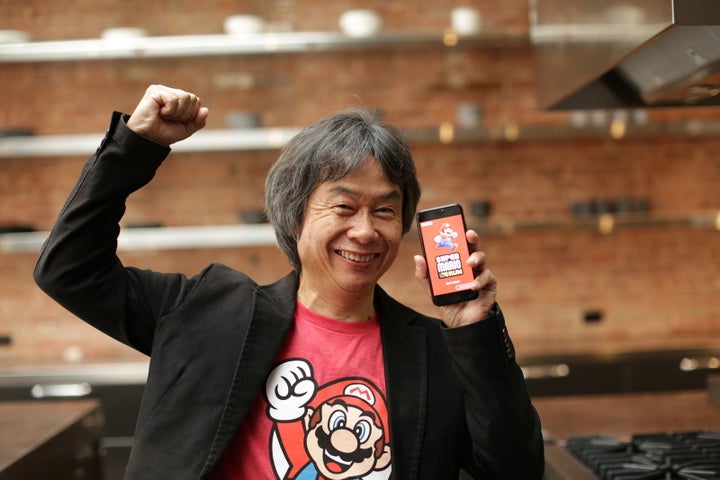
Shigeru Miyamoto Explains Why Nintendo Finally Brought Mario To The iPhone
Benjamin Bogard / BuzzFeed News

Next Thursday, Nintendo will release Super Mario Run for the iPhone and iPad. It&;s the first time in the 35-year life of the iconic plumber that gamers will be able to control Mario on a smart device. To get a sense of how big and weird and wild a deal that is, here&039;s a short thought experiment:

What if you could only watch Disney movies on special televisions made by Disney?

As in, what if every time you wanted to see Mickey, or Minnie, or Goofy, or Simba, you had to turn off the TV you use to watch almost everything else, and turn on your Disney TV, which costs as much as your regular one? (And by the way, you have to replace your Disney TV with a new one, like, every four or five years.)

Who would keep buying such devices? Sure, there&039;d be an audience: families with kids, and fanatics, and a core group of nostalgics. But what about the average consumer, the one with fond memories of Fantasia and limited disposable income?

For Nintendo, the Japanese gaming company that is still synonymous for much of the world with videogames, which it helped popularize three decades ago, this has always been the case. Emulators and the odd exception notwithstanding, consumers could not play the most beloved game series in history — Super Mario Bros. — without a Nintendo device.

That changes next week, when Super Mario Run releases to hundreds of millions of iOS devices, just in time for the holidays. It&039;s a defining moment for the House of Mario, and by extension for Shigeru Miyamoto, the creator of Mario (and Zelda, and Donkey Kong, and Star Fox) who is often called the Walt Disney of videogames.

BuzzFeed News sat down on Tuesday with Miyamoto — who holds the charmingly modest title of “Creative Fellow” at Nintendo — to talk about the new game. At 64, Miyamoto still has the hair of a hobbit and the smile of a scamp, and as he waited for the reporter to be briefed on Super Mario Run, he passed the time by noodling on his acoustic guitar.

View Video ›

video-cdn.buzzfeed.com

So how does the father of Mario feel on the eve of what is, strangely, a kind of coming out party for the most famous character in gaming?

“I’m very excited to be able to bring Mario to people who haven’t had a chance to play Mario games,” Miyamoto told BuzzFeed News. “And to reconnect with people who haven&039;t played for a long time.”

About that long time: Yes, Nintendo heard the clamoring for Mario games on mobile devices.

“For more than 10 years, people would often ask, &039;Why can’t you put your games on cell phones?&039;” Miyamoto said. “We often felt that with cell phones we couldn’t get the same level of gameplay response that we could from our own devices. Over the last two to three years we’ve been looking at what’s the right experience for a Mario game on our devices versus on an iPhone.”

In Super Mario Run, which he produced, Miyamoto thinks they&039;ve found it. Though the game looks like a very polished, very well-rendered version of the Marios many of us grew up playing, there&039;s a major difference. Mario runs without any help from the user. There&039;s only one input: Tap to jump, and hold the tap to jump higher. (In the classic Mario games, players pressed a directional button to make the round, mustachioed Italian trundle forward.)

This solution to the awkwardness of character control in mobile games isn&039;t new, exactly. Platform games in which a character runs without pressing a button – and a subgenre, so-called “endless runners,” in which play only ends when the character runs into or off something – have been popular on mobile devices since at least 2010 (think Temple Run and its myriad knockoffs.) But befitting Nintendo, which is quirky and sometimes enigmatic, the company came to the mechanic in a roundabout way.

Miyamoto told BuzzFeed News that Nintendo started playing around with the idea during the late-aughts heyday of the company&039;s Wii console. “We had experiments back then where you would make Mario jump in time to music,” Miyamoto said. Though those experiments never made it into a game until now, Nintendo continued to tinker with the idea as it developed New Super Mario Bros., a series of games for the Wii, handheld 3DS, and Wii U that that resembled the 2D games of the &039;80s and &039;90s and were intended to attract Mario novices.

According to Miyamoto, part of the inspiration for Super Mario Run&039;s auto-running came from a surprising source: “super players.” Watching online videos of these gamers&039; astounding speed runs and other feats of gaming skill, Nintendo employees noticed that the gamers never let up on the D-Pad. Mario always kept running, and all of the skill came down to the incredible precision of the jumping. What if, the Nintendo braintrust reasoned, all players could have that experience? Ironically, the most skilled Super Mario players in the world may be partially responsible for introducing Mario to thousands and thousands of first-time players.

Nintendo is hoping that this vast audience of first timers, along with people who haven&039;t played Mario in years, will spend $10 to unlock the whole game. If Super Mario Run succeeds, it would mark the second mobile triumph of the year for Nintendo, whose summer sensation Pokémon Go saw the company&039;s stock surge to its highest level in years. The company hit a second (and perhaps more sustainable) peak not long after, when Miyamoto announced Super Mario Run alongside Tim Cook at an Apple event in September.

Together, the two games represent an admission by Nintendo that the company needs to bring its most valuable asset — its characters – to the machines where humans, especially young ones who did not grow up with Mario, spend much of their time. And that means Nintendo can&039;t always build these machines itself. Miyamoto told BuzzFeed News that the company had once considered building GPS into its 3DS mobile system for a Pokémon Go-type game on proprietary hardware. Instead, Miyamoto said, Nintendo decided that it made more sense to put the game on millions of devices that already had satellite location tracking.

Indeed, coming off the disappointing sales of its Wii U console, and ahead of the March release of its NX console, Nintendo may be realizing that its future as a hardware manufacturer may be linked to getting their characters in front of a new generation of players, even if that means meeting them halfway.

“Kids are playing on devices that they’re getting from their parents when their parents are upgrading,” Miyamoto said. “We wanted to take an approach of how can we bring Nintendo IP to smart devices and give kids the opportunity to interact with our characters and our games.”

Quelle: <a href="Shigeru Miyamoto Explains Why Nintendo Finally Brought Mario To The iPhone“>BuzzFeed

Facebook Is Testing A Tool To Weed Out Scammy Advertisers

Via Facebook: 1428828810722465

Facebook is testing a tool that asks users about their experiences buying things from its advertisers, after promising earlier this year to crack down on shady businesses that use the social network to find customers.

The tool appears underneath ads on the site, asking users if they have purchased something from the seller in the past. If so, if asks them if the purchase went “well” or “poorly.”

Facebook

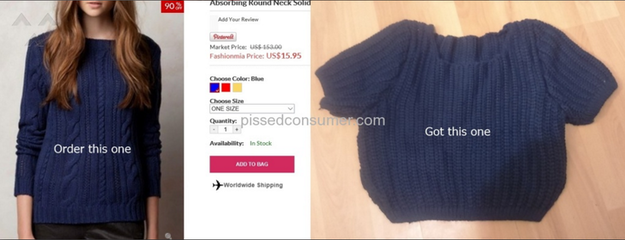
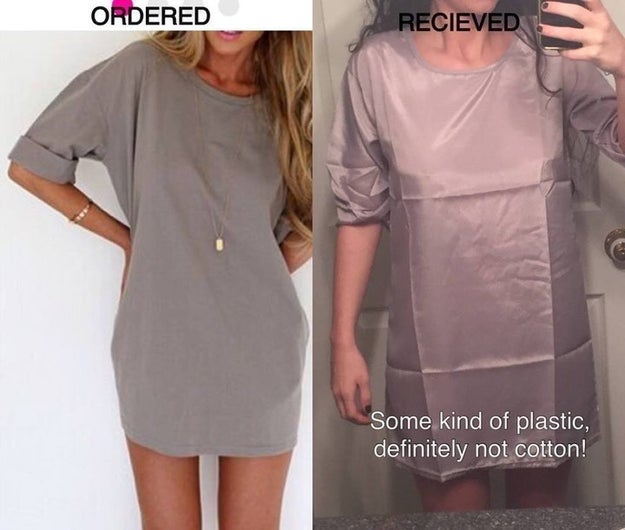
In April, a BuzzFeed News investigation revealed a network of China-based fashion sites using Facebook to acquire customers, racking up thousands of complaints over the poor, sometimes comical, quality of the products they shipped to users. Many used images stolen from high-end fashion brands to hawk poorly made, often unwearable products.

pissedconsumer.com / Via fashionmia.pissedconsumer.com

In response to the story, Facebook advertising chief Andrew Bosworth said the company would “do everything we can” to stop advertisers from using its platform to sell “overwhelmingly unsatisfactory” products to its users.

The new tool appears to be part of that response. “We said we’d continue improving our signals to better understand people’s experiences with businesses and product purchases that came from ads on Facebook,” a spokesperson told BuzzFeed News.

“This test survey is one of the tools we’re employing to garner feedback from people on those kinds of purchases. Making ads better for both people and businesses is our consistent goal and we’ll continue to work on improving ads that drive commerce.”

It&;s unclear when Facebook rolled out the test, or how many users are seeing it. Twitter user Alexander Kaufman spotted it in the wild on Wednesday.

Say No To The Dress

Quelle: <a href="Facebook Is Testing A Tool To Weed Out Scammy Advertisers“>BuzzFeed

A Skeptical Senate Prods AT&T And Time Warner On Their Mega-Merger

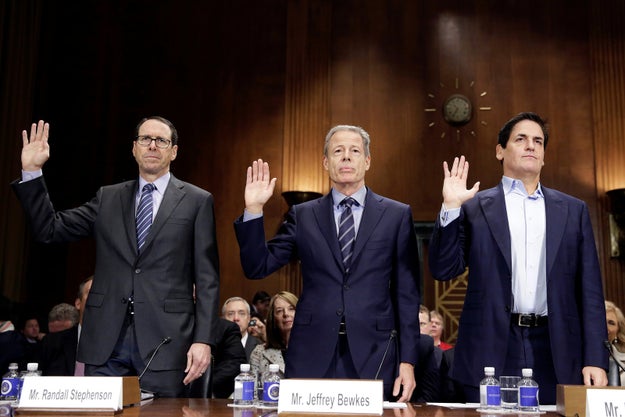
Chairman and CEO of AT&T Randall Stephenson, Chairman and CEO of Time Warner Jeffrey Bewkes, and Chairman of AXS TV and owner of the Dallas Mavericks Mark Cuban are sworn in before a Senate Judiciary Committee Antitrust Subcommittee hearing on the proposed deal between AT&T and Time Warner on December 7, 2016.

Joshua Roberts / Reuters

The chief executives of AT&T and Time Warner pitched their proposed merger to a skeptical Senate antitrust panel Wednesday, selling the $85 billion deal, which some say will lead to fewer choices and escalating costs, as a boon to customers craving cheap content on the go. Rather than squashing competition, they say the merger will help dislodge the entrenched cable bundle, and lead to innovation in the nascent market for streaming video.

Senators from both sides of the aisle needled the leaders of AT&T and Time Warner over the colossal merger in a nearly 3-hour long session, which also included Dallas Mavericks owner, Shark Tank investor, and media entrepreneur Mark Cuban, who spoke as an expert witness. Lawmakers raised the possibility of the deal leading to unfair price hikes, restrictions on prized content like HBO’s Game of Thrones, and incentives to stifle innovative streaming competitors like Netflix and Amazon.

During the hearing, Sen. Richard Blumenthal reminded the CEOs that President-elect Donald Trump has already vowed to block the deal. “I take him at his word,” Sen. Blumenthal said. AT&T Chairman and CEO Randall Stephenson has not met with Trump’s transition team, but he said he is confident that regulators will approve the deal, “once everyone hears the facts and has the appropriate competitive analysis.”

While many Senators raised pointed questions and offered sustained criticism about the deal, Blumenthal was perhaps the most critical. “I have yet to be convinced that the benefits outweigh the harms to competition and possibly to consumers,” he said.

AT&T’s Stephenson insisted the deal will help liberate unsatisfied cable customers from expensive contracts, cumbersome set-top boxes, and limitations on watching video through phones and tablets. Stephenson touted AT&T’s new service, DirecTV Now, which gives customers dozens of pay-TV streaming channels without the need for a traditional cable subscription, as a sign of innovation to come — so long as the merger is given the green light. “We want consumers to pay for their content once, and then watch it anywhere, anytime,” Stephenson said. He told Senators that the merger would allow AT&T to offer customers cheaper prices and more diverse programming, helping the company compete in the pay-TV market.

But Sens. Mike Lee and Amy Klobuchar expressed concerns that the deal would incentivize AT&T to restrict Time Warner to its own network, or that the network would exploit its ownership of HBO to extract hefty fees from rivals like Comcast.

Both Time Warner Chairman and CEO Jeffrey Bewkes and Stephenson countered that their company’s successes depend on broad distribution. Time Warner’s value would suffer if AT&T chose to restrict its reach to only certain audiences, Stephenson said. “I don&;t see the economic rationale nor do I see the customer rationale,” he said.

Lawmakers said the antitrust division of the Justice Department, the lead agency reviewing the merger, will need to examine zero rating, the practice in which internet providers exempt certain services from counting against the data limits of their customers. AT&T’s zero rating scheme with DirecTV has already drawn the scrutiny of the Federal Communications Commission, which found in a preliminary analysis that AT&T’s plan is anticompetitive. As the AT&T-Time Warner deal proceeds, regulators will determine if acquiring Time Warner’s library of content may also give AT&T incentives to engage in exclusive dealing and unfair pricing.

Both the FCC and lawmakers who oversee the industry say zero rating itself does not necessarily harm customers. It’s free data, after all. What’s key is whether exempting certain apps favors an internet provider’s in-house service over those offered by rivals. “The notion that a provider would offer to exempt content from monthly data caps strikes me as something consumers should applaud,” Sen. Orrin Hatch told BuzzFeed News. “Of course, we also need to be sure such exemptions are offered on equal terms so they aren’t used as a means to disadvantage competitors.”

AT&T insisted that all content providers who want to participate in the wireless carrier’s zero rating program are charged the same. But Sen. Al Franken challenged Stephenson on that claim. Since AT&T owns DirecTV, Sen. Franken described any cost incurred by DirecTV to get on AT&T’s wireless network as merely shifting money from one pocket to another, a kind of accounting fiction that ultimately conceals AT&T’s gain to the detriment of rival mobile video services. “How do we know you’re not giving DirecTV a deal — because you own it?” he asked. Stephenson said he would make internal data available to the Justice Department, and told the Senate panel AT&T does not discriminate against other services.

A big question left unanswered by AT&T’s chief is whether the two companies will structure the deal to avoid the regulatory of scrutiny of the FCC. Unlike the Justice Department, which can challenge a planned merger if it will harm competition, the FCC has a broader mandate; companies must show that their marriage serves the public interest to earn the FCC’s approval. At least according to this first round of Congressional scrutiny and the reactions of lawmakers, it’s not yet clear if the deal would meet that standard.

Quelle: <a href="A Skeptical Senate Prods AT&T And Time Warner On Their Mega-Merger“>BuzzFeed

Most Americans Who See Fake News Believe It, New Survey Says

BuzzFeed News / Getty Images

Fake news headlines fool American adults about 75% of the time, according to a large-scale new survey conducted by Ipsos Public Affairs for BuzzFeed News.

The survey also found that people who cite Facebook as a major source of news are more likely to view fake news headlines as accurate than those who rely less on the platform for news.

This survey is the first large-scale public opinion research study into the fake news phenomenon that has had a sweeping effect on global politics, and that recently caused a gunman to threaten a DC pizza place. The results paint a picture of news consumers with little ability to evaluate the headlines that often fly toward them without context on social media platforms. They also — surprisingly — suggest that consumers are likely to believe even false stories that don&;t fit their ideological bias. And the survey calls into question the notion — which Facebook has reportedly begun testing — that consumers themselves can do the work of distinguishing between real and fake news.

The new data comes from an online survey of 3,015 US adults conducted between Nov. 28 and Dec. 1. For more on the methodology, see the bottom of this article. A detailed summary of results to all questions can be found here. Additional calculations can be found here.

“The 2016 election may mark the point in modern political history when information and disinformation became a dominant electoral currency,” said Chris Jackson of Ipsos Public Affairs, which conducted the survey on behalf of BuzzFeed News. “Public opinion, as reflected in this survey, showed that ‘fake news’ was remembered by a significant portion of the electorate and those stories were seen as credible.”

The survey found that those who identify as Republican are more likely to view fake election news stories as very or somewhat accurate. Roughly 84% of the time, Republicans rated fake news headlines as accurate (among those they recognized), compared to a rate of 71% among Democrats. The survey also found that Trump voters are more likely to rate familiar fake news headlines as accurate than Clinton voters.

Top Fake News Headlines

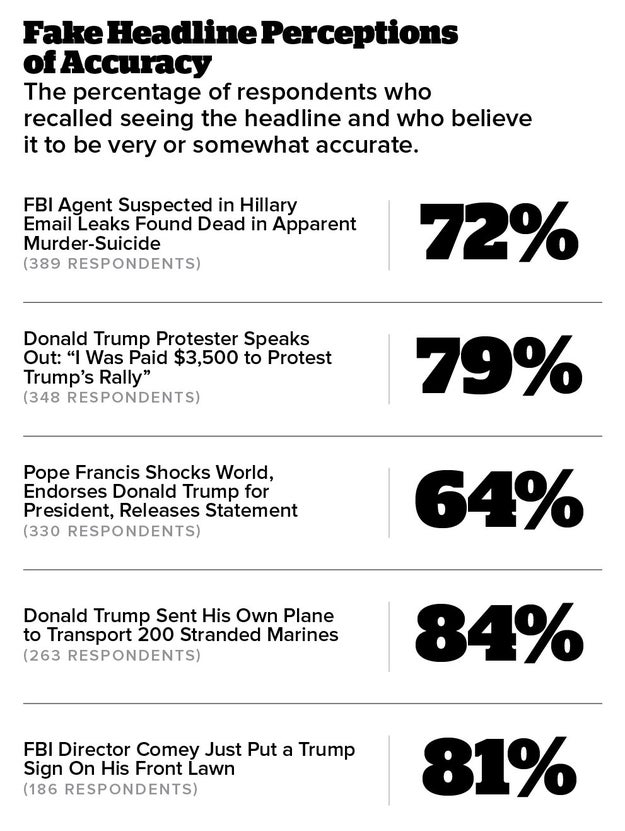
In the survey, respondents were shown a random selection of six headlines — three true and three false — related to the election. Those six were drawn from a list of 11 headlines gathered largely from a BuzzFeed News analysis that compared the top-performing fake election news articles on Facebook to the the top-performing real election news articles on Facebook. Of the 11 headlines tested, five were false and six were true.

Respondents who said they recalled the story in question were then asked to rate the claim in the headline as “very accurate,” “somewhat accurate,” “not very accurate,” or “not at all accurate.”

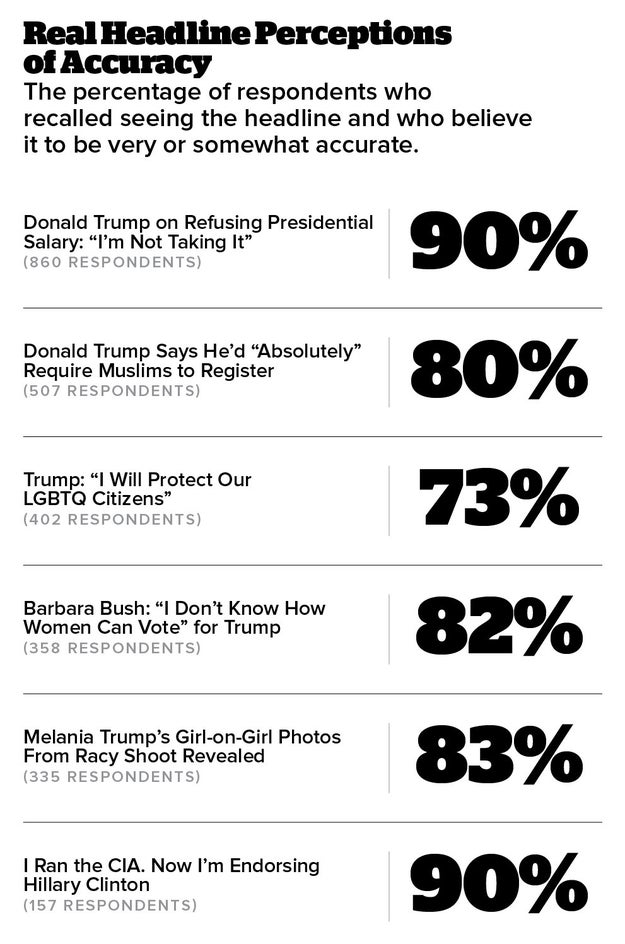
Real news headlines received a higher overall accuracy rating than fake news. The respondents made 1,516 judgments about fake news headlines they’d recalled seeing or hearing about; 75% of the time, they thought those headlines were “somewhat” or “very” accurate. By comparison, they considered 83% of real news headlines to be accurate, based on 2,619 judgments.

Of the people surveyed, nearly 33% recalled seeing at least one of a selection of fake news headlines from the election. That compared to 57% of respondents who recalled seeing at least one of the real news headlines tested in the survey.

The fake news headline recalled by the largest number of respondents is the story from hoax website the Denver Guardian, “FBI Agent Suspected in Hillary Email Leaks Found Dead in Apparent Murder-Suicide.” Twenty-two percent of respondents people said they recalled seeing it.

BuzzFeed News

The real news headline with the highest recall is a post-election CBS News story about Donald Trump saying he will not accept a presidential salary, “Donald Trump on Refusing Presidential Salary: ‘I&039;m Not Taking It.’” It was recalled by 57% of the 1,507 people shown the headline in the survey.

BuzzFeed News

The fake news headline with the highest overall accuracy rating from respondents is “FBI Director Comey Just Put a Trump Sign on His Front Lawn.” Of the 186 people who recalled seeing it, 81% said it was very or somewhat accurate. (Go here to read a debunking of that claim.)

A false headline claiming a man was paid $3,500 to protest at a Trump rally also received a high accuracy rating, with 79% of the 348 respondents who recalled seeing it saying it was very or somewhat accurate.

One contributing factor to its spread is that the story was tweeted by Eric Trump, by former Trump campaign manager Corey Lewandowski, and even by Kellyanne Conway, the Trump campaign manager who led him to victory. (Conway later deleted her tweet.)

BuzzFeed News

The two real headlines with the highest accuracy ratings from those who recalled seeing them were the the New York Times op-ed “I Ran the CIA. Now I’m Endorsing Hillary Clinton” with a 90% accuracy rating (among the 157 respondents who recognized the headline). A CBS News story about Donald Trump saying he will not accept a salary as president was also rated as very or somewhat accurate by 90% of the 860 respondents who recognized it.

BuzzFeed News

Clinton Versus Trump Voters

People who say they voted for Hillary Clinton were less likely than Trump voters to view the claims made in these fake headlines as accurate, according to the survey. This may be partly due to the fact that the majority of top-performing fake news stories about the election on Facebook had a decidedly pro-Trump or anti-Clinton bent. However, it’s notable that a majority of Clinton voters still believed the fake news stories to be very or somewhat accurate.

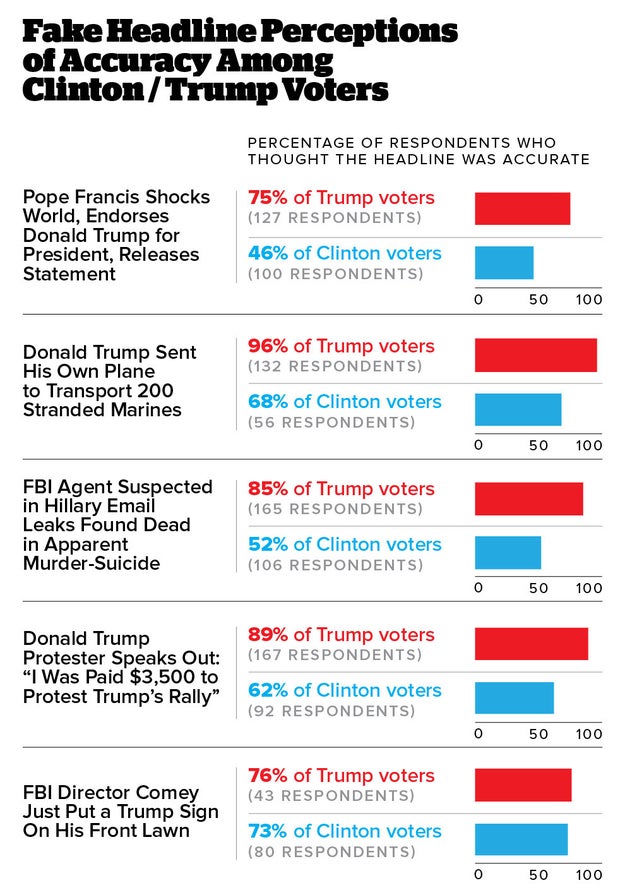
On average, Clinton voters judged 58% of familiar fake news headlines as accurate, versus 86% for Trump voters. (These percentages are based on 434 judgments by Clinton voters and 634 judgments by Trump voters.)

A fake story about the pope endorsing Trump was seen as accurate by 46% of Clinton voters compared to 75% of Trump voters. The hoax about an FBI agent connected to a Clinton investigation being found dead was seen as accurate by 52% of Clinton voters and 85% of Trump voters.

BuzzFeed News

Brendan Nyhan, a political science professor at Dartmouth college who conducts research into political misinformation, reviewed the data and said he is surprised by the high percentage of Democrats who rated the pro-Trump stories as very or somewhat accurate.

“It’s especially striking that both Democrats and Republicans think the stories are accurate in many cases,” said Nyhan. “Even partisan-motivated reasoning — which we might expect to make people question fake news that is harmful to their candidate — does not appear to protect people from believing in it.”

Trump voters in particular gave a high accuracy rating to a story that falsely claimed he had sent his own plane to fly 200 US Marines home. That claim, which was debunked by the Washington Post, was given a boost in awareness when the website of Fox News host Sean Hannity reported it and Trump&039;s campaign said it was true.

Facebook’s Role in Exposing People to Fake News

Though the survey does not prove a direct link between Facebook use and exposure to and belief of fake election news, it offers new data about the relationship between the platform and election misinformation.

People who said they rely on Facebook as a “major” source of news appeared to be disproportionately susceptible to fake news headlines. In the course of 553 judgments about fake news headlines they recognized, these respondents deemed the information to be somewhat or very accurate 83% of the time.

By comparison, fake news headlines were deemed accurate 76% of the time by people who consider Facebook to be a “minor” source of news (465 judgments), and 64% of the time by people who rarely or never use Facebook for news (498 judgments).

However, these percentages came from small groups of respondents and should be read cautiously.

“We have a lot more to learn about this topic, but it’s clear that Facebook in particular needs to take fake news much more seriously going forward,” said Nyhan.

BuzzFeed News

The survey also reinforces how important Facebook has become as a source of news for Americans. A total of 23% of the more than 3,000 respondents list Facebook as a major source of news for them, with another 27% citing it as a minor source. Only CNN and Fox News had higher percentages of people who said they view those outlets as major or minor sources of news. (Both saw 27% of respondents list them as major sources of news.)

Of those surveyed, 47% say they visit Facebook multiple times per day, with another 15% saying they visit it once a day. YouTube was the second most popular social platform, with 20% saying they visit it multiple times per day, and 11% visiting it once per day.

“I don’t want Facebook deciding which legitimate political content appears in the News Feed, but I do hope the company can prevent 100% fake news from being such an attractive business opportunity to entrepreneurs and scam artists alike,” Nyhan said.

Notes and Methodology

Here’s the list of 11 election headlines tested in the survey:

  • Pope Francis Shocks World, Endorses Donald Trump for President, Releases Statement (Fake)

  • Donald Trump Sent His Own Plane to Transport 200 Stranded Marines (Fake)

  • FBI Agent Suspected in Hillary Email Leaks Found Dead in Apparent Murder-Suicide (Fake)

  • Donald Trump Protester Speaks Out: “I Was Paid $3,500 to Protest Trump’s Rally” (Fake)

  • FBI Director Comey Just Put a Trump Sign on His Front Lawn (Fake)

  • Melania Trump’s Girl-on-Girl Photos From Racy Shoot Revealed (True)

  • Barbara Bush: “I Don’t Know How Women Can Vote” for Trump (True)

  • Donald Trump Says He’d “Absolutely” Require Muslims to Register (True)

  • Trump: “I Will Protect Our LGBTQ Citizens” (True)

  • I Ran the CIA. Now I’m Endorsing Hillary Clinton (True)

  • Donald Trump on Refusing Presidential Salary: “I’m Not Taking It” (True)

Respondents were shown a random selection of six headlines, of which three were real and three were fake. If they said they recalled seeing or hearing about the headline, they were then asked to rate its accuracy as Very Accurate, Somewhat Accurate, Not Very Accurate, or Not At All Accurate. This was to ensure that the survey captured the overall awareness of real and fake headlines, and that it only tested perceptions of accuracy with people who said they were familiar with the headlines in question. As with any survey that relies on human memory, it’s important to note that some people may be mistaken as to whether they saw the headline or not.

Of the more than 3,000 people who completed the survey, 50% said they voted for Hillary Clinton, and 41% said they voted for Donald Trump. (The rest said either that they voted for another candidate or didn’t vote.) Thirty-nine percent said they are Democrats, 29% said they are Republicans, 28% said they were Independents, and 3% considered themselves to be “Other.”

For the more standard survey questions related to demographics and media consumption, we used questions developed by Ipsos and those previously used by BuzzFeed Research.

For survey results representing all respondents, the poll has a credibility interval of plus or minus 2 percentage points for all respondents. For more information about Ipsos Public Opinion’s online polling methodology, please go here.

Quelle: <a href="Most Americans Who See Fake News Believe It, New Survey Says“>BuzzFeed

These Adorable Dolls Share Kids' Information With A Defense Contractor

These Adorable Dolls Share Kids' Information With A Defense Contractor

Getty Images/Leon Neal

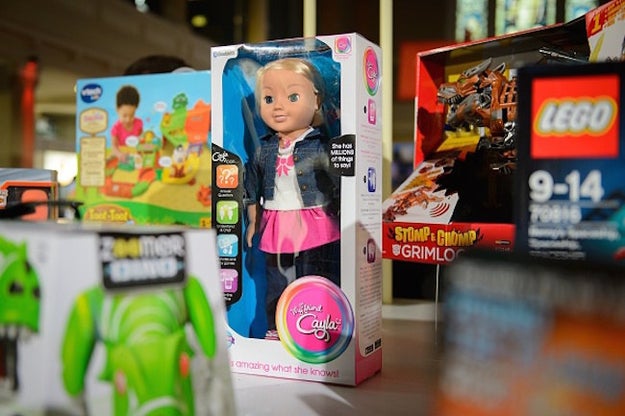
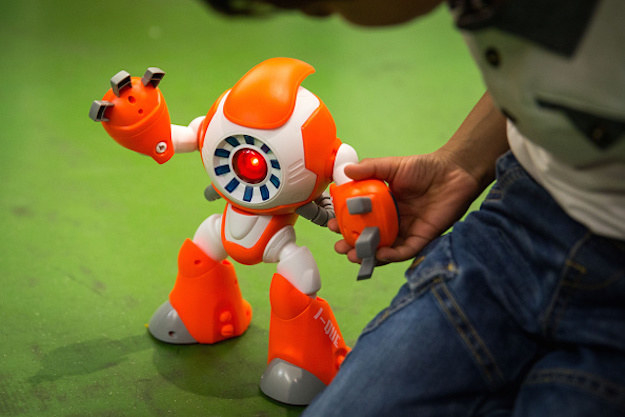
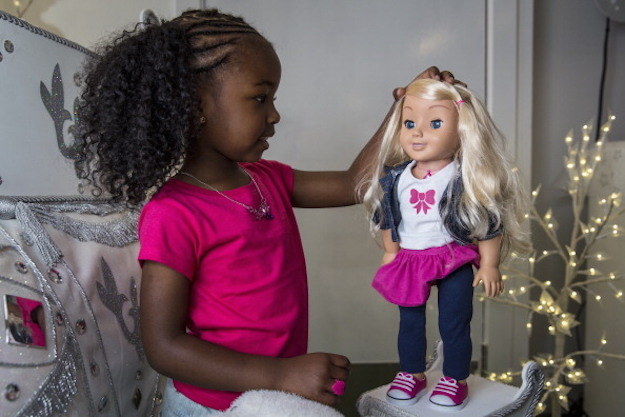
Two brands of talking dolls, My Friend Cayla and I-Que Intelligent Robot, collect personal information from children and send it to a software company that contracts with military and intelligence agencies, according to a complaint filed with the Federal Trade Commission on Tuesday.

The privacy groups that filed the complaint said the maker of the dolls, Genesis Toys, doesn’t get consent from parents before collecting their children’s voice recordings and personal information. That&;s a violation of the Children’s Online Privacy Protection Act, according to the complaint.

“With the growing Internet of Things, American consumers face unprecedented levels of surveillance in their most private spaces, and young children are uniquely vulnerable,” said Claire Gartland, director of EPIC Consumer Privacy Project. “The FTC has an obligation here to step in and safeguard the privacy of young children against toys that spy and companies that exploit their very voices for corporate gain.”

Genesis Toys did not immediately respond to BuzzFeed News&039; request for comment.

“Children form friendships with dolls and toys with &039;personalities,&039; and confide intimate details about their lives with them,” said Josh Golin, executive director of the Campaign for a Commercial Free Childhood, in a statement. “It is critical that the sensitive data collected by these toys be subject to the most stringent protections and not be used for manipulative and sneaky marketing.”

youtube.com

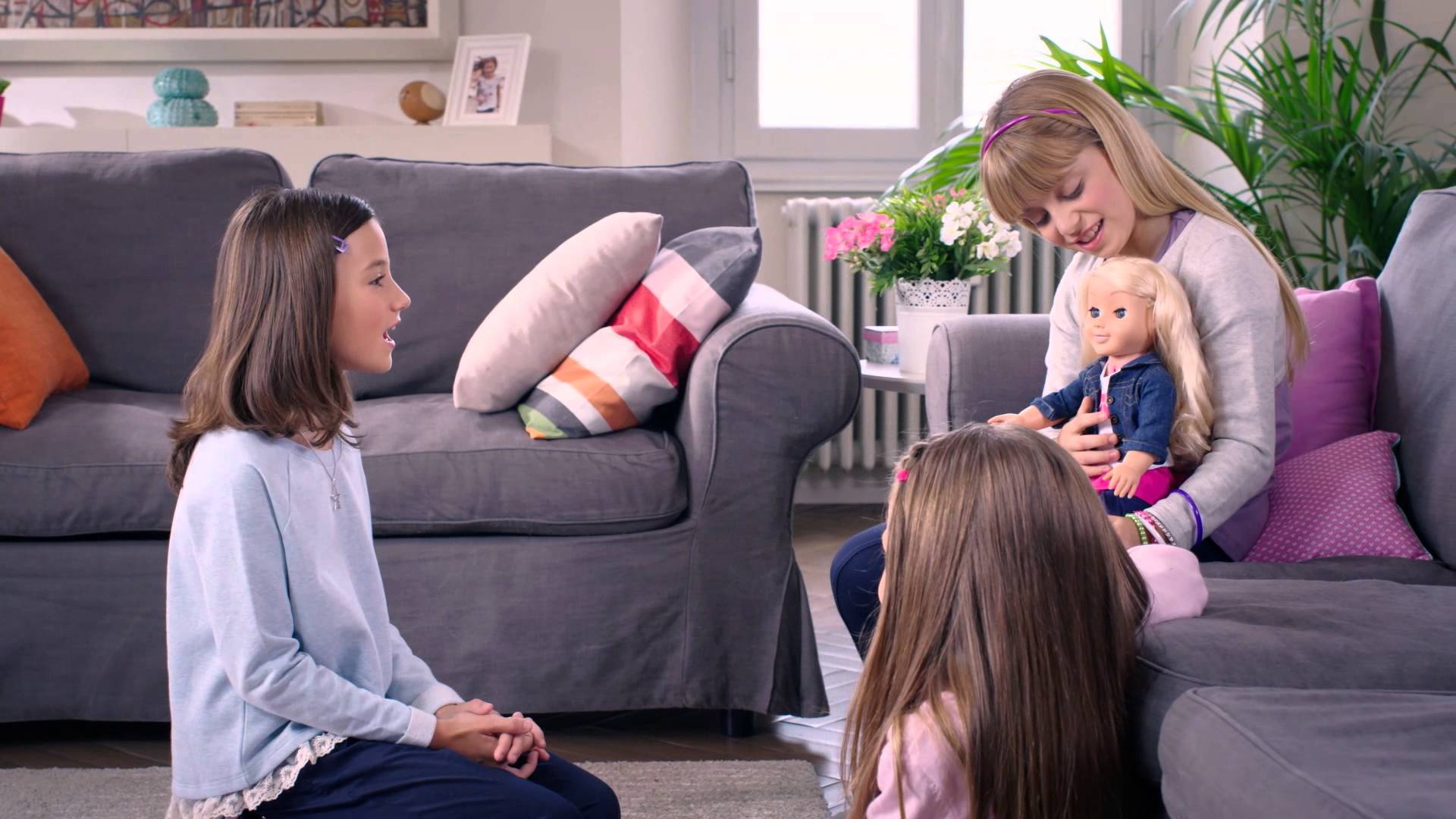
The My Friend Cayla doll, which is sold at Walmart for about $60, uses speech recognition technology, a microphone, and speakers to communicate with a child. The doll pairs with a smartphone and app, and when children speak to the toy, it connects to the app to generate an answer.

But to use the doll, a child must first answer several questions, including their name, their parents&039; names, their school, their hometown, and their physical location.

I-Que Intelligent Robot, sold for $90 on Amazon, also requires a smartphone app connected to the internet in order to function. But it also requests access to the smartphone&039;s camera, which, the complaint alleges, “is not necessary to the toy’s functions and is not explained or justified.”

Getty Images/Rob Stothard

It is difficult to find where the company details the information it collects. Cayla’s privacy policy doesn&039;t mention speech data, nor does it describe the collection, use, or disclosure of such data by third parties. The I-Que privacy policy makes no
reference to such information collection. Genesis also tells consumers that their privacy policy is subject to change and recommends that parents check their website for regular updates.

Once that data is collected, it is stored on a server provided by Nuance Communications, a voice recognition technology company that also contracts with military and intelligence agencies. Cayla&039;s privacy policy indicates that this
information may also be stored on Google&039;s server.

“We have adhered to our policy with respect to the voice data collected through the toys referred to in the complaint,” Nuance said in a statement. “Nuance does not share voice data collected from or on behalf of any of our customers with any of our other customers.”

The company&039;s privacy policy says it “may use the information that we collect for our internal purposes to develop, tune, enhance, and improve our products and services, and for advertising and marketing consistent with this Privacy Policy.”

This isn&039;t the first time the internet-connected dolls have faced backlash. Several European consumer organizations have also filed formal complaints with EU regulators, and with data protection, consumer protection, and product safety agencies, about the toys in France, the Netherlands, Belgium, Ireland, and Norway.

Getty Images/Rob Stothard

Quelle: <a href="These Adorable Dolls Share Kids&039; Information With A Defense Contractor“>BuzzFeed

DNA Biohackers Sold A DIY Kit For Glowing Booze And Here’s What Happened

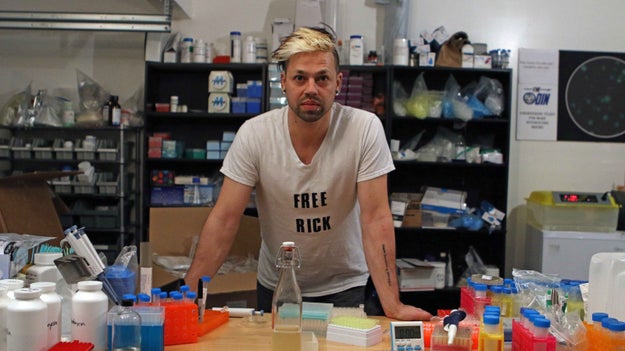
Josiah Zayner, CEO and founder of the Odin.

Allyson Laquian / BuzzFeed News

“Don’t be too impressed,” said Josiah Zayner as he cracked open the fridge. On the top shelf, next to Silk soy milk cartons, was the Bay Area biohacker’s latest creation: a bottle of amber-colored booze.

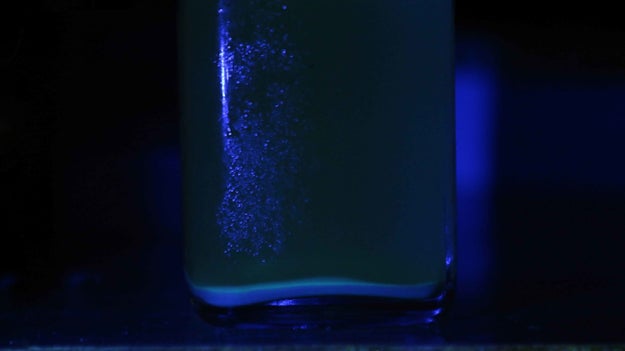
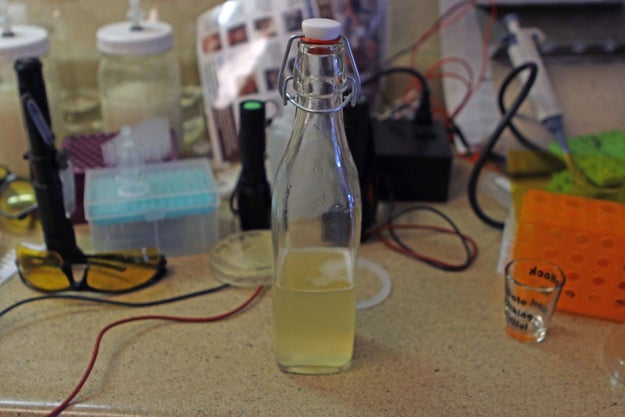
With the kitchen lights turned off, Zayner pointed a blacklight at the alcohol. And a faint green glow sparkled at the bottom of the bottle.

The drink tasted fizzy, faintly intoxicating, and sweet, thanks to the fermented honey that gives mead its alcoholic kick. “I don’t know if you feel like a Viking when you drink mead. I kind of do. Arrrr&;” he said, adding, “You can taste the honey, you can taste the alcohol a little bit.”

Zayner, 35, had made the glowing booze partly with a do-it-yourself DNA kit that his startup, the Odin, has just started selling online. The company conceived it as a gimmick to introduce homebrewers to genetic engineering. But in the short time the kit’s been for sale, it’s also become a test for the citizen scientists to see how far they can push the FDA.

With the kit, customers can genetically engineer yeast to make mead that gleams like a lantern — the ideal refreshment for, presumably, poorly lit house parties. “Imagine a world in which after work you invite your friends over to have them try a custom beer you brewed that glows in the dark using your own genetically designed yeast,” the Odin’s website read early last week.

The FDA also began to imagine this world after the kit started selling last week, unknownst to the agency — and then it started asking whether fluorescent homebrew was safe.

By initially marketing the kit as a food-making device, the startup may have exposed a loophole in laws that haven’t caught up to a generation of biohackers tinkering with the DNA of bacteria, plants, and animals in their kitchens and garages.

“The system wasn’t set up to deal with things like this,” said Todd Kuiken, a senior research scholar at North Carolina State University’s Genetic Engineering and Society Center.

While humans have for centuries used yeast to make wine and beer, and homebrewing has been legal federally since 1978 and in all 50 states since 2013, the Odin’s light-up twist could give regulators a hangover-sized headache.

“I can’t imagine when they wrote the laws for this, [they said,] ‘Well, at some point, somebody’s going to be able to engineer yeast for beer that will make it glow in the dark,’” Kuiken said.

A green glowing line can be seen above the layer of yeast sediment on the bottom of this bottle.

Allyson Laquian / BuzzFeed News

Scientific research is traditionally conducted by scholars with multiple degrees and access to expensive equipment at universities and industry labs. But like its DIY bio brethren, the Odin, short for the Open Discovery Institute, wants to make those tools cheap and easy, so everyone can be scientists. Its five employees, who work out of a garage in a suburb across the bay from San Francisco, are used to operating on the fringe of the scientific establishment.

Zayner, the CEO and founder, is a former NASA research fellow with a biophysics and biochemistry PhD from the University of Chicago. Pushing the legal and physical limits of scientific experimentation is second nature for him: Earlier this year, he performed an unsanctioned fecal transplant on himself, using poop from a friend, to relieve gastrointestinal pain. In late 2015, he crowdfunded kits to alter bacteria with the gene-editing technology CRISPR; the Odin, a business he started in grad school, now sells them.

Zayner and his team dreamed up the newest kit as a way to make genetic engineering accessible and useful. Homebrewing, whose popularity has been skyrocketing, seemed like an activity that people would enjoy doing — more so than editing bacteria DNA — and maybe they’d pick up some biology in the process.

“There’s never been anything like this before, where somebody has a kit where they can engineer something they can do something with,” Zayner told BuzzFeed News. “Someone can genetically engineer something they can consume.”

When Zayner set out to advertise the kit, he believed he was in the clear due to what he saw as a legal distinction: the FDA regulates food products, including some alcohol — but the Odin wasn’t selling a beverage.

It’s selling equipment like a pipette and petri dishes, along with yeast and DNA, and providing instructions on how to genetically manipulate yeast cells so they express green fluorescence, the same genetic trait found in jellyfish. Originally, the Odin also instructed homebrewers to add the engineered yeast to water and honey, which the company didn’t provide. Left alone for one or two weeks, the yeast would convert the honey’s sugars into mead, a process called fermentation. Zayner told BuzzFeed News that the result is about 5% alcohol.

“Someone can genetically engineer something they can consume.”

Last week, I visited Zayner at his Castro Valley townhome for a taste test, knowing that what I was about to down hadn’t been FDA-approved. Zayner, who has bleached hair, nose rings, and ears rimmed with piercings, uncorked the bottle with a pop. Then he filled up a pair of shot glasses that said “Biohack the Shot.”

The liquid wasn’t exactly as bright as a glowstick, but under a blacklight, a slight gleam was visible at the bottom where a layer of yeast sediment had settled. Zayner said the three-week-old brew had been more luminous when it was actively fermenting.

“Cheers,” we said, clinking our glasses.

Earlier in the week, Zayner had said that he didn’t know what the consequences of his scientific and business experiment would be, nor was he afraid of finding out. He hadn’t contacted the FDA before making and putting the kit up for sale, originally for $225 and now $199.

“As far as we know, there’s no regulation on stuff like this,” he said, although he conceded that his team may have missed something while scouring the internet. “We’re kind of a small company, we’re off the radar. Does the government even care, would they even care? Even if they did, what would they do?”

It turned out that the government did care. After BuzzFeed News asked Zayner about the product’s legal status, he contacted the FDA, and learned the agency had been waiting for his call. Agency officials held a conference call with Zayner on Thursday. Zayner taped the call with their permission, and shared the recording with BuzzFeed News.

On the call, the two sides went back and forth. Three FDA staffers told Zayner that the green fluorescence protein was likely a color additive for food, and it hadn’t been recognized as safe to consume; Zayner questioned whether it was really a “color” additive when, he noted, the green glow was only visible under a blacklight. Zayner argued that the kits were being sold in part as an educational tool; the FDA disagreed.

“If we did continue to sell these kits, what would you guys do?” Zayner asked during the call.

Jason Dietz, an FDA policy analyst, told him that the agency could issue a warning letter or, at the extreme end, seize the company’s equipment — “that would be unlikely, I would hope,” he added. “Typically people, when they find they’re doing something unlawful, correct it, because it’s not good for business.”

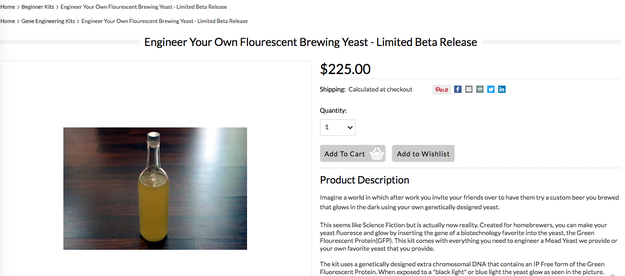
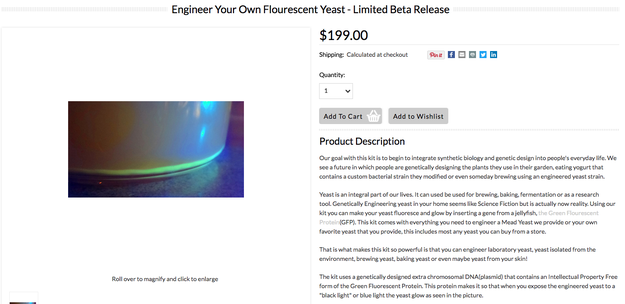
By the next day, the Odin had tweaked its website. It revised its instruction manual to remove all mentions of using the yeast to ferment mead. Gone from the product page, as of Monday morning, was a photo of a full bottle of mead and most of the alcohol references, although the site still said that this type of yeast is meant for mead. It also said, “We see a future in which people are genetically designing the plants they use in their garden, eating yogurt that contains a custom bacterial strain they modified or even someday brewing using an engineered yeast strain.”

A screenshot of the Odin&;s page for its DIY yeast kit on Nov. 30.

BuzzFeed News / Via the-odin.com

A screenshot from Dec. 5.

BuzzFeed News / Via the-odin.com

Although he would go on to make the changes, Zayner, ever the provocateur, felt compelled after the call to point out to BuzzFeed News all the limits he saw to the FDA’s logic. He wondered: How could regulators justify potentially seizing his yeast when yeast, on its own, isn’t a food product? The Odin didn’t want to harm anyone, Zayner said, but why was the FDA worried about one fluorescent protein when studies show that beer yeasts in general have been evolving and mutating on their own for centuries?

FDA spokesperson Megan McSeveney told BuzzFeed News on Friday that the agency “does not have enough information at this time to determine the regulatory status of this product.” She added that food manufacturers are responsible for complying with federal, state, and local laws.

On Monday, Zayner wrote a blog post in which he backed down even more from the language used in the original advertising. Yeast made with the kits, he wrote, had not been FDA-cleared for consumption. “However,” he wrote, “we believe that there might be people who would attempt to use our kits to create alcohol against the FDA’s wishes so we wanted them be knowledgeable about the product.”

He added that the company planned to seek FDA clearance.

Provided that the federal agency approves, Zayner also hopes to make glow-in-the-dark beer the next craft brewing sensation. The Odin has teamed up with Inoculum Ale Works, a sour-beer brewery near Tampa, Florida that wants to make and sell the beer next year, perhaps online and in its future taproom. The brewery says it also plans to make beers genetically engineered to have citrus flavors, for example, or include a nutritional compound called squalene.

Inoculum CEO and co-owner Nick Moench told BuzzFeed News that, having spoken to some FDA staff, he’s confident that he and Zayner will be able to show that the green fluorescence protein is safe to consume. “This isn’t a small undertaking — it’s going to take some resource and perseverance,” he said via Gchat. “Fortunately we’re swimming in perseverance.”

The Odin isn’t the only company that’s genetically altering yeast to make food. Swiss company Evolva has created synthetic vanillin, the vanilla flavor in ice cream and cake, which prompted the environmental activist group Friends of the Earth to condemn it as an “extreme form” of genetic engineering. Other Bay Area biohackers are engineering yeast to make vegan cheese.

They all aim to create foods that are essentially identical to their conventional counterparts. “The idea with those things is you have a new way of producing it, but the product is chemically the same,” said Gregory Kaebnick, a research scholar at the Hastings Center, a bioethics think tank.

Allyson Laquian / BuzzFeed News

Glow-in-the-dark booze, however, would look quite unlike conventional homebrews — and that’s where the startup would potentially clash with the FDA. Before any substances, including color additives, can be added to food for sale, the agency requires them to either be approved by the agency, or be already generally recognized by experts as safe to eat.

Approved substances are listed in a federal database. Green fluorescence proteins are not on that list.

“Obviously, the Odin folks, they’re not interested in making people sick, they’re not deliberately trying to make something dangerous,” Kuiken said. But “from the FDA’s standpoint, that is probably something that they’re going to want to take a look at, because it hasn’t been looked at before.”

If a food item made with the Odin’s kit were to sicken people, Kuiken worries that the emerging biohacking community could suffer. Glowing plants, fecal transplants, and other boundary-testing science projects have similarly sparked debates over what ethical responsibility independent scientists have to police themselves.

“We’ve seen in the past when particularly some biotech companies just ignore the FDA, they can come down on them really hard, to the point where the companies can get shut down,” Kuiken said. “That’s something I think we’re all trying to avoid happening, and we want to encourage this kind of exploration, but it also needs to be done responsibly.”

Zayner, on the other hand, doesn’t think that cautious behavior necessarily benefits the DIY biotech community. Taking risks expands the possibilities of what they can do.

“It’s better to ask forgiveness than permission,” he said, “because they’re always going to say no to everything.”

LINK: Make-Your-Own Heroin Is Almost Here, Scientists Warn

LINK: This Startup Is Designing Yeast To Make Brand-New Scents, Flavors

Quelle: <a href="DNA Biohackers Sold A DIY Kit For Glowing Booze And Here’s What Happened“>BuzzFeed

Japanese Billionaire Celebrates Trump, Who Celebrates Him Back

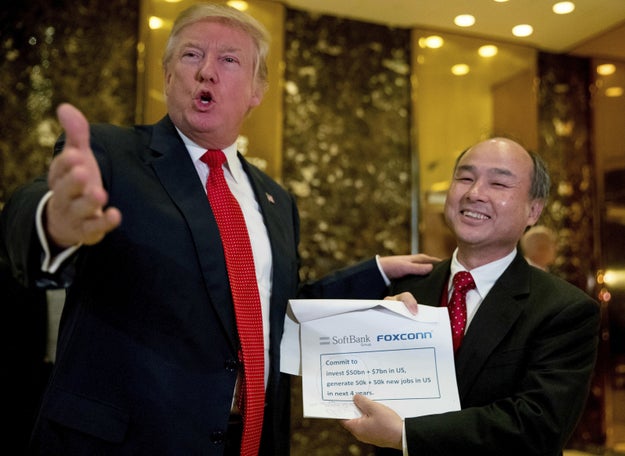
President-elect Donald Trump, accompanied by SoftBank CEO Masayoshi Son, speaks to members of the media at Trump Tower in New York, Tuesday, Dec. 6, 2016. (AP Photo/Andrew Harnik)

Andrew Harnik / AP

The billionaire chief of Japanese technology giant SoftBank visited Donald Trump today, announcing that his companies would invest $50 billion in the United States and create 50,000 new jobs in the coming four years.

“I just came here to celebrate his new job,” Son told reporters camped out at Trump Tower. “He will do a lot of deregulation, I said, &;This is great, the U.S. will become great again.&039;”

“This is Masa of SoftBank from Japan,” Trump told reporters, with the Japanese executive cradled under his arm. “He&039;s one of the great men of industry, so I just want to thank you very much.”

Son told the Wall Street Journal the US investments would come from a $100 billion technology fund he has created in partnership with Saudi Arabia.

SoftBank already has a major presence in the US. It owns Sprint and recently acquired the UK-based chip designer ARM, whose chips are used throughout the mobile industry, including in the iPhone. The company is also an active venture capital investor in Silicon Valley, where it invested $1 billion in online lender SoFi last year (SoftBank is an investor in BuzzFeed).

There&039;s one particular US deal that is likely to be on Son&039;s mind. Since buying Sprint, he has pushed to merge the company with T-Mobile, in a takeover that would create a serious third competitor to AT&T and Verizon. A 2014 attempt to merge Sprint and T-Mobile was called off after federal regulators made it clear they would oppose the deal.

But Donald Trump will soon be appointing a new set of regulators, and Wall Street interpreted the friendly words with Son as a hint that a takeover attempt could be in the cards again. After Trump&039;s tweets, the T-Mobile&039;s stock price shot up by about 3%, bringing its valuation to just under $50 billion.

Google Finance

Quelle: <a href="Japanese Billionaire Celebrates Trump, Who Celebrates Him Back“>BuzzFeed

Snap Inc’s Current Hype Machine Could Hurt It Post-IPO

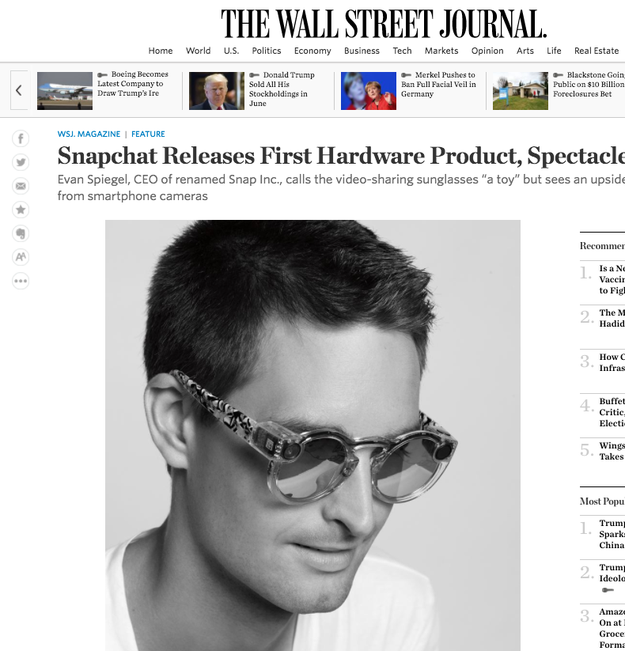
Snap Inc. is in the midst of a pre-IPO marketing push so masterful it will likely be taught in business schools for years to come. The company&;s unofficial roadshow kicked off with a product story in the Wall Street Journal introducing Spectacles, its new sunglass-with-a-camera product. The Spectacles announcement and limited rollout created a massive hype cycle, solidifying a narrative that Snap can do no wrong as it prepares to hit the public markets at an expected $25 billion valuation. But Snap will be valued based off ad sales not Spectacles sales and, with history as a guide, the hype may come back to bite it.

To see the sort of a disaster a much-hyped IPO can lead to for an emerging social company, you need only to look to Twitter’s November 2013 offering. Twitter, at the time, was still on a victory tour of its centrality to the 2012 election, and it did little to temper investor’s exuberant enthusiasm. On the day of Twitter’s IPO, then-Twitter CEO Dick Costolo told CNBC the company was experiencing “consistent, tremendous growth” and wanted to “enable the 2.3 billion connected people in the world to all become users of the platform.”

The consensus that Twitter was bound to continue growing users and revenue helped its stock rise 73% on its first day of trading, leaving it with a market cap of $24.4 billion by the end of the day — almost exactly where Snap is expected to start off. But the pressure to live up those lofty growth expectations became debilitating for Twitter relatively quickly, and it has spent almost the entire time since trying to explain why it has not met them. Three years later, Twitter has a market cap of $13 billion, about half of what it was worth on IPO day. After so much hype, its business never came close to matching Costolo’s predictions.

The parallels between Twitter and Snap are easy to miss if you&039;re enamored of Spectacles, but hard to dismiss once you look at the overall business. Snap, like Twitter, is an emerging social platform with significant cultural relevance but without the user numbers to match, thanks in part to a difficult-to-use product. Snapchat, like Twitter, appeals to a big but ultimately niche audience: Twitter appeals to newshounds, Snap to young people. And perhaps most importantly, Snap is bringing a largely unproven set of ad products to an online advertising game dominated by Google and Facebook; platforms that are so effective, advertisers told BuzzFeed News there’s a fat chance they’ll move large portions of their budgets anywhere else.

“The Twitter comparison is apt,” Kyle Bunch, of the ad agency R/GA, told BuzzFeed News. Bunch, who manages social platforms for the 2,000 person agency, said Twitter is in advertising plans for virtually all of R/GA’s clients, but Facebook and Google’s data and optimization capabilities have made spending money with them almost formulaic; X dollars in ads on those platforms gets you Y dollars in sales. Sure enough, 85 cents of every incremental ad dollar spent online is going to those two companies, according to Morgan Stanley analyst Brian Nowak. “It’s easy for advertisers to become essentially addicted to Facebook and Google and it’s really hard to cut back,” Bunch said.

All Sorts Of Challenges

Conversations with multiple advertisers revealed that Snap has a number of obstacles to overcome before it can be anything more than a fly for Google and Facebook to swat away.

Advertisers do not like the fact that Snap’s Snapchat ads are skippable. Though video ads on Snapchat can run for ten seconds, people actually watch them for an average of less than three, according to an Ad Age report that BuzzFeed News confirmed with multiple advertisers. When advertisers spend money, they are accustomed to force-feeding their messaging down consumers throats. Three seconds on Facebook isn’t even considered a view, and so three seconds on Snapchat is hard to work with.

Snapchat also exists largely as a black hole, where users go in and don&039;t come out via links like they do on Google, Facebook and even Twitter. Snapchat has made improvements to its ad platform in recent months, opening up an API to allow for better measurement, but it’s going to have difficulty attracting advertisers who need their ad spend to translate to web visits.

And then there’s the Facebook issue. Since Facebook cloned Snapchat Stories in Instagram, Snapchat Story views have gone down for brands, one ad pro told BuzzFeed News. Another agency executive said that Instagram Stories makes him doubt Snapchat can sustain its audience growth.

Because of these weaknesses, Snap has been unable to break out of the “experimental” portion of many advertisers’ budgets, according to the agency executive. These budgets, the agency executive said, get portioned out based on a 70/20/10 rule: 70% of advertiser budgets is spent inside platforms that are tried and true, 20% is spent with platforms that are still emerging and 10% in spent in the next/innovation bucket. “I would bet that most still put Snapchat in that 10%,” the agency executive said. “For us, Facebook is in that 70% and Snapchat is nowhere near that.”

Snap’s weaknesses have also made it entirely unappealing to other companies whose bread and butter is online advertising. Groupon, for instance, spends hundreds of millions of dollars a year on advertising but only a “tiny, tiny, tiny” amount of money on Snapchat, according to its CEO, Rich Williams. And Socialflow, a social platform that spends millions boosting content on social platforms, looked into Snapchat as a potential place to spend money, but it’s found no use for the platform so far. “There is a large barrier to entry to advertising on Snapchat,” Jess Bahr, director of paid social at Socialflow, told BuzzFeed News. “Unfortunately, it’s seen as risky and it’s hard to tie back to revenue.”

There’s Hope, But…

Snap will still pull in $935.5 million in revenue next year and $1,760.1 billion in 2018, according to the research firm eMarketer. Those numbers are still short of the more than $2 billion in revenue Twitter made last year, but eMarketer analyst Catherine Boyle said that its core product, Snapchat, is different than Twitter thanks to its high concentration of millennials, an attractive demographic to advertisers. “Snapchat will reach more than half of US millennials in 2016 and those millennials will make up 70% of Snapchat’s US user base in 2016,” Boyle said. “If, in a worse-case scenario, Snapchat does not expand its user base as we expect it will and it remains mostly a millennials platform, advertisers are likely to continue investing.”

Sarah Hofstetter, CEO of the ad agency 360i, said she likes what she’s seen from the company, giving Snap credit for improving its ad development and measurement in a “ridiculously short time.”

Still, asked what marketers talk about when it comes to Snap, Hofstetter said something likely familiar to executives at Twitter, who have been trying to make their product more usable for years. “Most marketers still today ask for a tutorial on it,” she said. “Their kids are on it but they don’t know how to use it.”

In one of business’s great contradictions, it’s possible to screw your company over through great marketing. Snap, ready to go public, may want to closely examine Twitter’s history of doing so or it could end up in the “tough lessons” section of the business textbooks as well.

Quelle: <a href="Snap Inc’s Current Hype Machine Could Hurt It Post-IPO“>BuzzFeed

Supreme Court Sides With Samsung In Patent War With Apple

Jung Yeon-je / AFP / Getty Images

The Supreme Court on Tuesday ruled in favor of Samsung in a years-long patent battle pitting the Korean manufacturer against Apple over the value of design — specifically the design of the iPhone.

In a unanimous decision, the justices voted 8-0 to have the case resettled by a lower court, throwing out a $399 million judgment against Samsung for infringing on three of Apple&;s design patents for the iPhone.

Samsung was successful in convincing the court that it should not have to pay the full amount, which comes from the total profits Samsung banked from eleven of its phone models that mimicked the iPhone&039;s design. Instead, Samsung argued, the company should only pay for the value of the individual parts that it copied, not the entire value of the phone.

The Supreme court agreed, ruling that damages awarded in a design patent case can be based on individual components as well as the entire product. Rather than decide the exact dollar amount Samsung should owe, the justices sent the case back down to the lower court, giving Samsung another chance to argue for a smaller penalty.

Quelle: <a href="Supreme Court Sides With Samsung In Patent War With Apple“>BuzzFeed

Google Wifi Makes Wireless Internet At Home Suck Less

It’s an easy-to-use router replacement that eliminates Wi-Fi dead zones and works right out of the box.

On the list of Things That Are Often Annoying, dealing with Wi-Fi definitely makes the top three. This year, several companies pledged their products would make Wi-Fi faster, more reliable, and easier to set up – and the latest is Alphabet’s Google Wifi, which starts shipping to customers through Amazon, Best Buy, Walmart, and the Google Store today.

Three and a half years ago, an internal team at Google started what was known as “Project Kerouac,” an initiative to improve the at-home Internet experience. The group surveyed hundreds of households to better understand what kinds of frustrations people had with their wireless connections. Google Wifi is their hardware solution.

It’s not Google’s first router. OnHub, aimed at simplicity and created alongside TP-Link and Asus, was launched last year. But Google Wifi is the first networking product designed, marketed, and sold entirely by the Google, without the input of a third-party partner.

I’ve been reviewing Google Wifi in my one-ish bedroom apartment for about a week. The router replacement made my bottom-tier Internet subscription actually bearable – so far, I’ve experienced both better coverage and faster speeds.

Google Wifi isn’t for network tinkerers who are comfortable with highly technical interfaces and prefer granular system controls. But it *is* a great option for those who live in a space with Wi-Fi dead zones or want a low maintenance router that works right out of the box.

BuzzFeed News; Google

What the heck is a mesh network?

What the heck is a mesh network?

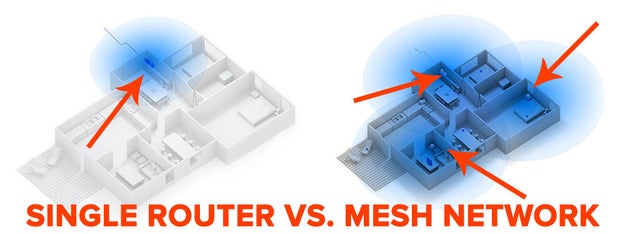
Google Wifi, which is sold as a one-pack ($129) or a three-pack ($299), works best as a group. One device is sufficient for smaller, open spaces between 500 to 1500 square feet, but multiple devices are ideal for larger homes (between 1500 to 4500 sq. ft.) or narrow apartments. When you set up more than one device, Google Wifi creates what’s called a “mesh network,” which, for a lot of people, means better, faster wireless Internet.

Here’s how it works. Most homes have a single router. Physical obstructions, like walls or large furniture, often interfere with the signals a router emits and signal strength also fades over long distances. But in a mesh network, multiple routers placed around your home work as a sort of relay team that bounces Internet from one access point to the next, improving Wi-Fi everywhere, not just the area by the router.

A mesh network allows a strong connection to travel farther than a typical single-router system. If you buy a single Google Wifi, you’ll miss out on the mesh network experience, but you’ll still benefit from the device’s network automation features.

People usually rely on range extenders (such as this one) to bring Wi-Fi access to hard-to-reach areas, but these often halve Internet speeds and, because they create two separate Wi-Fi networks, aren’t effective for moving from one space to the next.

Products like Eero, Luma, and, now, Google Wifi are bringing mesh networking, a technology typically managed by a fleet of IT professionals in large spaces like airports, to normal humans like you and me.

Google / Via blog.google

Google Wifi doesn’t look like a traditional black router, either.

Google Wifi doesn't look like a traditional black router, either.

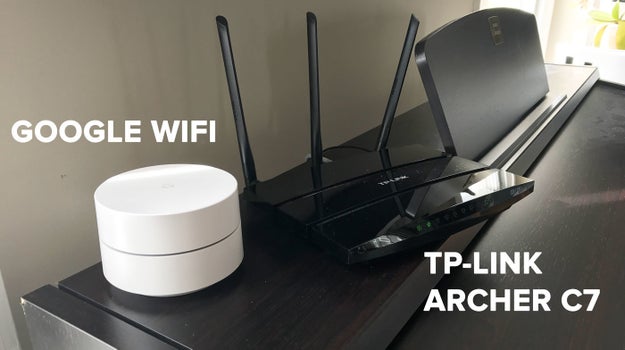
Each Google Wifi device is small enough to fit in your hand. It doesn’t have a row of flashing icons down its side or unsightly antennas poking out the back. Instead, Google Wifi has a sleek, all-white body, save for a glowing TRON-esque light strip down the middle.

Its look and feel is very similar to that of Google Home, the company’s voice-activated smart speaker. While Google Wifi doesn’t work directly with Home, users will be able to use the IFTTT recipes designed for Google’s older OnHub routers*, to connect the two devices.

By giving Google Wifi an elegant design, Google hopes that users will keep them out in the open, which alone can improve Wi-Fi performance.

*Customers with existing OnHub devices will receive an over-the-air update that adds mesh networking technology to their routers, too. But they’ll need at least one Google Wifi device to create a mesh network.

Nicole Nguyen / BuzzFeed News

Google Wi-Fi is so easy to set up.

Google Wi-Fi is so easy to set up.

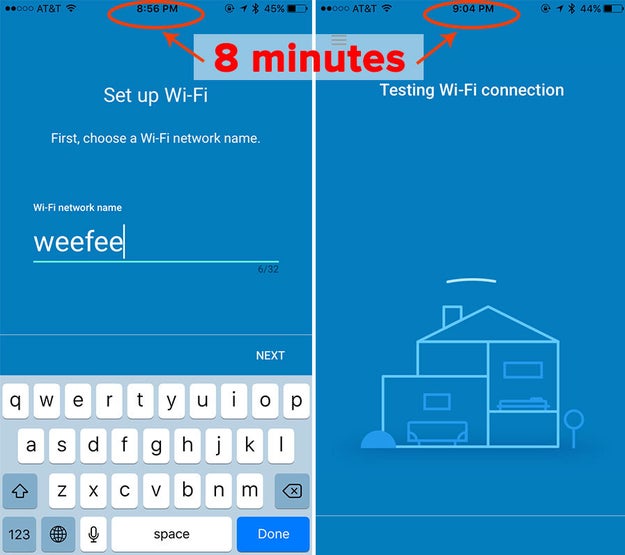
Installing and maintaining Google Wifi is simple. Out of the box there are two cables (one USB-C power cable and one ethernet cable), the router itself, and a power plug. It’s a pretty simple order of operation. The Google Wifi app (available for both iOS and Android) walks you through setup, step by step. Getting two devices up and running took less than 10 minutes, and it was completely painless.

Nicole Nguyen / BuzzFeed News


View Entire List ›

Quelle: <a href="Google Wifi Makes Wireless Internet At Home Suck Less“>BuzzFeed