India's Supreme Court Wants To Know How WhatsApp Users' Privacy Will Be Protected

Dado Ruvic / Reuters

India&;s Supreme Court wants to know what the government, regulators, and Facebook are doing to protect the privacy of WhatsApp users, which shares data with the world&039;s largest social network.

It has given Facebook, the federal government, and India&039;s telecom regulator two weeks to respond to a petition that asks for a privacy policy to be framed for social media networks like Facebook and WhatsApp.

The petition was first filed in September 2016 in the New Delhi High Court by Karmanya Singh Sareen, a 19-year-old engineering student, after WhatsApp — which is used by over 160 million Indians — updated its privacy policy to start sharing user data with Facebook.

The Delhi High Court, in a verdict, ruled that WhatsApp should delete the data of users who deleted their accounts before September 25. WhatsApp was also forbidden from sharing any user data with Facebook that it gathered before September 25.

Sareen, however, appealed this verdict, and brought it to the Supreme Court, India&039;s highest judicial authority.

Despite the Supreme Court&039;s notice, it had some strong words for Sareen.

“You can choose to walk out of WhatsApp if you want to protect your privacy,” the Supreme Court reportedly said. “What is disturbing here is you want to continue using this private service and at the same time [you] want to protect your privacy. You can choose not to avail of [WhatsApp].”

“The Supreme Court clearly isn&039;t satisfied with the High Court&039;s September verdict,” said Raman Jit Singh Chima, a Supreme Court lawyer and volunteer with the Internet Freedom Foundation, a non-profit advocacy organisation for a free and open internet in India. “It wants a clear answer from the government, the telecom regulator, and Facebook, about the steps they are taking to protect users&039; privacy.”

The problem, says Chima, has less to do with WhatsApp and everything to do with the fact that India doesn&039;t have an overarching privacy law for its citizens.

“Whatever data protection that users in India get is what companies like Facebook offer them voluntarily or what privacy laws in other countries force these companies to do,” he said.

Facebook did not respond to a request for a comment from BuzzFeed News.

Quelle: <a href="India&039;s Supreme Court Wants To Know How WhatsApp Users&039; Privacy Will Be Protected“>BuzzFeed

Facebook Is Expanding Its Program To Fight Fake News Into Germany

Sean Gallup / Getty Images

Facing pressure from lawmakers and a pending court hearing over the spread of fake news in Germany, Facebook on Sunday announced an initiative to fight fake news in that country.

The move comes exactly one month since the social network unveiled a new effort in the United States to stem the flow of misinformation on its platform. That involved a new tweak to the News Feed ranking algorithm, easier ways for users to report false content, and new ways to prevent scammers from making money from completely fake news. The biggest move was an unprecedented partnership with third-party fact-checking organizations that alerts users if a link on Facebook contains claims that are disputed by at least two fact checkers.

Facebook said the new fake news reporting feature, measures to disrupt spammers, and third-party fact checking will be rolled out to German users in the coming weeks.

Germany has quickly become a hotspot of concern regarding fake news as it prepares to hold elections later this year.

A new analysis from BuzzFeed News found that Chancellor Angela Merkel is already being targeted with false and misleading content that is performing well on Facebook.

This week, a Syrian refugee in Germany filed for an injunction against the social network because he says Facebook failed to remove content that accuses him of terrorism. A German lawmaker also recently suggested fining the social network 500,000 euro each time it does not remove fake news quickly.

“When we launched this in the US we said that we would expand the pilot into other countries over time,” a Facebook spokesperson told BuzzFeed News. “We’ve listened to our community and begun talks with other global partners, and the readiness of German partners allows us to begin testing in Germany.”

In the German version of its announcement, Facebook said the investigative reporting organization Correctiv is its first German fact checking partner.

The organizations participating in the Facebook fact checking program must be signatories of the International Fact-Checking Network&039;s Code of Principles. No German organization, including Correctiv, has signed on as of now. The IFCN put a hold on accepting new signatories when the initiative with Facebook was first announced in December. But that is about to change, according to Alexios Mantzarlis, the organization&;s director.

“[W]e will be re-opening the code to new signatories next week, following a consultation among top fact checkers about how to vet organizations claiming to be fact-checking,” he told BuzzFeed News. “So we will soon be able to add signatories to the list again.”

Quelle: <a href="Facebook Is Expanding Its Program To Fight Fake News Into Germany“>BuzzFeed

Hyperpartisan Sites And Facebook Pages Are Publishing False Stories And Conspiracy Theories About Angela Merkel

Hyperpartisan Sites And Facebook Pages Are Publishing False Stories And Conspiracy Theories About Angela Merkel

Tobias Schwarz / AFP / Getty Images

German Chancellor Angela Merkel is facing an onslaught of negative and misleading stories from right-wing media outlets and conspiracy theories spread by fringe websites that publish fake news, a BuzzFeed News analysis has found.

Driving the popularity of anti-Merkel content on social media are primarily hyperpartisan and far-right groups that are trying to discredit the German chancellor ahead of this year’s election. These groups, which play a major role in helping propagate negative stories with misleading headlines, are increasingly focused on Merkel’s liberal stance on the refugee crisis. The analysis showed that these stories were among the top-performing content about Merkel on social platforms last year, both in English and German languages.

Echoing what was seen during the US election, many of these sites mix legitimate partisan political content with false and conspiratorial information, especially about refugees and Islam, in order to inspire passion and increase social engagement. Large right-wing pages in the US are also increasingly sharing anti-Merkel content, helping it gain wider distribution on Facebook.

BuzzFeed News analysis also found that many of the most popular Merkel stories on Facebook in German language come from a mix of negative and right-wing news sources like Junge Freiheit — a weekly newspaper that has been endorsed by the co-founder of the far-right party Alternative for Germany (AfD) — and the business-news site Deutsche Wirtschafts Nachrichten, which has been called a drip feed of “fear and distrust” by German news magazine Spiegel.

Among the websites publishing popular fake news in German is Anonymousnews.ru, a site that frequently features both pro-Kremlin propaganda and conspiracy theories, including claims that 9/11 was carried out by the CIA. After Facebook took down the group’s page last May, it started posting mostly on VK, a major social network in Russia, where it has had a page since 2011.

“In Germany we have a crisis of trust towards established media channels,” said Lutz Helm of Hoaxmap, a website tracking fake news in the country. “A growing minority of people don&;t trust media stories anymore and are looking for alternative sources. This gives conspiracy theories and obscure news sites a lot of attention, and it also leads to an increase of hoaxes and conspiracy theories on social networks.”
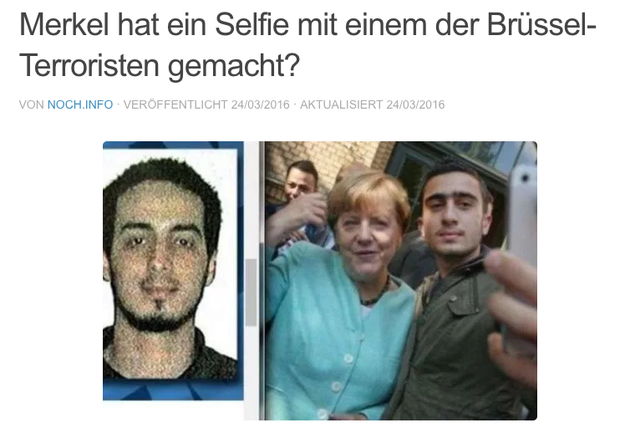
A fake news story alleging that the chancellor took a selfie with one of the Brussels terrorists published by the German website noch.info.

NOCH

Websites responsible for publishing conspiracy theories, dubious content, and fake news produce some of the top-performing content in both English and German. Among the most shared English-language links, there are stories published by yesimright.com, shoebat.com, endingthefed.com, truthfeed.com, and yournewswire.com. Most of these websites would appear to have been registered in the past two years, and several like Ending the Fed quickly became popular by posting pro–Donald Trump and far-right content. It also published fake news stories claiming that Megyn Kelly was fired by Fox News, and that the Pope endorsed Donald Trump.

A post on Your Newswire, which falsely claims Merkel took a selfie with one of the Brussels terrorists, generated more than 32,000 shares, reactions, and comments on Facebook.

By comparison, the real story of the chancellor’s selfie with a refugee published in English by German broadcaster Deutsche Welle received fewer than 13,000 engagements. (Facebook engagement does not necessarily translate into traffic to a website, but higher engagement means the link’s headline and image was likely exposed to more people on Facebook.)

Your Newswire also helped to spread an early version the bizarre conspiracy theory known as “Pizzagate,” which ended with a man entering a pizza restaurant in Washington, DC, with a shotgun to “self-investigate” the ludicrous story that the restaurant secretly provided underage prostitutes to top Democrats.

The top-performing German-language content about Merkel includes sites like blog.halle-leaks.de, rapefugees.net, info.kopp-verlag.de, anonymousnews.ru, and noch.info.

Noch.info was one of the first sites in Germany to spread the false claim about Merkel’s selfie with a terrorist. Just last week, citing “Russian intelligence sources,” it reported that President Barack Obama was secretly meeting Trump’s son-in-law Jared Kushner in Hawaii. Kopp Verlag, in addition to publishing books about aliens and UFOs, has falsely reported that the government is putting refugees being welcomed in Germany on social benefits for life. In 2014, it posted an article that asked “Is Michelle Obama a trans?” claiming that the first lady is in reality a man called Michael.

Some of the more outlandish fake stories unearthed by BuzzFeed News, and shared by the same far-right accounts that post anti-Merkel content, are from the website Anonymousnews.ru. Alongside numerous examples of pro-Kremlin propaganda, recent headlines on the site include fabricated stories about refugees in Germany using free Wi-Fi to search for animal porn and German NATO officers arrested in Aleppo for colluding with ISIS (16,000 Facebook engagements). One misleading article published by the site about German army generals defying Merkel generated 25,000 engagement. The conspiratorial story about NATO officers arrested in Syria was also covered by the German-language version of the Kremlin propaganda channel RT.

But no other publications have been more relentless in pursuing anti-Merkel rhetoric than British tabloids like the Express, MailOnline — the most popular English-language newspaper website in the world — and, more recently, more fringe conservative news websites like Breitbart, which is already planning to launch a German version.

Top-Performing Angela Merkel Stories on Facebook in 2016
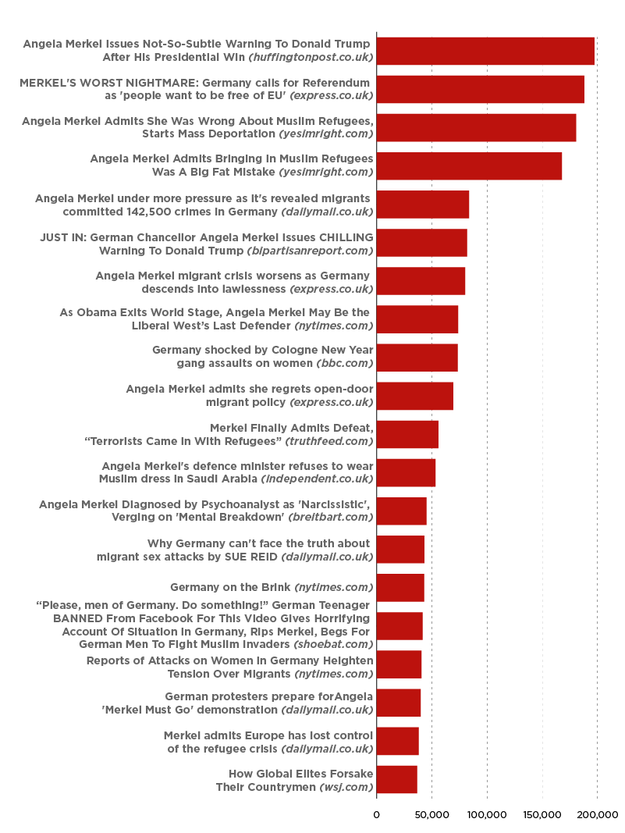
Top-Performing Angela Merkel Stories on Facebook in 2016

Facebook engagement is defined as Facebook shares, comments, and reactions.

Lam Thuy Vo / BuzzSumo

Across all English-language content, British right-wing tabloids the Daily Express and Daily Mail published 16 of the 50 top-performing news stories about Merkel on Facebook, according to the analysis. Content on MailOnline, which has 7.5 million followers on its Facebook page, and the Express, with a million followers, gain significant traction on Facebook because of promotion from US-based conservative, alt-right, and conspiracy news sites, and their social media accounts.

The CrowdTangle browser plugin, which analyzes a link and lists its top sharers on Facebook and Twitter, showed that US Facebook pages and groups such as Conservative Country (700,000 followers), The Deplorables (450,000 members), and Freedom Daily (1.6 million followers) shared anti-Merkel content from British tabloids. (A previous BuzzFeed News analysis of content published by Freedom Daily found that it published false or misleading content 46% of the time.)

One of the top-performing stories in the Express carried an inaccurate headline that said “MERKEL&039;S WORST NIGHTMARE: Germany calls for Referendum as ‘people want to be free of EU’” (which generated over 185,000 shares, reactions, and comments and on Facebook and over 5,000 shares on Twitter). In reality, the idea of holding a referendum on EU membership in Germany is harbored only on the fringes of the political mainstream. Polling shows that some 80% of Germans support EU membership while 70% think a UK-style Brexit referendum in Germany would be a bad idea.

Another top-performing story about Merkel in 2016 was a misleading piece titled “Angela Merkel under more pressure over refugee policy as it is revealed migrants committed 142,500 crimes in Germany during the first six months of 2016.” The Mail story, which grossly mischaracterized crime data, was cross-posted to the Express and the website of New York–based Gatestone Institute, which has been accused of fanning anti-Muslim hate. The Mail&039;s version generated more than 80,000 engagements on Facebook and was shared more than 4,000 times on Twitter.

Several of the stories featured in the Express and the Mail were very similar to ones that appeared earlier in right-wing German publications. For example, the piece “German asylum seekers refuse to work insisting ‘We are Merkel&039;s GUESTS’” published by the Express, appeared days earlier on the right-wing website Junge Freiheit. The German story generated close to 40,000 engagements on Facebook and was among the 50 best-performing pieces about Merkel in German media last year.

The same headlines also gained traction on Facebook thanks to a string of UK accounts, including several associated with Nigel Farage’s UKIP, the far-right political party Britain First (1.5 million followers), and anti-EU groups such as Get Britain Out (170,000 likes).

In the English language, the anti-EU British tabloids dominate coverage of Germany and the EU, according to Wolfgang Blau, chief digital officer for Condé Nast International and the former editor of Zeit.de.

“Since the Brexit vote last June, this global reliance on UK media for following EU affairs poses an even bigger vulnerability for the EU than it already has in the past,” Blau told BuzzFeed News. “The world gets its news about Europe from one of the EU&039;s fiercest opponents, often without even knowing so: the UK media.”

Not all the top stories about Merkel are negative. Among the most popular pieces there are articles by the New York Times and The Guardian lauding the German chancellor&039;s liberal values. However, in both cases engagement is primarily driven by the publishers&039; own Facebook pages. While one of the most popular pieces in German, an article by Süddeutsche Zeitung that suggests Merkel deserves the Nobel Peace Prize, was mostly shared on Google Plus.

Those critical of Merkel’s approach to refugees are also increasingly vocal on Twitter. After the recent attack on a Berlin Christmas market, pro-Trump Twitter accounts began pumping out anti-Merkel memes and content.

“There’s a lot of evidence that there are now targeted attempts to massively attack Merkel, including with bots,” Simon Hegelich, a political scientist at Munich’s Technical University, told Bloomberg. As BuzzFeed News reported last month, a number of pro-Trump troll accounts have shifted their attention to Merkel, filling social platforms with anti-Merkel messages and links to stories critical of her government’s refugee policy.

One of last year’s most viral stories in Germany involved a misleading claim — it was later debunked — that the public television station ZDF receives direct instructions from Merkel on what to report. Nearly all of the other viral stories were about refugees.

An analysis of the Junge Freiheit piece about the people who came to Germany seeking asylum from war-torn countries and who refused to work found that it generated additional engagement from Facebook accounts associated with the AfD, the far-right National Democratic Party of Germany (NPD), and the Austrian far-right Freedom Party (FPO), as well as others linked to the anti-Muslim movement Pegida.
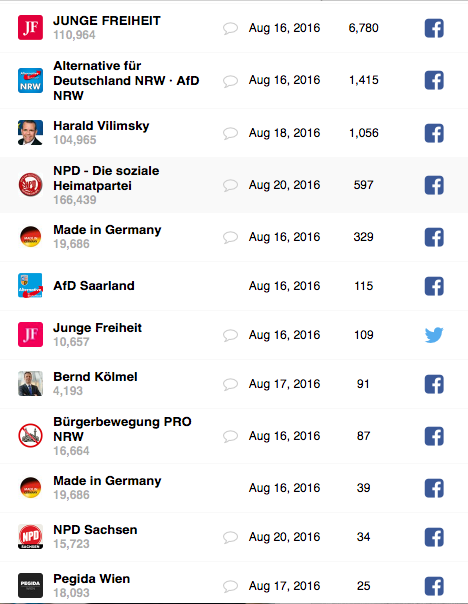
The influential Facebook pages and Twitter accounts that shared the story, and the total number of engagements generated as a result.

CrowdTangle

It’s often the same Twitter accounts that repeatedly share the top-performing German content. A number of these accounts retweet obsessively, suggesting they exist mostly to help spread this type of content. The AfD has said it will use automated accounts that help further amplify messages on Twitter — one analysis suggests the party is already adopting bots — in the upcoming election.

Facebook / Via Facebook: gegen-die-alternative-f

Many of the German links that generated most engagement in 2016 spread conspiratorial claims about Merkel’s mental health. A YouTube video titled “Angela Merkel is insane, Canadian TV provides the evidence” has been viewed more than a million times, and has generated more than 82,000 engagements on Facebook. The video, produced by Canadian right-wing publisher Rebel Media, shows conservative commentator Ezra Levant dissecting a video in which Merkel answers questions at a public event. Although he is highly critical of Merkel, he does not label her “insane” — the German version simply added that.

Top Merkel Content on Facebook in 2016 in German*
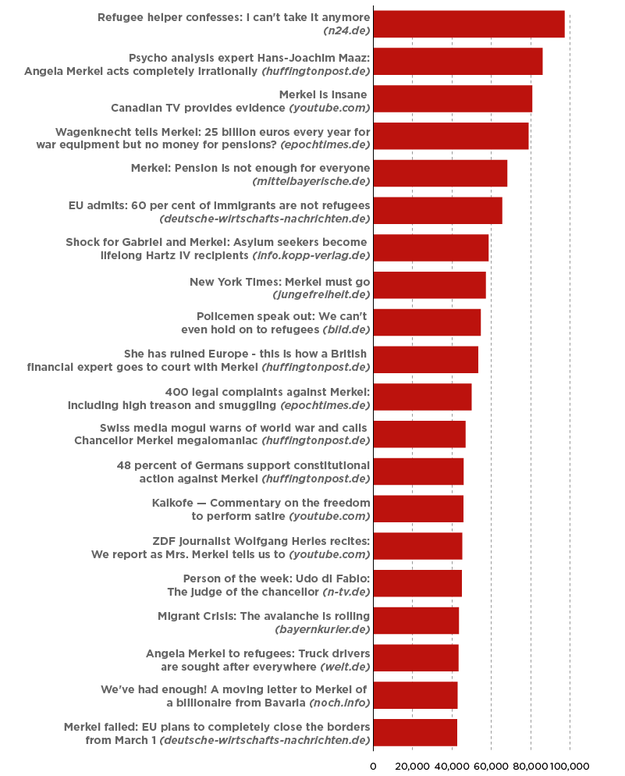
Top Merkel Content on Facebook in 2016 in German*

*Headlines have been translated from German.

Lam Thuy Vo / BuzzSumo

Quelle: <a href="Hyperpartisan Sites And Facebook Pages Are Publishing False Stories And Conspiracy Theories About Angela Merkel“>BuzzFeed
Those 100,000 New Amazon Jobs Might Not Be Good For Everyone

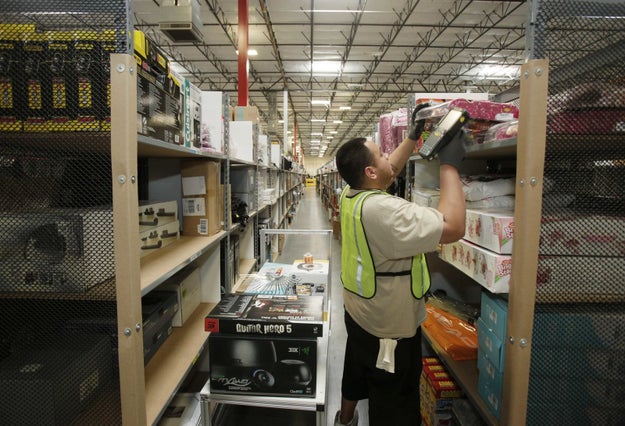
Shipment picker Marcus Marintez of Phoenix pulls items for shipment inside the 800,000 sq. ft. Amazon.com warehouse in Goodyear, Ariz.

Ross Franklin / AP

President elect Donald Trump was quick to take part of the credit for Amazon’s announcement this week that it will create 100,000 new jobs in the US in the next 18 months.

Amazon has not confirmed whether the job creation is the result of a conversation with Trump, who last spring falsely called the e-commerce giant a “huge antitrust problem.” He also accused CEO Jeff Bezos of manipulating coverage by the Washington Post, which he owns, to his advantage. Bezos was among the tech titans who met with Trump last month.

100,000 new jobs would be a coup for Trump, who has spent the weeks leading up to his inauguration talking about efforts by companies like Carrier and Sprint to keep manufacturing jobs in the US. For a figural comparison, Japanese billionaire Masayoshi Son told the incoming president that he planned to invest $50 billion in the US economy, a massive sum that he says will result in just 50,000 new jobs. But while Amazon’s planned growth is impressive, whether those jobs end up being good for the economy is debatable.

“Many of these jobs will be low-paid, short-term, and have high turnover. Some will be temporary positions,” said Stacy Mitchell, co-director of the Institute for Local Self-Reliance, a research and advocacy group focused on stimulating local economies. “Those are not the kind of jobs we need in order to address the economic challenges that so many Americans are facing.” (In its press release, Amazon said all 100,000 new positions will be “full-time, full-benefit” jobs.”)

Earlier this year, Mitchell — who literally wrote the book on the negative impacts big box stores have on communities — co-authored a report on Amazon about the kinds of jobs it creates and the kinds of jobs it destroys. As the New York Times reported Friday, for every position Amazon fills, a greater number of traditional retail jobs are eliminated, undercutting the company’s job creation claims.

But even if the warehouse and delivery jobs Amazon generates are replacing retail jobs at brick-and-mortar shops and department stores, the quality of the jobs isn’t necessarily the same. And what Mitchell has to say about the working conditions for many Amazon workers does not sound good. (Mitchell’s insights on working conditions at Amazon comes from original interviews with warehouse workers and labor organizers, as well as extensive previous reportage from news outlets including Mother Jones, The Seattle Times, and The Morning Call.)

“Amazon’s warehouses are very finely tuned machines and the company organizes the human labor to be parts of the machine,” Mitchell said. “So the tasks are highly repetitive, and they are physically demanding. In warehouses that haven’t been automated yet, it involves running across warehouses that are multiple football fields in size to pick items.”

The report also describes the experience of employees who had to kneel on the ground hundreds of times a day, and a job posting that says employees must be able to lift up to 49 pounds in temperatures of up to 90 degrees. But Mitchell said, in researching Amazon, what struck her most was the psychological stress to which even Amazon’s lowest paid workers were exposed.

“Amazon consistently sets the performance goals above what people can actually achieve,” Mitchell said. “You’re always racing and running and falling behind and, among other things, not only does it make you do more, but it makes you demoralized, and less likely to speak up or join with your fellow workers in speaking up about working conditions.”

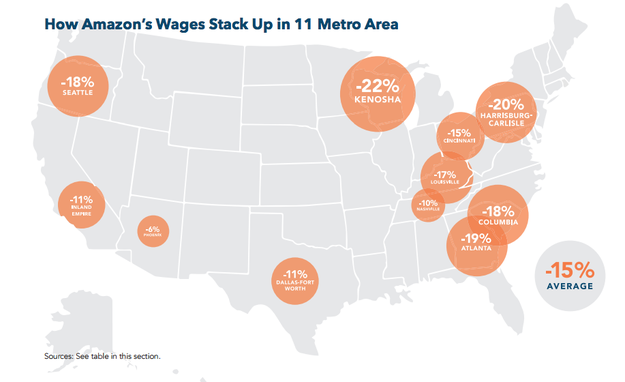
On top of all that, Mitchell’s report also found that Amazon paid its warehouse workers less to do these unpleasant jobs than comparable employers paid theirs. Comparing Amazon hourly wages found on Glassdoor to Bureau of Labor Statistics data, Mitchell found that, in 11 markets where Amazon is currently active, Amazon wages were on average 15% lower than the prevailing wage for warehouse workers; in Atlanta it was 19% less, while in Phoenix it was 6% less.

Wages submitted to Glassdoor are anonymous and therefore difficult to fact-check, but Mitchell said the data, which she only pulled from markets with a significant volume of submissions, was corroborated by job postings and staffing agency listings.

In a statement, an Amazon spokesperson said that its fulfillment center employees earn 30 percent more than retail workers typically do and that the company is “proud of the work environment and the culture we have at Amazon.”

Amazon prefers to compare the wages it pays fulfillment center employees to prevailing wages in the retail industry. Retail work, because it’s less physically demanding, is typically lower paid than warehouse work.

Institute for Local Self-Reliance / Via ilsr.org

While more jobs are generally good news, for low-skill workers, Mitchell thinks the fact that Amazon pays comparatively low wages despite its dominance of the online retail market is definitely a cause for concern, especially in communities where a decline in manufacturing has led to high unemployment.

“There’s a lot of economic research that suggests the biggest problem facing the US economy is not so much lack of jobs, but that the jobs we do have pay too little,” she said. “This is more of the same.”

In Amazon’s press release announcing the new jobs, the company details the unusually generous benefits it offers entry-level workers, including subsidized job training, retirement savings and stock options, and a generous 20-week parental leave program for all parents. Though the company’s release focuses on fulfillment centers, some of the new positions Amazon creates in the next 18 months will be white-collar jobs in fields like AI and cloud services.

Quelle: <a href="Those 100,000 New Amazon Jobs Might Not Be Good For Everyone“>BuzzFeed

Boosted's Latest Electric Board Is Recalled For Smoking Battery

Boosted's Latest Electric Board Is Recalled For Smoking Battery

Boosted

Federal product safety commissioners on Thursday issued a recall notice for the second generation of Boosted Boards, electric longboards popular with the tech crowd.

“Consumers should immediately stop using the recalled skateboards and contact Boosted for a free replacement battery pack,” the Consumer Product Safety Commission (CPSC) warned.

Roughly 3,300 of the Dual+ boards, which retail for $1,500, are subject to the recall. The recall is voluntary, but both the CPSC and Boosted recommend that all Dual+ owners return their batteries.

Boosted said in a statement on its website that it investigated the batteries after two claims that they smoked while in operation and found the issue was a result of water entering the battery pack. No injuries were reported.

The company posted instructions to return the battery for a replacement on its website: remove the battery, record the serial number, recycle the battery, retain a receipt for doing so, and fill out a form. Removing the battery pack requires a hex wrench, which Boosted will mail to consumers if need be.

The boards received glowing reviews from various tech publications and bloggers. Josh Constine, an editor at TechCrunch, is a particular personal fan. He did not immediately respond to request for comment.

And reviews of the boards frequently accrue millions of views on YouTube.

youtube.com

Boosted Boards are the latest victim in a long line of problems with lithium ion batteries, which have accrued no small amount of negative press in the past two years. Hoverboards, e-cigarettes, and the Samsung Galaxy Note7 smartphone all have all fallen prey to the explosive issues the batteries may cause. Airlines have banned devices that use them from flights.

Boosted and the CPSC did not immediately respond to requests for comment.

Boosted is based in Mountain View, CA, and the boards are manufactured in China.

Quelle: <a href="Boosted&039;s Latest Electric Board Is Recalled For Smoking Battery“>BuzzFeed

Trump's Potential FDA Pick Attended McAfee For President Fundraiser

Judd Weiss / Via facebook.com

Before he became one of President-elect Donald Trump’s potential picks for Food and Drug Administration commissioner, Jim O&;Neill, an associate of Silicon Valley venture capitalist Peter Thiel, showed up one night last year to support another presidential hopeful. It was John McAfee, aspiring Libertarian candidate, cybersecurity tycoon, and person of interest in a murder case.

On May 17, 2016, the day after a Libertarian presidential debate in Las Vegas, McAfee and his running mate, photographer and entrepreneur Judd Weiss, were in San Francisco for a fundraising party. The bash was at the home of two founders of Velorum Capital, a venture capital firm, one of them a former SpaceX engineer. Tickets were going for $40 to $90 a head; San Francisco magazine reported that dozens were in attendance.

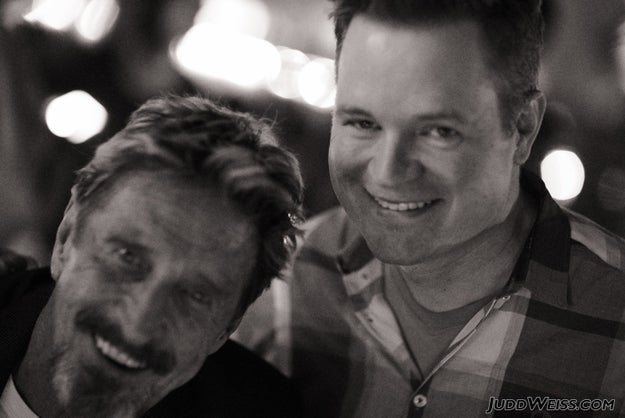
Among them was O&039;Neill, who posed with McAfee in a picture snapped by Weiss and posted on Facebook.

O&039;Neill is managing director at Mithril Capital Management, a growth-stage fund launched by Thiel in 2012. He is one of a few names being floated for FDA commissioner in the Trump administration; on Thursday, he met Trump in Trump Tower.

O&039;Neill&039;s libertarian leanings aren&039;t secret: he&039;s publicly argued for free markets in health care services and goods.

McAfee, however, is not a run-of-the-mill politician, even by libertarian standards. He was the founder of McAfee Associates, which sold the antivirus software of the same name. (He left the company in 1994 prior to its sale to Intel.) McAfee then spent years in Belize, where he was funding a lab to turn plants into an unproven form of antibiotics. There, he came under investigation when a neighbor of his was murdered (McAfee has repeatedly said he was not responsible), and fled to Guatemala, where he was later arrested and deported to the United States.

“You&039;ll want to make sure you&039;re here for this. This will be more of a high level tech/futurist crowd,” Weiss wrote on the Eventbrite page for the May 2016 gathering. “Perfect company for a legendary high level Tech CEO like John McAfee. Especially since these are the people who consciously regularly think about how to re-imagine a better way to move the world forward, and they actually do it&;”

BuzzFeed News has reached out to McAfee and O&039;Neill for comment.

Quelle: <a href="Trump&039;s Potential FDA Pick Attended McAfee For President Fundraiser“>BuzzFeed

Apple Might Soon Start Producing Original TV Shows Like Netflix

Apple may soon start releasing original TV shows and movies to subscribers of its Apple Music streaming service, the Wall Street Journal reports.

Apple has been in talks with producers, directors, and film and TV marketers in recent months about buying the rights to various shows and promoting them, according to the Journal, and the company is aiming to release the original programming by the end of 2017.

Apple has had a few other small forays into TV. It produced a few short documentaries about musical artists and recently bought the rights to James Corden&;s “Carpool Karaoke,” a segment on his late night show. The company is also producing a semi-autobiographical scripted show, “Vital Signs,” about Dr. Dre, an executive at the company and the creator of the Apple-owned Beats headphones. Apple has yet to buy scripted programming from outside producers, though, and the content it&039;s currently considering will not be directly tied to music, the Journal reports.

Apple Music won&039;t become the next Netflix or Amazon Video any time soon, however. Without a plan for an entire slate of programming costing hundreds of millions of dollars, it is unlikely that Apple will be a direct competitor to either. Still, the move signals that Apple is heading towards being a media company as well as a technology company. Whether the company will distribute the original programming via Apple TV remains unclear. Beats Radio creates original content in addition to working as a distribution and discovery engine for Apple Music: It employs DJs who host talk shows as well as curate playlists.

The pivot to original programming comes as sales of Apple&039;s flagship products are slowing. The iPhone 6S, launched in September 2015, met with lower demand than expected. And competition in the smartphone market is rising after Google debuted the Pixel, its first designed-from-scratch phone, and as Chinese smartphone companies like Huawei and Xiaomi race catch up to their American rivals. Apple reported a 33% decline in Chinese sales in July 2016.

Apple Music, too, has some catching up to do. Its biggest rival, Spotify, holds a huge lead in paid subscribers. The Swedish company boasted 40 million paid subscribers in September 2016. Apple Music&039;s paid subscribers doubled in 2016, but that still only put the service at 20 million subscribers.

An Apple spokesperson declined to comment.

Quelle: <a href="Apple Might Soon Start Producing Original TV Shows Like Netflix“>BuzzFeed

This "My Little Pony" Figurine In A Jar Will Delete Your Faith In Humanity

The final chapter in a jar of bodily fluids that&;s been developing since 2014. WARNING: extremely vile gross stuff below.

When BuzzFeed covered this back in 2014, we wrote:

The original poster claims that for some ungodly reason he was collecting his ejaculations in a jar that contained a figurine of the Rainbow Dash from My Little Pony. The name for this little endeavor? “The Pony Cum Jar Project.” He unfortunately stored his “cum jar” too close to a radiator, accidentally boiling his My Little Pony figurine in his own seminal fluid.

Warning: this is extremely gross. It’s a Rainbow Dash figurine in a jar of very gross looking liquid.

Warning: this is extremely gross. It's a Rainbow Dash figurine in a jar of very gross looking liquid.

In the 4chan original post, he claimed that the smell was too bad, and he was giving it up. He also said he planned on burying the jar (as one does).

But the jar prevailed. And this week, our hero returned triumphantly to the /mlp board to post what he says may be the final update to the saga: he is transferring it to a more secure jar.

He posted a video of the transfer, from one jar that looks like a Yankee candle jar (???) to another, more secure jar. Wait for the exciting moment when Rainbow Dash finally appears&;

BuzzFeed reached the jizzmaster by email and asked him… why?

“Sheer curiosity and scientific research,” he replied. Sounds good.


View Entire List ›

Quelle: <a href="This "My Little Pony" Figurine In A Jar Will Delete Your Faith In Humanity“>BuzzFeed

How Encrypted Chat Apps Like Signal Risk Ratting Out Whistleblowers

Following the election of Donald Trump, many concerned about the future of surveillance have signed up for secure messaging systems, like Signal, which saw a 400% increase in daily downloads in the weeks following election day. Yet that app can also provide a false sense of security by revealing who uses it, based on their phone numbers. And as President-elect Donald Trump’s own pick for CIA Director, Rep. Mike Pompeo, told Congress, the use of encryption in personal communications can be a factor used against American suspects.

When you sign up for Signal, it plugs into your address book. That lets you see who else in your contacts list uses Signal, and lets others see that you have joined Signal as well (even firing a notification to others about new users). In recent weeks, Signal users have seen their contact lists swell. But as some have pointed out, these user lists, which cannot be opted out of, undermine attempts to communicate securely. Simply put: if you know someone’s number, you can tell whether or not that person is on Signal.

For example, employers, law enforcement, and other government agencies could create and upload address books of suspected leakers to check for matches. This means if a whistleblower signs up for Signal to communicate with a reporter, that whistleblower becomes much easier to identify. The app even calls out new users; when someone in your address book signs up, the app sends a notification encouraging you to greet them. And while you can opt out of receiving these notifications, you can’t opt out of having them sent about you. Worse; nor can users opt out of letting others see whether any given phone number is associated with a Signal account.

“There is definitely some form of privacy leak here.”

“There is definitely some form of privacy leak here,” Matthew Green, a professor at Johns Hopkins University who focuses on applied cryptography, told BuzzFeed News. “If I join Signal with my real number, anyone else who knows my number can see if I&;m on Signal. It is definitely something to be cognizant of if you are concerned about people knowing you use the software.”

Moxie Marlinspike, the founder of Open Whisper Systems, the nonprofit behind Signal, told BuzzFeed News, “Using Signal is not supposed to be a secret. We’re trying to develop a messenger that’s for everybody. That is something that people can use for all their messaging, everyday, and in every context. It’s not designed just for super-secret spycraft.” For people with concerns about being tied to their phone number, Marlinspike suggested using a throwaway Google Voice or VoIP number to sign up for Signal.

While the app is marketed as a tool secure enough even for secretive figures like Edward Snowden, users may not realize they need to take that extra, cumbersome step of setting up a secondary phone number to enhance their privacy. This could leave them vulnerable to detection.

To its credit, Signal only stores contact lists locally. Signal doesn’t save users’ contact lists on its servers. And when the government subpoenaed Open Whisper for information associated with two phone numbers last year, it turned over just the date a user signed up, and the last time their account connected to the service. That’s the only data Open Whisper had kept. However, even that would still be enough to verify that someone signed up before a leak took place.

“Privacy concerns include what information other people keep about us, just as much as what information vendors and providers keep about us.”

“Privacy is not about austerity,” Marlinspike said, making the case that an app that connects people to their existing contacts is part of what makes Signal a robust and dependable tool. “We’re not trying to build something where you live in a vault.”

“Privacy concerns include what information other people keep about us, just as much as what information vendors and providers keep about us,” Wendy Nather, the principal security strategist for Duo Security, told BuzzFeed News.

While Marlinspike did acknowledge that there are “legitimate use cases where people don’t want to publicize their phone number,” he believes that Signal’s encrypted messaging system, based around a user’s phone book, is both “privacy-preserving” and places people in control of their own social network. Marlinspike told BuzzFeed News that allowing people to opt out of showing up in others’ contact lists would create an “unworkable” product that requires users to rebuild their network from scratch anytime they get new phones.

Yet Wickr, another secure messaging app, which claims to have 5 million users, does not require people to enter their phone numbers when they sign up. Chris Howell, Wickr’s cofounder and CTO, told BuzzFeed News that about half its customers join using only a unique handle, while the other half sign up using their phone numbers and email address. A user’s contacts are stored on Wickr’s servers, but the company encodes the information in such a way that the service doesn’t know who a person’s contacts are, even when people choose to sync their phonebook. Like Signal, Wickr also has an in-app notification for customers who turn on phone book matching when people in their contacts join the service.

Contact list matching does come with a positive tradeoff, Howell explained. It’s easy and quick to connect. And a messaging app that doesn’t sync with phone books could limit its ability to attract and keep users, he said.

One way around the “red flag” of encryption use is for encrypted messaging apps to eventually become so mainstream that most people rely on them.

“Hopefully we get to a day where it’s as ubiquitous as SSL, [like] having a lock on your website when you hit a browser,” Howell said. “That’s not a cause for alarm.”

Quelle: <a href="How Encrypted Chat Apps Like Signal Risk Ratting Out Whistleblowers“>BuzzFeed

This Is What Trump's CIA Pick Thinks About Encrypted Messaging Apps

Joe Raedle / Getty Images

The use of encrypted messaging apps like WhatsApp and Signal should not serve as a basis for surveillance of Americans, according to Rep. Mike Pompeo, President elect Donald Trump&;s nominee to lead the CIA.

In a questionnaire submitted by Sens. Ron Wyden and Martin Heinrich, lawmakers asked Rep. Pompeo to clarify his stance on the personal use of encrypted communication, and whether that use might trigger government suspicion.

“In my view, a US person&039;s use of strong encryption would not be sufficient by itself to establish probable that the person is an agent of a foreign power,” Pompeo said, in the questionnaire released Thursday.

Pompeo added, however, that if the CIA has reason to believe that an American has been in contact with suspected terrorists, has “viewed or posted violent extremist propaganda online, expressed a desire to conduct a Homeland attack, and recently started using encrypted communications, his or her use of those communications should be considered in the course of the FBI investigation into the person.”

Pompeo&039;s remarks appear to soften his prior stance on encryption, and how the government perceives the use of encrypted messaging by individuals. Last year, Pompeo wrote in the Wall Street Journal that “the use of strong encryption in personal communications may itself be a red flag.”

Quelle: <a href="This Is What Trump&039;s CIA Pick Thinks About Encrypted Messaging Apps“>BuzzFeed