The Trump Administration Is Turning Cautious Liberals Into Paranoid Preppers

John Paczkowski / BuzzFeed News

Jim Ray is the kind of urban-dwelling liberal who you’d think finds prepping a little silly. Stockpiling food and ammo in anticipation of some civilization-destroying cataclysm? That, he says, is the province of nutty conservatives, and Ray, 37, isn&;t one of them. He lives in a one-bedroom apartment in San Francisco with his wife, Sadie, and their toddler. He works in developer support at the popular software startup Slack. He doesn&039;t own a gun, and he has no plans to buy one. He and his wife did get an earthquake preparedness kit when they moved here from Seattle five and a half years ago — but every San Franciscan needs an earthquake kit.

Then, around the start of the new year, Ray looked through the earthquake kit to check whether any perishables — batteries, glow sticks, calorie food bars — were expired. He had performed this ritual in years past, but with a Trump presidency on the horizon, this time it felt weightier. So when he ordered replacement items on Amazon, he also bought some new things, like a tarp, “just so I could set up a mini shelter if we needed to,” and a water-filtration straw.

“There&039;s this undeniable feeling — is there something else we need to be preparing for?” he said. “The world in general feels more tumultuous than it did, in a lot of ways. For liberally minded people, the election made that a reality in a way that it wasn&039;t before.”

As many liberals look toward President-elect Trump&039;s inauguration on Friday with a feeling of impending doom, some are taking inspiration from preppers on the other end of the political spectrum. Theirs is a quieter kind of prepping, with a degree of self-consciousness — and it involves a lot less weaponry. Some anxious souls are buying jugs of water and dehydrated meals — or even, in at least one case, obtaining foreign visas and unregistered vehicles — while others are simply considering their earthquake kits and backpacking gear in a new light.

There&039;s a sense in which prepping for a Trump administration is basically incompatible with liberal values. It&039;s not based on science, or, if we&039;re being honest, any hard evidence at all. To imagine a civilization-altering catastrophe under the Trump administration, you have to make several mental leaps. Still, Trump&039;s erratic tweets and other pronouncements can easily fuel such fantasies. Many of those dabbling in prepping are, they say, just playing it safe.

At Disaster Supply Center, a survival kit store in San Rafael, half an hour&039;s drive north of San Francisco, car kits — with food, water, blankets, ponchos, flashlights, and tents — have been flying off the shelves. Sales in January were up between 20% and 30% compared with a year earlier, according to Michael Skyler, who owns the business along with his wife, Mona. (He declined to disclose exact figures.)

“The instability in the political arena has brought some people out to just get prepared, not knowing what may happen,” Skyler said. “People see it&039;s possible to have more than just a natural disaster.”

One concerned citizen, Deb, who asked that her last name be withheld, lives in a rural area in the middle of Pennsylvania where extreme weather or natural disasters aren&039;t really a concern. Apart from first aid items in her car, she didn&039;t own emergency preparedness supplies. But right before the election, when there was speculation in the press over whether President Obama would retaliate against the Russians for hacking the Democratic National Committee, the possibility of an escalating cyberwar suddenly seemed real, so Deb ordered a cubic water container from Amazon. Anxious for it to arrive, she went to get another one at Walmart.

“And I never shop at Walmart, liberal that I am,” Deb, who is in her mid-40s, said with a laugh. She now has two water containers, totaling 12 gallons. “It definitely feels a bit like overkill, because I definitely have cans of seltzer water lying around, too.”

Later, in December, Deb came across the blog of the Survival Mom, a popular site run by a Texas mother who argues that prepping is common sense. That prompted Deb to order between $200 and $300 worth of dehydrated food — which, in a disaster scenario, she would share with her six cats. “It’s like a big grocery bill for me,” she said, noting that other packages of survival food sold online run into the thousands of dollars. An article on The Sweethome reviews site, Deb said, helped her fill in the gaps in her stash of first aid gear.

Most survival equipment is utilitarian by design, but surviving a disaster doesn&039;t have to involve bland-tasting food and off-brand products. One startup, Preppi, sells what might be described as survivalist chic. Its signature Prepster kit, encased in a vintage-inspired canvas doctor bag, includes cartons of Boxed Water, a bar of TCHO Chocolate, face and hair care products from Malin+Goetz — and a waterproof notebook from Field Notes. A one-person kit sells for $375.00, the two-person version costs $445.00, and a custom monogram is $75 extra. The actress Julie Bowen, star of the show “Modern Family,” gave the kits to the show&039;s crew as holiday presents, according to The New York Post.

He&039;s also working on protections ranging from encryption and measures to hide his network traffic, to building faraday cages in his home.

One prominent figure in the tech industry, who requested anonymity due to his security concerns, described preparations for a Trump presidency that sounded straight out of a spy novel — perhaps because they were put together with the help of a consultant from an intelligence agency. This person&039;s supplies include all the basics for disaster preparedness (water, food, medicine), as well as next-level precautions should things really go to hell (solar panels, gas masks, dehumidifiers to provide fresh water from the air).

But this tech figure has also taken precautions specifically to protect against Trump himself, as opposed to just the fallout from, say, a nuclear exchange in Asia. To that end, he is securing duplicate passports and foreign visas, as well as stashes of cash and unregistered vehicles should he need to bug out. He&039;s also working on protections to prevent being spied upon — ranging from encryption and measures to hide his network traffic, to building faraday cages in his home.

Not all prepping efforts are so elaborate. Mike Davidson, the former vice president of design at Twitter, who now lives in Seattle, said he started buying supplies a couple weeks after the election. After doing some research on online, he got water-filtration straws, hand-crank flashlights, freeze-dried and canned food, and eight five-gallon jugs of water. He&039;s considering getting a generator, too. Most of the lightweight gear, he said, is in a bag that “I could carry for miles if I needed to.” In all, he has spent “probably several hundred dollars on this.”

“I&039;m anti-gun. I would never have a gun in my house. I&039;m not going that far,” Davidson, 42, said. “But I do think if you have a house, if you have space, and you have some disposable income, it makes sense to ensure you can live for a few weeks if you have to.”

Not surprisingly, guns don&039;t seem to play a major role in preparations by liberals. Gun store owners contacted by BuzzFeed News said there hadn&039;t been any Trump-related surge in sales since the election. At least, there hasn&039;t been anything on the scale of what happened after President Obama&039;s election in 2008, when enthusiasts rushed to buy firearms and ammunition because of fears that Obama would restrict gun ownership.

“Ammo went through the roof,” said Jeff Guite, the president of the Seattle-based American Preparedness, which sells emergency kits.

And while conservatives might be interested in buying ammunition, “liberals might want to put their money into softer products,” Guite said. That includes “stoves, things that would lend more to comfort and security than protection.”

“It makes sense to ensure you can live for a few weeks if you have to.”

Jason Shellen, a longtime tech industry executive who lives in Lafayette, California, made the point that “the one thing you have in California is people who are active and outdoorsy anyway.” He said his brother in Santa Cruz had experienced a loss of water pressure in a recent storm. “And when I checked on him, he said, &039;Oh we&039;re good, we just went into our camping supplies, and we have a big thing of water.&039;”

In California&039;s Bay Area, REI has recently seen strong demand for its wilderness survival courses, and the waitlists for the latest backcountry orienteering courses are “definitely a little bit longer” than last year, according to Michael Beetham, the market coordinator for outdoor programs and outreach. In pouring rain on a recent Saturday, all 12 students in a wilderness survival course showed up, Beetham said. But he cautioned that this interest — among a population crazy for the outdoors — “could be due to any number of influences.”

Still, there is something about the prepper lifestyle that can appeal to one&039;s inner adventurer, even among those who might look askance at traditional preppers.

“There&039;s the sort of conspiratorial, militant aspect of them that I find a little bit off-putting, but there&039;s a lot of it — I&039;m an Eagle Scout — there&039;s a lot of it that reminds me of the &039;be prepared&039; mantra of being a Boy Scout,” said Ray, the Slack employee.

For people like Ray, any prepping efforts aren&039;t all-consuming in the way they are for, say, people on the National Geographic show “Doomsday Preppers.” Deb, from Pennsylvania, said it was “hard for me to even think of it being a possibility that I’d have to use the water or the food.”

“I think a lot of people who are prepping think they will have to use it, possibility imminently,” she said. “And just, I don’t know, that seems so surreal, but 2016 was so surreal that you think, well, I guess I should do this.”

Mat Honan contributed to this report.

Quelle: <a href="The Trump Administration Is Turning Cautious Liberals Into Paranoid Preppers“>BuzzFeed


A Biotech Will Pay $100 Million Over A Monopoly Price Hike

Ziquiu / Getty Images

Mallinckrodt Pharmaceuticals has agreed to pay $100 million to settle federal and state allegations that it illegally bought rights to a competitor&;s drug in order to protect a monopoly and raise its drug&039;s price by 85,000%, the Federal Trade Commission said on Wednesday.

Mallinckrodt and its division Questcor Pharmaceuticals sell H.P. Acthar Gel, a drug that treats infantile spasms — rare seizures that afflict infants — as well as a kidney disorder called nephrotic syndrome. The FTC&039;s complaint alleges that Questcor violated antitrust laws by acquiring the drug in 2001, and went on to raise its price from $40 per vial to more than $34,000 today. A course of treatment, which requires multiple vials, costs more than $100,000, the agency says.

The investigation comes at a time when pharmaceutical price hikes are drawing scrutiny from politicians and the public, and shows how companies — allegedly — can suppress competition in order to charge more for their products.

“We are pleased with the agreement reached to resolve this legacy matter, although we continue to strongly disagree with allegations outlined in the FTC&039;s complaint, believing that key claims are unsupported and even contradicted by scientific data and market facts, and appear to be inconsistent with the views of the FDA,” the United Kingdom company said in a statement. The agreement was made “without admission of wrongdoing,” according to the firm.

In 2013, Questcor paid Novartis $135 million for the rights to develop a drug, known as Synacthen, that could have competed with Acthar in the United States, according to the FTC.

Ironically, Questcor outbid Retrophin — then run by none other than Martin Shkreli, who is now notorious for hiking the price of another drug, Daraprim. And in 2014, Retrophin sued Questcor, saying the purchase was illegal because it shut down a drug that could compete with Acthar. (That lawsuit settled for $15.5 million.)

Achatr generated more than $1 billion in US revenue in 2015, according to the FTC.

“We charge that, to maintain its monopoly pricing, it acquired the rights to its greatest competitive threat, a synthetic version of Acthar, to forestall future competition,” FTC Chairwoman Edith Ramirez said in a statement. “This is precisely the kind of conduct the antitrust laws prohibit.”

As part of the settlement, Questcor must also grant a license to develop Synacthen to treat infantile spasms and nephrotic syndrome to a licensee approved by the FTC. The states of Alaska, Maryland, New York, Texas, and Washington joined the FTC’s complaint.

Mallinckrodt&039;s stock was temporarily halted before the FTC settlement was announced, and ended the day down about 6%.

“The monopoly power of the pharmaceutical industry is the single greatest reason prices are high and Americans can&039;t afford their medicine,” Peter Maybarduk, Access to Medicines director at the consumer rights advocacy group Public Citizen, told BuzzFeed News. “It&039;s a critical issue and it&039;s good to see the FTC pushing on it.”

From 1991 through 2015, the pharmaceutical industry paid state and federal agencies a total of $35.7 billion to settle allegations of violations like illegally marketing drugs for off-label uses and overcharging taxpayer-funded health programs like Medicare and Medicaid, according to a Public Citizen analysis.

“Americans see the government moving to stop price abuse as a very important deal for this next government, and there&039;s some potential bipartisan support for it,” Maybarduk said, referring to how President-elect Donald Trump has pledged to crack down on drug prices. “The problem, like always, is the power and influence of the pharmaceutical lobby, and we have to see if our government is willing to stand up to it.”

LINK: Meet The Man Who Raised The Price Of A Lifesaving Drug From $13.50 To $750

Quelle: <a href="A Biotech Will Pay 0 Million Over A Monopoly Price Hike“>BuzzFeed

Here’s What The Tech Workers Protesting Palantir Hope To Accomplish

Palantir CEO Alex Karp

Sean Gallup / Getty Images

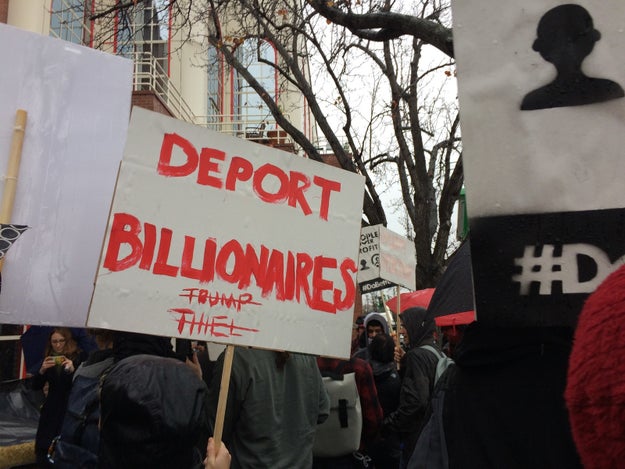
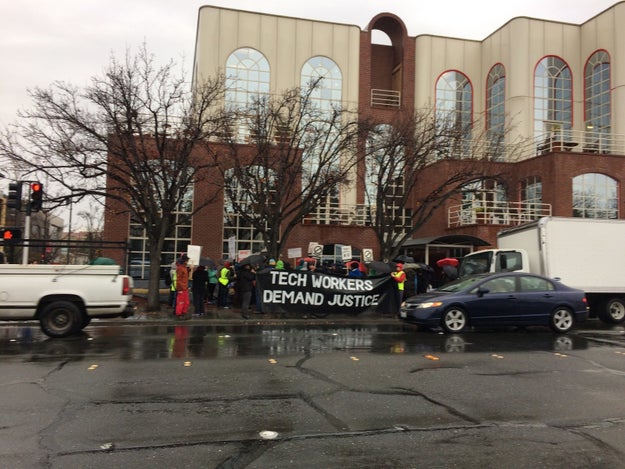
Roughly 60 people braved a rainstorm this morning to demonstrate outside the headquarters of Palantir Technologies, the secretive Silicon Valley company considered by some to be best positioned to help the Trump administration built a Muslim registry, given its role in building black box software systems that are already used to facilitate workplace raids and deportations. The crowd, assembled in water-logged windbreakers and sopping down coats, included employees from Facebook and other tech companies, along with labor activists, and students from nearby Stanford University. The hour-long protest was staged to pressure Palantir into more accountability and transparency around the databases it has built.

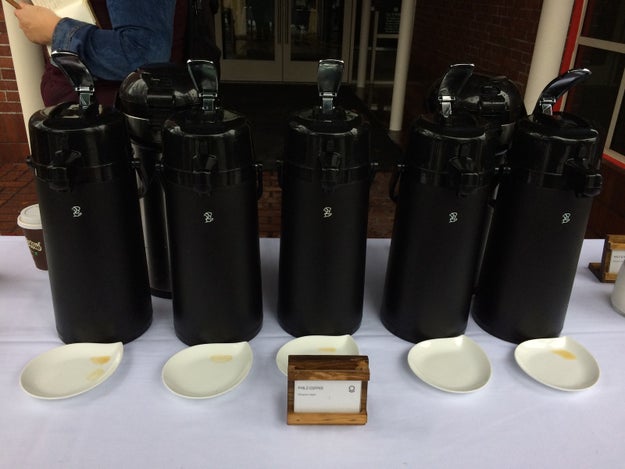
Palantir has made some conciliatory efforts since the protest was announced in the first week of January. After weeks of ignoring questions from BuzzFeed News and other outlets about a Muslim registry, the company — and its influential board member Peter Thiel, a top advisor to President Elect Donald Trump — broke their silence: “If we were asked, we wouldn’t do it,” Palantir CEO Alex Karp told Forbes. The company was also hospitable to protesters, putting out a table of free Philz coffee with a little Palantir logo.

Nitasha Tiku / BuzzFeed News

But demonstrators saw the protest as a chance to push Palantir to be even more accountable. “Well, did they meet the demands? I mean, we didn’t demand coffee,” Gilbert Bernstein, a Stanford PhD student in computer science told BuzzFeed News. Bernstein, who was also present at a recent meeting of the Bay Area Tech Solidarity Meetup, pointed out that Palantir could easily be playing coy, considering that databases that track Muslim-Americans like NSEERS have already been built. “They just play games with the terms,” he said.

Palantir’s dealings with President -Elect Donald Trump have been under particular scrutiny given new reports in The Intercept and The Verge about Palantir’s role in building government intelligence systems like Analytical Framework for Intelligence (AFI) and FALCON that would most likely be employed if Trump follows through with comments on “extreme vetting” of Muslims or increased deportations.

Then there’s Thiel’s growing closeness with Trump. Both Thiel and Karp, who donated to Hillary Clinton’s campaign, were present at January&;s closed-door meeting at Trump Tower with the President-Elect and his children.

Nitasha Tiku / BuzzFeed News

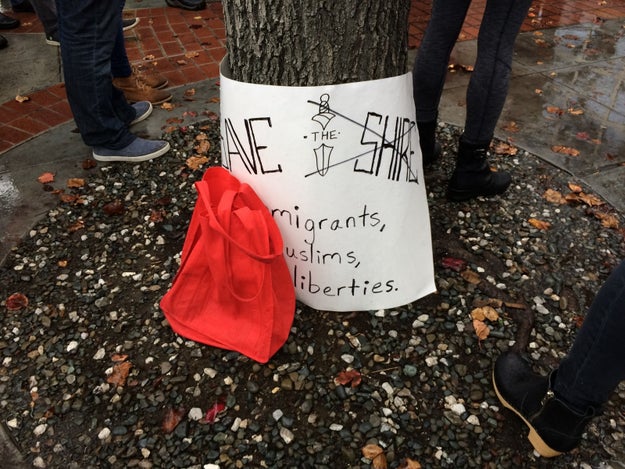
Under a staggered canopy of umbrellas, protesters held signs with slogans like “Protest Not Profits,” and “,” a reference to the website and slogan for today’s demonstration.

Jason Prado, a Facebook engineer who helped put together today’s event, said that Karp’s statement was great, but it’s still imperative to “raise awareness about this company that lives right in our backyard in Silicon Valley and is building tools that we don’t think agree with the values of Silicon Valley.”

The protest was organized by the Tech Workers Coalition, Bay Area group that includes tech industry employees, labor organizers, and other activists, and their requests of Palantir are significant, such as asking Palantir to disclose any steps the company has taken or plans to take in order to prevent abuses of AFI and FALCON.

“Palantir is particularly well poised to profit from potential policies that the next administration might roll out and has already established very lucrative contracts [for databases that could] very easily be used for horrific purposes,” Shahid Buttar, director of grassroots advocacy at the Electronic Frontier Foundation (EFF) told BuzzFeed News.

Tech giants like Facebook, Google, IBM, and Apple have all publicly vowed not to help build a Muslim registry, but, just like Palantir, they initially hoped to avoid making a public statement.

Nitasha Tiku / BuzzFeed News

In fact, today’s protest took a page from the engineers behind the Never Again pledge, which put pressure on tech companies by hit them where it hurts: their workforce. After their employees vowed not to help build a Muslim registry, their bosses followed suit. Today’s protest comes with its own pledge from Stanford students and alumni who pledge not to work for Palantir and “to continue to questioning Palantir’s outsized presence and reputation in our community.”

“I come from Stanford, where they are one of the top recruiters in Silicon Valley,” Prado told BuzzFeed News. “The Stanford [computer science] department just kind of pours into Palantir.” As of last night, more than 75 people had signed the pledge including numerous Stanford students and alumni, as well as employees from Apple, Twitter, Slack, and Asana.

“By showing up to the Palantir headquarters and exerting our physical presence, we want to send a message to employees,” designer Sophie Xie, a former product designer at Facebook who helped make the protest website at DoBetter.tech told BuzzFeed News. “It’s pretty clear that employees are one of the most powerful levers that can fight for change internally.”

Nitasha Tiku / BuzzFeed News

None of the protesters that BuzzFeed spoke with seemed to be under the illusion that their demands would be met. (Their final request is to “dismantle the AFI and FALCON databases entirely” if abuses can’t be accounted for and prevented.) But this direct action is part of the Silicon Valley’s proletariat testing the bounds of their influence.

“Pre-Trump election, there was a sense that we believed in the mission of our companies maybe in a purer way,” said Xie.

BuzzFeed News asked to enter the building to speak to someone from Palantir about the protest, but were told that no one could enter without an ID. An email to Palantir&039;s media relations went unanswered. However, BuzzFeed News did hear back from four of the outside experts who advise Palantir’s Privacy and Civil Liberties Team. All four said that the team is still active and meets three or four times a year, but could not say whether they had discussed a Muslim registry.

Quelle: <a href="Here’s What The Tech Workers Protesting Palantir Hope To Accomplish“>BuzzFeed

That Weird Glamour Shot Selfie App You're Seeing Is Called Meitu

Mega popular selfie app Meitu is having a bump in popularity in the US right now.

Hello, you. You probably don’t look like a magical beautiful cartoon. Well, there’s a fix for that!

Hello, you. You probably don't look like a magical beautiful cartoon. Well, there's a fix for that!

Here is our San Francisco bureau chief, Mat, made beautiful.

The Meitu app is wildly popular in China and elsewhere in Asia, and has been around for a few years. Basically, it&;s an app that lets you edit your selfies to look better (or over the top). BuzzFeed even did a video about using it in June 2015.

Last month, the New York Times reported that Meitu, the Chinese company behind the app, was looking for a valuation of as much as $5.23 billion.


View Entire List ›

Quelle: <a href="That Weird Glamour Shot Selfie App You&039;re Seeing Is Called Meitu“>BuzzFeed

Here's How Cell Carriers Are Prepping For The Inauguration’s Data Overload

Verizon

One million people — Trump supporters, protesters, politicians, dignitaries, and members of the press — are expected to attend Donald Trump&;s inauguration in Washington, DC on January 20.

These crowds of people are going to be sending iMessages, Snapchatting, tweeting, and streaming video nonstop. And when a large number of people gather in an area covered by only one or a handful of cell service sites — say, at an event like the inauguration or a music festival — that infrastructure quickly becomes overwhelmed by network traffic jams. Here&039;s how major cell carriers have been preparing to handle the deluge of calls, texts, and data at the 2017 inauguration.

Scott Mair, AT&T senior vice president of network planning, told BuzzFeed News in a statement, “During the 2013 Inauguration, our customers in the National Mall area set what was then a record on our network for a single-day event: more than 527 gigabytes of data, with the peak level of traffic on the National Mall hitting 110 gigabytes of total traffic during the 11 am hour, leading to the swearing in ceremony.”

It&039;s likely that twice as many of the million attendees will own smartphones than did in 2013. AT&T said that mobile data usage in Washington, DC increased 16-fold from 2009 to 2013, coinciding with a rise in smartphone ownership. And in a nationwide survey, Pew Research said that 35% of American adults owned a smartphone in 2012, whereas more than 72% did in 2016.

Those extra smartphone owners will likely be using more data per capita than the inauguration attendees of 2013, too. According to AT&T, mobile data usage has skyrocketed 250,000% since 2007 in the US. The company also expects that people using Snapchat and other photo/video sharing apps will take up a large portion of the mobile data usage during the inauguration.

AT&T has spent $15 million on improving its mobile data infrastructure over the past two years to get ready, Mair told BuzzFeed News. The company plans to permanently upgrade LTE capacity to more than 20 cell sites, and before January 20 it will deploy seven mobile towers — dubbed Cell On Wheels (COWs) — designed for short-term use with large crowds along the National Mall. It&039;ll be the carrier&039;s largest temporary network setup yet.

The phalanx of COWs will equal the capacity of 20 traditional cell towers, which AT&T confirmed during a test on the National Mall during the annual Cherry Blossom Festival last year. The mobile towers have at least 10 antennae each, according to AT&T, which allows them to segment big crowds and respond to demand, whereas a traditional cell tower often only has one.

T-Mobile CTO Neville Ray tweeted that his company would add new sites, improve old ones, and bring in temporary cell towers for “~10X more capacity&;” T-Mobile declined to offer further details.

Verizon, too, is taking measures to improve its mobile data infrastructure during the inauguration. In a statement emailed to BuzzFeed News, Verizon said it planned to upgrade all permanent cell sites around the Mall with to boost coverage and capacity. Verizon has also upgraded data capacity at Dulles airport, Union Station, and convention centers around the city. Like AT&T, Verizon will use equipment to divide coverage demands within crowds and respond in sections.

Verizon also said it has made adjustments to its temporary towers that will allow engineers to change their capacity, allowing them to respond to demand as it surges among different sections of the city. Engineers will also be on the ground during the inauguration to test cell data capabilities.

Internet providers are hopping on the bandwagon, too. In a statement emailed to BuzzFeed News, Comcast said it will open more than 6,800 Xfinity Wi-Fi hotspots throughout Washington, DC for public use during the inauguration festivities.

Quelle: <a href="Here&039;s How Cell Carriers Are Prepping For The Inauguration’s Data Overload“>BuzzFeed

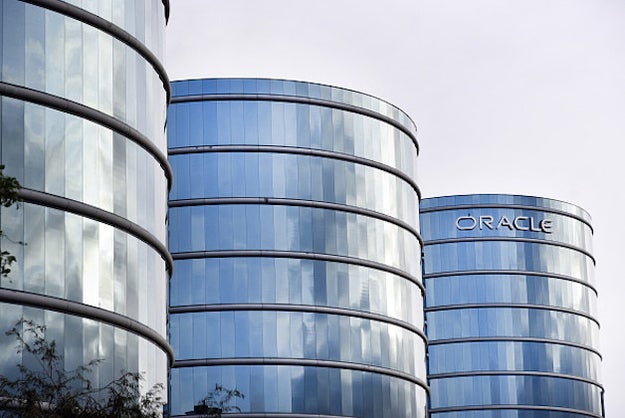
Oracle Sued By Department Of Labor For Paying White Men More

Michael Short / Getty Images

Just two weeks after filing suit against Google, the Department of Labor has brought suit against another big tech company: Oracle. On Wednesday morning the agency filed a complaint of racial discrimination against the database giant, which employs some 45,000 people in the US.

The complaint alleges that Oracle engaged a “systemic practice of paying Caucasian male workers more than their counterparts in the same job title,” resulting in pay discrimination against women, African-American and Asian employees, especially in technical and product development positions.

The complaint further alleges that Oracle favors Asian applicants — specifically, Asian Indians — when hiring, in part because “targeted recruitment, and referral bonuses … encouraged its heavily Asian workforce to recruit other Asians.”

In a statement, Oracle spokesperson Deborah Hellinger denied allegations of discrimination, decrying the Department of Labor&;s complaint as “politically motivated, based on false allegations, and wholly without merit. Oracle values diversity and inclusion, and is a responsible equal opportunity and affirmative action employer, Our hiring and pay decisions are non-discriminatory and made based on legitimate business factors including experience and merit.”

Oracle CEO Safra Catz joined President Elect Donald Trump&039;s transition team last month, following a meeting between Trump and leaders in the tech industry. “I plan to tell the president-elect that we are with him and will help in any way we can,” Catz said ahead of the meeting. “If he can reform the tax code, reduce regulation and negotiate better trade deals, the U.S. technology industry will be stronger and more competitive than ever.”

Oracle has many contracts with the federal government which are worth hundred of millions of dollars. As such, the company has to meet certain requirements when it comes to equal employment opportunity and the provision of certain data. The Department of Labor in its complaint alleges that Oracle “refused to produce” compensation data, hiring data, and “any material demonstrating whether or not it had performed an in-depth review of its compensation practices.”

If government contractors don&039;t provide necessary information, the government can sue — and it has, filing similar suits against Google earlier this month, and Palantir last fall. The agency also sued JP Morgan today over similar allegations of gender pay discrimination.

The Department of Labor itself is in a transitional moment, with President Elect Donald Trump&039;s inauguration coming up on Friday and the Obama administration on its way out. The confirmation of Trump&039;s pick for Labor Secretary, Andrew Puzder, has been delayed, following revived accusations of spousal abuse and reports that widespread criticism from unions and democrats has left Puzder less than enthusiastic about taking the job. (Puzder has more or less denied these claims.)

Oracle, meanwhile, did not immediately respond to a BuzzFeed News request for recent diversity numbers. According to the company&039;s website, less than a third of the company is female, but 37% of its staff are “minority employees.” Whether Oracle includes Asians in the “minority employees” category is unclear. Oracle&039;s diversity website makes no mention of compensation parity.

Quelle: <a href="Oracle Sued By Department Of Labor For Paying White Men More“>BuzzFeed

Trump's Proposed Labor Secretary Is On A Blocking Binge

Fast food CEO Andy Puzder has faced a rough few weeks since Donald Trump nominated him to become Secretary of Labor, with activist groups engaging in a blitz of criticism over his history of opposition to raising the federal minimum wage.

In response, Puzder is following a time-honored technique: One by one, he&;s blocking his enemies on Twitter.

The Hardees and Carl&039;s Jr. CEO has blocked the Twitter accounts of at least five labor advocacy groups. This week, he even blocked one of the country&039;s most prominent union leaders, Mary Kay Henry of the 2-million member Service Employees International Union.

“Yes, the Twitter news is true. A sentence I can&039;t believe I&039;m writing,” an SEIU spokesperson told BuzzFeed News on Tuesday evening. The union is the second-largest in the country, and has been the main backer of the Fight For $15 movement to raise wages in the fast food industry.

As a veteran fast food leader opposed to wage hikes, Puzder&039;s beef with Henry and the SEIU seems clear. But he&039;s handing out the blocks more liberally than that. The cabinet nominee has also blocked the National Employment Law Project, the Economic Policy Institute, MoveOn.org, the Fight for $15, and the Leadership Conference on Civil and Human Rights — all organizations that advocate on behalf of workers, especially low-wage workers and workers of color.

These groups have been critical of his nomination, tweeting at him and about him, and perhaps earning their block along the way. The Economic Policy Institute told BuzzFeed News it was blocked after this tweet:

MoveOn.org said it was blocked after this tweet:

The National Employment Law Project first noticed its block on Tuesday. The group has been engaged in “legitimate policy discussions,” said Judith Conti, its Federal Advocacy Coordinator. “We’re not name-calling. There are no ad hominem attacks. This is a man we don’t think is temperamentally or philosophically suited to be the nations’ chief advocate for working people.

“He can’t even handle a Twitter feed that has things in it that are legitimately and respectfully critical,” Conti told BuzzFeed News. “When faced with legitimate critiques, what does he do? He tries to shut it out and shut it down.”

Puzder may have learned the art of the block, but he&039;s no Donald Trump when it comes to Twitter: he has a little over 5,000 followers, and has tweeted just over 1,400 times since 2008. His last tweet, on Monday, was a minimalist seven-word response to a CNN report that said he may withdraw his nomination due to the intense criticism he is facing.

The Trump transition team did not respond to a request for comment. Puzder&039;s confirmation hearing for his position has been rescheduled for February 2.

Quelle: <a href="Trump&039;s Proposed Labor Secretary Is On A Blocking Binge“>BuzzFeed

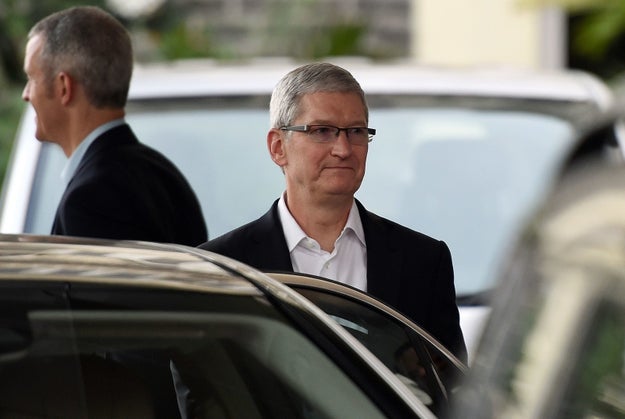
India Is Considering Giving Apple A 15-Year Exemption On Customs Duty "With An Open Mind"

Apple CEO Tim Cook leaves the Taj Mahal Palace hotel in Mumbai on May 18, 2016.

Punit Paranjpe / AFP / Getty Images

Apple really wants to make iPhones in India, but before it does that, it would really like the Indian government to give it some major incentives, including a 15-year exemption on customs duty and the freedom to keep the back of the iPhone free of regulatory labelling.

So far, India has been reluctant to make exceptions for a single company, but it seems like the country might just give in to Apple.

India Minister for Information Technology Ravi Shankar Prasad told reporters on Wednesday that the country will consider Apple’s request “with an open mind.”

“We will very much like Apple to come and have a base in India,” he said.

BuzzFeed News has reached out to Apple for comment.

Making iPhones in India would help Apple lower iPhone pricing in the country, where the company is striking to gain marketshare against Android, which currently powers 97% of India’s 300 million smartphones.

And having Apple make its flagship product in the country would help the government’s “Make in India” initiative, which aims to boost India’s manufacturing industry and create jobs.

The Times of India recently reported that a team from Apple&;s Cupertino headquarters would arrive in India next week to present Apple&039;s case for seeking tax benefits and other perks to make iPhones in India.

Quelle: <a href="India Is Considering Giving Apple A 15-Year Exemption On Customs Duty "With An Open Mind"“>BuzzFeed

Vine Goes Dark Today

Vine has been replaced by “Vine Camera” in the App Store. If you have the old version on your phone, you can still save your videos.

If not, you&;ll have to browse them at vine.co. For now, you can also download them there too, though a message on the site warns that you should “remember to download your Vines before Jan. 17.”

Twitter rolled out the transition from Vine to “Vine Camera,” a stripped down version that integrates with Twitter, on January 17. Vine Camera will allow you to save your six-second videos to your camera roll or post them directly to Twitter, where they will still loop.

If you have updated to Vine Camera or have deleted Vine, you will not be able to download old videos from your phone, though your Vines will continue to exist on the company&039;s website for an unspecified amount of time. But if you still have the OG Vine app on your phone, today&039;s the last day you can use it to download your old videos, sources familiar with Twitter&039;s plans tell BuzzFeed News.

Twitter bought Vine in 2012; when Twitter announced Vine&039;s demise, the app&039;s founder seemed to regret his choice.

Twitter announced Vine&039;s shutdown in October. The short video platform&039;s usage had declined in recent years, and many people at the Twitter subsidiary had left the company. Twitter announced layoffs of 350 people at the same time it disclosed Vine&039;s shuttering.

So what should you do with your old Vines?

Giphy has offered a tool to convert Vines into GIFs, though the tool downloads the video and sound files separately.

To export your Vines on your phone via the original app, go to your profile page in the app and click “Save Vines;” then the app will save the videos to your camera roll. The other option, a download link, will allow you to save the social data — Favorites and Revines — associated with the video. On the website, you can click “Download your Vines” in the top right hand corner of the page; the site will give you the same options as the app.

&;, Vine

On the day of its demise, popular Vine creators paid tribute to the platform that made them famous:

Viner Cody Johns, who now creates videos for YouTube, Instagram, and Snapchat, previously wrote to BuzzFeed News, “Vine was a springboard for many careers, and it was similar to being on a hit television show for several years. As an entertainer, you realize the industry moves fast, and you have to move on and secure your next opportunity.”

Twitter did not respond to requests for comment.

Quelle: <a href="Vine Goes Dark Today“>BuzzFeed

As Trump Takes Office, Birth Control Startups See Demand Spike

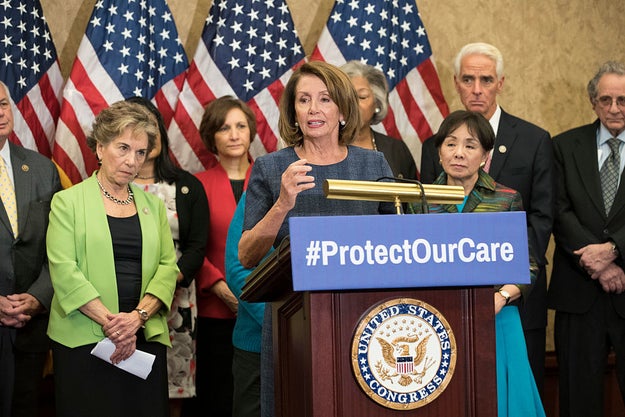
House Minority Leader Nancy Pelosi, flanked by House Democrats, speaks in support of the Affordable Care Act on January 12.

Aaron P. Bernstein / Getty Images

After a blood clot made it unsafe for her to take birth control pills, Liz Van Voorhis switched to an intrauterine device a few years ago. It was free — thanks to the Affordable Care Act, which in 2012 required insurance plans to cover contraceptives at no cost to customers.

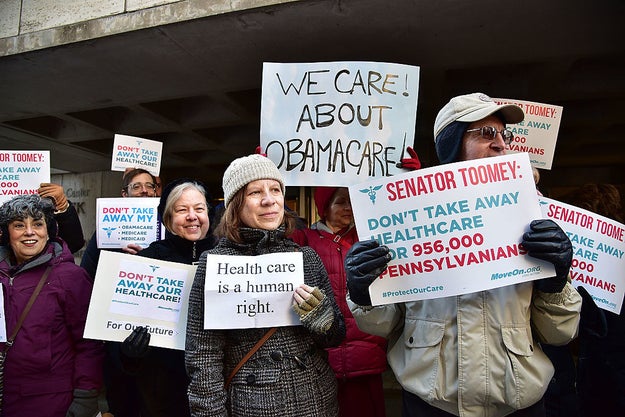
Five years later, though, president-elect Donald Trump’s pick for health secretary, Tom Price, is on record for opposing that rule. The Republican-majority Congress is moving to repeal the health care law. And Trump has vowed to defund Planned Parenthood.

Van Voorhis was counting on the birth control mandate to cover a new IUD in 2017, and would have trouble single-handedly affording a device, which costs up to $1,000. But if that mandate vanishes along with the health care law Trump has sworn to repeal, she fears that she would no longer qualify for insurance coverage because she has diabetes, an expensive condition. “I shouldn’t have to make the decision between my health and if I can afford it,” the 37-year-old told BuzzFeed News.

Van Voorhis isn’t the only woman worried about affording and accessing birth control under Trump: Planned Parenthood’s president told CNN last week that the organization has seen a 900% increase in women trying to get IUDs. Those fears have also translated into a reported uptick in business for on-demand birth control startups — like the Pill Club, Nurx, and Maven — that in response are temporarily making it cheaper and easier to order contraception through their apps and websites.

These promotions aren’t entirely altruistic, of course. In the unprecedented political climate, capitalizing on concerns is also a way to gain new customers.

“Our own patients were [asking], especially after the election, ‘What’s going to happen to my coverage?’” said Nick Chang, CEO of the Pill Club, a Silicon Valley startup that writes and fills birth control prescriptions. “We have only so much we can control in terms of what Trump and [vice-president-elect Mike] Pence and Price do. But one of the ways that we can help patients right now and prepare them for anything that happens down the line is to give them protection and backup options.”

An ad for Nurx&;s December promotion.

Nurx

Since December, the Pill Club has been offering the Fallback Solo emergency contraceptive for free to customers with insurance; doses vary from six a year to one every three months, depending on coverage. (Emergency contraception is also covered by the birth control mandate.) The Pill Club only writes prescriptions in California, but can ship to people who already have prescriptions across 10 states.

Until the end of January, New York City-based Maven is offering customers a free telemedicine visit with a doctor or nurse to get a birth control prescription, or just reproductive health advice. Maven, which can prescribe in 47 states, ships orders to a pharmacy for the customer to pick up.

“A lot of women have been writing in, asking questions, talking about how nervous they are,” CEO Katherine Ryder said. (She added that not all patients were worried. When Maven referenced a “stressful” election in an email to clients offering mental health visit discounts, “a lot of people wrote back and said they weren’t stressed at all,” Ryder said.)

Nurx, a Y Combinator startup that raised $5.3 million last fall, gave new customers $45 toward birth control in December. It’s doing so again in January (promo code: “TinyHands”). The startup, which also covers delivery costs, ships to California, Washington state, Washington, DC, New York, Pennsylvania, and, as of last week, Virginia and Illinois.

An ad for Maven&039;s birth control promotion.

Via mavenclinic.com

“We have a lot of users who are concerned that they would lose access to birth control and certain users who were talking about stockpiling birth control,” said Hans Gangeskar, who co-founded the San Francisco startup. Nurx doesn’t encourage hoarding, and birth control pills usually expire after about 12 months, but “we always think it’s a good idea for women to have an extra pack or two, from a logistical perspective,” he said.

The birth control mandate is rooted in the Affordable Care Act, but the law doesn’t have to be repealed for the mandate to end.

The law says insurance must cover preventive health benefits for women, and leaves it up to the Department of Health and Human Services to decide what counts. In 2011, it decided that birth control counted. (The rule was later clarified to mean that of the 18 categories of birth control that are FDA-approved, most insurers have to cover at least one drug or device in each category. That means, for instance, that some health plans cover certain brands of birth control pills at no cost to consumers, but don&039;t cover others.)

The new administration could simply write a regulation that says otherwise. “That policy of requiring no co-pay for contraceptive coverage was huge and allowed many millions of women access to birth control care in a way that made it accessible and affordable,” said Amy Friedrich-Karnik, senior federal policy advisor at the Center for Reproductive Rights, an advocacy group. “That policy and that access is really threatened,” particularly for low-income women and women of color.

Still, it’s hard to predict how quickly the Affordable Care Act as a whole will actually go away, and whether or not alternative sources of birth control, like startups, could become crucial as a result. The startups also say they are optimistic about staying operational even without the health care law: “You will need the pill whether you have Obamacare or not,” Chang said in an email.

Repealing the law may be more difficult than initially portrayed by the Republicans who repeatedly campaigned on that pledge. Congress moved forward last week on setting up a repeal bill, but GOP leaders — and Trump himself — are offering mixed messages on if they’ll establish an alternative and what that might be. Some 20 million Americans received insurance coverage under the law.

Even if the birth control mandate were to go away, that doesn’t mean that all women would have to pay out of pocket for it.

Lisa Lake / Getty Images for Moveon.org

A few states — Maryland, Vermont, Illinois, and California — have in recent years passed their own laws that require insurance plans in those states to cover contraception, from pills to IUDs, at no cost to customers. These state laws will continue to provide coverage regardless of what happens to the federal law, said Susan Berke Fogel, director of reproductive health at the National Health Law Program.

However, those laws don’t apply to everyone in those states; California’s law, for example, exempts health care plans for religious employers.

In addition, certain birth control pills cost relatively little out of pocket, so some women may still be able to afford them if their coverage goes away. Nurx, for instance, says that it plans to keep selling some medications for as low as $15 a month to uninsured customers.

Still, the uncertain future unnerves many women like Van Voorhis. As for what she’ll do when it comes time to remove her IUD this year, she’s not sure.

“If anything, the choice is probably that I would consider not pursuing [an IUD] in the future and just ending my current plan of health,” she said. “And optimistically hoping that someone talks some sense into the right people, and we have the right type of advocacy to make a change.”

Quelle: <a href="As Trump Takes Office, Birth Control Startups See Demand Spike“>BuzzFeed