No, Signatures On The White House Petition Site Aren't Intentionally Frozen
Lumy010 / Getty Images

You may have seen stories going around questioning whether the Trump administration has frozen the signatures on certain initiatives on the We The People petition platform. That&;s likely not the case.

President Obama&039;s administration created We The People in 2011 as a way for citizens to communicate with the White House about issues that mattered to them. The platform allows anyone to start a petition that others can digitally sign to show their support, and Obama&039;s White House said it would respond to any petition that received 100,000 signatures within 30 days. That clause is still part of the “about” page on We The People, though whether the Trump administration will respond to petitions is unconfirmed. On the day of his inauguration, Trump&039;s administration archived all existing petitions on the platform.

Right now, though, We The People seems to be barely registering some signatures. A petition titled “Preserve the National Endowment for the Arts and the National Endowment for the Humanities” only had 96 signatures at press time, despite accruing hundreds of shares on Twitter alone. (The president is expected to cut funding for the NEA and NEH dramatically.) Another petition for a similar cause has showed a relatively static number of signatures, despite a continuing high volume of social shares. It is possible that the similarity of these petitions is spreading signatures thinly between them, though another petition about something entirely different shared widely on Twitter also has only one signature.

Trump&039;s administration seemed to acknowledge that something was wrong with the website, but denied it had intentionally stalled the platform. A spokesperson for the White House told BuzzFeed News, “It&039;s a question of high volume at the end of the day, but the signatures are being captured. Because of high volume they&039;re having to change how they’re being captured.” The spokesperson did not elaborate on what that change would entail.

Some of the shortened URLs that appear in shared social media posts for petitions have recently been leading to broken webpages, which also may be affecting the petitions&039; signature counts.

Macon Phillips, who served as Obama&039;s coordinator of International Information Programs, oversaw the creation We The People. In response to questions about how slowly the site seems to be counting signatures, he told BuzzFeed News he didn&039;t think it was intentional interference by Trump&039;s administration. “The system doesn&039;t really allow you to make it behave that way. It seems like more of a caching issue. I think the team there is still trying to get their heads around how it works,” he said. President Trump has appointed a new acting director of International Information Programs, Jonathan Henick, who did not immediately respond to request for comment.

The number of signatures on a few other petitions also indicate that the administration is not suppressing signature counts on We The People. Two petitions on the site, “Immediately release Donald Trump&039;s full tax returns, with all information needed to verify emoluments clause compliance,” and “Divest or put in a blind trust all of the President&039;s business and financial assets,” have reached 372,520 and 114,924 signatures, respectively, at press time. White House spokesperson Kellyanne Conway responded to the tax returns petition on TV recently, at least indirectly — at first, she refused to release the returns, but then later walked back on that refusal.

This is the latest development in the Trump administration&039;s tech struggles. Earlier this week, it was discovered that the @POTUS official Twitter account was tied to a Gmail address. The account registration was changed after journalists flagged the registration on Twitter.

Adrian Carrasquillo contributed to this report.

Quelle: <a href="No, Signatures On The White House Petition Site Aren&039;t Intentionally Frozen“>BuzzFeed
Here's What It Feels Like To Be Trolled In Trump's America

Lam Thuy Vo / BuzzFeed News

A couple of weeks ago, Washington Post homepage editor Doris Truong found herself at the center of a partisan flame war.

During a break in Rex Tillerson’s confirmation hearing for secretary of state, an Asian woman was spotted appearing to take snapshots of Tillerson’s notes. Bloggers quickly decided that the woman in the video must be Truong, who also happens to be Asian. One Reddit thread, for instance, was titled “Fake News Journalist Doris Truong caught taking photos of Rex Tillerson&039;s notes from confirmation hearing today.”

The thing is, Truong was not covering the Tillerson hearing. To put it in her own words: “Trolls decided I was taking pictures of Rex Tillerson’s notes. I wasn’t even there.”

On a typical day, Truong gets maybe a half dozen mentions on Twitter. By 10 a.m. on Thursday, Jan. 12 — the day after she had been falsely identified as the woman from the picture — she had 4,638 new mentions since the previous evening. And it just kept going. Within 24 hours, her handle had been mentioned 20,179 times, an increase of 185,300%, according to screenshots provided by Truong.

Here’s what that looked like:

Note: This graphic is based on a BuzzFeed News analysis of 24,731 mentions of Truong’s twitter handle, @doristruong, starting roughly two days before false stories of her started circulating on the web and ending seven days after the incident.

Source: Twitter’s API

Source: Twitter’s API

“That initial moment of seeing the Twitter notifications was dumbfounding,” Truong wrote in an email to BuzzFeed News. “I was looking at the app on my cellphone, where &;20+&039; is the readout even if an account has far more mentions. I had to scroll through dozens of screens of people saying ‘how dare you’ (and worse) to finally figure out what had caught their attention.”

Experiences like Truong’s are becoming more and more common. According to a recent study from Data & Society, 47% of internet users aged 15 and older have experienced online harassment or abuse at some point. Thirty-six percent of all respondents reported that they had been harassed directly, meaning they had been threatened, called abusive names, or stalked.

When a story goes viral, this experience is amplified.

“This idea of people coming together within specific affinity groups and behaving in ways that are really good for the ‘in’ group and terrible for members of the ‘out’ group […] there’s nothing new about that,” said Whitney M. Phillips, a professor at Mercer University who has been studying how people talk online for close to 10 years and who has written a book about online trolling titled This Is Why We Can’t Have Nice Things. “But having different tools means we suddenly have new superpowers.”

Though online trolling has existed for years, experts like Phillips worry that the election of Donald Trump as president may embolden people who already harass others online. Trump has insulted politicians, media organizations, public figures, and private citizens on Twitter, which, in some cases, has incited his supporters to launch social media attacks on the people he singled out. He has spread and amplified skewed information and has tweeted falsehoods.

“What do you do when the president is doing the thing that you’re trying to get average citizens not to do anymore?” said Phillips.

Truong’s story became a battleground for different factions to debate their own views about the media and politics. While roughly 70% of the 100 most retweeted tweets about her contained insults against her, the media, and/or “liberals,” a little less than a third of all the mentions from that same sample were trying to defend Truong (and a small percentage were not related to the story).

Those who believed the false story about Truong slung insults toward her. “Where is your integrity? Oh wait you work for WaPo don&039;t you” or “Media is SCUM,” some wrote. A few also featured hashtags like in their tweets. Others swooped in to defend her:

This factioning of responses mirrors how politically divided the nation is and just how important identity politics have become in the digital realm.

Participating in debates like this is “the digital equivalent of wearing a Make America Great Again hat and a pussy hat […] It’s that idea that you’re signaling your affiliation with your group,” said Phillips. “If someone comes at you screaming, it’s very tempting to scream back at them.”

The most intense part of Truong’s experience lasted approximately three days. And though she told BuzzFeed News that she was “mildly concerned” about her safety, she wrote that she will continue to use social media platforms: “The whole episode is not going to drive me off social media, which provides a way for me to connect with people across the miles, including strangers, and to be exposed to a diversity of opinions — including ones I disagree with.”

Quelle: <a href="Here&039;s What It Feels Like To Be Trolled In Trump&039;s America“>BuzzFeed

Ivanka Trump's Website Promotes A Russian App That Quietly Tracks Your Location

Spencer Platt / Getty Images

Ivanka Trump’s fashion-and-lifestyle website is promoting an app, developed by a Russian company, that can track people’s location even when it is not running. The app, called SkyGuru, was featured in the latest edition of “Weekly Clicks,” a roundup of recipes, fashion tips and fitness trends that “ clicked, read and loved.”

SkyGuru says it can calm anxious flyers by alerting them to turbulence and tracking their flights through the air. But the small print on the app’s download page reveals another feature: it continues to monitor users’ whereabouts after their flights land, regardless of whether they close the app.

SkyGuru says this feature is no different than other GPS-related apps, like Google Maps or Uber, and that users can switch off the function.

SkyGuru was developed by Taktik Labs, a team of coders and marketers in Russia that includes a man with ties to a state-run investment firm. Amidst questions regarding President Donald Trump’s relationship with Moscow, the coincidence of electronic surveillance and the Russian government brought Trump and SkyGuru a sharp rebuke on social media.

SkyGuru’s founder, Alex Gervash, says the app “does not contain any malicious code” and the company does not store the data it collects.

“It uses GPS data just like any other navigator,” Gervash said.

Taktik Labs has built a suite of apps, including KidRadar, which allows parents to monitor their children’s movements, and MoscowSecrets, which offers tips to travelers.

One member of the Taktik team is Andrey Lebedev, a consultant whose biography says he helped establish Rusnano Capital, a government-owned company that invests in things like energy projects and nanotechnology.

Lebedev reports on LinkedIn that he helped launch Rusnano in 2007 and was “awarded a thank you letter” from the deputy prime minister. Garvesh says Taktik has no connection to Rusnano and that Lebedev’s job is to find outside investors.

After Trump&;s website promoted the app, Russia Today, the premiere outlet of Russian state media, proudly announced that SkyGuru&039;s downloads had tripled.

Gervash, a pilot with a degree in psychology, told BuzzFeed News in an email: “We are very happy that our app has created such a hype and so many discussions among our followers. Allow us to remind you that the main goal of SkyGuru is to explain to anxious passengers the ongoing processes during flight in order to help them cope with fear of flying.”

It was not clear who promoted SkyGuru from Trump’s website or Twitter account. Representatives of IvankaTrump.com did not return two messages seeking comment. SkyGuru said it has no ties to either Ivanka or President Donald Trump, but found a unique way to say thanks to both of them.

Quelle: <a href="Ivanka Trump&039;s Website Promotes A Russian App That Quietly Tracks Your Location“>BuzzFeed

President Trump's Official Twitter Account Was Registered To A Personal Gmail Address

Chip Somodevilla / Getty Images

Until Thursday afternoon, Donald Trump&;s official @POTUS Twitter was registered to a private, non-government email address, raising concerns about the security of the White House&039;s primary social media account. The account registration was changed after journalists flagged the registration on Twitter.

The registration was first noticed by TV Guide Managing Editor, Alex Zalben:

Others have confirmed that the password reset link directs to what appears to be White House Social Media Director, Dan Scavino&039;s personal Gmail account.

The White House press office has not yet responded to a request for comment. White House Director of Social Media, Dan Scavino has not yet responded to BuzzFeed News query asking if the account will be transferred to a different, government address in the future.

The registration to a personal account rekindles concerns about the security of the Trump administration&039;s social media accounts, especially Trump&039;s Twitter accounts, arguably the President&039;s most important communications&039; tools. The account, which changed hands from the Obama administration just moments after Trump was sworn into office last Friday, has quickly amassed 14.3 million followers and is obsessively tracked by journalists and even financial trading algorithms. Though Trump has opted to use his personal, @realDonaldTrump account as his primary method of personal communication, the @POTUS account is largely seen as the official Twitter account of the administration.

This week a hacker who identifies himself as as WauchulaGhost told CNN that he had been able to easily find the emails associated with the @POTUS, @FLOTUS, and @VP accounts and suggested the White House update security settings. WauchulaGhost told CNN that the accounts, “haven&039;t selected a basic security feature on Twitter that requires you to provide a phone number or email address to reset your password.”

And just this morning, White House Press Secretary, Sean Spicer appeared to accidentally tweet out the password to one of his accounts. Some have suggested that Spicer was trying to log-in to his Twitter account using two-factor authentication, and accidentally copied in his password.

BuzzFeed News reported earlier this month that the @POTUS account has special security protocols. The security tools, according to the White House Communications Agency include multiple password layers as well as limiting the number of encrypted devices that can post to the official account.

“It’s a small handful of devices that are under significant security and handled with extreme care,” a former director of online engagement told BuzzFeed News this month about the account. The new registration under Scavino&039;s email would suggest this protocol has changed when the account was transferred.

Quelle: <a href="President Trump&039;s Official Twitter Account Was Registered To A Personal Gmail Address“>BuzzFeed

Twitter Says Goodbye To The Moments Tab, And Hello to Explore

Twitter’s Moments tab is dead. Long live Moments.

In an effort to improve content discovery on its platform, Twitter is replacing its Moments tab with a new tab called Explore. Moments themselves will live on in the Explore tab, but they will take up decidedly less real estate. The Explore tab will also feature search, a list of trends, live video (at times), and shortcuts to get to Moments categories such as News, Sports, and Entertainment.

“Over the past year, we’ve been exploring different ways to make it simpler for people to find and use trends, Moments, and search,” the company said in a blog post. “During our research process, people told us that the new Explore tab helped them easily find news, what’s trending, and what’s popular right now.”

The tab could be especially useful home for Twitter’s premium live video efforts, which have included numerous sports games, the presidential debates, and the Trump inauguration. The videos have not been easy to find inside the Twitter app, which hasn’t had a dedicated tab to host them.

Twitter, used by 317 million people each month, has struggled to attract new users. The company has cited usability as an area it needs to improve upon. One of the key issues new users have is finding the best content inside Twitter, which is what Moments is supposed to address. Twitter still plans to publish the same volume of Moments, and the team working on the feature will not be reduced.

The new Explore tab rolls out globally on iOS today and Android in the coming weeks. If you find yourself longing for Moments in its absence, you can still access the tab on desktop, at least until it eventually switches over to Explore too.

Quelle: <a href="Twitter Says Goodbye To The Moments Tab, And Hello to Explore“>BuzzFeed

The White House Denies That Alex Jones Has Been Offered Press Credentials

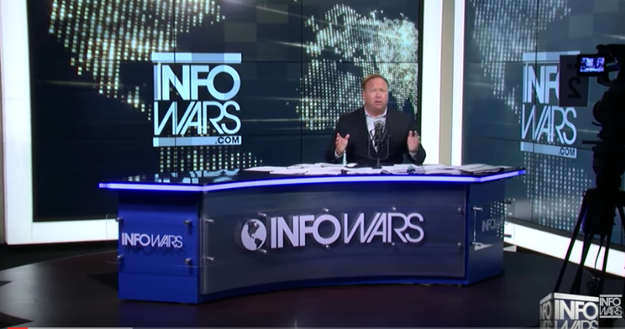
Alex Jones will likely won&;t be attending any upcoming White House press briefings, according to the Trump adminstration&039;s press office.

Yesterday Alex Jones told viewers on his popular YouTube channel that his conspiracy news site, Infowars has been offered White House press credentials by the new administration to cover the Trump White House. But on Thursday White House press officials tell BuzzFeed News that Jones and Infowars have not been offered a spot in the briefing room. “He is not credentialed for the White House,” a White Deputy Press Secretary said. “The White House Press office has not offered him credentials.”

Jones, an ardent Trump supporter has been called “America’s leading conspiracy theorist” and is a prominent 9/11 and Sandy Hook truther. His false suggestion that he&039;s been offered White House press credentials comes on the heels of reports that the Trump administration is planning to open the briefing room to alternative outlets. The far right-leaning outlet, Gateway Pundit, for example has also suggested it will receive a spot in the briefing room and has already hired a White House correspondent. Currently though, the administration has only announced it will open up four “virtual press seats” for local press outlets more than 50 miles outside Washington D.C.

Here&039;s Jones&039; full statement from his YouTube page on the White House credentials, via Media Matters:

The statement contradicts Jones&039; video”Here&039;s the deal, I know I get White House credentials, we&039;ve already been offered them, we&039;re going to get them, but I&039;ve just got to spend the money to send somebody there. I want to make sure it&039;s even worth it. I don&039;t want to just sit there up there like “I&039;m in the media, look our people are there.” People don&039;t understand this paradigm, we&039;re devolving in a good way, power from the federal government back to the people, back from the centralized MSM [mainstream media] to the people, just like Trump said in his speech.

But there is investigative journalism, or people to interview in DC. Might be good to put a few reporters there, it&039;s just all a money issue. That&039;s why it&039;s important for people who are watching us to know, you are our sponsors. You&039;re the reason we&039;re able to do this. You&039;re the reason we&039;re able to have the crew and do what we do and change the world.

Quelle: <a href="The White House Denies That Alex Jones Has Been Offered Press Credentials“>BuzzFeed

Searching For "Bigot" And "Racist" On Twitter Brings Up @RealDonaldTrump

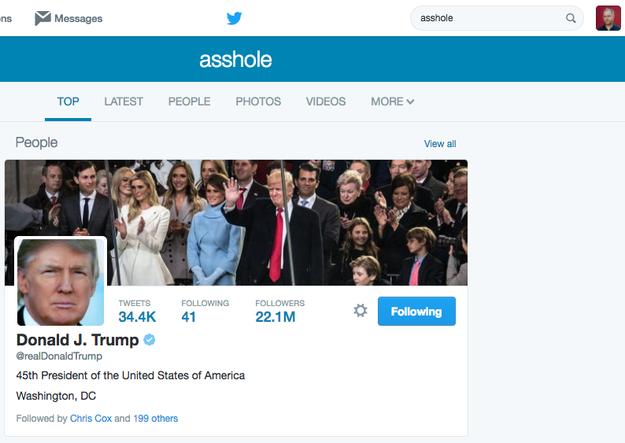
Some Twitter users have noticed that searching for “worst,” “asshole,” and “douchebag” on Twitter right now brings up President Donald Trump&;s account as a top result.

Other terms that return @realDonaldTrump as one of the primary results include “racist,” “bigot,” and “fascist.”

Twitter declined to comment. But this is likely happening because large numbers of people have been using these words when they mention the president, so Twitter&039;s search algorithm identifies them as commonly associated with him.

“Sexist” and “misogynist,” terms frequently applied to the president by his detractors, did not produce the same results. Searching for “president” also returns @realDonaldTrump, but entering “powerful” produces Barack Obama&039;s account as a top result. “Leader” brings up the accounts of Obama and Bill Gates. And “corrupt” turns up Hillary Clinton&039;s account:

Trump is currently driving a tremendous amount of conversation on Twitter. Between Dec. 5, 2016 and Jan. 5 2017, he was mentioned 42.7 million times on Twitter — more than 10 times as often as the Kardashians — and his presence there has led to a wave of exposure for the platform. On January 23, Trump even created a Twitter Moment. So far, @realdonaldTrump hasn’t tweeted about the search results he’s featured in.

Alex Kantrowitz contributed reporting to this story.

Quelle: <a href="Searching For "Bigot" And "Racist" On Twitter Brings Up @RealDonaldTrump“>BuzzFeed

Here’s How The Feds And Cops Watched Trump’s Inauguration And Protests From The Air

Pool / Getty Images

As President Donald Trump took the oath of office on Friday, federal surveillance helicopters were buzzing the event’s perimeter.

But the Feds’ eyes in the skies apparently had little interest in Saturday’s Women’s March on Washington. Protests in several other major cities also seemed to pass off without intensive aerial surveillance — although those in Oakland and San Francisco were watched closely by state and local police.

Surveillance and security for public events and protests are hard for outsiders to monitor. But the helicopters and other aircraft operated by law enforcement send transponder signals that are tracked by flight-monitoring websites.

Over a weekend that saw hundreds of thousands of Americans take to the streets, BuzzFeed News used two of these sites, Flightradar24 and ADS-B Exchange, to watch the skies over Washington DC, New York City, Los Angeles, Chicago, and the San Francisco Bay Area. On Saturday, these cities hosted some of the largest protest marches across the nation.

Flightradar24 uses both crowdsourced data and a feed provided by the Federal Aviation Administration (FAA), but may hide certain planes if requested by their operators. ADS-B Exchange is completely crowdsourced, and does not censor its data. We looked for aircraft operated by federal, state, and local law enforcement — including those registered to companies previously identified as fronts for federal aerial surveillance.

Both sites have good coverage for the cities we monitored, and revealed essentially the same picture — federal, state, and local law enforcement aircraft were apparently not trying to hide from view.

In the maps below, drawn from Flightradar24 data, the tracks of federal aircraft are shown in green, state police in purple, and local law enforcement in orange. Slide to the right to see flights on Friday Jan. 20, the day of the inauguration, and to the left to see flights on Saturday Jan. 21, when women’s marches and other protests took place across the nation. (Days are from midnight to midnight, local time.)

Washington DC

Peter Aldhous for BuzzFeed News / Via flightradar24.com

As a designated National Special Security Event, the inauguration was under close scrutiny — federal helicopters were in the air for most of the day. They included Department of Homeland Security (DHS) choppers, plus two registered to Midwest Aerial Imaging and TAFY Consulting. Documents submitted to the FAA that reveal the the former’s choppers are part of the DHS fleet; the latter registers its aircraft to a PO Box used by the FBI.

These helicopters patrolled a perimeter around the Mall and the US Capitol, where crowds gathered for the inauguration. The most intense surveillance was above a corridor to the north of the Mall that includes Washington’s bohemian restaurant district and the historically black Howard University. A DHS chopper also circled around the campus of the University of Maryland, to the northwest.

But we detected no law enforcement aircraft on Saturday, when hundreds of thousands of women and other protesters marched in Washington DC.

Federal officials would not comment on these patterns of aerial surveillance — although the FBI has previously told BuzzFeed News that its aircraft do not monitor activities protected by the First Amendment, which would include Saturday’s peaceful protests.

“As a matter of policy, we do not discuss law enforcement techniques or practices,” acting DHS press secretary Gillian Christensen told BuzzFeed News by email. The Secret Service, which coordinated security for the inauguration, also declined to comment.

According to a DHS statement issued on Tuesday, security for the inauguration involved more than 50 agencies, including the military.

Peter Aldhous for BuzzFeed News / Via flightradar24.com

The NYPD has an extensive fleet of helicopters, but they were not especially busy over the inauguration weekend. On Friday, they monitored bridges over the East River, which is a common pattern. On Saturday, a lone NYPD chopper meandered over Manhattan.

Chicago

We detected no law enforcement flights over the city on either day.

Los Angeles

Peter Aldhous for BuzzFeed News / Via flightradar24.com

Both the LAPD and the Los Angeles County Sheriffs Department were in the air over downtown Los Angeles on Friday and especially on Saturday. But they did not seem to have a tight focus on the women’s march, which ended at City Hall.

Oakland and San Francisco

Peter Aldhous for BuzzFeed News / Via flightradar24.com

The San Francisco Bay Area was a notable exception to the pattern of sparse aerial surveillance of the weekend’s protests. Both on Friday and Saturday, the Oakland Police and the California Highway Patrol (CHP) circled downtown Oakland, where protesters gathered over the weekend. The CHP also circled protest locations in San Francisco, including City Hall.

The CHP, which dispatched a small plane and a helicopter to the Bay Area, did not immediately respond to queries from BuzzFeed News about its interest in the weekend’s protests. However, in July 2016, Black Lives Matter protesters closed the I-880 freeway for several hours, after marching from Oakland City Hall.

With additional reporting by Charles Seife.

LINK: Spies In The Skies

LINK: Government Spy Planes Circled Over The Democratic Convention More Intensely Than GOP Event

LINK: The Republican Convention Was Secretly Watched From Above

Quelle: <a href="Here’s How The Feds And Cops Watched Trump’s Inauguration And Protests From The Air“>BuzzFeed

Google Pulled 1.7 Billion Ads In 2016, Including Ones For Fake News

Ethan Miller / Getty Images

Google removed 1.7 billion ads — largely sponsored search results and banner ads that appear on other sites — in 2016, according to a blog post published by the company. That&;s more than double the number of ads it took down in 2015.

According to Google, two key factors led to the uptick in deleted ads. First, it expanded the scope of the policy for removing ads. For example, the company declared war on high-interest, predatory payday loans in May. It cut 5 million ads for those services in the ensuing months and has “taken action” against 8,000 sites that offer such services. The company would not specify what that action was.

Not all of these 1.7 billion ads made it onto the internet. Google said that many of them were filtered out during its approval process, which uses a mixture of human and computer reviewers, though it declined to specify percentages. The process of submitting ads varies by advertiser, product, and country. The company emphasized that it reviews all ads in some capacity.

Google also said that a combination of human and technological reviewers make the large-scale takedowns of millions of ads possible. For ads that require nuance or whose scam type is newer, human reviewers are involved. “Tabloid cloakers,” which are essentially ads for fake news that lead to product pages, are a newer type of scam in the online ad world, so identifying and taking them down requires human reviewers. The company also said that sophisticated bad actors have learned how to change the appearance of their ads after they&039;re reviewed and accepted by Google, which presents a new challenge that for now necessitates human involvement.

Cloakers were on the rise in 2016. The company gave an example: “When people click on that story about Ellen DeGeneres and aliens, they go to a site selling weight-loss products, not a news story.” It suspended 1,300 tabloid cloaker accounts in 2016, but it advises people to be on the lookout; these types of ads garner lots of clicks, and they&039;re likely to grow in 2017.

There&039;s another category of fake news, however, that Google says it took action against. The company said that in November and December of 2016 — US election time — it reviewed 550 sites that “were suspected of misrepresenting content to users, including impersonating news organizations,” and banned nearly 200 of them from its advertising network. Around the same time, social media sites — Facebook especially — were embroiled in a debate over fake political news that spread throughout their platforms and likely influenced the outcome of the election.

These are the other categories of flagrant ads Google targeted in 2016, according to the blog post:

  • Sketchy pharmaceuticals — 68 million ads removed in 2016, up from 12.5 million in 2015. Google&039;s definition varies by country due to differing medical regulations, but its healthcare advertising policy broadly prohibits illegal products, “false or misleading health claims,” herbal and dietary supplements with unapproved pharmaceutical ingredients, federally unapproved products marketed as safe, or products that masquerade as others. In many countries, it also prohibits the advertising of abortion services.
  • Misleading ads for things like “weight loss miracles” — 80 million ads removed in 2016. The company also “took action” against 47,000 sites promoting weight loss scams.
  • Self-clicking ads on mobile — 23,000 ads removed. AdSense reports that this is a large increase from 2015, though it did not specify by how much.

Quelle: <a href="Google Pulled 1.7 Billion Ads In 2016, Including Ones For Fake News“>BuzzFeed

Facebook’s Snapchat Stories Clone Could Solve One Of Its Biggest Problems

Facebook is testing a Snapchat Stories clone in its main app after a similar clone on Instagram helped spark a sharing increase on the platform.

The test, officially called Facebook Stories, could help invigorate original sharing (posts that are personal in nature) on Facebook at a time when the company is reportedly experiencing a decline in such activity. Since Facebook&;s News Feed is, to some extent, powered by original sharing, a dwindling of personal posts could hurt its quality. Facebook has embraced a number of new content formats to thwart the problem, including Stories and live video.

Snapchat Stories — photos and videos users string together that disappear after 24 hours — could prove to be a perfect solution to the problem. The format has been a rousing success inside the Facebook-owned Instagram, used by 150 million people each month, and credited for helping increase Instagram’s sharing level significantly. When Instagram executives discussed Stories’ results in an interview with Recode this week, they could hardly contain themselves. “In the last couple months, with ranked feed and Stories, people are sharing more now than ever on a per-person basis, and more people are sharing [in] total,” Instagram CEO Kevin Systrom said. “We have more people sharing every single day than ever before.”

Now that Stories have proven themselves on Instagram, Facebook is bringing them into its main app as well. They’ll debut in Ireland with an eye toward extending them to other markets in the months ahead. “The way people share today is different to five or even two years ago — it&039;s much more visual, with more photos and videos than ever before,” a Facebook spokesperson told BuzzFeed News via email. “We want to make it fast and fun for people to share creative and expressive photos and videos with whoever they want, whenever they want.”

As Snap barrels towards a public offering anticipated to hit the markets in the first half of 2017, it will have to convince investors that it can hold its own against Facebook, a company that&039;s copied its products and made them available to a larger user base, while wooing advertisers with better data.

For Facebook, cloning Snap’s Stories feature is an opportunity to kill two birds with one stone: undercut a rival with its own creation, and temper a potentially troubling decline in original sharing.

Quelle: <a href="Facebook’s Snapchat Stories Clone Could Solve One Of Its Biggest Problems“>BuzzFeed