Here’s How To Make Your Facebook News Feed Less Miserable

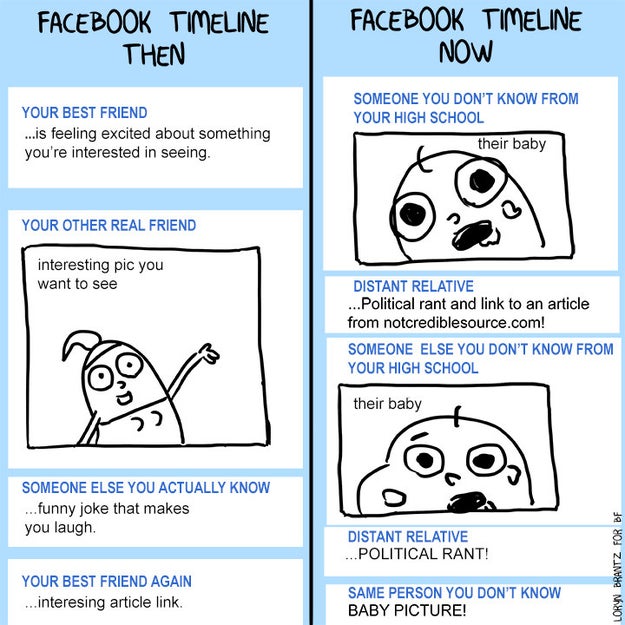
A friendly PSA: you can block your slightly racist uncle without unfriending him.

It’s natural to want relief from the constant stream of online news, engagement announcements, baby updates, and the five-year-old memes your dad keeps posting. You may not be ready to unfriend your cousin who keeps sharing fake news (no, Vin Diesel is *not* relocating to Saskatoon, Saskatchewan), or your slightly racist uncle But you can, at least, politely and — most importantly, discreetly — remove them (and/or the offending news site) from your news feed.

To be clear: I am not suggesting that you should block everyone who disagrees with you from your news feed. That would only intensify the filter bubble/echo chamber Facebook’s algorithms have already created on your behalf. But, every once in a while, it&;s nice to take a break. Here are a handful of simple ways to make your feed more manageable.

Loryn Brantz / BuzzFeed

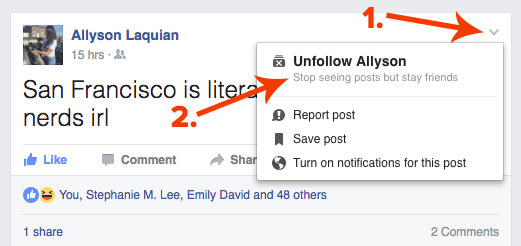
If you don’t want to see posts from certain individuals.

If you don’t want to see posts from certain individuals.

You don’t have to deal with the dramz of unfriending them&; Click that downward arrow, select Unfollow [Person’s Name], and — BOOM&033; — they outta there. Forever. Until you follow them back. That’s it&033;

Nicole Nguyen / BuzzFeed News

If you want to see more stuff from people and pages you actually like, generally.

If you want to see more stuff from people and pages you actually like, generally.

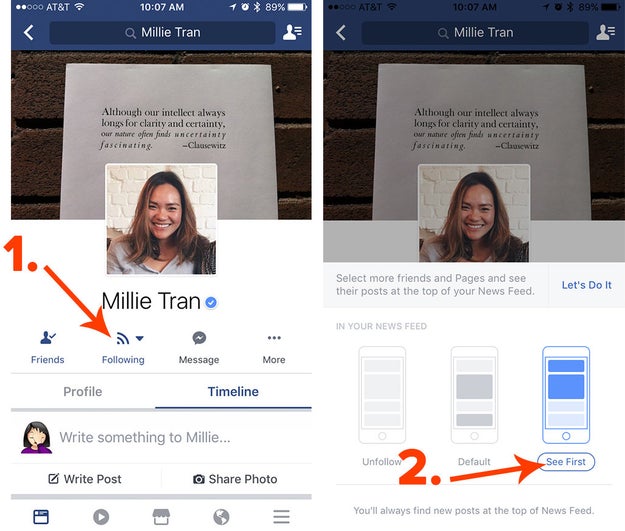
The See First feature is the best way to tell Facebook what you actually want look at in your news feed. It’s also a great way to point the site’s algorithms to high-quality content from friends, public pages, and news organizations you trust.

From a desktop computer, you can mark someone as See First on their page, on the bottom right corner of their cover photo. On mobile, from their profile tap Following and then See First. You can mark a page (like BuzzFeed News’s or Beyoncé’s) by clicking on Following and then See First. You’re limited to 30 people or pages. And, no, they won’t be notified that you’re ~really into~ their posts.

Posts from those people or pages will appear first, before anything else in your News Feed. On desktop, manage these by going to your news feed and on the left column, hover your mouse over the ellipses next to News Feed and click Edit preferences, then Prioritize who to see first.

Nicole Nguyen / BuzzFeed News

On any post, tap the downward arrow, select Hide post. You should then see a small box after the hidden post is collapsed. Next, click See less from [Person’s Name].


View Entire List ›

Quelle: <a href="Here’s How To Make Your Facebook News Feed Less Miserable“>BuzzFeed

Even Good-Guy Student Loan Startups Still Favor the Rich

Even Good-Guy Student Loan Startups Still Favor the Rich

Last February, the online lending company SoFi paid $5 million for a 30-second ad during the Super Bowl. The spot begins at a busy city crosswalk, panning from person to person as the narrator assesses their worth. “Jim is great. Sarah is not great at all,” a male voice intones as the focus swoops from a white dude to a white woman. “This guy? Never been great,” the narrator continues, as the camera settles on a smiling bro, who has no idea he just failed a financial test. The commercial ends with an order: “Find out if you&;re great at SoFi.com.”

That wasn’t where it always landed. The original version of the ad included three more words: “You’re probably not.” But at the last minute, SoFi cut them. The message, a spokesperson told Adweek, wasn’t “authentic” to the company’s image.

youtube.com

The line may have sounded too crude for national TV, but it was actually a perfect encapsulation of SoFi&039;s brand. Most people aren’t in great financial shape, and SoFi was built around identifying the best and rejecting the rest. Other Silicon Valley-backed startups specializing in student loan refinancing, including Earnest and CommonBond, followed in SoFi&039;s wake. All of these online lenders promise a faster, easier, more data-driven way to refinance student loans online, but they can only offer cheaper rates by courting the kinds of customers who have no trouble paying off their loans in the first place: doctors, lawyers, pharmacists, and MBAs in their early to mid thirties, who went to good schools and have good jobs but are still paying off major loan balances. SoFi even has a catchy nickname to describe its ideal demographic: HENRYs (high earners, not rich yet).

Last spring — after biting its tongue at the Super Bowl — it plastered public bus stops in San Francisco, a city still suffering an affordable housing crisis, with posters that said, “10% down. Because you’re too smart to rent.” In New York, it greeted subway riders with an ad that said, “Six figures is for your salary, not your student loans.”
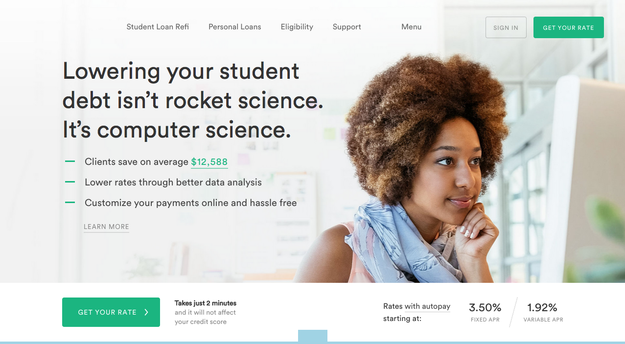
Marketing for student loan refinancing on Earnest’s website. / Via earnest.com

These high-end customers base (and their very attractive debt) have attracted big-league investors like investment banks (who give startups like SoFi lines of credit to support their lending operations), and the insurance companies, long-term mutual funds, and hedge funds that ultimately buy the loans. (Just like mortgages, student loans can be pooled together so that they are easier to sell. Investors are buying the future income stream of monthly repayments and interest.) In May last year, SoFi received Moody’s highest rating, AAA, for a $380 million bond backed by student loan repayments. On Thursday, SoFi became the first student lender to get a AAA rating from S&P, this time for a $561 million bond. SoFi has refinanced $9.76 billion worth of student loans since it launched and offered $2.7 billion in bonds in 2016 alone.
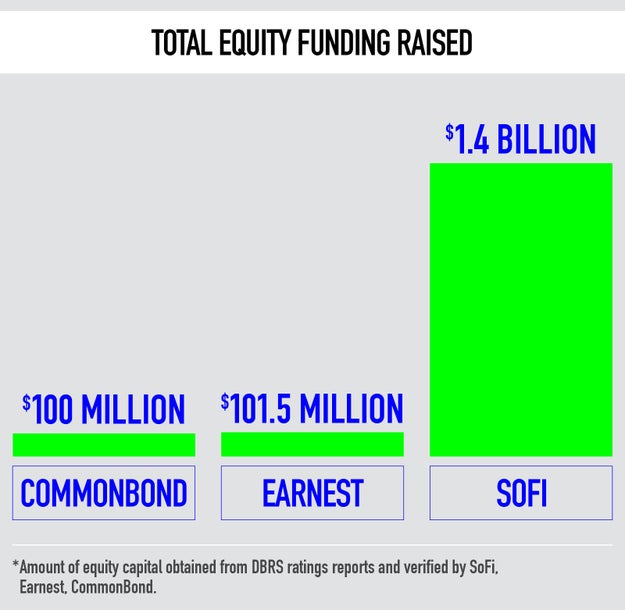
BuzzFeed News

President Donald Trump has hinted at potential changes to the student loan system, including increased reliance on private lenders over the federal government. Ben Miller, senior director for postsecondary education at the Center for American Progress, told BuzzFeed News that he doesn’t “expect much leadership” from Betsy DeVos, Trump’s pick to run the Department of Education, who also happens to be an early investor in SoFi. “There&039;s no evidence Betsy DeVos knows a single thing about student loans and any major change would have to come from Congress,” said Miller.

But Silicon Valley has not been waiting around for Washington. In their buzzy ad campaigns, SoFi, Earnest and other fintech startups say they want to help fix the student loan crisis by bringing Silicon Valley-style meritocracy to one of the oldest financial instruments in the world, the loan. In practice, however, private student loan refinancing looks more like an updated version of the same wealth management services that have always catered to the rich — except these startups capture customers while they’re still young.

In some ways, especially in the eyes of critics, these companies&039; closest analogue isn&039;t a traditional bank but a startup like Uber — but instead of on-demand private drivers undermining the public transportation system, it’s refinancing for the rich masquerading as a solution for the dire student loan crisis that has left most graduates burdened with debt for decades to come. Last year the Wall Street Journal published a profile of SoFi called “The Uberization of Banking,” which asks and answers its own question: “But isn’t SoFi cherry-picking loans? Absolutely.”

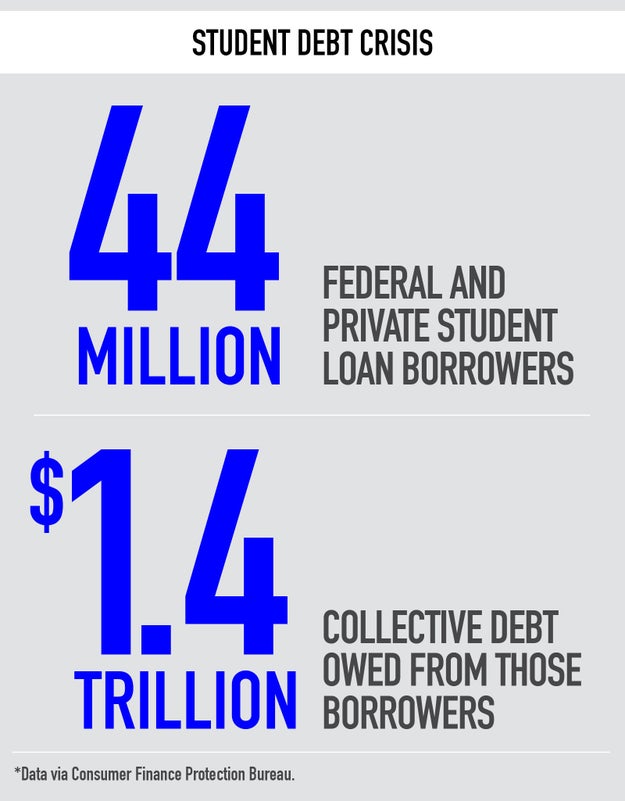
The problem these startups purport to solve is, inarguably, a huge one. Forty-four million Americans currently owe more than $1.4 trillion in student debt. That’s $1.4 trillion dollars hanging over 44 million heads, and, for those who can’t repay their loans, it’s a lifetime of ruined credit scores and dodging collections agencies.

Most of that debt comes from federal student loans, which all have the same, relatively low, interest rate, assigned by the government each year. SoFi, Earnest, and CommonBond’s innovation is promising a rate even lower — as low as 2 or 3% — though only to the kind of borrower who can reliably be trusted to pay off such a loan. SoFi CEO Mike Cagney got the idea for the company when he learned that Stanford MBAs almost never default on their student loans. When the company launched in 2011, its services were only available to this group.

But though sorting would-be borrowers by school alone may have been a simple way to identify HENRYs, it was a controversial one. Consumer advocates, regulators (and the aforementioned Journal article) have called this selection process “cherry-picking” or “cream-skimming” the best borrowers from the federal loan program. So these days, the pitch to both consumers and the press is less about borrower pedigree than data science, algorithms, and detailed new metrics for credit scoring (such as replacing “debt-to-income ratio,” a benchmark used by traditional lenders, with “free cash flow,” a more granular criterion that shows money available after expenses like rent). Take Earnest, which is sort of like the Lyft to SoFi’s Uber — smaller, friendlier, and less likely to dominate the world. The company says its “merit-based” lending algorithms analyze 80,000 to 100,000 data points per client. The average Earnest borrower shares read-only access to six accounts, including their bank, investment, and retirement accounts.

According to the company’s CEO, Louis Beryl, this allows Earnest to price more accurately and ultimately lend to more borrowers, identifying worthy candidates across a wider credit spectrum. By scanning tons of data, the logic goes, online lenders can see past a blip on your record. Earnest&039;s website, for example, claims that profile information “is run through a series of predictive analytics and algorithms to find people who show great financial responsibility and potential.” And Beryl is fond of saying his company has the least biased lending algorithms in America. “You could be low-income, but if your expenses are very low and you’re a good saver that’s fine,” he told BuzzFeed News. “You could have gone to any school, you could have any type of employment. What we think is that our system is actually much more fair.”

CommonBond, which introduced a “multi-variate underwriting model” in 2015, told BuzzFeed News a similar story. The company’s goal “has always been to have the broadest impact possible on the student debt crisis,” said Phil DeGisi, CommonBond&039;s vice president of marketing. “We want to help as many people as possible save.”
BuzzFeed News

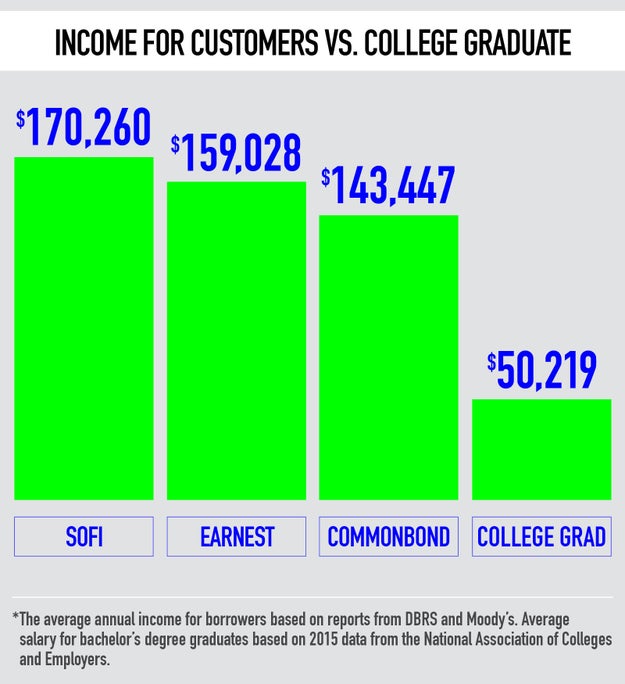
But although the marketing has changed, the demographics have not. Ratings reports from the past four months show that the average Earnest borrower is a 32-year-old with an annual income of $143,447 and monthly free cash flow after expenses of $4,524. CommonBond’s average borrower is 33 years old with an annual income of $159,028 and $5,996 in monthly free cash flow. SoFi&039;s average borrower, in the new bond with the AAA rating from S&P, is 34 years old, with an annual income of $170,260 and free cash flow of $7,088. (Most graduates saddled with student loan debt don’t fit that description, which is why applicants for private refinancing often need their creditworthy parents to cosign, a caveat that doesn’t get mentioned in the ads.)

In fact, one former Earnest employee, who spoke to BuzzFeed News on the condition of anonymity, said that promoting detailed data analysis made applicants with a mark against them feel like they had a better chance. “Our team was coached to be deliberately obscure when it came to explaining the eligibility requirements,” such as FICO scores, the ex-employee said. “Not being able to be completely honest with the person on the other end of the phone was the hardest part of my job, especially when it meant giving them a sense of false hope, wasting their time, and further damaging their ability to obtain credit.”

As it turns out, building a more equitable way to refinance student loans — while still turning a profit — is harder than it sounds. All lenders are in the business of being paid back, of course. But unlike banks that can easily use money from deposits, refinancing startups need to be able to borrow money cheaply in order to buy the loans in the first place. And those traditional financiers expect traditional metrics, not “free cash flow.” To hear critics and consumer advocates tell it, new metrics are more about window dressing to differentiate fintech companies from banks — and from each other — than about substantively changing underwriting.

Kevin Reed, chief operating officer at Peer IQ, a risk analysis firm focused on online lending, said the emphasis on new metrics is aimed at venture capital investors, not institutional investors. “When you’re pitching Silicon Valley, you need an angle, some competitive differentiation,” he said.
Data via Consumer Finance Protection Bureau.

BuzzFeed News

Others are skeptical that testing different metrics can be meaningful when the borrowers are so high-quality to begin with. “When you’re only playing in the very very top of the market, a lot more data really is not going to influence your decision,” said Brendan Coughlin, executive vice president of consumer lending at Citizens Bank, a Boston-based bank that is quickly gaining ground on SoFi in student loan refinancing. “It’s going to be hard to get to a point where you’re not going to approve [applicants] based on other information.”

In fact, one of the strongest signals that these online lenders are focusing on elite borrowers is the fact that banks like Citizens, which jumped in to compete in the refinancing ring, have a similar customer base but don’t use cutting-edge technology to find them. On an earnings call in July, Citizens’ CFO, Eric Aboaf, reassured an analyst about the quality of refinancing customers. “We&039;re talking about undergraduates to colleges that you and others and we all went to, MBA graduate degrees, doctors, lawyers, business degrees, that kind of thing,” said Aboaf, who graduated from Wharton and MIT.

Mark Huelsman is a senior policy analyst who focuses on higher education at the think tank Demos. “In an era of entrenched inequality and lack of upward mobility,” he told me, “the same things that would ding a borrower’s credit — a bout of unemployment, an inability to pay a student loan, an unlucky medical history — are the same things that any private lender would be looking at in approving a new loan.” (Refinancing federal loans with lending startups can also make borrowers ineligible for federal loan forgiveness programs, as well as the ability to discharge the debt in case of death or permanent disability.)

The way Huelsman sees it, these private lenders could end up compounding existing disparities, “if we allow a system to perpetuate where high-income students, primarily white students with graduate degrees, are receiving better rates.” For example, those borrowers may be able to get more favorable terms on a mortgage, whereas working-class students can’t access the same financial instruments. “That’s sort of the American story — wealth begets wealth.”

In Silicon Valley, the Uber approach — starting with town cars then moving down-market — is a respected means of disruption. When it comes to lending, however, the idea of catering to the luxury sedan sector of debtors undermines vital equal-opportunity protections, especially if the mass-market option never arrives. (Imagine if a new neighborhood bank advertised itself as serving no one except thirtysomething doctors and lawyers.)

Online lenders are not as restricted as banks when it comes to asking for information about their borrowers. The startups are regulated by the Consumer Financial Protection Bureau, which enforces fair lending laws to prevent discrimination based on age, race, gender, or country of origin. However, banks, which are FDIC-insured, are also prohibited from redlining, or discriminating against borrowers in low-income neighborhoods.

Imagine if a new neighborhood bank advertised itself as serving no one except thirtysomething doctors and lawyers.

Quelle: <a href="Even Good-Guy Student Loan Startups Still Favor the Rich“>BuzzFeed
This Website Wants To Be The Snopes Of WhatsApp Hoaxes In India

Akash Iyer / Via BuzzFeed India

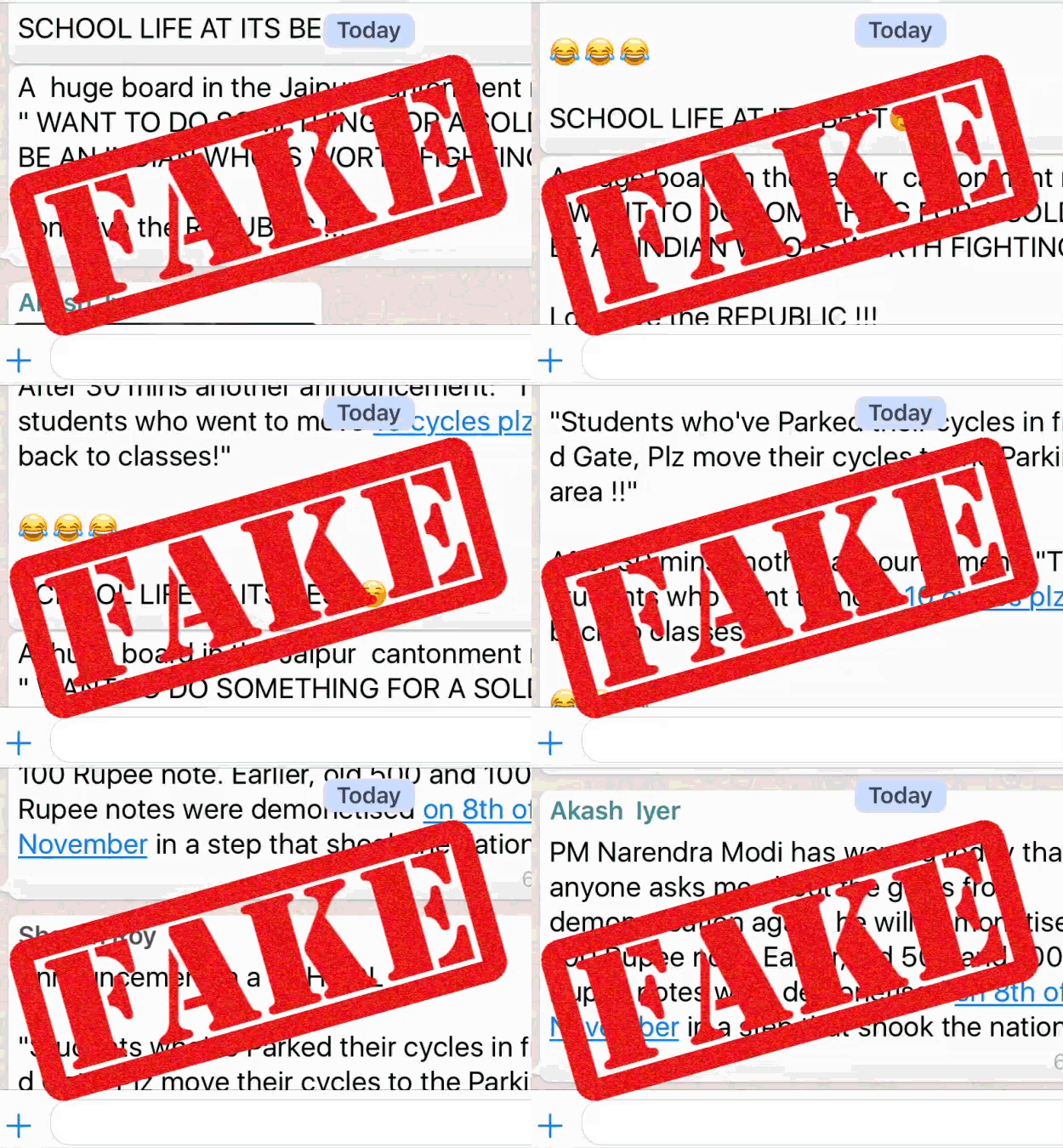
Shammas Oliyath has spent every lunch break for the last six months telling strangers all over India that a Gujarati woman didn’t really give birth to 11 babies at once, malicious Indian grocers aren’t really selling AIDS-laced fruits, Guinness hasn’t really declared Kannada the world’s oldest language, and the UNESCO certainly hasn’t named Narendra Modi as the world’s best Prime minister.

“It’s a social service,” he said. “I feel really good about clearing people’s misconceptions.”

Oliyath, a software engineer at IBM in Bengaluru, is the co-founder of Check4Spam.com, a website that focuses on fact-checking and busting viral hoaxes, urban myths, and political propaganda that are spreading on WhatsApp and rapidly becoming India’s own fake news crisis.

“We are hoping to become the Snopes of India,” Oliyath told BuzzFeed News, referring to the San Diego-based website that, in its 20-year history, has evolved from busting urban legends (Does a colony of alligators make its home in the New York City sewer system?) to fact-checking America’s 45th President himself. “We want to take the work Snopes has done and apply it in a very Indian context.”

“We want to take the work Snopes has done and apply it in a very Indian context.”

Doing that not only means debunking Indian hoaxes but also doing it on the very platform where they originate: WhatsApp. The Facebook-owned instant messenger is used by more than 160 million Indians and is by far the fastest way that misinformation spreads in the country. Last year, the Indian state turned off internet access in large swaths of the country to prevent WhatsApp rumor-mongering from inciting tensions.

Check4Spam provides a dedicated phone number for people to forward any hoaxes they receive directly over WhatsApp. On a typical day, this hoax-busting hotline gets between 60 and 70 forwards to fact-check.

Oliyath works methodically through each forward he gets, sending back links if the rumor in question has already been busted on his website, and trawling the web to verify new ones.

He usually skips the first few dozen pages of search results and starts searching from the back “because that’s often where the original real post or image on which something fake is based on exists.”

Often, he relies on what India’s mainstream press has already reported, but says that he will frequently double and triple check even traditional sources to prevent any inherent media biases from tainting his debunking.

“Sometimes, we’ll get a lot of a certain piece of fake news or a hoax, so we can actually tell which hoax is trending on WhatsApp on that day,” Oliyath said. “WhatsApp is a good barometer.”

“We can actually tell which hoax is trending on WhatsApp on that day.”

This ability to spot patterns in hoaxes is particularly useful. In the last few months, for instance, Oliyath has noticed a particular kind of hoax gaining popularity: fake promotional messages that promise free cellular data and voice minutes (including this gem where President Trump gives every Indian free mobile minutes) in exchange for clicking on a link or installing an app that inevitably turns out to be malware.

“I’m an English-speaking software engineer and I’m fairly savvy, so I can tell that things like these are fake,” said Oliyath. “But a lot of older people, early smartphone adopters, and people who don&;t read or speak English in India are often unable to tell that these promotions are fake and end up installing malware on their phones.”

Worse, Oliyath discovered that a significant number of his non English-speaking users often ended up mistaking his English debunk itself for a genuine promotion and ended up falling for it anyway. So now he writes “fake” in half a dozen Indian languages on these posts to make sure that users who don&039;t understand English know it&039;s a hoax.

Some rumors, like a recent one about buffalo-headed fish found in an Indian river, are fairly easy to bust: Oliyath ran the picture through a reverse image search and instantly found the original one (a regular fish, in case you&039;re wondering). “Most of these guys are pretty bad at Photoshop&;” he laughs.

Others are harder. Last year, when a WhatsApp forward about 275 job openings in Indian IT giant Wipro started doing the rounds, Oliyath had a Check4Spam volunteer call and email Wipro’s HR department to check if the news was true (it wasn’t).

“It’s a lot of legwork,” said Oliyath. “It’s tough to do it at scale.”

That’s the reason why Check4Spam recently started accepting debunks from volunteers over WhatsApp. “We allow anyone to volunteer,” said Oliyath. “But I do scrutinize volunteer-submitted debunks before posting them on the website.”

Oliyath said that the site currently receives half a million pageviews a month, driven largely by word of mouth (Snopes can get 2.5 million in a single day). Before Bal Krishan Birla, the site’s other co-founder came on board in July, Oliyath had been struggling to figure out a way to grow it. Birla, a serial entrepreneur and an SEO expert decided that staying topical was the key to growth.

When J Jayalalithaa, a prominent Indian politician, was admitted to a hospital in a critical condition in December, for instance, the duo stayed focused on debunking hoax messages and photographs about her death days before she actually passed away. “Once people receive a WhatsApp forward, they want to know whether it is true or not and they invariably end up looking it up on Google,” Birla told BuzzFeed News. “So SEO is important for us to grow.”

Birla lets Oliyath focus on the actual debunking and calls himself Check4Spam’s tech guy, focusing on keeping the website up and running. But he’s also drawing up a roadmap: he would eventually like to build a browser plugin to detect Indian fake news on the internet. And if WhatsApp ever lets third-party bots hook into it like Facebook Messenger, he thinks that building a fact-checking bot for India&039;s most popular instant messenger would be a terrific use case.

A fact-checking bot for India&039;s most popular instant messenger would be a terrific use case

For now, Check4Spam remains a labor of love. Both Birla and Oliyath said that they’re not looking for funding or revenue yet, mostly because their real jobs keep them busy, but might think about hiring one or two more fact-checkers to ease their load. The real motivation, they say, comes from the feedback they get.

“People are really overwhelmed when they actually send something over WhatsApp to our hotline and promptly receive a response,” said Oliyath. “I’ve had elderly strangers who are obviously new to WhatsApp thank me profusely for our service. Even if the website doesn’t grow or turn into anything significant, I’ll still bust hoaxes on WhatsApp for them.”

Want to verify a WhatsApp forward? Send it over to Check4Spam’s WhatsApp hotline at +919035067726.

Quelle: <a href="This Website Wants To Be The Snopes Of WhatsApp Hoaxes In India“>BuzzFeed

People Are Figuring Out How To Cheat Facebook To Spread Their Political Messages

You’ve probably noticed this in the last few weeks on Facebook. Maybe a friend of yours, maybe it’s even you. Someone particularly impassioned about politics, or perhaps someone who usually keeps quiet but has been moved to post all of a sudden. Perhaps the language of it doesn&;t not really seem like the way your friend usually talks.

It’s a text post, usually a pretty long one. It’s political – but more than just an opinion, a call to action. Maybe it’s instructions of how to call your local legislator, or maybe it’s just instructive in a vaguer sense of like “if you voted for [whoever], fuck off&;”

But the last line has an interesting twist: “COPY AND PASTE TO SHARE&033;”

Facebook, of course, has a way for you to share text statuses: the “Share” button. These people know that. They also know that Facebook’s newsfeed has an algorithm, and that algorithm is confusing and opaque. They know some things will get pushed to the top of their friends’ feeds, and some things won’t. The theory here is that a NEW text status, rather than a share of an existing one, will be shown more prominently.

There’s a practical design issue here too: A long text in shared post gets cut off – you have to click to “see more”. In a fresh post, more of the text shows up in your friends’ feeds.

I asked one of my Facebook friends why he was doing it. “[It] came down to how it looks when you share something that is just text on Facebook,” said Preston Olson, 40, of New Jersey. “It just shows only the first line or two. Then you have to click on it, it opens up a new page to get the full text. It’s annoying.” He had posted a long list of political actions since the Women’s March on Washington that he saw as positive (I saw other friends, completely unrelated to Olson, also copy and paste the same text).

People are revolting against the medium to get their message out. We’re starting to fight the tyranny of the feed, the sense that in a deluge of information that our friends see, our own voices won’t cut through.

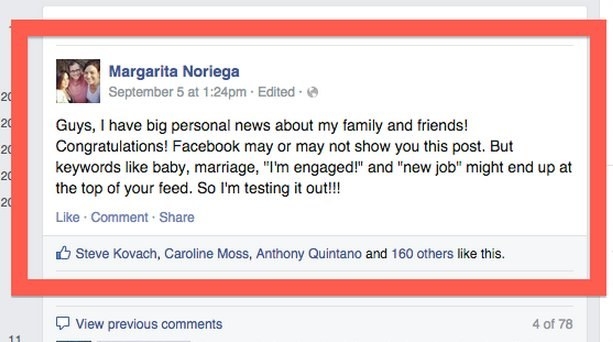
This isn’t the first time this kind of attempt to game the algorithm has happened. You may have seen a life event update that your friend Got Married, and then in the description something like, “don’t worry, Mom, I’m not really married. I just wanted to tell you all about something very important to me….” People figured out that “life events” like changing your status to engaged or married is hugely prioritized in Facebook’s algorithm, and they used that instead of a text post to write their political screed. Others noticed that even if you didn’t do the full-on “life event” but just MENTIONED words like engaged, married, ring, baby, announcement that Facebook magically knew that this was probably a life event announcement that would be prioritized.

Via businessinsider.com

Losing our voices to the chaos of the feed is a fear to more than just the politically minded among us. Remember the great chaos this spring among C-list celebrities and social media stars when it was announced that Instagram was going to switch to an algorithmic feed? They all posted asking their followers to turn on notifications for their images so that they wouldn’t miss them. Can you imagine? Getting a notification alert on your phone each time a former contestant from The Bachelor posts to Instagram? Hell is truly within our reach.

So why are we seeing this “copy and paste, don’t share&033;” Facebook meme all of a sudden? Well, for one thing, it’s got a built-in call to action to share. That does actually help things go viral. But more than anything, the last two week have stirred some sort of political passion inside people who would normally never bother posting political messages. Innovation springs from need, and these people who have been pushed over the edge into the realm of political posting have invented something new: a way to trick Facebook into pushing their message into your face.

Unfortunately, for those who are allergic to political talk on social media and have been dealing with a full year now of watching relatives and high school friends arguing back and forth, this is just making 2017 worse.

Quelle: <a href="People Are Figuring Out How To Cheat Facebook To Spread Their Political Messages“>BuzzFeed

Amazon Employees Are Trying To Force The Company To Cut Ad Ties With Breitbart

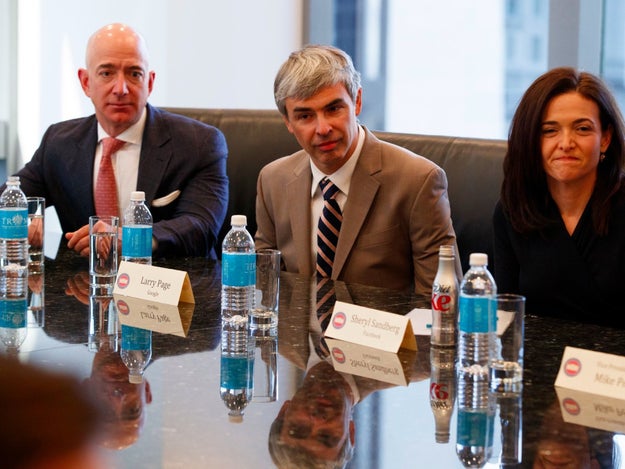
Jeff Bezos at a meeting with President-elect Donald Trump at Trump Tower in New York City, Dec. 14, 2016.

Drew Angerer / Getty Images

As Amazon positions itself as an outspoken critic of President Donald Trump’s immigration policies, inside the company, dozens of employees are voicing deep concern about another political issue: Amazon’s choice to advertise on Breitbart.com.

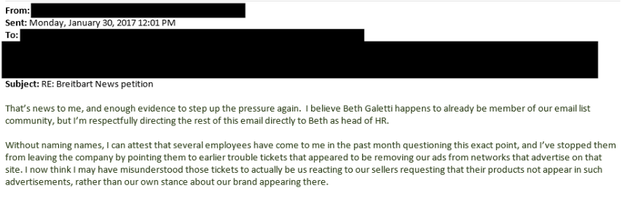
According to internal emails and documents obtained by BuzzFeed News, employees have begun voicing concerns about the company’s advertising relationship with the provocative far-right website. Some piled on to a complaint ticket in Amazon’s internal issue escalation system urging the company to sever its relationship with Breitbart, the site that former editor and now–Senior White House Advisor Steve Bannon once called “the platform for the alt-right.” Others are taking even stronger stands.

“Without naming names, I can attest that several employees have come to me in the past month questioning this exact point and I’ve stopped them from leaving the company,” one employee wrote on an email chain of worried Amazon employees.

Despite this internal unrest, Amazon has given no indication that it is changing its advertising relationship with Breitbart. Responding to the complaint ticket, Amazon’s ad team said it would not block the site from its program and closed the ticket from further responses. “As per guidance from PR/Policy/Legal, the DA team are not blocking breitbart.com,” Amazon’s ad team wrote. “As per prior guidance ‘our customers are choosing to go there. It is not our place to assume why they&;re going there, or impose our own standards.’” The ad team did specify that it was looking into a “longer term solution to use a 3rd party brand safety which may block amazon ads from showing up on certain pages on sites like Breitbart in the future.”

Amazon’s human resources department then closed the complaint ticket.

Amazon declined to comment for this story.

Currently, Amazon advertisements that appear on Breitbart are placed there programmatically, meaning they are algorithmically and automatically purchased from third party advertising exchange inventory. The ads are calibrated in such a way that Amazon customers see them on websites they choose to visit. In other words, if no Amazon customers visited Breitbart, no Amazon ads would appear on Breitbart.

While Amazon doesn&039;t have a direct relationship with Breitbart, it does choose which exchanges through which it buys and sells ads, and could potentially earn revenue from Breitbart&039;s audience. Amazon’s Associates program’s rules explicitly state that publishers using its advertising API may not “promote discrimination,” a line item that a number of Amazon employees feel Breitbart violates.

“I actually do believe Amazon does have the right to follow its customers to wherever they may spend their time online, but … I also believe that amazon employees have the right to reject profiting from and funding any website they personally disagree with,” one employee wrote in an email. “It seems evident now that for some current Amazonians, Breitbart is one of those sites.”

Amazon&039;s decision to abruptly close the Breitbart complaint ticket caused confusion among employees advocating for the company to end its advertising relationship with the site.

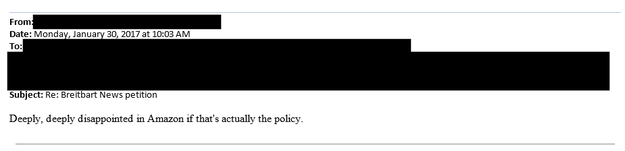
“I’m deeply, deeply disappointed in Amazon if that’s actually the policy.”

“Maybe I’m misreading this but it sounds like we’ve made a very conscious decision to keep advertising on Breitbart,” one employee wrote. Said another, “I’m deeply, deeply disappointed in Amazon if that’s actually the policy (Amazon would not confirm or deny any policies).”

In a different email on the thread, an employee worried that the decision not to distance itself from Breitbart could hurt the company in the future. “While I understand the business concerns and the current climate make talking about this kind of thing a minefield, we’re rapidly approaching the point where not talking about it will only foment bad blood, and at best we’ll start silently losing customers and employees,” the employee wrote on the internal email chain. “That’s not the Amazon I know.”

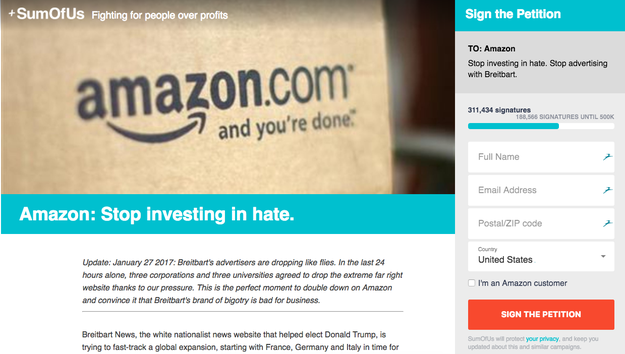
Since Trump’s election, a grassroots online protest movement has emerged that’s attempting to cut off advertising revenue to sites it feels promote racism, misogyny, and xenophobia. One anonymous organization that goes by the name of Sleeping Giants has taken to Twitter to exert pressure on advertisers, including Amazon. So far, nearly 400 advertisers, including some prominent brands like Kellogg’s, have pledged to stop ad buys on Breitbart. Externally, frustrations over Amazon’s decision to advertise on Breitbart continue to mount. A quick search of Twitter returns hundreds of tweets urging the company to “join 750+ corporations & stop advertising w/ Breitbart.” A viral petition on the activism site SumOfUs.org titled “Amazon: Stop Investing in Hate” has collected over 311,000 signatures.

The SumOfUs Breitbart petition.

This outcry comes despite Amazon&039;s pointed criticism of President Trump’s refugee ban. On Sunday, CEO Jeff Bezos denounced it in an all-hands message to employees. “This executive order is one we do not support,” he wrote. “Our public policy team in D.C. has reached out to senior administration officials to make our opposition clear. … To our employees in the U.S. and around the world who may be directly affected by this order, I want you to know that the full extent of Amazon’s resources are behind you.” On Tuesday, Amazon joined Expedia to file a sworn statement in Washington state court to aid in the state attorney general’s lawsuit against President Trump&039;s order.

But Amazon’s aggressive stance toward the Trump administration’s refugee order has left concerned employees mystified as to its relationship with Breitbart. “Given HR’s and Jeff’s latest statements on immigration executive order, keeping Amazon ads on Breitbart, a white nationalist website which has been promoting the same hateful rhetoric behind the EO, for years, is directly contradictory to the principles HR and Jeff claim Amazon stands for,” an employee wrote in an internal email. ”The current stance (from the [complaint ticket]) doesn’t make me feel safe as an Amazon employee.”

According to one employee, Bezos’s stance this week on the refugee ban has “empowered more employees to speak up and ask leadership to put their foot down.” A number of employees have asked that the Breitbart complaint ticket be reopened; meanwhile, they are encouraging further participation from employees to “chime in” and voice their opinions about the company’s advertising relationship with Breitbart. A recent internal email obtained by BuzzFeed News suggests that Amazon’s leadership is revisiting the issue. The last update on the closed ticket notes that it was being “converted to a secure ticket as we want to avoid confidential business details on a public internal forum. We are working with colleagues to determine next steps.”

Meanwhile, employees are continuing to pressure leadership with impassioned emails. “We hope for the best, but prepare for the worst,” one employee wrote on an internal email chain this week.

Another chimed in: “Rest assured our children’s children are watching us, in this moment, from the future (assuming we get there).”

Quelle: <a href="Amazon Employees Are Trying To Force The Company To Cut Ad Ties With Breitbart“>BuzzFeed

Here's What Facebook's Live Video Filter Bubble Looks Like

Lam Thuy Vo / BuzzFeed / Via facebook.com

On Jan. 25, at a speech at the Department of Homeland Security, Donald Trump officially announced his executive order to construct a wall along the Mexican border. “We are going to restore the rule of law in the United States,” the president told the room.

The speech was met with, naturally, divided reactions by the press. “Trump Flips Liberals’ Script,” Breitbart’s headline read. Right-wing blog the Gateway Pundit simply said, “IT BEGINS.” The Intercept, meanwhile, decried Trump’s executive order as “appalling” in its headline.

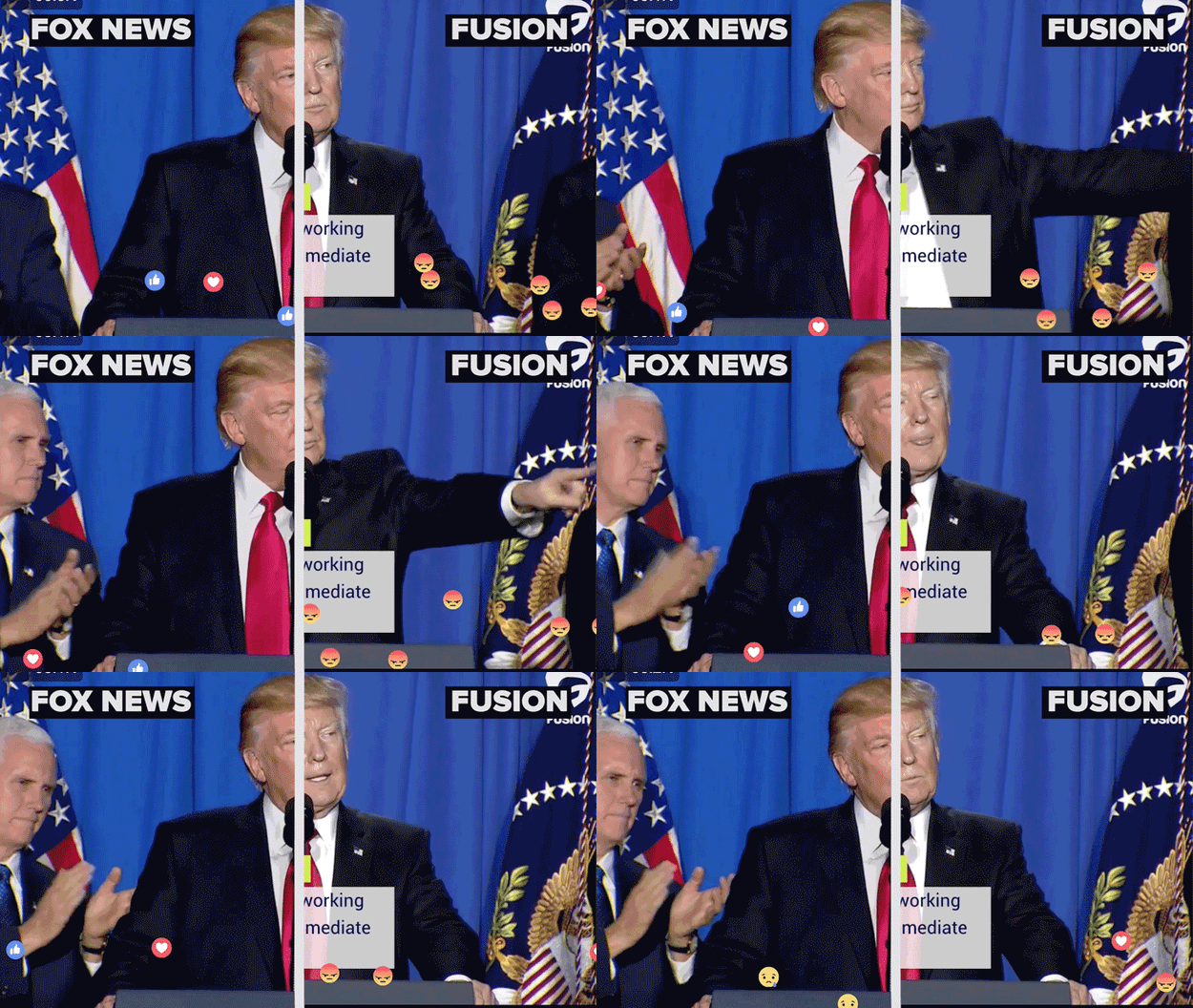
But millions of people chose to skip the media — and its attendant bias — entirely and watch the speech live, via Facebook. There, however, they were greeted with a litany of comments and emoticon reactions, all colored by the point of view of the outlet broadcasting it. As it turns out, escaping the filter bubble is harder than it seems.

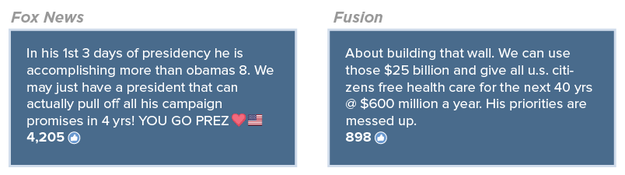
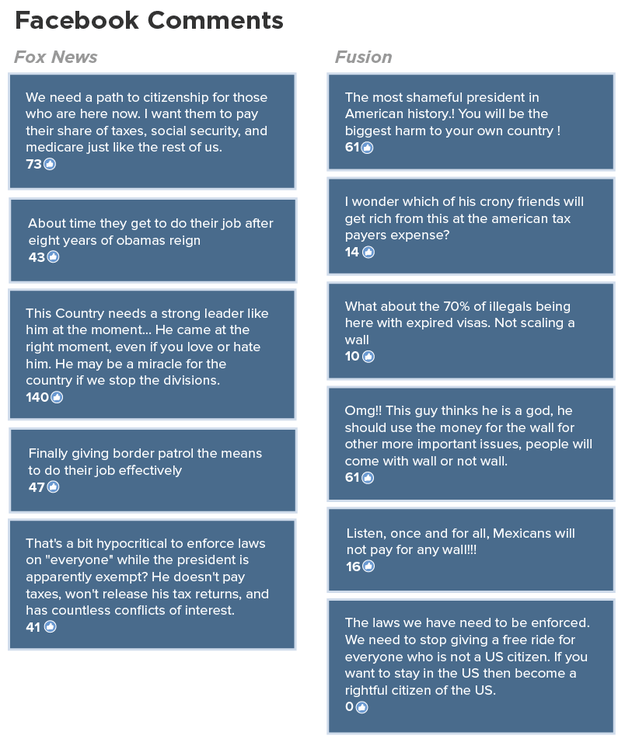
Top comments on the livestream on Fox News’ and Fusion’s Facebook pages.

To better understand how different audiences experience the same event on Facebook, BuzzFeed News video captured two different Facebook livestreams of the press conference last Thursday — one from Fox News and one from Fusion. We scraped comments from the two streams and tallied the total number of Facebook reactions (like, love, laugh, angry, sad, and wow). We also collected and compared comments from the moment of the press conference most frequently mentioned and quoted by both right and left-leaning news organizations.

First, one important caveat: The Fox stream reached significantly more people than the Fusion stream did: Fox News had 2.3 million views and 15,675 shares. Fusion had 531,000 views and 4,309 shares by the end of the day of the press conference. Only 2% to 3% of both audiences chose to comment or react to the stream. But those who did had very different emotional reactions to the same speech.

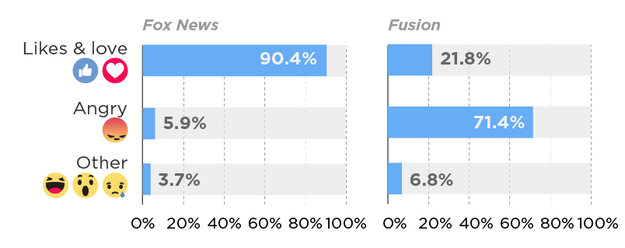
Ninety percent of the roughly 83,000 emotional reactions from Fox News Facebook watchers came in the form of “like” and “love,” with just 5.9% choosing the angry reaction. Viewers of Fusion’s Facebook livestream reacted overwhelmingly negative to the speech. Seventy-one percent of the 14,000-plus viewers who reacted on Fusion’s feed did so angrily; just 22% reacted with “like” or “love.”

Facebook Reactions to President Donald Trump’s Press Conference, by News Organization:

Facebook Reactions to President Donald Trump’s Press Conference, by News Organization:

Note: Reactions were measured seven hours after the livestreams on the Fox News and Fusion Facebook pages, respectively, on Jan. 25, 2017. Fox News’ stream received about 83,000 reactions, and Fusion&;s received roughly 14,000.
Source: Facebook.

Lam Thuy Vo / BuzzFeed News

A similar pattern follows for comments: “About time they get to do their job after eight years of Obama’s reign,” one Fox commenter posted just as Trump pledged to give the nation back control of its borders. At the very same moment, a Fusion commenter wrote, “Omg. He thinks he is a god.”

BuzzFeed News identified the most quoted portion among both right- and left-leaning news outlets to demonstrate the difference in tone between the two feeds.

Below is a side-by-side video comparison of how that quote — “A nation without borders is not a nation. Beginning today, the United States of America gets back control of its borders, gets back its borders” — played across the two feeds.

Video of Donald Trump’s Remarks About American Borders

View Video ›

video-cdn.buzzfeed.com

Source: Fox News&039; and Fusion&039;s Facebook pages

The result is something akin to a live or real-time filter bubble, where a viewer’s perceptions of a live event are colored by the commentary that surrounds it. It’s a new problem that’s as old as the cable news chyron and the online comment section, but on Facebook, it’s front and center like never before — at times literally scrawled across the viewer’s video feed. And at a time when concerns over media bias are particularly charged, it’s a potent reminder that there’s no such thing as truly raw video on Facebook.

Quelle: <a href="Here&039;s What Facebook&039;s Live Video Filter Bubble Looks Like“>BuzzFeed

Twitter Partnerships VP Ali Jafari Is Leaving The Company

Twitter CEO Jack Dorsey

Thomas Samson / AFP / Getty Images

Twitter Partnerships VP Ali Jafari is leaving the company, BuzzFeed News has learned. His next stop is Nextdoor, according to multiple sources.

Jafari, who has been with Twitter since March 2011 according to his LinkedIn profile, is the latest executive to depart under the leadership of Twitter CEO Jack Dorsey.

In the last year, Twitter has lost its COO Adam Bain, CTO Adam Messinger, head of communications Nat Kerris, among others. At the start of 2016, Twitter&;s product head Kevin Weil also decamped for Instagram.

Twitter declined to comment, as did Jafari. Nextdoor did not immediately respond.

Quelle: <a href="Twitter Partnerships VP Ali Jafari Is Leaving The Company“>BuzzFeed

Elon Musk Will Stay On Trump's Advisory Groups For "The Greater Good"

Elon Musk will remain on two of President Trump&;s advisory councils because “engaging on critical issues will on balance serve the greater good,” he tweeted Thursday, hours after Uber&039;s chief executive Travis Kalanick quit a White House advisory group.

“Advisory councils simply provide advice and attending does not mean that I agree with actions by the Administration,” Musk said Thursday on Twitter, one day ahead of the first meeting of an economic advisory group he sits on.

Musk had fielded some criticism over his decision to sit on an economic advisory group and another manufacturing-focused council under Trump&039;s administration. At least a handful of customers canceled their Model 3 orders over Musk&039;s relationship with Trump, BuzzFeed News reported.

The tweet reaffirms Musk&039;s belief that he can “serve the greater good” by sitting on the council. Still, today would have been an easier day for Musk to ditch the advisory groups: Uber CEO Travis Kalanick dropped out of the economic advisory group a few hours earlier after backlash from customers and Uber employees. Kalanick said in a memo to staff announcing his departure from the group that he did not intend for the decision to join the group to serve as an endorsement of Trump or his agenda, but it had been “misinterpreted” as such.

Musk rebutted the idea that joining the group was an endorsement in his tweet, and said he would object to Trump&039;s controversial immigration ban in the meeting.

Quelle: <a href="Elon Musk Will Stay On Trump&039;s Advisory Groups For "The Greater Good"“>BuzzFeed

Snapchat Wants Its Workers To Call Each Other Out For Food In Their Teeth

Snapchat CEO Evan Spiegel

Michael Kovac / Getty Images

Letting a coworker know they have food stuck in their teeth might be “a little awkward,” but that kind of candor is an important facet of the creative culture at Snapchat, the social app&;s parent company revealed on Thursday.

The company, Snap, offered this detail as part of a legal prospectus it filed in anticipation of its IPO. The document, geared toward prospective investors, contained financial information and warnings about possible risks, as well as a series of diagrams showing how to navigate Snapchat&039;s sometimes-baffling interface. But some of the most intriguing disclosures pertained to the culture of the famously secretive company.

Like many tech startups, Snap sees itself as more than just a place where workers punch a clock and collect a paycheck. Instead, the company says, working at Snap means adhering to a particular code of values and beliefs.

“Our team is kind, smart, and creative,” the IPO prospectus reads. “When we say &039;kind,&039; we mean the type of kindness that compels you to let someone know that they have something stuck in their teeth even though it’s a little awkward.”

“We care deeply about kindness because we want to create a space that helps to give our team the courage to create,” the company continued. “We think our team feels comfortable creating new things because they are surrounded by the kindness of their peers and know they have our support.”

But working at Snap doesn&039;t just mean being vigilant about your colleagues&039; oral hygiene. Given the sprawling nature of the company&039;s network of offices, the prospectus says, some employees may not even get the chance to interact at all.

While Snap&039;s main offices are in the Venice neighborhood of Los Angeles, workers are spread across “many office buildings that are dispersed throughout the city,” according to the company. Among the potential side effects? Sadness, isolation, and quitting.

“This diffuse structure may prevent us from fostering positive employee morale and encouraging social interaction among our employees and different business units,” the company says.

“Moreover, because our office buildings are dispersed throughout the area, we may be unable to adequately oversee employees and business functions,” the company continues. “If we cannot compensate for these and other issues caused by this geographically dispersed office structure, we may lose employees, which could seriously harm our business.”

Outlining risks like this is standard practice for a company preparing to go public. Another risk, the company revealed, stems from its own success.

“We have many current employees whose equity ownership in our company gives them a substantial amount of personal wealth,” Snap says in the prospectus, noting that many employees could grow even wealthier after the IPO.

“As a result, it may be difficult for us to continue to retain and motivate these employees, and this wealth could affect their decision about whether they continue to work for us,” the company says.

Still, Snap makes an effort to keep employees happy and loyal. It says it has a “Snap-a-Wish” financial support program, which in the past has provided last-minute plane tickets for an employee during a family emergency, and a rental car to an employee whose car was stolen.

In addition, Snap holds a biweekly “Council” program that lets employees “express themselves and listen to others.”

“We believe that this type of sharing teaches and reminds our team to listen and learn from those around them,” the company says.

Quelle: <a href="Snapchat Wants Its Workers To Call Each Other Out For Food In Their Teeth“>BuzzFeed

10 Big Numbers From Snapchat's IPO Filing

Scott Eisen / Getty Images

Snapchat will soon be traded on the New York Stock Exchange, with its parent company Snap Inc. publishing the paperwork for its initial public offering on Thursday. The company is seeking to raise $3 billion by selling shares to investors. .

The IPO filing revealed all sorts of new information about Snap, giving the public detailed information about the financial health of the company for the first time, among other juicy details. Here are the 10 most essential details from the filing.

1. Snapchat’s daily user growth is flattening

As BuzzFeed News reported Wednesday, Instagram recently overtook Snapchat in the critical time-spent-per-user category. Snap’s filing contains even more concerning details for investors: daily active user growth is flattening, meaning the company may have hit a growth ceiling. “The growth in Daily Active Users was relatively flat in the latter part of the quarter ended September 30, 2016,” the filing said.

The flattening user growth Snap describes coincides with the rise of Instagram Stories, a near-direct clone of Snapchat’s Stories product.

2. Snap lost $514.6 million in 2016

Startups are often comfortable losing money in the pursuit of growth, and Snap is no different. The company generated $404.5 million in revenue in 2016, and reported $924.9 million in expenses. While its 2016 revenue was almost seven times greater than in 2015, Snap warned prospective shareholders that it “may never achieve or maintain profitability.”

3. Spectacles were not a big money maker

Spectacles “has not generated significant revenue for us,” Snap said in the filing. When Spectacles came out, some wondered whether the video-capturing sunglasses were a major new product for Snap or a brilliant marketing device. It seems like it might be the latter.

4. We still don’t know the valuation Snap is seeking

All the details Snap provided will help investors learn more about the company, but the key detail, the amount Snap believes it’s worth, is missing at this point — which isn’t surprising. Snap is expected to release this information in a revised prospectus in the coming weeks. If Snap aims too high, it could end up in a situation similar to Twitter, which has spent its post-IPO existence trying to live up its IPO valuation.

5. Evan Spiegel will own about a quarter of Snap.

The Snap CEO currently has a 22.4% stake, the prospectus shows. After the IPO, he’ll get a special bonus — a “CEO award” — of an additional 3% of the shares.

6. New shareholders will have no say in running the company

Snap’s founders, Spiegel and Robert Murphy, currently control a combined 88.6% of the company’s voting stock, according to the prospectus. The company is selling only one class of stock in its IPO, and these shares will have “no vote on matters submitted to our stockholders.”

“Mr. Spiegel and Mr. Murphy, and potentially either one of them alone, have the ability to control the outcome of all matters submitted to our stockholders for approval,” the IPO document says. This set-up is similar to ones used at Google and Facebook that let the company’s founders control it with little-to-no input from other investors.

7. Snapchat will spend $2 billion on Google services in the next five years

The company has committed to $2 billion of spending on Google&;s services in the next five years, and is very dependent on Google. Snap warned potential investors it has “built our software and computer systems to use computing, storage capabilities, bandwidth, and other services provided by Google, some of which do not have an alternative in the market.”

8. Spiegel borrowed $15 million from Snap last year.

The Snap CEO borrowed the $15 million in February 2016, on top of $5 million he had previously borrowed from the company, according to the prospectus. He repaid the loans before the end of the year.

9. Snap paid $890,339 to protect Spiegel last year.

The bill for the CEO’s personal security was bigger than his $503,205 salary, but not as big as his $1 million bonus.

10. Snap has been very friendly to Evan Spiegel’s dad’s law firm.

Snap has paid hundreds of thousands of dollars for legal services from the Los Angeles corporate law firm Munger, Tolles & Olson, where Evan Spiegel’s dad John Spiegel is a partner. While the elder Spiegel hasn’t done any legal work for the company, it has paid almost $650,000 for legal work in the past three years.

Quelle: <a href="10 Big Numbers From Snapchat&039;s IPO Filing“>BuzzFeed