Netflix May Soon Sell New Merch For Hit Shows Like “Stranger Things”

Netflix

Barb from Netflix&;s hit series Stranger Things may be the new Barbie. Netflix seems to be considering making toys and other merchandise based on its original shows and movies.

According to a job posting on its website, Netflix is searching for a senior manager of “Licensing, Merchandising and Promotion,” who will “own licensing of our content across the category landscape (eg. books, comics, gaming toys, collectibles, soundtrack and apparel) including ownership of relationship with retailers and suppliers across geographies.” The job listing says that the new manager will bring the merchandise to online and physical markets.

Netflix currently sells “Stranger Things” merchandise through Hot Topic, but the hiring of a senior manager of merchandise may indicate it&039;s looking to expand production and sales of clothes, toys, and other branded goods based on its content.

Bloomberg reports that Netflix has also asked its partner studios, such as Trigger Street Productions and Lionsgate Television, which have made popular series like House of Cards and Orange Is the New Black, respectively, to share revenue from licensed merchandise. Stranger Things was one of Netflix&039;s first hits made at its own studios. The company has also produced the family sitcom “The Ranch” and the talk show “Chelsea” with Chelsea Handler in-house, and it plans to release the self-explanatory “Comedians in Cars Getting Coffee” this year. Netflix has said it will release 1,000 hours of original content, produced in-house and by partners, in 2017.

The streaming company would be following in the steps of major studios like Disney and 20th Century Fox by stepping up its merchandising efforts. According to Bloomberg, Disney&039;s consumer division — which administers the studio&039;s theme parks, toys, clothes, and other products — had sales of $1.5 billion in Q4 2016. It&039;s not a new approach, either: Variety reported in 2013 that merchandise from The Simpsons alone had earned 20th Century Fox $4.6 billion during its 25-year lifespan.

Netflix might not be looking solely for revenue with licensed goods, though. In the merchandising manager job description, the company wrote, “We want licensed merchandise to help promote our titles so they become part of the zeitgeist for longer periods of time.” A t-shirt is a walking advertisement, after all.

Netflix did not immediately respond to request for comment.

Quelle: <a href="Netflix May Soon Sell New Merch For Hit Shows Like “Stranger Things”“>BuzzFeed

When The Senate Silenced Elizabeth Warren Last Night It Gave Her A Massive Day On Social

When The Senate Silenced Elizabeth Warren Last Night It Gave Her A Massive Day On Social

Sen. Elizabeth Warren was forced to stop talking in the Senate yesterday, but her voice is now booming on social media.

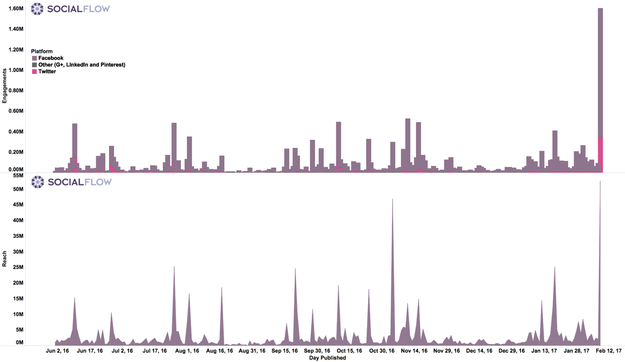
Over the past 24 hours, the Senator has been discussed more on social media than she had been in any single day since at least June 16 2015, according to the social analytics firm SocialFlow.

The data shows that Senate Majority Leader Mitch McConnell&;s use of a rule to silence Warren instead sent her words booming across the internet. McConnell invoked the rule, against assailing the “conduct or motive” of a senator, as Warren argued against Sen. Jeff Sessions in his nomination to be attorney general.

“When you look at a typical day in the social media life of Elizabeth Warren and look at what happened over the past 24 hours, she went through the roof,” SocialFlow spokesperson Mark White said in an interview. “It made her a superstar.”

Discussion of Elizabeth Warren spikes following her Senate showdown with Mitch McConnell

SocialFlow

SocialFlow, software that many publishers use to manage their social media presence, said 1,124 articles about Warren were posted to the social platforms it tracks on Wednesday.

Still, Warren has a long way to go to catch up to President Trump. In January, SocialFlow registered more than 2 million posts to social media platforms, and Trump, White said, is regularly the subject of many thousands of them each day.

Warren also went live on Facebook after walking out of the Senate chamber, reading the anti-Sessions letter penned by Coretta Scott King decades ago that she was prevented from reading on the Senate floor. That video has been viewed nearly 9 million times.

View Video ›

Facebook: video.php

LINK: Why Mitch McConnell Used A Senate Rule To Silence Elizabeth Warren

Quelle: <a href="When The Senate Silenced Elizabeth Warren Last Night It Gave Her A Massive Day On Social“>BuzzFeed

Oracle Employees Are Asking The Company To Oppose Trump’s Immigration Order

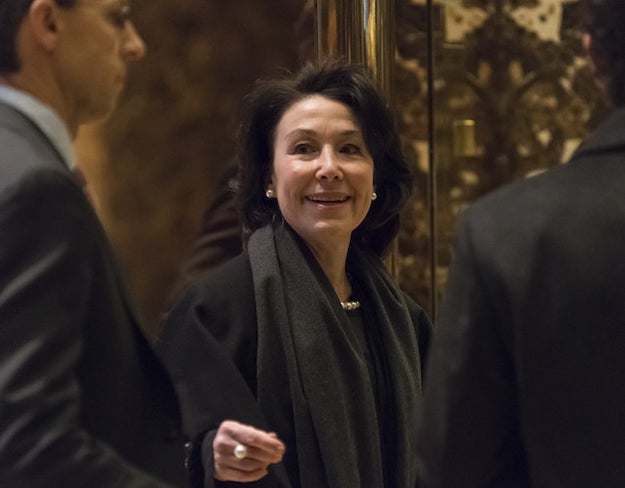
Oracle CEO Safra Catz is seen in the lobby of Trump Tower in New York, NY, USA on December 14, 2016. Credit: Albin Lohr-Jones / Pool via CNP /MediaPunch/IPX

Albin Lohr-jones / Albin Lohr-Jones/MediaPunch/IPx

Oracle employees concerned about the company&;s silence on President Trump’s executive order on immigration are circulating a petition on the issue. So far, 366 individuals have signed the letter, asking Oracle — whose CEO, Safra Catz, served as an advisor on Trump’s transition team — to add its name to an amicus brief in support of a lawsuit against the order by Washington state Attorney General Bob Ferguson.

“We want them to stand with the other leaders in tech that have taken a firm stance on this,” said Oracle employee Irene Scher, who posted the petition to Coworker.org. “Oracle has been built on the backs of many immigrants. The company is incredibly diverse. That’s one of my favorite things about it, and I think it makes sense for them to get involved as others have.”

Neither Oracle nor IBM — whose CEO serves on Trump’s economic advisory council — has signed on with a coalition of 130 tech companies opposing President Trump’s immigration order, which is currently on hold as its legality is debated in appellate court.

Employees at both IBM and Oracle have resigned over ties between their CEOs and Trump.

Created by Oracle employees Rachel Kane, Irene Scher and Lara Beers, the petition currently has just 377 signatures — small compared to the over 1,800 that have amassed beneath the IBM petition, and minuscule compared to Oracle’s global staff of 140,000. But the three are hopeful that it will gather momentum and carry concerns about Trump’s immigration order to management’s ears.

The Oracle petition, which is being circulated internally and on Coworker.org, is gaining momentum among employees who&039;ve been trying to send a similar message of concern to the company’s leadership. “What I&039;ve heard from other employees is, because we have people in leadership who are immigrants themselves, it’s an opportunity for Oracle to be a leader to stand up and talk about this executive order being so far reaching and broad,” Beers said.

The petition’s authors cited Tesla and SpaceX founder Elon Musk as an example of a tech leader who agreed to advise Trump, but has nonetheless added Tesla and SpaceX to the list of tech companies that oppose the immigration order. “It was inspiring to see that Elon Musk, despite being on the transition team, signed on behalf his companies. So we’re hopeful Oracle will take a similar stance,” Scher said.

Even if the company doesn’t take a stance, Beers hopes the petition will at least elicit greater transparency between management and employees. “I think it would be great to know why they aren’t joining our peers,” she said, “why Oracle feels we shouldn’t be joining them and standing against the executive order.”

Oracle did not respond to a request for comment.

Quelle: <a href="Oracle Employees Are Asking The Company To Oppose Trump’s Immigration Order“>BuzzFeed

Pittsburgh Mayor Says He Is In A “Cooling Off” Period With Uber

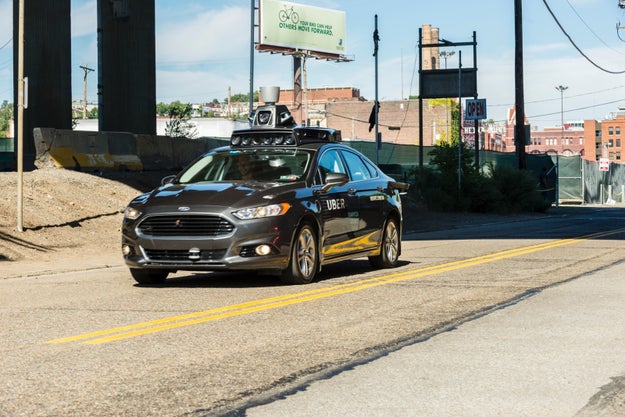
A self-driving Uber test car in Pittsburgh.

Afp / AFP / Getty Images

Pittsburgh Mayor Bill Peduto – whose city was the first to host Uber’s self-driving car pilot program – says he is in a “cooling off” period with the ride-hail giant and is “opening up” to other autonomous vehicle companies.

Peduto told BuzzFeed News that in the last year and a half of working with Uber, the city has catered to the company’s requests and welcomed its self-driving pilot. Now, Peduto says, the city is looking for something in return.

Peduto doesn’t have a list of specific demands, but says he expects the company to be a better partner with the city. “Our vision for Pittsburgh needs to be your vision for Pittsburgh as well,” he told the company.

“You’ve already given your asks and we delivered,” Peduto told BuzzFeed News during the NewShift Co Forum in San Francisco on Wednesday, referencing Uber. “Now these are our asks. Every time we ask, you’re saying no.”

Peduto, who spoke on Wednesday in San Francisco at the NewShift Co Forum, an event that brought tech leaders and policy wonks together to discuss both business and the current political climate, said he was not planning to visit Uber’s headquarters while in the city.

In a statement to BuzzFeed News, Uber said it is “incredibly proud of our work in Pittsburgh.”

“Since we set up shop in 2015, we’ve brought hundreds of high tech jobs to the city and invested millions of dollars in the local economy,” the statement said.

Pittsburgh isn’t satisfied with what Peduto has called a “one-way” relationship with Uber, the mayor told the Pittsburgh Post-Gazette last week. “I need to see more interest from them in our communities, both locally and internationally,” he said. Peduto said he does not plan to ask Uber to leave Pittsburgh. (The company employs at least 700 people at its Advanced Technologies Center there, after poaching researchers away from Carnegie Mellon University.) But Pittsburgh is “opening up” to other autonomous vehicle companies.

“We’ve had conversations with several other industry leaders,” Peduto said. Pittsburgh is, after all, home to Carnegie Mellon’s robotics research centers, and has served as a testing ground for autonomous vehicles for more than a decade. “We can bring other companies in, and we will.”

For example, Peduto told BuzzFeed the city turned to Uber for financial support for an autonomous road project it planned to propose to help win a federal grant contest. “They balked at it and came back with a proposal simply to benefit them, which was ridiculous,” Peduto said. (Emails obtained by PennLive show Pittsburgh asked Uber to pay $25 million to help fund the project, and in exchange offered five years of exclusive rights to operate along a proposed busway.)

Uber could also demonstrate its involvement in the community by creating a coding academy in Pittsburgh, Peduto said. “Create models in the cities you’re partnering with to provide opportunity to all,” he said.

About three months after Uber began putting passengers in self-driving cars in Pittsburgh, it expanded the pilot program to San Francisco. But on the same day it launched in San Francisco, a state regulator threatened legal action against the company for failing to obtain the proper permits, and then revoked Uber’s car registrations, halting the program. Uber then shipped its cars to Arizona.

Peduto said he last spoke with Uber on Monday.

“I’m hoping, and the conversation we had with them, is that 2017 will be much better than 2016,” he said.

Quelle: <a href="Pittsburgh Mayor Says He Is In A “Cooling Off” Period With Uber“>BuzzFeed

Alongside Trump, Intel Reannounces Arizona Factory It Promised To Create During Obama Years

Intel CEO Brian Krzanich visited President Trump at the White House Wednesday and announced a $7 billion investment in a semiconductor factor in Chandler, Arizona that he claims will employ 3,000 high-wage workers at the height of production.

Dubbed Fab 42, Intel&;s Chandler factory will build some of “the most advanced 7-nanometer semiconductor chips on the planet,” Krzanich said, adding that the company&039;s investment in the factory is also an investment in American manufacturing. Intel — which announced layoffs of some 12,000 employees in 2016said the facility will create “approximately 3,000 high-tech, high-wage jobs” and “more than 10,000 total long-term jobs in Arizona.”

“We&039;re very happy and I can tell you the people of Arizona are very happy,” President Trump said of Intel&039;s factory announcement.

Today marks the second time Intel has announced Fab 42 alongside a sitting US President. In February of 2011, the company announced Fab 42 during a visit to an Intel facility by President Obama. At that time it said the facility would “create thousands of construction and permanent manufacturing jobs,” with a scheduled completion date in 2013.

Asked about the timing of Intel&039;s investment at the White House Wednesday, Krzanich said that Intel held back on “doing this investment until now.” Asked why Intel chose to make the announcement at the White House, he said, “It&039;s really in support of the tax and regulatory policies that we see the administration pushing forward,” according to the pool report.

In an email to Intel employees, Krzanich explained the company&039;s rationale for the Chandler factory investment. “We’ve maintained this U.S.-based manufacturing even
though approximately 80 percent of our product is sold outside the United States —we’re one of the top 5 exporters and top 2 R&D spenders in the U.S. — and despite the fact that from a tax and regulatory position we have been disadvantaged relative to the rest of the world where we compete,” Krzanich wrote.

Last summer, Krzanich scheduled a political event in the bay area with then-candidate Donald Trump, but claims he cancelled it once it became a campaign fundraiser. Krzanich is also one of the few tech industry leaders who advises the president. Along with Elon Musk and Michael Dell, Krzanich is a member of the president&039;s manufacturing council.

And while Intel&039;s chief appears to be an ally in promoting Trump&039;s job-centric agenda, Intel is one of 130 technology companies who have joined a friend-of-the-court brief opposing the president&039;s refugee and travel ban.

Intel has not yet responded to a request for comment.

Quelle: <a href="Alongside Trump, Intel Reannounces Arizona Factory It Promised To Create During Obama Years“>BuzzFeed

President Trump Is Shaming Nordstrom On Twitter, Facebook, And Instagram

President Donald Trump, unhappy his daughter Ivanka&;s fashion line was dropped by Nordstrom, lashed out Wednesday at the retailer on Twitter. And on Facebook. And on Instagram.

The multi-platform targeting of an American department store is new territory as far as US presidents go, but not entirely out of the ordinary for Trump, who has often used his social media accounts to fire away at those he believes wronged him.

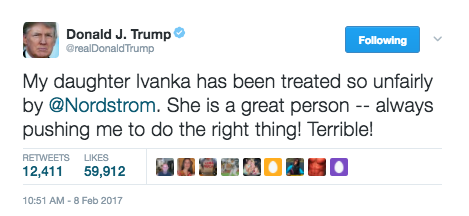
“My daughter Ivanka has been treated so unfairly by Nordstrom,” the president tweeted. “She is a great person — always pushing me to do the right thing&; Terrible&033;”

Instagram: @realdonaldtrump

View Video ›

Facebook: DonaldTrump

After posting the initial tweet on his @realDonaldTrump account, Trump reposted the language to Instagram and Facebook, and retweeted it from the @POTUS account, leading some to question if it was ethical for a sitting president to pressure a family business partner.

Trump has used his Instagram to attack opponents in the past, including Jeb Bush and Hillary Clinton. While some imagined Trump might change his approach to social media once he took the presidency, there appears to be no change in his early days in the White House.

Instagram: @realdonaldtrump

Instagram: @realdonaldtrump

Trump is bringing a proven political social media strategy to bear on corporations with whom he&039;s displeased. Only now, instead of Jeb and Hillary, it&039;s Nordstrom and others.

Nordstrom, for its part, tweeted that the decision to drop Ivanka Trump&039;s fashion line was due to “business results.”

Press Secretary Sean Spicer defended Trump&039;s attacks at his press briefing today.

Quelle: <a href="President Trump Is Shaming Nordstrom On Twitter, Facebook, And Instagram“>BuzzFeed

Everything You Need To Know About Google's New Smartwatches

Android Wear 2.0, the platform’s first big update since 2014, starts rolling out to supported devices this week.

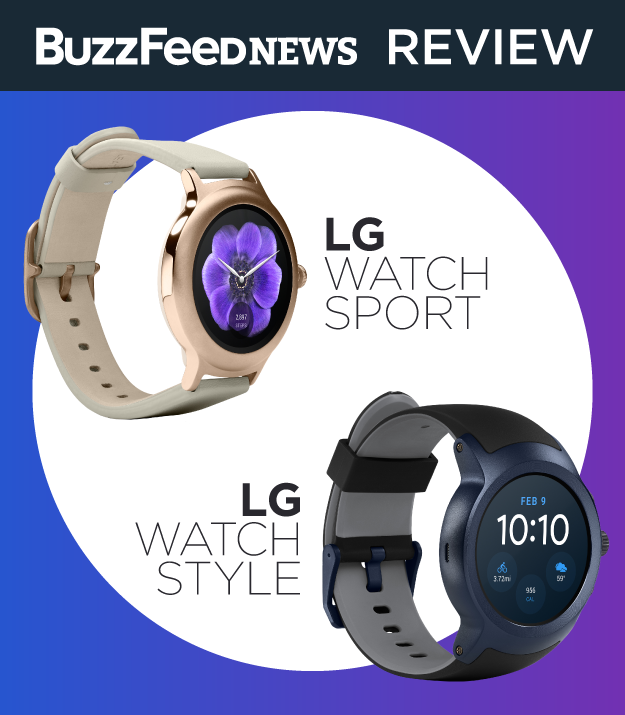
Whaddya know&; Google still makes smartwatches. After nearly three years of incremental software updates to a small fleet of wearable devices, Android Wear 2.0 is finally available on two new watches – the LG Watch Style and LG Watch Sport – designed specifically for the refined software. Existing, supported watches, like the Moto 360 2 and ASUS ZenWatch 2, will be able to download 2.0 in the coming weeks.

You might be wondering: Why is Google continuing to invest resources in wearables, a D-list gadget category that it isn’t doing so hot right now? Operations at Kickstarter darling Pebble shut down in December 2016, and the company folded into Fitbit, which recently cut between 5% to 10% of its workforce after disappointing holiday sales. Intel-owned Basis had to recall its devices when they began overheating and melting their own chargers. Jawbone is reportedly winding down its fitness-focused wearables business. Even the number of smartwatches sold by the industry’s two leading manufacturers, Samsung (with 800,000 watches) and Apple (with 5.2 million), pale in comparison those companies’ smartphone sales (77.5 and 78.3 million, respectively, in the last quarter of 2016 alone). Furthermore, compared to Samsung and Apple, Google has struggled to gain traction in the smartwatch category.

Well, Google, it seems, wants its core suite of software services available in as many form factors as possible, from smart speakers to routers. There are many ways one can “google” something and, if smartwatches are your thing, the wrist is another place where you can do just that. Google&;s hardware is merely a vessel for its software – and Android Wear is no different.

The new Android watches designed in partnership with LG were clearly made to prioritize Google’s software, and don’t have some of the more premium hardware features that its competitors do, like the Samsung Gear S3’s multi-day battery life or the Apple Watch Series 2’s swim-proofness. The new update most notably includes access to Google Assistant, the “smart” voice-activated personal assistant that can send messages, set reminders, or make restaurant reservations. It’s also compatible with Android Pay, a mobile tap-and-go payment platform.

In my week of testing the first Android watches slated to ship with 2.0, I found that, while the new update will most likely satisfy longtime Android Wear loyalists, if you’re not sold on smartwatches, the LG Watch Sport and Style aren’t going to be the ones that convince you otherwise. Here are some of my first impressions:

Google / BuzzFeed News

Look at how big this damn thing is.

Look at how big this damn thing is.

This is the size of the LG Watch Sport on my wrist. It is Not Good. The watch is 14.2 mm thick, which may not sound like a lot, but it is, especially when you’re trying to jam it through a fitted sweater.

The Sport version of the watch has cellular LTE data, built-in GPS, NFC for mobile payments, a heart rate sensor, and a battery to support all of those energy-draining technologies crammed underneath its 1.38-inch diameter display. It’s water resistant in up to 1.5 meters for 30 minutes, which is good for running in the rain, but wouldn’t survive a swim. The device feels heavy too, like a metal paperweight strapped to your wrist, though those with thicker, stronger forearms might disagree. Those 89.4 grams start to feel like a burden after all-day wear.

The slimmer, more lightweight Style is more my speed, but it doesn’t have any of the features I mentioned above. It’s essentially a step counter with a display for apps, notifications, and Google Assistant.

Nicole Nguyen / BuzzFeed News

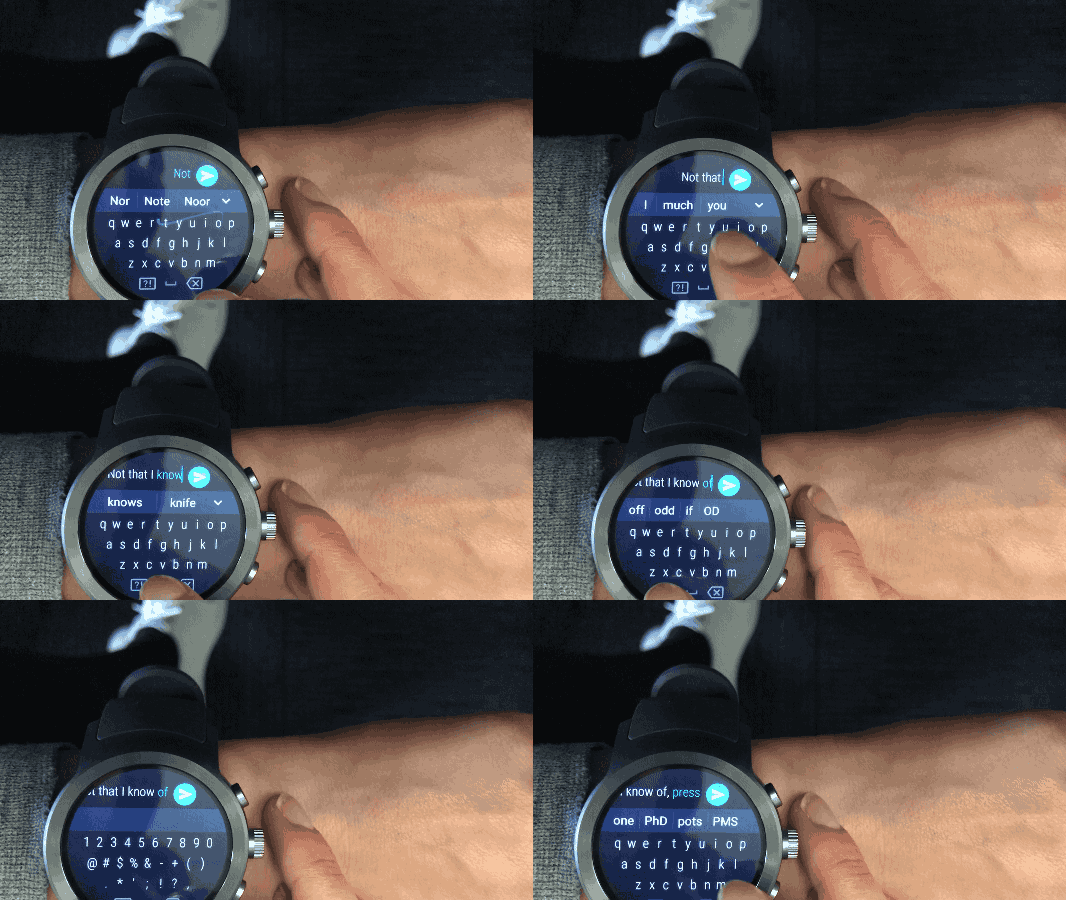
Android Wear has the best tiny typing experience for wearables, period.

Android Wear has the best tiny typing experience for wearables, period.

You’d think that replying to messages, Slacks, and emails on a watch would be a typo nightmare, but Android’s new on-watch keyboard is anything but. You can swipe your finger over the mini keyboard or peck each letter, and Google will employ machine learning to figure out what you’re trying to say.

There are also a number of “smart” replies, generated by Google based on the contents of your message, that you can choose from. For example, for an email requesting a meeting, the watch suggested “OK, let me get back to you” as an automatic response, along with “I agree,” “Nice,” and the smiley face emoji.

You can also respond purely with emoji, by choosing them from a long list or attempting to draw one. And by draw, I mean, scribble the “Pinterest fail” version of a thumbs up and Google’s algorithms are smart enough to understand what you intended.

Nicole Nguyen / BuzzFeed News

During my briefing with Google, two product managers explained that this feature was introduced so you can easily switch between your “work” watch face and your “home” watch face. But it’s not super clear that, like, anybody wants or needs that??


View Entire List ›

Quelle: <a href="Everything You Need To Know About Google&039;s New Smartwatches“>BuzzFeed

Mark Zuckerberg And Priscilla Chan Are Funding Dozens Of Scientists

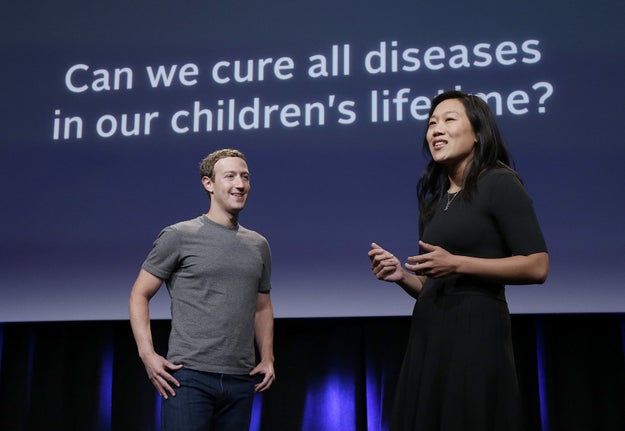
Facebook CEO Mark Zuckerberg and wife Priscilla Chan.

Jeff Chiu / AP

Six months ago, Facebook CEO Mark Zuckerberg and his wife launched a $3 billion effort to “cure, prevent, or manage all diseases” by the end of the century, starting with a new research center in the San Francisco Bay Area.

The leaders of that center, the Chan Zuckerberg Biohub, announced on Wednesday one of the first major components of that ambitious goal: It will fund nearly 50 scientists in fields such as engineering, biology, chemistry, computer science, math, and physics.

The Biohub Investigators, as they’re being called, hail from UC Berkeley, Stanford University, and UC San Francisco, and will each receive up to $1.5 million for five years of research. The nonprofit was launched with a 10-year, $600 million commitment from Zuckerberg and Priscilla Chan, a UCSF-trained pediatrician, and their philanthropy-oriented limited liability company, the Chan Zuckerberg Initiative, which is also investing in education and technology projects.

Zuckerberg and Chan’s goal is for the scientists to use the biohub, located near UCSF, to collaborate on interdisciplinary projects and build research tools together, on top of keeping their positions and labs at their home institutions. Joseph DeRisi, the Biohub’s co-president, told BuzzFeed News that the couple regularly communicates with him, although they didn’t help select the 47 Biohub Investigators. That task was left to an international panel of 60 scientists and engineers, who vetted more than 700 applicaticants from the three universities.

“Both Mark and Priscilla are avid consumers of science,” said DeRisi, a UCSF professor of biochemistry and biophysics. “They enjoy learning new things and knowing what the cutting edge of research is all about.”

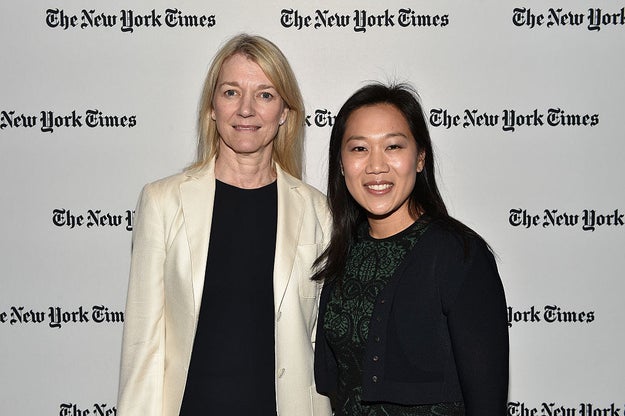
President of Science at the Chan Zuckerberg Initiative Cori Bargmann and Chan Zuckerberg Initiative Co-Founder Priscilla Chan.

Bryan Bedder / Getty Images for The New York Times

The scientists are a mix of early- and late-career faculty members. (A complete list can be found here.)

DeRisi highlighted Aaron Streets, a UC Berkeley researcher developing tools to precisely analyze single cells; Jill Banfield, also of UC Berkeley, who studies environmental microorganisms; and Alex Marson, a UCSF scientist who uses genome-editing technologies to understand the body’s immune system. Others include Stanford’s Manu Prakash, who has invented a folding paper telescope that costs $1 and is used by scientists and students around the world.

Meanwhile, a handful of Biohub staffers, who came on-board before the new Investigators, are already getting started on two of the hub’s big projects: figuring out how to detect, respond to, treat, and prevent infectious diseases; and creating a comprehensive atlas of all the cells in the human body.

In an effort to more quickly share results with other researchers and the public, scientists will be required to publish in an open-source database the drafts of papers being submitted to peer-reviewed journals, according to Stephen Quake, Biohub co-president and Stanford professor of bioengineering and applied physics.

And faculty won’t be bound to finish a certain project or publish a certain number of papers before their five years are up.

“We asked for, ‘What have you done that’s great in the past, and what is your bold vision of the future?’” DeRisi said. “We are leaving the door open to maximize creativity and dynamically go where the research takes them.”

LINK: Document Shows How Mark Zuckerberg’s New Science Charity Will Handle IP

Quelle: <a href="Mark Zuckerberg And Priscilla Chan Are Funding Dozens Of Scientists“>BuzzFeed

Here's Why Venmo Users Should Care If Sean Spicer Is Being Trolled

White House Press Secretary Sean Spicer.

Alex Wong / Getty Images

It’s safe to say White House press secretary Sean Spicer is having a bad week. To put the mayo on his turd sandwich, last night, people discovered his account on Venmo and started sending him bogus payment requests with trolling messages.

The wave of trolling was kicked off when the celebrity gossip podcast Who? Weekly tweeted that Spicer could be found on Venmo after a listener tipped them off. This isn’t the first time the podcast has looked for C-list celebs on the payment app – they found Bella Thorne and Tiffany Trump [full disclosure: I am a friend of the hosts and made one of its theme songs]. A few hours after Spicer’s Venmo was trolled, people found Kellyanne Conway’s account and did the same. This is all meant to be relatively harmless fun; only a real killjoy wouldn’t see the appeal of the weirdness of finding celebrities on a highly plebeian money app. It’s funny to find celebrities on Venmo precisely because you wouldn’t expect them to be there, and it’s the kind of app that we use for unglamorous and petty things like splitting cab fare or drinks.

A bunch of extraneous Venmo requests are probably the least of Spicer&;s concerns at the moment (BuzzFeed News confirmed the account was his by matching his phone number). However, The ability to use Venmo to harass someone with bogus payment requests should strike you as somewhat alarming.

Here’s why.

1) Venmo is convenient precisely because it’s so easy to find your friends on it, just by phone number, email, or by name. The privacy settings allow you to make the details of your payments private, but there’s no option to keep your account completely hidden from search. If you’re on there, people can find you by just your name.

This level of privacy setting is akin to what other social networks like Facebook or Twitter offer – you can make the details of your account private, but not the fact that you HAVE an account. But on those platforms, you can prevent randos from sending you messages or even trying to add you.

Part of what makes Venmo fun is the fact that it layers elements of a social network on top of a regular payments app: You can look at the feed of your friends’ payments and see who they’re interacting with. If you really want to be weird, you can even comment on their payments. Tilt your head and squint, and Venmo is a social network that happens to do payments. And where there’s a social network, there’s trolls.

2) Venmo sends you a text message and push notification for payments and requests. It’s possible to turn these off deep in the Settings, but it’s likely many people leave these on – I have them left on. This means Sean Spicer’s phone was probably blowing up late into the night while people sent him pennies.

The text message that Venmo sends you for a payment or request contains the message from the transaction. Here’s what this means: Let’s say you want to say “go jump in a lake” to Sean Spicer. You could tweet at him, but let’s be real: At best he’ll probably just quickly glance it while scrolling through his mentions. And in the context of Twitter, it’s nothing. You, the average citizen, don’t have much ability to directly get the attention of one of the people at the tight inner circle to the President. But if you merely search his name on Venmo, you can send a payment request, and blammo&; you sent a message via a text directly to his personal cell phone. And while you can block people, you have to do it one by one (according to some reports, Spicer was receiving hundreds of these messages).

3) While you can reject requests for payments, you cannot reject someone sending you money. Which… in the case of a government official like Sean Spicer, is kind of weird. Spicer has no way of stopping me from sending him $100,000 and writing it “Trump payola, per our conversation” in the message. Sure, there’s nothing to stop me from dropping off a bag of cash at his doorstep either, but that might not be public or easy. For non-celebs, it’s not too hard to imagine scenarios in which sending someone money could be a form of harassment – a weapon to be used in a financial grudge between exes, friends, or business people.

4) It works as an ad hoc reverse cellphone lookup. You can’t see a person’s phone number from their profile, but you can match up a phone number to a profile. Let’s say you have an anonymous cell phone number, and you want to find out who it belongs to. You can’t search by the phone number in Venmo, but if you complete a payment or request, it reveals the name attached to the number. Same with matching a name to an email address.

Facebook and Twitter allow you to search for people by email or phone, but that option can be turned off. In Venmo, there’s no option to turn this search off, or make it so that your number can’t be used to find you. Reporters need to match cell phones to names all the time, so this is a great tool for us — or perhaps just for anyone who sees their partner texting a stranger’s number and wants to find out who it is.

5) You can’t make your “friends” list private, which you can do on Facebook. This matters in cases like Spicer’s: For example, one of BuzzFeed’s politics reporters was able to help verify that the account actually belonged to the press secretary by glancing through his friends list and seeing names of Washington insiders.

Here’s where Venmo significantly differs from social networks: being “friends” on Venmo with Spicer doesn’t mean he’s friendly with someone, it means they may have a financial connection. That matters for Sean Spicer; it matters for the rest of us, too.

A spokesperson for Venmo said that privacy for users is one of their highest priorities, and pointed me to a list of customizable privacy settings that control how your transactions will show up to other people. While the tools to make your payments private are there, this doesn’t significantly address what’s happening to Sean Spicer (his payments are all private).

“This doesn’t happen a lot. This is a new thing for Venmo to think about,” a company spokesperson told me. They were indeed very aware of what was happening with Mr. Spicer today from the news, but declined to tell me if any direct actions had been taken, citing user privacy.

Quelle: <a href="Here&039;s Why Venmo Users Should Care If Sean Spicer Is Being Trolled“>BuzzFeed

Here's Why Venmo Users Should Care If Sean Spicer Is Being Trolled

White House Press Secretary Sean Spicer.

Alex Wong / Getty Images

It’s safe to say White House press secretary Sean Spicer is having a bad week. To put the mayo on his turd sandwich, last night, people discovered his account on Venmo and started sending him bogus payment requests with trolling messages.

The wave of trolling was kicked off when the celebrity gossip podcast Who? Weekly tweeted that Spicer could be found on Venmo after a listener tipped them off. This isn’t the first time the podcast has looked for C-list celebs on the payment app – they found Bella Thorne and Tiffany Trump [full disclosure: I am a friend of the hosts and made one of its theme songs]. A few hours after Spicer’s Venmo was trolled, people found Kellyanne Conway’s account and did the same. This is all meant to be relatively harmless fun; only a real killjoy wouldn’t see the appeal of the weirdness of finding celebrities on a highly plebeian money app. It’s funny to find celebrities on Venmo precisely because you wouldn’t expect them to be there, and it’s the kind of app that we use for unglamorous and petty things like splitting cab fare or drinks.

A bunch of extraneous Venmo requests are probably the least of Spicer&;s concerns at the moment (BuzzFeed News confirmed the account was his by matching his phone number). However, The ability to use Venmo to harass someone with bogus payment requests should strike you as somewhat alarming.

Here’s why.

1) Venmo is convenient precisely because it’s so easy to find your friends on it, just by phone number, email, or by name. The privacy settings allow you to make the details of your payments private, but there’s no option to keep your account completely hidden from search. If you’re on there, people can find you by just your name.

This level of privacy setting is akin to what other social networks like Facebook or Twitter offer – you can make the details of your account private, but not the fact that you HAVE an account. But on those platforms, you can prevent randos from sending you messages or even trying to add you.

Part of what makes Venmo fun is the fact that it layers elements of a social network on top of a regular payments app: You can look at the feed of your friends’ payments and see who they’re interacting with. If you really want to be weird, you can even comment on their payments. Tilt your head and squint, and Venmo is a social network that happens to do payments. And where there’s a social network, there’s trolls.

2) Venmo sends you a text message and push notification for payments and requests. It’s possible to turn these off deep in the Settings, but it’s likely many people leave these on – I have them left on. This means Sean Spicer’s phone was probably blowing up late into the night while people sent him pennies.

The text message that Venmo sends you for a payment or request contains the message from the transaction. Here’s what this means: Let’s say you want to say “go jump in a lake” to Sean Spicer. You could tweet at him, but let’s be real: At best he’ll probably just quickly glance it while scrolling through his mentions. And in the context of Twitter, it’s nothing. You, the average citizen, don’t have much ability to directly get the attention of one of the people at the tight inner circle to the President. But if you merely search his name on Venmo, you can send a payment request, and blammo&; you sent a message via a text directly to his personal cell phone. And while you can block people, you have to do it one by one (according to some reports, Spicer was receiving hundreds of these messages).

3) While you can reject requests for payments, you cannot reject someone sending you money. Which… in the case of a government official like Sean Spicer, is kind of weird. Spicer has no way of stopping me from sending him $100,000 and writing it “Trump payola, per our conversation” in the message. Sure, there’s nothing to stop me from dropping off a bag of cash at his doorstep either, but that might not be public or easy. For non-celebs, it’s not too hard to imagine scenarios in which sending someone money could be a form of harassment – a weapon to be used in a financial grudge between exes, friends, or business people.

4) It works as an ad hoc reverse cellphone lookup. You can’t see a person’s phone number from their profile, but you can match up a phone number to a profile. Let’s say you have an anonymous cell phone number, and you want to find out who it belongs to. You can’t search by the phone number in Venmo, but if you complete a payment or request, it reveals the name attached to the number. Same with matching a name to an email address.

Facebook and Twitter allow you to search for people by email or phone, but that option can be turned off. In Venmo, there’s no option to turn this search off, or make it so that your number can’t be used to find you. Reporters need to match cell phones to names all the time, so this is a great tool for us — or perhaps just for anyone who sees their partner texting a stranger’s number and wants to find out who it is.

5) You can’t make your “friends” list private, which you can do on Facebook. This matters in cases like Spicer’s: For example, one of BuzzFeed’s politics reporters was able to help verify that the account actually belonged to the press secretary by glancing through his friends list and seeing names of Washington insiders.

Here’s where Venmo significantly differs from social networks: being “friends” on Venmo with Spicer doesn’t mean he’s friendly with someone, it means they may have a financial connection. That matters for Sean Spicer; it matters for the rest of us, too.

A spokesperson for Venmo said that privacy for users is one of their highest priorities, and pointed me to a list of customizable privacy settings that control how your transactions will show up to other people. While the tools to make your payments private are there, this doesn’t significantly address what’s happening to Sean Spicer (his payments are all private).

“This doesn’t happen a lot. This is a new thing for Venmo to think about,” a company spokesperson told me. They were indeed very aware of what was happening with Mr. Spicer today from the news, but declined to tell me if any direct actions had been taken, citing user privacy.

Quelle: <a href="Here&039;s Why Venmo Users Should Care If Sean Spicer Is Being Trolled“>BuzzFeed