Tesla Employee Who Wants A Union Says He's "Disappointed In" Musk

Tesla Employee Who Wants A Union Says He's "Disappointed In" Musk
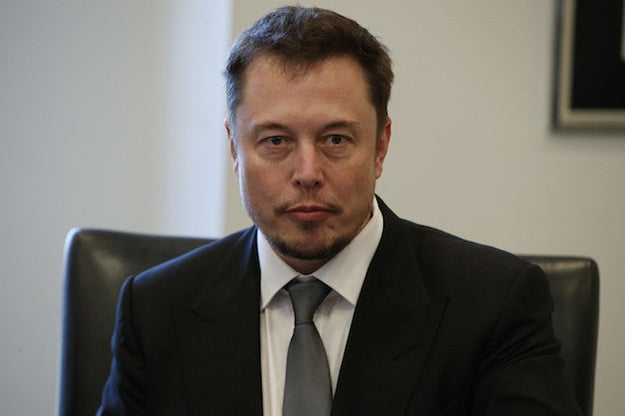
Tesla CEO Elon Musk.

Evan Vucci / AP

Jose Moran, the Tesla employee who’s leading the effort to form a union at the company’s 6,200-person factory in Fremont, CA, said he’s “disappointed” in Tesla CEO Elon Musk’s reaction to his concerns about working conditions and desire to join a union.

In an interview with Gizmodo, Musk called “the attack” on Tesla working conditions to be “morally outrageous” and accused Moran of being a operative hired by the UAW to agitate for a union. Moran categorically denied that he is on the union payroll, saying of Musk, “It goes to show what kind of respect he has for workers’ opinions.”

On the call, Moran, who says he’s worked in Tesla’s facility for over four years, said it’s not uncommon for him and his fellow workers on Tesla&;s production line — 200 of whom he said are members of a Facebook group where they discuss work-related issues — to work 10 to 12 hour days. Moran said he first reached out to the UAW in 2013, not long after workers were asked to work 12-hour shifts three days in a row. In his comments to Gizmodo, Musk said Tesla is in the process of phasing out the practice known at Tesla as “mandatory overtime.” Moran, who was a union member in the past when he worked for NUMMI, the auto manufacturer that previously operated in the current Tesla facility, said the practice has decreased somewhat since he started working at Tesla.

In addition to long hours, Moran’s grievances with Tesla include what he describes as comparatively low pay and unsafe working conditions, specifically repeated stress that can lead to ergonomic injuries. According to his LinkedIn profile, Moran is an UnderBody team lead in the Body Center at Tesla&039;s factory. In his Medium post, Moran said six of his eight coworkers were recently out of work on medical leave due to injuries that resulted from working long hours on “machinery…often not ergonomically compatible with our bodies.”

View Video ›

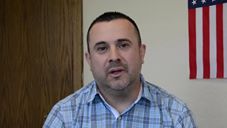
Here&039;s Moran discussing his concerns about working conditions at Tesla in a video posted to the union campaign&039;s Facebook page.

Facebook: video.php

Tesla did not immediately respond to request for comment on this story. In his comments to Gizmodo, Musk described his position as “union neutral,” adding that Tesla is “the last car company left in California, because costs are so high.”

Tesla’s has a rocky track record with California’s Department of Occupational Safety and Health. A 2014 electrical explosion at the Fremont facility led to serious injuries for one employee and hefty fines for Tesla. In 2013, three employees were burned by molten aluminum, which CalOSHA found to be the result of training and safety failures. (Musk later visited them at the hospital.) More recently, a Fremont Tesla employee was struck by a forklift in 2015. There were three health and safety inspections at Tesla’s Fremont facility in 2016, two of which are ongoing.

Moran didn’t comment on any past or current OSHA inspections during Friday’s call, but he did say that he felt union representation would make working at Tesla’s factory safer. “I think the union is good because we can work to prevent … injuries,” he said, “and have a more involved safety and health representative.”

In an interview with Marketwatch earlier this week, Fremont’s mayor Lily Mei praised the economic impact the company has had on the city. But not all local elected officials are as enthusiastic. Earlier this year, five lawmakers sent a letter to Tesla, expressing concerns that employees had been denied the right to speak openly about working conditions in the factory.

“While I greatly respect and admire Tesla’s achievements in creating eco-friendly automobiles and green jobs right here in California, I want to ensure worker rights are protected and that they are provided a safe working environment,” wrote Assemblymember Kansen Chu, one of the letter’s signatories, in an email to BuzzFeed News.

This isn’t the first time Tesla has had trouble with unions. A year ago, union construction workers walked off the job at Tesla’s “gigafactory” in Nevada over hiring practices.

Meanwhile, in Fremont, a representative for the Building & Construction Trades Council of Alameda County told BuzzFeed News that his organization, which previously placed contracted union workers at NUMMI, hadn’t succeeded in winning the same deal with Tesla. Earlier this week, the Building & Construction Trades Council of Alameda County wrote an open letter asking Tesla to consider “using skilled Alameda County Building Trades workers on your Fremont plant expansion.”

“The quality of our skilled workers and local residents meets the high standards of Tesla,” the letter reads. “Working together, we can build on the Labor-Tech partnerships other tech leaders such as Apple, Facebook and Google have successfully implemented as the model of innovation moving forward.”

Multiple Tesla employees reached for comment on the union issue by BuzzFeed News declined to discuss the issue. On the conference call, Moran said, to his knowledge, no employees have been fired or otherwise retaliated against for discussing unionization, but he did say that fear of intimidation made him concerned about speaking out. He said his coworkers’ response to the letter was overwhelmingly positive. “I had quite a few people come up to me and congratulate me for speaking up,” he said.

Moran also said management approached him for a one-on-one meeting to discuss safety concerns on Friday; he described the tenor of that meeting as “casual.”

Quelle: <a href="Tesla Employee Who Wants A Union Says He&039;s "Disappointed In" Musk“>BuzzFeed
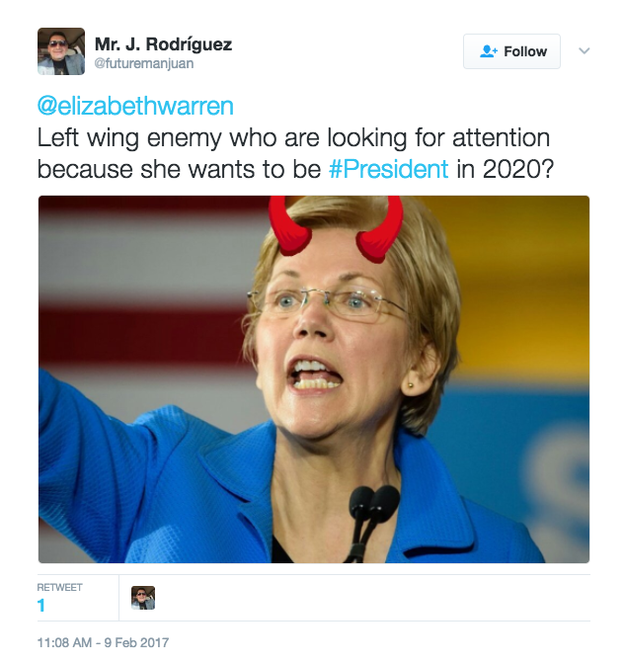
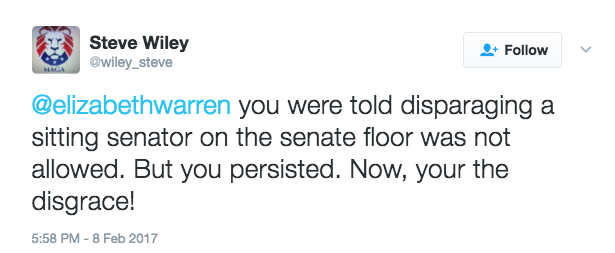
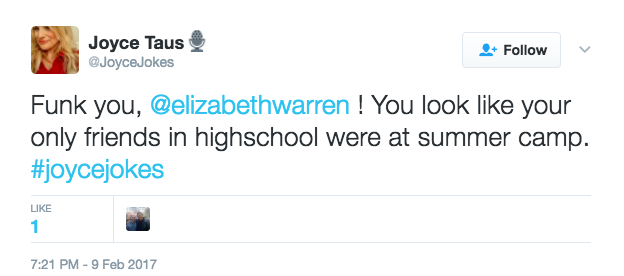
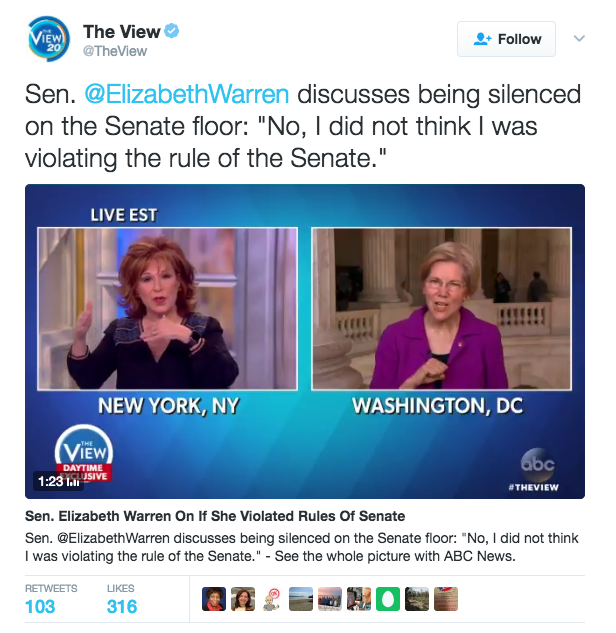
This Woman Has The Same Name As Donald Trump's Least Favorite Senator And It's A Nightmare

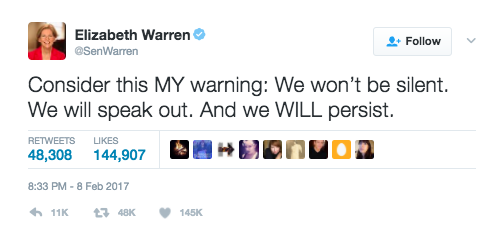
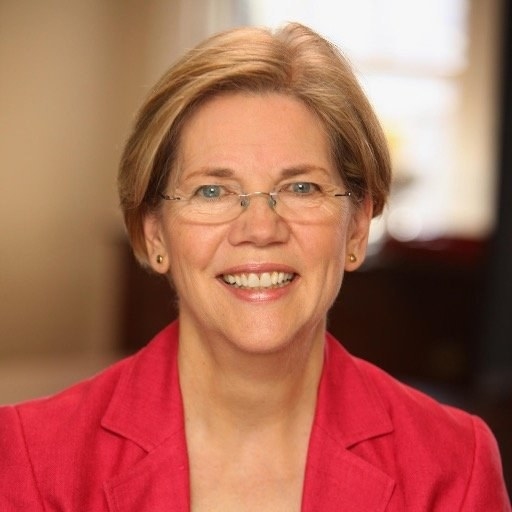
This is Elizabeth Warren.

She&;s a US Senator from Massachusetts who tweets regularly from her @SenWarren account.

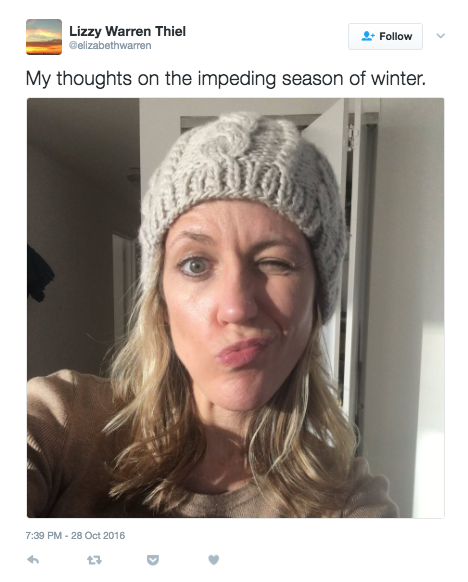
This is also Elizabeth Warren.

She is a self-described “dreamer. builder. discoverer.” who tweets regularly from her @ElizabethWarren account.

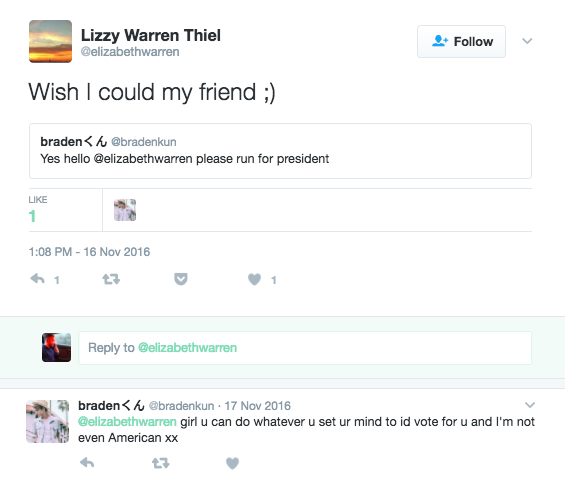
The Internet, because it&039;s the Internet, regularly sends tweets meant for @SenWarren to @ElizabethWarren.

Some are very nice&;

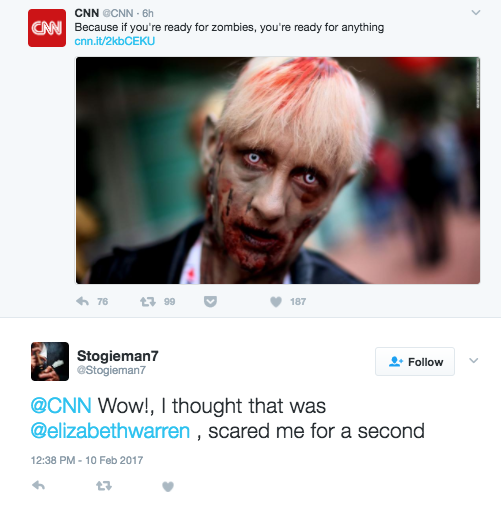
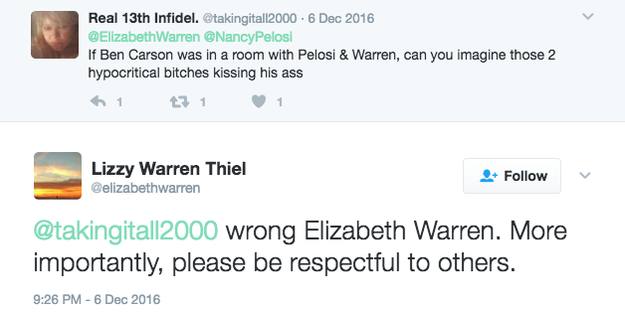
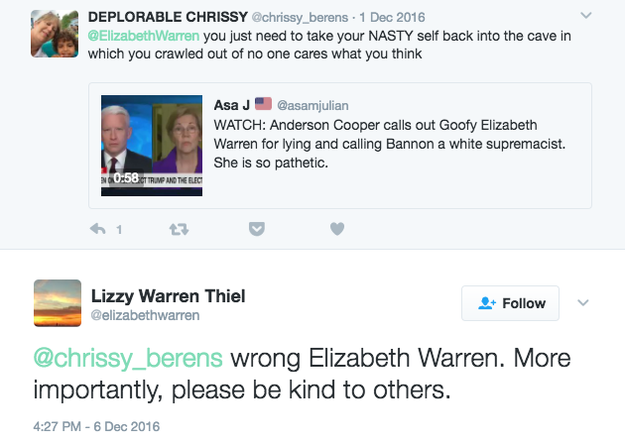
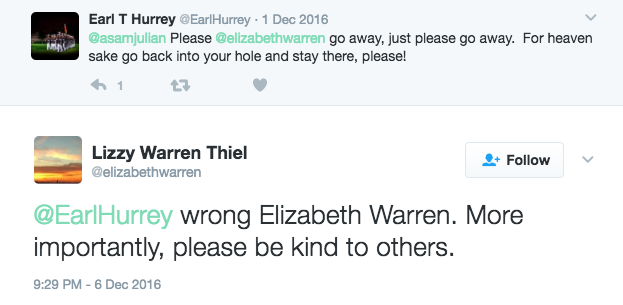
But many tweets to @ElizabethWarren are, well, exceptionally mean.

Note: It&039;s not cool to like your own tweets, Mr J.

Note: It&039;s “you&039;re the disgrace&033;” not “your the disgrace&033;”

Even The View got it wrong&033;

How does @ElizabethWarren respond? With a cool head and calm demeanor our politics so often lack.

Inception

Quelle: <a href="This Woman Has The Same Name As Donald Trump&039;s Least Favorite Senator And It&039;s A Nightmare“>BuzzFeed

Ford Is Investing $1 Billion In An Ex-Googler’s Artificial Intelligence Company

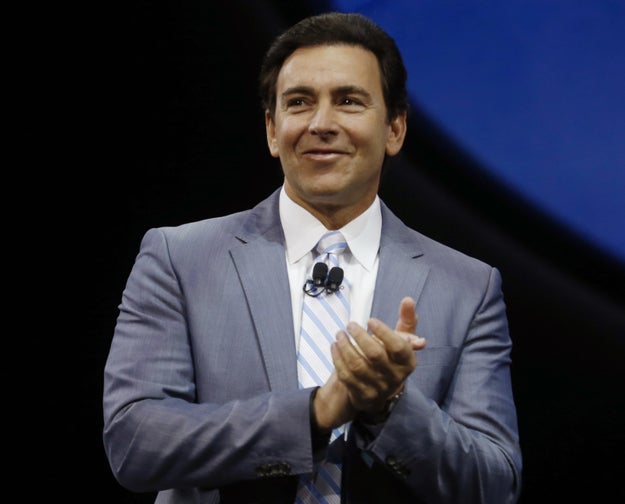
Mark Fields, president and chief executive of Ford.

Rebecca Cook / Reuters

Ford, which has plans to put self-driving cars on the road by 2021, said Friday that it will invest $1 billion in the artificial intelligence company Argo AI that’s run by former leaders of Google and Uber’s self-driving car programs.

The $1 billion investment over the next five years – which turns the AI startup into a subsidiary of the more than 100-year-old automaker – is part of a string of big bets Ford has made on self-driving cars in the last year. Argo’s chief executive, Brian Salesky, previously led hardware development for Google’s self-driving program. Peter Rander, Argo’s chief operating officer, was an engineering lead at Uber’s Advanced Technology Center. The pair formed Argo AI late next year and will now focus primarily on Ford’s autonomous vehicle efforts.

“With Argo AI’s agility and also Ford’s scale, we’re combining the benefits of a technology startup…with the experience and discipline we have,” Mark Fields, Ford’s chief executive, told reporters Friday. “We firmly believe this strengthens our business and our leadership in autonomy.”

Ford’s board of directors approved the deal on Wednesday, Fields said. Some members of Ford’s existing autonomous vehicle team will join Argo. Salesky declined to say how many employees Argo currently has, but said the AI company plans to hire about 200 people by the end of the year. Ford will be a majority stakeholder in Argo, but the startup will operate independently.

“We founded [Argo] with the intent and the vision of wanting to see self-driving vehicles made available at scale,” Salesky said. “In order to do that, you really need the scale of a company like Ford.”

Raj Nair, Ford’s chief technical officer, said the company plans to build an autonomous vehicle platform than can run across Ford’s line of vehicles, and it could license the technology out to other companies. Fields compared the potential impact of Ford’s plans to mass-produce autonomous vehicles to how Ford changed automotive manufacturing by introducing the moving assembly line in 1913.

As automakers and tech companies race to develop autonomous vehicles, many have partnered with or purchased startups to accelerate their efforts. Last year, Uber bought the artificial intelligence startup called Geometric Intelligence to create an in-house AI lab. General Motors bought Cruise Automation, another self-driving startup.

And Ford also made a series of investments last year to boost its self-driving program. It invested $75 million into Velodyne, a company that makes sensors for self-driving cars, and acquired an Israeli machine learning company called SAIPS.

“Lets face it,” Fields said. “There’s a war for talent these days.”

Quelle: <a href="Ford Is Investing Billion In An Ex-Googler’s Artificial Intelligence Company“>BuzzFeed

This Fancy Chromebook Has a Touchscreen, Stylus, And A Price You Can Actually Afford

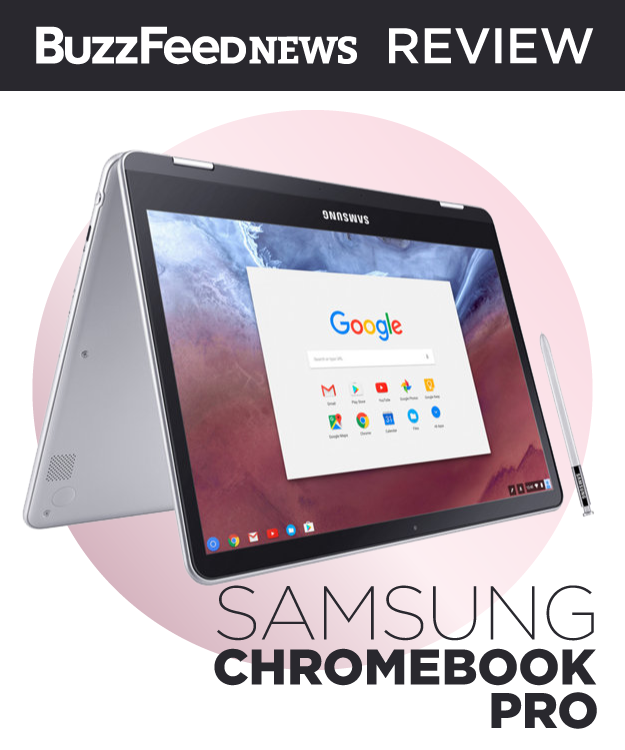
Google goes after Microsoft’s Surface Pro and Apple’s iPad Pro with its new premium Samsung Chromebook Pro and Plus laptop-tablet hybrids.

It’s a laptop&; It’s a tablet&033; It has a stylus&033; You can fold it backwards&033; You can draw on it&033; The Samsung Chromebook Pro and Plus aren’t your kid brother’s classroom Chromebooks. Google is adding new premium options to its low-cost laptop line: two Samsung-branded hybrid computer-tablets (what gadget p33ps call “convertibles”) with styluses built-in.

The devices are clearly aimed at customers who are interested in Microsoft&;s Surface Pro (between $699-$1,049) or Apple&039;s iPad Pro tablets ($599-$929), but who aren’t keen on those products’ hefty price tags. The Chromebook Pro is now Google’s most high-end Chromebook offering — and it costs just $549, while the Chromebook Plus is priced at $449.

What’s unique about the devices aren’t just that they’re ~fancier~ than Chromebooks past – it’s that the laptops can run Android apps for phones and tablets. All of them. Google is hoping that opening its Chromebooks to the over two million touchscreen-friendly games and mobile apps available in its Play Store will give its lightweight laptops even more of an edge over other devices.

I’ve been letting my MacBook Air collect dust for two weeks while testing out a pre-production version of the new Chromebook Pro, the faster and more powerful of the two. It&039;s available at the end of April with no specific release date set. I found the Pro to be impressively versatile. It was sufficient at most of my work computer tasks (namely messaging my boss, writing reviews like this one, and reading articles). The other bells and whistles, like the stylus and touchscreen, were non-essential, but worked well when I needed them.

Samsung / Buzzfeed News

If you’re already familiar, just jump to the next section.

Chromebooks are breathtakingly cheap computers. I once bought two mascaras and a foundation at Sephora and it was more expensive than the cheapest Chromebook you can get at Best Buy.

But you get what you pay for. They’re simple machines that can handle a lot of things, like responding to email, scrolling through Facebook, watching YouTube videos, streaming Netflix, word processing, and reading articles. Chromebooks need a strong Wi-Fi connection, and, while you can still use Google Docs, watch some Netflix shows, and listen to Spotify offline, there’s isn’t a ton of functionality for people who don’t have access to reliable Internet.

Chromebooks are the conceptual opposite of Android phones, which have, historically, been more appealing to tinkerers and gadget geeks. Chromebooks, on the other hand, are grab-and-go machines designed for people who know how to surf the web, but don’t consider themselves techies.

The laptops are dead simple. To start using one, all you need is a Google account. The devices are less susceptible to malware than others, and benefit from automatic security updates every six weeks. They’re a good fit for a lot of people. Chromebooks outsold Macs for the first time in 2016, with over half of that market going to the education sector. Over 20 million students now use Chromebooks in classrooms worldwide.

But they’re not for everyone.

Processors typically aren’t very good in Chromebooks. Gamers and extreme multi-taskers will find that the computers become slow and unusable under a heavy load. People who prefer to optimize their digital workspace with apps like F.lux and BetterSnapTool might find the cookie cutter Chrome environment too limiting. Lastly, and most importantly, Chromebooks can’t do most photo and video editing. You can do lightweight stuff (adjust brightness, draw on photos, and add filters, etc.) but Chromebooks can’t run Photoshop CC or Premiere CC.

First of all, the new Samsung Chromebook Pro can do this:

First of all, the new Samsung Chromebook Pro can do this:

Nicole Nguyen / BuzzFeed News


View Entire List ›

Quelle: <a href="This Fancy Chromebook Has a Touchscreen, Stylus, And A Price You Can Actually Afford“>BuzzFeed

Google Has Sent Android App Developers A Privacy Ultimatum

Josh Edelson / AFP / Getty Images

Google is finally cracking down on apps in the Play Store that don&;t do enough to protect users&039; privacy. The company has quietly been warning Android app developers to fix their apps that are in violation of Google&039;s User Data policy. Google is giving them two options, according to its email: link to a valid privacy policy, or remove any requests for users&039; personal information. Developers have until March 15 to comply or will face “limited visibility” in the Google Play store, a punishment that ranges from hiding the app from top and trending lists to removing it entirely from the Play Store.

It&039;s been a common complaint for years that the Play Store is full of “shovelware,” meaning apps full of mediocre content that are cheaply produced en masse. Creators of this category of app, also known as “zombie apps,” may not take the time to craft privacy policies that stand up to Google&039;s test.

Google&039;s User Data policy mandates that an app that handles users&039; personal information must have a working privacy policy that “comprehensively discloses how your app collects, uses and shares user data, including the types of parties with whom it’s shared.” The app must do so “prominently,” according to the User Data policy, meaning that users should be able to see it. Any app handling personal information must also “Handle the user data securely, including transmitting it using modern cryptography (for example, over HTTPS).”

Some developers were confused. And upset.

Some people did not care.

Google told BuzzFeed News, “The update to our privacy policy (in the Google Play Developer Program Policies) was actually made last August and is consistent with industry practices. Since then, we have been sending regular reminders to developers to comply with this change.”

An app that records personal information but gives no discernible privacy policy faces fines or even suspension for deceptive practices. The FTC fined social networking app Path for $800,000 in 2013 for illegally collecting personal information from children under 13 because it did not offer users an obvious opt-out option. Tech companies have varying stances on privacy, which are smart to keep in mind when downloading apps and accepting their permissions requests.

Quelle: <a href="Google Has Sent Android App Developers A Privacy Ultimatum“>BuzzFeed

California Lawmakers Asked Tesla To Loosen Its Confidentiality Agreement With Factory Workers

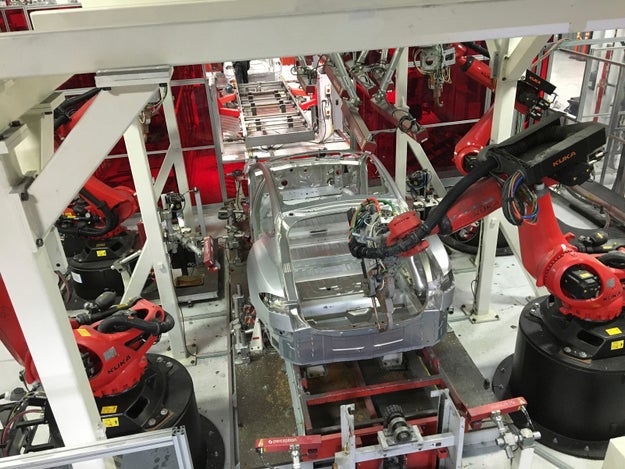
Tesla vehicles are being assembled by robots at Tesla Motors Inc factory in Fremont, California, U.S. on July 25, 2016. REUTERS/Joseph White/File Photo GLOBAL BUSINESS WEEK AHEAD PACKAGE Ð SEARCH ÒBUSINESS WEEK AHEAD 3 OCTÓ FOR ALL IMAGES

Jim Tanner / Reuters

California lawmakers sent a letter to Tesla last month asking the company to loosen its employee confidentiality agreement. Signed by five state assembly members, the letter expressed concerns that Tesla’s policy might violate state and federal labor laws by preventing workers from communicating about wages and working conditions.

“We are concerned that over-broad language in the confidentiality agreement violates these provisions and has resulted in a chilling effect on workers&; ability to engage in protected activity,” the assembly members’ letter to Tesla, dated Jan. 10, reads. “As we are confident that this was not your intention, we respectfully request that Tesla revise this policy to protect employee rights and comply with the law, and immediately communicate this clarification to all workers.”

The letter comes as comes amid ongoing unionization talk by employees at Tesla’s Fremont auto factory. Employees have been communicating with United Auto Workers union officials for nearly a year, according to reports. United Auto Workers did not immediately respond to a request for comment.

In a Jan. 17 response to the assembly members, Tesla’s general counsel said the company reminded employees about their confidentiality agreement after “a rash of unauthorized leaks to the press and social media.” Tesla included an “acknowledgement” in the letter to employees that “unless otherwise allowed by law,” workers would be held to the confidentiality contract. Todd Maron, Tesla’s general counsel, said the National Labor Relations Act would fall into that category.

“Rather than overwhelm them with a complicated legal document that is incomprehensible to lay people, we set out to use plain language, writing in a brief, plain-spoken manner that is respectful of the legal rights of our employees and fully compliant with state and federal laws,” Maron wrote. “Note that the Acknowledgement is clearly not intended to prohibit employees from discussing concerns about wages or working conditions whether amongst themselves or with third parties.”

Here’s what the acknowledgement said, according to Maron’s letter: “Unless otherwise allowed by law…you must not, for example, discuss confidential information with anyone outside of Tesla, take or post photos or make video or audio recordings inside Tesla facilities, forward work emails outside of Tesla or to a personal email account, or write about your work in any social media, blog, or book.”

On Thursday, a man claiming to work in Tesla’s Fremont factory — where the company is gearing up to begin production on the $35,000 Model 3 — published a Medium post called “Time for Tesla to Listen.” In it, he wrote that he and other workers had begun conversations with United Auto Workers about unionizing, “but at the same time, management actions are feeding workers’ fears about speaking out.”

“I often feel like I am working for a company of the future under working conditions of the past,” Jose Moran wrote. “Most of my 5,000-plus coworkers work well over 40 hours a week, including excessive mandatory overtime…We need better organization in the plant, and I, along with many of my coworkers, believe we can achieve that by coming together and forming a union.”

In a statement provided to BuzzFeed News, Tesla said, “As California’s largest manufacturing employer and a company that has created thousands of quality jobs here in the Bay Area, this is not the first time we have been the target of a professional union organizing effort such as this. The safety and job satisfaction of our employees here at Tesla has always been extremely important to us. We have a long history of engaging directly with our employees on the issues that matter to them, and we will continue to do so because it’s the right thing to do.”

Quelle: <a href="California Lawmakers Asked Tesla To Loosen Its Confidentiality Agreement With Factory Workers“>BuzzFeed

The Viral Anti-Trump Movement Is Here — And It's A Huge Target

In the 20 days since the inauguration, public acts of opposition to the Trump administration and its supporters have started to go viral. An online consumer movement — DeleteUber — spread so wildly that it may have played a role in Uber’s decision to drop out of the President’s business advisory council. A video of a masked man punching white separatist leader Richard Spencer was transmogrified into thousands of memes. And most significantly, a series of protests, some violent, have been broadcast via smartphone to the social feeds of a rapt nation.

Together, these acts have been taken by media across the political spectrum as the first stirrings of a new kind of mass resistance that leverages the scale and speed of the social internet. Writing in the New York Times, Farhad Manjoo made the case that these events constitute unignorable counterprogramming to a President who has an estranged relationship with the truth:

“…there are crowds on every screen and every feed. The people aren’t saying nice things about [Trump]. And there’s something worse than that, too: They’ve stolen the limelight for themselves.”

It’s a powerful vision: Dissenting citizens empowered by the internet, forcing the nation’s attention on themselves, demanding to be heard. But while moments like these might hearten the opposition to Donald Trump in the short term, they also provide an enormous and permanent target for an equally sophisticated internet movement that supports the American president and is well equipped to use the viral tools of the opposition against individuals.

“One of the great strengths of social networks like Twitter is that they allow communities to be visible that have been invisible,” said Aimée Morrison, a professor of New Media studies at the University of Waterloo. “There’s a winning and losing that comes from greater visibility. There is political power… As a group that’s great, but individual people can become very vulnerable.”

In 2017, the limelight is a strange and lingering thing. Almost as soon as they happen, viral political moments pass through the prisms of unprecedentedly partisan filter bubbles, into the obsessive digital netherworlds of internet investigation and conspiratorial media, where they&;re used and re-used in contexts often dramatically different from the ones from which they came. And, crucially, they leave residue — images, words, video — along the way. The video of, for example, Spencer&039;s assault, now exists in numerous forms and lives in thousands or tens of thousands of different places online. Like any meme, it is everywhere. And now, the anti-anti-Trump internet is rabidly searching for the identity of the masked man who punched Spencer, the subject of a $5000 “bounty” on the right-wing crowd-sourced investigations site WeSearchr.

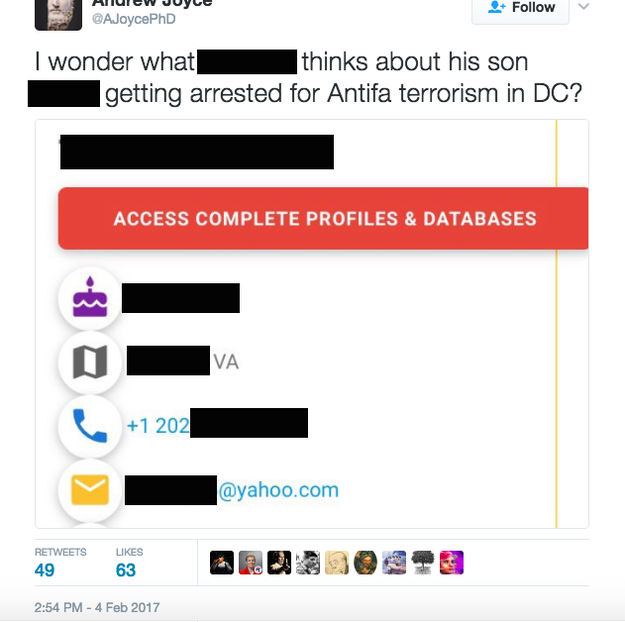
Last week, another right-wing news site, GotNews, obtained and published the names, ages and hometowns of 231 people arrested during Inauguration Day protests in Washington, DC. Other fringe right-wing news sites followed. And almost immediately, a network of Twitter accounts and white nationalist forums began poring over the information and linking the names to social media accounts, and in some cases outing the arrestees.

A Virginia man who was arrested at the inauguration and who asked not to be identified told BuzzFeed News that his name and information were posted to Twitter by the white nationalist writer Andrew Joyce. Though Joyce’s account was suspended, the man said someone posted a screenshot of the Tweet to Facebook page of a business he runs out of his home, along with a warning not to patronize it.

“I was afraid to go outside that night,” he said. “I went to smoke a cigarette and I thought, what if someone comes and shoots me?” The man said he has since taken down the Facebook page.

“I was afraid to go outside that night. I went to smoke a cigarette and I thought, what if someone comes and shoots me?”

Charles Johnson, the owner of GotNews and founder of WeSearchr, told BuzzFeed News that the public had a right to know the names of the protestors.

“It&039;s journalism bro,” he wrote in an email. “These are criminals and the public deserves to know who they are. In my opinion it&039;s racist that the mug shots aren&039;t being released. We always get the mug shots of black criminals. Why not hipster rioters from Brooklyn? We have several cash bounties against the antifa and are actively working with federal and local law enforcement to see them brought to justice. It won&039;t be long now.”

The anti-anti-Trump internet hardly limits its efforts to black bloc anti-fascists and overzealous protesters. Last month, immigration activists warned that trolls were monitoring and promoting the popular Twitter hashtag in an effort to catalogue and report undocumented workers.

Acts of political resistance spread on social media, followed by personal retribution: This is a familiar pattern. In 2011, journalists, politicians, and technologists hailed the role that social networks played in toppling a succession of dictators in the Middle East. In the years that followed, the same people watched in despair as revanchist authoritarians scoured the very same social networks to target the activists and organizers who had used them, they thought, to gain their political freedom. The great technological lesson of the Arab Spring was that social platforms are not inherently democratic; rather, they can just as easily oppress people as express their will.

To be sure, the next anti-administration activist the pro-Trump, alt-right internet manages to get thrown in jail will be the first. But it would be a mistake to dismiss the anti-anti-Trump internet as simply conspiracy mongers or attention-seeking opportunists. While the alt-right may not be able to turn out in great numbers to a street protest, they’ve shown themselves since the nascent days of Gamergate to be remarkably adept at fomenting information campaigns against individual and corporate targets, from Brianna Wu and Intel to Comet Ping Pong and John Podesta. (Earlier this week. the alt-right came up with its own answer to : , a response to the site releasing a television expansion of the 2014 campus satire Dear White People, which the Twitter user @BakedAlaska, a hero of the pro-Trump internet said “promotes white genocide.”) Meanwhile, the sheer number of new, Trump-loyal outlets trading in conspiracy and confirmation bias suggests that any and all information surfaced by the same churning engine that produced will be spread further and faster than ever.

And maybe higher. Charles Johnson worked for Steve Bannon, the president’s powerful chief strategist, at Breitbart, and was reported by Forbes to be advising the Trump transition team. While there is no evidence to suggest that the Trump administration is actively monitoring social media campaigns in order to target private individuals, federal law enforcement has used social media as a tool to impose the President’s since-stayed executive order on immigration. Last week, BBC reporter Ali Hamedani announced that a customs agent seized his phone and read his tweets during his detention at Chicago’s O’Hare airport:

It’s a reminder that, for all the excitement that viral Trump resistance has produced on the left, every unit of that virality — whether it’s a face on a Periscope stream, a tweet, or a Facebook group — is a piece of information that can be seized, decontextualized, and ultimately used against the opposition. And that when it comes to social media’s ability to effect change, proximity to power and access to force matter just as much — if not more — than a majority.

Quelle: <a href="The Viral Anti-Trump Movement Is Here — And It&039;s A Huge Target“>BuzzFeed

Zenefits Is Laying Off Almost Half Its Employees

Matt Chase for BuzzFeed News

Zenefits will lay off 45% of its employees in an effort to slash costs, according to an internal memo this morning that was obtained by BuzzFeed News, a stark acknowledgment by the embattled human resources startup that its onetime expectations for growth were vastly inflated.

Roughly 430 workers will be cut, including 250 in Zenefits&; San Francisco headquarters and 150 in its office in Tempe, Arizona, leaving the company with about 500 employees, according to the memo and a person briefed on the matter. That&039;s about a third of the size it was a year ago, when it ousted its founding CEO, Parker Conrad, over revelations that it flouted state regulations for selling health insurance.

Thursday&039;s announcement, coming on the morning after the one-year anniversary of Conrad&039;s departure, is the third round of layoffs — and the largest — to hit the company since the crisis began.

Zenefits, which is both a software maker and a health insurance broker, will turn to staffing agencies for seasonal workers during the fall and winter months, a busy period when customers are enrolling in benefits. In addition, after upgrades in its software, Zenefits has less need for workers to help with tasks like customer enrollment, the person briefed on the matter said.

Jay Fulcher, the newly appointed CEO, informed employees of the layoffs this morning; the person briefed on the matter, insisting on anonymity, provided additional details. Fulcher took the helm a week ago from David Sacks, who succeeded Conrad as CEO and was forced to clean up the company&039;s regulatory mess.

“This isn&039;t how any CEO would choose to spend his first week on the job,” Fulcher said in the email to staff, “but I strongly believe these difficult decisions are essential in setting Zenefits up for success.”

A Zenefits spokesperson, Jessica Hoffman, said in an emailed statement to BuzzFeed News: “This has been planned for some time and is the result of a lot of hard work over the past year to improve our products and service and make the operations of the company more efficient.”

Even in a town built on hype, Zenefits turned heads for its rapid ascent to elite “unicorn” status, gaining a $4.5 billion valuation just after its second birthday. Conrad, its leader at the time, said the company was on track to reach $100 million in annual recurring revenue by the end of 2015, and he aggressively staffed up in anticipation of that milestone.

But the reality fell short. By the middle of 2016, annual recurring revenue was around $60 million, and Zenefits had slashed its valuation to $2 billion. More detailed financial information obtained by BuzzFeed News showed that Zenefits lost $100 million in the six months from February through July 2016, on revenue of $35.3 million. During that period, the company burned through $97.1 million of cash, a rate that put it on track to run out of cash by the end of 2017.

As a result of the latest layoffs, Hoffman said in the statement, “we have a dramatically improved cost structure, the ability to deliver a market-leading product roadmap that exceeds customer expectations, and enough cash to fund our operations for years to come.”

In part, the layoffs reflect recent improvements in Zenefits&039; software that have made the administration of benefits more automated, the person briefed on the matter said. Before a software overhaul led by Sacks last year, core Zenefits functions were heavily reliant on manual work by staff, leading to seemingly careless errors, BuzzFeed News has reported.

In the wake of Conrad&039;s departure last year, Zenefits shed hundreds of employees, including many on the sales team, through a combination of layoffs and an offer to take severance pay and quit. The latest layoffs fall more heavily on the operations department and other areas outside of sales, though they touch every department.

Fulcher said in the memo that Zenefits would consolidate its operations group in its Arizona office, while expanding its product and engineering groups in Vancouver and Bangalore to supplement its San Francisco team.

“The Bay Area is an expensive place to do business,” Hoffman said in the statement.

Fulcher, whose appointment was announced earlier this week, was formerly the CEO of Ooyala, a video tech startup that was acquired by the Australian telecom company Telstra.

Quelle: <a href="Zenefits Is Laying Off Almost Half Its Employees“>BuzzFeed

Twitter's Algorithmic Timeline Is Working

Drew Angerer / Getty Images

There&;s a subtle change happening on Twitter that&039;s so nondescript it&039;s easy to miss. But it&039;s helping the company in a very noticeable way.

For the past year, Twitter has moved away (slightly) from the orthodox adherence to reverse-chronological order that once defined its stream. It’s prioritized relevance over recency, at least in spurts. And by all indications, its algorithmic reordering of some tweets in the timeline appears to be working.

Twitter has taken its lumps over the past year. It’s tried to sell itself and failed, for instance, and it’s admitted it was too slow to tackle a harassment problem which it has yet to solve. But the company seems to be slowly building momentum.

In Twitter’s most recent earnings call, held last October, Twitter CEO Jack Dorsey was quick to point out the algorithm&039;s positive influence on Twitter’s business. Asked what Twitter product changes were leading to revenue and engagement growth, Dorsey’s first point was the timeline update. “We made a change earlier in the year to make sure that we&039;re not just sorting by recency but also by relevance,” Dorsey explained. “We&039;re showing the most important tweets and the tweets that you really need to see faster and higher up in your timeline.” A year after it was introduced, less than 2% of people have opted out of the algorithm, a number that remains consistent from when it was first announced last year, a Twitter spokesperson confirmed.

Twitter’s stock price is 4 points higher than at this point last year (but still disappointing overall), and it’s slowly picked up user growth, adding 4 million monthly active users last quarter. And now, even some analysts are coming around. “We are upgrading Twitter to BUY,” Rich Greenfield of BITG research wrote in a note Wednesday. “Our upgrade of TWTR is premised on the belief that Twitter’s daily active user (DAU) growth is accelerating, particularly in the US, which has a disproportionate impact on Twitter’s revenues and profits.” Tomorrow, we’ll get another update as Twitter reports its fourth quarter earnings.

(The ascendance of Donald Trump to the presidency hasn’t saved the platform, but it hasn’t hurt either. Twitter will remain central to the global conversation at least as long as Trump remains president and continues to tweet regularly.)

When Twitter rolled out the algorithm last year, it did so almost abashedly. After a large protest, Dorsey promised Twitter’s users he wasn’t going to reorder their timelines (adding the key caveat: “next week”), and since then he’s stayed away from the very word “algorithm,” using “enhanced timeline” instead. The algorithm is so hard to pick out, you have to stare at the timestamps affixed to the top of tweets as they tick off out of order in subtle grey to notice it.

But Twitter doesn’t need to make a big show about the algorithm, or put it in a big “This Might Be Interesting” box. What’s important is that it’s working.

Quelle: <a href="Twitter&039;s Algorithmic Timeline Is Working“>BuzzFeed

A Samsung Battery Factory Exploded Because 2017

A Samsung Battery Factory Exploded Because 2017

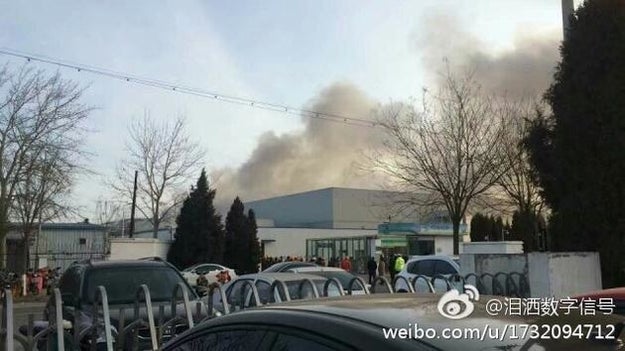
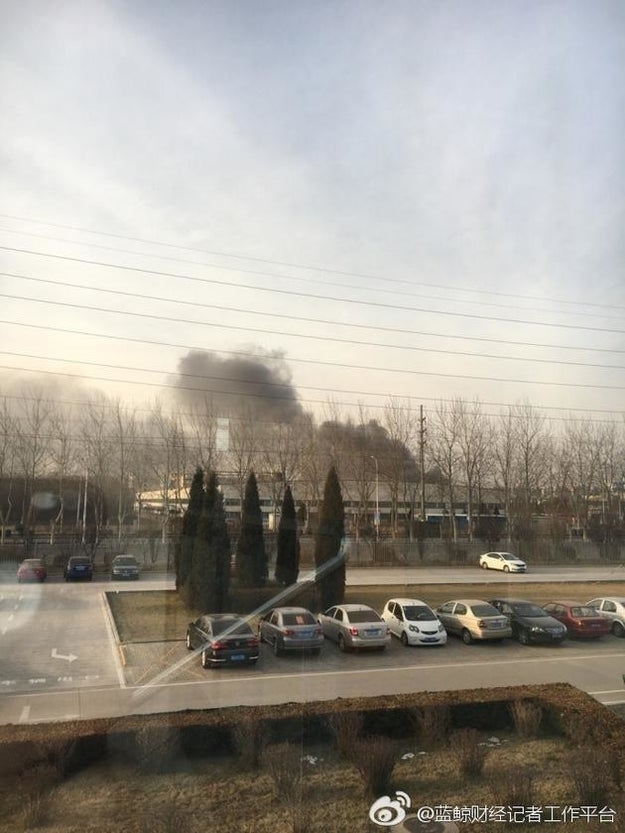
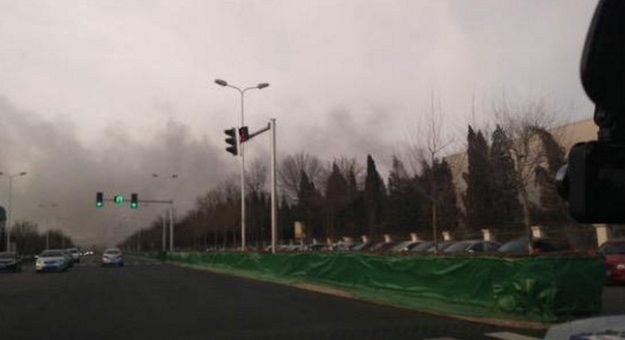
A section of Samsung SDI&;s battery manufacturing facility in Tianjin, China exploded on Wednesday morning, Reuters reports. Of course it did.

A photo of the smoking Samsung SDI factory posted to the Chinese social network Weibo

Weibo / Via tech.sina.com.cn

It was the part of the factory that deals with waste from the battery-making process. Faulty lithium ion batteries caught fire, according to the local fire department, which sent 110 firefighters and 19 trucks to the factory. There were no casualties, and the factory&039;s operations weren&039;t significantly impacted, according to Reuters.

Of course it did. Because 2017. It wasn&039;t enough to have exploding phones in 2016. Now this devil year is blowing up the places where Samsung makes its phones.

Samsung has blamed its battery manufacturing partners, Samsung SDI and Amperex, for the problems that dogged its Galaxy Note7 smartphone.

Another photo of the Samsung SDI factory posted to Weibo.

Weibo / Via tech.sina.com.cn

This isn&039;t Samsung&039;s first explosion. Oh no. You may have heard about the Samsung Galaxy Note7, the phone that was the mascot of 2016.

The US Consumer Product Safety Commission recalled 2.5 million Note7s in September 2016 for fire hazards posed by the lithium ion battery — the same type of battery linked to the fire in the Tianjin factory on Wednesday. Samsung entirely halted global production of the Note7 over similar concerns after replacement phones also caught fire.

In case you blacked out 2016 (understandable), here&039;s a video of the Note7 smoking in an unsuspecting person&039;s home.

youtube.com

There&039;s also the small matter of the 2.8 million exploding washing machines Samsung later recalled.

The factory explosion might not help Samsung&039;s image in China, where consumers aren&039;t happy about how it handled the whole Note7 debacle. After the official recall in the US, Samsung told Chinese consumers that their Galaxy Note7s, which were manufactured by a different company than phones sold elsewhere, were fine. But these phones were exploding too. Eventually, Samsung got around to recalling the phone globally.

Smoke from the Samsung SDI factory as faulty batteries burned.

Weibo / Via tech.sina.com.cn

Overall, though, the factory fire probably won&039;t hurt Samsung&039;s profits.

The quarter after the Note7 recall, the Korean conglomerate posted its highest profits in three years.

Quelle: <a href="A Samsung Battery Factory Exploded Because 2017“>BuzzFeed