Samsung Just Unveiled A High-Performance Tablet With A Keyboard

Korean conglomerate Samsung revealed two new types of tablets today at Mobile World Congress in Barcelona: a high-performance Galaxy Book series with full desktop PC capabilities, and the sleek, all-glass Galaxy Tab S3, a tablet optimized for entertainment. Price and availability have not been announced for either device.

It has a 9.7-inch AMOLED screen with 2048 &; 1536 resolution with HDR, 10-bit color support to watch Netflix and browse Facebook. There are four speakers that detect tablet rotation and change the audio output to reflect whether the device is in landscape or portrait. At .928 pounds, it’s slightly heavier than the previous Tab S2, and Samsung claims it has a 12-hour battery life. The tablet uses the new USB Type-C port for charging.

Some of the standout software features include a blue light filter that eliminates blue light while reading or browsing. (Blue light may block the production of melatonin, a chemical that makes you feel sleepy.) There’s also a new game launcher that blocks notifications during gameplay.

It’s powered by the latest version of Android, Nougat 7.0, a Snapdragon 820 processor, 4GB of RAM with a microSD slot for up to 256GB of storage, a 5MP front-facing camera, and a 13MP rear camera.

The Tab S3 comes with an S Pen stylus for note-taking, creating GIFs, and quick translations. The tablet also has a special connector that works with a keyboard cover, sold separately. Neither the keyboard nor stylus require pairing or charging.

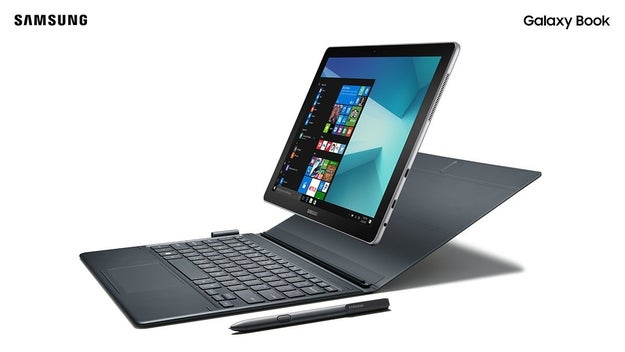
The Galaxy Book series — Samsung’s answer to the iPad Pro and Microsoft Surface — is a workhorse designed with productivity and multitaskers in mind.

The Galaxy Book series — Samsung’s answer to the iPad Pro and Microsoft Surface — is a workhorse designed with productivity and multitaskers in mind.

Samsung

It’s a convertible laptop/tablet hybrid that comes in a 10.6-inch and a 12-inch version. The new device’s most notable capability is its ability to run the Windows 10 operating system, meaning that it can easily go from a touchscreen tablet to a true laptop PC. The hybrid is super slim, at 7.6mm thick, and weighs a pound and a half. There are also 2 USB-C ports for accessories or monitors.

It ships with an S Pen, which is compatible with Adobe’s programs out of the box. The Galaxy Book also includes a backlit keyboard.

Samsung claims the Galaxy Book can do anything a full desktop PC can do. Here are the technical details:

The 12-inch model:

  • 2160 &215; 1440 AMOLED screen that supports videos in HDR
  • 3.1GHZ Kaby Lake Core i5 processor
  • Two options: 4GB of RAM with a 128GB solid state drive or 8GB of RAM with a 256GB solid state drive
  • 13MP rear-facing camera and a 5MP front-facing camera

The 10-inch model:

  • 1920 &215; 1280 AMOLED screen
  • 2.6GHz Intel Core m3 processor
  • 5MP front-facing camera only

Samsung has had a rocky several months following the recall and eventual discontinuing of the Note7, built with faulty batteries that led to explosions. Samsung’s reputation in the US plummeted as a result. Company vice chairman Jay Y. Lee was formally arrested on unrelated bribery allegations.

Samsung kicked off Sunday’s presentation with a video highlighting the company’s commitment to quality assurance, showing that its phones are tested and re-tested. “The past six months have undoubtedly been the most challenging periods in our history,” said Samsung CMO David Lowes.

Where’s the Galaxy S8?

Samsung is holding off on announcing its top-of-the-line flagship phone, the Galaxy S8, for now. The new phone now has an official announcement date (March 29) and is rumored to have an April 21 release date.

The only other tidbit we heard from the company today is that its newest phone will ship with specially tuned AKG earphones.

An app image may have revealed the design of the S8. According to the mockup discovered by SamMobile, the S8 may feature a button-less, nearly bezel-less design.

Leaks indicate that the new phone will have an even larger display than past devices, come in two sizes, and feature Samsung’s version of Google Assistant and Siri, called Bixby. Stay tuned for more news on the Galaxy S8 in March.

Quelle: <a href="Samsung Just Unveiled A High-Performance Tablet With A Keyboard“>BuzzFeed

Girl Scouts Are Taking Credit Card Payments For Cookies And It’s Diabolical

It&;s Girl Scout cookie season, which means our wallets are getting smaller and our pant sizes are getting bigger.

Seasons vary by place. Here&039;s how to find yours.

But in these hip modern times, how can you get your Thin Mint fix if you don&039;t carry cash?

According to a 2014 report by Bankrate and Princeton Survey Research Associates International, 50% of Americans carry $20 or less every day, and 9% don&039;t carry cash at all. Retailers are adapting at varying speeds.

Oh, the burnt caramel taste of sorrow&;

Giphy

The Scouts know this is a problem, though, and they&039;re trying something new: mobile credit card readers.

Giphy

That&039;s right. Some Girl Scouts have started using Square to take payments, and people around the country have taken notice.

Square doesn&039;t have any official data on the prevalence of its readers among the Scouts, and Troop 87 didn&039;t respond to requests for comment about why they decided to try the mobile card readers.

Square did say it has seen a trend of more parents telling the company they&039;ve started using readers, as well as more social media chatter about scouts around the country using them in 2017 than in 2016.

The readers didn&039;t come from an official Girl Scout partnership with Square, and there probably won&039;t be one in the future.

Square was excited about the scouts, though: “We love when sellers use Square in creative ways. As you can imagine, their customers are equally as excited that they don&039;t have to carry cash anymore.”

There&039;s an expense for the convenience, though: the company takes a 2.75% transaction fee for all credit and debit card transactions.

Who are these scouts of the future?

Meet Ava Burns. She&039;s a seven-year-old Girl Scout and is in the first grade in Austin, Texas. She&039;s sold 720 boxes of Girl Scout cookies this year, the most of anyone in Troop 87.

It&039;s only her second year in Girl Scouts, and last year she sold 500 boxes.

Her goal for 2017 was 650, which she&039;s obviously already beaten. Her mom, Briana Burns, attributes the increase to one big change: a Square credit card reader.

“I think 90% of the people who weren&039;t carrying cash, which were mostly young people, turned around and bought something when they heard we took credit cards,” she told BuzzFeed News.

Briana Burns

Last year, Ava and her mom had some trouble. Several potential cookie buyers walked away empty-handed, saying, “Ah, I want to buy some, but I don&039;t have any cash.”

The same thing started happening when cookie season started again on January 18 this year. But two days into the season, Troop 87 offered its members the chance to use Square readers to process payments for cookies. Ava wanted to try it out, so she brought the reader with her when she was selling door-to-door after school and when setting up cookie sales booths at Walmart or Walgreens on weekends.

Sales end this Sunday, and Ava is currently the top seller in her troop. Briana said that the other scout with a Square reader is among the top three as well. Briana predicts more people will use the readers in 2018 because of how successful they were this year.

“Ava asked me last week if we had met our goal, and I looked, and we were already 70 boxes past it,” Briana said.

It wasn&039;t just Ava&039;s mom using the reader to take payments, either.

Ava herself became well-versed in using Square to take credit card payments. The two had set up shop outside a Walmart one day when Briana started having trouble getting the reader to scan a card — “They&039;re easy to use, but a bit touchy,” she said — when Ava snatched the iPhone and the reader with a quick “Ugh, mom, just let me do it,” and swiped the card herself.

“It really empowered her to see technology as a means to achieving her goals rather than a spare time thing,” Briana said. “She&039;s my little entrepreneur.”

The reader had other benefits, too.

The troop had instituted a two-box minimum for transactions using the Square reader, so all the customers who didn&039;t have cash had to buy more cookies by default. What a burden to have ~two~ boxes of Samoas instead of one.

It was also safer. After a successful day of sales, Girl Scouts can be carrying plenty of cash. In the California Bay Area this year, a Girl Scout and her mother were allegedly robbed at gunpoint for the cash they&039;d collected from cookie sales.

“Having the reader at the booths, especially when it&039;s just me and Ava, makes me feel like we&039;re less likely to be targeted because there&039;s less cash on hand. And we don&039;t have to run into Walmart to make change or go to the bank to deposit all this money,” Briana said.

On one of her Saturday shifts from 11-1 outside of a Walmart, Ava sold 130 boxes of cookies, beating even the iconic San Francisco Girl Scout Danielle Lei who set up shop outside of a marijuana dispensary in 2014 and sold 117 boxes in two hours.

Bottom line: Ava&039;s a champ.

Ava is hoping to use the rewards from her cookie sales to go to Girl Scout riding camp, as her mom did when she was a scout. Her favorite cookie is the Samoa, also known as the Caramel Delight. Briana&039;s is the S&039;More, the new cookie for 2017 that became one of this year&039;s top sellers.

Quelle: <a href="Girl Scouts Are Taking Credit Card Payments For Cookies And It’s Diabolical“>BuzzFeed

What’s Up With David Beckham Casually Posing With Lotion?

Welcome to “Is This an Ad?,” a column in which we take a celebrity social media post about a brand or product and find out if they’re getting paid to post about it or what. Because even though the FTC recently came out with rules on this, it’s not always clear. Send a tip for ambiguous tweets or ‘grams to katie@buzzfeed.com.

THE CASE:

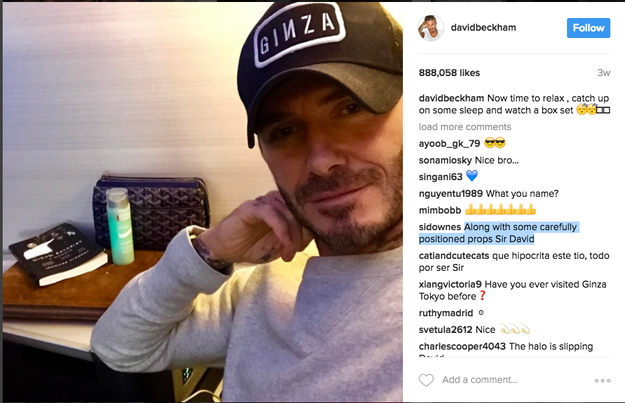
Soccer star David Beckham posted an Instagram where he’s awkwardly sitting in front of a strange desk or table in front of a blank wall. I’m guessing it’s a hotel room of sorts – he has a Goyard toiletries-sized bag and a copy of Widow Basquiat, a biography of Jean-Michel Basquiat’s girlfriend, propped up on some brown thing (the hotel room service menu, perhaps?). And quite noticeably… you can see a bottle of green lotion with the label turned sideways, too small to read. Whatever that bottle is… is this an ad for it?

Note the green bottle. Is this a low-key ad?

Note the green bottle. Is this a low-key ad?

At least one person in Beckham&;s comments noticed the conspicuous lotion placement and wrote, “along with some carefully positioned props Sir David.”

Via instagram.com

THE EVIDENCE:

David Beckham is no stranger to endorsement deals. He’s a soccer star, and athlete endorsements for sports apparel or sneakers is completely normal to most people – nobody bats an eye or thinks a player is a “sell out” if they’re in a Nike ad.

Beckham is one of the most famous athletes ever, and he’s done endorsement deals for many, many brands, including Adidas, H&M, Burger King, Gillette, and Motorola, and lots more. He does TV and print ads for these things, very classic and recognizable advertising. He doesn’t do sneaky or lame diet tea ads.

A HINT:

Ok, you should know this: David Beckham is the ambassador of the Biotherm Homme skincare line, and the lotion pictured in his instagram (even if it’s hard to tell) is their Aquapower Gel moisturizer.

But that doesn’t make the answer totally clear either, right? Is this meant to be an ad, or does he just happen to randomly have his bottle of moisturizer (let’s assume he truly uses the stuff) on his hotel nightstand next to his book before he goes to bed? It’s not so unreasonable you or I would randomly have moisturizer and a toiletries bag in the background of a hotel selfie, right?

Plus, he doesn’t mention the name of the moisturizer in his caption, it just appears in the background, so small you can’t even read the label.

There’s one other piece of information you should know: PR for L’Oréal sent BuzzFeed a press alert about this particular Instagram, touting how the brand’s ambassador uses the cream in his relaxing nightly routine. Again, that doesn’t mean that they paid him to post that instagram, but he does have an endorsement deal with them.

I asked L’Oréal what “ambassador” means, and they explained that he has a longstanding relationship with the company, is the face of Biotherm Homme, and has a deal to develop his own product line in the future.

So basically, Beckham has some skin in the game (heh) – he’s not just getting paid a lump sum to do one TV ad. The better this product sells, the better for him.

THE VERDICT:

Here’s what L’Oréal told me:

L’Oréal’s policy is to respect all disclosure obligations for endorsements. David Beckham is the global face of Biotherm Homme, appearing in all media, but while Beckham’s Instagram post shows a Biotherm product on his desk behind him in the background, this appearance was not obligated.

According to them, this isn’t an “ad” per se, because they didn’t ASK him to post it.

Then I asked Bonnie Patton, a lawyer and executive director of the nonprofit advocacy group Truth In Advertising. “The FTC law is quite clear,” Patton said. “If there is a material connection between the endorser and the product, then that needs to be disclosed.”

Ok, but what about this particular post? Patton said: “we would look at an Instagram post like this and say it’s Mr. Beckham&039;s responsibility and the responsibility of the company to make sure that consumers are informed that he has a material connection to this product.”

So according to an industry watchdog group, it’s an ad and should be disclosed. In this case, I’m giving a ruling to the watchdog group instead of the brand. It’s an ad.

Ironically, I asked a friend to help identify the book in the photo, and he had read it and recommended it highly, so I ordered it on Amazon. This was a tremendously effective ad, but for the book instead of the men’s moisturizer.

Quelle: <a href="What’s Up With David Beckham Casually Posing With Lotion?“>BuzzFeed

How YouTube Serves As The Content Engine Of The Internet's Dark Side

How YouTube Serves As The Content Engine Of The Internet's Dark Side

YouTube

David Seaman is the King of the Internet.

On Twitter, Seaman posts dozens of messages a day to his 66,000 followers, often about the secret cabal — including Rothschilds, Satanists, and the other nabobs of the New World Order — behind the nation’s best-known, super-duper-secret child sex ring under a DC pizza parlor.

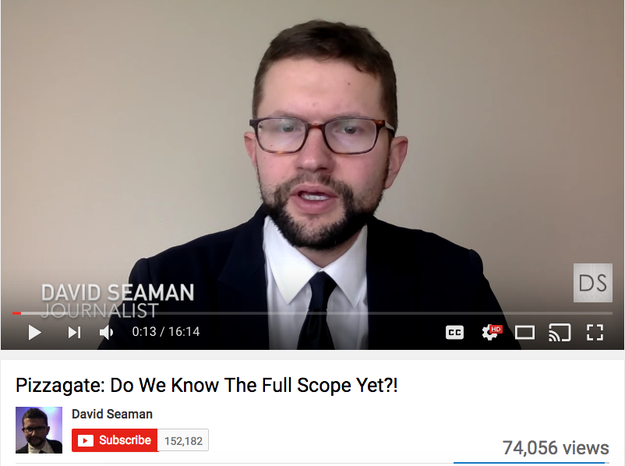
But it’s on YouTube where he really goes to work. Since Nov. 4, four days before the election, Seaman has uploaded 136 videos, more than one a day. Of those, at least 42 are about Pizzagate. The videos, which tend to run about eight to fifteen minutes, typically consist of Seaman, a young, brown-haired man with glasses and a short beard, speaking directly into a camera in front of a white wall. He doesn’t equivocate: Recent videos are titled “Pizzagate Will Dominate 2017, Because It Is Real” and “PizzaGate New Info 12/6/16: Link To Pagan God of Pedophilia/Rape.”

Seaman has more than 150,000 subscribers. His videos, usually preceded by preroll ads for major brands like Quaker Oats and Uber, have been watched almost 18 million times, which is roughly the number of people who tuned in to last year’s season finale of NCIS, the most popular show on television.

His biography reads, in part, “I report the truth.”

In the aftermath of the 2016 presidential election, the major social platforms, most notably Twitter, Facebook, and Reddit, have been forced to undergo painful, often public reckonings with the role they play in spreading bad information. How do services that have become windows onto the world for hundreds of millions of people square their desire to grow with the damage that viral false information, “alternative facts,” and filter bubbles do to a democracy?

And yet there is a mammoth social platform, a cornerstone of the modern internet with more than a billion active users every month, which hosts and even pays for a fathomless stock of bad information, including viral fake news, conspiracy theories, and hate speech of every kind — and it’s been held up to virtually no scrutiny: YouTube.

The entire contemporary conspiracy-industrial complex of internet investigation and social media promulgation, which has become a defining feature of media and politics in the Trump era, would be a very small fraction of itself without YouTube. Yes, the site most people associate with “Gangnam Style,” pirated music, and compilations of dachshunds sneezing is also the central content engine of the unruliest segments of the ascendant right-wing internet, and sometimes its enabler.

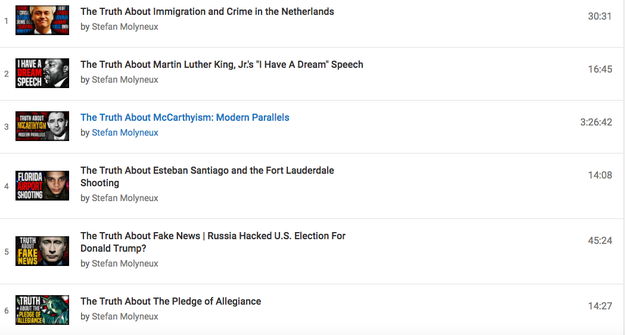
To wit, the conspiracy-news internet’s biggest stars, some of whom now enjoy New Yorker profiles and presidential influence, largely live on YouTube. Infowars — whose founder and host, Alex Jones, claims Sandy Hook didn’t happen, Michelle Obama is a man, and 9/11 was an inside job — broadcasts to 2 million subscribers on YouTube. So does Michael “Gorilla Mindset” Cernovich. So too do a whole genre of lesser-known but still wildly popular YouTubers, people like Seaman and Stefan Molyneux (an Irishman closely associated with the popular “Truth About” format). As do a related breed of prolific political-correctness watchdogs like Paul Joseph Watson and Sargon of Akkad (real name: Carl Benjamin), whose videos focus on the supposed hypocrisies of modern liberal culture and the ways they leave Western democracy open to a hostile Islamic takeover. As do a related group of conspiratorial white-identity vloggers like Red Ice TV, which regularly hosts neo-Nazis in its videos.

“The internet provides people with access to more points of view than ever before,” YouTube wrote in a statement. “We&;re always taking feedback so we can continue to improve and present as many perspectives at a given moment in time as possible.”

YouTube

All this is a far cry from the platform’s halcyon days of 2006 and George Allen’s infamous “Macaca” gaffe. Back then, it felt reasonable to hope the site would change politics by bypassing a rose-tinted broadcast media filter to hold politicians accountable. As recently as 2012, Mother Jones posted to YouTube hidden footage of Mitt Romney discussing the “47%” of the electorate who would never vote for him, a video that may have swung the election. But by the time the 2016 campaign hit its stride, and a series of widely broadcast, ugly comments by then-candidate Trump didn’t keep him out of office, YouTube’s relationship to politics had changed.

Today, it fills the enormous trough of right-leaning conspiracy and revisionist historical content into which the vast, ravening right-wing social internet lowers its jaws to drink. Shared widely everywhere from white supremacist message boards to chans to Facebook groups, these videos constitute a kind of crowdsourced, predigested ideological education, offering the “Truth” about everything from Michelle Obama’s real biological sex (760,000 views&;) to why medieval Islamic civilization wasn’t actually advanced.

Frequently, the videos consist of little more than screenshots of a Reddit “investigation” laid out chronologically, set to ominous music. Other times, they’re very simple, featuring a man in a sparse room speaking directly into his webcam, or a very fast monotone narration over a series of photographs with effects straight out of iMovie. There’s a financial incentive for vloggers to make as many videos as cheaply they can; the more videos you make, the more likely one is to go viral. David Seaman’s videos typically garner more than 50,000 views and often exceed 100,000. Many of Seaman’s videos adjoin ads for major brands. A preroll ad for Asana, the productivity software, precedes a video entitled “WIKILEAKS: Illuminati Rothschild Influence & Simulation Theory”; before “Pizzagate: Do We Know the Full Scope Yet?&033;” it’s an ad for Uber, and before “HILLARY CLINTON&039;S HORROR SHOW,” one for a new Fox comedy. (Most YouTubers have no direct control over which brands&039; ads run next to their videos, and vice versa.)

This trough isn’t just wide, it’s deep. A YouTube search for the term “The Truth About the Holocaust” returns half a million results. The top 10 are all Holocaust-denying or Holocaust-skeptical. (Sample titles: “The Greatest Lie Ever Told,” which has 500,000 views; “The Great Jewish Lie”; “The Sick Lies of a Holocaust™ &039;Survivor.&039;”) Say the half million videos average about 10 minutes. That works out to 5 million minutes, or about 10 years, of “Truth About the Holocaust.”

Meanwhile, “The Truth About Pizzagate” returns a quarter of a million results, including “PizzaGate Definitive Factcheck: Oh My God” (620,000 views and counting) and “The Men Who Knew Too Much About PizzaGate” (who, per a teaser image, include retired Gen. Michael Flynn and Andrew Breitbart).

Sometimes, these videos go hugely viral. “With Open Gates: The Forced Collective Suicide of European Nations” — an alarming 20-minute video about Muslim immigration to Europe featuring deceptive editing and debunked footage — received some 4 million views in late 2015 before being taken down by YouTube over a copyright claim. (Infowars: “YouTube Scrambles to Censor Viral Video Exposing Migrant Invasion.”) That’s roughly as many people as watched the Game of Thrones Season 3 premiere. It’s since been scrubbed of the copyrighted music and reuploaded dozens of times.

First circulated by white supremacist blogs and chans, “With Gates Wide Open” gained social steam until it was picked up by Breitbart, at which point it exploded, blazing the viral trail by which conspiracy-right “Truth” videos now travel. Last week, President Trump incensed the nation of Sweden by falsely implying that it had recently suffered a terrorist attack. Later, he clarified in a tweet that he was referring to a Fox News segment. That segment featured footage from a viral YouTube documentary, Stockholm Syndrome, about the dangers of Muslim immigration into Europe. Sources featured in the documentary have since accused its director, Ami Horowitz, of “bad journalism” for taking their answers out of context.

So what responsibility, if any, does YouTube bear for the universe of often conspiratorial, sometimes bigoted, frequently incorrect information that it pays its creators to host, and that is now being filtered up to the most powerful person in the world? Legally, per the Digital Millennium Copyright Act, which absolves service providers of liability for content they host, none. But morally and ethically, shouldn’t YouTube be asking itself the same hard questions as Facebook and Twitter about the role it plays in a representative democracy? How do those questions change because YouTube is literally paying people to upload bad information?

And practically, if YouTube decided to crack down, could it really do anything?

YouTube does “demonitize” videos that it deems “not advertiser-friendly,” and last week, following a report in the Wall Street Journal that Disney had nixed a sponsorship deal with the YouTube superstar PewDiePie over anti-Semitic content in his videos, YouTube pulled his channel from its premium ad network. But such steps have tended to follow public pressure and have only affected extremely famous YouTubers. And it’s not like PewDiePie will go hungry; he can still run ads on his videos, which regularly do millions of views.

Ultimately, the platform may be so huge as to be ungovernable: Users upload 400 hours of video to YouTube every minute. One possibility is drawing a firmer line between content the company officially designates as news and everything else; YouTube has a dedicated News vertical that pulls in videos from publishers approved by Google News.

Even there, though, YouTube has its work cut out for it. On a recent evening, the first result I saw under the “Live Now – News” subsection of youtube.com/news was the Infowars “Defense of Liberty 13 Hour Special Broadcast.” Alex Jones was staring into the camera.

Quelle: <a href="How YouTube Serves As The Content Engine Of The Internet&039;s Dark Side“>BuzzFeed

Elon Musk Slams Union Drive At Tesla Factory

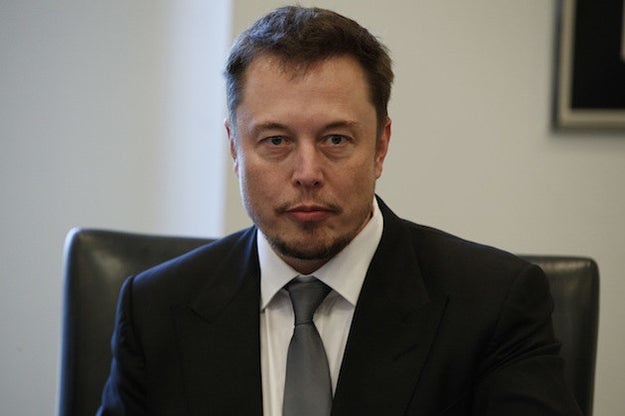
Tesla CEO Elon Musk listens as President-elect Donald Trump speaks during a meeting with technology industry leaders at Trump Tower in New York, Wednesday, Dec. 14, 2016. (AP Photo/Evan Vucci)

Evan Vucci / AP

In a lengthy Thursday night email to Tesla employees, CEO Elon Musk defended his record as an employer, and appealed to workers not to join the United Auto Workers union.

In the message, first leaked to Electrek.co and later obtained in full by BuzzFeed News, Musk took direct aim at claims made earlier this month in a Medium post by factory worker Jose Moran. Moran alleged that long hours of physical labor once forced six of his eight team members to take medical leave simultaneously. Musk disputed this allegation, claiming a Tesla investigation has proven it to be false. “After looking into this claim, not only was it untrue for this individual’s team, it was untrue for any of the hundreds of teams in the factory,” he wrote.

“The forces arrayed against us are many and incredibly powerful. This is David vs Goliath if David were six inches tall&;”

The Tesla CEO also lambasted the efforts of the United Auto Workers union to unionize Tesla employees at the company&;s Fremont, CA factory, calling the organization&039;s tactics for doing so “disingenuous or outright false.” Musk alleged that the UAW&039;s “true allegiance is to the giant car companies, where the money they take from employees in dues is vastly more than they could ever make from Tesla.”

“The forces arrayed against us are many and incredibly powerful,” Musk wrote. “This is David vs Goliath if David were six inches tall&033; Only by being smarter, faster and working well as a tightly integrated team do we have any chance of success.”

Moran&039;s post — which was later followed by a press conference and a Facebook video — detailed how low pay, long hours, and difficult working conditions are making life difficult for Tesla employees. Moran argued that unionizing would improve the factory workers&039; situation.

Musk immediately swung back at Moran, telling Gizmodo that he was a union plant; earlier this week, during a Tesla earnings call, Musk told investors that the unionization “isn&039;t likely to occur.”

Moran denied Musk&039;s claims that he&039;s paid by the UAW to lead unionization efforts. His communications team, Storefront Political, declined comment on Musk&039;s email.

Musk&039;s email includes a point-by-point rebuttal of a number of Moran&039;s claims. Regarding long hours, Musk said overtime has actually decreased by 50% in the last year, and that the average employee worked 43 hours a week. Regarding compensation, he noted that Tesla factory workers earn equity, and therefore, over a four year period, earned “between $70,000 and $100,000 more in total compensation than the employees at other US auto companies.” On issues of safety, Musk said Tesla&039;s incident rate is less than half the industry average, and noted that the goal is to be “as close to zero injuries as possible.”

“There will also be little things that come along like free frozen yogurt stands scattered around the factory.”

In addition to defending Tesla&039;s record as an employer, Musk told workers that he plans to improve life at the Tesla factory, which is currently in the process of switching over its lines for production of the Model 3. For example, when the Model 3 reaches “volume production,” Musk said he&039;ll throw them “a really amazing party.”

“There will also be little things that come along like free frozen yogurt stands scattered around the factory and my personal favorite: a Tesla electric pod car roller coaster (with an optional loop the loop route, of course&033;) that will allow fast and fun travel throughout our Fremont campus, dipping in and out of the factory and connecting all the parking lots,” Musk wrote. “It’s going to get crazy good.”

Tesla declined comment. The full text of Musk&039;s email is below.

If you have information on working conditions or unionization efforts at Tesla, please contact the author directly, or tip us anonymously via contact.buzzfeed.com.

For Tesla to become and remain one of the great companies of the 21st century, we must have an environment that is as safe, fair and fun as possible. It is incredibly important to me that you look forward to coming to work every day. For that, we must be a fair and just company – the only kind worth creating.

This is vital to succeed in our mission to accelerate the advent of a clean, sustainable energy future. The forces arrayed against us are many and incredibly powerful. This is David vs Goliath if David were six inches tall&033; Only by being smarter, faster and working well as a tightly integrated team do we have any chance of success. We should never forget the history of car startups originating in the United States: dozens have gone bankrupt and only two, Tesla and Ford, have not. Despite the odds being strongly against us, my faith in you is why I am confident that we will succeed.

That is why I was so distraught when I read the recent blog post promoting the UAW, which does not share our mission and whose true allegiance is to the giant car companies, where the money they take from employees in dues is vastly more than they could ever make from Tesla.

The tactics they have resorted to are disingenuous or outright false. I will address their underhanded attacks below. While this discussion focuses on Fremont, these same principles apply to every Tesla facility worldwide.

Safety First

The workplace issue that comes before any other is safety. If you do not have your health, then nothing else matters. Simply due to size and bad luck, there will always be some injuries in a company with over 30,000 employees, but our goal is simple: to have as close to zero injuries as possible and be the safest factory in the auto industry by far. The Tesla executive team and I are absolutely committed to this goal.

That is why I was particularly troubled by the safety claim in last week’s blog post, which said: “A few months ago, six out of eight people in my work team were out on medical leave at the same time due to various work-related injuries. I hear the ergonomics are even more severe in other areas of the factory.”

Obviously, this cannot be true: if three quarters of his team suddenly went on medical leave, we would not be able to operate that part of the factory. Furthermore, if things were really even worse in other departments, that would mean something like 80% or more of the factory would be out on injury, production would drop to virtually nothing and the parking lot would be almost empty. As you know firsthand, we have the *opposite* problem – there is never enough room to park&033; In fact, we are working at top speed to build more parking. Also, hopefully our darn BART train station will open before all hell freezes over&033;

After looking into this claim, not only was it untrue for this individual’s team, it was untrue for any of the hundreds of teams in the factory.

That said, reducing excess overtime and improving safety are extremely important. This is why we hired thousands of additional team members to create a third shift, which has reduced the burden on everyone. Moreover, since the beginning of Tesla production at Fremont five years ago, there have been dedicated health and safety experts covering the factory and we hold regular safety meetings with operations leaders. Since the majority of the injuries in the factory are ergonomic in nature, we have an ergonomics department focused exclusively on this issue.

The net result is that since January 1st, our total recordable incident rate (TRIR) is under 3.3, which is less than half the industry average of 6.7.

Of course, the goal is to have as close to zero injuries as humanly possible, so we need to keep improving. If you have a safety concern or an idea on how to make things better, please let your manager, safety representative or HR partner know. You can also send an anonymous note through the Integrity Hotline (this applies broadly to any problems you notice at our company) or you can email.

Compensation

At Tesla, we believe it is important for everyone to be an owner of the company. This is your company. That is why, unlike other car companies, everyone is awarded shares and you get to buy stock at a discount compared to the public through the employee stock purchase program. Last year, stock equity grants were increased significantly and it will happen again later this year once Model 3 achieves high volume.

The chart below contrasts the total comp received by a Tesla production team member who started on January 1, 2013 against the total comp received over the same period at GM, Ford, and Fiat Chrysler. A four year period is used because that’s the vesting length of a new hire equity grant. I believe the equity gain over the next four years will be similar. As shown below, a Tesla team member earned between $70,000 and $100,000 more in total compensation than the employees at other US auto companies&033;

Work Hours

Another issue raised in the UAW blog was hours worked. First, I want to recognize how hard you worked to make our company successful. Those hours mattered to you, to your family and to our company, and I can’t tell you how much I appreciate them.

However, the pace needs to be sustainable. This is why the third shift was established and why we created alternate work schedules based on feedback from various teams in the factory.

These changes have had a big impact. The average amount of hours worked by production team members this year is about 43 hours per week. The percentage of overtime hours has declined by almost 50% since the super tough time we had last year achieving rate on the Model X, which is probably the hardest car to build in history. What an amazing accomplishment&033; It is also a lesson learned, which is why Model 3 is designed to be dramatically easier to manufacture.

Fun

As we get closer to being a profitable company, we will be able to afford more and more fun things. For example, as I mentioned at the last company talk, we are going to hold a really amazing party once Model 3 reaches volume production later this year. There will also be little things that come along like free frozen yogurt stands scattered around the factory and my personal favorite: a Tesla electric pod car roller coaster (with an optional loop the loop route, of course&033;) that will allow fast and fun travel throughout our Fremont campus, dipping in and out of the factory and connecting all the parking lots. It’s going to get crazy good

Thanks again for all your effort and I look forward to working alongside you to create an amazing future&033;

Elon

Quelle: <a href="Elon Musk Slams Union Drive At Tesla Factory“>BuzzFeed
Here Are The Passwords You Should Change Immediately

A software bug discovered in Cloudflare, a popular web performance and security company, may have compromised the security of over 5 million websites, including Fitbit, Uber, and OK Cupid.

If you have or had accounts on Fitbit, Uber, Ok Cupid, Medium, or Yelp, you should probably change your passwords. In a blog post published on Thursday, the web performance and security company Cloudflare claimed that it has fixed a critical bug, discovered over the weekend, that had been leaking sensitive information such as website passwords in plain text from September 2016 to February 2017. Over 5.5 million websites use Cloudflare, including Fitbit, Uber, Ok Cupid, Medium, and Yelp.

Some website sessions accessed through HTTPS, a secure web protocol that encrypts data sent to and from a page, have been compromised as a result, and what makes the bug particularly serious is that some search engines (like Bing, Google, and DuckDuckGo) cached, or saved, a variety of the leaked data for some time. This data isn&;t easy for an non-technical person to find, but for someone with knowledge of how to craft specific queries for affected websites&039; leaked data on search engines, it was well within their reach.

Thomas Trutschel / Getty Images


View Entire List ›

Quelle: <a href="Here Are The Passwords You Should Change Immediately“>BuzzFeed

Which Messaging App Should You Use?

WHY ARE THERE SO MANY?!

There are so many ways to send a message these days. Google Voice recently added texts, group messaging, and transcribed voicemail after not updating their app for *five years,* bringing the number of Google&;s messaging apps to four (including Hangouts, Allo, and Duo). Facebook&039;s got two apps (WhatsApp and Messenger). Microsoft&039;s got two apps (GroupMe and Skype). Apple also kind of has two apps (iMessage and FaceTime).

That doesn&039;t include all of the other, independent messaging apps out there like Viber, WeChat, LINE, Telegram, and Kakaotalk, to name a few.

It&039;s true. We live in a time of TOO MANY messaging apps. So if you&039;re feeling lost in this ~brave new world~ of online communication, here&039;s a guide to the best platforms.

Christopher Furlong / Getty Images

The ~*ultimate*~ cross-platform messaging app is WhatsApp.

The ~*ultimate*~ cross-platform messaging app is WhatsApp.

WhatsApp (free, iOS, Android, Windows phone and web) is the Ultimate Messaging App. It has a giant user base, is super fast, works on many different devices (even Blackberry&;), has an easy-to-understand interface, and provides end-to-end encryption.

Plus, the Facebook-owned app has over one billion users on its platform, so it&039;s likely that some of your friends already using it.

WhatsApp offers free text messaging, group messaging, voice, and video calls over cellular data or Wi-Fi. It has a simple, easy-to-understand interface, without the overwhelming bells and whistles of the Viber and Line apps. The app is also fast. Multimedia (like photos, videos, audio messages and files up to 100MB) are compressed automatically by the app, so they send quickly even when connection is poor.

One of my favorite features is the ability to “star” messages with important reference information and access all of those starred messages in one, convenient place.

You can send and receive WhatsApp text messages from your mobile phone or the web. There is, unfortunately, no native desktop app and you can&039;t voice or video call from the web.

The app is encrypted end-to-end by default, but it can record metadata like the date, timestamp, and phone numbers associated with a message, according to a recently revised privacy policy. The app also announced last year that it was going to start sharing user information with Facebook, though it did let users opt out before agreeing to the updated terms of service. If you didn&039;t opt out before updating, you got an additional 30 days to make your choice.

Nicole Nguyen / BuzzFeed News

If you – and most of your contacts – have iPhones, it’s a no brainer: use iMessage.

If you – and most of your contacts – have iPhones, it's a no brainer: use iMessage.

For iPhone users, iMessage ticks all the boxes.

You don&039;t have to sign up for anything. It&039;s the default messaging app on all iPhones, unlike on some Android devices, where there can be up to four messaging apps to choose from (Hangouts? Allo? Duo? The cell carrier&039;s own messaging app?).

It works seamlessly with FaceTime video and audio calling over data or a cell connection. It&039;s encrypted end-to-end (although, only when you message other iPhone users). It works on your phone, it works on your Mac, and it works on your iPad. It lets you send lasers to your friends. It automatically sends texts via iMessage when it&039;s appropriate, and regular SMS to those outside the “blue bubble.” It can handle all kinds of media: GIFs, contacts, location, links, photos, videos, and voice memos.

You can use Siri to check messages or send new messages, and install integrations from the new iMessage app store. You can also access Yelp, Venmo, and Dropbox without ever leaving the Messages app.

Sure, there&039;s still room for improvement. Namely, lack of compatibility with ANY OTHER PLATFORMS (ugh). Apple can also collect some metadata, like the numbers you enter into iMessage, which are sent to Apple servers to determine whether or not the message should be sent through iMessage or SMS. Apple retains that data for up to 30 days, and can be compelled to hand it over to law enforcement with a subpoena or court order.

If iMessage were cross-platform, it might be the Perfect Messaging App. But until then, it&039;s the best option for those with iPhones to communicate with other peeps with iPhones.

Nicole Nguyen / BuzzFeed News

If you prefer features over security, plus texting, audio, *and* video chat, here are some options.

If you prefer features over security, plus texting, audio, *and* video chat, here are some options.

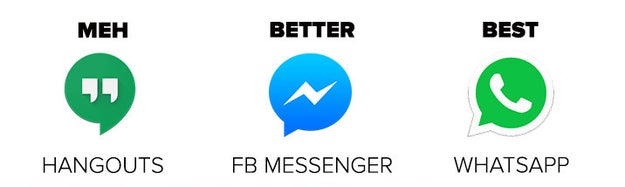
In addition to WhatsApp (read above), Facebook Messenger and Hangouts are some other apps to consider.

Facebook Messenger is more feature-rich, but doesn&039;t have as many privacy and security settings.

The messaging app by WhatsApp&039;s parent company, Facebook Messenger (free, iOS, Android, the web), has some pretty killer features, like being able to use high-definition video and audio calling on mobile or web. Messenger is unique because you can send money directly through the app in the US. There are also bots built into Messenger that can help you diagnose that weird rash or shop for you. One thing to note: users know when you&039;ve read their messages (and vice versa) and there&039;s no straightforward way to disable read receipts, sadly.

The app recently rolled out a new, fully encrypted feature called “Secret Conversations,” which ensures that the message&039;s content can&039;t be read by law enforcement or the company itself. The reason why Messenger is only for the ~moderately paranoid~ is because the encryption feature is opt-in, and needs to be turned on for every conversation, unlike WhatsApp, which automatically encrypts every chat by default. Additionally, “Secret Conversations” only encrypts text messages, photos, and videos sent in the thread, but it doesn&039;t protect audio and video calls.

Google Hangouts is fine, but isn&039;t as secure.

Hangouts (free, iOS, Android, and web) puts text messaging, audio calling, and video calling in one place – but it does not offer full encryption, so Google can wiretap conversations at the request of law enforcement. You&039;ll need to use Google Allo&039;s incognito mode for messaging and Google Duo for video chatting with end-to-end encryption.

And unlike WhatsApp or Facebook Messenger, which allow you to sign up with just your phone number and without a Facebook account, Hangouts requires a Google account.

Nicole Nguyen / BuzzFeed News


View Entire List ›

Quelle: <a href="Which Messaging App Should You Use?“>BuzzFeed

Uber Women To CEO Travis Kalanick: We Have A Systemic Problem

Getty Images

Uber CEO Travis Kalanick joined a group of more than 100 female engineers on Thursday to discuss the explosive allegations of sexual harassment and sexism recently leveled against the ride-hailing company. During an hour-long meeting, the engineers grilled Kalanick on what they say is a systemic problem at the company and urged him to begin “listening to your own people,” according to an audio recording of obtained by BuzzFeed News.

“In a situation where many women have experienced this kind of thing, the onus is on us to earn credibility,” Kalanick said. “Part of how we get to that place where there’s more optimism is by taking it and apologizing, understanding and doing everything we can to get to the bottom of it.”

Held four days after the publication of a damning essay penned by former Uber engineer Susan Fowler Rigetti, the meeting revealed a company scrambling to address an ugly crisis, with a contrite and emotional Kalanick promising “credible, thorough justice” via an internal investigation by former attorney general Eric Holder and Uber board member Arianna Huffington.

“There are people in this room who have experienced things that are incredibly unjust.”

“I think that we should kind of address the elephant in the room … which is that everyone who’s in these rooms now … believes that there is a systemic problem here. We wouldn’t be here if we didn’t,” one engineer told Kalanick. “I do not think that we need [Eric Holder’s] help in admitting to ourselves as a company that we have a systemic problem.”

“Fair enough. Fair enough. Fair enough,” Kalanick replied. “I understand.”

Circling back to the same question later in the meeting, Kalanick added, “There are people in this room who have experienced things that are incredibly unjust. I want to root out the injustice. I want to get at the people who are making this place a bad place. And you have my commitment. I understand that this is bigger than the Susan situation and I want you to know that I’m all about rooting this out and being very aggressive about that, while also being supportive and empathetic and trying to build that support and empathy throughout the organization.”

Kalanick’s meeting with Uber’s “Lady Eng” group caps a week of upset and declining morale at the ride-hail company which is still bruised from last month’s viral deleteUber campaign. Rigetti&;s essay inspired a flood of criticism and media scrutiny, that Kalanick&039;s apology to Uber employees during a Tuesday company-wide meeting has done little to temper. On Wednesday, the New York Times published a scathing account of the company’s work culture, citing an incident in which a manager groped a female employee, and another case in which a different manager threatened to beat an underperforming employee with a baseball bat. A day later, Uber investors Mitch and Freada Kapor published an open letter to Uber&039;s board and investors decrying “toxic patterns” at the company and criticizing it for choosing “a team of insiders” to investigate its destructive culture and make recommendations for change.”

“Eric Holder has been working on behalf of Uber since at least last June, when he and his firm were hired to advocate on behalf of Uber to lawmakers concerning using fingerprints as part of background checks on drivers,” the Kapors explained. “Arianna Huffington has held a board seat for about a year and is deeply invested in the company weathering the PR crisis.”

Kalanick did his best to rebut this criticism during the Lady Eng meeting. “There are very few law firms in the world that we haven’t worked with in some way,” he said. “The amount of fees that have gone to Eric Holder is as close to 0 as you can get to date.”

Liane Hornsey, Uber’s chief human resources officer, also attended the meeting and urged employees to trust that the company is working to address its aggressive workplace culture. “I know many people are in pain, and I know there’s many things we have to go through together,” she said. “But at some point, we just have to shift into something that is more positive and assumes trust, and tries to believe that we’re doing the right thing.”

Another engineer asked Kalanick what he thought of Microsoft CEO Satya Nadella’s comments two years ago that women should trust that “the system will actually give you the right raises,” despite low diversity at technology companies.

“I believe that first the trust must be earned,” Kalanick said. “But i also understand that we’re operating here in a system that hasn&039;t earned that trust. … God-willing, we will earn it. But we still need to do that.”

Uber declined comment.

Quelle: <a href="Uber Women To CEO Travis Kalanick: We Have A Systemic Problem“>BuzzFeed

Amazon Says Your Alexa Recordings Are Protected By The First Amendment

Staff / Reuters

Amazon is turning to the First Amendment to support its refusal to give law enforcement recordings and responses captured by the Alexa voice assistant on an Amazon Echo speaker that may help police solve a murder case.

After James Bates was charged with murdering his colleague Victor Collins in Walmart&039;s hometown of Bentonville, Arkansas in November 2015, police issued a search warrant for the contents of Bates&; Echo speaker. But Amazon has fired back with a 90-page brief contending that the records Alexa collected are protected free speech. Forbes has reproduced the document in full.

Bates also owned an LG Nexus cell phone, which, as Amazon noted in its brief, could contain his Echo&039;s recording if he had downloaded the Alexa app. Amazon has already handed over Bates’ purchase history and account information to law enforcement, but it has declined to release his speaker’s records.

In its brief, Amazon argued, “Such government demands inevitably chill users from exercising their First Amendment rights to seek and receive information and expressive content in the privacy of their own home, conduct which lies at the core of the Constitution.”

As the Echo becomes more popular — the company sold out of the speaker during the 2016 holidays despite increase production — Bates&039; case holds implications for a growing number of American homes. If Amazon loses its fight and is forced to give police Bates&039; Alexa recordings, it will set a significant precedent. Knowledge that the government and police may gain access to consumers&039; Echo recordings could damage trust in Alexa, a product so beloved that people sometimes propose to the AI voice assistant.

Amazon cited Riley v. California, a 2014 US Supreme Court case ruling that warrantless searches of electronic devices and digital records are unconstitutional, to say, “searching Alexa’s recordings is not the same as searching a drawer, a pocket, or a glove compartment. Like cell phones, such modern &039;smart&039; electronic devices contain a multitude of data that can &039;reveal much more in combination than any isolated record,&039; allowing those with access to it to reconstruct &039;[t]he sum of an individual’s private life.&039;”

Amazon&039;s legal team also argued, “At the heart of that First Amendment protection is the right to browse and purchase expressive materials anonymously, without fear of government discovery.”

Amazon is attempting to classify Alexa&039;s recordings, responses, and transcripts as equivalent to the purchase or viewing of “expressive materials” — things like books, music, and podcasts — under the law. The team cited the high-profile inquiry into former president Bill Clinton during his impeachment to make its case: Investigators demanded that a bookstore hand over records of purchases made by Monica Lewinsky, but courts ruled that her “freedom of inquiry,” protected by her right to freedom of speech, required law enforcement demonstrate that they really, truly needed those records.

Lewinsky eventually provided the records willingly, but the precedent for “heightened demonstration of need” stood. It&039;s a rule that demands that law enforcement show a “compelling need” for the information and that there is a “&039;sufficient nexus&039; between the information sought and the underlying inquiry of the investigation.”

Amazon also argued that Alexa&039;s speech should be heard as coming from Amazon itself: “the response constitutes Amazon&039;s First Amendment-protected speech.” It equated Alexa&039;s speech to Baidu&039;s search results, which a US judge ruled were editorial judgments and therefore protected free speech in Zhaing v. Baidu, where New York residents sued Baidu for censoring articles about China&039;s democracy movement. A New York judge declined to hear the case.

(The warrant for the Echo recordings, issued December 4, 2015, has actually expired under Arkansas law. But Amazon has chosen not to challenge it under that law, favoring the First Amendment approach.)

Neither Amazon nor the Bentonville police immediately responded to request for comment.

Quelle: <a href="Amazon Says Your Alexa Recordings Are Protected By The First Amendment“>BuzzFeed