Facebook Bans Developers From Using Its Data To Make Surveillance Tools
Stephen Lam / Reuters

Facebook and Instagram developers are no longer allowed to siphon information about you from public posts and package that information into surveillance tools for law enforcement, Facebook announced Monday.

The social networking giant updated its policy, clarifying that developers can&;t “use data obtained from us to provide tools that are used for surveillance.” Facebook said the new policy now makes the ban on surveillance tools explicit. “Over the past several months we have taken enforcement action against developers who created and marketed tools meant for surveillance, in violation of our existing policies; we want to be sure everyone understands the underlying policy and how to comply,” Facebook said.

The announcement follows a widely discussed American Civil Liberties Union investigation last year that uncovered a partnership between law enforcement officials across the country and a social media monitoring company called Geofeedia. Through public records requests, the ACLU learned that Geofeedia had been providing law enforcement with information gathered from social media, including people&039;s location data. Geofeedia, which works with hundreds of local police departments, also specifically targeted people on Facebook, Instagram, and Twitter who had participated in demonstrations against police violence and abuse, the ACLU found.

The investigation raised serious concerns about Twitter and Facebook&039;s role in aiding government surveillance, and it undercut the companies&039; public commitments to supporting activism and free speech. Since the results of the ACLU&039;s investigation went public, Facebook, Instagram, and Twitter have cut off Geofeedia&039;s access to their users&039; data.

The ACLU praised Facebook&039;s updated developer policy as a positive change. “Now more than ever, we expect companies to slam shut any surveillance side doors and make sure nobody can use their platforms to target people of color and activists,” said Nicole Ozer, the director of technology and civil liberties at the ACLU of California, in a statement.

Still, the ACLU, the Center for Media Justice, and Color of Change have urged Facebook to do more to enforce their prohibition on surveillance. In a statement Monday, the advocacy groups described the updated policy as a “first step.”

Facebook enforces its developer rules through both automated and human audits. The company told BuzzFeed News that developers must disclose what they are using Facebook data for, and that Facebook can conduct broader audits after they receive a complaint of potential violations. But the advocacy groups emphasized the need for strict enforcement of Facebook&039;s policies to suss out developers who break surveillance rules, and “swift action for violations.”

Quelle: <a href="Facebook Bans Developers From Using Its Data To Make Surveillance Tools“>BuzzFeed
Austin's Uber Replacements Flunked An Important Test During SXSW

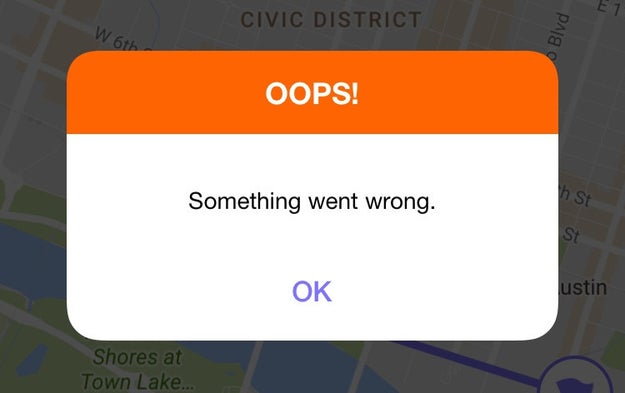
A screenshot of Fasten&;s app on Saturday.

William Alden / Via BuzzFeed News

Austin&039;s homegrown ride-hailing services, which sprung up after Uber and Lyft left the city in protest of a local rule, had hoped to ace the task of shuttling the global tech and media elite around the SXSW Conference and Festivals here this weekend.

But these apps — which claim Uber can be replaced, and that there&039;s no “secret sauce” behind its spectacular success — failed a major stress test during their moment in the spotlight last night.

With rain pouring down and crowds of festival attendees hopping from party to party, RideAustin and Fasten, two popular ride-hail apps in town, went totally dead for at least portions of the evening. Fasten, a small startup from Boston that paid to be the “official” ride-hail service of SXSW, experienced a 12-times increase in demand Saturday night that forced it offline for at least an hour. RideAustin, a nonprofit that&039;s especially popular among locals, was down for “several hours,” it said in a Facebook post, after its database was overloaded.

The local ride-hail apps still have a week to try to redeem themselves, but this weekend was supposed to be a triumph for them. RideAustin, Fasten, and others emerged in the Texas capital after Uber and Lyft exited last May, protesting a requirement that their drivers be fingerprinted for background checks. The local services portrayed the departure of the two behemoths as typical of the bullying capitalists from Silicon Valley.

But on Sunday, these homespun upstarts found themselves weathering a storm of customer rage that is all too familiar to Uber and Lyft.

“Spent an hour trying to find a ride,” tweeted Ryan Hoover, a well-known techie from San Francisco who founded Product Hunt. “Austin is broken w/o Uber or Lyft. Other ridesharing apps aren&039;t working and all the taxis are full.”

Others went on Twitter to post screenshots of the flatlining apps or of the breathtakingly high fares they had to pay when service was available. Fasten says it doesn&039;t use surge pricing — instead letting customers choose to pay more to attract drivers, with so-called “boost pricing” — but that claim rang hollow to riders who paid, in one example, more than $60 to go less than 5 miles on Saturday.

Fasten and RideAustin both made public apologies, saying the outages wouldn&039;t happen again. The CEO of Fasten, Kirill Evdakov, told BuzzFeed News that the higher prices, determined by algorithm, are necessary to attract drivers during busy times. (Fasten takes only 99 cents from each fare, even when prices reach the stratosphere — meaning drivers stand to make a serious killing if the app can stay online in the coming week.)

“We&039;re confident that it was a great idea to invest in support of SXSW,” Evdakov told BuzzFeed News on Sunday morning. Referring to the outage, he added, “We definitely don&039;t think it&039;s going to ruin SXSW in general. It&039;s just one hour out of 240 hours of the event.”

According to Austin locals interviewed by BuzzFeed News, the apps perform well in normal circumstances, and they&039;ve won devoted fans. The nonprofit RideAustin, which lets drivers keep the entirety of their fares for standard rides, invites customers to round their fares up to the nearest dollar and donate the balance to charity. Had the outages not happened, the SXSW festival might have provided a convincing argument against the effective duopoly enjoyed by Uber and Lyft.

“RideAustin now works as well as Uber. And the fact that it&039;s nonprofit and supports local charities I love,” said Rajiv Bala, an Austin-based venture capitalist at S3 Ventures.

“I like them better than Uber or Lyft,” said Chris Shonk, another Austin venture capitalist who is a general partner at ATX Seed Ventures. He said he especially appreciated how Fare, another local app, lets customers schedule a ride in advance.

Austin&039;s mayor, Steve Adler, told BuzzFeed News in an interview on Sunday that Uber can have issues, too. He recalled being unable to hail an Uber during the start of the Democratic National Convention in Philadelphia last year, and having to take a long bus ride back to his hotel.

He said he was rooting for Austin&039;s local ride-hail apps.

“I am hopeful and anxious for them, to see how they do tonight, and I hope that they do well,” Adler said. “This obviously was a test of capacity and capability that they hadn&039;t seen yet.”

The local apps had sought to make the most of the SXSW spotlight with a marketing push. In promotional cards at hotels, and in stickers plastered above urinals, RideAustin advertised the “lowest rate per mile” and declared, “NO UBER, NO PROBLEM&;” Near the Austin Convention Center, marketers working for Fare wore branded t-shirts and handed out water bottles.

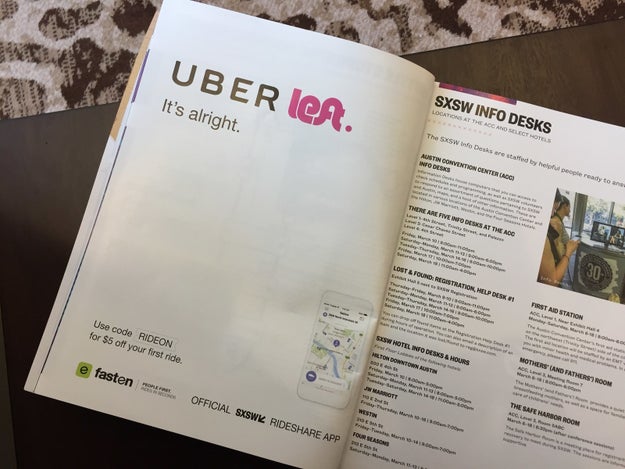
At hotels, official signage included a code for attendees to get $5 off their first Fasten ride. A Fasten ad in the SXSW guidebook says, “Uber Left” — with “Left” styled to look like Lyft&039;s logo — “it&039;s alright.”

William Alden / Via BuzzFeed News

But on Saturday night, many partygoers downtown were forced to walk in the rain or try to hail a traditional cab — though it seemed at times that hardly any were available.

Leaving the Andreessen Horowitz party, and unable to get a car in the pouring rain, Chris Messina and his friends found a creative solution. Messina, a well-known tech figure who until recently was an executive at Uber, hopped in a taxi that turned out to be occupied. The passenger, sitting shotgun, graciously allowed the group to squeeze in the back. It became a carpool, or as Messina declared, a makeshift UberPool.

LINK: Post-Uber Austin Has A Chance To Rebuild Ride-Hail

LINK: In An Austin Without Uber, Drivers Are Left Wondering What’s Next

Quelle: <a href="Austin&039;s Uber Replacements Flunked An Important Test During SXSW“>BuzzFeed

This Guy's Mini Cooper Got Stolen Twice In Two Days And He Live Streamed Tracking It Down

This Guy's Mini Cooper Got Stolen Twice In Two Days And He Live Streamed Tracking It Down

Ben Yu, a startup cofounder who lives in San Francisco, had his Mini Cooper stolen on Wednesday.

His car has already been through some trauma. “There&;s a lot of vehicle crime and property theft where I am,” he told BuzzFeed News. He lives in San Francisco&039;s Mission neighborhood. “I&039;ve had the windows smashed, the convertible roof slashed, and the battery drained by homeless people sleeping in it with the heat on several times.” According to SFGate, reported car break-ins nearly tripled from 2010 to 2015, when there were nearly 26,000. That&039;s more than 70 per day.

When Yu saw that his car was gone Wednesday morning, he realized he could track its location using the GPS in his Getaround app, which Yu uses to earn extra money when he doesn&039;t need his car. Getaround is a service that allows people to rent their personal cars to other people.

After he opened the app and saw exactly where the thief was joyriding around San Francisco, he called 911 and told police that his car had been stolen, and that he knew where it was. The cops told him he needed to file a police report before they could do anything, so he went to the station and waited three hours for the report to be filed. Meanwhile, his car ran out of gas a whole city away in Brisbane, CA. The thief left it on the side of the road and stole the key.

He retrieved the car with no gas and no key… Then it got jacked again on Thursday.

According to his Facebook, Yu woke up at 8:15 am on Thursday and found that his car had been stolen again from almost the exact same spot. He guessed it was the same perpetrator as Wednesday&039;s theft because that person would have already had a key.

How that happened: If you&039;re letting people rent your car through Getaround, you leave your keys in your car, and the Getaround app locks the doors and disables the engine in case of a break-in. Yu&039;s friend Travis Herrick had been using the Mini, and Herrick had used the normal key to lock the car instead of the Getaround app, though he still left the spare key in the car for renters. When the thief broke in for the second time, they could start the car and make away with it because the app hadn&039;t hobbled the engine.

Yu called the San Francisco police again, and they told him he&039;d have to file another report before law enforcement could take action, despite the fact that he knew the exact location of the car again. After waiting at the station for an hour, an officer told him the police would intervene if he could see his stolen car. So Yu rented a car from Getaround, sped off to find his car himself, and livestreamed it.

~The Chase~

View Video ›

Facebook: video.php

In the live stream, he follows the GPS signal of the car as his friend Herrick drives. When they find it in a Safeway parking lot, they call the cops, who then apprehend the thief.

“I didn&039;t think it would become violent,” he told BuzzFeed News. “When I established visual contact, the police came. But if this hadn&039;t been the world&039;s most incompetent criminal, he would&039;ve gotten away with my car.”

More than anything, Yu said, the encounter obliterated any faith he had in the police.

The first time the car was stolen, he told BuzzFeed News, he was willing to give police the benefit of the doubt. When police said he would have to file a report on the second day, though, he began to believe that police procedure did more harm than good.

As he wrote on Facebook, “What *really* gets me, and what *really* bothers me, is that if it&039;s *this* hard and this ludicrously ridiculous to get the police to help me chase down a car that is literally being driven by the perpetrators for the past 2 hours that I have a literal GPS tracker for that shows exactly where the car is, and that ultimately they fail to apprehend the suspect or do anything about it for 1.5 hours while I&039;m mired in filing a police report, and that I have to literally track the suspects down myself is some absurd vigilante justice situation before the cops are able to apprehend them, how can I possibly have faith that the police will be able to competently accomplish their stated mission and responsibilities when it comes to far more important, serious, pressing, and traumatic crimes that are not material, superficial, and economic in nature, but threaten life and bodily harm and violation?”

View Video ›

Facebook: intenex

He said his immediate plans for his car are to remove it from Getaround and to install security measures.

“Even with the engine disabled, people can still steal the key. That&039;s $200 right there,” he said. “I want to put in an alarm and security cameras, which I&039;d have to disable every time someone wanted to rent it from Getaround.”

His Mini is with SFPD now; they&039;re dusting it for prints, but he does not know what charges the thief will face, or if they will face any at all.

Getaround and the San Francisco Police Department did not immediately respond to request for comment.

Quelle: <a href="This Guy&039;s Mini Cooper Got Stolen Twice In Two Days And He Live Streamed Tracking It Down“>BuzzFeed

This Guy's Mini Cooper Got Stolen Twice In Two Days And He Live Streamed Tracking It Down

This Guy's Mini Cooper Got Stolen Twice In Two Days And He Live Streamed Tracking It Down

Ben Yu, a startup cofounder who lives in San Francisco, had his Mini Cooper stolen on Wednesday.

His car has already been through some trauma. “There&;s a lot of vehicle crime and property theft where I am,” he told BuzzFeed News. He lives in San Francisco&039;s Mission neighborhood. “I&039;ve had the windows smashed, the convertible roof slashed, and the battery drained by homeless people sleeping in it with the heat on several times.” According to SFGate, reported car break-ins nearly tripled from 2010 to 2015, when there were nearly 26,000. That&039;s more than 70 per day.

When Yu saw that his car was gone Wednesday morning, he realized he could track its location using the GPS in his Getaround app, which Yu uses to earn extra money when he doesn&039;t need his car. Getaround is a service that allows people to rent their personal cars to other people.

After he opened the app and saw exactly where the thief was joyriding around San Francisco, he called 911 and told police that his car had been stolen, and that he knew where it was. The cops told him he needed to file a police report before they could do anything, so he went to the station and waited three hours for the report to be filed. Meanwhile, his car ran out of gas a whole city away in Brisbane, CA. The thief left it on the side of the road and stole the key.

He retrieved the car with no gas and no key… Then it got jacked again on Thursday.

According to his Facebook, Yu woke up at 8:15 am on Thursday and found that his car had been stolen again from almost the exact same spot. He guessed it was the same perpetrator as Wednesday&039;s theft because that person would have already had a key.

How that happened: If you&039;re letting people rent your car through Getaround, you leave your keys in your car, and the Getaround app locks the doors and disables the engine in case of a break-in. Yu&039;s friend Travis Herrick had been using the Mini, and Herrick had used the normal key to lock the car instead of the Getaround app, though he still left the spare key in the car for renters. When the thief broke in for the second time, they could start the car and make away with it because the app hadn&039;t hobbled the engine.

Yu called the San Francisco police again, and they told him he&039;d have to file another report before law enforcement could take action, despite the fact that he knew the exact location of the car again. After waiting at the station for an hour, an officer told him the police would intervene if he could see his stolen car. So Yu rented a car from Getaround, sped off to find his car himself, and livestreamed it.

~The Chase~

View Video ›

Facebook: video.php

In the live stream, he follows the GPS signal of the car as his friend Herrick drives. When they find it in a Safeway parking lot, they call the cops, who then apprehend the thief.

“I didn&039;t think it would become violent,” he told BuzzFeed News. “When I established visual contact, the police came. But if this hadn&039;t been the world&039;s most incompetent criminal, he would&039;ve gotten away with my car.”

More than anything, Yu said, the encounter obliterated any faith he had in the police.

The first time the car was stolen, he told BuzzFeed News, he was willing to give police the benefit of the doubt. When police said he would have to file a report on the second day, though, he began to believe that police procedure did more harm than good.

As he wrote on Facebook, “What *really* gets me, and what *really* bothers me, is that if it&039;s *this* hard and this ludicrously ridiculous to get the police to help me chase down a car that is literally being driven by the perpetrators for the past 2 hours that I have a literal GPS tracker for that shows exactly where the car is, and that ultimately they fail to apprehend the suspect or do anything about it for 1.5 hours while I&039;m mired in filing a police report, and that I have to literally track the suspects down myself is some absurd vigilante justice situation before the cops are able to apprehend them, how can I possibly have faith that the police will be able to competently accomplish their stated mission and responsibilities when it comes to far more important, serious, pressing, and traumatic crimes that are not material, superficial, and economic in nature, but threaten life and bodily harm and violation?”

View Video ›

Facebook: intenex

He said his immediate plans for his car are to remove it from Getaround and to install security measures.

“Even with the engine disabled, people can still steal the key. That&039;s $200 right there,” he said. “I want to put in an alarm and security cameras, which I&039;d have to disable every time someone wanted to rent it from Getaround.”

His Mini is with SFPD now; they&039;re dusting it for prints, but he does not know what charges the thief will face, or if they will face any at all.

Getaround and the San Francisco Police Department did not immediately respond to request for comment.

Quelle: <a href="This Guy&039;s Mini Cooper Got Stolen Twice In Two Days And He Live Streamed Tracking It Down“>BuzzFeed

Alphabet's Waymo Asks Judge To Halt Uber’s Self-Driving Program

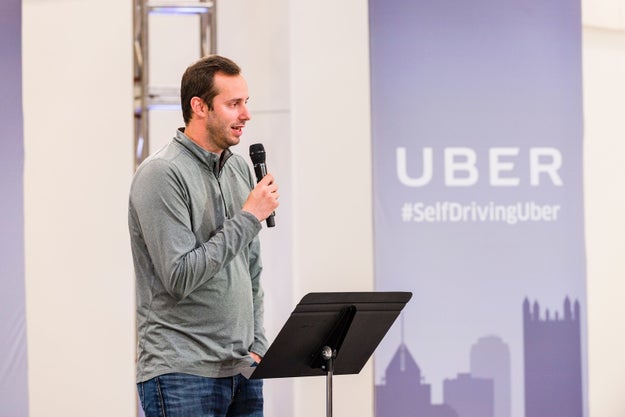
Anthony Levandowski

Afp / AFP / Getty Images

Waymo, Alphabet’s autonomous car company, on Friday asked a federal judge to stop Uber from using technology it alleges the ride-hail giant stole from it.

The motion for preliminary injunction comes about two weeks after Waymo sued Uber alleging that Anthony Levandowski, the leader of Uber’s self-driving program, stole a crucial part of Waymo’s self-driving technology before leaving Waymo parent company Alphabet (Levandowski joined Uber when it acquired his self-driving truck startup, Otto, last summer).

Waymo’s motion includes sworn testimony from one of Google’s forensic engineers, alleging Levandowski downloaded more than 14,000 files related to its self-driving car efforts. It also includes allegations against two other former Alphabet employees who decamped to Otto and later joined Uber which it claims allegedly downloaded proprietary data as well. Waymo’s filing requests a preliminary injunction that would stop Uber from using what it claims is proprietary technology.

Waymo’s lawsuit centers around laser technology called LiDAR (Light Detection And Ranging), which helps self-driving cars see and navigate the world. Waymo filed suit against Uber after inadvertently receiving an attachment from a supplier, which showed drawings of Uber’s laser technology. In its original complaint against Uber, Waymo argued that those designs bear “striking resemblance” to its own proprietary design.

“Competition should be fueled by innovation in the labs and on the roads, not through unlawful actions,” a Waymo spokesman said in a statement. “Given the strong evidence we have, we are asking the court step in to protect intellectual property developed by our engineers over thousands of hours and to prevent any use of that stolen IP.”

Uber said it was reviewing the latest court filings and reiterated an earlier statement decrying Waymo’s lawsuit as “a baseless attempt to slow down a competitor.”

Waymo&;s request for a preliminary injunction is clearly bad news for Uber — more so should it be granted by a judge. But the lawsuit is far from a death knell for the ride-hail giant&039;s self-driving ambitions. Though Uber is working to develop its own self-driving technologies, it&039;s also using some tech developed by others. The self-driving cars the company is piloting in Pittsburgh and Arizona, for example, both use Velodyne LiDAR.

Lisa Larrimore Ouellette, a professor at Stanford Law School, told BuzzFeedNews that in trade secret cases, courts often decide whether to grant a request for an injunction based on “how quickly the accused infringer brings a product to market and whether that timeline is reasonable if they weren&039;t relying on the trade secret information.”

In Otto’s case, Levandowski started the company in May and sold it to Uber in August. In October, just five months after Otto launched, it made headlines for driving a trailer of 2,000 cases of Budweiser more than 120 miles across Colorado with a driver in the back seat.

Ouellette said it&039;s possible Levandowski could argue that since he has worked on multiple self-driving projects, he was able to quickly produce new self-driving technology for Otto. Employees who switch companies take the skills they acquired with them. “But they can’t take files,” she said, referring to allegations that Levandowski downloaded proprietary data before leaving Google. “That’s clearly not permissible.”

Quelle: <a href="Alphabet&039;s Waymo Asks Judge To Halt Uber’s Self-Driving Program“>BuzzFeed

AT&T Discriminated Against Low-Income Neighborhoods, Study Finds

Stephanie Keith / Reuters

Over the past decade, AT&T has likely engaged in “digital redlining” of high poverty communities in Cleveland, leaving households there with limited internet access, according to a study released Friday by the National Digital Inclusion Alliance and Connect Your Community, a Cleveland nonprofit.

Based on new government filings detailing broadband availability, the analysis “strongly suggests that AT&T has systematically discriminated against lower-income Cleveland neighborhoods in its deployment of home Internet and video technologies,” the groups said. The scope of the study was limited to the Cleveland area.

The groups argue that AT&T deliberately neglected key internet investments in many low income neighborhoods, where 35% of residents make less than the poverty threshold.

A spokesperson for AT&T told BuzzFeed news: “The report does not accurately reflect the investment we&;ve made in bringing faster internet to urban and rural areas across the US.”

Thirty-four million Americans, which is about 10 percent of the population, lack access to broadband internet, according to the Federal Communications Commission. Race, income, education, and geography each play a part in defining the digital divide. And even as more Americans are using smartphones to connect, the shift to mobile hasn&039;t solved the problem of connectivity for those who can only get online using their phones. These Americans tend to be people of color, less educated, younger, and lower income, which are the same groups that tend not to have internet at home, according to Pew researchers.

The Cleveland analysis looks specifically at AT&T&039;s broadband technology known as “fiber to the node,” in which data travels through fiber into a neighborhood device and then to individual homes. While most middle-income neighborhoods and suburbs that surround Cleveland have this technology, most of the high poverty communities inside Cleveland do not, the analysis found. These communities depend on older tech, in which data travels longer distances from a “central office” often located miles away from households, the groups said.

The difference in tech translates to vastly inferior internet speeds for economically disadvantaged communities. According to the analysis, fiber to the node can deliver speeds of 18, 24, 45, and 75 mbps. But the older technology delivers only 18 and 24 mbps, with customers experiencing 3 or 6 mbps depending on how far their homes are from the “central office.” That&039;s a significant disparity — someone with only 3 mbsp internet access can be quite limited in what they can do online compared to someone with 24 mbps speed.

The analysis shows “a clear and troubling pattern,” the report concludes. “A pattern of long-term, systematic failure to invest in the infrastructure required to provide equitable, mainstream Internet access to residents of the central city (compared to the suburbs) and to lower-income city neighborhoods.”

AT&T said in a statement that it has invested $135 billion in its wireless and wired networks in the past four years. But according to the study, “there is no indication that AT&T has expanded its [node] infrastructure to any new areas of the city of Cleveland since 2013.”

The analysis was based in part on documents AT&T filed with the Federal Communications Commission detailing where the company offers internet service, as well as city construction permits.

Quelle: <a href="AT&T Discriminated Against Low-Income Neighborhoods, Study Finds“>BuzzFeed

Do You Have What It Takes To Be A CIA Hacker?

The US spy agency uses some ridiculous names for its pretty scary programs — can you pick the real ones from the bunch?

Wikileaks’ latest document dump provided details about some scary-sounding projects being run out of the CIA.

Wikileaks' latest document dump provided details about some scary-sounding projects being run out of the CIA.

The leaked documents, courtesy of the group that distributed emails stolen by Russian hackers during last year&;s election, are filled with projects aimed at figuring out how to hack things like your phone and smart TV. (Though they don&039;t say that the CIA has figured out how to break into your encrypted apps.) But in there with the detailed charts about the ways the CIA is trying to collect digital information, there are also things like a giant list of emojis and the revelation that some of the projects have totally ridiculous names.

Saul Loeb / AFP / Getty Images

Quelle: <a href="Do You Have What It Takes To Be A CIA Hacker?“>BuzzFeed

This Goldman Sachs Conference Has 76 Speakers And Only Five Are Women

Tamer Cosgun

Goldman Sachs is hosting a two-day technology conference in London where 76 people are scheduled to speak, and just five of them are women.

The event agenda, seen by BuzzFeed News, features investors, technology executives, Goldman employees, and even the former head of the British signals intelligence agency, discussing everything from “Driverless Cars: Turning Vision into Reality” to “Investing in a Time of Constant Disruption.”

But 93% of those speakers are men. Of the five women speaking, three of them are Goldman Sachs employees, one of whom was recently added to the agenda as a replacement for a male Goldman banker originally selected to speak.

Matthew Zeitlin

The gender disparity is most stark in the presentations to be given by technology companies, who select their own representatives to speak at the conference. Just one of those 37 presentations features a woman. About 11% of the investors attending the conference are women, the source familiar with the conference said.

Leaders and workers in the tech industry and beyond have frequently objected to the lack of women represented at industry conferences. The events offer speakers the chance to promote both themselves and their companies, and to network with industry leaders and financial power brokers like Goldman Sachs.

Just four events on the Goldman conference agenda have any female panelists or speakers. Sherry Coutu, an entrepreneur who runs Founders4Schools, a UK organization that brings businesspeople to schools to give talks to schoolchildren, will talk on a panel moderated by Joanne Hannaford, a Goldman technology executive. Stephanie Eltz, the founder of health startup Doctify, is scheduled to speak with the company&;s CEO, Oliver Thomas.

The four tech executives on a panel titled “What you soon won&039;t be able to live without” are all men, but they&039;ll be moderated by Sumana Manohar, a Goldman analyst. Another all-male panel, “The Future’s Bright, The Future’s Listed,” is being moderated by Katherine Ward, one of Goldman&039;s UK-based managing directors.

Ward is a new addition to the event: A version of the conference agenda available online Thursday listed another male executive moderating the panel. That agenda has since been updated, with Ward switched in as the moderator.

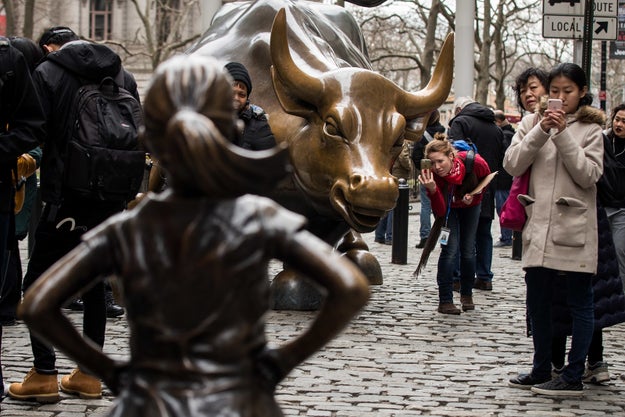
The male-dominated banks of Wall Street have launched a number of women-friendly initiatives in recent years, including Goldman 10,000 Women program, which invests in and trains female entrepreneurs. Just this week, State Street earned itself a round of friendly coverage when it set up a statue of a little girl facing down the famous Wall Street bull on International Women&039;s Day.

Drew Angerer / Getty Images

Women made up 23% of the 84 Goldman bankers promoted to the coveted partner level in 2016, the highest proportion ever. But men still dominate the bank&039;s leadership, with just five women on its 33-person management committee and two women among its nine executive officers.

At a women-focused conference hosted by Fortune last year, Goldman&039;s chief executive Lloyd Blankfein joked that he could replace the bank&039;s staff with the participants in the 10,000 Women program.

“You could take the population of Goldman Sachs, brush them aside, give them a few more weeks of training, and we could replace them with this crowd,” he said. When asked to follow up on the comment, he said “I said ‘could,’ but that would be a little bit of a radical step.”

Quelle: <a href="This Goldman Sachs Conference Has 76 Speakers And Only Five Are Women“>BuzzFeed

Apple Is Fighting Laws That Make It Easier To Repair Your iPhone

Shailesh Andrade / Reuters

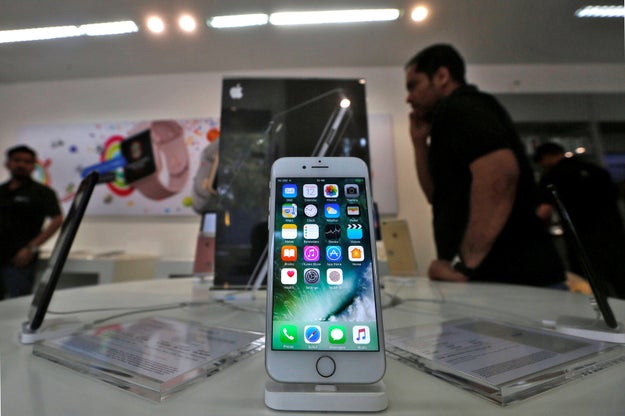
Apple is opposing a bill in Nebraska that&;s designed to make it easier and possibly cheaper for you to repair your iPhone. On Thursday afternoon, legislators in Nebraska considered a “right to repair” proposal, which was designed to open up the state&039;s repair market for electronic equipment. It would require manufacturers to provide manuals and diagnostic tools that would allow independent shops to fix devices like computers and smartphones. But, according to the bill&039;s supporters, Apple wants to it see it fail. And it wouldn’t be the first time the company has tried to defeat such a proposal.

The chair of the Judiciary Committee in Nebraska&039;s legislature concluded Thursday&039;s hearing by saying the bill will likely not be considered this year, reflecting the challenge of passing new legislation with enough urgency and support in state houses.

Eight states — Kansas, Minnesota, Nebraska, New York, Tennessee, Massachusetts, Illinois, and Wyoming — are considering right to repair legislation. The laws would require that device manufacturers like Apple, Samsung, and John Deere provide repair manuals and parts to independent repair shops, giving customers more options to fix their phones and ultimately lower the cost of repairs, proponents say.

Opponents of right to repair say such laws would unfairly expose their trade secrets and could lead to safety and security concerns for consumers. But one prominent repair organization estimates that phone manufacturers stand to lose billions of dollars in repair services that for now they largely control.

State Senator Lydia Brasch, who is sponsoring the Nebraska bill, told BuzzFeed News that in a recent meeting with Apple representative Steve Kester, she was told her state would become the “Mecca for bad actors” if the bill passed, with hackers flooding into the state. According to Sen. Brasch, the Apple representative said if she were to except phones from the legislation, then Apple would not oppose it. The bill wouldn&039;t just apply to smartphones but to host of electronic devices, including tablets, computers, and printers, as well as computerized farming equipment like tractors.

New York State Senator Phil Boyle first introduced right to repair legislation in 2014, but he told BuzzFeed News he faced an uphill battle, with tech companies, Apple among them, lobbying him and his colleagues against it.

“Some of us believe that this practice is monopolistic,” Sen. Boyle said. “If I buy a computer, they are almost requiring me to go back to the facility to get it fixed at an inflated rate.”

“The last time, it came up against strong lobbying from the tech sector,” Sen. Boyle said. The bill in the previous session never made it to a vote. But he has reintroduced the right to repair bill with jobs and antitrust concerns in mind.

Massachusetts State Representative Claire Cronin also received opposition from Apple on her right to repair bill during the last legislative session. “Currently, there is a monopoly on the repair industry,” Rep. Cronin told BuzzFeed News in a statement. “This legislation serves to expand competition in the repair market, which helps consumers repair their electronic products at a reasonable and affordable cost.”

Other state legislators have drawn inspiration from Massachusetts&039; fight. Signed into law in 2013, landmark automotive right to repair rules there prompted car dealers to pledge to share repair and diagnostic information to mechanics across the country. Rep. Cronin extends the principle behind the automative law into the world of consumer electronics. “Apple opposed this legislation in the last session. However, we sense growing public support and look forward to the hearing and public debate on the issue,” she said.

Apple declined to comment on Nebraska&039;s right to repair legislation or its lobbying efforts in other states. But the company said that limiting repairs to authorized vendors is the only way it can guarantee that genuine parts are used and that the devices are fixed correctly.

Speaking of manufacturers generally, Sen. Boyle of New York told BuzzFeed News that he is open to allowing businesses to authorize specific repair shops to work on their devices, but only if the certification requirements are reasonable. In the past, Boyle said, certifications have included exorbitant fees for small businesses, he said, mentioning one such fee at $5,000, “effectively making it impossible.”

A host of tech industry groups, including CompTIA, the Consumer Technology Association, and the Information Technology Industry Council are also opposing the Nebraska legislation. The groups represent some of the biggest names in consumer tech: Apple, Microsoft, Google, Samsung, Nintendo and Sony.

In a recent letter to Sen. Brasch, the groups wrote that her proposed legislation “compromises intellectual property” and would “jeopardize consumer safety and security,” making them vulnerable to hackers and improper repairs. The groups also say that right to repair is unnecessary, since customers already have “substantial choice when it comes to visiting the repair facility that best suits their needs.”

Apple told BuzzFeed News that it has 1,371 authorized service partner locations in the country, in addition to 270 Apple Stores across 44 states.

But Gay Gordon-Byrne, executive director of the Repair Association, said that authorized repair providers are limited in the types of repairs they can perform. And Sen. Brasch emphasized that it&039;s harder for Americans living in rural communities to access a narrow set of authorized vendors. There is only one Apple Store in the state of Nebraska.

A spokesperson for CompTIA, one of the tech groups opposing the bill, told BuzzFeed News in a statement that: “It’s important to stress that we support the ability of consumers to freely and safely repair their electronic devices. But that’s not really what these bills are about.” CompTIA went on to argue that the Nebraska legislation and similar bills “expose trade secrets,” a claim that Sen. Brasch, Sen. Boyle, and Gordon-Byrn insist is false.

“Anybody who deals with technology repair is getting a raw deal in the marketplace,” Gordon-Byrne said. “We should be able to repair the things we buy.”

Quelle: <a href="Apple Is Fighting Laws That Make It Easier To Repair Your iPhone“>BuzzFeed

Google Is Building A New Corporate Campus That Seems To Rival Apple's

Google&;s plans for a new, massive corporate campus in Mountain View, California have been approved.

The city council gave the final approval for Google&039;s plans at a March 7 meeting.

The campus will be a giant dome and other buildings, collectively dubbed “Charleston East,” after the street it occupies.

It&039;ll be 18 acres. Google unveiled plans for the office park two years ago, and preparations for construction have already begun. The building, slated to be nearly 600,000 square feet and completed by 2019, will serve as office space for 2,700 Google employees as well as contractors and service workers. That&039;s basically as big as 10.3 football fields. It amounts to about 220 square feet per employee. Now think about how big your office space is.

Google

The company released renderings of the campus back in 2015. They look like Hudson River School paintings from the future.

Google

Amirite?? “The Oxbow,” by Thomas Cole.

Wikipedia

The rendering of the inside looks like a temple.

“The Course of Empire: The Consummation of Empire” by Thomas Cole.

LACMA

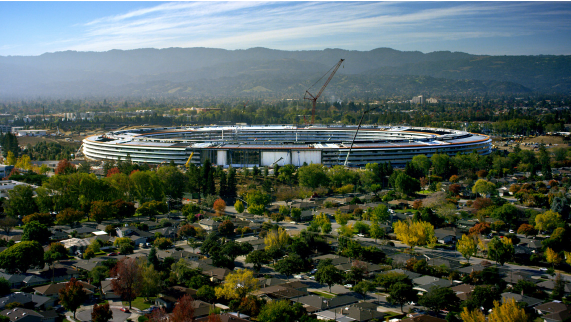
~Coincidentally~ rival tech giant Apple announced the upcoming opening of its new 175-acre corporate campus two weeks ago.

“Apple Park” will open in Cupertino, CA in April. Its campus will be nearly 10 times bigger than Charleston East and will house 12,000 employees.

The campus will feature a theater named after Steve Jobs, the company&039;s co-founder, accessible only by glass cylinder, pictured below.

Quelle: <a href="Google Is Building A New Corporate Campus That Seems To Rival Apple&039;s“>BuzzFeed