Google Is Under Pressure Because Brands Are Pulling Adverts Over Hate Speech Fears

Yui Mok / PA Wire/PA Images

Google has issued a public apology after a series of high-profile brands and the UK government pulled adverts from appearing on Google and its video site YouTube.

It follows an investigation by The Times that found adverts had appeared alongside hate speech and content uploaded by terrorists, sparking fears that UK companies may have been inadvertently funding terrorism.

On Monday, Marks & Spencer became the latest company to freeze ad spend with the global giant to “ensure brand safety” while the “matter is worked through”.

It followed similar moves by companies including Sainsbury&;s, HSBC, Lloyds, Royal Bank of Scotland, McDonald&039;s, and L&039;Oreal. The UK government has also suspended advertising “pending reassurances from Google that government messages can be delivered in a safe and appropriate way”.

In a statement on Monday, Matt Brittin, head of Google for Europe, the Middle East, and Africa, apologised. He said: “I would like to apologise to our partners and advertisers who might have been affected by their ads appearing on controversial content. We take our responsibilities to these industry issues very seriously.”

The company was, he added, “making improvements” to its advertising policies and “increasing investment in enforcement to act faster”.

Each minute hundreds of hours of content are uploaded to YouTube. Google only reviews content that has been flagged as inappropriate by its users, rather than proactively monitoring for content that falls outside its terms of use.

The internet giant, which controls 35% of the digital advertising market, has faced growing criticism in recent months for allowing hate content on the site and will be under pressure to offer a solution.

Last week, during a bruising two-hour examination of executives from Google, Facebook, and Twitter, MPs accused the companies of not doing enough to stop hateful material being shared on their platforms.

Quelle: <a href="Google Is Under Pressure Because Brands Are Pulling Adverts Over Hate Speech Fears“>BuzzFeed

Laptops And Electronics Banned On Flights From Some Middle Eastern Countries

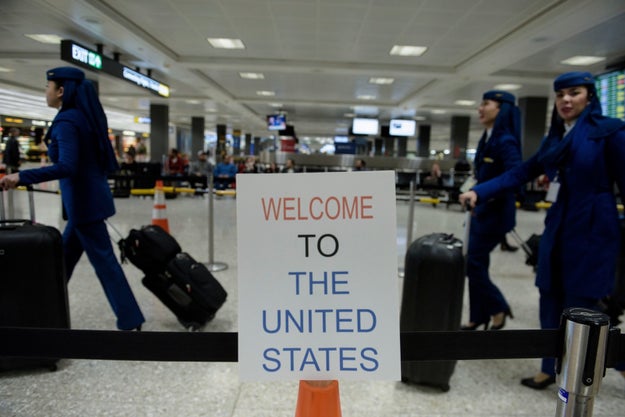
A Saudia airlines crew arrives at Washington Dulles International Airport on February 6, 2017.

Brendan Smialowski / AFP / Getty Images

At least two Middle Eastern airlines are telling passengers that laptops, tablet computers and other electronic devices are no longer allowed as carry-on items in flights headed to the US, citing orders from US authorities.

A representative of Saudi Arabian Airlines, based at JFK International Airport in New York, told BuzzFeed News that the ban begins immediately, and covers all electronic devices, excluding cellphones. They said it applies on flights headed to the US, but not on Saudi-bound flights.

The representative declined to answer further questions and said inquiries should be directed to the TSA. The Saudi daily newspaper Al Riyadh quoted the country&;s civil aviation authority as saying the ban applies to all US-bound flights from Saudi Arabia.

Details of the ban will be announced on Tuesday, NBC News reported, saying such changes to security rules “are made periodically in response to threat intelligence, and laptop computers have long been the source of concern.” The Guardian reported that the ban will apply to flights from 13 countries, and was announced to airlines on Monday via a confidential advisory from the TSA.

“There is a security concern regarding passengers boarding non-stop flights to the U.S. from some specific countries,” CNN reported, citing an unnamed US official. “The directive is to ensure enhanced security measures at select airports for a limited duration.”

The Transportation Security Administration referred inquiries to the Department of Homeland Security. A Homeland Security spokesperson told BuzzFeed News: “We have no comment on potential security precautions, but will provide an update when appropriate.”

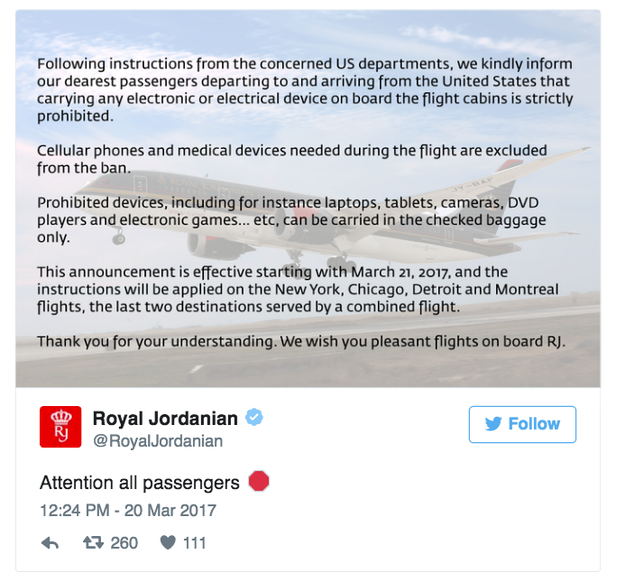
Royal Jordanian Airlines informed passengers of a ban coming into effect on Tuesday. “Following instructions from the concerned US departments,” it said in a tweet, all electronics are banned on US-bound flights, with an exception for cellphones and medical devices.

That tweet has since been deleted. In a response to inquiries from BuzzFeed News, a representative said “further updates will be announced soon.”

Here’s the original, deleted Royal Jordanian tweet.

Here's the original, deleted Royal Jordanian tweet.

JFK-based representatives of Dubai&039;s Emirates Airline and Doha-based Qatar Airways said they had not heard of any changes. BuzzFeed News has reached out to other Middle Eastern and African airlines, and will update this article as responses come in.

Quelle: <a href="Laptops And Electronics Banned On Flights From Some Middle Eastern Countries“>BuzzFeed

DoorDash Will Start Delivering Food Via Robots In California This Thursday

DoorDash Will Start Delivering Food Via Robots In California This Thursday

This Thursday, the on-demand delivery company DoorDash&;s human couriers will begin working alongside a new type of coworker: robots.

DoorDash is putting a small fleet of six-wheeled delivery robots into action for the first time in Redwood City, California following weeks of tests. The robots, built by a company called Starship Technologies, are about the size of a golden retriever and roll around sidewalks with relative ease. They&039;ll be used to lug food from restaurants to customers on short-distance orders, spanning anywhere from one to two miles.

View Video ›

Facebook: video.php

Automation has emerged as a critical issue in the US following a 2016 election that focused largely on jobs and plans to save them. Though a significant amount of attention has been directed towards autonomous driving as a potential job killer, specifically for long haul trucking, delivery robots appear poised to go mainstream much sooner.

Asked whether robots would replace human “Dashers,” DoorDash co-founder and chief product officer Stanley Tang told BuzzFeed News that the company sees the &039;bots as a compliment, not replacement. “We’ve found that the robots are better suited to the smaller, short-distance orders that Dashers often avoid, thereby freeing up Dashers to fulfill the bigger and more complex deliveries that often result in more money for them,” he said.

DoorDash is putting six delivery robots into action in California with plans to expand elsewhere in the US. The company recently started testing the robots in Washington DC. And robot-maker Starship Technologies is currently working with Postmates, another on-demand delivery company, to add robot deliveries to its service too.

Quelle: <a href="DoorDash Will Start Delivering Food Via Robots In California This Thursday“>BuzzFeed

Uber President Quits As Company Deals With Sexism, Management

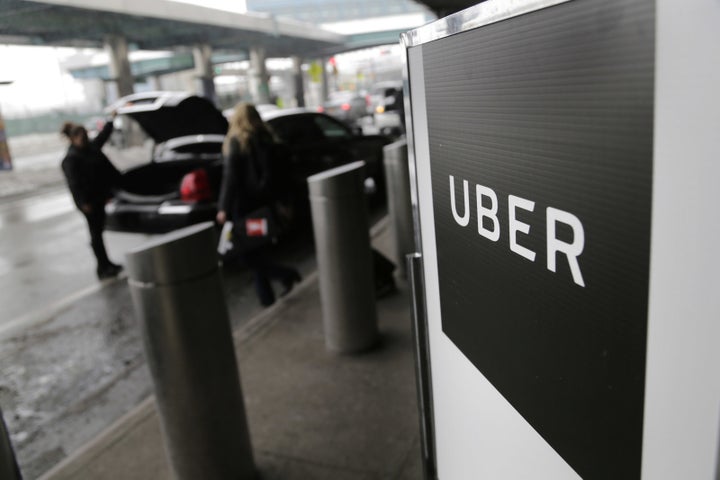
Seth Wenig / AP

Uber president Jeff Jones is leaving the ride-hailing company as it continues to face issues of sexism and leadership.

Jones, previously an executive with retailer Target, joined Uber six months ago as its president of ride-sharing.

“The beliefs and approach to leadership that have guided my career are inconsistent with what I saw and experienced at Uber, and I can no longer continue as president of the ride sharing business,” Jones said in a statement to Recode. “There are thousands of amazing people at the company, and I truly wish everyone well.”

Uber confirmed Jones&; departure in a statement.

“We want to thank Jeff for his six months at the company and wish him all the best,” the statement said.

The company recently made headlines after former engineer Susan Fowler Rigetti wrote about rampant sexual harassment and inequality. Management was regularly in chaos as employees pursued their own interests, and human resources did nothing when complaints were reported, she said.

More than 100 other women engineers in the company agreed there was a systemic problem.

In response, Uber CEO Travis Kalanick ordered an internal investigation and held an emotional meeting, where he apologized.

The revelations about company culture come after deleteUber swept social media — a social media response to the company&039;s suspension of surge pricing in New York while taxi drivers were striking to protest President Trump&039;s travel ban, a move that was perceived as undermining the strike.

LINK: Uber Women To CEO Travis Kalanick: We Have A Systemic Problem

Quelle: <a href="Uber President Quits As Company Deals With Sexism, Management“>BuzzFeed

Here's Jeff Bezos In A Giant Robot Exoskeleton Because 2017 Isn't A Dystopia At All

Here's Jeff Bezos In A Giant Robot Exoskeleton Because 2017 Isn't A Dystopia At All

Here&;s Jeff Bezos, CEO of Amazon, evolving into his final form as a giant robot.

Bezos tried on the robot exoskeleton at at Amazon&039;s annual MARS conference, which covers machine learning, home automation, robotics, and space exploration.

Hankook Mirae Technology, which created the 13-foot, 1.6-ton Method-2 roboexoskeleton that Bezos is piloting, is a South Korean robotics company. The equipment resembles several iconic robots from science fiction movies and more advanced versions could theoretically be used for interplanetary or intergalactic human exploration. Bezos is particularly interested in space science and has invested $500 million into his space exploration company Blue Origin as of July 2016.

Here’s the suit in action without Jeff Bezos.

youtube.com

And here&039;s the iconic battle between Sigourney Weaver and the monster in the original Alien film.

The comparison wasn&039;t lost on Bezos, who asked at the conference crowd, “Why do I feel so much like Sigourney Weaver?” They chuckled nervously in response.

youtube.com

The Method-2 bears the same human-encased-in-glass-with-giant-robo-limbs design of the robot suits in Avatar:

youtube.com

Vitaly Bulgarov, one of the designers working with Hankook Mirae on Method-2, designed robots for the film Ghost in the Shell and the 2018 anime adaptation Battle Angel Alita.

He&039;s a co-founder of Kiln, a weapons company creating “innovative and custom gun parts,” according to his website. Bulgarov&039;s Instagram looks less than an engineer&039;s account and more like it belongs to the general of the robot army that will soon enslave the world.

“Here is the robot that will separate you from your loved ones very soon&;” —Vitaly Bulgarov, probably.

Instagram: @vitalybulgarov

“This one will round up the lawmakers&033;&033;” —Vitaly Bulgarov, maybe.

Instagram: @vitalybulgarov

Enjoy the fresh air while it lasts&033;

Quelle: <a href="Here&039;s Jeff Bezos In A Giant Robot Exoskeleton Because 2017 Isn&039;t A Dystopia At All“>BuzzFeed

Saks Fifth Avenue Exposed Personal Info On Tens Of Thousands Of Customers

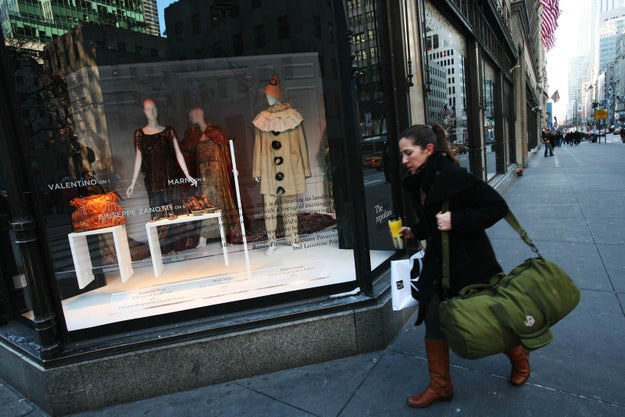
AP/Mark Lennihan

The personal information of tens of thousands of customers of Saks Fifth Avenue, Gilt, Lord & Taylor, and other retail brands have been publicly available in plain text online, BuzzFeed News has learned.

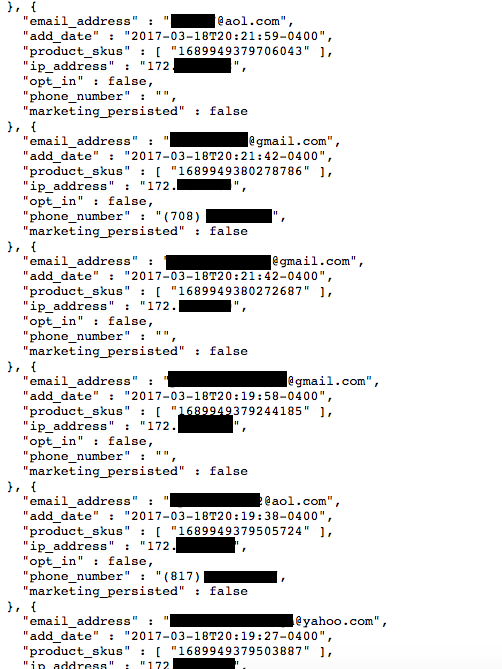
The online shopping sites for the brands are all maintained by the digital division of their owner, the Canada-based Hudson&;s Bay Company. The sites have exposed thousands of private customer emails, phone numbers and IP addresses — along with identification codes for products the customers expressed interest in buying — on unencrypted, plain text web pages that were accessible to anyone with a web browser.

The pages, which were reviewed by BuzzFeed News in recent days, were taken offline after HBC was contacted for comment on this story. Further site security issues may leave online shoppers&039; information vulnerable to hackers while they browse the site on an open Wifi network.

“This is bad,” said Robert Graham, a cybersecurity expert and owner of Errata Security, to BuzzFeed News. “This is as bad as it gets.”

“Everyone is vulnerable,” he added.

Here’s a redacted screenshot of the kind of information that was publicly available

Here's a redacted screenshot of the kind of information that was publicly available

“We take this matter seriously,” a Hudson Bay Company spokesperson told BuzzFeed News. “There is no allegation or indication that credit, payment, or password information have been exposed. The security of our customers is of utmost priority and we are moving quickly and aggressively to resolve the situation, which is limited to some email addresses at this time.”

It is unclear why the information was publicly available online. But a Hudson Bay Company spokesperson told BuzzFeed News it has “teams dedicated to the security of our customers&039; data and follow industry best practices for information security.”

The Canadian retailer is the oldest continually operating business in North America, with roots dating back to a fur trader founded in 1670. The company is currently on the hunt for a major new U.S. department store acquisition, and has been in takeover talks with both Neiman Marcus and Macy&039;s, the New York Times reported last week.

One publicly-accessible page viewed by BuzzFeed News shows information on customers who signed up for wait lists to buy products from its sites. The page includes a number of Gmail, AOL and Hotmail addresses, along with work email accounts from JPMorgan, Charter Communications and government addresses. These were often paired with phone numbers left by the customer.

Graham, the cybersecurity professional who reviewed some of the vulnerabilities after being contacted by BuzzFeed News, said they could expose people to further security headaches.

“Where there&039;s smoke, there’s fire,” he said. “There is probably a way to get password information, but you would have to search further.”

The online shopping sites also use a mix of secure and non-secure pages, which can pose another vulnerability to shoppers.

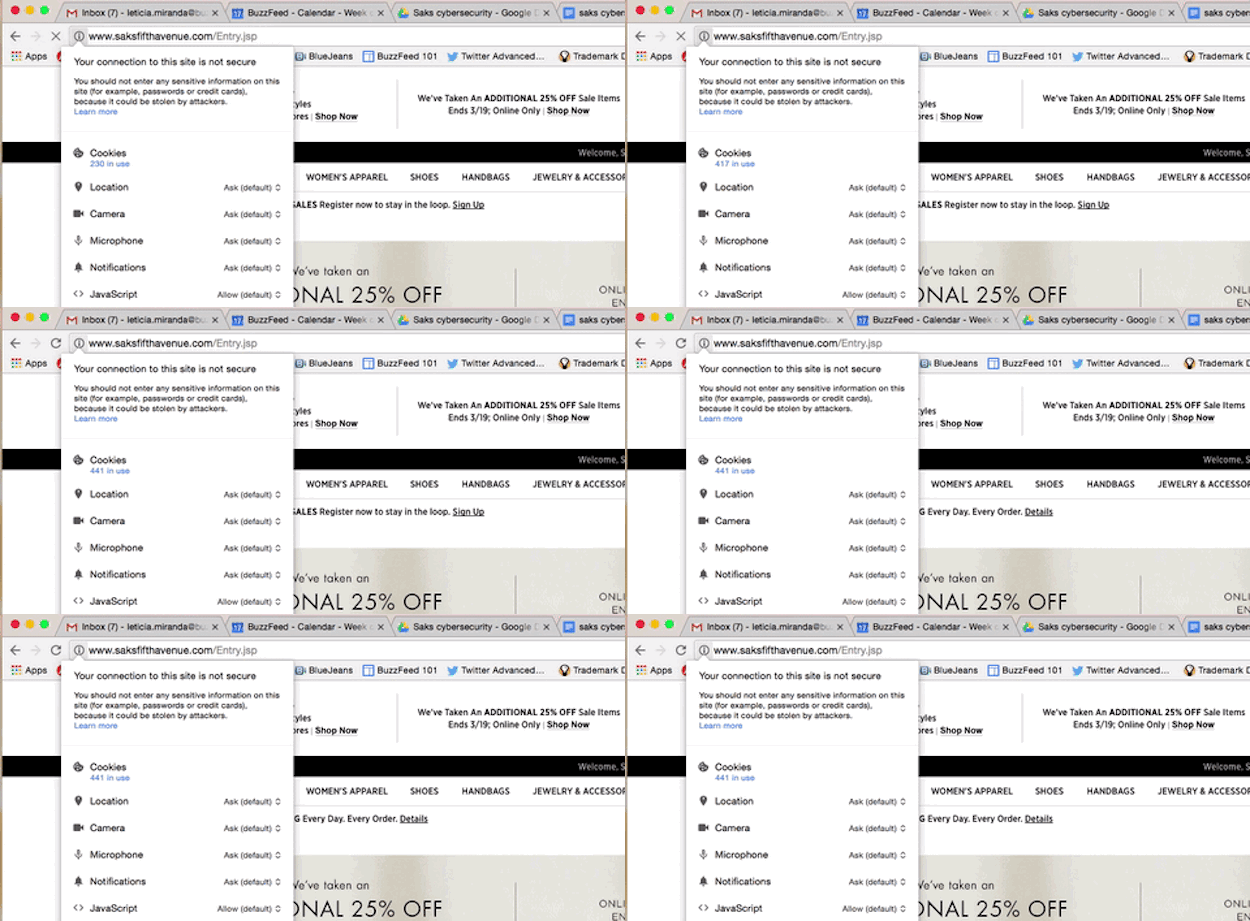
On Saks Fifth Avenue’s homepage, a small notification appears in the website bar warning users that the connection is not secure. Even when a shopper is logged into their account, a number of the site&039;s other pages do not require secure browsing, which a user can verify when “https” appears ahead of the URL.

SaksFifthAvenue.com / Via saksfifthavenue.com

Graham said that this mix of secure and non-secure pages can leave a shopper vulnerable when browsing on an open WiFi network, as are commonly found in coffee shops and other public places.

A hacker using the same wireless network as a Saks online shopper could eavesdrop on their connection in some circumstances, intercepting data that could allow them to login to the system as the customer in the future, making purchases and grabbing personal information.

“The solution is for every webpage to be encrypted, not just the login,” said Graham. “They should all be https links.”

Quelle: <a href="Saks Fifth Avenue Exposed Personal Info On Tens Of Thousands Of Customers“>BuzzFeed

Meet The Man Whose Site Mark Zuckerberg Reads Every Day

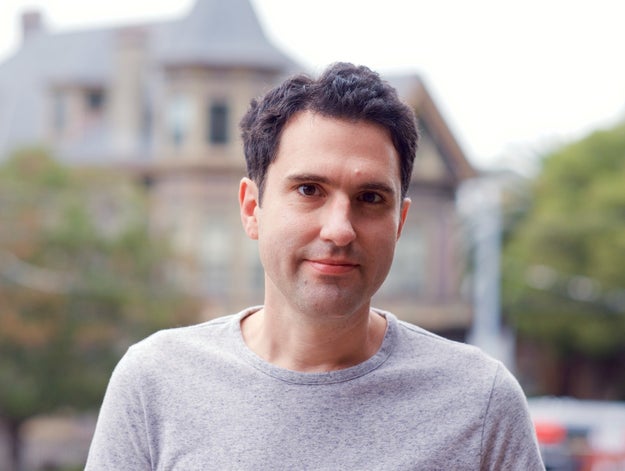
Gabe Rivera was halfway through his lamb gyro when it became clear he’d been spotted. It was the middle of the lunch rush at a bustling upscale food court in downtown San Francisco and Rivera was looking to maintain a low profile. His plans were foiled when a PR rep for a mid-sized tech company picked Rivera’s messy head of hair out from the crowd and headed over with an enthusiastic grin to invite him to an industry party that evening.

Rivera had, of course, already been invited, but responded graciously. The rep, clearly thrilled by the serendipitous encounter, hovered over Rivera at the reclaimed barnwood table, burbling small talk; at one point, before leaving, the rep closed his eyes and shook his head — as if having just tasted something divine — and uttered something to the effect of “as always, loove the site&;” Rivera’s face was equal parts cordial and uncomfortable.

When we’d been left alone, I asked if fans often approached when he ventured out in San Francisco. Rivera was dismissive. “I&;d say Techmeme is still really a very niche site,” he told me later.

Techmeme wields tremendous power over a tremendously powerful group of people.

This modesty was somewhat misplaced. Techmeme may be a niche site compared to the Facebooks and the YouTubes of the world, but the tech-news aggregator influences the people who make the Facebooks and the YouTubes of the world: Mark Zuckerberg and Sundar Pichai are both confessed readers, as are LinkedIn’s Jeff Weiner, former PayPal exec and current Facebook Messenger head David Marcus, former Twitter CEO Dick Costolo, and Microsoft’s Satya Nadella. Hunter Walk, a former product manager at YouTube turned seed-stage venture capitalist, told me he checks the site three to five times daily. “It’s one of my first morning sites,” he told me over email. “My perception is that lots of us [in Silicon Valley] use it.” That includes journalists: Rivera’s taste in that day’s news often dictates what stories are followed and chased by newsrooms across the country. Without writing a word himself, Rivera is shaping tech’s story for the legion of reporters and editors tasked to tell it.

Techmeme, then, wields tremendous power over a tremendously powerful group of people. And as its founder, Rivera has been quietly defining Silicon Valley’s narrative for the industry’s power brokers for more than a decade. But Rivera is uncomfortable — or unwilling — to reckon with how his influence has affected one of the most important and powerful industries in the world. The result is that Rivera can cast himself both as a gimlet-eyed insider with a powerful readership and as a mostly anonymous entrepreneur running a niche link blog from the comfort of his home. It’s a convenient cognitive dissonance.

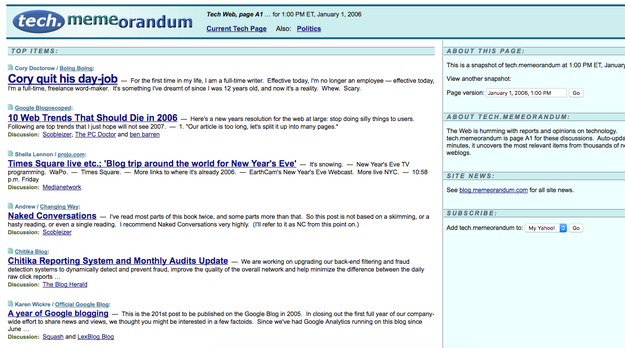
A snapshot of Techmeme (then known as tech.memeorandum) on January 1, 2006.

Rivera is 43 but looks a decade younger. He is sarcastic, self-deprecating, and gently neurotic. He speaks in meandering sentences that often circle back to revise themselves, and carries himself with what one person I spoke with described it as “an economy of movement with shifty eye contact and a lack of aggression that’s self-assured.”

Rivera worked as an engineer at Intel in the early aughts before launching Techmeme in 2005 as an automated news site that rounded up links from mainstream outlets and obscure technology blogs. He’d already built Memeorandum, a politics aggregation page with a similar look and feel (and has since expanded with a media property called Mediagazer). Both properties were a solution to the now-quaint problem of cluttered RSS feeds, offering the best of the news in their various subject areas, and both took off in their own small corners of the internet. In 2008, to boost the quality and diversity of stories on the site, Techmeme switched to human aggregators.

Everything about Techmeme and its lingering success seems to defy the contemporary wisdom of building a popular website. It publishes zero original reporting and is not a social network. It doesn’t have a mobile app or a newsletter or even much of a social presence beyond its Twitter account, which posts dry commodity news with zero flair for clickability. Revenue comes from sponsored posts and a “who’s hiring” page (Rivera makes a point not to seek any outside funding). Its headlines are typically fact-spattered and unwieldy synopses of the stories they tout; consider, for example, the perfectly serviceable TechCrunch headline “Facebook & Google Dominate The List Of 2016’s Top Apps,” which Techmeme transformed into this grand mountain range of a title: “Nielsen&039;s 2016 top apps by monthly uniques: Facebook, up 14% YoY to 146M; Messenger, up 28% to 129M; and YouTube, up 20% to 113M; Amazon hits , up 43% to 65M.”

Everything about Techmeme and its lingering success seems to defy the contemporary wisdom of building a popular website.

For its first seven years, Techmeme retained the look of the cluttered, aggressively hyperlinked design fever dream of the mid-2000s web; after a 2012 redesign, it now looks like a text-only newspaper homepage and still eschews the most bare-bones navigation features. In an era where the homepage is thought to be on life support, Techmeme is basically nothing more than exactly that, full of wonky text.

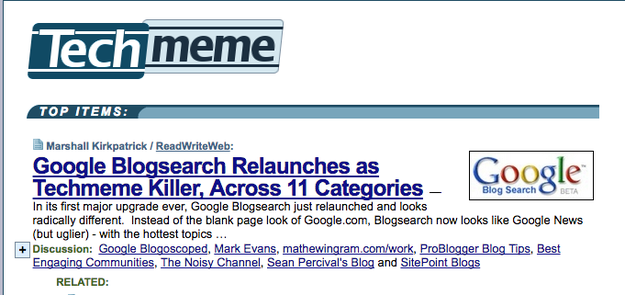
A Techmeme headline reporting on a competitor from 2008.

And yet. Run a search query for “Techmeme killer” and you’ll see a graveyard of old headlines for failed experiments like ePlatform, New York Times Blogrunner, Google Blogsearch, and something called Newspond. They&039;re all gone now, and Techmeme persists. Not even Twitter has fazed it.

Google Ventures general partner and former TechCrunch writer M.G. Siegler told me most reporters he knows check the site regularly. “The same also seems to be true of many VCs I know,” he said via direct message. “It&039;s simply the best way to quickly get caught up on what you need to know in our industry.” Joe Brown, the editor-in-chief of Popular Science, described Techmeme as the ultimate insider enthusiast publication. “It’s a small restaurant that serves your favorite dish. And for people that are interested in technology, just knowing about Techmeme is kind of its own reward and carries its own kind of status.”

Chris Dale, YouTube’s global head of communications and public affairs, is a self-confessed “Techmeme addict” and has a Techmeme bookmark on his home row, which he checks religiously between meetings (since there’s no app). “After email, it&039;s the first thing I check in the morning, he told BuzzFeed News. “If your company&039;s trending on Techmeme for something good, it&039;s great validation. If you&039;re trending for something bad, you know you&039;re in for a rough couple of days.”

Put it that way, and Rivera sounds an awful lot like, well, a journalist. Techmeme publishes 30–40 stories a day out of thousands, which means Rivera and his team are constantly making choices about which narratives are important and which are not. It’s not unlike an editor-in-chief slotting stories for Page One.

“Say there’s a story about sexual harassment in a company,” Rivera said. “To what extent do we cover this? If we cover every tiny iteration of the scandal, do people think we are championing this as an issue too much? Is Techmeme turning into an advocacy platform for this issue?” (Ultimately, Rivera has settled on covering cultural topics to the extent that they matter to the industry, or to a given company’s bottom line.)

Just as interesting is what Techmeme’s chosen not to cover. A search on Techmeme for Theranos — arguably the biggest tech scandal of the last few years — turns up only four results, none by the Wall Street Journal, which broke the story of the company’s fraudulent technology. Rivera told BuzzFeed News that the decision not to cover the Journal’s reporting on Theranos was because the site doesn’t follow medical technology (or other niche tech spheres like space or food tech).

When I asked if he views himself as a journalist, Rivera seemed uninterested in the classification. “I guess not? I mean, I don’t care. It’s just a definition,” he said. “It’s a purely semantic thing. We do journalistic things and I edit the editors, so…sort of?”

“When I care deeply, I try to bend the debate. And I usually succeed.”

It felt like a genuine answer, but still, that casual and self-effacing attitude can serve to play down the burden of responsibility that comes with running a site that decision-makers in key companies read every day. For example, when asked in 2014 about traffic by Business Insider, Rivera told the site, “Monthly uniques are a particularly bad stat for aggregators like Techmeme.” That’s not untrue; Techmeme’s reach extends beyond homepage views — but it&039;s also a convenient way of dodging the question.

And after all, though Techmeme’s team of editors does discuss and vote on controversial coverage decisions, Rivera admits he often has final say. “When I care deeply, I try to bend the debate,” he said. “And I usually succeed.”

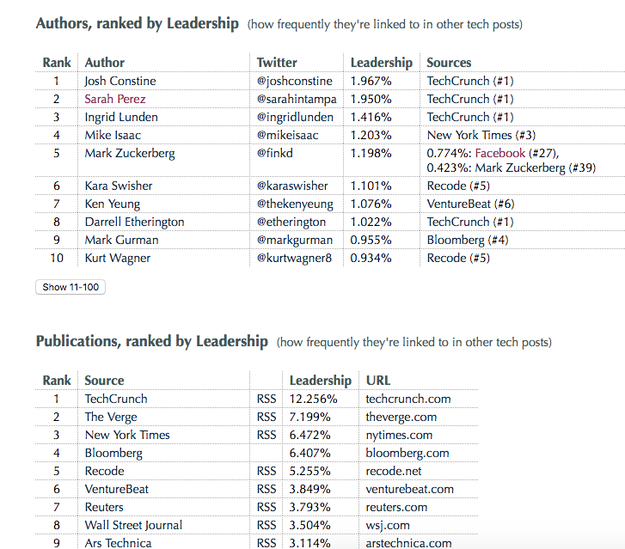
I asked to meet Rivera mostly out of my own intensely conflicted relationship with his website. For years now, I’ve bemoaned Techmeme’s leaderboard system, which ranks journalists both by presence (how frequently they&039;re featured on Techmeme) and leadership (how frequently they&039;re linked to in other tech posts). During tech’s gadget blogging heyday, Techmeme’s leaderboards often sparked an exhausting competition among publications scrambling to be first with a press release microscoop or unboxing video. Those days are now largely over, though Rivera notes that occasionally reporters will squabble on Twitter over which story deserved to be picked up by Techmeme, much to his delight. (“That’s really fun — I love when that happens.”) But Techmeme still plays a singular role in spurring journalists to chase a particular type of content: inside-industry scooplets — executive shuffles, product updates — that might matter more to venture capitalists and CEOs than the millions of civilian tech consumers.

Techmeme&039;s leaderboards.

In a 2011, Siegler published a post arguing that “tech blogging is a game” with only three key elements “that matter: pageviews, scoops, and Techmeme.” He continued, “Techmeme is the most fascinating game. Everyone in the industry reads the site, and all serious tech bloggers know where they stand on the Leaderboard.” “I think Techmeme was absolutely an enabler of that inconsequential blogging crap, which I suppose is the bad part of being around so long,” said Brown.

Techmeme still plays a singular role in spurring journalists to chase a particular type of content.

As tech coverage has moved away from gadget reporting and more toward the business and culture of the industry, the leaderboard pandering has faded some, but the site’s influence remains in the back of the minds of reporters and editors. “Techmeme has an influential audience, and so I’ve always felt like being featured there was a nice validation that you’d contributed something meaningful,” Casey Newton, the Silicon Valley editor at The Verge, told BuzzFeed News. “I don’t write stories to get on Techmeme — I write stories because they’re news. But I’m always glad whenever Techmeme’s editors feature my stuff.”

Looking at Techmeme’s leaderboard and its top 30 publishers, it’s clear that the site tends to favor insidery blogs, many of which feature high-volume work like product announcements and updates over in-depth reporting and analysis. TechCrunch, a trade publication long known as a home for near-comprehensive, bloggy coverage of tech, has been at the top of Techmeme’s leaderboard since the aggregator’s earliest days. The two publications have something of a personal history together. Rivera rented a room from TechCrunch founder Mike Arrington shortly after Techmeme launched. Rivera also dated a TechCrunch writer, Alexia Tsotsis, who in 2012 became the site’s co-editor.

Rivera, for his part, disputed the idea that these personal relationships even hint at a possible conflict of interest. While he conceded that TechCrunch&039;s Arrington-authored early coverage of Techmeme “definitely helped” raise the site&039;s visibility, he argued that it was tech enthusiast Robert Scoble that put it on the map in 2005 with a few favorable blog posts. “We don&039;t give preferential treatment to publications,” he said.

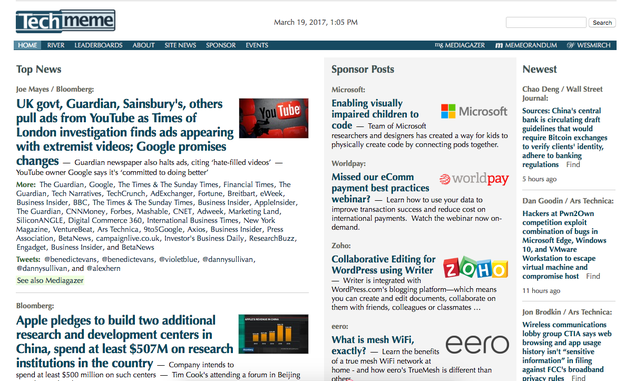
Techmeme&039;s front page as of this writing.

After our lunch, in a stark conference room in BuzzFeed’s San Francisco bureau, Rivera opened his laptop to check on the site. Toggling between a Slack chat and the window where Techmeme’s software routinely crawls over 11,000 sites and blogs, Rivera sifted through a cascade of tips before turning his attention to the site’s innards and the tools editors use to rank stories. “Ugh, we really need to work on design,” he sighed. “But I guess, in a way, that’s kind of who we are.”

Rivera seems to be one of the few people in Silicon Valley unconcerned with scale.

Staring at the guts of his decade-old creation, Rivera seems to be one of the few people in Silicon Valley unconcerned with scale. And it&039;s somewhat refreshing or reassuring. Or both. Unencumbered by growth metrics, Techmeme has so far succeeded while shirking pretty much all the trappings of modern publishing. It&039;s not incentivized to post original work or to post the work of others in volume, or even to prod readers into clicking through to the stories it aggregates. And you won&039;t find it seeking eyeballs on Snapchat Discover or experimenting with live video on Facebook. In that sense, Techmeme is less a publication or “portal” than it is a daily ledger, and Rivera its scrivener — a guy turning out a steady and deadpan accounting of the daily life of a flashy, fast-moving industry. It suits Rivera just fine.

Quelle: <a href="Meet The Man Whose Site Mark Zuckerberg Reads Every Day“>BuzzFeed

Chance The Rapper Reveals Details Of His Apple Music Deal To Defend His Indie Cred

Chance The Rapper Reveals Details Of His Apple Music Deal To Defend His Indie Cred

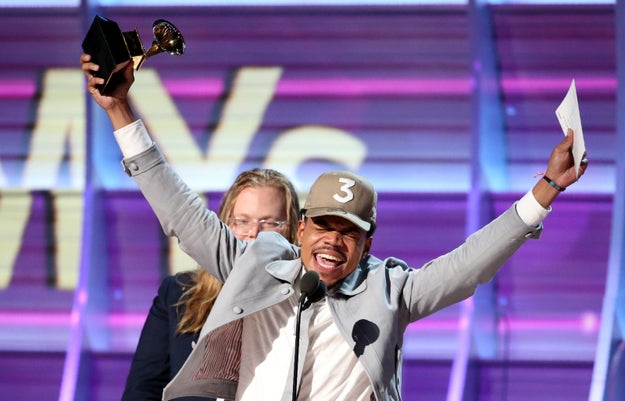
Chance the Rapper celebrates as he accepts the Grammy for Best Rap Album for “Coloring Book.”

Lucy Nicholson / Reuters

Chance the Rapper, the artist who recently won a historic Grammy for his online mixtape “Coloring Book,” took to Twitter today to respond to growing skepticism over his status as an independent artist.

Chance has publicly championed his freedom from record labels throughout his career, and he hasn&;t signed to a label to date. But there&039;s been a rising tide of questions and criticisms (The Village Voice, the Ringer, Fact Magazine) about his growing stardom and his choice to temporarily make “Coloring Book” an Apple Music exclusive for two weeks, despite claiming that it was free.

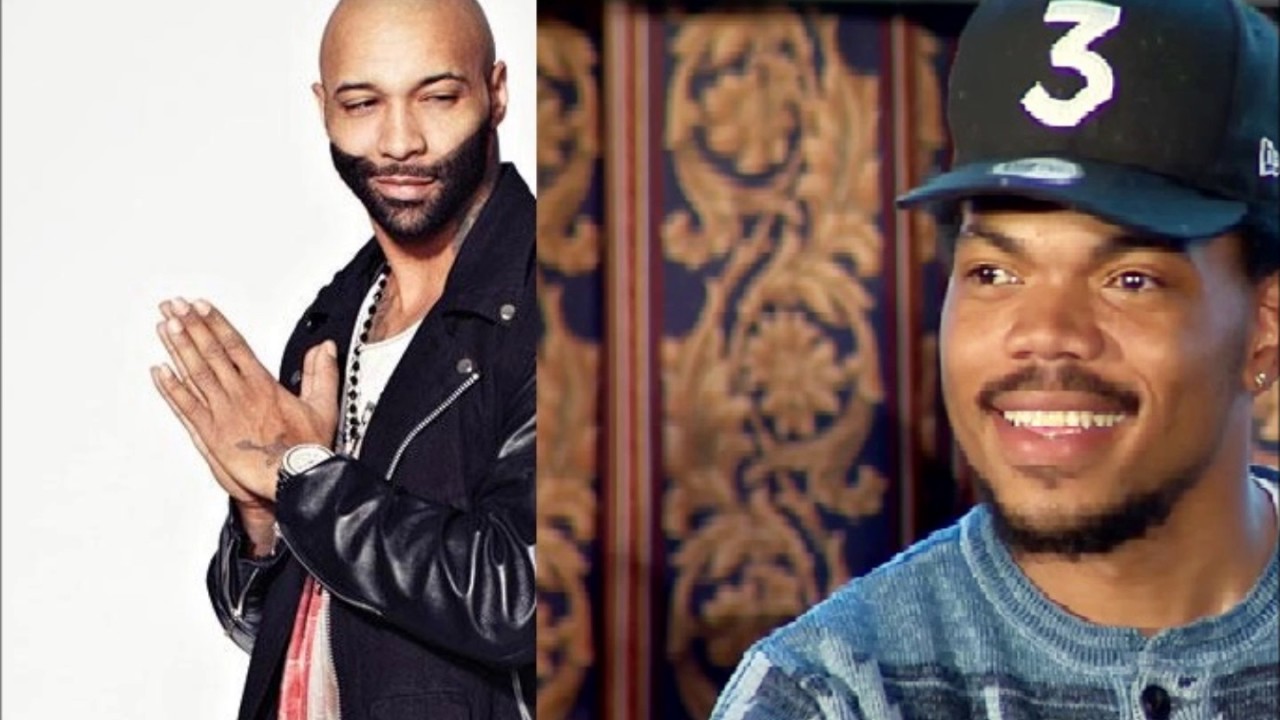
Reality TV personality and rapper Joe Budden debated Chance&039;s independence just yesterday on his podcast, “I&039;ll Name This Podcast Later.” Chance previously made all his music available for free online, so his decision to sell exclusive streaming rights over his music to a major corporation (even if for a limited time) jarred some of his fans.

You can listen to the conversation about Chance in this clip posted to YouTube:

youtube.com

Some people on Twitter were also unconvinced about exactly how ~independent~ Chance might be:

Apple Music struck a similar deal with Frank Ocean for his album Blonde, which also debuted in 2016 exclusively on Apple Music.

But others pointed out that Apple Music isn&039;t a label and therefore doesn&039;t own the rights to the rapper&039;s music.

According to sources within the company, Apple only worked with Chance as a distribution and marketing partner, so it doesn&039;t own the rights to any of his music.

In an interview with Complex Magazine released March 13, Chance talked about the creative importance of being independent from major labels.

“I don&039;t mean do it by yourself, like literally, like, &039;I&039;m doing everything,&039;” he said. “You can bring on your friends and professionals that you know and build a business where you&039;re the upper management. Where you&039;re the creative, and you are the last decision maker, and you don&039;t ever have to feel compromised…But [when] you sign to label, you get a boss, and that shit&039;s just fucked up to me. Why should you have a boss?”

Chance the Rapper&039;s publicist did not immediately respond to request for comment.

Quelle: <a href="Chance The Rapper Reveals Details Of His Apple Music Deal To Defend His Indie Cred“>BuzzFeed

Facebook Marketplace Kinda Sucks

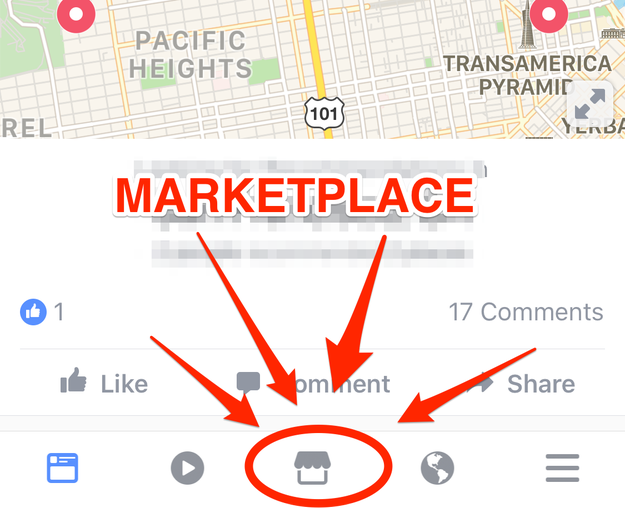
You probably have noticed a strange abomination in your Facebook mobile app recently. On the bottom row of buttons, right next to the Notifications button, there’s a cute little shop awning icon. Errantly tap into it and you&;re instantly transported to the most depressive bazaar of Shit. Welcome to Marketplace. It sucks.

Marketplace launched this October, and it’s basically Craigslist lite. Facebook doesn’t even make any money from it — no cut from sales or payment processing. As far as a piece of technology, it’s not particularly exciting.

Plenty of social good comes from selling used stuff — it’s environmentally friendly, and hey, cheap&; I fully appreciate that buying and selling used stuff is incredibly worthy and valuable. It’s just that Marketplace is a crap feature for Facebook.

You can totally imagine how Marketplace seemed like a great idea on paper. There were already tons of buy/sell/trade groups springing up organically — according to Facebook, 450 million people a month visited a buy/sell group before Marketplace launched. Some of these are location-based; some are interest-based, like this group where furries trade and sell fursuits. Buying and selling your old junk is as old as time: Yard sales, penny-saver circulars, and even AM radio swap shows known as “tradio” all existed as peer-to-peer networks for selling used shit long before the two dominant used-shit sites, Craigslist and eBay, came around.

But eBay involves the hassle of shipping, and Craigslist has a reputation for stranger danger. Facebook Marketplace offers a solution: You can see the Facebook profile of the buyer/seller, so you don’t have to worry about some creepy perv or a scammer. Plus, it harnesses the power of everything Facebook knows about you (age, gender, interests) to tailor the main feed of products for sale right to you. Great, right?

And yet somehow Marketplace manages to be not quite as whimsical as Craigslist, less thorough than eBay, and kind of just, well, depressing. It’s the technology equivalent of a bundle of unworn corporate fun run T-shirts at Goodwill.

For example, one day I saw a Ikea Bjursta dining table for $99 (retails at $149 new, so this is a bad deal) and a very ugly 60-piece set of ’70s-looking dishware for $125 (I could see the seller had tried to list this a few times; no one wants it). Outdated video game systems, used cat carriers, Uggs, baby clothes, baby strollers, baby bouncers. A used yoga mat (ew) for $5.

The vibe is definitely more “I need to get rid of this crap” than great finds. This is shit you do not want. I mean, maybe you do, I don’t know your tastes. But probably you don’t want it.

One thing Marketplace reveals is that left to ourselves, we’re terrible free market capitalists. Sellers aren’t coming up with a price based on competition, partly because there’s not enough stuff on there to actually compete with. So what you get is people just making up a price based on what they think it should be, and somehow a whole lot of people think a 25% discount on the retail price for a year-old used Ikea dresser is reasonable. Buddy, let me tell you something: When you drive that Malm off the lot, you lose 50% right there.

What you also see is a poor sense of “what will someone drive over to my house in person to pick up?” Inexpensive goods, like a $10 sweater, are better suited to thrift store shopping, and not worth schlepping to someone else’s house to pick up. But not everyone realizes this.

Marketplace’s prominent position on the app

Here’s what’s truly baffling about it: its placement on the Facebook app. The Marketplace tab occupies the most primo real estate, right in the bottom center, between the Notifications and Video buttons.

Think about how often you actually buy or sell something on Craigslist. Maybe only when you’re moving, or looking for something specific. But how many times a day do you open the Facebook app? Lots&033; You’re not looking to shop for used couches or cars every time you open Facebook.

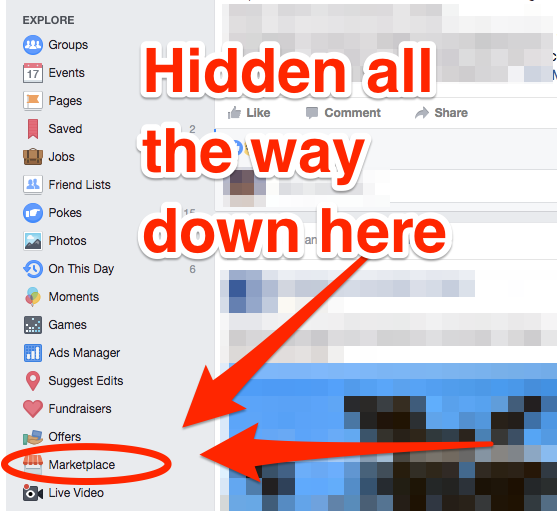
Marketplace is much more hidden on the website version of Facebook. It’s tucked into the sidebar options, but hidden down where you have to click to see the full list.

Facebook did not provide a reason for why Marketplace is positioned so prominently on the app, and said that the app design changes all the time, which is true (remember when the Messenger button was on the bottom?).

A reasonable explanation here is that Marketplace is brand-new, and the only way it will become truly useful is if there’s a critical mass of people buying and selling on there. So by putting it right in front of so many people, it will raise awareness of the feature enough to get it up and running with lots of stuff to buy. Then, they can move it somewhere less noticeable, but people will know that Marketplace is a good place to sell that used guitar. I’ve been checking out Marketplace almost daily since it launched, and I can confirm that from what I can see, there’s definitely lots more stuff available in lots more categories.

A place for strangers

Perhaps the weirdest element of Marketplace is that it offers something completely different than the core Facebook experience: You see strangers. Normally, you’re only ever seeing people you know, or perhaps friends of friends tagged in a photo or post. Aside from Groups (which is where all the fun is at, trust me), Facebook doesn’t give you much opportunity to ever see strangers.

As more people use it, Marketplace will undoubtedly get better. And a lot of its problems — crappy merchandise, bad pricing — are exactly the same on Craigslist or similar sites. And I can’t complain too much myself: Last weekend I finally wall-mounted my TV and posted my used hideous Ikea TV stand on there for $10. Someone responded right away.

Quelle: <a href="Facebook Marketplace Kinda Sucks“>BuzzFeed

Does This Biotech CEO Have A PhD? The Answer Is No. But He Did Leave School Under A Cloud

Freenome CEO and cofounder Gabriel Otte.

Courtesy / Freenome

You could be forgiven for thinking that Gabriel Otte, the CEO and cofounder of a well-funded biotech startup called Freenome, holds a PhD. Articles, conference programs, and other websites identify him as a PhD. Freenome’s website even identified him as “Gabriel Otte, PhD” — that is, until BuzzFeed News began asking questions about his degree, and the honorific disappeared last week. But he does not have a PhD.

Like many startup founders in Silicon Valley, Otte dropped out of school. In his case, he left a PhD at the University of Pennsylvania and started Freenome, which is creating a blood test for early-stage cancer.

Moreover, Otte’s departure from school was not amicable, BuzzFeed News has learned. In fact, he left under a cloud after a professor says she raised questions about some of his research.

“There were many issues about Gabe’s work in the lab and Gabe leaving,” said his former adviser, Shelley Berger, director of UPenn’s Epigenetics Institute and a professor at its medical school, when reached for comment.

Asked about the circumstances under which he left UPenn, Otte said in an interview this week, “It’s a very sensitive subject for me. I do not want to discuss that.”

From September 2011 to October 2014, Otte was a graduate student in the Genomics and Computational Biology group, according to university spokesperson Katherine Baillie. His research there does not seem related to what Freenome is now developing: a test to catch cancer before patients know they’re sick, based on telltale bits of DNA in a blood sample, instead of a more conventional, costly, and invasive tissue sample.

Based in South San Francisco, California, Freenome says it has started testing its screening method in clinical trials on patients’ samples, and has partnered with Massachusetts General Hospital, UC San Francisco, and other medical centers. It has not published any data in a peer-reviewed journal.

Otte and his cofounder Riley Ennis, both of whom made Forbes“30 Under 30” list this year, are in a fierce race against Grail, a rival that just raised almost $1 billion.

“There were many issues about Gabe’s work in the lab and Gabe leaving.”

Earlier this month, Freenome raised $65 million in a round led by Andreessen Horowitz. The powerhouse venture-capital firm (and BuzzFeed investor) also led a $5.5 million seed round in Freenome last year. Other high-profile backers include Eric Schmidt’s Innovation Endeavors, Peter Thiel’s Founders Fund, Polaris Partners, and GV, Alphabet’s venture arm. BuzzFeed News reported that the startup was worth about $210 million after the latest round (Freenome declined to comment).

The biotech company’s backers say they know that Otte’s degree is incomplete. Documents that Freenome provided to investors while raising money, and that investors in turn shared with BuzzFeed News, list Otte’s degree as unfinished.

“From the day we first met Gabe, he has been incredibly upfront about the fact that he doesn’t have a PhD and left Penn before finishing his PhD work,” said Vijay Pande, general partner at Andreessen Horowitz and Freenome board member. “Separately, we have done our own due diligence on Gabe and the technical details of the work he’s doing at Freenome and we’re thrilled to be one of his investors.”

Erin Gleason, a Founders Fund spokesperson, said, “Gabe did not misrepresent his background to our team, and his academic credentials had no bearing on our investment in Freenome.” “Gabe was always clear with GV that although he had done PhD work at Penn, he did not complete his PhD,” said Blake Byers, a general partner at GV. “This wasn’t an issue for us, as it’s not uncommon for grad students to drop out of school to start companies.” Luke Lee, principal at Asset Management Ventures, said, “We knew that he was enrolled in a PhD program at Penn and he eventually chose to leave and we understood that.”

Otte says he has always been clear about his academic history. “I am very open about speaking about the fact that I did work on a PhD,” the 28-year-old said. “I don’t claim I’ve ever completed one.”
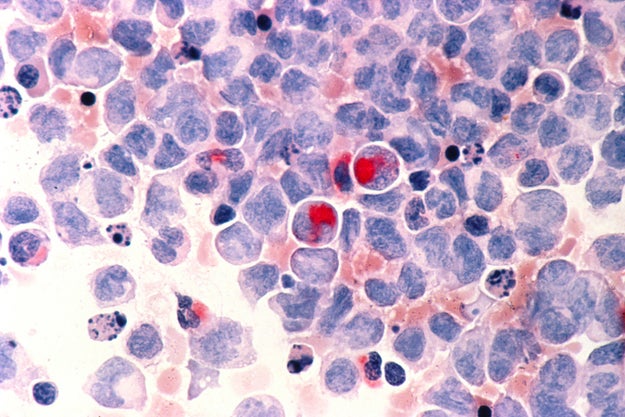
Human cells with acute myelocytic leukemia

Dr. Lance Liotta Laboratory / Via visualsonline.cancer.gov

But interviews and other publicly available online information could be reasonably interpreted to mean that Otte has a PhD. The CEO says that these instances are misunderstandings.

On why Freenome’s website identified him as a PhD, then removed the reference: “To the extent that I’m aware, it did not. I do think there was a refresh of the website that we were performing and there could have been a typo.”

In an interview with Fast Company last year, he said, “And my PhD is in genomics.” (“I believe what I actually said was ‘PhD work was in genomics,’” he told BuzzFeed News.) His biography reads: “While working on his Ph.D. in computational biology at the University of Pennsylvania, he published several papers on applications of machine learning on large genomics datasets and other big data.” (Asked if he thought this sentence implied he had a PhD, Otte said, “Not at all.”) A conference identified him, a speaker, as a PhD on its website. (“I don’t know what they listed me as.”) So did a few other conferences. And Fortune described him as “a Ph.D. in computational biology.” (Otte did not respond when asked for comment about these references.)

On March 3, BuzzFeed News emailed Freenome’s public relations agency to ask if Otte had finished a PhD. A Freenome spokesperson responded: “Yes he did, he received his PhD in computational biology from UPenn.” (Otte later said, “They put a bio together and it was not a bio that I had personally written, but it’s something I should have been more careful about.”)

After answering questions on the phone with BuzzFeed News, Otte later issued a statement in which he pledged to be more careful. “I was working towards a PhD, but did not receive a PhD,” he said. “It’s an important distinction and one where I haven’t been careful enough to ensure that it is correctly reflected in public information attached to me. This is inexcusable. I need to do a better job of this and will correct errors that exist in the public today and any moving forward.”

He added, “My advisors and investors understand I don’t have a PhD. But they also understand and support the work we’re doing at Freenome (and how we are doing it) and have made independent assessments of what they’re investing in and why.”
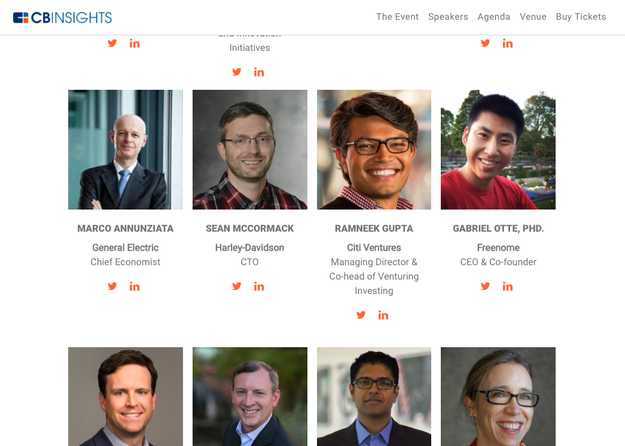
A tech conference identified speaker Gabriel Otte as a PhD.

BuzzFeed News / Via events.cbinsights.com

At UPenn, Otte joined Berger’s lab in 2012, she said. He co-authored five papers published from 2013 to 2016. Those papers, which were about biological mechanisms that control gene activity, are sound, and his work on them appears to be unrelated to Freenome’s publicly stated objective of finding cancer-relevant mutations in blood drawn from patients, Berger said.

But Berger did have concerns about research of his that was never published. “In one instance, Gabe reported experimental results to me for which the primary physical data could not be found and hence, in my opinion, the information was unpublishable and hence not submitted to any journal,” she said when contacted by BuzzFeed News.

An anonymous UPenn-affiliated source confirmed this account. According to a person familiar with Otte’s time in the lab, someone then conducted a search for his primary data, but came up empty.

Otte said, “I’m not going to speak about that incident around my leaving Penn.”

“From the day we first met Gabe, he has been incredibly upfront about the fact that he doesn’t have a PhD.”

“I do know there was some issue with his adviser in terms of the authenticity of data and there were claims going in both directions,” said a person familiar with how the company presented itself to investors.

Another investor said that Otte had been consistently honest about not having a PhD. “His and his team’s work at Freenome has been independently validated by academic and industry experts, and we believe that it can transform cancer care and save countless lives,” said Matt Ocko, managing partner at Data Collective.

Otte was a PhD student at UPenn, according to Baillie, the university spokesperson, but appears to have presented himself at times as working toward a medical degree as well as his PhD. According to five alumni, all of whom requested anonymity due to the sensitivity of the situation, Otte told classmates he was earning both degrees. “He was able to convince a few faculty members he was an MD student,” one alum said. (“I think they must have misheard then,” Otte said.)

A 2013 church newsletter identified him as an MD/PhD student. And the website of Acorn, a three-person startup that Otte used to run, described him as having “received his MD/PhD from the University of Pennsylvania.”

“I didn’t develop that site, so I don’t know,” Otte said. While he said he did consider joining the program, “I didn’t have an MD/PhD from Penn, that’s for sure.”
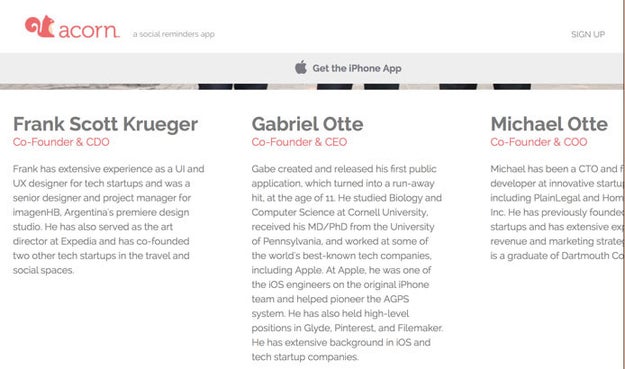
A screenshot of the former website for Acorn, Gabriel Otte&;s ex-social media app, says Otte “received his MD/PhD from the University of Pennsylvania.”

BuzzFeed News

Otte left UPenn in October 2014. He had spent the summer at a tech startup accelerator in New York City, working on Acorn, a location-based social media app, with his younger brother, according to several media accounts. (Otte declined to comment on this subject.)

Soon after, they moved to Northern California and abandoned Acorn, and Otte cofounded Freenome. In November 2014, he said he was taking a break from school. “I was actually almost kicked out of my program because starting a company violated my PhD contract,” he said in an interview with a blogger at Cornell University, his undergraduate alma mater, when asked about Acorn. “Thankfully, it was worked out in the end and I’m currently on a leave of absence.” (Otte declined to comment on this remark.)

Otte has said he started a biotech company out of a disillusionment with academia, fostered at UPenn. “I looked at my paper and realized that it was not going to amount to very much in terms of helping human health,” he told the Silicon Valley Business Journal. And it was a lack of resources that drove him out of Philadelphia. “When I asked Penn, where I had connections, for help, they just basically shut us down,” he said. “They said these are valuable samples and you are just a rinky dink startup.”

Otte is now leading one of Silicon Valley’s hottest biotech startups, working on a screening method that’s a self-described “combination of machine learning, biology and computer science.”

If proven accurate and reliable, Otte says it could be “a catch-all, first line of defense you might be able to take, as easy as doing a yearly physical.”

If you have information or tips, you can contact this reporter over the encrypted chat service Signal at (415) 322-8701. You can also find our SecureDrop information here.


LINK: This Startup Wants To Catch Cancer In Its Early Days

Quelle: <a href="Does This Biotech CEO Have A PhD? The Answer Is No. But He Did Leave School Under A Cloud“>BuzzFeed