Twitter Is Considering Offering An Enhanced Version Of Its Service — For A Price

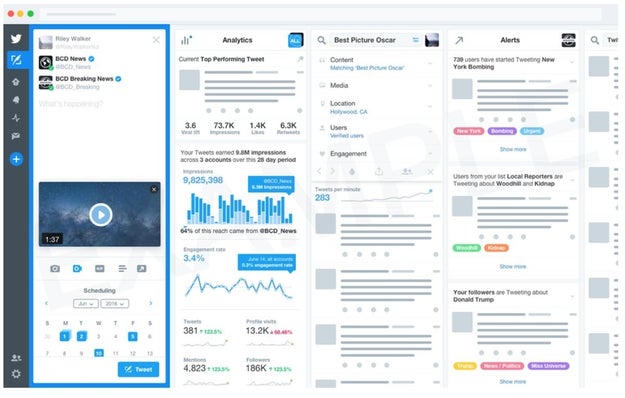
A mockup included in a Twitter survey shows an enhanced version of the company&;s Tweetdeck app.

Twitter

Twitter is considering offering a paid version of its service, the company confirmed Thursday.

The paid version, geared to power users, would feature a number of enhanced features made available in the Twitter-owned app Tweetdeck. It would not supplant the current version of Twitter. The company is still determining what features it would include in such a product, and is surveying some users to figure out what features they&039;d be most interested in.

“We’re conducting this survey to assess the interest in a new, more enhanced version of Tweetdeck,” a Twitter spokesperson told BuzzFeed News. “We regularly conduct user research to gather feedback about people’s Twitter experience and to better inform our product investment decisions, and we&039;re exploring several ways to make Tweetdeck even more valuable for professionals.”

Twitter is not currently developing the product, and it would continue to offer a free version of Tweetdeck if it decided to roll the paid product out. The survey used language describing what the product “will be,” making it seem like an inevitability.

“This premium tool set will provide valuable viewing, posting, and signaling tools like alerts, trends and activity analysis, advanced analytics, and composing and posting tools all in one customizable dashboard,” the survey said. “It will be designed to make it easier than ever to keep up with multiple interests, grow your audience, and see even more great content and information in real-time.”

Twitter is trading far below its IPO price and is struggling to grow its revenue, so a subscription product for power users could be one method to squeeze some cash out of those who get the most out of the platform.

Quelle: <a href="Twitter Is Considering Offering An Enhanced Version Of Its Service — For A Price“>BuzzFeed

Instacart Just Settled A $4.6 Million Worker Lawsuit

Instacart employees fulfill orders for delivery in downtown Los Angeles, California.

Patrick T. Fallon / Getty Images

The Instacart workers who buy and deliver groceries just won a small victory — the grocery-on-demand startup just settled a class action lawsuit to the tune of $4.6 million.

The lawsuit alleged that workers were owed back pay because Instacart should have classified them as employees, not independent contractors; the payout, per Recode, will be as much as $5,000 for three workers named in the suit, while others will receive “a couple hundred dollars” at most, depending on a points-based system that ranks how much they worked. The settlement won’t, however, grant workers employee status.

“We have settled a nationwide class action lawsuit, primarily over the classification of our shoppers as independent contractors. This is a positive, early resolution for the Company, and we look forward to finalizing the settlement,” Instacart said in a statement.

In 2015, workers filed an initial suit against Instacart, claiming they had been misclassified as contractors, and were owed for the benefits and protections they would have earned as employees of the company. At the end of 2016, after the first case was moved to private arbitration, the same firm, Arns Law, refiled a second lawsuit, hoping to get the workers their day in court.

Since the first lawsuit was filed, Instacart has reconfigured its workforce, changing its in-store shoppers status to employees, while delivery workers remained contractors. But it has also repeatedly cut wages, and made it more difficult for customers to tip, which workers say has severely impacted their overall earnings.

Though Instacart workers will remain contractors under this settlement, they have won changes that might alleviate some of their concerns about tipping.

In a copy of the settlement agreement obtained by Recode, Instacart promised to modify its app&;s user interface to make “the differences between the Service fee and tip” more clear for customers.

Last fall, BuzzFeed News reported that when Instacart added a pooled service fee in addition to tips, some workers wages fell by around 30%, because customers weren&039;t tipping as much. Some workers were so frustrated with the pooled service fee they threatened to strike, and passed out flyers detailing how to tip in the new app to customers. When the second lawsuit was filed in December, it pointed to Instacart’s control over how tips are distributed as evidence that delivery workers should have been classified as employees.

Other on-demand startups that have faced class action lawsuits over worker classification include Uber, Lyft, Postmates, Washio, DoorDash, Homejoy and Caviar. Of those, the most high profile settlements so far have been the Uber and Lyft cases. (Like Instacart, Uber and Lyft successfully avoided trial by jury because workers agreed to private arbitration when they signed their contracts. Instacart has since made arbitration opt-out, as has Postmates.) Uber’s settlement, which could have forced Uber to pay out $100 million, is still being negotiated. Lyft recently finalized its $27 million settlement with drivers.

In October, Instacart CEO Apoorva Mehta told BuzzFeed News that, in order for the company to continue to grow, some delivery workers were going to have take a paycut. Earlier this month, Instacart finalized a funding round of $400 million, bringing the company’s valuation to $3.4 billion.

In an email to workers announcing the funding, Mehta said he planned to hold a town hall to answer any questions they might have about the news. “This is a big milestone for our company. It will allow us to continue to make our product and tools better for you and the customers,” Mehta wrote. “It will also allow us to invest in marketing as well as rapidly expand, so that many more customers across the country can use our service.”

Some shoppers noted that the influx of cash did not bring with it news of a pay raise. In fact, in some markets, wages for Instacart workers have continued to fall since the beginning of the year. For example, screenshots of pay rates reviewed by BuzzFeed News show that in Hollywood, the per-order base rate has fallen from a little below $10 at the beginning of the year to as low as $7.50 by the end of February.

Deirdre Big, a worker in Boulder, said she “won’t be sticking around Instacart much longer” after rates fell from around $7.55 per order at the end of January to $6.25 at the end of February.

This is a developing story; further details to follow.

Quelle: <a href="Instacart Just Settled A .6 Million Worker Lawsuit“>BuzzFeed

Senate Republicans Vote To Gut Internet Privacy

Brendan Mcdermid / Reuters

The Senate voted Thursday to make it easier for internet service providers to share sensitive information about their customers, a first step in overturning landmark privacy rules that consumer advocates and Democratic lawmakers view as crucial protections in the digital age. The vote was passed along party lines, 50-48, with all but two Republicans voting in favor of the repeal and every Democrat voting against it. Two Republican Senators did not vote.

Passed by the Federal Communications Commission in the final months of the Obama presidency, the privacy rules prohibited internet providers like Comcast and Verizon from selling customer information, including browsing history and location data, without first getting consent. The rules also compelled providers to tell customers about the data they collect, the purpose of that data collection, and to identify the types of third party companies that might be given access to that information.

But the telecom industry and Republicans in Congress fiercely opposed the new regulations. Critics argued that these rules unfairly target internet providers, restricting their ability to turn personal information into targeted advertising and other tailored services, even as giant web companies like Google and Facebook are free to collect and sell our information without those limitations.

Last month, Ajit Pai, the new Trump-appointed Chair of the FCC moved to block a piece of the privacy rules that required internet providers to adopt reasonable security measures and notify customers when data breaches occur. Along with Maureen Ohlhausen, the acting chair of the Federal Trade Commision who was also appointed by President Trump, Pai believes that consumers will be better protected with a single set of internet privacy rules, ones that encompass providers like Comcast and web services like Facebook.

“The federal government shouldn’t favor one set of companies over another — and certainly not when it comes to a marketplace as dynamic as the Internet,” Pai and Ohlhausen said in a joint statement earlier this month. “So going forward, we will work together to establish a technology-neutral privacy framework for the online world.”

But some privacy advocates and Democratic lawmakers view that stance as disingenuous. “If Republicans and the industry want to [work] hand in hand with consumers and come up with a comprehensive privacy regime, we’re happy to meet them at the table,” said Gaurav Laroia, policy counsel at Free Press. “But repealing the broadband privacy rules doesn&;t get us any closer and instead leaves a regulatory black hole where there is no effective privacy protections for customers of broadband ISPs.”

On the Senate floor Thursday Democratic Senator Ron Wyden defended the privacy regulations as a crucial tool for transparency and a way to give consumers some control over their digital footprint. “The broadband privacy rules are not some kind of blitzkrieg attack on monetizing consumer data,” he said. “But simply a recognition of the importance of consumer consent.”

With the Senate’s passage, the resolution to strip the FCC’s privacy rules will move to the House of Representatives next, and if it gets the expected votes there, the legislation would need Trump’s signature, which could then block the FCC from passing similar rules in the future.

Quelle: <a href="Senate Republicans Vote To Gut Internet Privacy“>BuzzFeed

Prosecutors Are Extracting Data From More Than 100 Locked Phones Seized During Inauguration Day Arrests

Police detain a demonstrator on January 20, 2017

Zach Gibson / AFP / Getty Images

WASHINGTON — Prosecutors are extracting data from more than 100 locked cell phones seized during arrests in downtown Washington, DC, on President Trump&;s Inauguration Day, according to court papers prosecutors filed on Wednesday.

Prosecutors said they had search warrants to pull data from the phones, which were taken from individuals arrested on Inauguration Day, including some who were not indicted. All of the phones were locked, according to the government, “which requires more time-sensitive efforts to try to obtain the data.” But the filing appeared to indicate that they were successful in accessing information on the phones.

There are 214 people facing a felony rioting charge in connection with demonstrations on Jan. 20 that turned violent and, according to prosecutors, involved more than $100,000 in property damage. A handful of defendants are also facing separate charges for destruction of property and assaulting police.

According to the filings on Wednesday, the government plans to produce the information it collects from the seized phones to the defendants by way of an electronic database that would be made available to defense counsel. The extracted data includes irrelevant personal information, prosecutors said, so they&039;re seeking an order from the court that would prohibit defense lawyers from copying or sharing information unless it&039;s relevant to defend their client.

A number of defendants filed requests after they were arrested asking the judge to hold a hearing on any requests by the government for search warrants for electronic devices or social media accounts. The judge overseeing all of these cases denied those requests, saying that if defendants believed the government carried out an illegal search, they could ask the court later to suppress information.

Some defendants have also been filing motions to dismiss the charges against them, arguing that the indictments aren&039;t specific enough in tying individuals to particular acts of rioting. Other defendants are arguing that the Justice Department should be disqualified because the protests were against Trump, who is now the head of the executive branch. The government has not yet responded to these motions.

Defendants have been coming to court in groups over the past few weeks for arraignments. Prosecutors on Wednesday proposed formally dividing the defendants into at least four categories for future trials, based on the type of conduct they were accused of, the seriousness of the alleged offenses, and the available evidence that could apply to groups of people.

Christopher Mutimer, a defense lawyer representing one of the defendants, told BuzzFeed News by email on Wednesday that he would oppose efforts by the government to hold joint trials.

“These cases should be tried individually in a manner that protects each individual defendant&039;s constitutional rights,” Mutimer said. “Not in groupings that make the trials most convenient for the government. Grouping individuals for trial creates a danger of wrongful convictions based on guilt by association.”

Arraignments are scheduled through early April, and then follow-up hearings are set starting in the middle of the month, when the judge is likely to begin addressing any evidence-related issues and motions.

Quelle: <a href="Prosecutors Are Extracting Data From More Than 100 Locked Phones Seized During Inauguration Day Arrests“>BuzzFeed

AT&T Pulls YouTube Ads Over Google's Hate Speech Controversy

Stephanie Keith / Reuters

AT&T is the latest high-profile company to pull its advertising from YouTube and Google as the search and advertising giant struggles to quell a controversy over online hate speech and its marketing platforms.

“We are deeply concerned that our ads may have appeared alongside YouTube content promoting terrorism and hate,” a spokeswoman for AT&T said in a statement to BuzzFeed News Wednesday. “Until Google can ensure this won’t happen again, we are removing our ads from Google’s non-search platforms.”

Several other brands including McDonald&;s, HSBC, and L’Oreal, as well as the British government, have also recently pulled advertising from YouTube over concerns that the company is not doing enough to protect them from having their marketing campaigns tied to abusive and extremist content online.

The sudden departure of advertising partners followed news reports that Google had failed to remove hateful material from YouTube, in what appeared to be a breach of its own guidelines.

Earlier this week Matt Brittin, the head of Google&039;s operations for Europe, the Middle East, and Africa, issued an apology for the company&039;s apparent mishandling of ad placements. “I would like to apologize to our partners and advertisers who might have been affected by their ads appearing on controversial content,” he said. We take our responsibilities to these industry issues very seriously.”

On Tuesday, Philipp Schindler, Google&039;s chief business officer said the company would soon offer businesses tools to better control where and when their ads appear, and to prevent their marketing campaigns from being displayed alongside “potentially objectionable” and “higher risk” content.

In a statement concerning AT&T&039;s move, a Google spokesperson told BuzzFeed News: “We don&039;t comment on individual customers but as announced, we’ve begun an extensive review of our advertising policies and have made a public commitment to put in place changes that give brands more control over where their ads appear. We&039;re also raising the bar for our ads policies to further safeguard our advertisers’ brands.”

Quelle: <a href="AT&T Pulls YouTube Ads Over Google&039;s Hate Speech Controversy“>BuzzFeed

Is This An Ad? Lin-Manuel Miranda's Interview For Morgan Stanley

Welcome to “Is This an Ad?,” a column in which we take a celebrity social media post about a brand or product and find out if they’re getting paid to post about it or what. Because even though the FTC recently came out with rules on this, it’s not always clear. Send a tip for ambiguous tweets or ’grams to katie@buzzfeed.com.

THE CASE:

On March 15, the investment bank Morgan Stanley published an interview with Lin-Manuel Miranda, the creator and star of Hamilton. The interview is about Miranda’s own journey to understanding personal finance and wealth management, and is full of really weird moments like this quote: “In writing about Alexander Hamilton, I had to learn a great deal about the birth of our financial system” and this question: “With the incredible success of Hamilton, what has your journey as a writer, actor and artist taught you about the importance of financial literacy?”

Via morganstanley.com

It feels kinda like an ad, but is it one?

THE EVIDENCE:

So, famous Broadway celebrities don’t normally do interviews for, um, bank websites? And it’s sort of unclear what kind of “content” this actually is. First of all, the article doesn’t have a byline, which is a strong indicator that it’s sponcon or advertising, not purely editorial content. Second of all, this isn’t even an interview about what Miranda actually does (theater) —it’s about personal finance? Come on, this SCREAMS “it’s an ad&;”

On the other hand, you have to take into account who it is. Lin-Manuel Miranda is not exactly someone you’d expect to sell out and do sponsored content for some investment bank, right? For one thing, he’s got an aura of wokeness that is at odds with shilling for Wall Street. Also, he’s probably rich as fuck&033; Do you know how expensive Hamilton tickets are? I have no idea, to be honest, because even thinking about it makes me break out in poverty sweats. He doesn’t need to do some bullshit paid interview for a Morgan Stanley site.

On the other other hand… he did cut his ponytail off recently. There’s no surer a symbol of selling out.

Short haircut of a soulless corporate shill?

Matt Winkelmeyer / Getty Images

THE VERDICT:
Morgan Stanley declined to comment for this article. A rep for Lin-Manuel Miranda told me he did NOT receive any compensation for this interview. However, one thing I’ve learned from doing this column is that it’s rarely that simple: Almost never do celebrities just get a pile of cash in exchange for doing an Instagram or tweet — which is exactly what makes sponcon so insidious and so hard to spot. Sometimes you have to ask the question using the right words. (For instance, some places will deny something is a “paid ad” if they gave a celebrity free merchandise instead of outright cash *cough Airbnb cough*. )

A lot of these big Wall Street places will pay for big speakers to come, and pay handsomely – remember the scandal over Hillary Clinton’s speaking fees from Goldman Sachs? Perhaps he did a paid speaking gig for Morgan Stanley, and this interview was part of that. Nope, said the rep. Not that either.

But then I saw a Facebook post for an event held by CAT Youth theater, a free after-school theater program for middle school and high school kids in New York City. The post reads:

On Wednesday, January 27th, we were thrilled to be Morgan Stanley’s Awareness Partner at “An Afternoon on Broadway, HAMILTON: An American Musical.” YT Alum Lin-Manuel Miranda was introduced by Youth theater Program Director Helen White.

AHA&033; So Miranda is involved with a charity near and dear to his heart — he attended this theater program as a kid — and Morgan Stanley gave money to the charity. Miranda’s rep confirmed that the interview occurred during that lunch event at the CAT Youth Theater.

You can imagine how this probably went down. Miranda is a passionate supporter of this youth theater program, and was happy to do an interview for Morgan Stanley’s website as an enticement to have them give money to the program. [I reached out to the theater program and have not heard back at press time.]

A sample convo I’m imagining:

Theater: Hey Lin-Manuel, will you help us do a fundraiser event?

Lin-Manuel: Sure, anything for the kids&033; This program changed my life&033;

Theater: Hey Morgan Stanley, will you be our awareness partner? Lin-Manuel will be at the event.

Morgan Stanley: Hmmm can we do something with Lin-Manuel for our website?

Theater: Uh, sure, I’m sure we can work it out.

Theater: [to Lin-Manuel, nervously] So….. you have to do an interview about personal finance.

Lin-Manuel: Ugh, fine. How much are they giving you guys again?

Theater: [mumbles some large number]

So if you suspect that something smelled funny, you were right. There is indeed some form of quid pro quo and exchange of money going on here. It’s true, celebrities don’t just do this kind of thing for no reason. I would consider this one to be not an “ad”, but with an asterisk because there&;s some sort maneuvering and charity tie-in here.

Yes, he’s shilling, but he’s shilling for a good cause. Morgan Stanley’s money isn’t going into his pockets, it’s funding a program for kids.

The last question in the interview goes:

What are you saving for today?

My family, my children, and supporting causes dear to my heart.

Indeed, he’s supporting a cause close to his heart by literally answering that question.


Quelle: <a href="Is This An Ad? Lin-Manuel Miranda&039;s Interview For Morgan Stanley“>BuzzFeed
Uber Says Business Is Growing Despite Sexism Allegations And Staff Turnover

Uber CEO Travis Kalanick

Adnan Abidi / Reuters

Uber said on Tuesday that its business is growing despite the unrelenting public relations crises it’s faced this year. The company is dealing with fallout from systemic sexism allegations, a damning lawsuit over whether it stole key self-driving technology from a competitor, and high executive turnover as the company searches for a No. 2 to CEO Travis Kalanick.

On a call with reporters Tuesday, Rachel Holt, the head of Uber’s US and Canada business, said the ride-hail company has “grown faster in the first 10 weeks of 2017 than the first 10 weeks of 2016.” “Last week riders in the US took more trips with Uber than ever before,” she said.

Arianna Huffington, who sits on Uber’s board and is on a subcommittee that will review results of the company’s internal investigation into claims of rampant sexism, said “change starts at the top” and praised Kalanick, who admitted last month that he needs “leadership help.” Asked if the board would consider whether Kalanick should step down, Huffington said she is “a big believer in people, leaders, companies being allowed to evolve.”

“It’s clear that both Uber and the ridesharing industry would not be where we are today without Travis,” Huffington said. “I have seen personally Travis’s evolution.”

2017 has proved to be a year of continued turmoil for Uber. In January, Kalanick dropped out of President Trump’s economic advisory group before its first meeting after protests outside its headquarters, employee dissent and a DeleteUber backlash. (The New York Times reported that about 200,000 users deleted their accounts.) On Feb. 19, a female ex-engineer posted a viral blog detailing systemic sexism at the company. In response, Uber brought on former attorney general Eric Holder to lead an investigation into its workplace environment, and Kalanick apologized to employees and promised Uber would “do better.” That same week, more than 100 of Uber’s female engineers met with Kalanick and a member of group told him, “everyone who’s in these rooms now … believes that there is a systemic problem here,” according to leaked audio obtained by BuzzFeed.

Kalanick found himself apologizing to his staff once again on Feb. 28, after Bloomberg published video of him yelling at one of the company’s drivers during an argument over fares. “To say that I am ashamed is an extreme understatement,” Kalanick said.

And on Sunday, Uber said its president of ride-sharing, Jeff Jones, had resigned. Jones came to Uber just six months ago from Target, where he helped rebuild the company’s image after hackers stole millions of credit card numbers from the retailer in December 2013. As president of Uber’s main business, Jones was tasked with running the logistics of ride-hailing, and improving Uber’s relationship with its drivers. He joins several other executives who have jumped ship recently. Just in the last three months, Uber has lost Brian McClendon (vice president of maps), Ed Baker (vice president of product and growth), Amit Singhal (senior vice president of engineering, who left related to revelations he did not disclose a sexual harassment allegation while at his previous employer, Google), Gary Marcus (the new head of its artificial intelligence lab), and Raffi Krikorian (a director and former leader of its self-driving car program).

This is a developing story; further details to follow.

Quelle: <a href="Uber Says Business Is Growing Despite Sexism Allegations And Staff Turnover“>BuzzFeed

Apple's New App Makes Video Editing Stupid Easy

“Clips” lets you easily caption videos with your voice, add animations, and drop in a soundtrack.

Apple’s adding another mobile video editor to the mix: Clips. It’s the Goldilocks of Apple’s video editing apps – not too simplistic, but not too complicated, either. The free app, set to launch in April, is more customizable than the automatically generated slideshows made by the Photos app’s “Memories” tab, but less complicated than iMovie.

I can see where Clips would be useful. I&;ve taken a gazillion hours of GoPro/iPhone footage that have never seen the light of day, because of the headache of sorting and editing the video. But with its pre-built animations and an easy drag-and-drop timeline, the new app makes vacation/home video creation seem less daunting, and more enjoyable.

The app has a simple interface: a big “Hold-to-Record” button, a square-shaped live camera preview in the middle, and a variety of animated elements you can add at the top. Photos and videos can be mixed and matched, and you can capture media live or tap into your photo library to create a video. But there&039;s a big caveat: the videos, which are capped at 60 minutes, *must* be square-shaped.

Apple

You can add stylized text, shapes, speech bubbles, and emojis to annotate photos or videos.

You can add stylized text, shapes, speech bubbles, and emojis to annotate photos or videos.

All of the text and shapes are easily customizable. You can pinch to increase or decrease the size, drag the element all over the screen, and edit the text. They’re animated too, which gives videos a ~Ken Burns~ polish.

The filters available in the Photos app, like the vintage-inspired “Fade” and a new hyper-stylized comic book-esque filter, are also offered in Clips.

Apple

Apple


View Entire List ›

Quelle: <a href="Apple&039;s New App Makes Video Editing Stupid Easy“>BuzzFeed

Apple Just Announced An Updated iPad And A (Red) iPhone

In its first product launch of 2017, Apple announced that it is rolling out a series of new iPads and a special edition red iPhone to benefit the (Red) campaign to fight AIDS.

The updated iPads will come in a 9.7-inch model. The update comes in the form of a brighter 9.7-inch Retina display and A9 chip for graphics processing. The iPad is available to order starting Friday and in stores next week. And it starts at $329

The (Red) iPhones specs are similar to those of the current iPhone 7 and iPhone 7 plus models. It&;ll be available in stores beginning Friday, March 24 .

They&039;ll look like this:

The launch was foreshadowed this morning when Apple&039;s online store went down just after midnight, sometimes a signal of a new product announcement. But the new tablets come just weeks after some sluggish iPad sales in the company&039;s most recent quarterly earnings report. According to the company, Apple sold 13.3 million iPads. Enough to earn $5.5 billion in revenue. Still, the sales figures are a 19 percent drop in iPads sold and show a 22 percent drop in revenue from a just one year ago.

Apple joined the (Red) campaign to fight AIDS in 2006 with the launch of a red a special edition iPod nano. Since then, the company has raised over more than $120 million from the proceeds of (Red)-branded Apple products.

Quelle: <a href="Apple Just Announced An Updated iPad And A (Red) iPhone“>BuzzFeed

YouTube Says It Wrongly Blocked Some LGBT Videos In "Restricted Mode"

The video site&;s &;restricted mode&; aims to filter sensitive content, but several LGBT vloggers and artists say it went too far.

YouTube apologized on Monday after several prominent LGBT video creators accused the site of censoring their videos with a filtering mechanism that flags and hides content as inappropriate.

YouTube apologized on Monday after several prominent LGBT video creators accused the site of censoring their videos with a filtering mechanism that flags and hides content as inappropriate.

AP / YouTube

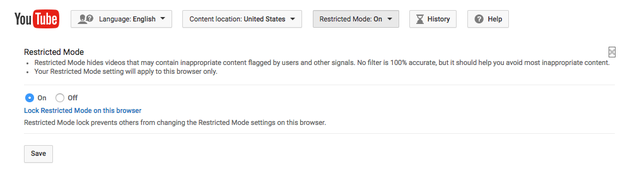
The site’s “restricted mode” lets users filter out “potentially objectionable content,” the platform says, but some vloggers said it’s actually hiding pro-LGBT material.

The site's "restricted mode" lets users filter out "potentially objectionable content," the platform says, but some vloggers said it's actually hiding pro-LGBT material.

YouTube

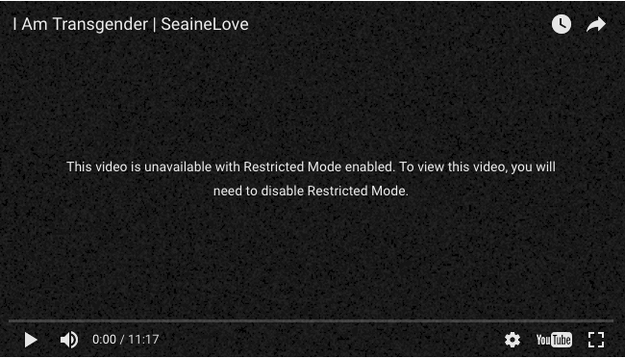
Videos ranging from a makeup lesson for trans women to an LGBT couple reciting wedding vows were no longer visible after the filter was enacted.

Videos ranging from a makeup lesson for trans women to an LGBT couple reciting wedding vows were no longer visible after the filter was enacted.

YouTube


View Entire List ›

Quelle: <a href="YouTube Says It Wrongly Blocked Some LGBT Videos In "Restricted Mode"“>BuzzFeed