Bringing cloud storage into the hybrid era

An interesting anomaly has quietly evolved in large enterprises in recent years. As organizations have rightly come to revere as the path to true scalability, efficiency, and economics, one corner of it — storage — has been left to wallow in the silos of yesteryear, with limited advances or innovation.
Researchers continue to predict that the digital universe will expand at a rapid rate, topping 44 zettabytes by 2020 (that’s over 44 billion terabytes), up from 1.8ZB just five years ago.
To help cope with this growth, enterprises are turning to hybrid cloud computing, which delivers management and support of on-premise and cloud-based computing infrastructures and applications. In fact, such obvious tangible benefits as improved scalability, IT flexibility, and economics has most researchers predicting continued growth for the hybrid cloud market, one estimating an annual growth rate of 27 percent.
Storage, however, has not experienced the same advances. When it comes to data storage, organizations have been left to manage their growing data volumes much as they have been for the past 10 years — either on in-house devices, or in cloud storage, but not together.
Until now.
The release of IBM Cloud Object Storage last week enables organizations for the first time to scale large unstructured data volumes across on-premise storage systems on public and/or private clouds or as hybrid solutions with combinations of on-premises and cloud. Enterprises will finally have the capabilities they’ve leveraged with hybrid cloud computing at the data storage level: dramatic increases in flexibility, availability, and better economics.
For the first time they will be able to quickly and easily store, manage and access their object data, what some researchers say makes up 80 percent of the digital universe, across their hybrid clouds.
But it doesn’t stop there. We’ve gone to great lengths to bring advanced capabilities to the world of hybrid cloud storage, like encrypted data slicing. With this innovation, the system automatically breaks up incoming data into slices and stores the different pieces across geographically dispersed systems. As a result, the data is not only secure, but available in the event of a breach, hack or natural disaster.
As the hybrid cloud platform advances ever more quickly, and adoption rates climb, it was about time that storage was brought along for the ride. Enterprises around the world will reap the benefits.
_______________________________
Related Stories:
Why Business Shouldn’t Settle for Just Any Storage – Thoughts on Cloud
Beyond Four Walls: Rocketing Into Hybrid Cloud – In the Making
Partner Perspectives:
Hybrid Matters – Panzura
A Platform for Hybrid Cloud Enterprise Services – CTERA
IBM Cloud Object Storage – Nasuni
IBM COS: The Foundation of the Digital & Cognitive Eras – Mark III Systems

A version of this post originally appeared on the THINK blog.
The post Bringing cloud storage into the hybrid era appeared first on Cloud computing news.
Quelle: Thoughts on Cloud

Amazon's New Fire TV Stick Is On Sale Now

Amazon’s second-generation Fire TV Stick starts shipping to customers today.
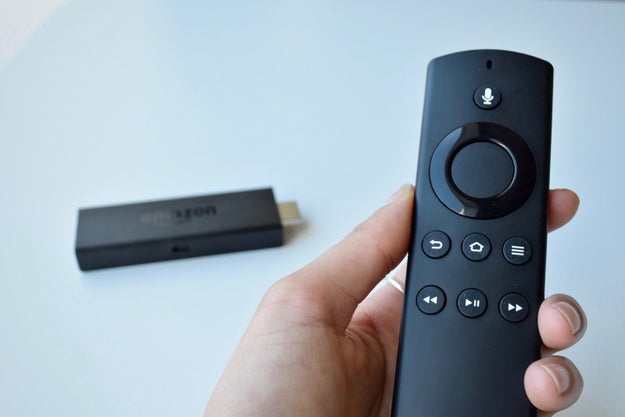
Amazon's second-generation Fire TV Stick starts shipping to customers today.

Nicole Nguyen / BuzzFeed News

The portable media streaming device, which is on sale for $40, includes a remote with a special button that activates Alexa, Amazon&;s voice-controlled personal assistant. Previously, the Alexa Voice Remote was sold separately for $30. You can ask Alexa to “find [genre]” like sci-fi or romantic comedy, “play [show]” or “skip ahead two minutes.”

The new Fire TV Stick, which is no larger than a stick of gum, plugs right into a TV&039;s HDMI port, and doesn&039;t look any different from the first-generation model introduced in 2014. Like its predecessor, this Fire TV Stick can stream shows from online services like Netflix, Hulu, HBO Now, and, of course, Amazon Prime to the big screen. It also still has 8GB of storage and 1GB of memory.

What is new is what&039;s inside. The gadget now runs on a quad-core processor (up from dual-core) and supports 802.11ac Wi-Fi routers (the previous only supported up to 802.11n, which has slower data transfer speeds).

The biggest upgrade is the Stick’s re-designed, more personalized software, which will be available for all Fire TV customers, starting with the new Fire TV Stick.
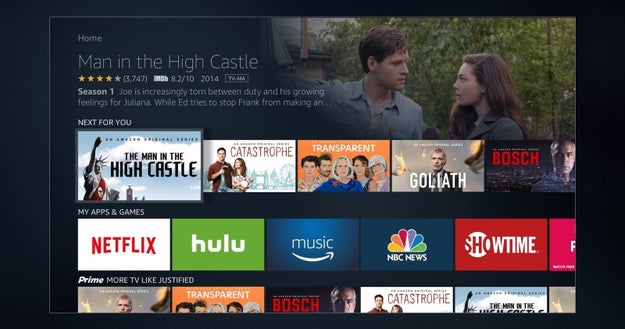
The biggest upgrade is the Stick's re-designed, more personalized software, which will be available for all Fire TV customers, starting with the new Fire TV Stick.

Amazon

The Fire TV Stick now features rows of personalized recommendations, which will surface show and movie suggestions based on the user&039;s viewing history for services they subscribe to.

In search results, Amazon also shows all of the services that a given movie or TV show is available on. The device will remember whatever the user selects as a preference, and default to that service the next time he or she plays a movie or TV show. It will also default to where you can watch that content for free. For example, if The West Wing is available to stream on Netflix and rent or purchase on Amazon Video, the Fire TV Stick will choose Netflix.

Other Fire TV customers will get an over-the-air update for the redesigned software later this year.

Amazon&039;s streamer goes head-to-head with the Roku Streaming Stick ($50), announced in April, which also has a quad-core processor and unbiased search, and Google&039;s Chromecast ($35), which uses the phone as a remote and can mirror Android and tablet screens.

The Fire TV Stick is the more affordable, more portable media streaming device in Amazon&039;s line up. The Fire TV ($100) is a box-like device that can be connected to the Internet via ethernet, has double the memory of the Fire TV Stick, and supports 4K Ultra HD content. That more premium streamer is more in line with Chromecast&039;s new 4K-ready Ultra ($69), Roku Ultra ($130), and Apple TV ($140).

Quelle: <a href="Amazon&039;s New Fire TV Stick Is On Sale Now“>BuzzFeed






