How does Anthos simplify hybrid & multicloud deployments?

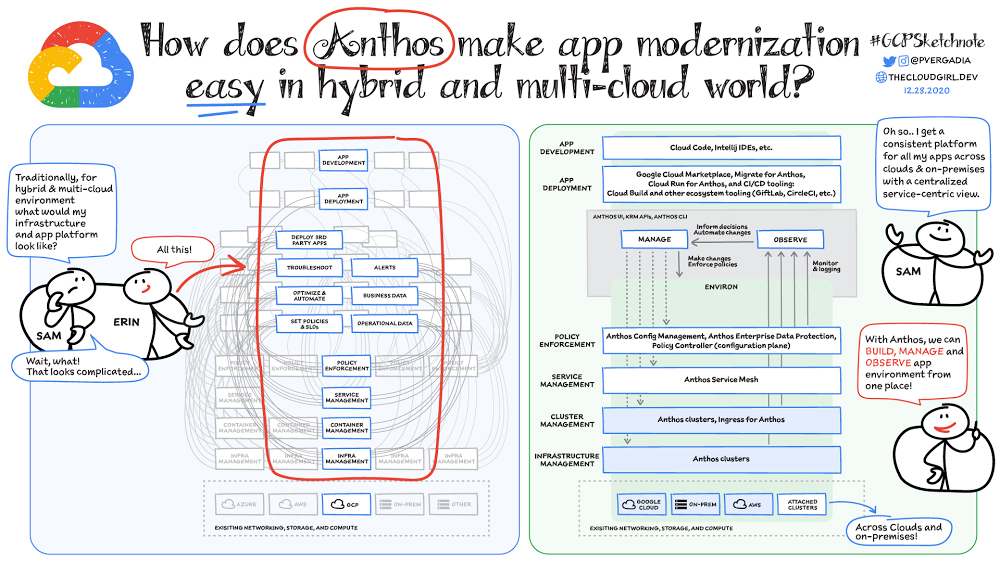
Most enterprises have applications in disparate locations—in their own data centers, in multiple public clouds, and at the edge. These apps run on different proprietary technology stacks, which reduces developer velocity, wastes computing resources, and hinders scalability. How can you consistently secure and operate existing apps, while developing and deploying new apps across hybrid and multicloud environments? How can you get centralized visibility and management of the resources? Well, that is why Anthos exists!This post explores why traditional hybrid and multicloud deployments are difficult, and then shows how Anthos makes it easy to manage applications across multiple environments. (Click to enlarge)Why is traditional hybrid and multicloud difficult?In hybrid and multicloud environments, you need to manage infrastructure. Let’s say you use containers on the clouds, and you develop apps using services on Google Cloud and AWS. Regardless of environment, you will need policy enforcement across your IT footprint. To manage your apps across the environment, you need monitoring and logging systems. You need to integrate that data into meaningful categories, like business data, operational data, and alerts.Digging further, you might use operational data and alerts to inform optimizations, implement automations, and set policies or SLOs. You might use business data to do all those things, and to deploy third-party apps. Then, to actually enact the changes you decide to implement, you need to act on different parts of the system. That means digging into each tool for policy enforcement, securing services, orchestrating containers, and managing infrastructure. Don’t forget, all of this work is in addition to what it takes to develop and deploy your own apps.(Click to enlarge)Now, consider repeating this set of tasks across a hybrid and multicloud landscape. It becomes very complex, very quickly. Your platform admins, SREs,  and DevOps teams who are responsible for security and efficiency have to do manual, cluster-by-cluster management, data collection, and information synthesis. With this complexity, it’s hard to stay current, to understand business implications, and to ensure compliance (not to mention the difficulty of onboarding a new hire). Anthos helps solve these challenges!How does Anthos make hybrid and multicloud easy?With Anthos, you get a consistent way to manage your infrastructure, with similar infrastructure management, container management, service management, and policy enforcement across your landscape.As a result, you have observability across all your platforms in one place, including access to business information, alerts, and operations information. With this information you might decide to optimize, automate, and set policies or SLOs. Digging deeper into Anthos EnvironsYou may have different regions that need different policies, and also have different development, staging, or production environments that need different permissions. Some parts of your work may need more security. That’s where environs come in! Environs are a way to create logical sets of underlying Kubernetes clusters, regardless of which platform those clusters live on. By considering, grouping, and managing sets of clusters as logical environs, you can think about and work with your applications at the right level of detail for what you need to do, be it acquiring business insights over the entire system, updating settings for a dev environment, or troubleshooting data for a specific cluster. Using environs, each part of the functional stack can take declarative direction about configuration, compliance, and more.(Click to enlarge)Modernize application developmentAnthos also helps modernize application development because it uses environs to enforce policies and processes, and abstracts away the cluster and container management from application teams. Anthos enables you to easily abstract away infrastructure from application teams, making it easy for them to incorporate a wide variety of CI/CD solutions on top of environs.  It lets you view and manage your applications at the right level of detail, be it business insights for services across the entire system, or troubleshooting data for a specific cluster. Anthos also works with container-based tools like buildpacks to simplify the packaging process. It offers Migrate for Anthos to take those applications out of the VMs and move them to a more modern hosting environment. What’s in it for platform administrators? Anthos provides platform administrators a single place to monitor and manage their landscape, with policy control and marketplace access. This reduces person-hours needed for management, enforcement, discovery, and communication. Anthos also provides administrators an out-of-the-box structured view of their entire system, including services, clusters, and more, so they can improve security, use resources more efficiently, and demonstrate measurable success. Administrators also save time and effort by managing declaratively, and they can communicate the success, cost savings, and efficiency of the platforms without needing to manually combine data. Interested in getting started with Anthos? Check out the free on-demand training here and my YouTube series. For more resources, you can also read the Anthos ebook at no cost. For more #GCPSketchnote and similar cloud content, follow me on twitter @pvergadia and keep an eye out on thecloudgirl.devRelated ArticleWhat are my hybrid and multicloud deployment options with Anthos?Anthos is a managed application platform that extends Google Cloud services and engineering practices to your environments so you can mo…Read Article
Quelle: Google Cloud Platform

How reCAPTCHA Enterprise protects unemployment and COVID-19 vaccination portals

More people than ever have been conducting more of their lives online due to the COVID-19 pandemic. This creates a new landscape for fraudsters to create and release new attacks. Researchcommissioned by Forrester Consulting showed 84% of companies have seen an increase in bot attacks. 71% of organizations have seen an increase in the amount of successful attacks. 65% of businesses have experienced more frequent attacks and greater revenue loss due to bot attacks. With so many people visiting government websites to learn more about the COVID-19 vaccine, make vaccine appointments, or file for unemployment, these web pages have become prime targets for bot attacks and other abusive activities. But reCAPTCHA Enterprise has helped state governments protect COVID-19 vaccine registration portals and unemployment claims portals from abusive activities.Assisting with unemployment claims during COVID-19Alongside the wave of unemployment claims caused by COVID-19, many state government agencies, such as Wisconsin’s Workforce Development, have seen an increase in attempted malicious bot logins on their external websites. Many states have had malicious actors visit unemployment claims portals and enter stolen credentials to file fraudulent unemployment claims. Because many unemployment claims portals are mandated to pay a recipient within 2 weeks, the claims portal processes this fraudulent information and bad actors receive unemployment checks weeks before their false claims are recognized. By then, the fraudsters have their money and have repeated this process using other stolen credentials.reCAPTCHA Enterprise helps state governments reduce false claims by preventing adversaries from automatically reusing credentials on unemployment claims portals. reCAPTCHA Enterprise’s scale and speed to determine fraudster behavior across the Internet helped some of the largest states in the United States, such as Texas. Registering for the COVID-19 Vaccine and accessing state-sponsored resourcesSeveral states, such as Pennsylvania, are challenged by web traffic that fluctuates based on the COVID-19 Vaccine Phase. For example, during Phase 1, there was a large increase in web traffic from both humans and bots because of the demand for the very few available vaccination slots. As more states move into Phase 2 and Phase 3, and the vaccine is more widely available, traffic is increasing because bad actors know more people are coming to these websites to register to be vaccinated. reCAPTCHA Enterprise was implemented to stop bad actors from scripting bots to book vaccine appointments and then sell those appointment slots on another website for profit. These fake web pages are falsely promoted as websites where people can register for the vaccine. Vaccine appointments are not the only government system from which fraudsters try to profit. Transportation and social service departments also face frequent attacks, wherein fraudsters try to profit by booking and then selling appointments with those organizations. Fending off these attacks was made easier thanks to reCAPTCHA Enterprise, a frictionless fraud detection service that leverages our experience from more than a decade of defending the internet and data for our network of more than 5 million sites. The reCAPTCHA Enterprise platform can understand fraudulent behavior, introduce friction to block bots from booking appointments, and allow legitimate users to access the vaccine portals and other state portals. Because reCAPTCHA Enterprise does not require end users to complete captcha challenges, several state governments installed reCAPTCHA Enterprise across search, login, and registration web pages. State governments are also placing reCAPTCHA Enterprise on webpages where end users can access healthcare, receive assistance for housing or food, register motor vehicles, or propose legislation. With reCAPTCHA Enterprise on more pages, it becomes more difficult for malicious software or bots to carry out their attacks against different pages, but not for end users to browse, login into accounts, book appointments, or apply for resources. Because reCAPTCHA Enterprise requires no action from end users to stop fraud, state governments implemented reCAPTCHA Enterprise on all points of interaction on their webpages to ensure maximum security without impacting the user experience. Providing security everywhere and pricing for allMany state governments are familiar with buying cloud services in a pay-as-you-go model. reCAPTCHA Enterprise eased the purchasing process by providing state governments with predictable, scalable, and customizable pricing. State governments know up front how much they can expect to pay each month based on the number of assessments reCAPTCHA Enterprise performs. reCAPTCHA Enterprise’s flexible pricing model keeps pace with the natural fluctuations of visitors to vaccination registration and unemployment claims. reCAPTCHA Enterprise has a dedicated sales team that can tailor pricing to your specific use cases so both your webpages and budget are not compromised. reCAPTCHA Enterprise has helped many state governments serve their constituents by making it easier to get vaccinated and collect unemployment. It helps constituents take advantage of public services and makes it more difficult for fraudsters to manipulate and interfere with them. To start protecting your web pages from credential stuffing and other attacks, get started with reCAPTCHA Enterprise today.
Quelle: Google Cloud Platform

Docker Hub Incident Reviews – April 3rd and 15th 2021

In line with our promise last year to continue publishing incident reviews for Docker Hub, we have two to discuss from April. While many users were unaffected, it is important for us to be transparent with our community, and we hope it is both informative and instructive.

April 3rd 2021

Starting at about 07:30 UTC, a small proportion of registry requests (under 3%) against Docker Hub began failing. Initial investigation pointed towards several causes, including overloaded internal DNS services and significant and unusual load from several users and IPs. Changes were made to address all of these (scaling, blocking, etc), and while the issue seemed to resolve for several hours at a time, it continued coming back.

The issue re-occurred intermittently into the next day, at which point the actual root cause was determined to be under-scaled load balancers doing service discovery and routing for our applications. 

In the past, the bottleneck for the load balancing system was network bandwidth on the nodes, and auto scaling rules were thus tied to bandwidth metrics. Over time and across some significant changes to this system, the load balancing application had become more CPU intensive, and thus the current auto scaling setup was poorly equipped to handle certain scenarios. Due to the low traffic on the weekend, the system was allowed to scale too low, to the point where CPU became overloaded even though bandwidth was fine. In fact the high CPU load also lead to gaps in metrics reporting from those nodes, which further confirmed the theory:

Upon recognizing this, the deployment was manually scaled and the incident resolved at about 20:50 UTC on April 4th.

April 15th 2021

At 17:46 UTC, a change to the registry service was made that scaled up a new version and scaled down an old version. The configuration for our service discovery system needed to be updated to recognize this new version, but the changes were deployed in the wrong order. As such, our load balancers were unaware of any valid backends to serve Docker Hub registry traffic, and registry requests were met with a 503 error response.

The error in deployment was immediately recognized, and the configuration change for service discovery was quickly pushed. The error was resolved by 18:06 UTC.

Learnings and Improvements

With both incidents, we learned that we need more detailed and responsive monitoring for the registry pull request flow. We have already bolstered our internal monitoring to more quickly pick up these scenarios. In addition, while Hub endpoints are monitored externally, they are largely monitored in isolation – for example, checking that the registry API returns a valid response. Work is in progress to more exhaustively test the whole “docker pull” flow involving multiple API calls to multiple services, and from multiple external vantages, which would more quickly pick up on these types of issues.

For the earlier incident, we also made large changes to our load balancing deployment. Autoscaling rules were changed to reflect current bottlenecks (CPU), instance types were changed, and minimum instance counts were set higher. Metrics and alerting were updated to more quickly detect the issue, including looking for gaps in metrics. In the future, load testing for large changes will look at all metrics to determine whether the “bottleneck” attribute has changed.

As always, we take the availability of Docker Hub very seriously. We know millions of developers rely on Hub to get work done and to provide images for production workloads, and as such have made large investments in the reliability of Hub over the past several years. For example, the latter incident was resolved so easily and quickly in part due to better deployment automation built in the last year. We apologize for these incidents, and have taken action to ensure they don’t happen again.
The post Docker Hub Incident Reviews – April 3rd and 15th 2021 appeared first on Docker Blog.
Quelle: https://blog.docker.com/feed/

AWS Organizations führt neue Konsolenerfahrung ein

AWS Organizations bietet jetzt eine neue Konsolenerfahrung, welche Ihnen eine intuitivere Möglichkeit bietet, Ihre Multi-Account-Umgebung auf AWS zu verwalten. Sie können jetzt einfacher durch Ihre Organisationseinheiten-Hierarchie navigieren und AWS-Kontoverwaltungsaufgaben auf rationalisierte Weise durchführen. Die aktualisierte Schnittstelle bietet Ihnen außerdem einen einfachen Zugriff auf Dokumentation, Produktinformationen und Ressourcen, die Sie bei der Verwaltung Ihrer Multi-Account-Umgebung unterstützen.
Quelle: aws.amazon.com

Amazon SageMaker Automatic Model Tuning unterstützt jetzt ein bis zu 10-mal schnelleres Tuning und ermöglicht die Untersuchung von bis zu 20-mal mehr Modellen

Amazon SageMaker Automatic Model Tuning ermöglicht es, die beste Version eines Modells zu finden, indem der optimale Satz von Hyperparametern für Ihren Datensatz ermittelt wird. Ab heute unterstützt SageMaker Automatic Model Tuning jetzt die Ausführung von bis zu 100 parallelen Trainingsaufgaben für die Hyperparameter-Tuning, was Ihnen eine 10-fache Steigerung der parallelen Trainingsaufgaben ermöglicht, so dass Sie Ihr Tuning schneller abschließen können. Zusätzlich unterstützt SageMaker Automatic Model Tuning für die Suchstrategie "Random" jetzt die Durchsuchung von bis zu 10.000 Hyperparameterkonfigurationen, was eine 20-fache Steigerung gegenüber der vorherigen Grenze von 500 darstellt und es Ihnen ermöglicht, die Abdeckung des Suchraums zu verbessern, was zu einer potenziell besseren Prognoseleistung Ihres Modells führt.
Quelle: aws.amazon.com

Schnellere und einfachere Vorbereitung von Daten für Machine Learning auf Amazon SageMaker Data Wrangler mit Support für mehr Datenquellen und verteilte Aufträge

Amazon SageMaker Data Wrangler reduziert den Zeitaufwand für die Zusammenführung und Vorbereitung von Daten für maschinelles Lernen (ML) von Wochen auf Minuten. Mit SageMaker Data Wrangler können Sie den Prozess der Datenaufbereitung und des Merkmal-Engineerings vereinfachen, und jeden Schritt des Datenaufbereitungs-Arbeitsprozess, einschließlich der Datenauswahl, -bereinigung, -erkundung und -visualisierung, über eine einzige visuelle Oberfläche abschließen. Ab heute können Sie neue Funktionen von Amazon SageMaker Data Wrangler nutzen, welche die Vorbereitung von Daten für Machine Learning vereinfachen und beschleunigen, darunter: kontoübergreifender Zugriff auf Amazon S3, Support für bis zu 1000 Datenspalten, verteilte Aufträge und ein neues SageMaker Data Wrangler Notebook-Erlebnis.
Quelle: aws.amazon.com

AWS Audit Manager bietet jetzt drei neue Frameworks: NIST Cybersecurity Framework Version 1.1, AWS Foundational Security Best Practices und AWS Well-Architected Framework

AWS Audit Manager bietet jetzt drei neue vorgefertigte Standard-Frameworks: NIST Cybersecurity Framework Version 1.1, AWS Foundational Security Best Practices und AWS Well-Architected Framework. Diese Frameworks ergänzen die bereits vorhandenen vorgefertigten Frameworks, die in Audit Manager bereitgestellt werden. Mit dieser Version können Sie mit wenigen Klicks eine Bewertung aus einem dieser Frameworks heraus starten. Audit Manager ordnet Ihre AWS-Ressourcen den Anforderungen des gewünschten Frameworks zu und beginnt automatisch mit dem Sammeln von Beweisen, damit Sie Ihre Audit-Funktion in der Cloud skalieren können, wenn Ihr Unternehmen wächst.
Quelle: aws.amazon.com





