Anzeige: Wiederaufladbare USB-C Batterien unter 15 Euro im Angebot
Mit 28 Prozent Rabatt locken die 1,5 V USB-C Batterien für nur 14,44 Euro im Angebot auf Amazon als günstige Alternative zu Einwegbatterien. (Technik/Hardware, Akku)
Quelle: Golem

Mit 28 Prozent Rabatt locken die 1,5 V USB-C Batterien für nur 14,44 Euro im Angebot auf Amazon als günstige Alternative zu Einwegbatterien. (Technik/Hardware, Akku)
Quelle: Golem

Obwohl Alien: Earth beim Publikum gut ankam, ließ sich Disney+ mit der Verlängerung Zeit. (Aliens, Disney)
Quelle: Golem

Der Kölner Hauptbahnhof sollte in den kommenden Tagen auf ein neues Stellwerk umgestellt werden. Doch ein Software-Fehler verhindert das. (Deutsche Bahn, Software)
Quelle: Golem

Phison will sich auf Enterprise-Kunden fokussieren. Für Endkunden könnten deshalb Preise steigen. Die Fabriken sind für nächstes Jahr bereits ausgebucht. (RAM, Speichermedien)
Quelle: Golem

Unter Trump verschwinden Klimaarchive und Gesundheitsinfos. Doch ein Team um einen Kölner Historiker rettet die Informationen ins Netz. Ein Bericht von Oliver Jessner (Politik, Zensur)
Quelle: Golem
In just a year, the Model Context Protocol (MCP) has become the standard for connecting AI agents to tools and external systems. The Docker MCP Catalog now hosts hundreds of containerized local MCP servers, enabling developers to quickly experiment and prototype locally.
We have now added support for remote MCP servers to the Docker MCP Catalog. These servers function like local MCP servers but run over the internet, making them easier to access from any environment without the need for local configuration.
With the latest update, the Docker MCP Toolkit now supports remote MCP servers with OAuth, making it easier than ever to securely connect to external apps like Notion and Linear, right from your Docker environment. Plus, the Docker MCP Catalog just grew by 60+ new remote MCP servers, giving you an even wider range of integrations to power your workflows and accelerate how you build, collaborate, and automate.
As remote MCP servers gain popularity, we’re excited to make this capability available to millions of developers building with Docker.
In this post, we’ll explore what this means for developers, why OAuth support is a game-changer, and how you can get started with remote MCP servers with just two simple commands.
Connect to Remote MCP Servers- Securely, Easily, Seamlessly
Goodbye Manual Setup, Hello OAuth Magic
Figuring out how to find and generate API tokens for a service is often tedious, especially for beginners. Tokens also tend to expire unpredictably, breaking existing MCP connections and require reconfiguration.
With OAuth built directly into Docker MCP, you’ll no longer need to juggle tokens or manually configure connections. You can securely connect to remote MCP servers in seconds – all while keeping your credentials safe.
60+ New Remote MCP Servers, Instantly Available
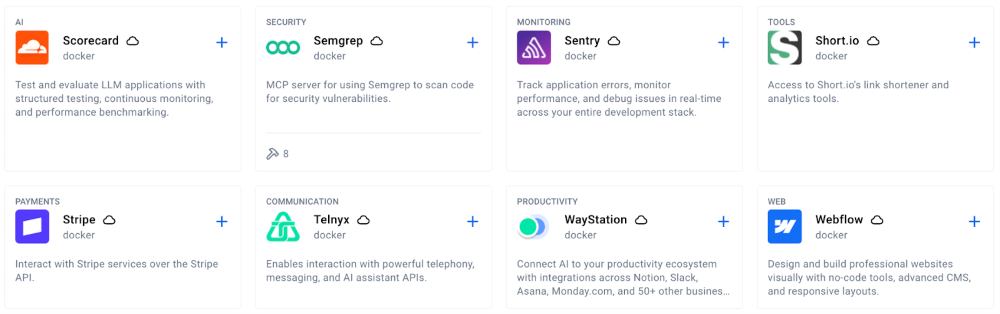
From project management to documentation and issue tracking, the expanded MCP Catalog now includes integrations for Notion, Linear, and dozens more. Whatever tools your team depends on, they’re now just a command away. We will continue to expand the catalog as new remote servers become available.
Figure 1: Some examples of remote MCP servers that are now part of the Docker MCP Catalog
Easy to use via the CLI or Docker Desktop
No new setup. No steep learning curve. Just use your existing Docker CLI and get going. Enabling and authorizing remote MCP servers is fully integrated into the familiar command-line experience you already love. You can also install servers via one-click with Docker Desktop.
Two Commands to Connect and Authorize Remote MCP Servers- It’s That Simple
Using Docker CLI
Step 1: Enable Your Remote MCP Server
Pick your server, and enable it with one line:
docker mcp server enable notion-remote
This registers the remote server and prepares it for OAuth authorization.
Step 2: Authorize Securely with OAuth
Next, authorize your connection with:
docker mcp oauth authorize notion-remote
This launches your browser with an OAuth authorization page.
Using Docker Desktop
Step 1: Enable Your Remote MCP Server
If you prefer to use Docker Desktop instead of the command line, open the Catalog tab and search for the server you want to use. The cloud icon indicates that it’s a remote server. Click the “+” button to enable the server.
Figure 2: Enabling the Linear remote MCP server is just one click.
Step 2: Authorize Securely with OAuth
Open the OAuth tab and click the “Authorize” button next to the MCP Server you want to authenticate with.
Figure 3: Built-in OAuth flow for Linear remote MCP servers.
Once authorized, your connection is live. You can now interact with Notion, Linear, or any other supported MCP server directly through your Docker MCP environment.
Why This Update Matters for Developers
Unified Access Across Your Ecosystem
Developers rely on dozens of tools every day across different MCP clients. The Docker MCP Toolkit brings them together under one secure, unified interface – helping you move faster without manually configuring each MCP client. This means you don’t need to log in to the same service multiple times across Cursor, Claude Code, and other clients you may use.
Unlock AI-Powered Workflows
Remote MCP servers make it really easy to bridge data, tools, and AI. They are always up to date with the latest tools and are faster to use as they don’t run any code on your computer. With OAuth support, your connected apps can now securely provide context to AI models unlocking powerful new automation possibilities.
Building the Future of Developer Productivity
This update is more than just an integration boost – it’s the foundation for a more connected, intelligent, and automated developer experience. And this is only the beginning.
Conclusion
The addition of OAuth for remote MCP servers makes Docker MCP Toolkit the most powerful way to securely connect your tools, workflows, and AI-powered automations.
With 60+ new remote servers now available and growing, developers can bring their favorite services – like Notion and Linear, directly into Docker MCP Toolkit.
Learn more
Head over to our docs to learn more
Explore the MCP Catalog: Discover containerized, security-hardened MCP servers
Open Docker Desktop and get started with the MCP Toolkit (Requires version 4.48 or newer to launch the MCP Toolkit automatically)
Quelle: https://blog.docker.com/feed/
This post is for Linux users running Docker Engine (Community Edition) directly on their hosts. Docker Desktop users don’t need to take any action — Engine updates are included automatically in future Desktop releases.
Docker Engine v29 is a foundational release that sets the stage for the future of the Docker platform. While it may not come with flashy new features, it introduces a few significant under-the-hood changes that simplify our architecture and improve ecosystem alignment:
Minimum API version update
The Containerd image store is now the default for new installations.
Migration to Go modules
Experimental Support for NFTables
These changes improve maintainability, developer experience, and interoperability across the container ecosystem.
Minimum API Version Update
Docker versions older than v25 are now end of life, and as such, we have increased the Minimum API version to 1.44 (Moby v25).
If you are getting the following error, you will need to update to a newer client or follow the mitigation steps to override the min-version
Error response from daemon: client version 1.43 is too old.Minimum supported API version is 1.44, please upgrade your client to a newer version
Override the minimum API version
There are two methods to launch dockerd with a lower minimum API version. Additional information can be found on docs.docker.com
Using flags when starting dockerd
Launch dockerd with the DOCKER_MIN_API_VERSION set to the previous value. For example:
DOCKER_MIN_API_VERSION=1.24 dockerd
Using a JSON configuration file — daemon.json
Set min-api-version in your daemon.json file.
{
"min-api-version": "1.24"
}
Containerd Image Store Becomes the Default
Why We Made This Change
The Containerd runtime originated as a core component of Docker Engine and was later split out and donated to the Cloud Native Computing Foundation (CNCF). It now serves as the industry-standard container runtime, powering Kubernetes and many other platforms.
While Docker introduced containerd for container execution years ago, we continued using the graph driver storage backend for managing image layers. Meanwhile, containerd evolved its own image content store and snapshotter framework, designed for modularity, performance, and ecosystem alignment.
To ensure stability, Docker has been gradually migrating to the containerd image store over time. Docker Desktop has already used the containerd image store as the default for most of the past year. With Docker Engine v29, this migration takes the next step by becoming the default in the Moby engine.
What it is
As of Docker Engine v29, the containerd image store becomes the default for image layer and content management for new installs.
Legacy graph drivers are still available, but are now deprecated. New installs can still opt out of Containerd image store if there is any issue.
Why This Matters
Simplified architecture: Both execution and storage now use containerd, reducing duplication and internal complexity
Unlock new feature possibilities, such as:
Snapshotter innovations
Lazy pulling of image content
Remote content stores
Peer-to-peer distribution
Ecosystem alignment: Brings Docker Engine in sync with containerd-based platforms, like Kubernetes, improving interoperability.
Future-proofing: Enables faster innovation in image layer handling and runtime behaviour
We appreciate that this change may cause some disruption, as the Containerd image store takes a different approach to content and layer management compared to the existing storage drivers.
However, this shift is a positive one. It enables a more consistent, modular, and predictable container experience.
Migration Path
To be clear, these changes only impact new installs; existing users will not be forced to containerd. However, you can start your migration now and opt-in.
We are working on a migration guide to help teams transition and move their existing content to the containerd image store.
What’s next
The graph driver backend will be removed in a future release.
Docker will continue evolving the image store experience, leveraging the full capabilities of containerd’s ecosystem.
Expect to see enhanced content management, multi-snapshotter support, and faster pull/push workflows in the future.
Moby Migrates to Go Modules
Why We Made This Change
Go modules have been the community standard since 2019, but until now, the Moby project used a legacy vendoring system. Avoiding Go modules was creating:
Constant maintenance churn to work around tooling assumptions
Confusing workflows for contributors
Compatibility issues with newer Go tools and ecosystem practices
Simply put, continuing to resist Go modules was making life harder for everyone.
What It Is
The Moby codebase is now fully module-aware using go.mod.
This means cleaner dependency management and better interoperability for tools and contributors.
External clients, API libraries, and SDKs will find the Moby codebase easier to consume and integrate with.
What It’s Not
This is not a user-facing feature—you won’t see a UI or command change.
However, it does affect developers who consume Docker’s Go APIs.
Important for Go Developers
If you’re consuming the Docker client or API packages in your own Go projects:
The old module path github.com/docker/docker will no longer receive updates.
To stay current with Docker Engine releases, you must switch to importing from github.com/moby/moby.
Experimental support for nftables
Why We Made This Change
For bridge and overlay networks on Linux, Docker Engine currently creates firewall rules using “iptables” and “ip6tables”.
In most cases, these commands are linked to “iptables-nft” and “ip6tables-nft”. So, Docker’s rules are translated to nftables behind the scenes.
However, OS distributions are beginning to deprecate support for iptables. It’s past time for Docker Engine to create its own nftables rules directly.
What It Is
Opt-in support for creating nftables rules instead of iptables.
The rules are functionally equivalent, but there are some differences to be aware of, particularly if you make use of the “DOCKER-USER” chain in iptables.
On a host that uses “firewalld”, iptables rules are created via firewalld’s deprecated “direct” interface. That’s not necessary for nftables because rules are organised into separate tables, each with its own base chains. Docker will still set up firewalld zones and policies for its devices, but it creates nftables rules directly, just as it does on a host without firewalld.
What It’s Not
In this initial version, nftables support is “experimental”. Please be cautious about deploying it in a production environment.
Swarm support is planned for a future release. At present, it’s not possible to enable Docker Engine’s nftables support on a node with Swarm enabled.
In a future release, nftables will become the default firewall backend and iptables support will be deprecated.
Future Work
In addition to adding planned Swarm support, there’s scope for efficiency improvements.
For example, the rules themselves could make more use of nftables features, particularly sets of ports.
These changes will be prioritised based on the feedback received. If you would like to contribute, do let us know!
Try It Out
Start dockerd with option –firewall-backend=nftables to enable nftables support.After a reboot, you may find you need to enable IP Forwarding on the host. If you’re using the “DOCKER-USER” iptables chain, it will need to be migrated. For more information, see https://docs.docker.com/engine/network/firewall-nftablesWe’re looking for feedback. If you find issues, let us know at https://github.com/moby/moby/issues.
Getting Started with Engine v29
As mentioned, this post is for Linux users running Docker Engine (Community Edition) directly on their hosts. Docker Desktop users don’t need to take any action — Engine updates are included automatically in the upcoming Desktop releases.
To install Docker Engine on your host or update an existing installation, please follow the guide for your specific OS.
For additional information about this release:
Release notes for Engine v29
Documentation
Quelle: https://blog.docker.com/feed/
Amazon Web Services (AWS) announces the availability of high performance Storage Optimized Amazon EC2 I7i instances in the AWS Asia Pacific (Hyderabad), Canada (Central) regions. Powered by 5th generation Intel Xeon Scalable processors with an all-core turbo frequency 3.2 GHz, these new instances deliver up to 23% better compute performance and more than 10% better price performance over previous generation I4i instances. Powered by 3rd generation AWS Nitro SSDs, I7i instances offer up to 45TB of NVMe storage with up to 50% better real-time storage performance, up to 50% lower storage I/O latency, and up to 60% lower storage I/O latency variability compared to I4i instances. I7i instances offer the best compute and storage performance for x86-based storage optimized instances in Amazon EC2, ideal for I/O intensive and latency-sensitive workloads that demand very high random IOPS performance with real-time latency to access the small to medium size datasets (multi-TBs). Additionally, torn write prevention feature support up to 16KB block sizes, enabling customers to eliminate database performance bottlenecks. I7i instances also support real-time, high-resolution performance statistics for the NVMe instance store volumes attached to them. To learn more, visit the detailed NVMe performance statistics page. I7i instances are available in eleven sizes – nine virtual sizes up to 48xlarge and two bare metal sizes – delivering up to 100Gbps of network bandwidth and 60Gbps of Amazon Elastic Block Store (EBS) bandwidth. To learn more, visit the I7i instances page.
Quelle: aws.amazon.com
Starting today, Amazon EC2 High Memory U7i instances with 6TB of memory (u7i-6tb.112xlarge) are now available in the Europe (Stockholm and Ireland) region. U7i-6tb instances are part of AWS 7th generation and are powered by custom fourth generation Intel Xeon Scalable Processors (Sapphire Rapids). U7i-6tb instances offer 6TB of DDR5 memory, enabling customers to scale transaction processing throughput in a fast-growing data environment. U7i-6tb instances offer 448 vCPUs, support up to 100Gbps Elastic Block Storage (EBS) for faster data loading and backups, deliver up to 100Gbps of network bandwidth, and support ENA Express. U7i instances are ideal for customers using mission-critical in-memory databases like SAP HANA, Oracle, and SQL Server. To learn more about U7i instances, visit the High Memory instances page.
Quelle: aws.amazon.com
Mountpoint for Amazon S3 is now available in Amazon Linux 2023 (AL2023), simplifying how you get started and manage updates. Previously, you had to download the Mountpoint package from GitHub, install dependencies, and manually manage updates. Now, when using AL2023, you can install or update to the latest release of Mountpoint with a single command, and mount an Amazon S3 bucket. Mountpoint for Amazon S3 is an open source project backed by AWS support, giving AWS Business and Enterprise Support customers 24/7 access to AWS cloud support engineers. To learn more and get started, visit GitHub, the Mountpoint overview page, the installation guide and AL2023 overview page.
Quelle: aws.amazon.com






