Seth Green's Stolen Bored Ape Is Back Home
“Fred is back home.”

Quelle: <a href="Seth Green's Stolen Bored Ape Is Back Home“>BuzzFeed
Quelle: <a href="Seth Green's Stolen Bored Ape Is Back Home“>BuzzFeed
Plugins are the building blocks and the rocket fuel for your WordPress.com website. They can help make your site faster and easier to manage but also bring essential elements to your fingertips. From email opt-ins and contact forms, to SEO, site speed optimization, calendars, and booking options — the list is nearly endless.
If you can imagine it, there’s a high likelihood that there’s a plugin to help you accomplish whatever your endeavor on your WP.com website.
And because of the vast community of WordPress developers, there are always new plugins being added to our marketplace. To better help you select the plugins for your business or passion, we are listing three of our hand-picked, most popular premium plugins below, in addition to several others, recently added to our marketplace.
WooCommerce Bookings
This invaluable plugin allows customers to book appointments, make reservations, or rent equipment. Both you and your customers can save valuable time since there’s no need for phone calls, emails, or other forms of communication to handle bookings. Prospects simply fill out the information themselves.
The benefits of WooCommerce Bookings are hard to overstate. For example, you can:
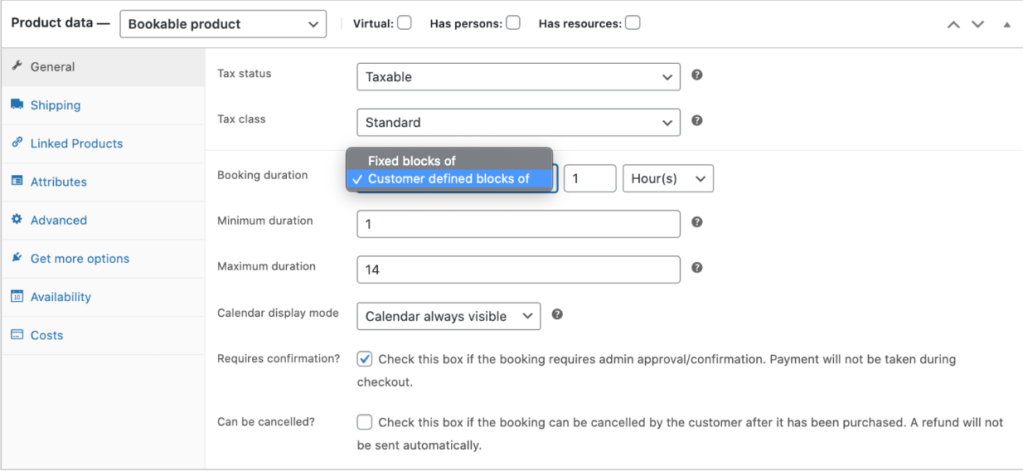
Define set options, like fixed time slots for a class, appointment, or guided tourLet customers choose the times that work best by giving them the flexibility to book whatever range they need, like checking into a hotelSet certain time periods as off limits and un-bookable, providing yourself a buffer between bookings
Perhaps best of all, the plugin integrates seamlessly with your Google calendar. Use the calendar view to see how your day or month is shaping up. Update existing bookings or availability, or filter to view specific services or resources. And if you have customers who insist on calling in to make bookings the old-fashioned way, you can add them manually from the calendar while you’re on the phone.
Whether you’re running a small bed and breakfast, a fishing guide service, or anything in between, WooCommerce Bookings can give you back valuable time, ensuring your customers have a friction-free booking process, which allows you to focus your energies elsewhere.
View the live demo here.Purchase WooCommerce Bookings
WooCommerce Subscriptions
With WooCommerce Subscriptions, customers can subscribe to your products or services and then pay for them at the frequency of their choosing — weekly, monthly, or even annually. This level of freedom can be a boon to the bottom line, as it easily sets your business up to enjoy the fruits of recurring revenue.
Better yet, WooCommerce Subscriptions not only allows you to create and manage products with recurring payments, but you can also introduce a variety of subscriptions for physical or virtual products and services, too. For example, you can offer weekly service subscriptions, create product-of-the-month clubs, or even yearly software billing packages.
Additional features include:
Multiple billing schedules available to suit your store’s needsIntegrates with more than 25 payment gateways for automatic recurring paymentsAccessible through any WooCommerce payment gateway, allowing for manual renewal payments along with automatic email invoices and receiptsPrevents lost revenue by supporting automatic rebilling on failed subscription payments
Additionally, this plugin offers built-in renewal notifications and automatic emails, which makes you and your customers aware of subscription payments being processed. Your customers can also manage their own subscriptions using the Subscriber’s View page. The page also allows subscribers to suspend or cancel a subscription, change the shipping address or payment method for future renewals, and upgrade or downgrade.
WooCommerce Subscriptions really do put your customers first, giving them the control they want and will appreciate while allowing you to automate a process and experience that saves time and strengthens your relationship with customers.
Learn more and purchase WooCommerce Subscriptions
AutomateWoo
High on every business owner’s list of goals is the ability to grow the company and earn more revenue. Well, AutomateWoo makes that task much simpler. This powerful, feature-rich plugin delivers a plethora of automated workflows to help you grow your business.
With AutomateWoo, you can create workflows using various triggers, rules, and actions, and then schedule them to run automatically.
For example, you can set up abandoned cart emails, which have been shown to increase the chance of recovering the sale by 63%.
One of the key features small business owners are sure to enjoy is the ability to design and send emails using a pre-installed template created for WooCommerce emails in the WordPress editor.
This easy-to-appreciate feature makes it a breeze to send targeted, multi-step campaigns that include incentives for customers. AutomateWoo gives you complete control over campaigns. For example, you can schedule different emails to be sent at intervals or after specific customer interactions; you can also offer incentives using the personalized coupon system.
Also, you can track all emails via a detailed log of every email sent and conversion recorded. Furthermore, with AutomateWoo’s intelligent tracking, you can capture guest emails during checkout.
This premium plugin comes packed with a host of other features as well, including, but not limited to:
Follow-up emails: Automatically email customers who buy specific products and ask for a review or suggest other products they might likeSMS notifications: Send text messages to customers or admins for any of AutomateWoo’s wide range of triggersWishlist marketing: Send timed wishlist reminder emails and notify when a wished-for product goes on sale; integrates with WooCommerce Wishlists or YITH WishlistsPersonalized coupons: Generate dynamic customized coupons for customers to raise purchase rates
AutomateWoo will make an indispensable asset for any business looking to create better synergies between their brand’s products or services and the overall experience customers have with them.
Learn more and purchase AutomateWoo
Additional Business-Boosting Plugins
In addition to WooCommerce Bookings, WooCommerce Subscriptions, and AutomateWoo, our marketplace has also launched a number of additional premium plugins, including:
WooCommerce Points and Rewards: Allows you to reward your customers for purchases and other actions with points that can be redeemed for discountsWooCommerce One Page Checkout: Gives you the ability to create special pages for customers to select products, checkout, and pay, all in one placeWooCommerce Deposits: Customers can place a deposit or use a payment plan for products. Min/Max Quantities: Make it possible to define minimum/maximum thresholds and multiple/group amounts per product (including variations) to restrict the quantities of items that can be purchased. Product Vendors: Enables multiple vendors to sell via your site, and in return take a commission on the sales. USPS Shipping Method: Provides shipping rates from the USPS API, with the ability to accurately cover both domestic and international parcels.
Get the Most Out of Your Website
Keep an eye on the plugin marketplace, as we’re continuing to offer premium plugins that help you best serve your site visitors and customers. At WordPress.com, we’re committed to helping you achieve your goals.
To get the most out of your WordPress.com website, upgrade to WordPress Pro, which puts the power of these plugins at your fingertips. Currently, only WordPress Pro plans or legacy Business + eComm customers can purchase plugins.
Quelle: RedHat Stack
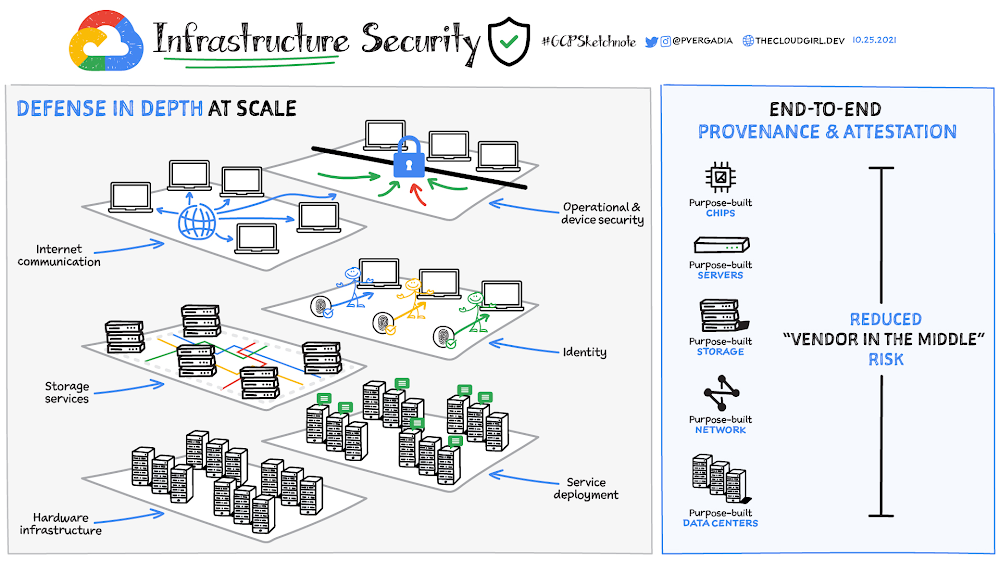
The security of the infrastructure that runs your applications is one of the most important considerations in choosing a cloud vendor. Google Cloud’s approach to infrastructure security is unique. Google doesn’t rely on any single technology to secure its infrastructure. Rather, it has built security through progressive layers that deliver defense in depth. Defense in depth at scaleData center physical security – Google data centers feature layered security with custom-designed electronic access cards, alarms, vehicle access barriers, perimeter fencing, metal detectors, biometrics, and laser beam intrusion detection. They are monitored 24/7 by high-resolution cameras that can detect and track intruders. Only approved employees with specific roles may enter. Hardware infrastructure – From the physical premises to the purpose-built servers, networking equipment, and custom security chips to the low-level software stack running on every machine, the entire hardware infrastructure is controlled, secured, and hardened by Google.Service deployment – Any application binary that runs on Google infrastructure is deployed securely. No trust is assumed between services, and multiple mechanisms are used to establish and maintain trust. Google infrastructure was designed from the start to be multitenant. Storage services – Data stored on Google’s infrastructure is automatically encrypted at rest and distributed for availability and reliability. This helps guard against unauthorized access and service interruptions.User identity – Identities, users, and services are strongly authenticated. Access to sensitive data is protected by advanced tools like phishing-resistant security keys.Internet communications – Communications over the internet to Google cloud services are encrypted in transit. The scale of the infrastructure enables it to absorb many denial-of-service (DoS) attacks, and multiple layers of protection further reduce the risk of any DoS impact. Operational and device security – Google operations teams develop and deploy infrastructure software using rigorous security practices. They work to detect threats and respond to incidents 24 x 7 x 365. Because Google runs on the same infrastructure that is made available to Google Cloud customers, all customers directly benefit from this security operations and expertise.End-to-end provenance and attestationGoogle’s hardware infrastructure is custom-designed “from chip to chiller” to precisely meet specific requirements, including security. Google servers and software are designed for the sole purpose of providing Google services. These servers are custom built and don’t include unnecessary components like video cards or peripheral interconnects that can introduce vulnerabilities. The same goes for software, including low-level software and the server OS, which is a stripped-down, hardened version of Linux. Further, Google designed and included hardware specifically for security. Titan, for example, is a purpose-built chip to establish a hardware root of trust for both machines and peripherals in cloud infrastructure. Google also built custom network hardware and software to improve performance and security. This all rolls up to Google’s custom data center designs, which includes multiple layers of physical and logical protection.Tracking provenance from the bottom of this hardware stack to the top enables Google to control the underpinnings of its security posture. This helps Google greatly reduce the “vendor in the middle problem”; if a vulnerability is found, steps can be immediately taken to develop and roll out a fix. This level of control results in greatly reduced exposure for both Google Cloud and its customers.That was a bird’s eye view of Google Cloud infrastructure security and some services that help protect your infrastructure in Google Cloud. For a more in-depth look into this topic check out the whitepaper. For more #GCPSketchnote, follow the GitHub repo. For similar cloud content follow me on Twitter @pvergadia and keep an eye out on thecloudgirl.dev
Quelle: Google Cloud Platform

Microsoft will OEMs verpflichten, nur noch Flash-Speicher als Boot-Laufwerk für Windows 11 einzusetzen. Das betrifft vor allem günstige PCs. (Windows 11, Microsoft)
Quelle: Golem

Für kleine und mittlere Unternehmen plus eine Ethernet-Variante: Mit den Atom C5000 (Parker Ridge) bietet Intel neue Spezialprozessoren an. (Atom, Prozessor)
Quelle: Golem

Der Genesis Electrified G80 ist eine große Elektroauto-Limousine, die schnell lädt, weit fährt und mit einem Solardach und V2L ausgestattet ist. (Elektroauto, Technologie)
Quelle: Golem

Der US-Fernsehsender AMC will seinen Streamingdienst AMC+ nach Deutschland bringen. Das bedeutet neue Konkurrenz für Netflix, Prime Video und Disney+. (Streaming, Disney)
Quelle: Golem

Metas Smartwatch sollte zwei Kameras haben und als Controller für das Metaverse dienen. Andere Wearables sollen weiterentwickelt werden. (Meta, Soziales Netz)
Quelle: Golem
Plugins are the building blocks and the rocket fuel for your WordPress.com website. They can help make your site faster and easier to manage but also bring essential elements to your fingertips. From email opt-ins and contact forms, to SEO, site speed optimization, calendars, and booking options — the list is nearly endless.
If you can imagine it, there’s a high likelihood that there’s a plugin to help you accomplish whatever your endeavor on your WP.com website.
And because of the vast community of WordPress developers, there are always new plugins being added to our marketplace. To better help you select the plugins for your business or passion, we are listing three of our hand-picked, most popular premium plugins below, in addition to several others, recently added to our marketplace.
WooCommerce Bookings
This invaluable plugin allows customers to book appointments, make reservations, or rent equipment. Both you and your customers can save valuable time since there’s no need for phone calls, emails, or other forms of communication to handle bookings. Prospects simply fill out the information themselves.
The benefits of WooCommerce Bookings are hard to overstate. For example, you can:
Define set options, like fixed time slots for a class, appointment, or guided tourLet customers choose the times that work best by giving them the flexibility to book whatever range they need, like checking into a hotelSet certain time periods as off limits and un-bookable, providing yourself a buffer between bookings
Perhaps best of all, the plugin integrates seamlessly with your Google calendar. Use the calendar view to see how your day or month is shaping up. Update existing bookings or availability, or filter to view specific services or resources. And if you have customers who insist on calling in to make bookings the old-fashioned way, you can add them manually from the calendar while you’re on the phone.
Whether you’re running a small bed and breakfast, a fishing guide service, or anything in between, WooCommerce Bookings can give you back valuable time, ensuring your customers have a friction-free booking process, which allows you to focus your energies elsewhere.
View the live demo here.Purchase WooCommerce Bookings
WooCommerce Subscriptions
With WooCommerce Subscriptions, customers can subscribe to your products or services and then pay for them at the frequency of their choosing — weekly, monthly, or even annually. This level of freedom can be a boon to the bottom line, as it easily sets your business up to enjoy the fruits of recurring revenue.
Better yet, WooCommerce Subscriptions not only allows you to create and manage products with recurring payments, but you can also introduce a variety of subscriptions for physical or virtual products and services, too. For example, you can offer weekly service subscriptions, create product-of-the-month clubs, or even yearly software billing packages.
Additional features include:
Multiple billing schedules available to suit your store’s needsIntegrates with more than 25 payment gateways for automatic recurring paymentsAccessible through any WooCommerce payment gateway, allowing for manual renewal payments along with automatic email invoices and receiptsPrevents lost revenue by supporting automatic rebilling on failed subscription payments
Additionally, this plugin offers built-in renewal notifications and automatic emails, which makes you and your customers aware of subscription payments being processed. Your customers can also manage their own subscriptions using the Subscriber’s View page. The page also allows subscribers to suspend or cancel a subscription, change the shipping address or payment method for future renewals, and upgrade or downgrade.
WooCommerce Subscriptions really do put your customers first, giving them the control they want and will appreciate while allowing you to automate a process and experience that saves time and strengthens your relationship with customers.
Learn more and purchase WooCommerce Subscriptions
AutomateWoo
High on every business owner’s list of goals is the ability to grow the company and earn more revenue. Well, AutomateWoo makes that task much simpler. This powerful, feature-rich plugin delivers a plethora of automated workflows to help you grow your business.
With AutomateWoo, you can create workflows using various triggers, rules, and actions, and then schedule them to run automatically.
For example, you can set up abandoned cart emails, which have been shown to increase the chance of recovering the sale by 63%.
One of the key features small business owners are sure to enjoy is the ability to design and send emails using a pre-installed template created for WooCommerce emails in the WordPress editor.
This easy-to-appreciate feature makes it a breeze to send targeted, multi-step campaigns that include incentives for customers. AutomateWoo gives you complete control over campaigns. For example, you can schedule different emails to be sent at intervals or after specific customer interactions; you can also offer incentives using the personalized coupon system.
Also, you can track all emails via a detailed log of every email sent and conversion recorded. Furthermore, with AutomateWoo’s intelligent tracking, you can capture guest emails during checkout.
This premium plugin comes packed with a host of other features as well, including, but not limited to:
Follow-up emails: Automatically email customers who buy specific products and ask for a review or suggest other products they might likeSMS notifications: Send text messages to customers or admins for any of AutomateWoo’s wide range of triggersWishlist marketing: Send timed wishlist reminder emails and notify when a wished-for product goes on sale; integrates with WooCommerce Wishlists or YITH WishlistsPersonalized coupons: Generate dynamic customized coupons for customers to raise purchase rates
AutomateWoo will make an indispensable asset for any business looking to create better synergies between their brand’s products or services and the overall experience customers have with them.
Learn more and purchase AutomateWoo
Additional Business-Boosting Plugins
In addition to WooCommerce Bookings, WooCommerce Subscriptions, and AutomateWoo, our marketplace has also launched a number of additional premium plugins, including:
WooCommerce Points and Rewards: Allows you to reward your customers for purchases and other actions with points that can be redeemed for discountsWooCommerce One Page Checkout: Gives you the ability to create special pages for customers to select products, checkout, and pay, all in one placeWooCommerce Deposits: Customers can place a deposit or use a payment plan for products. Min/Max Quantities: Make it possible to define minimum/maximum thresholds and multiple/group amounts per product (including variations) to restrict the quantities of items that can be purchased. Product Vendors: Enables multiple vendors to sell via your site, and in return take a commission on the sales. USPS Shipping Method: Provides shipping rates from the USPS API, with the ability to accurately cover both domestic and international parcels.
Get the Most Out of Your Website
Keep an eye on the plugin marketplace, as we’re continuing to offer premium plugins that help you best serve your site visitors and customers. At WordPress.com, we’re committed to helping you achieve your goals.
To get the most out of your WordPress.com website, upgrade to WordPress Pro, which puts the power of these plugins at your fingertips. Currently, only WordPress Pro plans or legacy Business + eComm customers can purchase plugins.
Quelle: RedHat Stack
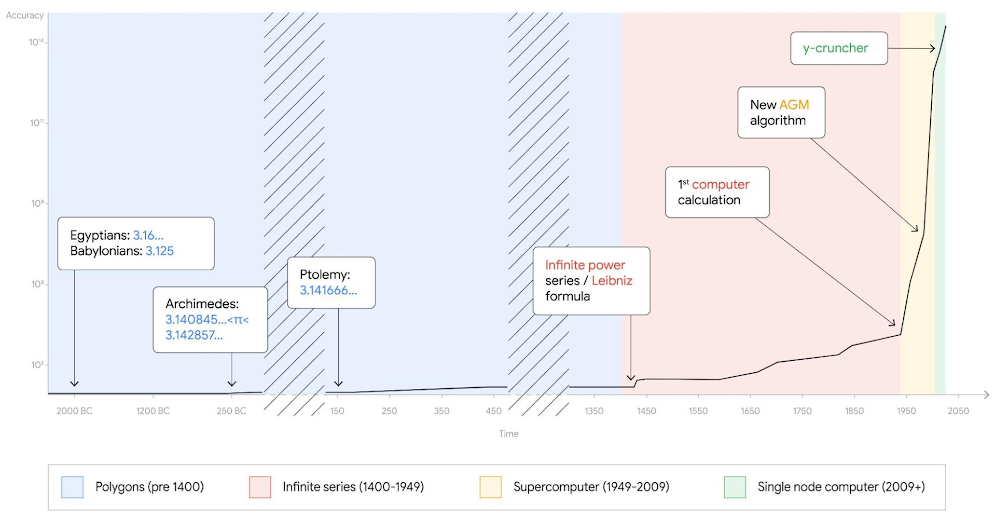
Records are made to be broken. In 2019, we calculated 31.4 trillion digits of π — a world record at the time. Then, in 2021, scientists at the University of Applied Sciences of the Grisons calculated another 31.4 trillion digits of the constant, bringing the total up to 62.8 trillion decimal places. Today we’re announcing yet another record: 100 trillion digits of π.This is the second time we’ve used Google Cloud to calculate a record number1 of digits for the mathematical constant, tripling the number of digits in just three years. This achievement is a testament to how much faster Google Cloud infrastructure gets, year in, year out. The underlying technology that made this possible is Compute Engine, Google Cloud’s secure and customizable compute service, and its several recent additions and improvements: the Compute Engine N2 machine family, 100 Gbps egress bandwidth, Google Virtual NIC, and balanced Persistent Disks. It’s a long list, but we’ll explain each feature one by one.Before we dive into the tech, here’s an overview of the job we ran to calculate our 100 trillion digits of π. Program: y-cruncher v0.7.8, by Alexander J. YeeAlgorithm: Chudnovsky algorithmCompute node: n2-highmem-128 with 128 vCPUs and 864 GB RAMStart time: Thu Oct 14 04:45:44 2021 UTCEnd time: Mon Mar 21 04:16:52 2022 UTCTotal elapsed time: 157 days, 23 hours, 31 minutes and 7.651 secondsTotal storage size: 663 TB available, 515 TB usedTotal I/O: 43.5 PB read, 38.5 PB written, 82 PB totalHistory of π computation from ancient times through today. You can see that we’re adding digits of π exponentially, thanks to computers getting exponentially faster.Architecture overviewCalculating π is compute-, storage-, and network-intensive. Here’s how we configured our Compute Engine environment for the challenge. For storage, we estimated the size of the temporary storage required for the calculation to be around 554 TB. The maximum persistent disk capacity that you can attach to a single virtual machine is 257 TB, which is often enough for traditional single node applications, but not in this case. We designed a cluster of one computational node and 32 storage nodes, for a total of 64 iSCSI block storage targets.The main compute node is a n2-highmem-128 machine running Debian Linux 11, with 128 vCPUs and 864 GB of memory, and 100 Gbps egress bandwidth support. The higher bandwidth support is a critical requirement for the system as we adopted a network-based shared storage architecture.Each storage server is a n2-highcpu-16 machine configured with two 10,359 GB zonal balanced persistent disks. The N2 machine series provides balanced price/performance, and when configured with 16 vCPUs it provides a network bandwidth of 32 Gbps, with an option to use the latest Intel Ice Lake CPU platform, which makes it a good choice for high-performance storage servers.Automating the solutionWe used Terraform to set up and manage the cluster. We also wrote a couple of shell scripts to automate critical tasks such as deleting old snapshots, and restarting from snapshots (we didn’t need to use this though). The Terraform scripts created OS guest policies to help ensure that the required software packages were automatically installed. Part of the guest OS setup process was handled by startup scripts. In this way, we were able to recreate the entire cluster with just a few commands.We knew the calculation would run for several months and even a small performance difference could change the runtime by days or possibly weeks. There are also a number of combinations of parameters in the operating system, infrastructure, and application itself. Terraform helped us test dozens of different infrastructure options in a short time. We also developed a small program that runs y-cruncher with different parameters and automated a significant portion of the measurement. Overall, the final design for this calculation was about twice as fast as our first design. In other words, the calculation could’ve taken 300 days instead of 157 days!The scripts we used are available on GitHub if you want to look at the actual code that we used to calculate the 100 trillion digits.Choosing the right machine type for the jobCompute Engine offers machine types that support compute- and I/O-intensive workloads. The amount of available memory and network bandwidth were the two most important factors, so we selected n2-highmem-128 (Intel Xeon, 128 vCPUs and 864 GB RAM). It satisfied our requirements: high-performance CPU, large memory, and 100 Gbps egress bandwidth. This VM shape is part of the most popular general purpose VM family in Google Cloud. 100 Gbps networkingThe n2-highmem-128 machine type’s support for up to 100 Gbps of egress throughput was also critical. Back in 2019 when we did our 31.4-trillion digit calculation, egress throughput was only 16 Gbps, meaning that bandwidth has increased by 600% in just three years. This increase was a big factor that made this 100-trillion experiment possible, allowing us to move 82.0 PB of data for the calculation, up from 19.1 PB in 2019.We also changed the network driver from virtio to the new Google Virtual NIC (gVNIC). gVNIC is a new device driver and tightly integrates with Google’s Andromeda virtual network stack to help achieve higher throughput and lower latency. It is also a requirement for 100 Gbps egress bandwidth.Storage designOur choice of storage was crucial to the success of this cluster – in terms of capacity, performance, reliability, cost and more. Because the dataset doesn’t fit into main memory, the speed of the storage system was the bottleneck of the calculation. We needed a robust, durable storage system that could handle petabytes of data without any loss or corruption, while fully utilizing the 100 Gbps bandwidth.Persistent Disk (PD) is a durable high-performance storage option for Compute Engine virtual machines. For this job we decided to use balanced PD, a new type of persistent disk that offers up to 1,200 MB/s read and write throughput and 15-80k IOPS, for about 60% of the cost of SSD PDs. This storage profile is a sweet spot for y-cruncher, which needs high throughput and medium IOPS.Using Terraform, we tested different combinations of storage node counts, iSCSI targets per node, machine types, and disk size. From those tests, we determined that 32 nodes and 64 disks would likely achieve the best performance for this particular workload.We scheduled backups automatically every two days using a shell script that checks the time since the last snapshots, runs the fstrim command to discard all unused blocks, and runs the gcloud compute disks snapshot command to create PD snapshots. The gcloud command returns and y-cruncher resumes calculations after a few seconds while the Compute Engine infrastructure copies the data blocks asynchronously in the background, minimizing downtime for the backups.To store the final results, we attached two 50 TB disks directly to the compute node. Those disks weren’t used until the very last moment, so we didn’t allocate the full capacity until y-cruncher reached the final steps of the calculation, saving four months worth of storage costs for 100 TB.ResultsAll this fine tuning and benchmarking got us to the one-hundred trillionth digit of π — 0. We verified the final numbers with another algorithm (Bailey–Borwein–Plouffe formula) when the calculation was completed. This verification was the scariest moment of the entire process because there is no sure way of knowing whether or not the calculation was successful until it finished, five months after it began. Happily, the Bailey-Borwein-Plouffe formula found that our results were valid. Woo-hoo! Here are the last 100 digits of the result:code_block[StructValue([(u’code’, u’4658718895 1242883556 4671544483 9873493812 1206904813 rn2656719174 5255431487 2142102057 7077336434 3095295560′), (u’language’, u”)])]You can also access the entire sequence of numbers on our demo site.So what?You may not need to calculate trillions of decimals of π, but this massive calculation demonstrates how Google Cloud’s flexible infrastructure lets teams around the world push the boundaries of scientific experimentation. It’s also an example of the reliability of our products – the program ran for more than five months without node failures, and handled every bit in the 82 PB of disk I/O correctly. The improvements to our infrastructure and products over the last three years made this calculation possible. Running this calculation was great fun, and we hope that this blog post has given you some ideas about how to use Google Cloud’s scalable compute, networking, and storage infrastructure for your own high performance computing workloads. To get started, we’ve created a codelab where you can create and calculate pi on a Compute Engine virtual machine with step-by-step instructions. And for more on the history of calculating pi, check out this post on The Keyword. Here’s to breaking the next record!1. We are actively working with Guinness World Records to secure their official validation of this feat as a “World Record”, but we couldn’t wait to share it with the world. This record has been reviewed and validated by Alexander J. Yee, the author of y-cruncher.Related ArticlePi in the sky: Calculating a record-breaking 31.4 trillion digits of Archimedes’ constant on Google Cloud[Editor’s note: It’s been two years since Googler Emma Haruka Iwao set a world record for calculating the most digits of Pi using Google …Read Article
Quelle: Google Cloud Platform






