Signify Wiz Spacesense: Smart-Home-Lampen erkennen Bewegungen mittels WLAN
Der Signify-Bereich Wiz hat eine Technik zur Bewegungserkennung vorgestellt, die lediglich zwei Smart-Home-Lampen in einem Raum benötigt. (Signify, Smart Home)
Quelle: Golem

Der Signify-Bereich Wiz hat eine Technik zur Bewegungserkennung vorgestellt, die lediglich zwei Smart-Home-Lampen in einem Raum benötigt. (Signify, Smart Home)
Quelle: Golem

Mehr Leistung pro Sockel und Thread: Mit Neoverse V2 arbeitet ARM samt Partner an sehr leistungsstarken Cloud-Chiplet-Prozessoren. (ARM-Server, Prozessor)
Quelle: Golem

Der neue Govecs Flex ist ein flinker, sehr gut verarbeiteter Elektroroller. Gefertigt wird der Roller in der EU – was sich auf den Preis auswirkt. Ein Test von Tobias Költzsch (Govecs, Test)
Quelle: Golem

Vom Vollpreis zum Free-to-Play: Der Einstieg in Die Sims 4 wird kostenlos. Gerüchten zufolge könnte das den Start von Die Sims 5 vorbereiten. (Die Sims 4, Electronic Arts)
Quelle: Golem

Gleitkommazahlen sind bisher für 16-Bit, 32-Bit und größer standardisiert. Für Deep-Learning sollen kleinere Zahlen helfen. (Deep Learning, Intel)
Quelle: Golem

Der Merge ist abgeschlossen, bisherige Mining-Pools von Ethereum sind nicht mehr sinnvoll. Bitfly hat reagiert und seinen Pool geschlossen. (Ethereum, Server)
Quelle: Golem
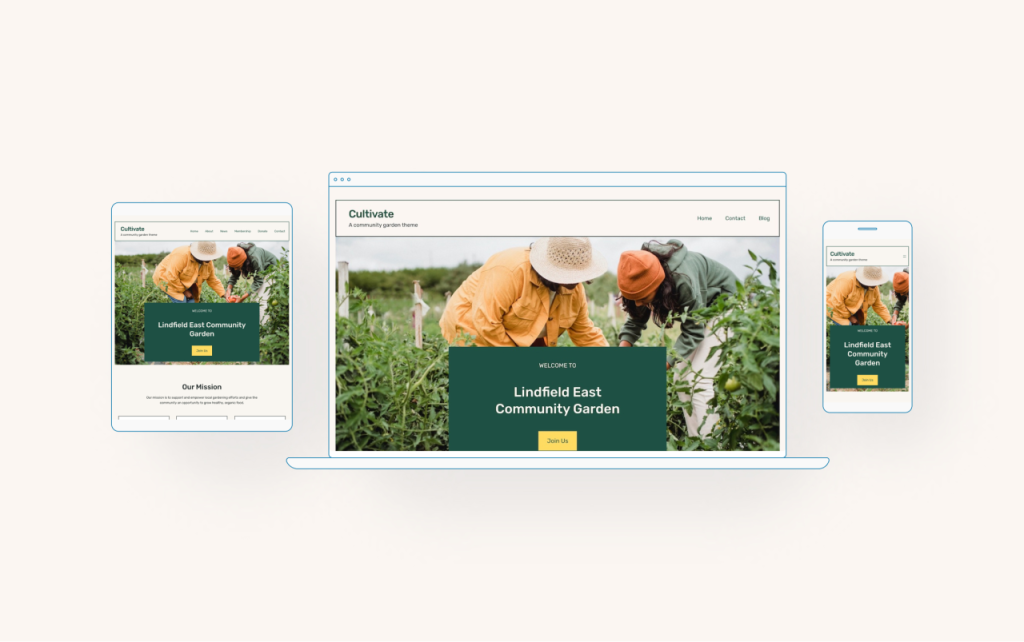
The WordPress.com team is always working on new design ideas to bring your website to life. Below you’ll find the four newest themes that we’ve added to our library, giving you beautiful options for small businesses/organizations, artists, and even a fun retro throwback.
To install any of the below themes, click the the name of the theme you like, which brings you right to the installation page. Then simply click the “Activate this design” button. You can also click “Open live demo,” which brings up a clickable, scrollable version of the theme for you to preview.
Premium themes are free to use for any user on a Premium plan or above, or can be purchased individually by those with free sites or Personal plans.
You can explore all of our themes by navigating to the “Themes” page, which is found under “Appearance” in the left-side menu of your WordPress.com dashboard. Or, just click here:
All WordPress.com Themes
Cultivate (Premium Theme)
Cultivate is a theme for the cause-driven individual, organization, or project. It was designed with community in mind and comes with useful patterns for earning memberships, taking donations, collecting emails, sharing news, and more.
Click here to view a demo of this theme.
Disco
Disco is a funky, vibrant, opinionated theme with a monospaced font. Both its styles and spacing form an edgy aesthetic perfect for those looking to build a quirky website.
Click here to view a demo of this theme.
Yuga (Premium Theme)
Yuga is a visually stunning theme meant for professionals and businesses who seek to showcase their work, team, and values.
Click here to view a demo of this theme.
Thriving Artist (Premium Theme)
Thriving Artist is a theme for creators who use the web to tell their stories, share their work, and connect with their fans. It leverages WooCommerce to give you the ability to integrate a simple (or extensive) store.
Don’t forget to grab your .art domain for more than 50% off while you’re at it!
Click here to view a demo of this theme.
Stay tuned for more updates about new themes, patterns, blocks, and other exciting product updates! And be sure to click below to take a look at the entire showcase of themes we offer:
All WordPress.com Themes
Quelle: RedHat Stack

Google Cloud Next ‘22 kicks off on October 11 at 9AM PDT with a 24-hour “follow the sun” global digital broadcast featuring live keynotes from five locations across the globe — New York, Sunnyvale, Tokyo, Bengaluru, and Munich. You’ll hear from the people shaping the future of computing and have the opportunity to learn from Google Cloud leaders and community influencers about ways they are solving the biggest challenges facing organizations today.You can experience Next ‘22 digitally and in-person. Here’s how: Join us digitally through the Google Cloud Next website to learn about the latest news, products, and Google Cloud technology and to access technical and training content. Visit us locally at one of 200 physical events across six continents. In conjunction with our Partner and Developer Communities, we are excited to bring a series of small physical events around the world. Be sure to register for Next ‘22 so we can alert you about physical events in your area soon. At Next ‘22, you’ll find knowledge and expertise to help for whatever you’re working on with content tracks personalized for application developers, data scientists, data engineers, system architects, and low/no-code developers.To make Google Cloud Next as inclusive as possible, it is free for all attendees. Here’s more about Next ‘22 for you to get excited:Experience content in your preferred language. The Next ‘22 web experience will be translated into nine languages using Cloud Translate API. For Livestream and session content, you can turn on YouTube for CC (closed captions), which supports 180+ languages.Engineer your own playlist. Create, build, explore, and share your own custom playlists and discover playlists curated by Google Cloud.Hang with fellow developers. Gain access to dedicated developer zones through Innovators Hive livestreams, in-person event registration, a developer badging experience, challenges, curated resources and more fun with drone racing.Engage with your community. Use session chats to engage with other participants and ask questions to presenters, so you can fully immerse yourself in the content.Register for Next ‘22Connect with experts, get inspired, and boost your skills.There’s no cost to join any of the Next ‘22 experience. We can’t wait to see you and we’ll be sure to keep you posted about ways to engage locally with the Google Cloud community in your area. Say hello to tomorrow. It’s here today, at Next.Register today.Related ArticleRead Article
Quelle: Google Cloud Platform
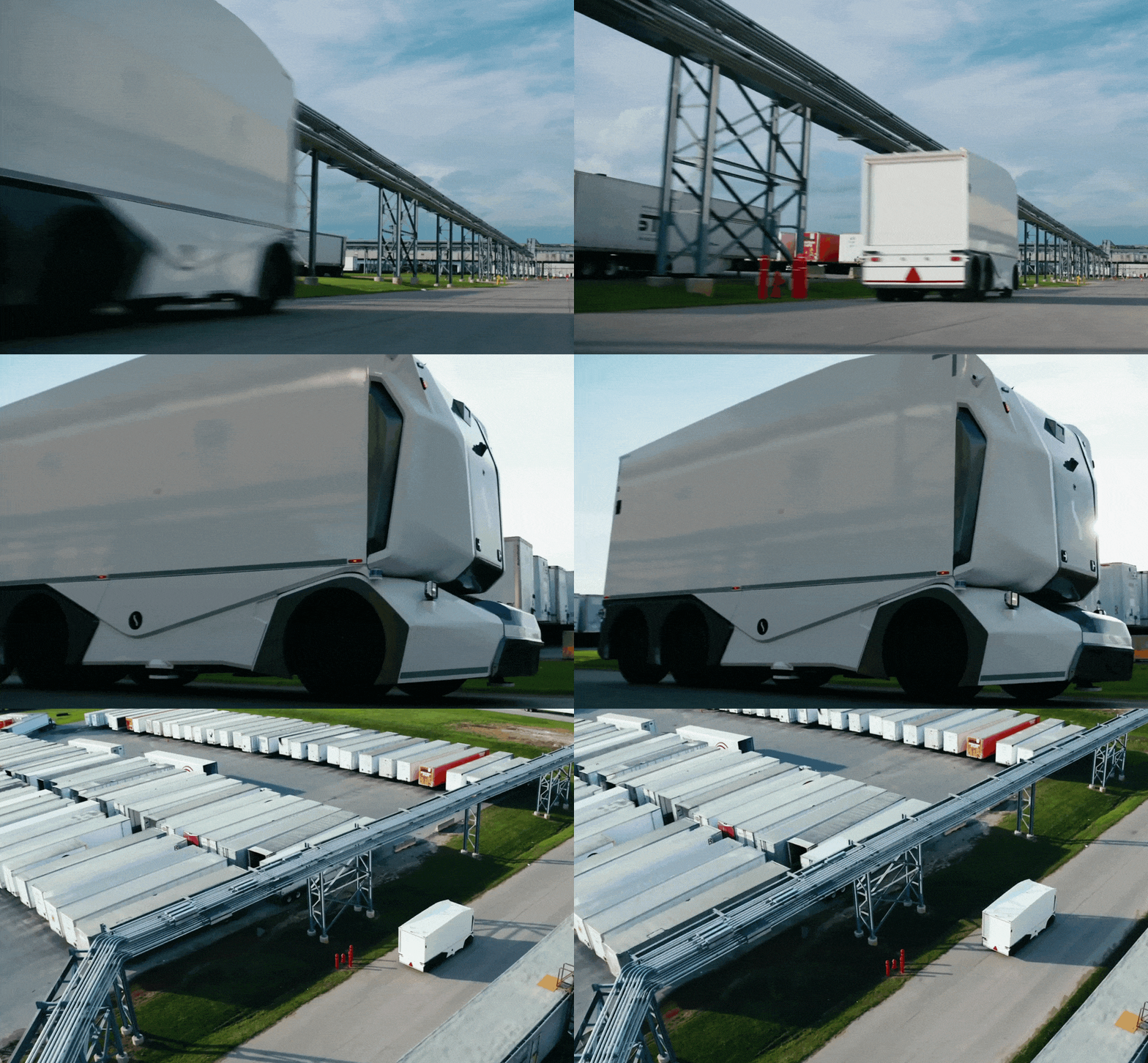
Industry after industry being transformed by software. It started with industries such as music, film and finance, whose assets lent themselves to being easily digitized. Fast forward to today, and we see a push to transform industries that have more physical hardware and require more human interaction, for example healthcare, agriculture and freight. It’s harder to digitize these industries – but it’s arguably more important. At Einride, we’re doing just that. Our mission is to make Earth a better place through intelligent movement, building a global autonomous and electric freight network that has zero dependence on fossil fuel. A big part of this is Einride Saga, the software platform that we’ve built on Google Cloud. But transforming the freight industry is a formidable technical task that goes far beyond software. Still, observing the software transformations of other industries has shown us a powerful way forward.So, what lessons have we learned from observing the industries that led the charge?The Einride Pod, an autonomous, all-electric freight vehicle designed and developed by Einride – here shown in pilot operations at GEA Appliance Park in Louisville, KY.Lessons from re-architecting software systemsMost of today’s successful software platforms started in co-located data centers, eventually moving into the public cloud, where engineers could focus more on product and less on compute infrastructure. Shifting to the cloud was done using a lift-and-shift approach: one-to-one replacements of machines in datacenters with VMs in the cloud. This way, the systems didn’t require re-architecting, but it was also incredibly inefficient and wasteful. Applications running on dedicated VMs often had, at best, 20% utilization. The other 80% was wasted energy and resources. Since then, we’ve learned that there are better ways to do it.Just as the advent of shipping containers opened up the entire planet for trade by simplifying and standardizing shipping cargo, containers have simplified and standardized shipping software. With containers, we can leave management of VMs to container orchestration systems like Kubernetes, an incredibly powerful tool that can manage any containerized application. But that power comes at the cost of complexity, often requiring dedicated infrastructure teams to manage clusters and reduce cognitive load for developers. That is a barrier of entry to new tech companies starting up in new industries — and that is where serverless comes in. Serverless offerings like Cloud Run abstract away cluster management and make building scalable systems simple for startups and established tech companies alike.Serverless isn’t a fit for all applications, of course. While almost any application can be containerized, not all applications can make use of serverless. It’s an architecture paradigm that must be considered from the start. Chances are, an application designed with a VM-focused mindset won’t be fully stateless, and this prevents it from successfully running on a serverless platform. Adopting a serverless paradigm for an existing system can be challenging and will often require redesign.Even so, the lessons from industries that digitized early are many: by abstracting away resource management, we can achieve higher utilization and more efficient systems. When resource management is centralized, we can apply algorithms like bin packing, and we can ensure that our workloads are efficiently allocated and dynamically re-allocated to keep our systems running optimally. With centralization comes added complexity, and the serveless paradigm enables us to shift complexity away from developers, as well as from entire companies.Opportunities in re-architecting freight systemsAt Einride, we have taken the lessons from software architecture and applied them to how we architect our freight systems. For example, the now familiar “lift-and-shift” approach is frequently applied in the industry for the deployment of electric trucks – but attempts at one-to-one replacements of diesel trucks lead to massive underutilization.With our software platform, Einride Saga, we address underutilization by applying serverless patterns to freight, abstracting away complexity from end-customers and centralizing management of resources using algorithms. With this approach, we have been able to achieve near-optimal utilization of the electric trucks, chargers and trailers that we manage. But to get these benefits, transport networks need to be re-architected. Flows in the network need to be reworked to support electric hardware and more dynamic planning, meaning that shippers will need to focus more on specifying demand and constraints, and less on planning out each shipment by themselves.We have also found patterns in the freight industry that influence how we build our software. Managing electric trucks has made us aware of the differences in availability of clean energy across the globe, because – much like electric trucks – Einride Saga relies on clean energy to operate in a sustainable way. With Google Cloud, we can run the platform on renewable energy, worldwide.The core concepts of serverless architecture — raising the abstraction level, and centralizing resource management — have the potential to revolutionize the freight industry. Einride’s success has sprung from an ability to realize ideas and then quickly bring them to market. Speed is everything, and the Saga platform – created without legacy in Google Cloud – has enabled us to design from the ground up and leverage the benefits of serverless.Advantages of a serverless architectureEinride’s architecture supports a company that combines multiple groundbreaking technologies — digital, electric and autonomous — into a transformational end-to-end freight service. The company culture is built on transparency and inclusivity, with digital communication and collaboration enabled by the Google Workspace suite. The technology culture promotes shared mastery of a few strategically selected technologies, enabling developers to move seamlessly up and down the tech stack — from autonomous vehicle to cloud platform.If a modern autonomous vehicle is a data center on wheels, then Go and gRPC are fuels that make our vehicle services and cloud services run. We initially started building our cloud services in GKE, but when Google Cloud announced gRPC support for Cloud Run (in September 2019), we immediately saw the potential to simplify our deployment setup, spend less time on cluster management, and increase the scalability of our services. At the time, we were still very much in startup mode, making Cloud Run’s lower operating costs a welcome bonus. When we migrated from GKE to Cloud Run and shut down our Kubernetes clusters, we even got a phone call from our reseller who noticed that our total spend had dropped dramatically. That’s when we knew we had stumbled on game-changing technology!Einride serverless architecture showing a gRPC-based microservice platform, built on Cloud Run and the full suite of Google Cloud serverless productsIn Identity Platform, we found the building blocks we needed for our Customer Identity and Access Management system. The seamless integration with Cloud Endpoints and ESPv2 enabled us to deploy serverless API gateways that took care of end-user authentication and provided transcoding from HTTP to gRPC. This enabled us to get the performance and security benefits of using gRPC in our backends, while keeping things simple with a standard HTTP stack in our frontends.For CI/CD, we adopted Cloud Build, which gave all our developers access to powerful build infrastructure without having to maintain our own build servers. With Go as our language for backend services, ko was an obvious choice for packaging our services into containers. We have found this to be an excellent tool for achieving both high security and performance, providing fast builds of distro-less containers with an SBOM generated by default.One of our challenges to date has been to provide seamless and fully integrated operations tooling for our SREs. At Einride, we apply the SRE-without-SRE approach: engineers who develop a service also operate it. When you wake up in the middle of the night to handle an alert, you need the best possible tooling available to diagnose the problem. That’s why we decided to leverage the full Cloud Operations suite, giving our SREs access to logging, monitoring, tracing, and even application profiling. The challenge has been to build this into each and every backend service in a consistent way. For that, we developed the Cloud Runner SDK for Go – a library that automatically configures the integrations and even fills in some of the gaps in the default Cloud Run monitoring, ensuring we have all four golden signals available for gRPC services.For storage, we found that the Go library ecosystem around Cloud Spanner provided us with the best end-to-end development experience. We chose Spanner for its ease of use and low management overhead – including managed backups, which we were able to automate with relative ease using Cloud Scheduler. Building our applications on top of Spanner has provided high availability for our applications, as well as high trust for our customers and investors.Using protocol buffers to create schemas for our data has allowed us to build a data lake on top of BigQuery, since our raw data is strongly typed. We even developed an open-source library to simplify storing and loading protocol buffers in BigQuery. To populate our data lake, we stream data from our applications and trucks via Pub/Sub. In most cases, we have been able to keep our ELT pipelines simple by loading data through stateless event handlers on Cloud Run.The list of serverless technologies we’ve leveraged at Einride goes on, and keeping track of them is a challenge of its own – especially for new developers joining the team who don’t have the historical context of technologies we’ve already assessed. We built our tech radar tool to curate and document how we develop our backend services, and perform regular reviews to ensure we stay on top of new technologies and updated features.Einride’s backend tech radar, a tool used by Einride to curate and document their serverless tech stack.But the journey is far from over. We are constantly evolving our tech stack and experimenting with new technologies on our tech radar. Our future goals include increasing our software supply chain security and building a fully serverless data mesh. We are currently investigating how to leverage ko and Cloud Build to achieve SLSA level 2 assurance in our build pipelines and how to incorporate Dataplex in our serverless data mesh.A freight industry reimagined with serverlessFor Einride, being at the cutting edge of adopting new serverless technologies has paid off. It’s what’s enabled us to grow from a startup to a company scaling globally without any investment into building our own infrastructure teams.Industry after industry is being transformed by software, including complex industries that have more physical hardware and require more human interaction. To succeed, we must learn from the industries that came before us, recognize the patterns, and apply the most successful solutions. In our case, it has been possible not just by building our own platform with a serverless architecture, but also by taking the core ideas of serverless and applying them to the freight industry as a whole.
Quelle: Google Cloud Platform

Since the launch of Azure Space two years ago, we’ve announced partnerships, products, and tools that have focused on how we can bring together the power of the cloud with the possibilities of space.
Today, we are introducing the next wave of product advancements for this mission and announcing specific ways in which we are democratizing space and empowering our partners.
Announcing the Azure Orbital Cloud Access Preview
A brand-new service that brings the power of the Microsoft Cloud to wherever you need it most.
Announcing the General Availability of Azure Orbital Ground Station
Since the launch of Azure Space in October 2020, we have talked about Azure Orbital Ground Station. Today, alongside our partner network, including KSAT, we are making this service available to all satellite operators, such as Pixxel, Muon Space, and Loft Orbital.
Advancing the digital transformation of satellite communication networks
The first demonstration of a fully virtualized iDirect modem.
Together with SES we are announcing a new joint satellite communications virtualization program.
The collective impact of these announcements points towards two key outcomes. First, we are dedicated to democratizing the possibilities of space by unlocking connectivity and data with the Microsoft Cloud. Second, we can also help support the digital transformation for our customers and partners in the space industry by using the flexible, scalable compute power in Azure.
Announcing Azure Orbital Cloud Access Preview
Azure Orbital Cloud Access brings connectivity from the cloud wherever businesses and public sector organizations need it the most. Across the space ecosystem, we are seeing a proliferation of low-latency satellite communication networks. This massive new expansion of connectivity across fiber, cellular, and satellite networks demands a new approach to connectivity, one which intelligently prioritizes traffic across these options, and bridges resilient connectivity into a seamless cloud experience.
Today, we are announcing the preview of Azure Orbital Cloud Access. Serving as a step toward the future of integrated 5G and satellite communications, Azure Orbital Cloud Access is a new service that enables low-latency (1-hop) access to the cloud—from anywhere on the planet—making it easier to bring satellite-based communications into your enterprise cloud operation.
Specifically, the preview for Azure Government customers unlocks new scenarios and opportunities in areas with low or no connectivity, or where a failover connectivity option is needed. Azure Orbital Cloud Access delivers prioritized network traffic through SpaceX’s Starlink connectivity and Azure edge devices, providing customers with access to Microsoft cloud services anywhere Starlink operates.
"Starlink’s high-speed, low-latency global connectivity in conjunction with Azure infrastructure will enable users to access fiber-like cloud computing access anywhere, anytime. We’re excited to offer this solution to both the public and the private sector."—Gwynne Shotwell, SpaceX President and Chief Operating Officer
Additionally, Azure Orbital Cloud Access manages the entire solution for customers, charging on a simple monthly subscription basis and a pay-as-you-go satellite communications consumption model.
The product also natively integrates with SD-WAN technology from Juniper Networks, which enables customers to prioritize connectivity between fiber, cellular, and satellite communications networks.
The Azure Orbital Cloud Access Preview is currently available for Azure Government customers. To sign up, please contact your Microsoft account team.
Connecting First Responders and the National Interagency Fire Center with Azure Orbital Cloud Access
Azure Orbital Cloud Access enables new scenarios for diverse types of customers and situations. For example, we recently worked with the Wildland Fire Information Technology (WFIT) group at the National Interagency Fire Center (NIFC) in Boise, Idaho. This work consisted of conducting a research test to address the challenge of bringing connectivity to wildland firefighters and incident management personnel, who often work in rural locations.
Tens of thousands of wildland fires occur throughout the United States each year. In many cases, these wildfires occur in remote locations with low or no connectivity, making it extremely difficult for firefighters and fire managers to communicate. Connectivity enables personnel to share information and helps ensure a coordinated response to these fires.
In collaboration with Microsoft, the National Interagency Fire Center conducted a test of Azure Orbital Cloud Access capabilities integrated with SpaceX’s Starlink LEO satellite constellation. The goal of this test was to enable wildland firefighters' connectivity to Microsoft Azure services in remote locations to provide uninterrupted support for firefighting operations and coordination.
This demonstration enabled access to FireNet (a cloud-based application for collaboration and management of wildfires using Microsoft Teams and Sharepoint) and remote access to wildfire data to share key insights to decision-makers in a secure and rapid manner. Through Azure Orbital Cloud Access, we achieved resilient communications and failover capabilities with intelligent prioritized traffic through cellular, fiber, or satellite.
Enabling digital resiliency through 5G and space with Pegatron and the Taiwan Hsinchu Fire Department
Digital resiliency is a key area of focus for Azure Space, and a critical use case for connectivity. As we look ahead at the future of possibilities for combining different pathways for connectivity, we partnered with Pegatron and SES to explore a scenario for natural disasters that brings together the power of 5G and space for the Hsinchu Fire Department.
Using space technology, mobile infrastructure, and Azure’s global footprint, we determined that we could offer alternative pathways for connectivity that exist outside of the reliance on local infrastructure—which is at risk of being damaged in a natural disaster.
"Communications on the front line are critical during natural disasters, but infrastructure is often destroyed, and connections are disrupted. This space-enabled 5G network would give us a much-needed tool allowing our first responders to effectively and efficiently focus on our fight to save lives and property."—Director General Shi-Kung Lee, Hsinchu City Fire Department, Taiwan
In partnership with Pegatron, an emergency response vehicle was built that could be rapidly deployed to disaster zones. Microsoft’s 5G core, Microsoft Teams, Pegatron’s 5G O-RAN base station, and SES’s MEO satellite communication constellation were integrated to create high-bandwidth, low-latency communication for first responders across command sites using Azure, strengthening the Hsinchu Fire Department’s response.
Announcing the General Availability of Azure Orbital Ground Station
Today, we are announcing the general availability of Azure Orbital Ground Station—our fully managed ground station as a service offering which is now available to all customers. Get started today.
The mission of Azure Orbital Ground Station is to work together with our partner ecosystem to enable satellite operators to focus on their satellites and operate from the cloud more reliably at lower cost and latency, allowing operators to get to market faster and achieve a higher level of security with the power of Azure. Through Microsoft’s unique partner-focused approach, we are bringing together a deep integration of ground station partner networks to enable our customers’ data delivery to an Azure region of choice at zero cost, thus reducing their total operational costs and ensuring data is available in the customer’s Azure tenant for further processing.
Pixxel
Pixxel is a space data company focused on building a constellation of hyperspectral earth imaging satellites and the analytical tools to mine insights from that data in the cloud. With the partnership of KSAT and Microsoft, Pixxel can minimize its time to market, access world-leading ground coverage, and lower its operating costs.
Microsoft’s integration with KSAT’s extensive network around the world enables Pixxel to stream their data directly to the Azure Cloud with zero data backhaul costs, and then further process it using Azure's AI/ML services to generate customer business insights.
Loft Orbital
Loft Orbital is a space infrastructure company offering rapid, reliable, and simplified access to space as a service. We previously announced a strategic partnership with Loft Orbital for on-orbit compute to enable a new way to develop, test, and validate software applications for space systems in Microsoft Azure, and then deploy them to satellites in orbit using Loft's space infrastructure tools and platforms. The first Azure-enabled Loft satellite will be launching next year and will be available for governments and companies to seamlessly deploy their software applications onto space hardware within the Azure environment.
Today marks the next step of our partnership. Alongside the launch of Azure Orbital Ground Station, Loft Orbital and Microsoft will support end-to-end customer missions as a service. Working with Microsoft, KSAT demonstrated how an existing customer, Loft Orbital, can test and onboard to Azure Orbital Ground Station and benefit from Microsoft and KSAT ground stations to support their specific mission needs.
Muon Space
Muon Space is developing a world-class satellite remote sensing platform to power data-driven decisions about the climate. Muon provides organizations with a turnkey solution to collecting datasets needed to achieve their environmental goals.
Many of these use cases are unlocked by global coverage and rapid cadence of observations. Azure Orbital Ground Station will support Muon’s coverage needs and operation by increasing the number of ground locations to ensure multiple contact opportunities on every orbit.
In addition to our ground stations, Muon Space is partnering with Microsoft’s sustainability product team to develop products targeting enterprise Environment Social Governance (ESG) analytics derived from their Earth Systems data.
Accelerating the pace of digital transformation for satellite network operators
Digital transformation is central to the DNA of how Microsoft operates. We believe in the power of the Azure cloud to transform industries—from healthcare, to retail, and even space. Satellite network operators and the communication they provide are unique in their digital transformation and transition to cloud technologies.
The future of the space industry depends on a way to realize the flexibility and scale that virtualization provides, transitioning away from capital-intensive hardware procurement cycles, while continuing to support existing non-virtualized networks. Azure Space is building a platform to enable the industry to make this transition seamlessly.
ST Engineering iDirect
Last year, we announced our partnership with ST Engineering iDirect, one of the industry’s largest ground segment providers. And today, we are showing progress on that partnership by announcing the first demonstration of an iDirect high data-rate modem running fully virtualized as a piece of software on Azure. This innovation is an example of Azure Space approach to digital transformation for space: bringing what was custom hardware into software that runs on standardized cloud computers—enabling flexibility, elasticity, and cost reduction for satellite operators.
SES
Two years ago, we announced our partnership with SES to bring cloud innovation to the Space industry and to ensure that our customers will have access to Azure services regardless of where they are.
This expanded into our selection of SES as the Medium Earth Orbit (MEO) network partner for Microsoft Azure orbital and co-locating ground stations of O3b mPOWER, SES’s second-generation MEO constellation, with Azure Cloud regions which will ensure customers one-hop and direct cloud access for secure and reliable delivery of Azure services and applications.
Today we're announcing an expansion of that partnership through a new joint Satellite Communications Virtualization Program. Through this program, Microsoft and SES will create the world’s first fully virtualized satellite communications ground network by focusing on software-defined hubs, customer edge terminals, new virtual network functions, edge cloud applications, and more. This virtualization will align cloud and satellite network architectures and enable 5G technology to be used in commercial satellite networks—bridging the gap between terrestrial and non-terrestrial connectivity networks. A virtualized architecture also allows for quicker standardization of system interfaces, which promotes more automation, API-based control, and cross-industry interoperability.
In the near term, this program will define and implement the pre-production architecture for a fully virtual SES ground station, which ultimately will serve as the blueprint for future fully virtualized ground station sites that bring the power of Azure to the Space ecosystem. For instance, a virtualized ground network will create a new paradigm where modem and antenna partners focus on developing software-defined networking technologies as opposed to hardware-centric offerings. This improves the velocity of ground system deployment and reconfiguration to match customer service needs.
"To truly cloud-enable space networks, satellite ground networks need to be open and programmable. This is especially critical since the customer edge for satellite networks is often in remote locations or in industries such as aviation and government with stringent security and certification requirements so upgrading disparate, proprietary equipment is costly and slows the delivery of new value-added services. Together with Microsoft, we will virtualize all aspects of satellite ground networks with standard, open hardware, software-defined radios, virtualized network functions, and edge cloud applications that can be dynamically programmed to create a virtual ground network."—John-Paul Hemingway, Chief Strategy and Product Officer of SES
Microsoft and SES will release a request for proposal (RFP) in the fourth quarter of this calendar year for the first cohort of program participants to seed this new, all-virtual ecosystem.
Conclusion
Azure Space democratizes access to and the power and capabilities of satellites to empower every organization on the planet to achieve more. These announcements are focused on what Azure and Microsoft do best—function as a platform for our customers and partners to unlock new business opportunities, empower our customers to digitally transform, and work closely with industry leaders to innovate. They forge what we aspire to enable—a future for the cloud where our customers combine the power of Azure with the possibilities of space.
Quelle: Azure






