Facebook Offers Few Details On Account Takedowns Following Korryn Gaines Standoff

Stephen Lam / Reuters

Earlier this month, Facebook, at the request of the law enforcement, disabled Korryn Gaines’ Facebook and Instagram accounts during the standoff with Baltimore County Police that would ultimately end her life. Facebook&;s decision to comply with that request has drawn sharp criticism — and is the latest example of internal murkiness around how and when the company censors speech — at a time when policing activists are demanding greater transparency from law enforcement officials.

It took about an hour for Facebook to disable Gaines’ accounts after police said her posts were escalating the standoff. But the social network’s policy and protocols for handling such emergency requests for the removal of content are unclear. On the company’s government request report, Facebook presents its information on emergency law enforcement requests as a single category; instances of Facebook taking someone’s account offline are lumped together with cases of Facebook handing over information to law enforcement. Facebook labels the category “Emergency Disclosures.”

“We comply with emergency requests based on representations from law enforcements and the facts as we understand them. That compliance without delay is required to prevent physical harm or death — that&039;s our standard,” a spokesperson told BuzzFeed News. Facebook has a team on staff that fields emergency requests, but the company declined to share details on the team’s makeup, its leadership, how many staff members they employ, or more on the protocols that guide the internal deliberation process.

The Baltimore County Police Department has said they filed for the emergency removal to help ensure the safety of Gaines, her child, and for the officers involved.

“Gaines was posting video of the operation, and followers were encouraging her not to comply with negotiators&039; requests that she surrender peacefully. This was a serious concern,” the police said in a statement. Most of Gaines’ posts from the encounter are no longer publicly accessible.

Facebook agreed to take Gaines’ accounts offline, and the police emphasized that it was ultimately the company’s decision.

Facebook releases information detailing the number of law enforcement requests for people’s data that the company receives. In the second half of 2015, Facebook received 855 emergency disclosure requests and complied with 73% of them. Facebook, however, does not state how many of those requests were for the suspension or removal of content, as opposed to providing data to law enforcement. A company spokesperson declined to clarify the figures.

As the Intercept reported earlier this week, Facebook’s policies on emergency requests from law enforcement appear to only apply to investigations in which law enforcement is seeking information, not trying to block its dissemination. According to the company’s government request report, Facebook displays information regarding “requests for data” and “percentage of requests where some data produced.” There’s no stated language on account takedowns.

The Facebook spokesperson told BuzzFeed News that its standards for compliance and the statistics it publishes on emergency requests apply to both disclosures and takedowns.

But Lee Rowland, an attorney with the ACLU’s speech, privacy, and technology project told BuzzFeed News that it’s a mistake for Facebook to consider law enforcement requests for deactivation the same way it does for disclosures.

“There should be a much higher bar for silencing content because you are not just impacting one person’s rights, you are impacting the public’s right to access that speech,” she said.

Rowland added that powerful images, including the Facebook live video of Castile, are playing a crucial role in elevating the national debate on police accountability. And by censoring speech at the request of law enforcement, without a warrant, Facebook risks not only circumventing our rights to record interactions with police, but in alienating Americans who see the company as all too eager to side with the government.

“We have the Constitution to protect us from government abuse,” she said. “What’s a little trickier to establish is a right to be free from social media giants who voluntarily cooperate with requests from law enforcement that don’t meet those Constitutional standards.”

Quelle: <a href="Facebook Offers Few Details On Account Takedowns Following Korryn Gaines Standoff“>BuzzFeed

Even Techies Can’t Afford San Francisco Anymore

Flickr / HJL

On Wednesday, Kate Vershov Downing, a corporate lawyer for an enterprise cloud company called ServiceNow, resigned from the Palo Alto Planning and Transport Commission. The reason, she said, was that she and her husband — a software engineer — could no longer afford to live there.

“We rent our current home with another couple for $6200 a month,” Downing wrote in a post on Medium. “If we wanted to buy the same home and share it with children and not roommates, it would cost $2.7M and our monthly payment would be $12,177 a month in mortgage, taxes, and insurance. That’s $146,127 per year&;—&x200A;an entire professional’s income before taxes. This is unaffordable.”

Like dozens of her friends have already done, Downing will be relocating outside of the Bay Area — a financial decision a new report says is becoming a trend.

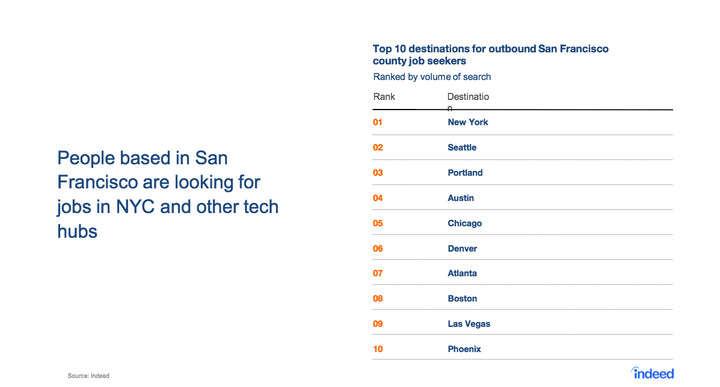
“Twenty six percent of software engineers in San Francisco are searching for jobs out of state,” said Indeed’s Paul D&;Arcy, who presented this research to San Francisco’s Chamber of Commerce on Wednesday afternoon. D’Arcy said that, specifically, they’re looking in Seattle, Portland, Austin and Denver — cities that have emerged as tech hubs, but where salaries go a little further.

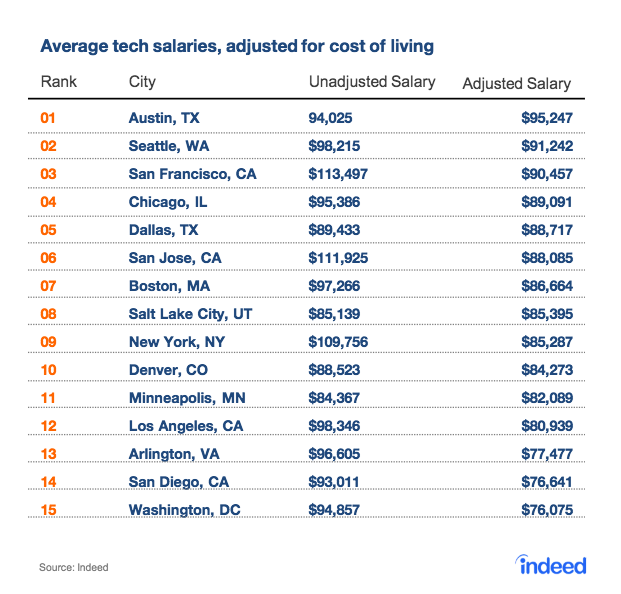
According to Indeed, tech workers in San Francisco are making an average $113,497 a year. In Seattle, that figure is lower, at $98,215, and in Austin, lower still, at $94,025. But when those salaries are adjusted for cost of living, which is much higher in California than it is in Texas, that order is reversed. While San Franciscan techies are spending around 37% of their income on rent, Austinites are only shelling out 23% of their earnings on housing.

“We&039;ve seen, globally, tech salaries equalize,” said D’Arcy during his presentation on Wednesday. “It used to be people in San Francisco made much more, but that gap is decreasing. With the dramatic increase in cost of living, the economics are becoming less favorable to workers.”

As a result, according to Indeed’s data, San Francisco has has fallen behind Washington DC and Austin when it comes to desired destinations for people searching for jobs in tech. (San Jose is still in the lead, though.)

If the city is interested in reversing this trend, D’Arcy said, it will need to invest heavily in transportation systems that would help commuters access cheaper housing; if companies want to help, he said, they’ll need to offer workers based in San Francisco increased flexibility — aka, permission to work from home.

San Francisco is the third most unequal city in America after Bridgeport, CT and New York City, according to Indeed’s report, and that gap is widening. As the top earners get richer, the lowest earners — those in the bottom 20th percentile — are actually seeing their income decrease. It’s a problem Kate Downing is thinking about, even as she prepares to bail on Silicon Valley proper.

“It’s clear that if professionals like me cannot raise a family here,” she wrote, “then all of our teachers, first responders, and service workers are in dire straits.”

Quelle: <a href="Even Techies Can’t Afford San Francisco Anymore“>BuzzFeed

Sources: Twitter CEO Dick Costolo Secretly Censored Abusive Responses To President Obama

Getty Images

In 2015, then-Twitter CEO Dick Costolo secretly ordered employees to filter out abusive and hateful replies to President Barack Obama during a Q&A session, sources tell BuzzFeed News.

According to these sources, the May 2015 town hall came out of Twitter senior leadership&;s frustration with the fact that platforms like Reddit had become home to celebrity Q&As.

According to a former senior Twitter employee, Costolo ordered employees to deploy an algorithm (which was built in-house by feeding it thousands of examples of abuse and harassing tweets) that would filter out abusive language directed at Obama. Another source said the media partnerships team also manually censored tweets, noting that Twitter’s public quality-filtering algorithms were inconsistent. Two sources told BuzzFeed News that this decision was kept from senior company employees for fear they would object to the decision.

According to sources, the decision upset some senior employees inside the company who strictly followed Twitter&039;s long-standing commitment to unfettered free speech.

In its early years, Twitter took numerous public stands against censorship, even fighting a secret government order to provide user information for WikiLeaks. In 2011, Twitter senior executives published a blog post titled “The Tweets Must Flow.”

“There are Tweets that we do remove, such as illegal Tweets and spam,” the post read. “However, we make efforts to keep these exceptions narrow so they may serve to prove a broader and more important rule — we strive not to remove Tweets on the basis of their content.” Not long after the post, Twitter executives began publicly touting that “Twitter is the free speech wing of the free speech party.”

A different source alleges that Twitter did the same thing during a Q&A with Caitlyn Jenner.

“This was another example of trying to woo celebs and show that you can have civilized conversations without the hate even if you’re a high-profile person,” the source said. “But it’s another example of a double standard — we’ll protect our celebrities, while the average user is out there subject to all kinds of horrible things.”

A month after the Obama Q&A, Costolo stepped down as CEO, retaining a seat on Twitter’s board. In an exit interview with The Guardian on his last day, he defended Twitter’s commitment to free speech. “I will say directly that I think regulation is a threat to free speech,” he said.

Costolo did not respond to requests for comment.

Read more about Twitter&039;s 10-year failure to curb abuse here.

Quelle: <a href="Sources: Twitter CEO Dick Costolo Secretly Censored Abusive Responses To President Obama“>BuzzFeed

Snapchat Removes Filter After "Yellowface" Criticism

The company said it was supposed to be &;anime&;.

Everyone knows the best part about Snapchat is the filters. But a new filter was added that many people found offensive. “Yellowface” is when a non-Asian person dresses up or uses makeup (or in this case, a filter) to create cartoonish exaggeration of stereotypical asian features – it&;s considered offensive in the same way blackface is.

Snapchat told The Verge that the filter was “inspired by anime and meant to be playful.” The filter has been taken out of rotation due to the response.


View Entire List ›

Quelle: <a href="Snapchat Removes Filter After "Yellowface" Criticism“>BuzzFeed

Engineering the move to cloud-based services

Supporting a network in transition: Q&A blog post series with David Lef

In a series of blog posts, this being the second, David Lef, principal network architect at Microsoft IT, chats with us about supporting a network as it transitions from a traditional infrastructure to a fully wireless platform. Microsoft IT is responsible for supporting 900 locations and 220,000 users around the world. David is helping to define the evolution of the network topology to a cloud-based model in Azure that supports changing customer demands and modern application designs.

David Lef explains the major factors that affect migration of IT-supported services and environments to cloud-based services, focusing on network-related practicalities and processes.

Q: Can you explain your role and the environment you support?

A: My role at Microsoft is principal network architect with Microsoft IT. My team supports almost 900 sites around the world and the networking components that connect those sites, which are used by a combination of over 220,000 Microsoft employees and vendors that work on our behalf Our network supports over 2,500 individual applications and business processes. We are responsible for providing wired, wireless, and remote network access for the organization, implementing network security across our network (including our network edges), and connectivity to Microsoft Azure in the cloud. We support a large Azure tenancy using a single Azure Active Directory tenancy that syncs with our internal Windows Server Active Directory forests. We have several connections from our on-premises datacenters to Azure using ExpressRoute. Our Azure tenancy supports a huge breadth of Azure resources, some of which are public-facing and some that are hosted as apps and services internal to Microsoft, but hosted on the Azure platform.

Q: What are the biggest networking challenges in migrating on-premises services to cloud-based services in Azure?

A: First of all, it&;s a fundamental change in traffic patterns. It used to be that we hosted most of our network traffic within our corporate network and datacenters, and selectively allowed access from the Internet into our network for apps and services that our employees needed to access while they were outside of the corporate network. From the aspect of traffic going in and out of our corporate network, we had our users accessing what you might call traditional Internet content, as well as users connecting to the corporate network using a virtual private network (VPN). Now, we are moving toward hosting the bulk of our on-premises datacenter infrastructure within Azure and choosing how we want to allow access to it.

Secondly, we’ve had network edge traffic increase a lot. Our bandwidth at the edge is over 500 percent what it was just a couple of years ago. The on-premises datacenter is no longer the hub of traffic for us and, and the cloud is the default app and infrastructure location for new projects at Microsoft. Our traffic pattern now revolves primarily around traffic to Azure datacenters. This, of course, has brought the demand for more robust and higher bandwidth edge connections—the resources that users formerly accessed within the corporate network are now being hosted in Azure, and those users experience the same level of responsiveness from their apps and services that they’ve been accustomed to.

We’re continuously moving apps and services from on-premises datacenters to Azure, so the connectivity requirements between Azure and our on-premises datacenters are changing as that migration continues. In addition, the pipeline between Azure and our datacenters is shrinking as more of our infrastructure moves to Azure. Our migration teams are moving as much as possible to software as a service (Saas) and platform as a service (Paas) in Azure wherever possible and, in situations where SaaS or PaaS doesn’t offer an immediate or beneficial solution, simply lifting the infrastructure components out of on-premises and into Azure infrastructure as a service (Iaas) virtual machines and virtual networks.

A significant part of the migration for these apps and services is analysis for redesign in the cloud. Wherever possible, our engineering teams are redesigning and re-architecting for the cloud. Internet-based traffic can have a higher latency than what Microsoft experiences within its corporate network infrastructure, so designing for that and educating users on the changes they should expect is important.

Q: How do you ensure adequate service levels in an Azure-based cloud delivery model?

A: The network component has a big impact on service levels, but it really does start with service design for our Azure-based resources. Connectivity to Azure is, for all intents and purposes, Internet connectivity, so anything hosted in Azure is designed as an Internet-based solution, wherever possible. Along with accommodating higher latency that I’ve already mentioned, the redesign process also includes retry logic for when a connection experiences any type of outage, caching and prefetching data, and compression of data across client connections.

After services design, we’re doing as much as we can on the network side to ensure robust connectivity. We’re using ExpressRoute extensively for our large locations, and making sure that we locate our hop onto ExpressRoute as close as physically possible to the resources that will use that connection, whether it is servers or users. That means using network service providers that have co-location facilities close to our physical locations. We don’t rely on traditional hub and spoke networking architectures for our location, and we try to avoid moving unnecessary traffic across our network backbones. We’ve found that the quicker you can drop someone onto the Internet, with the exception of cases where the provider infrastructure is very immature or limited, the better off they will be.

We monitor our environment pretty thoroughly. We’re designing the modern apps that run on Azure SaaS and PaaS to use the built-in instrumentation those platforms provide. We’re leveraging built-in synthetic transactions in those services and building in our own, using System Center products and Operations Management Services in Azure. It allows us to get a comprehensive view of our infrastructure; both centralized and decentralized. We treat our cloud services hosted in Azure as a product in which we’re the provider and the consumer—and all of Microsoft—is the customer.

Q: How does the challenge differ by geographic locations, and has that changed since the migration to cloud-based services?

A: Anytime we talk about geography, services placement is a huge consideration. We look at where our clients are for any given services, where the app to app dependencies lie, and plan accordingly. In most cases, we have at least one Azure datacenter within 1,000 kilometers of our clients, so we use that in our business continuity and disaster recovery planning. Azure’s built in geo-redundancy and resiliency components also help in those respects.

From a pure networking perspective, we try to place our Layer 3 management as close to the Azure datacenter as possible. That gives us the greatest control over traffic to Azure, and the best insight into what’s happening with that traffic.

Q: How do you encourage user adoption and buy-in when migrating to cloud-based services?

A: Our Azure teams provide a lot of guidance around the entire Azure experience. From a user experience, we do the best we can to provide them with accurate expectations for their apps and services that are migrated to Azure. In many cases, the general user experience is improved for apps on Azure, so this isn’t as much about softening the blow as it is showing them how having their app hosted on Azure changes the way the app is accessed and experienced. We make sure that users are aware of the ways that making an app available in the cloud can expose new functionality or ways to use the app. We focus on providing a user experience that enables mobile access from multiple device platforms. The key idea here is access from anywhere, on anything, at any time. An excellent example of this is the re-architecting of our licensing platform for the cloud, which was written about in a case study.

For the general migration to Azure, Microsoft IT has allotted people and capital to facilitate a smooth transition whenever a migration takes place. These resources contribute to the technical migration itself, training, and making sure that business processes are running as well or better than when the app or service was hosted on-premises.

Q: How have the IT teams changed to support this new delivery model?

A: The biggest change most people expect is this mass exodus or culling of traditional IT functions, but that’s not really the way it’s worked for us. We still have a network infrastructure to support throughout our physical locations, and datacenters don’t disappear overnight. Whether there are ten servers or 10,000 servers in a datacenter, disaster recovery and business continuity processes still need to happen and we need IT support for that. That being said, the requirement for on-premises infrastructure support does change. A lot of our high-level support teams are transitioning to different projects, sometimes in the Azure space. It’s given a lot of Microsoft employees the chance to improve their skill sets and shift their focus to development and innovation instead of maintenance and management.

With Azure, IT responsibilities become more compartmentalized, where we have IT staff that are focused on providing first-level support in their area of expertise, and it works without requiring a lot of people to have end-to-end knowledge of the environment or solution. Our Azure network experts provide their service and know their product and environment, and our Azure app experts do the same in their area, without needing to know specifically what’s happening with the network. The high-level knowledge is there across teams, of course, but resources and solutions become much more like plug-and-play solutions. This means that we’re more agile and able to respond to demand or start new projects more efficiently. Our teams don’t need to wait for physical servers to be built out or networking hardware to be installed; they simply request what they need, and Azure generates the resources.

Learn more

Other blog posts in this series:

Supporting network architecture that enables modern work styles

Learn how Microsoft IT is evolving its network architecture.
Quelle: Azure

Visual Studio Team Services digest: August 2016

This month we&;re kicking off the Visual Studio Team Services monthly digest on the Azure blog. Visual Studio Team Services offers the best DevOps tooling to create an efficient continuous integration and release pipeline to Azure.

With the rapidly expanding list of features in Team Services, teams can start to leverage it more efficiently for all areas of their Azure workflow, for apps written in any language and deployed to any OS. This post series will provide the latest updates and news for Visual Studio Team Services and will be a great way for Azure users to keep up-to-date with new features being released every three weeks.

SSH Support for Git Repos is now available

You can now connect to any Team Services Git repo using an SSH key. This is particularly helpful if you develop on Linux or Mac.

Try paid Team Services extensions

You can now try Team Services paid extensions free for 30 days. This allows you to test an extension easily and see if its the right fit for your use case.

Team Services plugins for IntelliJ and Android Studio 1.0 released

After several months in preview, we are excited to announce the release of the official 1.0 version of the Team Services plugin for IntelliJ and Android Studio.

A new build task to queue Jenkins jobs from Team Services

Team Services sprint 102 introduces a new build task, Jenkins Queue Job. Now your Team Services/TFS builds can integrate with Jenkins to queue and monitor Jenkins jobs. The Jenkins Queue Job task is cross-platform and does not require any additional build agent dependencies.

The Team Services plugin for Visual Studio Code now supports connecting to Team Foundation Server Update 2 or later

The Team Services plugin for Visual Studio Code allows you to manage your pull requests for your Team Services and Team Foundation Server Git repositories, as well as monitor builds and work items for your team project. With just a glance at the status bar, you can see the number of active pull requests assigned to you and check the status of the latest build for your repository.

Inside Team Services: Kanban boards with Patrick Desjardins

Each month, we will bring you the insiders view into Visual Studio Team Services: How the product is developed, how we dog food it and use it every day, who are the people behind it and tips and tricks on becoming a power user.

This month, we interview Patrick Desjardins, a software developer on the team that develops the Agile tooling at the Microsoft Redmond campus.

Quelle: Azure

Facebook’s Newsfeed Has A Friendship Problem

Blueberry banana overnight oats. Recipe HERE

Via foodfitnessfreshair.com

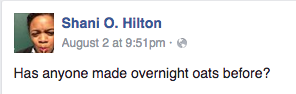
Last Tuesday night, Shani Hilton — head of U.S. news at BuzzFeed, apparent breakfast lover, and my Facebook friend — posted a simple status: “Has anyone made overnight oats before?&;

Shani’s quest for sensible breakfast advice and its string of replies has remained at the top of my Facebook feed for a week now. Every time I check Facebook for whatever the reason I compulsively check it multiple times a day, the overnight oats post glares back at me.

I never commented on it. I didn’t “like” it. I don’t even like overnight oats. I have no oat advice. This is not a topic I care about.

The intricacies of overnight oats had ground my mental state to the point of madness.

On Sunday, a full five days after Shani had posited the oat query, the oats were still at the top of my Facebook feed. They were even beating out an engagement and a pregnancy announcement — the gold standard of “sticky” Facebook content. I couldn’t take it anymore. The oat talk had taken over my life. Chia seeds, maple syrup, blueberries, whether to use regular or almond milk, the great debate over Greek yogurt. The intricacies of overnight oats had ground my mental state to the point of madness. And honestly, I still don’t really know what overnight oats are (are they different than oatmeal? Do they actually take a whole night?).

You know that thing where you say a word a bunch of times until it sounds really weird and not like a word at all? Oats. OATS. Ooooaaaatttssss. Oats. Fucking crazy, man.

This summer, Facebook announced that it was tweaking its Newsfeed algorithm — the thing that decides what goes to the top of your feed and what gets buried — to prioritize things posted by your actual friends, and to deprioritize brand pages and links to publishers (aka articles on websites like BuzzFeed). The reaction to this was mostly hand-wringing about the potential effect on publishers, who — like BuzzFeed — get a large chunk of their traffic from people sharing their content on Facebook.

Had Facebook toyed with these publishers, hypnotizing them into submission with a giant firehose of traffic, only to cruelly turn the faucet down to a trickle? Did Facebook ever care about publishing anyway? Or did it just care about “media” and “news” only when it was the one thing Twitter was beating them at, and as soon as they crushed their rival (however potentially hamfistedly), they lost interest and moved onto the next shiny thing – video? livestreams? Bots?

Or perhaps it was just going back to basics – people just want to use Facebook to interact with their friends, not to see a bunch of links to articles.

Interesting, but none of this is really relevant to my overnight oats problem.

Shani and I share a lot (97&;) of mutual Facebook friends, mainly coworkers here at BuzzFeed. So some of those replies with oat advice were from mutual friends. That’s an indicator to Facebook that this post must be something I’m interested in — look&033; Your mutual friends are discussing it&033; And because many of those mutual friends are also friends with each other, it kept bumping the post up to them as well, encouraging them to chime in with their favorite mix-ins. The cycle kept going and going, making Facebook more and more convinced that I would care about it.



I asked (on Twitter, of course) if anyone else had noticed lately that old posts had stayed “stuck” at the top of their Facebook feed for longer than normal. Several people had. Indeed, other coworkers and friends of Shani said that they too had had her oats post stuck at the top of their Facebook feed for days.

Facebook’s new news feed is operating based on the idea that you care more about what your friends have to say and their photos and videos than you do about links they post. Which is probably true&033; But even if it’s trying to be more friend-friendly, Newsfeed is still controlled by an algorithm. Based on a years-long friendship and a number of data points, the algorithm has figured out (I’m assuming — it’s a trade secret how the algorithm actually works, but it’s easy to guess) that I tend to be interested in what Shani posts.

Yet there is no way for it to understand that I do not care about overnight oats. That, in fact, I really really don’t care about overnight oats and I really don’t want to keep seeing a bunch of fucking overnight oat tips every time I check fucking Facebook.

What the oats revealed was machine learning&039;s limited understanding of friendship. There’s always been something a little cold and inhuman about the way that Facebook outwardly shows its understanding of how a human uses its service. When it rolled out its first Messenger bot earlier this year, it was a shopping bot to help you pick out clothing and shoes from an online store – the best way I found at the time to describe the experience is “this is something someone who works at Facebook would want to use.” It ignores the whimsy and pleasure of an online clothes shopping experience, where the user can browse for what they like. Instead, it just showed you just a few items in your price range in a generic category like “sneakers”. Messenger bots for weather and news were similarly panned at their launch for being glitchy and unuseful. Tech companies in general seem prone to explaining their services in this weird treacly simulacra of what a real human actually is. For a long time, the demonstration videos for new Apple features always seemed geared toward this imaginary perfect 40-something dad who loves exercising and just wants to share photos of his kids and find a great local sushi spot – I call him “Apple Man”. All the problems in his life can be solved by a slight new improvement in UI.

Facebook is sometimes is like the relative who thinks you still love horses because you were really into horses when you were 14 and keeps sending you birthday cards with horses on them.

But human relationships are messy in ways that technology and social platforms can’t really deal with. They get divorced but feel ashamed to announce it, they have weird passive-aggressive fights with their friends, they repeatedly lurk on the page of their partner’s ex. They have preferences that are not stated in their “Likes”, or they outgrow those Likes after a few years. If you look in your settings at what Facebook is telling advertisers that it knows about you, you will be shocked at both how creepily right it is and how hilariously wrong it is.

Facebook is sometimes is like the relative who thinks you still love horses because you were really into horses when you were 14 and keeps sending you birthday cards with horses on them. This uncanny feeling of someone sort of knowing you but not really is echoed all over the web. Like LinkedIn somehow suggesting you add someone you went on a blind date with years ago to your professional network. Or when you buy that pair of shoes online but the ads from Zappos for them follow you around every new site you visit seemingly forever, like a case of dynamic advertising HPV.

You, too, may have noticed in the last few weeks that certain posts from your friends seem to linger at the top of the Newsfeed for longer than usual – days even. Or that you have to scroll down further to see something that you haven’t already seen. If you’re a Facebook addict who checks multiple times a day and is used to fresh content, this is really annoying. Maybe it keeps showing you the same boring photo or post.

Or perhaps the real problem is that the limit of Facebook’s algorithm is that it’s only given the material to work with of who your friends are. If your friends are boring, you’re stuck with a boring feed.

But assuming you aren’t a monster, you like your friends. And Facebook knows that. But it doesn’t know that sometimes you don’t give a shit about what they post.

Point is, if you have good ideas about how to make overnight oats, please post in the comments below.

Quelle: <a href="Facebook’s Newsfeed Has A Friendship Problem“>BuzzFeed

Skully Founders Allegedly Used Funding As "Personal Piggy Banks"

Via skully.com

Earlier this week, Skully, a promising San Francisco-based startup that claimed to build a better motorcycle helmet using augmented reality, informed customers that it was shutting down and filing for bankruptcy. According to TechCrunch, the closure came a couple weeks after the board of directors forced out Marcus and Mitch Weller, the brothers who cofounded Skully. A newly discovered lawsuit filed by the brothers&; assistant may fill in some of the gaps.

The complaint alleges that the Wellers used Skully “as a tool to pay their personal expenses” and abused the company “in such a fraudulent manner it rendered the corporate entity a sham.”

The lawsuit was filled late last month by Isabelle Faithauer, who describes herself as an assistant to the brothers; her responsibilities included “managing the books of Skully,” under the Wellers&039; supervision. (Faithauer&039;s LinkedIn profile describes her as the executive assistant to the CEO, Marcus Weller.)

Her complaint alleges that the Wellers “routinely demanded that Plaintiff engage in fraudulent bookkeeping practices designed to defraud investors,” all while allegedly refusing to pay overtime or give her meal and rest breaks stipulated by California law.

Faithauer lists some of the alleged fraudulent bookkeeping that she was “required to generate, over her strong objections, in order to keep her job,” including:

  • Rent for the brothers&039; personal apartments in the Marina
  • Security deposits for an apartment in Dogpatch used by the Wellers
  • Weekly apartment cleanings
  • Personal grocery bills for the Wellers
  • All restaurant meals for the brothers
  • Mitchell Weller&039;s Dodge Viper, which was claimed for insurance following an accident, as well as the new Viper purchased by the company to replace it

Skully raised nearly $2.5 million in crowdfunding from IndieGogo in order to build helmets with a heads-up display, and claimed to raise an additional $11 million in subsequent rounds of venture financing.

None of Skully’s IndieGogo backers have received their helmets. TechCrunch, which obtained a copy of Skully&039;s letter to customers, reported that filing for bankruptcy means that customers “likely won’t be getting a refund on pre-orders for the $1,500 AR helmet Skully was working on.”

BuzzFeed News contacted the Wellers for comment, but we haven&039;t heard back.

This story is developing and we will update the post as we learn more.

See a copy of the lawsuit here:

Quelle: <a href="Skully Founders Allegedly Used Funding As "Personal Piggy Banks"“>BuzzFeed