Meet The Trump Movement's Post-Truth, Post-Math Anti–Nate Silver

On March 9, 2016, Mitt Romney was sitting on one of Jimmy Kimmel’s purple crushed-velvet chairs just trying to be a good sport. “This one’s from a Trump supporter,” Kimmel said as Romney accepted a stack of note cards full of PG-13 tweets calling the former Republican presidential nominee a loser. Through a pained smile, Romney read the contents of the card for the audience at home: “Donald Trump is trying to pull America back from the brink and freakin&; Mitt Romney is playing with matches in the bathroom.” Romney paused a beat, flashing a tired Jim Halpert-esque smile to the camera that’s all but become our national facial expression this election cycle, and shook his head. “I’m not touching that, I’ll tell you that.”

The bit dredged up a few nostalgic laughs and would make the rounds the next day on cable news. But the real effect was felt 3,000 miles away in a house in suburban Charlotte, North Carolina, in the Twitter mentions of a 56-year-old executive recruiter named Bill Mitchell. It had been Mitchell’s tweet that Romney read aloud, and though it was after midnight on the East Coast, his phone lit up as his 20,000 followers giddily tweeted him; the Kimmel shout-out was, as the Donald might put it, “big league.” It didn’t matter that the segment was as much about laughing at the impotent vitriol of the anonymous tweeters as it was at Romney; for Mitchell, the bit was proof of concept: It was fine if people were laughing at him as long they were paying attention.

Seven months later, Bill Mitchell — or @mitchellvii, as he&039;s known on Twitter — has more than quadrupled his audience. Tweeting an average of 270 times per day, he has arguably become Donald Trump’s most unrelenting social media surrogate. Despite Trump&039;s leaked tax returns and sexual assault allegations, Mitchell isn’t just unwavering in his support, but increasingly certain of his candidate’s chances, gunslinging 140-character projections like this one into the world every few minutes:

Mitchell has become this cycle’s mascot for a specific strain of poll-unskewing, conspiracy-theorist Trump supporter — earnest enough in his mistrust of modern electoral data and disdain for basic math that many have suspected @mitchellvii is perhaps a parody account. A few of his greatest hits:

But Bill Mitchell is no performance artist and, should you meet him, he’ll tell you that unprompted. “Oh, people think this is a parody account? Well, I have 90,000 followers and a blue check, so explain that,” he told me over a recent Skype interview. (Mitchell wouldn&039;t do in-person interviews for “security reasons,” suggesting “there are those on Team Hillary who do not wish me well.”) Where many of Trump’s most visible surrogates appear worn down, hateful, or actual card-carrying bigots, @mitchellvii is an eternal optimist, hardly ever curses, and stays largely away from the language of the alt-right.

And as Trump continues to distance himself from his party and even his advisers, his increasingly paranoid message is beginning to sound like one long @mitchellvii tweetstorm. But unlike Trump&039;s operatives and surrogates, Mitchell has no campaign ties and no professional reputation to lose. He’s just a guy tweeting from his home office and, arguably, the only person alive who will come out of the 2016 presidential campaign better than he started it.

“Oh, people think this is a parody account? Well, I have 90,000 followers and a blue check, so explain that.”

Glancing at his Twitter bio page, you’d think Bill Mitchell has been around the conservative talk pundit scene for ages. His face is long, with a head of well-styled silver hair and an intense jawline and bushy eyebrows that arch at a cartoonish pitch. Alongside his headshot, his bio boasts that his show, YourVoice™ Radio, is “a number one political talk show.” No matter that the show is hosted on a DIY podcasting platform and has only a few thousand listeners per episode. “Everyone seemed to assume he was some sort of somebody — like, a longtime local radio guy or whatever,” one reporter told me when I asked if he knew where Mitchell came from.
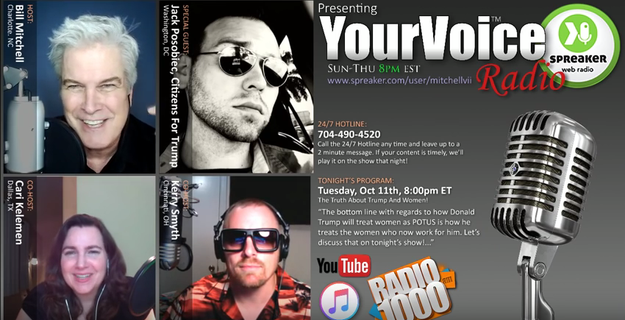
Mitchell&039;s radio show, which streams on YouTube.

In truth, Mitchell’s only qualification seems to be that he just started tweeting a lot. “I’ve always been clever with words,” he said. “As a recruiter, I make my living as a communicator. I’m good with word images and painting pictures with a short phrase here and there that people can relate to.” When asked how much time he spends crafting his tweets, he dismissed the idea that there’s too much forethought. “I’m just firing the thoughts out as I come to them. I have an interesting take, you see. I delve into the internals and really tell people what’s going on and it’s given me some fame.”

“I’m good with word images.”

Mitchell believes he’s been able to tap into a powerful demographic of disenfranchised, underrepresented voters who feel the country is on the wrong track and in need of a savior. “These are the people who call into Rush Limbaugh who hold on the line and never get on the air. My tweets caught on because I was saying out loud and using my talent for words to say what they wanted.” According to Mitchell, he’s averaging 40,000 retweets and 10 million Twitter impressions each day.

Mitchell&039;s appeal makes sense — he&039;s one of them. Like his audience, he&039;s quick to indulge a good conspiracy theory and subscribes to a media diet free of “mainstream bias,” reading Breitbart, Conservative Treehouse, DC Whispers, the Gateway Pundit, and the occasional Drudge article. He doesn’t check mainstream sites and networks like CNN or MSNBC because “it’s all spin to me.” For a growing number of Americans who’ve defined themselves online by adding “Deplorable” to their Twitter handle, @mitchellvii is a beacon in a growing storm of bad news — a kind of post-truth, post-math Nate Silver. For everyone else, the account is an almost anthropological look at Trumpism at its most simple-minded.
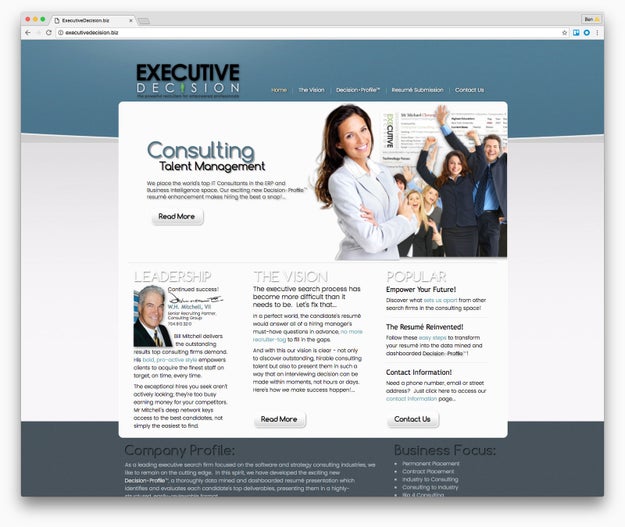
Mitchell&039;s executive recruiting business website.

When we spoke, Mitchell was fighting off a nasty flu he&039;d picked up around the same time that leaked footage from Access Hollywood showed Trump bragging about groping and kissing women. But rather than let it sideline him, Mitchell saw his fever and laryngitis as a kind of divine test. “They say that opportunity knocks at inopportune times and that’s why so many people don’t live out their dreams,” Mitchell told me. “I won’t lie to you, this is fun. I’m on a mission.”

To hear Mitchell tell it, that mission started around the time he was 10 years old, putting up signs in his neighborhood for Nixon. He’s a lifelong Republican but didn’t find the spark until he watched Ross Perot run as an independent presidential candidate in 1992. For Mitchell, who’s run his own business for decades, the idea of a businessman in the White House just seemed to make sense. And in June 2015, he got his wish with Donald Trump. “Around then I was an armchair quarterback with only 100 Twitter followers,” he said. “But when he decided to run, that’s when I decided to jump in.”
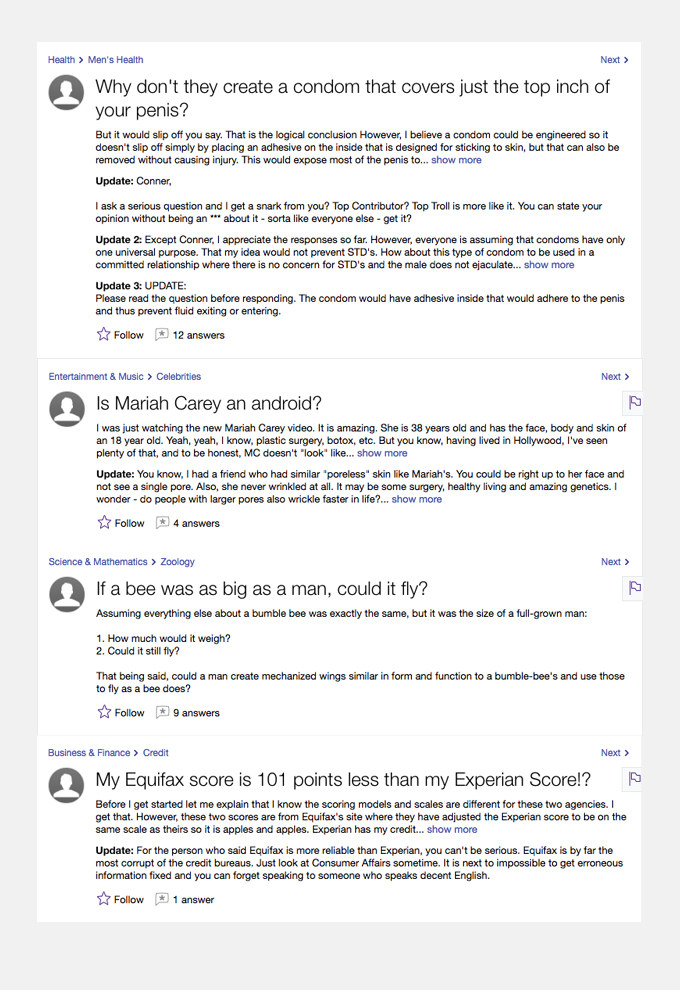
Screenshots of Mitchell&039;s Yahoo&; Answers activity.

Traces of Mitchell’s online presence from before he took his Trump oath of allegiance reveal an exceedingly average middle-aged man. He&039;s unmarried and has no kids. He graduated of the University of Maryland in 1982 and now runs an executive recruiting business, ExecutiveDecision.biz, which touts his “bold, pro-active style” that “empowers clients to acquire the finest staff on target, on time, every time.” His Yahoo Answers profile, stretching back more than a decade, paints a fuller picture. Across hundreds of questions and answers, Mitchell reveals a successful recovery from colon cancer, a frequent desire for feedback on whether or not to color his graying hair, and endless mundane curiosities ranging from the silly (“Why do Jack Russell owners all look like the [sic] want to kill themselves?” “Would a bumble bee the size of a man be able to fly?”) to the more existential (“What is intuition and how often is it correct?” “Why don&039;t they create a condom that covers just the top inch of your penis?”).

When he talks about polls, Mitchell’s friendly voice lowers considerably to the cadence of a condescending Little League coach. Mitchell’s take is that the polls are skewed to further silence Trump and the silent majority as a result of oversampling and overweighting Democrats. Get him going on the subject and he’ll argue that scientifically random polls conducted via landlines aren’t actually scientific or random, given the response rates; that the margins of error and small sample size tend to disqualify the national polls; and that major media polls don’t take into account built-in bias and key X factors — a favorite of Mitchell’s is “enthusiasm,” which Mitchell often calculates via tweets, yard signs, and rally sizes (Trump’s are YUGE, while Hillary struggles to put together a crowd of 200, he contends).

While in previous years this contempt for math would be roundly dismissed by all except the far fringes, today Mitchell’s message is inexplicably of the moment, casting the armchair tweeter in a different light. In a perfect world, Mitchell said, he would like to see polls abolished altogether — although he believes unscientific polls conducted via survey embeds on sites like the Drudge Report do a decent job capturing that elusive metric of enthusiasm. “If you arrived here from Mars today and you didn’t speak English but you saw Trump every single day of the week at these rallies — he’s dominating online, he’s dominating yard signs and rallies and all the physical things we can see. You’d think, This guy is winning. If it were up to me I’d make polling illegal. This is just my dream world.”

“The prize for the dumbest motherfucker on the internet goes to Bill Mitchell. This is a guy who’s proud of the fact that he doesn’t understand math.”

Pollsters and political operatives seem to agree that he’s living on a different plane of existence.

“The prize for the dumbest motherfucker on the internet — and there’s lots of competition this cycle — goes to Bill Mitchell, who’s way out ahead of the field,” Republican strategist Rick Wilson said when I asked him about Mitchell’s brand of punditry. “In the course of my 20-year career I’ve commissioned hundreds of surveys from presidential polling to state house races,” Wilson said, through intermittent, heavy sighs. “I’ve consumed a lot of polling and this is a guy who’s proud of the fact that he doesn’t understand math.”

Pollster Frank Luntz routinely takes shots at Mitchell on Twitter, calling into question Mitchell’s basic understanding of statistics. When Mitchell infamously tweeted this summer, “imagine polls don’t exist. Show me evidence Hilary is winning?” FiveThirtyEight’s Nate Silver had a laugh at his expense, tweeting, “Imagine there&039;s no polls/ It&039;s easy if you try/ No Pew or Quinnipiac/ On crowd size we rely.” Both Luntz and Silver did not respond to multiple requests to comment on Mitchell&039;s polling views.

Republican pollster Kristen Soltis Anderson — who recently had Mitchell’s “groundgame is in our hearts” tweet made into a ceramic coffee mug — is perhaps as charitable toward Mitchell as any statistician could possibly be. For her part, she understands the skepticism, driven by historical and recent polling misses like the Brexit vote. “He says in 140 characters the most absolutely perfect nonsense that anyone with any understanding can dismantle entirely,” Anderson says. “But we’re living in a post-fact environment. And If you don’t like the polls, having somebody who tells you they’re wrong makes you feel good.”

Becoming the laughingstock of the Washington establishment does not appear to trouble Mitchell. “I’m making all the right enemies,” he said. “You know you’ve made it on Twitter when famous people are trolling you. Frank Luntz trolls me all the time and I enjoy when they troll me. I enjoy the battle of wits.”

“I’m making all the right enemies.”

Despite Mitchell’s retweet-happy followers, his influence, even inside the Trump-supporting fringe conservative media sphere, is unclear. Before starting his homemade podcast, Mitchell was a frequent guest on the Wayne Dupree Show, a conservative podcast with a Cleveland AM radio following. Mitchell left the show abruptly under mysterious circumstances. (He has tweeted the departure was friendly and that he wanted to strike out on his own; Dupree didn&039;t wish to comment on the departure.)

Though he’s been retweeted three or four times by Trump himself, Mitchell claims he has no direct contact with the campaign and that no money has ever changed hands in return for his tens of thousands of on-message tweets. He suggested he’s in touch with a number of individuals close to the campaign and believes that the distance is “by design, so that I can remain an independent voice.” But one conservative media source suggested that Mitchell’s outsider status might have more to do with ego issues.

“He thought he was going to be in charge of a Trump group in North Carolina months ago and when he got there, he found out he wasn&039;t and left, deciding not to be a part,” a source said. Mitchell plays this down, alleging that he volunteered to run social media for the campaign in North Carolina but quit after a few weeks, deciding his personal account was more helpful to the campaign. Still, one source believes there’s tension between Mitchell and the campaign, explaining that earlier this year, Trump’s adviser and social media director Dan Scavino unfollowed Mitchell after an incessant series of Twitter direct messages filled with “pointers about how wrong they were doing social media.” Scavino did not respond to multiple requests for comment.

But what&039;s in it for Mitchell? He says that the work that goes into his radio show and constant tweeting “hasn&039;t come without considerable personal financial cost.” Still, he claims he hasn’t given thought to what could come after Election Day. “I have friends on TV who say when all’s said and done I should pursue this. I have people who now, before they go on TV, they contact me and say, ‘This is what we’re talking about, what should I say?’ and I give them zingers.” Though Mitchell wouldn’t reveal the identities of his TV friends, his podcast show has hosted, among others, Trump surrogate Katrina Pierson and conservative activist James O’Keefe.

But Mitchell’s influence is considerable — earlier this year, the MIT Media Lab listed him as the 26th most influential Twitter account of this election cycle (the highest ranked non-politician or journalist), between Lindsey Graham and Megyn Kelly. But neither a politician with the constant pressure to win elections nor a journalist bound by network standards and practices, Mitchell appears to have very little at stake. He is free to tout conspiracy theories that Clinton cheated in the debates with elaborate signals and teleprompters or that polls are an irresponsible way to take the pulse of an electorate.

“Trump has been caused, in large part, by a daily war against reality, waged not just by people at Fox News, but the Breitbarts of the world and random talk radio hosts like Bill Mitchell,” former Obama speechwriter Jon Favreau told me. “Information and media consumption is so diffuse now you have all these people on the right feeding other voters lies and alternative realities on a daily basis, and Bill is one of those people.”

Mitchell, for his part, is not worried about being wrong. After all, while the so-called experts dismissed Trump’s chances throughout the primaries, Mitchell was predicting landslide defeats with his gut, which he says is his guide. “It’s better to have tried and given it 100% than to sit back and worry about it,” he said. “I do what I think is right every day and say what I believe.”

Quelle: <a href="Meet The Trump Movement&039;s Post-Truth, Post-Math Anti–Nate Silver“>BuzzFeed

Delivery Workers For Instacart, Postmates And Uber Are Teaming Up For A Better Deal

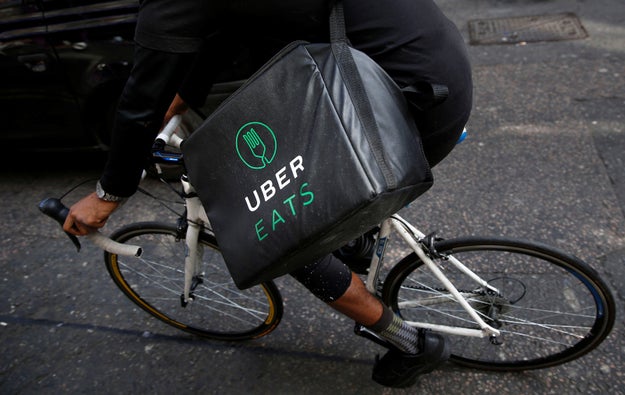
Neil Hall / Reuters

On the steps of New York&;s City Hall tomorrow morning, a group bike messengers will launch the New York Messengers Alliance, a first-of-its-kind organization for couriers who work for on-demand apps like Instacart, Postmates and Uber.

While not a formal union, the alliance aims to build power and solidarity among the labor force that supports the delivery-app economy, its organizers say. They want to use this power to negotiate for better working conditions, and their first priority is worker safety — specifically a demand for company-provided safety gear like helmets, and workers&039; compensation when they&039;re injured on the job.

Of the half dozen workers who attended an organizing meeting for the alliance earlier this month, two wore casts, and a third rolled up his sleeves to show grisly scabs from a recent crash. Sadio Bello, an Uber Rush courier who has worked as a bike messenger for 17 years, rode and made deliveries with a fractured ankle this past summer, he told BuzzFeed News, because he didn&039;t want to lose money.

Bike messengers working for the on-demand apps are classified as independent contractors, rather than employees, just like Uber drivers. They don&039;t receive any paid leave or medical cover.

Uber Rush courier Sadio Bello making a delivery while injured in New York.

Zishun Ning / Via vimeo.com

“Never in 20 years have I had a paid vacation,” courier Kurt Boone told BuzzFeed News. After two decades in the field “with nothing to show for it — no pension, no 401(k),” Boone said he sees an opportunity for the next generation of messengers in the alliance.

“Generally most messengers don’t work together. They’re individuals,” he said. “Collectively, I think we can go further.”

While little formal data exists on injury rates for bike messengers, a 2002 Harvard study of the profession in Boston found a rate comparable to that of professional football or the meatpacking industry, noting that “most injuries go unreported and that most couriers do not carry health insurance.”

Messengers say their experiences support those findings, and the danger comes with the territory. But they also insist companies could do more to protect and support them, and take issue with the apps&039; unpredictable pay and all-hours work-schedules. It combines, they say, to pressure couriers to do dangerous amounts of work just to earn as much as they used to with more regular schedules and rates.

“Initially, it was a fantastic deal,” said Harrington Día, who delivers for Uber&039;s Rush service, as well as for other companies. Día said he was initially drawn to the work by the $25 an hour wage Uber advertised. “I saw it as a way where I could live out this utopian fantasy of biking for a living,” he said. “That shattered when they began cutting wages.”

Día and others watched guaranteed pay steadily drop over the past two years for Uber Rush jobs, from $25 an hour to $20 to $15 and lower. When the company changed the delivery rate from $4 for a hand-off and $5 per mile to $3 for a hand-off and $4 a mile this past November (which meant workers could make as little as $7 per delivery), some couriers began showing up to protests by Uber drivers, who had also been dealing with pay cuts.

“The truth is they’ve been taking too much of the pie and we baked that pie and now we’re getting crumbs of it,” said Día.

Uber says couriers sign up for its service because of its flexibility. “Since couriers can and do use many other apps, we have to work every day to make Uber more rewarding for couriers, and we’re focused on just that, including by listening to feedback and making improvements,” the company told BuzzFeed News.

Instacart declined to comment on the new worker alliance, and Postmates did not respond to a request for comment.

The couriers have made a video to spread the word of their new alliance

vimeo.com

Elsewhere, organizing efforts by workers for these same on-demand companies are already racking up results. Even without the support of the new alliance, independent contractors for Instacart successfully won concessions from the company with the threat of a strike last week. After the contractors planned to “boycott” working for the platform for two days, the company agreed not to change its base pay and tip structure.

And independent contractors for Postmates received a boost from a complaint filed by the National Labor Relations Board against the company in Chicago, in which the board&039;s lawyers found Postmates couriers are employees, according to The New York Times, which received a copy of the complaint via a Freedom of Information Act request.

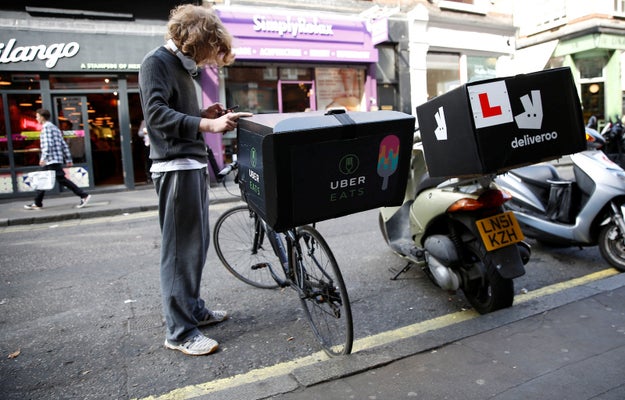
The protests also have an international element. In August, London-based couriers on the platform Deliveroo, an Uber Eats competitor, went on strike for seven days over a proposed new working contract. Deliveroo “subsequently backed down and said the new contract was an optional trial, although anyone who stayed on the old contract had to change to a zone where the new contract has not yet been implemented,” BuzzFeed News reported.

An UberEATS food delivery courier waits for an order in London, Britain September 7, 2016.

Neil Hall / Reuters

Last week also saw a new ruling related to the employee status of Uber drivers in New York (which the company is appealing), which found the workers qualify for unemployment benefits. And a bill being considered by the New York City Council would mandate on-demand companies like Uber provide safety equipment and training to couriers, despite their status as independent contractors.

The delivery workers in the messengers alliance, most of whom accept jobs from more than one app to make a living, are affiliating with the National Taxi Workers Alliance, an AFL-CIO-member union of taxi drivers that prides itself on its militancy. (In a flyer publicizing the launch event, the NYTWA calls itself “the only union to take Uber to court on behalf of workers.”) Founded in 1998, the NYTWA represents 19,000 yellow cab, green car, and black car drivers, including Uber and Lyft drivers.

“There are unions out there that don’t want to fight for employee status,” said Bhairavi Desai, executive director with the NYTWA. “They have articulated that position for themselves. To us, it&039;s clear that the role of the union is not to tactically make concessions to protect the business model, but to uncompromisingly elevate the power of the workers.”

Quelle: <a href="Delivery Workers For Instacart, Postmates And Uber Are Teaming Up For A Better Deal“>BuzzFeed

Apple Hires Director Of Artificial Intelligence To Ramp Up AI Recruitment

Compared to Silicon Valley giants like Facebook and Google, Apple&;s AI research projects have been largely inscrutable. But now, that looks like it&039;s about to change.

Apple has hired esteemed Carnegie Mellon computer science professor Russ Salakhutdinov as its director of artificial intelligence research, with plans to build a team of researchers for the company in the coming months. Salakhutdinov will remain in his post as an associate professor at CMU, Apple confirmed to BuzzFeed News.

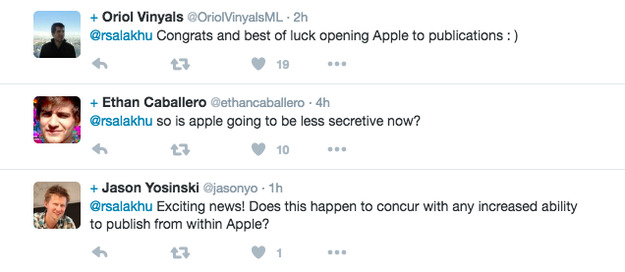
And in a move uncharacteristic of Apple&039;s historically secretive approach to its AI efforts, Salakhutdinov tweeted news of his hiring along with a link to his new team&039;s job listings.

Researchers replied to Salakhutdinov expressing skepticism about whether or not Apple, which is typically quiet about its artificial intelligence and machine learning efforts, would open itself up to the larger, more collaborative AI research community. The unexpected tweet seems to be part of Apple&039;s plan for recruiting for AI researchers — who are so hot right now in Silicon Valley.

All three of these men are artificial intelligence researchers. Vinyals works at Google, Caballero at Talla, and Yosinski at Geometric Intelligence.

Siri, Apple&039;s big public-facing AI technology, has faced widespread criticism for not being smart enough, especially compared to rival AI assistants. Just last week, Walt Mossberg, executive editor of the Verge and editor at large of Recode, asked, “Why does Siri seem so dumb?” in a recent column.

And Apple&039;s competitors have made very public strides into artificial intelligence, including being aggressive about hiring AI experts to take their research further. Google has been publishing hundreds of papers on machine learning. It&039;s also created a suite of products for varying levels of engagement: the Go champion DeepMind, the Siri-esque Google Now, the open source TensorFlow for developers, and the new texting bot Allo, to name a few. Amazon&039;s Echo speaker, whose key features rely the voice-controlled AI assistant Alexa, is rapidly reaching customer demographics outside of traditional smartphone markets. Facebook introduced its own personal assistant, M, in late 2015, just a year after Microsoft debuted Cortana.

Meanwhile, Apple has kept a low profile at the annual Neural Information Processing Systems Conference, which is the event of the season for researchers and companies developing and studying artificial intelligence. Google, Microsoft, Facebook, and IBM have all been active participants.

But Apple is racing to catch up. Before hiring Salakhutdinov, the company acquired three machine learning companies in the past year: Perceptio, Turi, and Tuplejump. And just this week, CEO Tim Cook told Nikkei Asian Review that Apple plans to open an AI research center in Yokohama, Japan later this year. “There is an incredible future ahead for AI and the iPhone,” Cook said.

Quelle: <a href="Apple Hires Director Of Artificial Intelligence To Ramp Up AI Recruitment“>BuzzFeed

DocumentDB updates in the Azure Portal: New metrics blade and improved collections management

Recently we released several updates to the DocumentDB portal experience. We added a new consolidated metrics experience with several new metrics available including new availability, throughput, consistency, and latency metrics which allows you to track how DocumentDB is meeting its SLA&;s. We also streamlined collection management by surfacing all collection operations and experiences on the left navigation bar, and eliminated excessive horizontal scrolling.

New metrics blade and SLA metrics

Azure DocumentDB is a globally distributed managed NoSQL database as a service that offers 99.99% guarantees for availability, throughput, <10ms read latency and <15ms write latency at 99th percentile, and guarantees 100% consistency.  We believe it is important for you to know how the service is performing against these guarantees. We also heard how important it is for you to have all metrics information readily available without browsing through multiple windows. In response to this feedback, we have added several new metrics to reflect service performance vs SLA, as well as introduced a new at-a-glance metrics experience for DocumentDB collections. If you click on the Metrics node under Collections, you will see all metrics DocumentDB provides for each of your collections on a single surface, including:

Actual collection availability vs. SLA
Requests rate grouped by status code
Consumed and provisioned throughput capacity measured in Request Units/second, as well as percentage of requests exceeding capacity
Observed latency in the regions where your collection is located
Percentage of requests that met consistency guarantees
Storage consumed vs. capacity

You can also zoom in and navigate to the standard metrics experience for the individual charts via zoom-in gesture.

Streamlined collections management

DocumentDB stores data in collections, and majority of your time working with DocumentDB is spent working with collections. With this portal change, we bring collections front and center in the portal experience and eliminate the excessive horizontal scrolling you used to encounter when working in the portal.

The overview blade now provides one-click access to collections, as well as "Add Collection" command.
All collection management experiences and tools are now available on the left navigation menu.
With this update, we eliminated the need for horizontal scrolling when working with DocumentDB in Azure portal.

We hope these new features will make your time in the Azure portal more efficient and provide you with the monitoring information that’s most important to you. As always, let us know how we are doing and what improvements you&039;d like to see going forward through Uservoice,  StackOverflow azure-documentdb, or Twitter @documentdb.
Quelle: Azure

Airlines Will Confiscate Your Samsung Galaxy Note7 If You Try To Fly With It

Airlines Will Confiscate Your Samsung Galaxy Note7 If You Try To Fly With It

A photo showing a blown-up Samsung Galaxy Note 7 smartphone in Gwangju, South Korea.

STR / Gwangju Bukbu Police Station / AFP

The Federal Aviation Administration, Department of Transportation, and the Pipeline and Hazardous Materials Safety Administration have issued an emergency order banning all Samsung Galaxy Note7 smartphones, even ones that have been powered off, from commercial and cargo US aircraft. The ban goes into effect October 15.

According to the order, passengers who attempt to board flights with a Note7 on their person or in their bags may have their phones confiscated. If an airline representative sees a passenger attempting to board with a Note7, the order authorizes them to bar that passenger from boarding. And passengers who try to sneak their Note7 phones on planes may face fines and criminal charges, the order states. However, exactly how airlines intend to enforce this ban is still unclear. The FAA previously advised passengers to power off the devices and refrain from charging them on flights.

The smartphone is now considered a forbidden hazardous material under the Federal Hazardous Material Regulations. FedEx and UPS previously told Bloomberg they would not be shipping the phones by air.

Samsung and the US Consumer Product Safety Commission have recalled the phones, which are linked to nearly 100 reports of overheating, catching fire, and exploding because of faulty batteries. Samsung sold nearly 2 million of them in the US, but after initial reports that the phones were exploding and smoking, it offered replacement Note7s with safe batteries. Several consumers reported, however, that these replacement phones showed the same problems as their predecessors. Notably, a Southwest Airlines flight was grounded because of a smoking replacement Note7. Samsung has stopped sales, shipping, and production of the phone and has sent explosion-proof boxes to customers to return their phones for refunds.

youtube.com

The company has slashed its operating profit projections for the third quarter of 2016 by 33 percent. It estimates the recall will cost $5.3 billion in total.

Samsung did not immediately respond to a request for comment on the FAA&;s announcement. In an October 13 statement about the CPSC&039;s expanded recall, the company said it was working with the government, and that “Customers’ safety remains a top priority and we ask consumers with an original or replacement Galaxy Note7 to power down and take advantage of the remedies available.”

If you have a Galaxy Note7, you can start the return process by clicking here. Now would probably be a good time to get around to it.

Quelle: <a href="Airlines Will Confiscate Your Samsung Galaxy Note7 If You Try To Fly With It“>BuzzFeed

Instacart Cancels Plans To Scrap Tips Amid Threats Of Strikes

Instacart is adjusting planned changes to its pay structure for full-service shoppers, following threats of a boycott by the independent contractors who were outraged over the $2 billion grocery delivery startup’s plans to replace tips with an optional 10% service fee collected by the company.

“After announcing this change we heard from shoppers that they liked most of the changes but wanted to retain the ability for customers to tip online,” Instacart explained in a Friday blog post. “We understand their concern and have decided to continue to accept tips.”

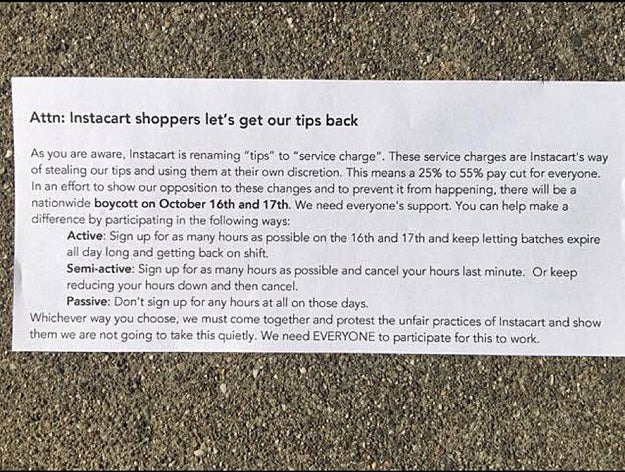
Instacart&;s move comes just two days ahead of a threatened October 16/17 strike organized around a “Let&039;s get our tips back” call to action.

Instacart had maintained that planned changes to its pay rate for independent contractors — which involved raising their base pay rate and replacing tips with an optional 10% “service amount” paid directly to Instacart — were intended to benefit workers by reducing reliance on tips.

“I get a lot of big tips. That’s what I rely on.”

But shoppers who did some back-of-the-envelope math following the company’s announcement worried that the changes would reduce their overall income. “I get a lot of big tips. That’s what I rely on,” said Matt, a shopper in Chicago who planned to boycott Instacart on Sunday and Monday. “I knew it wasn’t going to be in my best interests.”.”

Josh, a shopper on the East Coast, agreed. “Right now on an average week I make about $750, and I&039;ve made up to $1100 if I really work hard all week and things aren&039;t slow,” he told BuzzFeed News via email. “So, with the changes I’m looking at making between $500 and $700 for the same amount of work.”

As independent contractors working in different cities, Instacart shoppers don’t have a central method of communicating. But by sharing their frustration on social media —via Facebook groups, Instagram accounts and on Twitter — the beginnings of a movement started to congeal. Over email, Instacart shoppers in different cities orchestrated a plan to on October 16 and 17, the day the pay changes were set to roll out, hoping to slow service on what are typically two of the company&039;s busiest days.

When a widely shared blog post critical of Instacart&039;s plan to scrap tips fueled further outrage online, Instacart published a rebuttal on its blog. But some shoppers were even more frustrated by the way that post was written, arguing it intentionally clouded the issue of just who collected the “service amount.” While it’s true that 100% of the fee does go to shoppers it won’t necessarily be given to the person doing the shopping and the delivery. Instead, the service amount is pooled and redistributed by Instacart, which is where some in-store shoppers had a problem.

“Instacart is not being fully transparent to shoppers or customers,” said Liz Temkin, a shopper in Los Angeles, who isn’t planning to participate in the boycott. “They are telling customers that the service charge goes directly to the shopper, but that&039;s not the truth. It goes into a general pot, so that Instacart can pay us a higher delivery charge. It makes no sense to pay me the same for a small order of groceries versus the same number of items from Costco. And what about my mileage & loading stuff up from the car to deliver to an office building?”

Some Instacart shoppers who spoke with BuzzFeed News said they were worried about participating in the strike for fear of being removed from the platform for “reliability issues.” Many declined to share their names fearing Instacart might deactivate their account.

But some felt taking a risk was the only way to have an impact on Instacart’s policies. “Fear is going to keep [shoppers] from doing much outside of social media and talking. What we want is action,” said Matt, who estimated as many as forty shoppers in Chicago were prepared to join the boycott. “The only thing that’s going to get us what we want is what affects customer service and profit.”

The threat of a strike has had an impact. Following Instacart’s announcement today, the changes to base fare and addition of a service amount, charged by default when customers checkout, will remain as planned. But customers will have the option to add a tip on top of that in app if they so choose.

Given the adjusted rate and new fee, it’s unclear how many customers will be willing to also add a tip. Though Instacart says 20% of customers already don’t tip at all, and 40% of tips average around $2, top shoppers say big orders or deliveries that involve heavy lifting or lots of stairs can earn them much more than that. Whether the October 16/17 strike will still occur also remains to be seen. But if shoppers have something to say about the update, it seems that — for now at least — Instacart is willing to listen.

Quelle: <a href="Instacart Cancels Plans To Scrap Tips Amid Threats Of Strikes“>BuzzFeed

What To Do If Comcast Caps Your Internet Data

What To Do If Comcast Caps Your Internet Data

Comcast, the largest Internet provider in the US, is rolling out a one terabyte data cap on internet use for customers in 18 different states on November 1.

Via giphy.com

What does that mean?

If you&;re a Comcast subscriber and you live in one of the states getting the cap (comprehensive list here), you will be limited to 1TB of internet data per month. For some customers, this is actually a boost — Comcast has been slowly rolling out data caps across the US for a while. Some states had a 300GB cap, but they&039;re getting 1TB now, since, according to Ars Technica, some customers were exceeding the lower limit.

What this likely means in the long run is that data caps are officially a part of how Comcast plans to do business. In a world where people are connecting more devices with more and more data-hungry services (Netflix and chill, for example), this could bring the internet service provider in conflict with its subscribers.

Comcast insists 99% of its customers use less than 1TB a month, telling Wired that the average Comcast subscriber uses 75GB per month and that only 10% of its customers even exceeded the previous 300GB cap. There seems to be a group of data 1 percenters: Last year the ISP told Ars Technica that 10% of its subscribers use 80 percent of all the data Comcast provided.

Take those numbers with a grain of salt, though.

Ars also found that the accuracy of Comcast&039;s data meters is widely disputed; some users allege that the meters are off by full terabytes. The FCC also just fined Comcast $2.3 million—the biggest fine to a cable company ever—for charging customers for things they did not buy. In some cases, people declined the specific services they were later billed for. This all suggests Comcast isn&039;t always precise about these kinds of things.

Some see Comcast&039;s expanding data caps as a move against video streaming services like Netflix and Amazon Prime, which have been upping the quality of their videos in recent months. Higher quality video, including 4K video, means more data usage. And Comcast, in direct competition with streaming services, also sells cable set top boxes, though it recently announced a deal that lets subscribers stream Netflix from their set tops.

So even if you&039;re an average internet user, Comcast&039;s data cap has big implications for the future. Back in 2012, experts were predicting that our demand for data would only increase, while the capacity to provide it could plateau. With the proliferation of high-intensity applications like VR, video conferencing, and 4K streaming, it&039;s possible that we&039;ll all be using a terabyte a month soon enough.

TBH, the data cap probably won&039;t affect you right now. But take precautions…

1. Set your Comcast account to remind you.

Know when you&039;re at 50%, 75%, 100%, and 125% of your monthly data usage. Knowledge is power.

1.5. Figure out how much data you typically use.

Use Comcast&039;s data estimator. If you have a Comcast account, view your monthly usage.

via Giphy / Via giphy.com

2. Don&039;t beat yourself up about it.

Comcast allows for two months in a 12-month period to be over the 1TB limit. For the third month, Comcast will charge $10 for an additional 50GB of data, with a price cap of $200 for overages.

3. If you&039;re mad pressed about your data, you can buy more.

You can purchase an unlimited data plan for $50 on top of your current subscription. Otherwise you&039;ll pay overages when you max it out after your two grace months.

Via Giphy / Via giphy.com

4. Watch Comcast&039;s “What Can You Do With a Terabyte?” video.

Note the like to dislike ratio on the video. Note that Comcast has disabled comments. Laugh.

youtube.com / Via youtube.com

5. Recall that in many places, people have no option for Internet service besides Comcast. You can find community in complaining.

Via Giphy / Via giphy.com

The company consistently ranks among the worst across the US in customer satisfaction, so there are plenty of people kvetching along with you, even if it&039;s just in principle. If you&039;re angry about the data cap, you&039;re not alone.

Quelle: <a href="What To Do If Comcast Caps Your Internet Data“>BuzzFeed