Amazon Bedrock is now available in additional Regions

Beginning today, customers can use Amazon Bedrock in the Africa (Cape Town), Canada West (Calgary), Mexico (Central), and Middle East (Bahrain) regions to easily build and scale generative AI applications using a variety of foundation models (FMs) as well as powerful tools to build generative AI applications. Amazon Bedrock is a comprehensive and secure service for building generative AI applications and agents. Amazon Bedrock connects you to leading foundation models (FMs) and services to deploy and operate agents, enabling you to quickly move from experimentation to real-world deployment. To get started, visit the Amazon Bedrock page and see the Amazon Bedrock documentation for more details.
Quelle: aws.amazon.com

Amazon Connect now provides conversational analytics for voice and chat bots

Amazon Connect now provides conversational analytics for end-customer self-service interactions across voice and digital channels, helping you better understand and improve your customers’ self-service experiences. This includes across PSTN/telephony, in-app and web-calling, web and mobile chat, SMS, WhatsApp Business messaging, and Apple Messages for Business. With this launch, Connect now provides rich conversational analytics across both human-agent interactions and end-customer self-service interactions. You can now automatically analyze the quality of automated self-service interactions including customer sentiment, redact sensitive data, discover top contact drivers and themes, identify compliance risks, and proactively identify areas for improvement through easy-to-customize dashboards. Connect’s conversational analytics also enables you to use semantic matching rules to categorize interactions based on customer behavior, keywords, sentiment, or issue types, such as billing inquiries or agent escalation requests. Amazon Connect is an AI-powered application that provides one seamless experience for your contact center customers, agents, and supervisors. To learn more about Amazon Connect and its conversational analytics capabilities, refer to the following resources:

Amazon Connect website and pricing
Conversational analytics in the Administrator Guide
Supported languages and Regions

Quelle: aws.amazon.com

Powering Distributed AI/ML at Scale with Azure and Anyscale

The path from prototype to production for AI/ML workloads is rarely straightforward. As data pipelines expand and model complexity grows, teams can find themselves spending more time orchestrating distributed compute than building the intelligence that powers their products. Scaling from a laptop experiment to a production-grade workload still feels like reinventing the wheel. What if scaling AI workloads felt as natural as writing in Python itself? That’s the idea behind Ray, the open-source distributed computing framework born at UC Berkeley’s RISELab, and now, it’s coming to Azure in a whole new way.

Today, at Ray Summit, we announced a new partnership between Microsoft and Anyscale, the company founded by Ray’s creators, to bring Anyscale’s managed Ray service to Azure as a first-party offering in private preview. This new managed service will deliver the simplicity of Anyscale’s developer experience on top of Azure’s enterprise-grade Kubernetes infrastructure, making it possible to run distributed Python workloads with native integrations, unified governance, and streamlined operations, all inside your Azure subscription.

Ray: Open-Source Distributed Computing for PythonRay reimagines distributed systems for the Python ecosystem, making it simple for developers to scale code from a single laptop to a large cluster with minimal changes. Instead of rewriting applications for distributed execution, Ray offers Pythonic APIs that allow functions and classes to be transformed into distributed tasks and actors without altering core logic. Its smart scheduling seamlessly orchestrates workloads across CPUs, GPUs, and heterogeneous environments, ensuring efficient resource utilization.

Developers can also build complete AI systems using Ray’s native libraries—Ray Train for distributed training, Ray Data for data processing, Ray Serve for model serving, and Ray Tune for hyperparameter optimization—all fully compatible with frameworks like PyTorch and TensorFlow. By abstracting away infrastructure complexity, Ray lets teams focus on model performance and innovation.

Anyscale: Enterprise Ray on AzureRay makes distributed computing accessible; Anyscale running on Azure takes it to the next level for enterprise-readiness. At the heart of this offering is RayTurbo, Anyscale’s high-performance runtime for Ray. RayTurbo is designed to maximize cluster efficiency and accelerate Python workloads, enabling teams on Azure to:

Spin up Ray clusters in minutes, without Kubernetes expertise, directly from the Azure portal or CLI.Dynamically allocate tasks across CPUs, GPUs, and heterogeneous nodes, ensuring efficient resource utilization and minimizing idle time.Easily run large experiments quickly and cost-effectively with elastic scaling, GPU packing, and native support for Azure spot VMs.Run reliably at production scale with automatic fault recovery, zero-downtime upgrades, and integrated observability.Maintain control and governance; clusters run inside your Azure subscription, so data, models, and compute stay secure, with unified billing and compliance under Azure standards.By combining Ray’s flexible APIs with Anyscale’s managed platform and RayTurbo’s performance, Python developers can move from prototype to production faster, with less operational overhead, and at cloud scale on Azure.

Kubernetes for Distributed ComputingUnder the hood, Azure Kubernetes Service (AKS) powers this new managed offering, providing the infrastructure foundation for running Ray at production scale. AKS handles the complexity of orchestrating distributed workloads while delivering the scalability, resilience, and governance that enterprise AI applications require.

AKS delivers:

Dynamic resource orchestration: Automatically provision and scale clusters across CPUs, GPUs, and mixed configurations as demand shifts.High availability: Self-healing nodes and failover keep workloads running without interruption.Elastic scaling: scale from development clusters to production deployments spanning hundreds of nodes.Integrated Azure services: Native connections to Azure Monitor, Microsoft Entra ID, Blob Storage, and policy tools streamline governance across IT and data science teams.AKS gives Ray and Anyscale a strong foundation—one that’s already trusted for enterprise workloads and ready to scale from small experiments to global deployments.

Enabling teams with Anyscale running on AzureWith this partnership, Microsoft and Anyscale are bringing together the best of open-source Ray, managed cloud infrastructure, and Kubernetes orchestration. By pairing Ray’s distributed computing platform for Python with Anyscale’s management capabilities and AKS’s robust orchestration, Azure customers gain flexibility in how they can scale AI workloads. Whether you want to start small with rapid experimentation or run mission-critical systems at global scale, this offering gives you the choice to adopt distributed computing without the complexity of building and managing infrastructure yourself.

You can leverage Ray’s open-source ecosystem, integrate with Anyscale’s managed experience, or combine both with Azure-native services, all within your subscription and governance model. This optionality means teams can choose the path that best fits their needs: prototype quickly, optimize for cost and performance, or standardize for enterprise compliance.

Together, Microsoft and Anyscale are removing operational barriers and giving developers more ways to innovate with Python on Azure, so they can move faster, scale smarter, and focus on delivering breakthroughs. Read the full release here.

Get startedLearn more about the private preview and how to request access at https://aka.ms/anyscale or subscribe to Anyscale in the Azure Marketplace.
The post Powering Distributed AI/ML at Scale with Azure and Anyscale appeared first on Microsoft Azure Blog.
Quelle: Azure

Microsoft strengthens sovereign cloud capabilities with new services

Across Europe and around the world, organizations today face a complex mix of regulatory mandates, heightened expectations for resilience, and relentless technological advancement. Sovereignty has become a core requirement for governments, public institutions, and enterprises seeking to harness the full power of the cloud while retaining control over their data and operations.

In June 2025, Microsoft CEO Satya Nadella announced a broad range of solutions to help meet these needs with the Microsoft Sovereign Cloud. We continue to adapt our sovereignty approach—innovating to meet customer needs and regulatory requirements within our Sovereign Public Cloud and Sovereign Private Cloud. Today, we are announcing a new wave of capabilities, building upon our digital sovereignty controls, to deliver advanced AI and scale, strengthened by our ecosystem of specialized in-country partner experts. With this announcement, expanded features and services include:

End-to-end AI data-processing in Europe as part of EU (European Union) Data Boundary.

Microsoft 365 Copilot expands in-country processing for Copilot Interactions to 15 countries. Learn more about this announcement in the Microsoft 365 blog.

Sovereign Landing Zones service expansion and disconnected operations for Microsoft Azure Local.

Microsoft 365 Local general availability.

Increased maximum scale of Azure Local, support for external SAN storage, and support for the latest NVIDIA GPUs.

Availability of our partner Digital Sovereignty specialization.

Discover Microsoft Sovereign Cloud

Microsoft Sovereign Cloud continuous innovation

Our latest offerings include new digital sovereignty capabilities across AI, security, and productivity, as well as a suite of upcoming features that will further address our customers’ sovereign cloud needs.

We recognize the need for continuous innovation and have already begun implementing many commitments. As of this month, we have already:

Established a European board of directors, composed of European nationals, exclusively overseeing all datacenter operations in compliance with European law, thereby putting Europe’s cloud infrastructure into the hands of Europeans.

Increased European datacenter capacity with recent launches in Austria and an upcoming launch in Belgium this month.

Embedded our digital resiliency commitments into all relevant government contracts.

Expanded open‑source investment through funding secure open-source software (OSS) projects and collaborations as well as publishing AI Access Principles that widen safe, responsible access to advanced AI, helping European developers, startups, and enterprises compete more effectively across the region.

Advanced our European Security Program by providing AI-powered intelligence and cybersecurity capacity building initiatives to strengthen Europe’s digital resilience against threat actors.

New Sovereign Public Cloud and AI capabilities

From the moment organizations begin designing their environments for sovereignty, they need end-to-end capabilities that help them embed compliance and control from the start.

EU Data Boundary includes AI data processing residency

We are delivering on our end-to-end AI data processing commitments, where data processed by AI services for EU customers remains within the European Union Data Boundary, except as otherwise directed by the customer.

This means all customer data, whether at rest or in transit, will be stored and processed exclusively in the EU. Our approach includes implementing rigorous controls and transparency measures that comply with EU customer requirements.

Expanding Microsoft 365 Copilot in-country data processing to 15 countries

Building upon decades of investment in global infrastructure and industry-leading data residency capabilities, Microsoft will now offer in-country data processing for customers’ Microsoft 365 Copilot interactions in 15 countries around the world.

By the end of 2025, Microsoft will offer customers in four countries—Australia, India, Japan and the United Kingdom—the option to have Microsoft 365 Copilot interactions processed in-country. In 2026, we’ll expand the availability of in-country data processing for Microsoft 365 Copilot to customers in eleven more countries including Canada, Germany, Italy, Malaysia, Poland, South Africa, Spain, Sweden, Switzerland, the United Arab Emirates, and the United States.

Read the full announcement in the Microsoft 365 blog

New Sovereign Landing Zone (SLZ) foundation

We are also introducing our refreshed Sovereign Landing Zone (SLZ), built on the market-proven landing zone foundation of Azure Landing Zone (ALZ).

The Sovereign Landing Zone is the recommended platform landing zone for customers wanting to implement sovereign controls in the Azure public cloud as part of the Sovereign Public Cloud.

The refresh of the Sovereign Landing Zone includes:

Updated Management Group hierarchy and supporting Azure Policy definitions, initiatives, and assignments to help implement the Sovereign Public Cloud controls (Level 1, 2, and 3).

Guidance on deployment placement of Azure Key Vault Managed HSM, if required as part of Level 2 Sovereign controls.

Deployment simplified via the Azure landing zone accelerator and the Azure landing zone library. See Sovereign Landing Zone (SLZ) implementation options for further details.

Over the next few months, the Azure Policy definitions, initiatives, and assignments that come built-in to the Sovereign Landing Zone will continue to expand to help our customers achieve sovereign controls in the sovereign public cloud out-of-the-box faster.

By adopting Sovereign Landing Zones, customers can gain a prescriptive architecture that accelerates compliance with regional sovereignty requirements while reducing complexity in policy management. This approach also helps organizations confidently scale workloads across Azure regions without compromising on regulatory alignment or operational consistency.

Check out the new Sovereign Landing Zone (SLZ)

New Sovereign Private Cloud and AI capabilities

As organizations deepen their commitment to sovereignty, the ability to combine regulatory compliance with innovation becomes especially important. This next wave of enhancements helps bring together advanced AI capabilities and scalable infrastructure designed for both public and private environments.

Supporting thousands of AI models on Azure Local with NVIDIA RTX GPUs

As we advance our Sovereign Private Cloud capabilities with Azure Local, we are introducing a new Azure offering with the latest NVIDIA RTX Pro 6000 Blackwell Server Edition GPU purpose-built for high performance AI workloads in sovereign environments.

Designed to run over 1,000 models such as GPT OSS, DeepSeek-V3, Mistral NeMo, and Llama 4 Maverick, this GPU enables organizations to accelerate their AI initiatives directly within a sovereign private cloud environment. Customers gain the flexibility to experiment, innovate, and deploy advanced AI solutions with enhanced performance. This means organizations can pursue new AI-powered opportunities while helping ensure data protection and compliance.

In addition, customers can gain access to thousands of prebuilt and open-source AI models, ready to deploy for a wide range of scenarios—from generative AI and advanced analytics to real-time decision making. This combination empowers customers to experiment, innovate, and operationalize cutting edge AI solutions, while keeping governance front and center.

Increasing Azure Local scale to hundreds of servers

Azure Local has supported single clusters of up to 16 physical servers. With our latest updates, Azure Local can support hundreds of servers, opening new possibilities for organizations with large-scale or growing sovereign private cloud demands. This enhancement means customers can support bigger, more complex workloads, scale their infrastructure with ease, and respond to evolving business needs all while aligning with the security and sovereignty required by European and global regulations.

SAN support on Azure Local

A key highlight of expanding the scale of our Sovereign Private Cloud is the introduction of Storage Area Network (SAN) support on Azure Local. With this update, customers can now securely connect their existing on-premises storage solutions from industry leaders to Azure Local. This integration empowers organizations to leverage their trusted storage investments while benefiting from cloud-native services, helping ensure data remains within their desired jurisdiction. European enterprises, in particular, gain flexibility in meeting local data residency requirements without compromising on performance or control.

Microsoft 365 Local: General availability of key workloads

Another milestone is the general availability of Microsoft 365 Local, helping bring core productivity workloads—Exchange Server, SharePoint Server, and Skype for Business Server natively to Azure Local. Starting in December, customers can deploy these productivity workloads on Azure Local in a connected mode, with a disconnected option for complete isolation coming early 2026. This approach combines familiar collaboration tools with Azure Local’s unified management and consistent Azure services and APIs, enabling organizations to maintain full operational control while aligning with stringent compliance and data residency requirements.

Disconnected operations: General availability

Microsoft’s Sovereign Private Cloud extends sovereignty principles into fully dedicated environments for organizations with strict compliance and control requirements, enabled by Azure Local. Azure Local enables government agencies, multinational enterprises, and regulated entities to maintain local control while still benefiting from the scale and innovation of Microsoft’s global cloud platform.

As part of Azure Local, we are introducing the upcoming general availability of disconnected operations, including the ability to manage multiple Azure Local clusters from the same local control plane. Available in early 2026, this capability allows customers to operate private cloud environments with a completely on-premises control plane, enabling organizations to operate securely and independently within their own dedicated environments. With disconnected operations, customers can retain business continuity and operational resilience, even in highly regulated or edge scenarios.

Learn more about Azure Local

New partner Digital Sovereignty specialization now available

We’re excited to officially launch the Digital Sovereignty specialization as part of the Microsoft AI Cloud Partner Program. This new specialization empowers partners to demonstrate deep expertise in delivering secure, compliant, and sovereign cloud solutions across Azure and Microsoft 365 platforms. By earning this designation, partners signal their ability to meet stringent data residency, privacy, and regulatory requirements—helping customers maintain control over their applications and data while driving innovation. The specialization includes rigorous audit criteria and provides benefits such as enhanced discoverability, specialized badging, and priority access to sovereign cloud opportunities.

Looking ahead: Advancing sovereignty through greater controls

The Microsoft Sovereign Cloud roadmap will provide additional capabilities designed to address evolving customer needs including:

Sovereign Public Cloud

Data Guardian: This upcoming capability helps provide transparency into operational sovereignty controls in our European public cloud environments. All remote access by Microsoft engineers to the systems that store and process your data in Europe will be routed to the EU, where an EU-based operator can monitor and, if necessary, halt these activities. All remote access by Microsoft engineers will be recorded in a tamper-evident log.

Sovereign Private Cloud

Enhanced change controls: We will introduce a set of configurable policies and approval workflows that will empower organizations with explicit oversight of any changes propagating from the cloud to the edge, strengthening governance and compliance.

Site-to-site disaster recovery: Azure Site Recovery in Azure Local will help with business continuity by keeping business apps and workloads running during outages.

Move from hybrid to fully disconnected: Azure Local will enable customers to transition workloads from hybrid to fully disconnected operations, providing them with flexibility for business continuity.

National Partner Clouds

National Partner Clouds are a core part of the Microsoft Sovereign Cloud strategy. They provide independently operated cloud environments that deliver Microsoft Azure and Microsoft 365 capabilities under local ownership and control.

Delos Cloud is designed to meet German government’s BSI cloud platform requirements.

Bleu is designed to meet the French government’s (ANSSI) SecNumCloud requirements.

For many public sector organizations, ERP is a critical workload that requires modernization to cloud environments. SAP is planning to deploy its RISE with SAP offering on Microsoft Azure for both Bleu and Delos Cloud customers, in addition to support of RISE with SAP for customers using Microsoft Azure public cloud deployments.

Learn more about Microsoft’s sovereign solutions

Microsoft delivers unmatched sovereign solutions, offering a flexible public cloud environment, a private cloud that scales to your business needs, and national partner clouds designed to meet specific compliance requirements. Our commitment to continuous investment and innovation helps our customers meet sovereignty without compromise.

Discover what’s next in cloud innovation this November at Microsoft Ignite. Learn more and register today.
The post Microsoft strengthens sovereign cloud capabilities with new services appeared first on Microsoft Azure Blog.
Quelle: Azure

Driving ROI with Azure AI Foundry and UiPath: Intelligent agents in real-world healthcare workflows

Across industries, organizations are moving from experimentation with AI to operationalizing it within business-critical workflows. At Microsoft, we are partnering with UiPath—a preferred enterprise agentic automation platform on Azure—to empower customers with integrated solutions that combine automation and AI at scale.

One example is Azure AI Foundry agents and UiPath agents (built on Azure AI Foundry) orchestrated by UiPath Maestro™ in business processes, ensuring AI insights seamlessly flow into automated business processes that deliver measurable value.

Get started with agents built on Azure AI Foundry

From insight to action: Managing incidental findings in healthcare

In healthcare, where every insight can influence a life, the ability of AI to connect information and trigger timely action is especially transformative. Incidental findings in radiology reports—unexpected abnormalities uncovered during imaging studies like CT or MRI scans—represent one of the most challenging and overlooked gaps in patient care

As the volume of patient data grows, overlooked incidental findings outside the original imaging scope can delay care, raise costs, and increase liability risks.

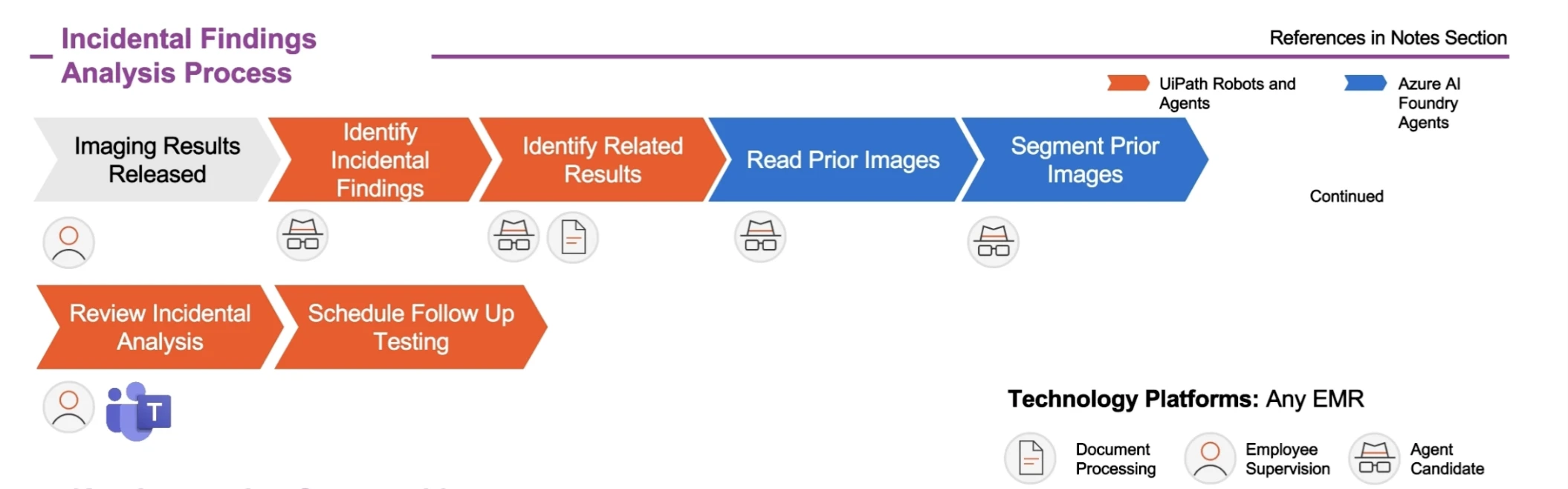
This is where AI steps in. In this workflow, Azure AI Foundry agents and UiPath agents—orchestrated by UiPath Maestro™—work together to operationalize this process in healthcare:

Radiology reports are generated and finalized in existing systems.

UiPath medical record summarization (MRS) agents review reports, flagging incidental findings.

Azure AI Foundry imaging agents analyze historical PACS images and radiology data, comparing past results with current findings relevant to the additional findings.

UiPath agents aggregate all results—including pertinent EMR history, prior imaging, and AI-generated imaging insights—into a comprehensive follow-up report.

The aggregated information is forwarded to the original ordering care provider in addition to the primary radiology report, eliminating the need to manually comb through the chart and prior exams for pertinent information. This creates both a secondary notification of the incidental finding and puts the summarized, relevant patient information in the clinicians’ hands, efficiently supporting the provision of safe, timely care.

UiPath Maestro™ orchestrates the business process, routing the consolidated packet to the ordering physician or specialist for next steps.

The combination of UiPath and Azure AI Foundry agents turns siloed data into precise documentation that can be used to create actionable care pathways—accelerating clinical decision making, reducing physician workload, and improving patient outcomes.

This scenario is enabled by:

UiPath Maestro™: Orchestrates complex workflows that span multiple agents, systems, and data sources; and integrates natively with Azure AI Foundry and UiPath Agents, providing tracing capabilities that create business trust in underlying AI agents.

UiPath agents: Extract and summarize structured and unstructured data from EMRs, reports, and historical records.

Azure AI Foundry agents: Analyze medical images and generate AI-powered diagnostic insights with healthcare-specific models on Azure AI Foundry that provide secure data access through DICOMweb APIs and FHIR standards, ensuring compliance and scalability.

Together, this creates an agentic ecosystem on Azure where AI insights are not isolated but operationalized directly within end-to-end business processes.

Delivering customer value

By embedding AI into automated workflows, customers see tangible ROI:

Improved outcomes: Faster detection and follow-up on incidental findings.

Efficiency gains: Automated data collection, summarization, and reporting reduce manual physician workload.

Cost savings: Early detection helps prevent expensive downstream interventions.

Trust and compliance: Built on Azure & UiPath’s security, privacy, and healthcare data standards.

This is the promise of combining enterprise-grade automation with enterprise-ready AI.

What customers are saying about AI automation in healthcare

AI-powered automation is redefining how healthcare operates. At Mercy, we are beginning to partner with Microsoft and UiPath which will allow us to move beyond data silos and create intelligent workflows that truly serve patients. This is the future of care—where insights instantly translate into action.
Robin Spraul, Automation Manager-Automation Opt & Process Engineering, Mercy

Partnership perspectives

With UiPath Maestro and Azure AI Foundry working together, we’re helping enterprises operationalize AI across workflows that matter most. This is how we turn intelligence into impact.
Asha Sharma, Corporate Vice President, Azure AI Platform

Healthcare is just the beginning. UiPath and Microsoft are empowering organizations everywhere to unlock ROI by bringing automation and AI together in real-world business processes.
Graham Sheldon, Chief Product Officer, UiPath

Looking ahead

This healthcare scenario is one of many where UiPath and Azure AI Foundry are transforming operations. From finance to supply chain to customer service, organizations can now confidently scale AI-powered automation with UiPath Maestro™ on Azure.

At Microsoft, we believe AI is only as valuable as the outcomes it delivers. Together with UiPath, we are enabling enterprises to achieve those outcomes today.

const currentTheme =
localStorage.getItem(‘msxcmCurrentTheme’) ||
(window.matchMedia(‘(prefers-color-scheme: dark)’).matches ? ‘dark’ : ‘light’);

// Modify player theme based on localStorage value.
let options = {“autoplay”:false,”hideControls”:null,”language”:”en-us”,”loop”:false,”partnerName”:”cloud-blogs”,”poster”:”http://cdn-dynmedia-1.microsoft.com/is/image/microsoftcorp/1090860-UiPath-Azure-HLS-Incidental?wid=1280″,”title”:””,”sources”:[{“src”:”http://cdn-dynmedia-1.microsoft.com/is/content/microsoftcorp/1090860-UiPath-Azure-HLS-Incidental-0x1080-6439k”,”type”:”video/mp4″,”quality”:”HQ”},{“src”:”http://cdn-dynmedia-1.microsoft.com/is/content/microsoftcorp/1090860-UiPath-Azure-HLS-Incidental-0x720-3266k”,”type”:”video/mp4″,”quality”:”HD”},{“src”:”http://cdn-dynmedia-1.microsoft.com/is/content/microsoftcorp/1090860-UiPath-Azure-HLS-Incidental-0x540-2160k”,”type”:”video/mp4″,”quality”:”SD”},{“src”:”http://cdn-dynmedia-1.microsoft.com/is/content/microsoftcorp/1090860-UiPath-Azure-HLS-Incidental-0x360-958k”,”type”:”video/mp4″,”quality”:”LO”}],”ccFiles”:[{“url”:”https://azure.microsoft.com/en-us/blog/wp-json/msxcm/v1/get-captions?url=https%3A%2F%2Fwww.microsoft.com%2Fcontent%2Fdam%2Fmicrosoft%2Fbade%2Fvideos%2Fproducts-and-services%2Fen-us%2Fazure%2F1090860-uipath-azure-hls-incidental%2F1090860-UiPath-Azure-HLS-Incidental_cc_en-us.ttml”,”locale”:”en-us”,”ccType”:”TTML”}]};

if (currentTheme) {
options.playButtonTheme = currentTheme;
}

document.addEventListener(‘DOMContentLoaded’, () => {
ump(“ump-69129fb513f58″, options);
});

The post Driving ROI with Azure AI Foundry and UiPath: Intelligent agents in real-world healthcare workflows appeared first on Microsoft Azure Blog.
Quelle: Azure