Playstation 5: Dualsense verfügt über Akku mit 1.560 mAh Nennladung
Der Akku im Gamepad der Playstation 5 verfügt über eine höhere Nennladung als bei der PS4. Ob das für längere Sessions reicht – unklar. (Playstation 5, Sony)
Quelle: Golem

Der Akku im Gamepad der Playstation 5 verfügt über eine höhere Nennladung als bei der PS4. Ob das für längere Sessions reicht – unklar. (Playstation 5, Sony)
Quelle: Golem
We’re pleased to share updates to our Google Cloud free programs so developers can get started even faster in solving real-world business challenges. With more and more developers building with the Google Cloud Platform every day, we’ve invested in a broad range of new hands-on resources, videos, tutorials, and comprehensive documentation to help you get started and grow and maintain momentum with Google Cloud. These include:The Free Trial program. Last year more than 750,000 new developers trained on GCP, and many started with our hands-on free trial experience that provides a great on-ramp to use our 200+ cloud products and services. We’ve found that one of the highest predictors of developer success is developers completing a proof of concept during the first three months of our free trial program. As a result, we’ve updated the program so that, starting August 17th, users now have 90 days to use their $300 USD in Google Cloud credits. In addition to the free trial, users can also leverage our free products, resources, and training. This lets us focus on helping developers and organizations maximize the impact of their free trial in those critical first months. There will be no changes for customers already in a free trial. For more information, check out all of the details on our trial program here.The Always Free Tier program. More than 20 of our most popular products and services are available for freeabove and beyond your $300 USD free trial credits, even after your free trial is complete. You can try everything from App Engine and Compute Engine, to industry-leading AI, data analytics, storage and security tools.Better training—and more resources to help you get started. All Google Cloud free trial and free tier users can access: 30 days of unlimited Qwiklabs training as well as more than 60 on-demand webinars, hundreds of how-to videos, playlists, and training courses and in-depth learning paths on platforms including Pluralsight and Coursera.User and expert resources in Google Cloud communities, on our Slack channel and Reddit. You can also check out GitHub or Stack Exchange boards to ask technical questions, discuss projects, and find targeted support.Regularly updated documentation, from detailed cloud basics to enterprise guides, which gives you foundational concepts, quickstarts, top use cases, and advanced hands-on guides. Support resources available right in your Google Cloud console.Like all Google Cloud services, we continue to improve our free trial programs based on your feedback. Please leave a note in any of the above channels letting us know what you think.
Quelle: Google Cloud Platform

Der Mi TV Lux Transparent Edition verwendet ein lichtdurchlässiges OLED-Panel. Das 55-Zoll-Gerät soll ab August in China erhältlich sein. (Xiaomi, Display)
Quelle: Golem

An den Regierungsplänen zur Urheberrechtsreform gibt es neben Lob auch viel Kritik. Google warnt vor Zwangslizenzen, die Gema fordert genau dies. Eine Analyse von Friedhelm Greis (Uploadfilter, Urheberrecht)
Quelle: Golem

Google erweitert Android Auto. Es werden mehr Navigations-Apps unterstützt, und eine vor einem Jahr entfernte Funktion kehrt zurück. (Android Auto, Google)
Quelle: Golem

Die wegen der Corona-Pandemie von den Straßen genommenen Jump-Pedelecs werden in Berlin wieder auf Gehwegen platziert. (Leihfahrrad, Technologie)
Quelle: Golem

Ein gerissenes Stahlseil hat große Schäden an der Schüssel des einst größten Radioteleskops der Welt angerichtet. (Astronomie, Internet)
Quelle: Golem
Editor’s note: In its more than 180 years of history, Procter & Gamble has been at the forefront of consumer insights and innovation. From soap operas to smart toothbrushes, P&G has specialized in consumer experience since the start. Here’s how they’re applying cutting-edge technology to the next century of consumer goods. At P&G, our aspiration is to serve the world’s consumers with goods from baby and feminine care, grooming, home hygiene, and healthcare to beauty products and more. Consumer understanding and insights have always been essential for us, and in today’s highly connected world, we’re using technology to meet consumer needs through more personalized experiences, whether that’s through diapers or toothbrushes. Advanced data analytics lets us offer consumers the best selection of products at their local stores and reach them on their preferred channels. We want to understand and serve our consumers better than anybody else, and data helps us do that. Beyond using data for descriptive and diagnostic purposes to understand what happens in our business and why, we’re using analytics to make predictions, such as the success of a promotion or the best product assortment by store clusters. During the pandemic, this capability helped manage spikes in demand across our supply chain.How technology fuels innovation at P&GUsing cloud infrastructure offers a few essential capabilities: the capacity to store big amounts of data on demand, the tools and the machine learning libraries to work on that data, the means to ensure operational reliability, and the protection of data privacy. At P&G, we believe in a multi-cloud environment as the way forward in modern technology. We maintain data across functional areas to serve many business use cases. About a year ago, we partnered with Google Cloud to store and analyze our brand and marketing information. Since then, we’ve been migrating our consumer information into a data lake. The data lake gives us a consistent, unified view of the consumer, and lets us create omni-channel consumer journeys. That means we can serve the right audiences at the right time with the right content on the right channels.We use many of Google Cloud’s analytics products, and we’ve been especially impressed by BigQuery, Google Cloud’s enterprise data warehouse. We’re using it for data science and to serve data to larger audiences, thanks to its compatibility with other visualization tools. Making our tools work better together is a great benefit and helps our teams meet business and analytics goals.How consumers benefit from back-end technologyWith this rich data lake environment, our data scientists and business analysts can create algorithms to solve some of our toughest questions. Increasingly, we turn those predictions into a prescription—so we automate the result of the algorithm and inject them into our transactional and planning systems, so mainstream decisions are automated, freeing up our team to invest time in more complex and unique challenges. Within the CPG space, you’ll see more examples of connected products, where consumers opt in to share information and get personalized services and advice in return. One of our products, Lumi by Pampers, helps parents track day-to-day developments and monitor their babies’ diapers, sleep habits and more. The Oral-B iO toothbrush has a unique and effective brush head design, but also helps users improve their cleaning routines. All this is made possible with the data we safely store on Google Cloud. Multi-cloud will power the futureWith a powerful cloud infrastructure, we can meet goals and reach new ones—and continue to evolve products and put consumer experience first. We’ve appreciated how Google Cloud’s teams work as an extension of ours, helping us develop our own open ecosystem. We’re looking forward to what working with Google Cloud will help us achieve for our customers.Learn more about P&G, and explore more about data analytics in this week’s Google Cloud Next ‘20: OnAir keynote.
Quelle: Google Cloud Platform
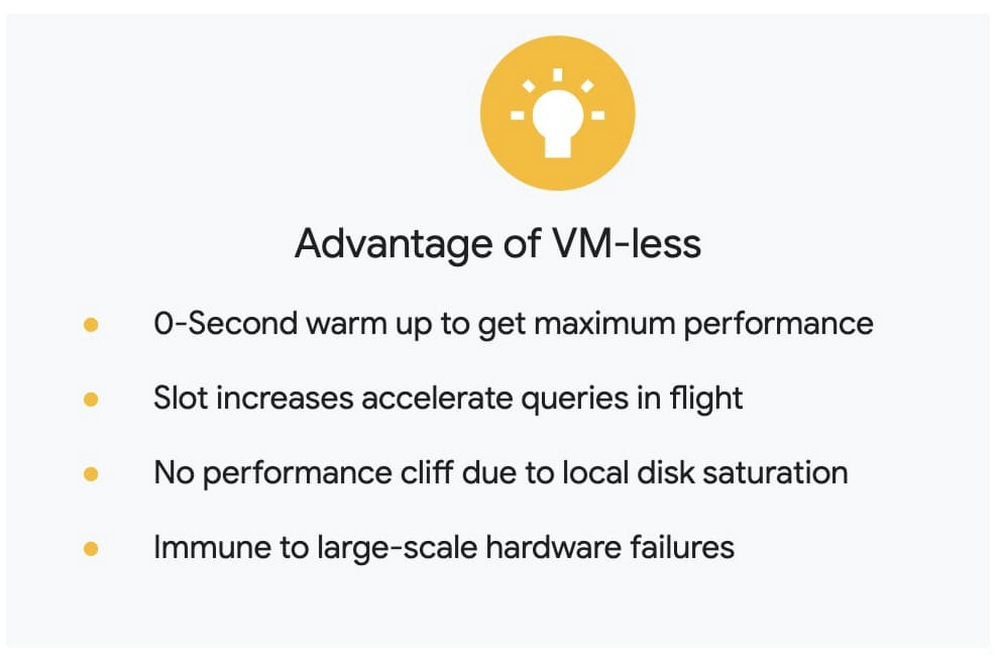
BigQuery is used by organizations of all sizes, and to meet the diverse needs of our users, BigQuery offers highly flexible pricing options. For enterprise customers, BigQuery’s flat-rate billing model is predictable and gives businesses direct control over cost and performance. We’re now making the flat-rate billing model even more accessible by lowering the minimum size to 100 slots, so you can get started faster and quicker.Starting now, you no longer need to purchase a minimum of 500 slots to take advantage of the slots billing model:Purchase as few as 100 slots at a timePurchase in increments of 100 slotsThis change applies to all commitment types—flex, monthly, and annual.Your price per slot remains the same, no matter how many slots you buy. These new billing changes can significantly lower the entry point for slots-based pricing. Here is an example of how this works:100 slots on an annual contract cost $1,700 per month.100 slots on a monthly commitment type cost $2,000 per month.100 flex slots cost just $4 per hour, or less than $0.07 per minute.We’ve heard that a lower-priced offering is especially relevant for organizations in emerging markets. “We have been using BigQuery as our single data warehouse, and using the 1,000 slots flat-rate option effectively,” said Yuan Gao, chief data officer in The Learnings Co., Ltd. “The 100-slot flat-rate offer will give us finer granularity to control the cost. When we have relatively small workloads, we can run them in one project with a 100-slot reservation, without affecting other workloads, with small and predictable costs.” About BigQuery slotsA slot is a virtual CPU used by BigQuery for data processing. When you purchase slots, BigQuery provisions dedicated capacity for your queries to use, and you pay for the seconds your slots were provisioned. For example, when you buy 1,000 slots with an annual commitment, you pay for 1,000 slots for 365 days, and all query costs are included in the price. The more slots you have, the better your throughput and performance. BigQuery’s architecture is serverless and VM-less. Because we don’t keep state in our compute nodes, BigQuery users get unique benefits, like no need to warm up to achieve maximum performance, and no performance cliffs associated with local disk limits.If you are considering switching from the bytes processed billing model to the slots billing model, consider that the bytes processed model gives users up to 2,000 slots or more. therefore, your query performance may not be as good with 100 slots. We recommend you monitor your slot usage and performance for the optimal number of slots to purchase.You can take advantage of the new 100 slots option by enabling BigQuery Reservations, an enterprise-grade workload and capacity management platform. With BigQuery Reservations, you can provision capacity in seconds and departmentalize it into isolated workloads and teams. To get started, head over to Introduction to BigQuery Reservations.To learn more, check out our Google Cloud Next ‘20: OnAir digital conference. This week is focused on data and analytics. My session, DA300: Awesome New Features to Help You Manage BigQuery, discusses in depth how to best utilize BigQuery slots and BigQuery Reservations.
Quelle: Google Cloud Platform
Data is the foundation for modern enterprises and it goes beyond just collecting and storing it. In a world where things are constantly changing, you need to be able to access and analyze data for insights to drive impactful business decisions. Big data is in our DNA: Google has been at the forefront of data-powered innovation for years, with the mission of organizing the world’s information and making it universally accessible and useful. Google was built to process and analyze large data sets, and the same technology that makes this happen is available for all businesses through our smart analytics platform.If there’s one lesson from this unpredictable year, it’s that we always need to be prepared for anything. Our customers trust us with their data, which is why our vision centers on offering an analytics platform with proven dependability and security for mission-critical workloads. At Google Cloud Next ‘20: OnAir this week, you’ll see our vision come to life across three core principles of our analytics platform: open, intelligent and flexible. Let’s take a deep dive into what’s new in data analytics, and what you can explore this week to help move your data strategy forward. Open platform that provides choice and portabilityWe know that you want options when you’re choosing analytics solutions. That includes choice of deployment across hybrid and multi-cloud , choice to leverage open source services (OSS) and the choice to leverage open APIs to ease migration and data access. BigQuery and its ecosystem of data products bring you an open platform, so you get maximum flexibility for managing analytical applications and data-driven solutions. That’s why we recently announced BigQuery Omni, a flexible, multi-cloud analytics solution that lets you analyze data in Google Cloud, AWS and Azure (coming soon) without moving data. Check out Analytics in a Multi-Cloud World with BigQuery Omni session to learn more.We also welcomed Looker into Google Cloud earlier this year. Looker is a data and analytics platform that runs on Google Cloud or the cloud of your choice, and can take advantage of the benefits of BigQuery. Looker allows data teams to unleash powerful data experiences and go beyond traditional reports and dashboards to deliver modern BI, integrated insights, data-driven workflows, and custom applications. Looker just announced Looker blocks for the complete Google Marketing Platform, and significant upgrades for application builders are now available in the Looker Marketplace. To learn more about these announcements, check out Looker’s Roadmap: 2020 & Beyond session or their post: New Looker feature enhancements for the data-driven workforce. We are also showing our first integration with Looker and BigQuery BI Engine in this session: Always Fast and Fresh Dashboards: Inside BigQuery BI Engine.Finally, we’re also providing a mix of managed services like Dataproc – What’s new in open source data processing and the ability to use open source languages like Spark and Presto with the BigQuery Storage API, allowing customers to continue using familiar tools across their data in Google Cloud. These are great examples of how we’re continuing to provide an open platform for our customers.Built-in intelligent services to do more with what you haveGoogle Cloud’s smart analytics platform provides intelligent services embedded into our tools and processes, so users don’t have to learn new things to take advantage of it. Businesses want to augment current solutions with AI and ML and optimize business outcomes with real-time intelligence. Google Cloud offers industry-leading AI services to improve those decisions and customer experiences.With BigQuery ML, for example, users can build custom ML models using standard SQL without moving data from the warehouse. We’ve recently added new models, including boosted trees using XGBoost, DNNs using TensorFlow, K-means clustering, matrix factorization, and more. We’re taking it further by leveraging these models to build real-time AI solutions like anomaly detection, pattern recognition, and predictive forecasting that can be used across multiple industries. These detailed and prescriptive design patterns help you build solutions that can find anomalies in log transactions, like with this telco, detect objects in video clips, or predict customer lifetime value (LTV). Demandbase is currently using BigQuery ML and will hone in on their use cases in What’s New in BigQuery ML, Featuring Demandbase.Flexibility so you can scale at the speed of businessFinally, we build data analytics tools that provide flexibility. We know that our customers span different industries and multiple use cases. For example, flexibility in BigQuery pricing models lets you uniquely mix and match pricing tiers across environments in order to meet demands and have direct control over cost and performance. Over the past year, we’ve announced Flex Slots, short-term analytics capacity bursts for as little as 60 seconds at a time; a 95% discounted BigQuery promotional offer for new customers with Trial Slots; and now, we’re announcing that you can purchase a minimum of 100 slots at a time in increments of 100 slots. This change applies to all commitment types—flex, monthly, and annual. We’ve heard from SMB and digital-native organizations that they wanted this new pricing tier, and it truly democratizes flat-rate pricing across these different segments. Learn more here.In addition, we’re catering to different customer needs across our portfolio. Data analysts prefer the familiar SQL interface, which they can access in the BigQuery UI, while data scientists prefer notebook environments, made possible using the Storage API and Dataproc Hub, and business analysts prefer an easy-to-consume BI interface like Looker and Tableau. In addition, you can use a familiar spreadsheet interface with Connected Sheets and natural language interface with the new Data QnA service to draw insights out of your data. For any of these interfaces, all the data lives in BigQuery, so you don’t need to worry about data silos or multiple copies of data. This is true democratization of analytics for everyone.Proven dependability for mission-critical workloadsFor all these things to work, you need a dependable platform that offers security, reliability, governance, and compliance for mission-critical applications. That is why we just announced 4 9s of availability for BigQuery—up to 99.99% availability with guaranteed SLAs, providing peace of mind that the platform will be available to handle all of your needs. We’re seeing adoption of our platform across retail, media and entertainment, telecommunications, financial services, transportation and more. You can check out sessions from customers including BlackRock, Iron Mountain, Twitter, MLB, Veolia, Verizon Media, Telus, Carto, Refinitiv, Geotab, Bluecore, and Demandbase. Tune in and watch all sessions across our 40+ breakout sessions to learn more from Googlers, customers, and partners, and find them all on-demand afterward. To get started with your data-driven transformation, download this HBR report to find out how data-to-value leaders succeed in driving results from their enterprise data strategy.
Quelle: Google Cloud Platform