2 Milliarden Euro: Telekom bekam Glasfaser beim Vectoring gefördert
Auch Vectoring wurde in Deutschland massiv gefördert. Über den Umweg des Glasfaserausbaus zum grauen Kasten (MFG) flossen über 1 Milliarde Euro. (Vectoring, DSL)
Quelle: Golem

Auch Vectoring wurde in Deutschland massiv gefördert. Über den Umweg des Glasfaserausbaus zum grauen Kasten (MFG) flossen über 1 Milliarde Euro. (Vectoring, DSL)
Quelle: Golem

Last year we released the Docker Dashboard as part of Docker Desktop, today we are excited to announce we are releasing the next piece of the dashboard to our community customers with a new Images UI. We have expanded the existing UI for your local machine with the ability to interact with your Docker images on Docker Hub and locally. This allows you to: display your local images, manage them (run, inspect, delete) through an intuitive UI without using the CLI. And for you images in Hub you can now view you repos or your teams repos and pull images directly from the UI.
To get started, Download the latest Docker Desktop release and load up the dashboard (we are also excited that we have given the dashboard an icon)
You will be able to see that we have also added a new sidebar to navigate between the two areas and we are planning to add new sections in here soon. To find out more about what’s coming or to give feedback on what you would like to see check out our public roadmap.
Let’s jump in and have a look at what we can do…
From the whale menu, you can access the “Dashboard” and then “Images” where you’ll see a summary and each image with its details: tag, image id, creation date, and size.
I can also see which of my images are being used by a running or stopped container with
Now I have all these images, I can have a go at running one of them.I will go for my standard demo my simple Whale, when I hover over the image line I can see I get two new buttons, I am going to start off by clicking ‘run’
This pops up a UI where you can either just ‘run’ or add in some values. In this instance I am just going to add a port mapping so I can see what is running in my container once I have started it.
Great this now takes me to my running container UI and I can see that my container is alive!
Next let’s look at clearing up what we have not used so far. I am going to start by hitting the clean up button we saw in the top right corner of our images UI
Then my UI changes, I am going to remove all my unused images, I can see I will free up 4gb which isn’t bad!
I hit remove up and I can then see after I accept the warning my clean up happens I only have my in use images remaining!
Now let’s have a look at our Hub images, as I am signed in I can just click on the remote repositories tab
Great! I can now see my repos in Hub along with my tags, I can either pull my image to then run it or I can switch between my Teams to see the repositories in my teams. If I click pull on one of my images, I can see this is started as it takes me back to my local image cache screen and shows me the progress of the download:
I’ve also created an “unboxing” walkthrough of the entire process. You can join me on a guided tour of the new features in this video.
We hope you are as excited as we are for the next piece of our Docker Dashboard, to get started you can download the latest Docker Desktop release to explore your local images. You can try out the Remote Repository functionality by signing into Docker Hub and pulling any of your existing images or if you are new why not try pulling a Docker Official Image like NGINX , retagging it and then having a go at pushing it from the UI.
The post The Docker Dashboard Welcomes Hub and Local Images appeared first on Docker Blog.
Quelle: https://blog.docker.com/feed/

Den 200 Millionen US-Dollar teuren Disney-Kinofilm Mulan gibt es bald auch bei der Konkurrenz – und das preisgünstiger als bei Disney+. (Disney+, Google)
Quelle: Golem

Indiens Jio ist bereits die Nummer 1 beim LTE-Mobilfunk in Indien. Nun wird das Glasfaser-Netz noch weiter ausgebaut. (Glasfaser, Mobilfunk)
Quelle: Golem

Durch die enorme Nachfrage und das geringe Angebot tritt die Marktwirtschaft in Kraft: Die Geforce RTX 3080 und 3090 sind momentan teurer. (Nvidia, Grafikhardware)
Quelle: Golem

Wer Fernsehen guckt, erwartet durchaus, Werbung zu sehen – allerdings nicht im Menü seines Fernsehers. Das Kartellamt hat Samsung nun dafür kritisiert. (Samsung, Heimkino)
Quelle: Golem

Bisher lässt sich die Kommunikation zwischen NTP-Servern und Clients nur schwer absichern. Der IETF-Standard NTS soll das ändern. (IETF, Internet)
Quelle: Golem
2020 has been a year of rapid change, unexpected challenges and new frontiers. In the face of this, government agencies, local leaders, and educational institutions worldwide have been challenged to reinvent their engagement with citizens, the way they accomplish their missions, and how they educate students. Despite its challenges, the pandemic has proven to be a crucible for rapid innovation and progress. Government and academic leaders have done heroes’ work, in some cases consolidating years’ worth of digital transformation into just days and weeks. They’ve spun up testing centers, unemployment websites, new citizen-facing call centers and digital classrooms, in some cases overnight, all while maintaining continuity of government services.At Google Cloud, we’re privileged to work side-by-side with our public sector customers during this time, as they respond to—and gradually begin to recover from—COVID-19. The pandemic has been a reminder of the incredible power of public and private sector partnership, and the positive impact we make together. With that spirit in mind, I’m thrilled to announce our first-ever Google Cloud Public Sector Summit. We invite all of our public sector customers across the globe to join us for a special, two-day virtual event, Dec. 8-9, where we’ll share lessons learned throughout this year and discuss the future of digital service. Here’s what you can expect at the Google Cloud Public Sector Summit:Hear from industry leaders: Join our keynotes and breakout sessions to hear industry experts discuss the latest trends and get a glimpse into the future of public sector work.Gather insights from your peers: Attend breakout sessions where government and education leaders will share their successes around fulfilling critical missions, scaling IT services, and building cultures of innovation. Engage with Google experts and partners: Request time for you or your team to engage live with Google solution experts and Google partners. Learn about Google’s purpose-built solutions for education and government: Hear about our security and compliance offerings and other solutions, including our student success platform, citizen services, workforce collaboration, cyber analytics, and more.The Google Cloud Public Sector Summit begins Dec. 8. Register today, at no cost, on the Public Sector Summit event website.
Quelle: Google Cloud Platform
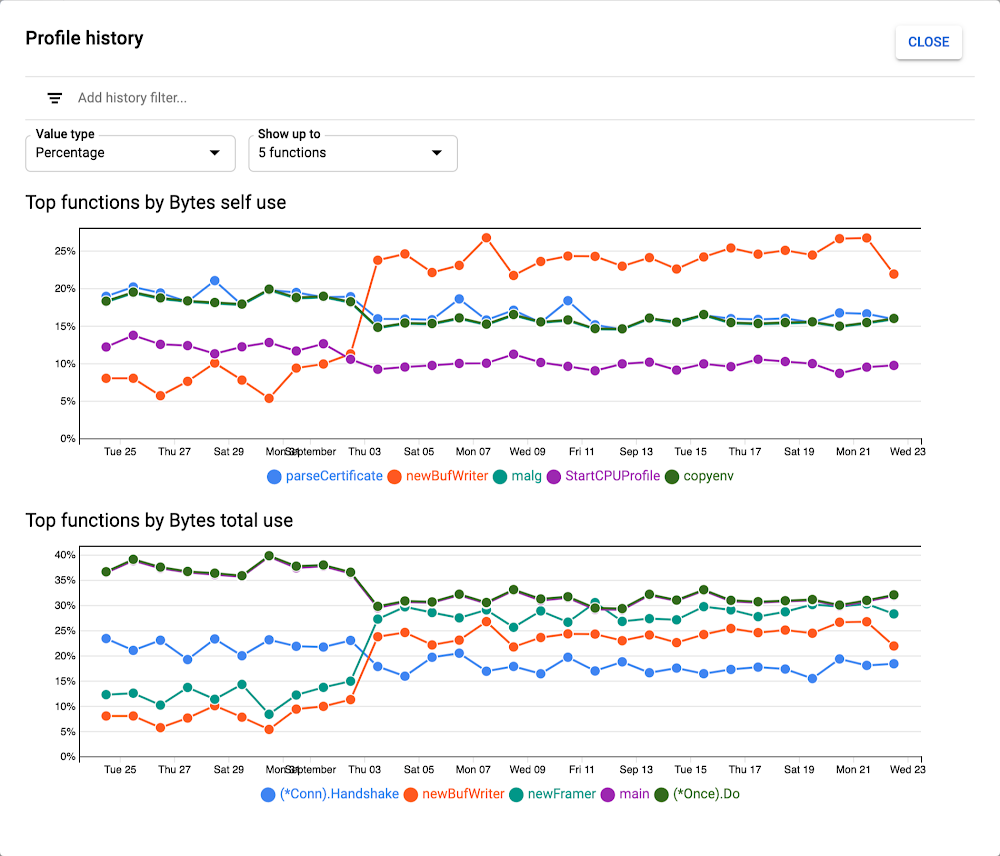
Cloud Profiler is a favorite of Google Cloud customers thanks to the insight that it provides into the performance of your production code. You can use this knowledge to reduce and shorten outages, improve performance, and optimize compute spend—always a popular topic! Profiler has always provided the ability to view and compare CPU and memory performance over time through time filters and the comparison feature. Now, Profiler lets you view the performance of a single function or a group of functions over time.You can access this using the history view button, which displays the new function history view window that shows the relative resource consumption of the most resource hungry functions within a given service.You can use the history view feature to do a number of different things:Intuitively understand the performance trends of the most resource-intensive functions over timeDiscover unintended resource usage changes. Large-scale or complex code changes can have unintended resource usage implications. Looking at the history view, you can verify that your code changes didn’t introduce unintended performance or resource usage changes.Verify the performance impact of recent code changes.Rapidly find the root cause of an outage of severe performance regression. If a service has stalled due to high CPU or memory consumption, looking at the history of each function’s resource consumption will provide insight into when and what parts of the code recently started using more resources.Characterize how a codebase’s performance changes due to external factors such as usage spikes (this can also be visualized with Profiler’s weight filter) or known changes in usage patterns.Profiler history view is available immediately as a preview for all users. Read more about how to use this feature.If you are new to Profiler, our Quickstart or codelab can help you get started.
Quelle: Google Cloud Platform

The benefits of containers and Kubernetes over traditional on-premises architectures are well-documented and understood. But when considering moving to the cloud, organizations want controls to limit risk and potential exposure of their data.In July, we announced the availability of the Confidential Computing product family, whose breakthrough technology encrypts data in-use—while it is being processed—without any code changes to the application. We also introduced Confidential VMs as the first member of that product family, which perform at levels comparable to VMsA few weeks back we announced the upcoming launch of Confidential Google Kubernetes Engine (GKE) Nodes in preview. Today, as we kick off cybersecurity month, we are rolling out the preview for Confidential GKE Nodes. With Confidential GKE Nodes you can achieve encryption in-use for data processed inside your GKE cluster, without significant performance degradation. Built on Confidential VMs, which utilize the AMD Secure Encrypted Virtualization (SEV) feature, Confidential GKE Nodes encrypt the memory of your nodes and the workloads that run on top of them with a dedicated per-Node instance key that is generated and managed by the AMD Secure Processors, which is embedded in the AMD EPYC™ processor. These keys are generated by the AMD Secure Processor during node creation and reside solely within it, making them unavailable to Google or any VMs running on the host. This, combined with other existing solutions for encryption at rest and in-transit, and workload isolation models such asGKE Sandbox, provides an even deeper and multi-layer defense-in-depth protection against data exfiltration attacks. Confidential GKE Nodes also leverage Shielded GKE nodes to offer protection against rootkit and bootkits, helping to ensure the integrity of the operating system you run on your Confidential GKE Nodes.Enabling Confidential GKE NodesWhen creating a new cluster, you can enable Confidential GKE Nodes by specifying the –enable-confidential-nodes option:After you create a Confidential GKE cluster, all the nodes and node pools you create will be confidential.You can verify that your cluster is using Confidential GKE Nodes by using the describe command:gcloud beta container clusters describe [CLUSTER_NAME]If Confidential GKE Nodes are enabled, the output of the command will include these lines:confidentialNodes:enabled: trueEnabling applications to run with Confidential GKE NodesYou may be wondering what you need to change in your application to leverage Confidential GKE Nodes? The answer is nothing! Google’s approach to confidential computing is to enable an effortless lift and shift for existing applications so that all GKE workloads you run today can run on Confidential GKE Nodes without any code changes. Optionally, if you use a GitOps model for storing your application configurations, you can use the cloud.google.com/gke-confidential-nodes nodeSelector to declaratively ensure that your sensitive workloads can only be scheduled on Confidential GKE Nodes. This can be useful later on if you want to demonstrate to auditors that your workloads ran exclusively on Confidential GKE nodes:Tune in to our latest Google Cloud Security Talks to learn more about confidential computing, and other areas of cloud security.Related ArticleExpanding Google Cloud’s Confidential Computing portfolioGoogle Cloud Confidential Computing is now GA and including Confidential GKE Nodes.Read Article
Quelle: Google Cloud Platform






