Developer Transition Kit: Apples A12Z trotz Emulation flotter als Snapdragon 8cx
Vier statt acht Kerne plus leistungshemmende Übersetzungsschicht und dennoch ist das Apple Silicon sehr schnell. (Apple Silicon, Core i5)
Quelle: Golem

Vier statt acht Kerne plus leistungshemmende Übersetzungsschicht und dennoch ist das Apple Silicon sehr schnell. (Apple Silicon, Core i5)
Quelle: Golem

Der US-Präsident Trump verbreite “hasserfüllte Rede” und darf nicht mehr auf Twitch streamen. Trump-Anhänger verlieren ein großes Forum. (Donald Trump, Soziales Netz)
Quelle: Golem

Mehrere Nutzer, einschließlich eines Golem.de-Lesers, berichten von brummenden Geräuschen beim Surface Book 3. Es gibt eine Lösung. (Surface Book, Notebook)
Quelle: Golem

Mit Scan & Go brauchen Penny-Kunden beim Bezahlen nur noch einen QR-Code einzuscannen. (Bezahlen, Applikationen)
Quelle: Golem
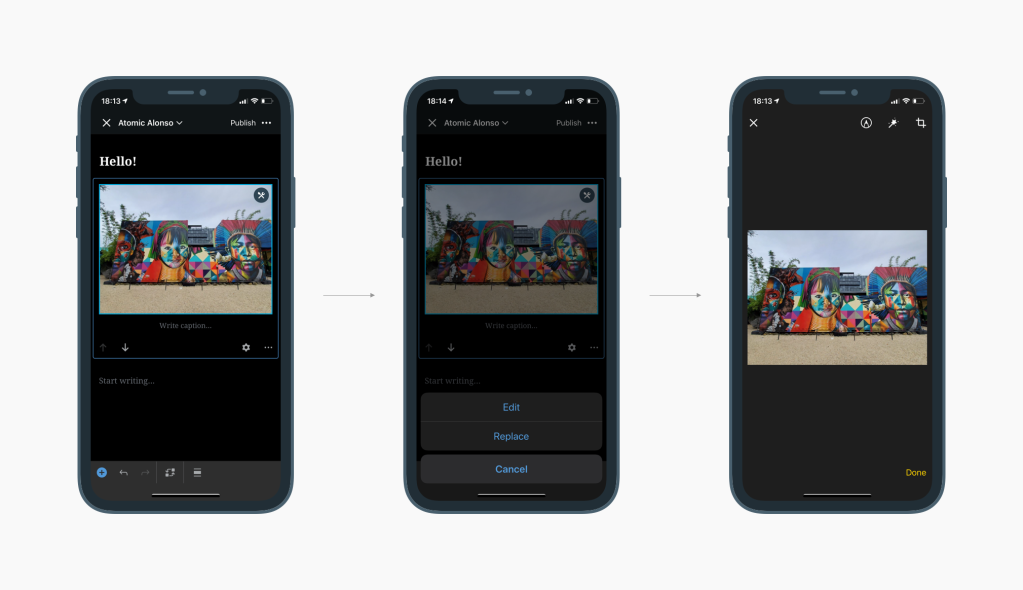
The WordPress app on your Android or iOS device is your companion wherever you go. Manage your site, write and publish, and even add images to your posts — from anywhere you are. Oftentimes, the most engaging posts include visuals, like the photos you take on the go: pictures from last week’s walk, snapshots of your afternoon picnic, or portraits of the family with your puppy.
Have you ever needed to edit your images on your phone? Maybe the lighting wasn’t quite right, or the framing and composition were off. You can now make small retouches right in the WordPress app, like cropping, rotating, and even adding a filter to change the mood of your photos.
Editing photos
You now have the option to edit an image. If your photo is already in the post, tap it, then tap the icon in the top right corner and select Edit. When you’re finished editing the image, tap Done and the previous image will be replaced with the new one.
If you’re adding a new image, you can edit it before inserting it into the post. For example, add a Gallery Block, tap Add Media, and select Choose from your device. Select one or multiple photos, then in the bottom left corner, tap Edit. Edit your image, tap Insert, and that’s it!
If you’re offline, you can still add, edit, and insert new images to a post.
Making small adjustments
Need to adjust or enhance an image? You can now rotate a photo or crop the borders:
Adding a filter or drawing over an image
If you’re using the iOS app, you can apply a filter to your picture:
And if you have iOS 13 or later, you can also draw over an image, either with your finger or with your Apple Pencil:
We’re thrilled about these new updates to the Media Editor! Let us know what you’d like to see in upcoming versions. We’d love to hear your feedback.
Quelle: RedHat Stack
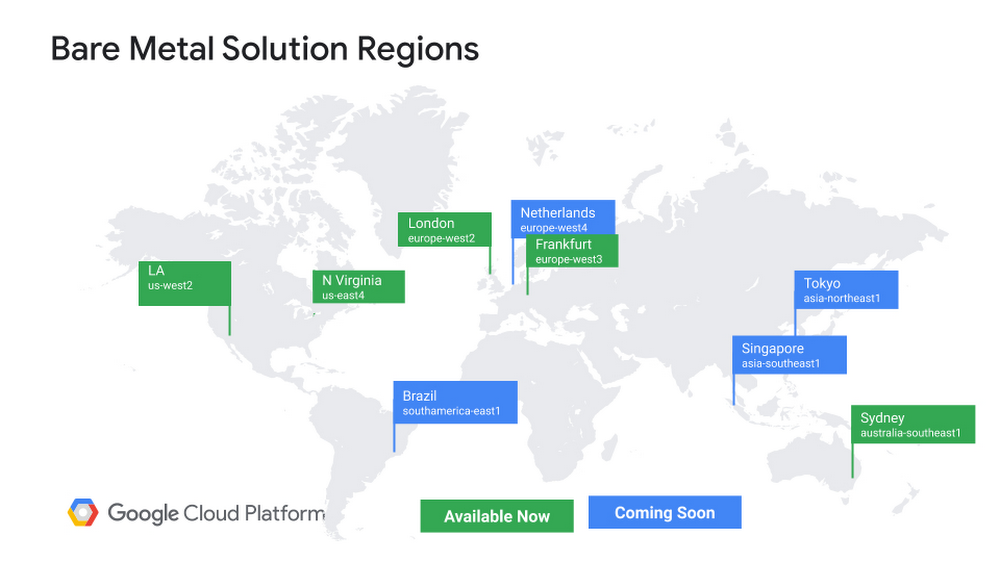
Last November, we announced Bare Metal Solution, which lets businesses run specialized workloads such as Oracle databases close to Google Cloud, while lowering overall costs and reducing risks associated with migration. Our next job was to make this solution global. Today, we’re announcing availability of Bare Metal Solution in five more regions: Ashburn, Virginia; Frankfurt; London; Los Angeles, California; and Sydney. By the end of this year we plan to launch four more sites: Amsterdam, São Paulo, Singapore, and Tokyo. Keep an eye out—Bare Metal Solution is coming to a Google Cloud data center near you!Click to enlargeEnabling specialized workloads in Google CloudBare Metal Solution is designed for the performance and high availability needs of mission-critical, enterprise-grade applications. To deliver that, Bare Metal Solution offers state-of-the-art dedicated servers based on 2nd Generation Intel Xeon Scalable Processors (Cascade Lake) that come in a variety of sizes. Depending on your needs, you can choose a Bare Metal server with as few as 16 cores, or all the way up to 112 cores with 3 terabytes of DRAM, all to handle your most demanding workloads. These servers are certified by almost all major software companies. We deploy Bare Metal Solution in a region extension with less than two millisecond latency to Google Cloud; in most cases we measured the latency to be sub-millisecond.One key aspect of any enterprise workload solution is storage performance and high availability. Bare Metal Solution leverages some of the world’s most advanced NVMe based storage that is fully tuned to provide a target level of IOPS and throughput out of the box. In addition, automated snapshots help provide data protection. Setting up networks can sometimes be an obstacle to deploying your enterprise applications quickly. Bare Metal Solution leverages our Partner Interconnect framework, delivering routing that’s pre-configured and optimized for your use case. This makes complex tasks such as setting up replication across sites a matter of a few clicks.With these features, Bare Metal Solution helps to make moving your workloads from your data center to Google Cloud a simple and quick task, while lowering overall costs and reducing migration risk. CloudBees, a leading provider of continuous delivery software services, recently used Bare Metal Solution to speed its migration to Google Cloud. “Google’s Bare Metal Solution provided us with ease of migration, and integration with Google Cloud services with little or no disruption to our current business processes. We are pleased with our experience with Bare Metal Solution—allowing us to easily leverage cloud-native databases.” – Francois Dechery, Chief Strategy Officer, CloudBees Built with a little help from our friends Bare Metal Solution leverages Google Cloud’s rich partner ecosystem to deliver important core functionality and optional add-on features. For example, Bare Metal Solution employs NetApp storage solution to support enterprise-class applications. Using NetApp’s NVMe storage technology provides enterprise-grade performance, while its industry-standard snapshot technology helps enhance Bare Metal Solution’s data protection capabilities. Our partner Actifio will provide add-on features to support backup and recovery. Actifio provides an integrated video of all of your data assets across Google Cloud in addition to a backup catalog and policy-based backups and restores. Actifio’s approach to copy data management reduces storage and software costs while lowering your time-to-recovery in the case of an outage. To learn more, please see Actifio’s blog post.In addition, Atos is delivering its Atos Database Hotel on top of Google’s Bare Metal Solution as a managed service for enterprise customers, providing organizations with a fully managed and secure cloud service, seamlessly integrated with Google Cloud, and leveraging Atos’ end-to-end orchestration, management, and infrastructure services.Taken together, we believe the mix of industry-leading technology and our partners’ expertise to enhance Bare Metal Solution can lower your implementation timelines and improve your overall user experience. Furthering our commitment to open source While developing Bare Metal Solution, we felt a responsibility to provide a differentiated experience to enterprise customers, in the form of an automation tool pack to help manage your specialized workloads, assist you with deployment, and help manage day-to-day functions such as backup. Using open-source Ansible IT automation, we created a toolkit to help you quickly install your databases, manage storage and set up your backups, and have made this toolkit available to everyone as open source on GitHub. In summaryWe at Google Cloud remain committed to building a cloud that meets and exceeds your expectations. Bare Metal Solution represents another step in that direction, helping to lower the cost of running enterprise workloads, reducing the risks associated with cloud migration, and making you the driver of your modernization journey. To learn more tune in to the Google Cloud Next ’20: OnAir session, Business Continuity with Oracle in Google Cloud, and visit the Bare Metal Solution website.
Quelle: Google Cloud Platform
It’s no secret that state governments in the U.S. have been asked to carry a heavy weight supporting their citizens during the COVID-19 pandemic. States have seen a rising volume of new unemployment requests, and other social services systems are being stressed like never before. At the same time, more state employees have transitioned to working from home and providing their services remotely. On top of all this, many states are trying to meet these challenges using decades-old legacy IT systems that were designed as the internet was gaining prominence and mobile was just a twinkle in technology’s eye. The coronavirus has shown what can happen when IT support systems get pushed to their limits. Governments have had to very quickly digitally transform their technology—making changes that would normally take months, or even years, in days. States provide support to citizens in all aspects of life, but the coronavirus has made that very difficult, given that shelter-at-home orders have increased states’ need to tap into more modern communication channels to connect with their citizens. States have responded by getting creative in the ways they’re handling the volume of requests, and many have turned to Google Cloud to help during these times when citizens need government support most. Agencies are transforming their service offerings to provide better customer service and rapid support that can scale to meet demand—no matter how high traffic gets, how citizens want to interact, or the status of legacy systems. Here’s a look at how states are addressing these challenges, and how Google Cloud is helping. Providing better service over the phone and webThis pandemic has left millions of people in need of state support, leading to unprecedented call volume and web traffic that many states’ legacy technology simply can’t support. With increased call volumes, it’s critical that employees can focus on cases that require the most expertise. Our Rapid Response Virtual Agent program can help agencies quickly develop and implement customized Contact Center AI virtual agents to respond to customers’ questions over chat, voice, and social channels—and deliver that information 24/7. This includes frequently asked questions, guidance from health authorities, locations for testing centers, and more. These features can help you efficiently deliver critical information, while alleviating the burden on your support staff.The Illinois Department of Employment Security (IDES) illustrates how this technology can help agencies provide better, faster customer service. Through Contact Center AI technology embedded in its Cisco Contact Center platform, IDES established an Automated Intelligent Virtual Web Agent and Intelligent Phone Agent to handle an influx of inbound calls and chats on its website, enabling the state to efficiently process 400,000 questions a day in 15,000 unique interactions. And the Virtual Phone Agent is answering 40,000 calls per day during after-hours. The service lets people interact in real time to offer immediate assistance to constituents with questions about eligibility, filing claims, and more. Another issue that comes up when lots of people are looking for information online at the same time is the risk of a critical website going down under the strain. Our content-delivery network (CDN)—the same one that supports other high-traffic Google services—can provide a backstop to help prevent your sites from crashing when traffic surges. Several state and local government websites, as well as healthcare providers, are turning to Google Cloud for our CDN offering for this very reason.Providing a more helpful user experienceSome users prefer to interact via a computer at home, others via a tablet or phone. For governments to serve all their constituents, they have to be able to make user experiences engaging and productive—no matter the device. Our modern, cloud-based architecture can help provide flexible user experiences and make changes on the fly, for the web or mobile devices.For example, the City of Chicago Public Health Department wanted to communicate directly with city residents experiencing COVID-19 symptoms. It worked with Google Cloud and MTX to build a health app, Chi COVID Coach, that will deliver important information and guidance directly to affected people. In a similar vein, Google Cloud and SpringML helped the City of Las Vegas build a COVID-19 intake application to manage placement of homeless patients at pop-up virus treatment centers in Las Vegas parking lots.Engaging with others remotelyOne of the biggest cultural changes COVID-19 has brought on is people relying on technology to interact virtually—for everything from meetings, to doctor’s appointments, to staying in touch with friends. But, it’s worth noting that remote work and other virtual interactions have been growing in popularity for years. Google Meet lets government employees, like social workers, engage with clients and deliver services virtually from the safety of their homes.We’re working with the Oklahoma State Department of Health, for instance, on solutions to help medical staff remotely engage with people who may have been exposed to the coronavirus. In under two days, the department deployed an app that lets medical staff follow up directly with people who reported symptoms and direct them to testing sites, if needed. In Georgia, there are a couple great examples of using Chromebooks with other Google technologies: Workers at the Georgia Department of Human Services Eligibility and Child Support are using Chromebooks to remotely access critical apps and data, while the Georgia Department of Community Supervision is using them to teleconference with Google Meet.Making legacy technology work for youIn the current environment, big IT projects like ripping out and replacing legacy IT systems are a non-starter for many government agencies. Our APIs (application programming interfaces) can help connect the modern technologies we’re discussing here with legacy mainframes and older IT systems. At the New York Department of Labor, for example, Google Cloud is working with the State Office of Information Technology Services to create a more user-friendly, streamlined, and reliable unemployment insurance application. The new system uses Google Cloud’s infrastructure to help increase reliability and allow the application to scale, so it can handle a high volume of users. In the first 24 hours of the updated application, more than 100,000 users successfully logged into the website.The past few months have changed the way we live and work. Public- and private-sector organizations alike are reimagining what’s possible and challenging the status quo to deliver digitally. Government agencies are moving with unheralded speed, innovation, and resiliency to modernize their legacy systems—and finding out along the way that this sort of transformation can provide benefits long into the future.
Quelle: Google Cloud Platform

Cloud Storage provides worldwide, highly durable object storage that scales to exabytes of data. This means customers of all sizes and industries can use it to store and protect any amount of data for a range of use cases, such as websites, mobile applications, backup and restore, archive, and big data analytics. The objects are stored in containers called buckets. Modern businesses typically collect data from internal and external sources at various frequencies throughout the day for batch and real-time processing. In most cases, if you’re an administrator or data engineer, it’s important to monitor when new files are received from an external source system and create alerts if the object count is less than expected. This helps in identifying any datasets that are missing due to source issues. This post walks you through setting up monitoring and alerting on object creation in Google Cloud Storage using data access logs and logs-based metrics. Data access audit logs contain API calls that read the configuration or metadata of resources, as well as user-driven API calls that create, modify, or read user-provided resource data. With this type of monitoring and alerting, you can ensure data quality and identify source system issues.Here’s a look at the architecture we’ll be using:Click to enlargeHere’s how to get started with monitoring and alerts. 1. Configure data access logs in your projectTo access audit log configuration options in the Cloud Console, follow these steps:From the Cloud Console, select IAM & Admin > Audit Logs from the upper left-hand overflow menu. Go to the Audit Logs page.Select an existing Google Cloud project, folder, or organization at the top of the page. In the main table on the Audit Logs page, select Google Cloud Storage by clicking on the box to the left of a service name in the Title column. In the Log Type tab in the information panel to the right of the table, select Data Write that you wish to enable and then click Save.After data access logs are enabled, every time you upload a file to the bucket you will be able to see a log created in your project.Click to enlarge2. Configure log-based metricIn the left pane, click Logging > Log-Based metricName the policy as Blog_demo.Provide the filter condition, as shown in the screenshot below. Note that the method name will be “storage.objects.create.” Replace bucket name with the name of the bucket you want to monitor and timestamp for which you want to monitor the logs.Click to enlargeA typical log entry for such a filter will look like this:Click to enlarge3. Create an alert in Cloud MonitoringIn the left pane, click Alerting > Create Policy.Name the policy as Blog_demo.Click Add Condition and create a condition for Cloud Storage data volume to fire an alert if no data is written within 10 minutes to the bucket.Here’s how the data looks from within Cloud Monitoring:Click to enlargeAs shown in the screenshot, the number of objects added to each bucket can be calculated by aligning the time series data into windows of 10 minutes each. For each window, the sum of all the underlying objects will give the final count.The thresholds for each bucket can be set up separately and can be used to trigger alerts.Learn more about data access logs and log-based metrics.
Quelle: Google Cloud Platform

We believe that enterprises that invest in building AI solutions are better positioned to be the industry leaders of tomorrow. Artificial intelligence (AI) can help organizations improve, scale, and automate the decision-making process across most business functions, while machine learning (ML) can create new opportunities and help you develop new revenue streams to grow your business. Together, they can drive significant value and give you a competitive advantage in your market. However, building an effective AI capability in your organization can present challenges, including: the technology you need to support building platforms and solutions, the people you need to implement and operate them, the data you need to fuel them, and the processes you need to govern them. When building an AI capability, executives often ask us: “Which skills should we hire and how should we structure our teams?”“What ML projects should we prioritise? ”“How do we implement responsible and explainable AI?” On the other hand, engineering leads often question: “How can we make data and ML assets discoverable, shareable, and reusable?”“How can we utilize cloud-native services to scale?”“How can we operationalize data processing and ML pipelines in production?”We created the Google Cloud AI Adoption Framework to help answer all these questions and more. This whitepaper aims to provide a guiding framework for technology leaders who want to leverage the power of AI to transform their business. It’s informed by Google’s own evolution, innovation, and thought leadership in AI, as well as many years of experience helping cloud customers—from startups to enterprises, in various industries—solve complex challenges. The AI Adoption Framework builds a structure on four areas: people, process, technology, and data. The interplay between these areas highlights six themes that are critical for success: Lead, Learn, Access, Scale, Automate, and Secure.Lead refers to the extent that leadership provides support and encouragement for data scientists and engineers to apply ML to business use cases, and the degree to which they are cross-functional, collaborative, and self-motivated.Learn entails the quality and scale of learning programs to upskill your staff, hiring talented people, and augmenting your data science and ML engineering staff with experienced partners.Access is about recognizing data management as a key element for enabling AI, and the degree to which data scientists and ML engineers can share, discover, and reuse data assets and other ML artifacts.Scale covers how you can use cloud-native services to scale with big datasets and a large number of data processing and ML jobs to reduce operational overhead.Secure addresses how you can classify and protect your sensitive data, as well as ensure that you’re implementing responsible and explainable AI practices.Automate encompasses the ability to deploy, execute, and operate technology for data processing and ML pipelines in production efficiently, frequently, and reliably.Successfully adopting AI in your business is determined by your current business practices in these areas, each of which will fall into one of three maturity phases: tactical, strategic,ortransformational. Knowing how mature your business is in each of these categories can help you determine where you are on your AI adoption journey today, and where you’d like to be.Download the whitepaper to learn more.AcknowledgementsThis whitepaper was authored by Donna Schut, Khalid Salama, Finn Toner, Barbara Fusinska, Valentine Fontama, and Lak Lakshmanan with valuable contributions from many teams across Google, including the Office of the CTO, ML Specialists, Solution Engineering, Professional Services, and Cloud AI.
Quelle: Google Cloud Platform

Last month at Microsoft Build 2020, we announced the new features for Azure Digital Twins, the IoT platform that enables the creation of next-generation IoT connected solutions that model the real world. Today, we are announcing that these updated capabilities are now available in preview. Using the power of IoT, businesses have gained unprecedented insights into their assets. But as connected solutions continue to evolve, companies are looking for ways to create richer models of entire business environments, which is quite challenging even for sophisticated businesses.
Our goal with Azure Digital Twins is to make the creation of sophisticated digital twin solutions easy. With today’s announcement, you can apply your domain expertise on top of Azure Digital Twins to design and build comprehensive digital models of entire environments.
Using Azure Digital Twins, you can gain insights that drive better products, optimization of operations, cost reduction, and breakthrough customer experiences. And you can now do so across environments of all types, including buildings, factories, farms, energy networks, railways, stadiums—even entire cities.
What’s new?
We received a lot of valuable feedback from the Azure Digital Twins preview and we are excited to share the expanded capabilities of Azure Digital Twins that will simplify and accelerate your creation of IoT connected solutions.
Open modeling language
The new preview of Azure Digital Twins lets you create custom models of any connected environment. The new preview of Azure Digital Twins lets you create custom models of any connected environment. Using the rich and flexible Digital Twins Definition Language (DTDL), based on the JSON-LD standard, you can configure your Azure Digital Twins service to tailor to the specific needs of your use case.
Real-world environments are created from connected twins. Each twin is modeled using properties, telemetry events, components, and relationships that define how twins can be connected into rich knowledge graphs. DTDL is also used for models throughout other Azure IoT services, including IoT Plug and Play and Azure Time Series Insights.
DTDL is the glue that helps you keep your Azure Digital Twins solution connected and compatible with other parts of the Azure ecosystem.
As part of our commitment to openness and interoperability, we will continue to promote best practices and shared digital twin models for a wide range of businesses and industry domains through the Digital Twins Consortium and other channels to accelerate your time building valuable IoT connected solutions that span many industry verticals and use cases.
Live execution environment
Azure Digital Twins lets you bring your digital twins to life using data from IoT and other data sources, creating an always-up-to-date digital representation of your environment that is scalable and secure.
Using a robust event system, you can build dynamic business logic and data processing as data flows through the execution environment, and now, you can harness the power of external compute resources, such as Azure Functions. This makes it easy to use pre-existing code with Azure Digital Twins, which provides freedom of choice in terms of programming languages and compute models.
To extract insights from the live execution environment, Azure Digital Twins provides a powerful query system that allows you to search for twins based on a wide range of conditions and relationships.
Input from IoT and business systems
You can easily connect assets such as IoT and IoT Edge devices, as well as existing business systems such as ERP and CRM, to Azure Digital Twins to drive the live execution environment.
You can now use a new or existing Azure IoT Hub to connect, monitor, and manage all of your assets at scale, taking advantage of the full device management capabilities that IoT Hub provides. The ability to use any existing Hub makes it easier to add Azure Digital Twins to existing IoT solutions incrementally.
Using the Azure Digital Twins REST APIs, you can also use data sources other than IoT, unlocking even more actionable insights with Azure Digital Twins.
Output to Azure Time Series Insight, storage, and analytics
You can integrate Azure Digital Twins with other Azure services to build complete end-to-end solutions. You can define event routes that send selected data to downstream services through endpoints that support Event Hubs, Event Grid, or Service Bus Event routes to send data to Azure Data Lake for long term storage; to data analytics services such as Azure Synapse Analytics to apply machine learning; to Logic Apps for workflow integration; or to Power BI to extract insights. Another important use case is time series data integration and historian analytics with Azure Time Series Insight.
Combined, these capabilities greatly simplify today’s difficult tasks of modeling and creating a digital representation of an environment, helping you focus on what differentiates your business rather than building and operating complex, distributed systems architecture securely and at scale.
Innovating with customers and partners
Azure Digital Twins is already being used by a broad set of customers and partners. Below are a few examples showcasing the applicability of Azure Digital Twins across a wide range of industries:
Ansys Twin Builder: physics-based digital twins
Physics-based simulation has long been an essential part of the product design process, helping engineers to optimize and validate design choices. With the broad deployment of IoT sensors in products and their environment, it is now possible to apply the same simulation technology after a product has been built, shipped and deployed in the field. Simulation technology can be used to optimize performance and energy usage or predict failures in a highly accurate and immediate way, without the complexities associated with alternative techniques.
“Ansys Twin Builder lets engineers quickly deliver real-time simulation models for operational use. With Microsoft’s Azure Digital Twins platform, it is now possible to efficiently integrate the simulation-based twins into a broader IoT solution.” —Sameer Kher, Senior Director,Twin Builder Product Line for Ansys
Bentley iTwin: infrastructure digital twins
In the world of infrastructure development, complex CAD data is the backbone of planning, execution and operation of major infrastructures, such as road and rail networks, public works and utilities, industrial plants, and commercial and institutional facilities. Bentley’s iTwin platform captures geometry and metadata of the project and its environment as the source of truth that drives daily decisions throughout the entire lifecycle of the project. As a developer, you can think of it as GitHub for CAD.
“Using Azure Digital Twins, we can bring this backbone to life using raw and processed information from IoT sensors distributed throughout the infrastructure. By bringing a wide range of information sources together into a comprehensive Digital Twin, including CAD data, real-world scans and photometry, IoT sensor data, weather feeds and many more, we can revolutionize the way infrastructure projects are planned, built and operated.” —Pavan Emani, Vice President, iTwin software development for Bentley
To learn more about the customers and partners using Azure Digital Twins in exciting ways, we encourage you to visit the customer stories covering a spectrum of industry use cases.
Get started
We look forward to continuing to deliver on our commitment of simplifying and accelerating your time to value building next-generation IoT connected solutions. We are excited about the role Azure Digital Twins will play helping you gain valuable insights across your environments.
Watch this video to learn more:
Get started with Azure Digital Twins today.
Visit the Azure Digital Twins product page.
See the Azure Digital Twins documentation and quick start guides.
Watch the Deep Dive: Azure Digital Twins webinar for technical walkthrough. Join event at 9 AM PT June 29, 2020 for Live Q & A.
Watch the Deep Dive: Bentley and Azure Digital Twins webinar for architectural overview. Join event at 9 AM PT August 3, 2020 for Live Q & A.
Watch how Bentley uses Azure Digital Twins to build Bentley iTwin solution.
Watch the Azure Digital Twins Microsoft Build event session.
Read our customer stories from Ansys and Bentley.
Read Announcing Azure Digital Twins: Create digital replicas of spaces and infrastructure using cloud, AI and IoT to get familiar with the previous release.
Quelle: Azure






