Celebrating Pride Month: Perspectives on Identity, Diversity, Communication, and Change

Throughout June, we’ve published a series of Q&As at WordPress Discover featuring members of the Automattic team. These conversations explore personal journeys; reflections on identity; and diversity and inclusion in tech, design, and the workplace. Here are highlights from these interviews.

“In a World That Wants You to Apologize or Minimize Who You Are, Don’t.”

Gina Gowins is an HR operations magician on the Human League, our global human resources team. In this interview, Gina examines identity and language; communication and trust-building in a distributed, mostly text-based environment; and how her life experiences have informed her work.

I am particularly attached to the term queer as a repurposing of a word that was once used to isolate and disempower people — it was used to call people out as problematically different and other. From my perspective, there is no normal and no other; instead, we are all individual and unique. Identifying as queer allows me to take pride in my own individuality.Language changes over time, and how we use language shapes our values and thinking. In a culture that is aggressively governed by heteronormative values and where it can still be dangerous and lonely to be LGBTQIA+ — such as the United States, where I live — defining myself as queer is also my small act of defiance. It is a reminder of the consistent fight for acceptance, inclusion, and justice that so many people face, and our inherent value and validity as humans.

Read Gina’s interview

“Reflect What Is Given, and In So Doing Change It a Little”

Echo Gregor is a software engineer on Jetpack’s Voyager team, working on new features that “expand Jetpack’s frontiers.” In this conversation, Echo talks about gender identity, pronouns, and names; and how xer identity and experiences have impacted xer approach to development and work in general.

Earlier in my transition, I called myself “E” sort of as a placeholder while I pondered name things. One late night, on the way home from a party, I had a friend ask if they could call me Echo, as it was the callsign equivalent for “E.” I immediately fell in love with the name, and gradually started using it more and more, until I made it my legal name.I like that it’s simple and doesn’t have many gendered connotations in the modern world. I also appreciate it’s mythological origin! In the myth, Echo was a mountain nymph cursed by the goddess Hera — to be unable to speak, and only repeat the last words said to her.I think there’s a lot of parallels in our world to that idea. We’re part of systems that are so much bigger than us that it’s rare any one of us can be loud enough to bring meaningful change, to speak new words. But echoes don’t perfectly repeat things. They reflect what is given, and in so doing change it a little. I like to try and live up to that by bringing a bit of change to the world, not by being the loudest, but by reflecting things back in my own way.

Read Echo’s interview

“Living My Life Freely and Authentically”

Mel Choyce-Dwan is a product designer on the theme team. In this Q&A, Mel tells us how she got involved with the WordPress community through a previous WordCamp, about her observations of tech events as a queer designer, and about the importance of inclusive design.

Show a lot of different kinds of people in your writing and your imagery, and don’t make assumptions. Talk to people from the communities you’re representing if you can, or read about their own experiences from their perspectives. Don’t assume you know better than someone else’s lived experience. When in doubt, talk to people.And don’t just talk to people about how your product should work, talk about how it shouldn’t work. Talk about how people think others could hurt them using your product. People of marginalized identities often have stories of being harassed, stalked, or abused on the web. We need to think about how our products can be used for harm before — not after — the harassment.

Read Mel’s interview

“Every Person and Voice Has the Opportunity to Be Heard”

Niesha Sweet, a people experience wrangler on the Human League, says she feels like she was destined to work at Automattic. In this final interview, Niesha reflects on her Pride Month traditions and what she finds most rewarding about her HR work.

I would say that we all have to apply an additional level of empathy, understanding, and openness when working together. Just with communication alone — English is not the first language for some Automatticians, and some cultures’ communication style is direct. Assuming positive intent and having an additional level of empathy for one another allows us to effectively communicate with each other, while also appreciating our differences. The reward that comes with our diverse workforce is that every person and voice has the opportunity to be heard. Impostor syndrome is real, so some Automatticians may not feel as though they can share their ideas with anyone at the company, but we truly can. Our level of diversity is truly outside of what the typical company is aiming to achieve. That’s not to say we’re not looking to hire more diverse Automatticians, or increase our workforce with non-US hires, but we’re not limited by age, sexual orientation, race, and gender identity. Diversity has a different meaning in a lot of the countries where we have Automatticians, and that alone is rewarding. 

Read Niesha’s interview

Learn more about diversity and inclusion at Automattic. We’re currently hiring — apply to work with us!
Quelle: RedHat Stack

Reinforcing our commitment to privacy with accredited ISO/IEC 27701 certification

For decades, there has been a growing focus on privacy in technology, with laws such as the EU’s General Data Protection Regulation (GDPR), the California Consumer Privacy Act, and the Australian Privacy Principlesproviding guidance on how to protect and maintain user privacy. Privacy has always been a priority at Google, and we’re continuously evolving to help our customers directly address global privacy and data protection requirements. Today, we’re pleased to announce that Google Cloud is the first major cloud provider to receive an accredited ISO/IEC 27701 certification as a data processor. Published in 2019, ISO/IEC 27701 is a global standard designed to help organizations align with international privacy frameworks and laws. It provides guidance for implementing, maintaining, and continuously improving a Privacy Information Management System (PIMS), and can be used by both data controllers and processors—a key consideration for organizations that must align with the GDPR. ISO/IEC 27701 is an extension of the security industry best practices that are codified in ISO/IEC 27001, which outlines and provides the requirements for an information security management system (ISMS).  Unlocking the benefits of ISO 27701Coalfire ISO, an independent third party, issued an accredited certificate of registration for ISO/IEC 27701 to Google Cloud Platform (GCP). This accredited certificate shows that Google’s PIMS for GCP (as shown in the certificate’s scope) conforms to the ISO/IEC 27701 requirements, and that the body conducting the audit and issuing the certificate did so in accordance with the International Accreditation Forum (IAF)/ANSI National Accreditation Board (ANAB) requirements. This means that the certificate will be recognized by other IAF-accredited audit and certification bodies under the IAF Multilateral Recognition Agreement (MLA). Ouraccredited certification demonstrates Google Cloud’s long-standing commitment to privacy and providing the most trusted experience for our customers. By meeting the rigorous standards outlined by ISO/IEC 27701, Google Cloud customers can leverage the many benefits our certification, including:A universal set of privacy controls, verified by a trusted third party in accordance with the requirements of their accreditation body, that can serve as a solid foundation for the implementation of a privacy programThe ability to rely on Google Cloud Platform’s accredited ISO/IEC 27701 certification in your own compliance effortsReduced time and expense for both internal and third-party auditors, who can now demonstrate compliance with several privacy objectives within a single audit cycleGreater clarity on privacy-related roles and responsibilities, which can facilitate efforts to comply with privacy regulations such as GDPROur commitment to customersCertifications provide independent validation of our ongoing commitment to world-class security and privacy, while also helping customers with their own compliance efforts. You can find more information on Google Cloud’s compliance efforts and our commitment to privacy in our compliance resource center.
Quelle: Google Cloud Platform

Dataproc Metastore: Fully managed Hive metastore now available for alpha testing

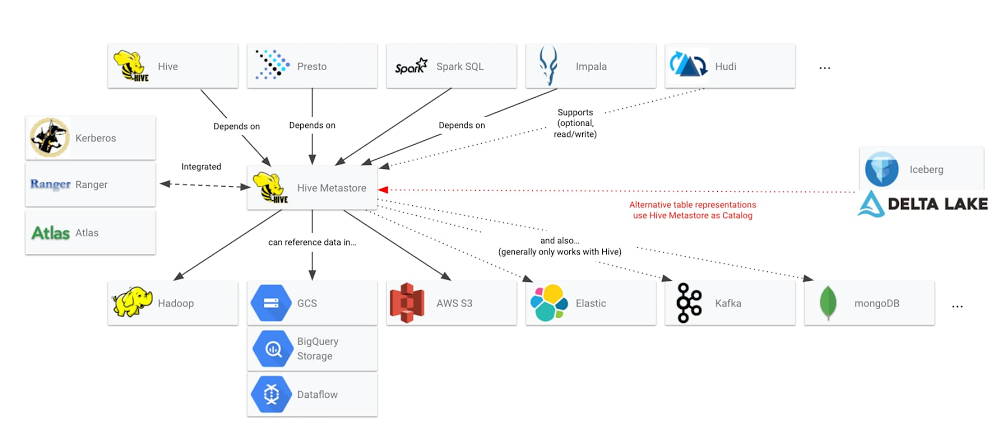
Google Cloud is announcing a new data lake building block for our smart analytics platform: Dataproc Metastore, a fully managed, highly available, auto-healing, open source Apache Hive metastore service that simplifies technical metadata management for customers building data lakes on Google Cloud. With Dataproc Metastore, you now have a completely serverless option for several use cases:A centralized metadata repository that can be shared among various ephemeral Dataproc clusters running different open source engines, such as Apache Spark, Apache Hive, and Presto;A metadata bridge between open source tables and code-free ETL/ELT with Data Fusion; A unified view of your open source tables across Google Cloud, providing interoperability between cloud-native services like Dataproc and various other open source-based partner offerings on Google Cloud.To get started with Dataproc Metastore today, join our alpha program by reaching out by email: join-dataproc-metastore-alpha@google.com.Why Hive Metastore?A core benefit of Dataproc is that it lets you create a fully configured, autoscaling, Hadoop and Spark cluster in around 90 seconds. This rapid creation and flexible compute platform makes it possible to treat cluster creation and job processing as a single entity. When the job completes, the cluster can terminate and you pay only for the Dataproc resources required to run your jobs. However, information about tables—the metadata—that was created during those jobs is not always something that you want to be thrown out with the cluster. You often want to keep that table information between jobs or make the metadata available to other clusters and other processing engines. If you use open source technologies in your data lakes, you likely already use the Hive Metastore as the trusted metastore for big data processing. Hive metastore has achieved standardization as the mechanism that open source data systems use to share data structures. The below diagram demonstrates just some of the ecosystem that is already built around Hive Metastore’s capabilities.Click to enlargeHowever, this same Hive Metastore can be a friction point for customers who need to run their data lakes on Google Cloud. Today, Dataproc customers will often use Cloud SQL to persist Hive metadata off-cluster. But we’ve heard about some challenges with this:You must self-manage and troubleshoot the RDBMS Cloud SQL instance.Hive servers are managed independently of RDBMS: This can create both scalability issues for incoming connections, and locking issues in the database. The CloudSQL instance is a single point of failure that requires a maintenance window with downtime, making it impossible to use with data lakes that need always-on processing. This architecture requires that direct JDBC access be provided to each cluster, which can introduce security risks when used with sensitive data.  In order to trust that the Hive Metastore can serve in the critical path for all your data processing jobs, your other option is to move beyond the CloudSQL workaround and spend significant time architecting a highly available IaaS layer that includes load balancing, autoscaling, installations and updates, testing, and backups. However, the Dataproc Metastore abstracts all of this toil and provides these as features in a managed service. Enterprise customers have told us they want a managed Hive Metastore that they can rely on for running business-critical data workloads in Google Cloud data lakes. In addition, customers have expressed a desire for the full, open source-based Hive metastore catalog that maintains their integration points with numerous applications, can provide table statistics for query optimization, and supports Kerberos authentication so that existing security models based on tools like Apache Ranger and Apache Atlas continue to function. We also hear that customers want to avoid a new client library that would require a rewrite of existing software or a “compatible” API that only offers limited functionality of the Hive metastore. Enterprise customers want to use the full features of the open source Hive metastore. The Dataproc Metastore team has accepted this challenge, and now provides a fully serverless Hive metastore service. The Dataproc Metastore complements the Google Cloud Data Catalog, a fully managed and highly scalable data discovery and metadata management service. Data Catalog empowers organizations to quickly discover, understand, and manage all their data with simple and easy-to-use search interfaces, while the Dataproc Metastore offers technical metadata interoperability among open source big data processing. Common use cases for Dataproc MetastoreFlexible analysis of your data lake with centralized metadata repositoryWhen German wholesale giant METRO moved their ecommerce data lake to Google Cloud, they were able to match daily events to compute processing and reduce infrastructure costs by 30% to 50%. The key to these types of gains when it comes to data lakes is severing the ties between storage and compute. By disconnecting the storage layer from compute clusters, your data lake gains flexibility. Not only can clusters come up and down as needed, but cluster specifications like vCPUs, GPUs, and RAM can be tailored to the specific needs of the jobs at hand. Dataproc already offers several features that help you achieve this flexibility.Cloud Storage Connector lets you take data off your cluster by providing Cloud Storage as a Hadoop Compatible File System (HCFS). Jobs based on data in the Hadoop Distributed File System (HDFS) can typically be converted to Cloud Storage with a simple file prefix change (more on HDFS vs. Cloud Storage here).Workflow Templates provides an easy-to-use mechanism for managing and executing workflows. You can specify a set of jobs to run on a managed cluster that gets created on demand and deleted when the jobs are finished. Dataproc Hub makes it easy to give data scientists, analysts, and engineers preconfigured Spark working environments in JupyterLab that automatically spawn and destroy Dataproc clusters without an administrator.   Now, with Dataproc Metastore, achieving flexible clusters is even easier for those clusters that want to share tables and schemas. Clusters of various shapes, sizes, and processing engines can safely and efficiently share the same tables and metadata simply by pointing a Dataproc cluster to a serverless Dataproc Metastore endpoint, as shown here:Serverless and code-free ETL/ELT with Dataproc Metastore and Data FusionWe’ve heard from customers that they’re able to use real-time data to improve customer service, network optimization, and more to save time and reach customers effectively. For companies building data pipelines, they can use Data Fusion, our fully managed, code-free, and cloud-native data integration service that lets you easily ingest and integrate data from various sources. Data Fusion is built with an open source core (CDAP), which offers a Hive source plugin. With this plugin, data scientists and other users of the data lake can share the structured results of their analysis using Dataproc Metastore, offering a shared repository that ETL/ELT developers can use to manage and productionize pipelines in the data lake. Below is one example of a workflow using Dataproc Metastore with Data Fusion to manage data pipelines, so you can go from unstructured raw data to a structured data warehouse without having to worry about running servers.Click to enlargeData scientists, data analysts, and data engineers log in to Dataproc Hub, which they use to spawn a personalized Dataproc cluster running a Juypter lab interface backed by Apache Spark processing. Unstructured raw data on Cloud Storage is analyzed, interpreted, and structured. Metadata about how to interpret Cloud Storage objects as structured tables is stored in Dataproc Metastore, allowing the personalized Dataproc cluster to be terminated without losing the metadata information.Data Fusion’s Hive connector uses the table created in the notebook as a data source via the thrift URL provided by Dataproc Metastore.Data Fusion reads the Cloud Storage data according to the structure provided by Dataproc Metastore. The data is harmonized with other data sources into a data warehouse table.The refined data table is written to BigQuery, Google Cloud’s serverless data warehouse.BigQuery tables are made available to Apache Spark on Jupyter Notebooks for further data lake queries and analysis with the Apache Spark BigQuery Connector.  Partner ecosystem accelerates Dataproc Metastore deployments across multi-cloud and hybrid data lakesAt Google, we believe in an open cloud, and Dataproc Metastore is built with our leading open source-centric partners in mind. Because Dataproc Metastore provides compatibility with open source Apache Hive Metastore, you can integrate Google Cloud partner services into your hybrid data lake architectures without having to give up metadata interoperability. Google Cloud-native services and open source applications can work in tandem. Collibra provides hybrid data lake visibility with Dataproc MetastoreIntegrating Dataproc Metastore with Collibra Data Catalog provides enterprises with enterprise-wide visibility across on-prem and cloud data lakes. Since Dataproc Metastore was built on top of Hive metastore, Collibra could quickly integrate into the solution without having to worry about proprietary data formats or APIs. “Dataproc Metastore provides a fully managed Hive metastore, and Collibra layers on data set discovery and governance, which is critical for any business looking to meet the strictest internal and external compliance standards,” says Chandra Papudesu, VP product management, Catalog and Lineage for Collibra.Qubole provides a single view of metadata across data lakesQubole’s open data lake platform provides end-to-end data lake services, such as continuous data engineering, financial governance, analytics, and machine learning with near-zero administration on any cloud. As enterprises continue to execute a multi-cloud strategy with Qubole, it’s critical to have one centralized view of your metadata for data discovery and governance. “Qubole’s co-founders led the Apache Hive project, which has spawned into many impactful projects and contributors globally,” said Anita Thomas, director of product management at Qubole. “Qubole’s platform has used a Hive metastore since its inception, and now with Google’s launch of an open metastore service, our joint customers have multiple options to deploy a fully managed, central metadata catalog for their machine learning, ad-hoc or streaming analytics applications,” Pricing During the alpha phase, you will not be charged for testing this service. However, under NDA, you can be provided a tentative price list to evaluate the value of Dataproc Metastore against the proposed fees. Sign up for the alpha testing program for Dataproc Metastore now.
Quelle: Google Cloud Platform