What is zero trust identity security?

A zero trust network is one in which no person, device, or network enjoys inherent trust. All trust, which allows access to information, must be earned, and the first step of that is demonstrating valid identity. A system needs to know who you are, confidently, before it can determine what you should have access to. Add to that the understanding of what you can access–authorization–and you’ve got the core foundation of zero trust security.At Google we rely on a zero trust system known as BeyondCorp, to move beyond the idea of a privileged corporate network.In this issue of GCP Comics we discuss ways of acquiring trust, as our friend attempts to visit some distant relatives.Why set up a zero trust model?Here are a few compelling reasons for setting up a zero trust system:Preserve the productivity of your employees working from home, from the office, from a coffee shop, or from anywhere elseDeploy quickly, faster than a traditional VPN system, for rapid onboardingSpin up new device access quickly in case of unexpected latté-applied-to-laptop and similar incidentsGive each web application its own access control, for precise security and lower riskDecide access based on identity, device health, location, time of day, or other factorsGoogle zero trust tools can protect your workloads on any public cloud, or on-premises, so you don’t need to move your applications to improve their securityBenefits of zero trustLower friction Zero trust systems can be invisible to the employees at your company. They sign in, they use a strong second factor, and they are ready to go. PortabilityThe authentication and authorization aren’t tied to your location. Previous methods of access control relied on trusted networks, giving privileged access to anyone inside the established corporate network. With a zero trust model it’s easy to work from home and access all the same systems and tools.SafetySwitching to a zero trust system has helped Google, and many other enterprises, reduce their exposure and minimize security incidents, proactively stopping phishing-based attacks and lateral movement after a compromise.ResourcesBeyondCorp Remote Access, our enterprise grade security offering for protecting workloads on Google Cloud, other clouds, or on-premisesBeyondCorp at Google, our own zero trust implementationPublished research papers on how Google created, deployed, and evolved the BeyondCorp model.Identity-Aware Proxy, The Google Cloud protective layer used to create context-based access to apps, VMs, and services.Want more GCP Comics? Visit gcpcomics.com & follow us on Twitter at @pvergadia and @maxsaltonstall  for updates on the next issue!Related ArticleKeep your teams working safely with BeyondCorp Remote AccessEnabling remote access to internal apps with a simpler and more secure approach without a remote-access VPNRead Article
Quelle: Google Cloud Platform

Mirantis Brings OpenStack to Kubernetes, Adding Private Cloud Capabilities to Mirantis Cloud Native Platform

The post Mirantis Brings OpenStack to Kubernetes, Adding Private Cloud Capabilities to Mirantis Cloud Native Platform appeared first on Mirantis | Ship Code Faster.
To help customers ship code faster, the new Mirantis OpenStack for Kubernetes combines Mirantis’ track record of enterprise success with both Kubernetes and OpenStack.
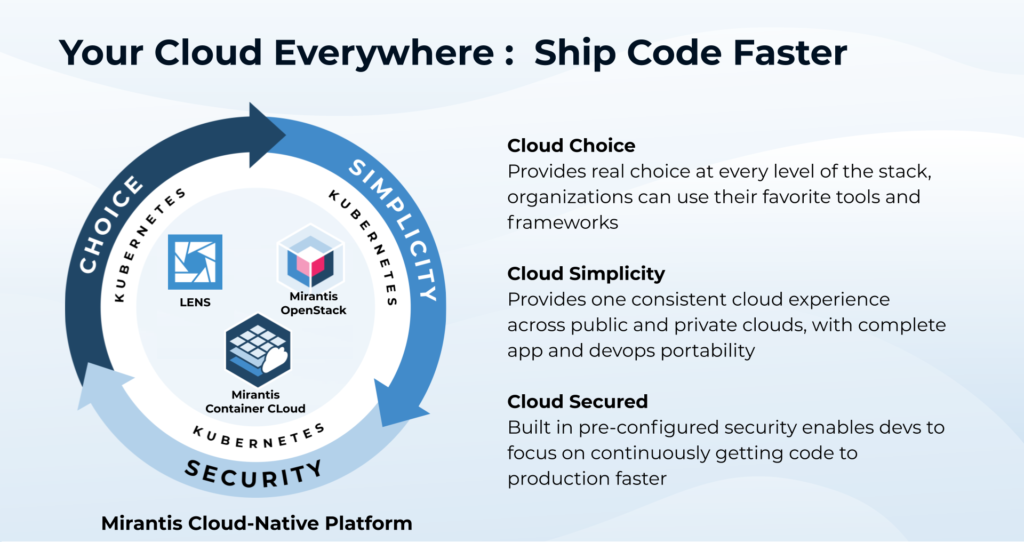
Campbell, CA, December 10, 2020 — Mirantis, the open cloud company, today announced the first in a planned series of enhancements to the Mirantis Cloud Native Platform, enabling customers to ship code faster on a Kubernetes foundation that provides simplicity, cloud choice and security. This first release, already available to Mirantis Container Cloud customers via continuous updates, adds the ability to deploy, scale, and update private clouds on Kubernetes substrates.
Building on this foundation, Mirantis today released Mirantis OpenStack for Kubernetes — a containerized edition of the open-source infrastructure-as-a-service (IaaS) platform chosen by Mirantis customers across industries and geographies to build some of the largest and best-performing private clouds in the world.
“Kubernetes and containers are superior technologies for building and releasing applications that run anywhere, scale gracefully, are resilient, and that can be updated without service downtime,” said Shaun O’Meara, global field CTO at Mirantis. “We engineered Mirantis Cloud Native Platform to deliver, monitor, and update Kubernetes clusters, anywhere — on bare metal, private, or public clouds — providing a simple, self-service experience for customers.”
Mirantis OpenStack for Kubernetes provides a feature-rich, mature environment for hosting both legacy apps and modern use cases such as Network Functions Virtualization, mobile network operations, and large-scale scientific computing. And it provides this without operational headaches — under the hood, leveraging Kubernetes to ensure configurability, resilience, robustness and seamless updates for OpenStack running on top of it.
“Organizations still need virtual machines and private cloud infrastructure to make them easy to consume and manage at scale — in many cases, hosting their most valuable applications,” said O’Meara. “At the same time, almost all are now moving forward with containers and Kubernetes, because they know these technologies will help them ship code faster and run applications with unprecedented resilience, scale, and economy. So Mirantis Cloud Native Platform addresses this whole continuum of needs, with maximum choice, simplicity, and security.”
By delivering a batteries-included, secure by default, and certified implementation of Kubernetes everywhere, and using it as a substrate for managing key applications and technologies, Mirantis Cloud Native Platform and Mirantis Container Cloud can deliver a simple cloud-like experience that supports all the development and hosting models organizations need (VMs, containers, orchestrators); managing the entire platform stack on any infrastructure (bare metal, private clouds, public clouds), and providing a unified management experience to smoothly operationalize these complex technologies across a diverse multi-cloud.
To learn more about Mirantis OpenStack for Kubernetes visit: https://www.mirantis.com/software/mirantis-openstack-for-kubernetes/ The post Mirantis Brings OpenStack to Kubernetes, Adding Private Cloud Capabilities to Mirantis Cloud Native Platform appeared first on Mirantis | Ship Code Faster.
Quelle: Mirantis

Announcing Mirantis OpenStack for Kubernetes

The post Announcing Mirantis OpenStack for Kubernetes appeared first on Mirantis | Ship Code Faster.
Today, Mirantis announced the general availability of Mirantis OpenStack for Kubernetes, a new offering now included in the Mirantis Cloud Native Platform. Existing users of Mirantis Container Cloud (formerly Docker Enterprise Container Cloud) will automatically receive the update, which lets them deploy containerized OpenStack control planes, Ceph storage, and compute hosts on Mirantis Kubernetes Engine (formerly Docker Enterprise/UCP).
What does this announcement mean?
Easy to use, resilient private clouds – Pragmatically, it means customers can use Mirantis Cloud Native Platform to air-drop classic private cloud capacity anywhere they have physical host capacity to run it (such as bare metal datacenters at HQ; distributed server farms at satellite locations; colos; medium-scale ‘edge’ server racks, etc. And then it lets them manage, observe, scale, and update this capacity via the same, smooth, public-cloud-like, centrally-administered, continuously-updated, self-service-oriented user experience Mirantis Container Cloud wraps around Kubernetes clusters.
In fact, if someone needs easy, self-service delivery of dev/test/production Kubernetes clouds in tandem with classic, mature virtual-machine hosting capability, they can use Mirantis Container Cloud to deploy Mirantis OpenStack, and then again to deploy Mirantis Kubernetes Engine clusters on virtual machines managed by OpenStack. Given the bare metal capacity, there’s probably no easier, faster way to bootstrap private infrastructure-as-a-service and use it to deliver dynamic container orchestration capability.
OpenStack — product of one of the world’s largest and most formidable open source communities — just celebrated its tenth anniversary. The Register and others marked the occasion with articles discussing the framework’s dominance in telecommunications, where it’s a preferred host for Network Functions Virtualization workloads, among other fields. OpenStack is today a very mature IaaS cloud solution that’s remarkably easy to use — complete with a sleek web interface (Horizon) and comprehensive APIs.
Why OpenStack on Kubernetes?
Using Kubernetes as a substrate for OpenStack solves “challenges” historically associated with running big, production OpenStack clouds (some of which will sound familiar to Kubernetes users).
MOS clusters leverage native Kubernetes features for resilience and adaptability. They use K8s operators to maintain cluster state, horizontal pod autoscaling to expand control-plane capacity under load, and seamless, zero-downtime Kubernetes rolling updates of OpenStack and other components. Containerized OpenStack components execute on Mirantis Container Runtime (formerly Docker Engine – Enterprise), which provides DISA STIG security, FIPS-140-2 encryption, and other characteristics making them suitable for use in gov/mil, financial services, and other regulated sectors.   
Mirantis Cloud Native Platform delivers Mirantis OpenStack for Kubernetes the same way  it does Mirantis Kubernetes Engine child clusters: ready for work, centrally administered, observed, and with Mirantis Container Cloud providing a single point of integration with corporate directory and other services. Mirantis OpenStack for Kubernetes clusters are delivered pre-instrumented and integrated with StackLight metrics, so users get observability out of the box. Mirantis Container Cloud also provides a single point of integration with enterprise directory, notifications, ticketing, etc., and top-level identity and access management, so Mirantis OpenStack clusters can be delivered with users, teams, tenants, SSH keys, etc. already provisioned for immediate use and secure access.

Kubernetes: Zamboni for the Multi-Cloud Hockey Rink
Mirantis OpenStack for Kubernetes also proves a point that Mirantis has embraced (and debated) internally for several years: that Kubernetes can work very well as a substrate for delivering and managing complex and even reputedly “tricky” applications, while giving users maximum choice in where their applications run.
As Shaun O’Meara, Global Field CTO at Mirantis, says in the press release: “Kubernetes and containers are superior technologies for building and releasing applications that run anywhere, scale gracefully, are resilient, and that can be updated without service downtime.” A modern workload constellation like containerized OpenStack can leverage Kubernetes directly for performance (for example, by scaling control-plane components out, horizontally, to deal with particular kinds of bursty load); resilience; optimal scheduling; failed-workload restarts; operator-based storage management; etc., and draw on its built-in lifecycle management features and associated best-practice for managing updates with zero or minimal impact on service availability.
And Kubernetes — or at least, Mirantis Kubernetes Engine: a Kubernetes distribution engineered to have minimal dependencies on host and OS — can “manage down” as well. For Mirantis Cloud Native Platform and Container Cloud, this means simpler, more reliable, and more highly-optimizable logic for managing bare metal, and for addressing the particular requirements and opportunities presented by private- and public-cloud substrates.
In short, Kubernetes means managing the whole stack more reliably, and delivering that seamless, simple, cloud experience for managing Kubernetes (and now OpenStack, and soon other enabling technologies) across the multi-cloud.
Early Adopters Show the Way
Current Mirantis OpenStack customers are enthusiastically evaluating and working with Mirantis OpenStack on Kubernetes, which lets them improve the efficiency and agility of their OpenStack private cloud implementations while also gaining a unified model for providing Kubernetes (and Swarm) orchestration across the multi-cloud. Several are also using Mirantis OpenStack to host Kubernetes clusters used as foundations for platform-as-a-service, serverless computing, and similar frameworks.
Enterprises, financial services, and other orgs are also using Mirantis OpenStack for Kubernetes to resource-manage high performance computing on bare-metal OpenStack compute nodes, using this capacity for machine-learning, big data analytics, media processing, and other initiatives. Mirantis Container Cloud, OpenStack, and Kubernetes give these organizations great flexibility to allocate compute dynamically and share expensive hardware economically among jobs, projects, and teams.
Infrastructure and service providers, meanwhile, are adopting Mirantis OpenStack for Kubernetes as a foundation for ambitious public IaaS offerings, as well as initiatives providing centralized infrastructure for managing large fleets of IoT devices and the data and transactional loads they generate. Telco operators are applying Mirantis OpenStack for Kubernetes for hosting NFV workloads, and for new trials around 5G edge computing.
To schedule a live demo of Mirantis OpenStack for Kubernetes, click here.
The post Announcing Mirantis OpenStack for Kubernetes appeared first on Mirantis | Ship Code Faster.
Quelle: Mirantis

Streaming analytics 101: Making modern data decisions with ease

Within the realm of modern data collection, streaming analytics is just what it sounds like: a flow of constantly moving data called event streams. These streams comprise events that occur as the result of an action at any moment, such as a web click, a transaction, or a fraudulent activity. Streaming analytics provides the ability to constantly monitor these operational events and automatically perform an action as soon as these event streams are generated. When streaming analytics is working well, you can ask questions of your data and get answers that help you make better decisions: What are your customers buying online at any given moment? What error messages are they seeing, and how often? To get streaming analytics right, it helps to think about what you want to get out of it. Think about where you want to focus your time and resources, and which data can provide you the most relevant insights.Why should you consider streaming analytics? According to IDC, by 2025, more than a quarter of data created in the global datasphere will be real time in nature. What’s driving the growth? Well, what aspects of your life or business aren’t creating a digital trail today? There are a lot of forces at work creating all this real-time data: digital and connected devices and connected devices innovations such as industrial sensors, smartphones, wearables, and car navigation; online interactions such as purchase histories, clickstreams, advertising, inventories, and ledgers; and digital communication services such as social media posts, photos, email, and collaboration platforms. The volume, velocity and variety of data is exponentially increasing and businesses have to be able to charter this new brave world in order to remain competitive. The de facto approach of organizing data for analytics has been in batch, where new data may only be processed hourly, daily or even weekly. This approach focuses on historical information, which limits businesses to only be able to react to past events. In today’s business environment, where data often has become a strategic differentiator, if data is not processed in near-real time, decisions may be made too late. Real-time data from event sources provides a high-value opportunity to act on a perishable insight within a tight window. That means businesses need to act fast. To do so, we need analysis to arrive at the point of action in real time. That’s the difference between preventing fraud and discovering fraud, a customer making a purchase or abandoning a cart, and proactive/effective and reactive/ineffective customer service.There are plenty more places where real-time data can make a difference on a business’s bottom line:Creating targeted pricing strategies. If your business runs promotions on items, testing the right pricing is paramount to ensuring that customers buy your products. Streaming data can allow for more precise actions on price elasticity for each customer, timing of discounts, customized offering and sales channelDetecting fraud in real time. Access to real-time streaming data means you can respond quickly to any financial irregularities—so instead of writing off the costs of a fraudulent transaction, a company can flag it immediately.Building customer loyalty and capturing market share. Building more responsive relationships helps to gain customer trust and capture revenue. So companies that can propose and interact with their prospects in close to real time with a customized offering of content, pricing, and solution will lead to loyal and happy customers.Finding operational efficiencies. Real-time data analytics can continually monitor data integrity and let you respond automatically. Adoption of streaming can help eliminate manual processes that are susceptible to error, enable better data interoperability with other organizations, and increase speed-to-market by making data more actionable.How to assess if streaming analytics is right for your businessNot all your problems will benefit from streaming analytics equally and getting started with real-time data can be overwhelming. There are plenty of ways to capture, ingest, and process data, and plenty of information to be gleaned from analyzing your company’s data. Which data is the right data to gather and analyze? What’s the right way to prioritize the data you want to capture in real time, and which data can wait? To decide if streaming analytics is right for you, it helps to consider the following: Assess your current environment: identify which applications generate data in your organization and rank those data streams based on their importance. For example, in retail, the need for real-time applications would probably rank higher for website clickstreams compared to back office payroll, given direct revenue generation opportunity. Map real-time analysis use cases to the data streams: decide which are your critical activities to improve top and bottom line, whether it be responding to customers, detecting faulty products or enhancing security.Evaluate buy vs. build: Do you have staff with the right skill sets to capture the maximum value from the technology? Do you have the resources to hire these experts? This will have an implication on time to value as you choose between an open source technology vs. a fully managed service.At Google Cloud, our fully managed, real-time streaming platform includes Cloud Pub/Sub for durable message storage and real-time message delivery, Cloud Dataflow, our data processing engine for real-time and batch pipelines, and BigQuery, our serverless data warehouse. We design for flexibility and scalability, so we also support and integrate with familiar open-source tools, plus other Google Cloud tools like Cloud Storage and our databases. The result is you don’t have to make compromises as streaming and batch sources are pulled into one place for easy access and powerful analytics.We offer reference patterns to help you get started with an architecture for your high-value use cases. What’s next?Learn more here, try Google Cloud for free or contact the Google Cloud sales team.Related ArticlePub/Sub makes scalable real-time analytics more accessible than everHere’s how the move from daily batch processing to real-time processing for data analytics gets easier with Pub/Sub to scale fast.Read Article
Quelle: Google Cloud Platform

How to develop secure and scalable serverless APIs

Among Google Cloud customers, we see a surge in interest in developing apps on so-called serverless platforms that let you develop scalable, request- or event-driven applications without having to set up your own dedicated infrastructure. A serverless architecture can considerably improve the way you build applications and services, in turn accelerating innovation and increasing agility. Serverless computing is also a key enabler of “composable enterprise” strategies where you modularly reuse and combine data and functionality to create new customer experiences and new business models.  Adding an API facade to serverless applications is a great way to connect data, integrate systems, and generally build more modern applications. APIs let a business securely share its data and services with developers both inside and outside the enterprise; doing so with serverless makes it easy to scale those APIs securely—without any of the usual technical complexity. Benefits of serverless RESTful APIsAs organizations expand their API programs, a key question is how to build comprehensive APIs that are highly scalable and secure. To accomplish this, many organizations have been migrating their business-critical APIs to serverless architectures. For these organizations, serverless APIs provide several benefits:ScalabilityReduced hardware and labor costs due to cloud-based payment modelReliability and availabilityNo need for load balancing, infrastructure maintenance, or security patchesOperational efficiency Increase in developer productivityDesigning serverless APIsDevelopers use REST APIs to build standalone applications for a mobile device or tablet, with apps running in a browser, or through any other type of app that can make a request to an HTTP endpoint. By building that API on a serverless environment like Cloud Run or Cloud Functions, you can have that code execute in response to requests or events—something you can’t do in a traditional VM or container-based environment. Since building a robust serverless application means designing with services and data in mind, it is important to develop APIs as an abstraction layer for your data and services. As an example, a database activity such as changes to a table’s row could be used as an event trigger that happens via an API call.Leveraging Google Cloud API Gateway to secure your APIsGoogle Cloud API Gateway lets you provide secure access to your backend services through a well-defined REST API, which is consistent across all of your services, regardless of the service implementation. This provides two key benefits: Scalability – API Gateway gives you all the operational benefits of serverless, such as flexible deployment and scalability, so that you can focus on building great applications. It can manage APIs for multiple backends including the serverless Cloud Functions, Cloud Run, and App Engine, as well as Compute Engine, and Google Kubernetes Engine.Security  – Google Cloud’s API Gateway adds additional layers of security, such as authentication and key validation, by configuring security definitions that require all incoming calls to provide a valid API key. It also allows you to set quotas and specify usage limits to protect your APIs from abuse or excessive usage.Here is a quick demo of Google Cloud API Gateway:Get started nowWith API Gateway, you can create, secure, and monitor APIs for Google Cloud serverless back ends, including Cloud Functions, Cloud Run, and App Engine. Built on Envoy, API Gateway gives you high performance, scalability, and the freedom to focus on building great apps. Get started building your APIs for free.Related ArticleGoogle Cloud API Gateway is now available in public betaGoogle Cloud API Gateway makes it easy to securely share and manage serverless APIsRead Article
Quelle: Google Cloud Platform