Prepare for Google Cloud certification with one free month of new Professional Certificates on Coursera

Coursera, one of our training partners, is offering one month of no-cost access to our growing portfolio of six Google Cloud Professional Certificates until November 191 to help you develop your cloud knowledge and prepare for the official Google Cloud certification exams. Industry-recognized Google Cloud certifications help you validate your cloud expertise, elevate your career, and transform businesses with Google Cloud technology. We’re also excited to announce that Google Cloud has launched three new Professional Certificates on Coursera: Google Cloud Networking Professional Certificate, Google Cloud Security Professional Certificate, and SRE and DevOps Engineer with Google Cloud Professional CertificateRead on to find out which Professional Certificate program is right for you.Google Cloud Networking Professional CertificateThis new certificate is for anyone interested in pursuing or furthering their career as a cloud network engineer. It helps you get ready for the Google Cloud Professional Cloud Network Engineer certification exam. With this program, you’ll get hands-on training on how to design, plan, and prototype a Google Cloud network, implement a Google Cloud Virtual Private Cloud (VPC), configure network services, implement hybrid interconnectivity, and implement network security. Google Cloud Security Professional Certificate The new Google Cloud Security Professional Certificate helps you to take your cloud security engineering career to the next level and prepares you for Google Cloud’s Professional Cloud Security Engineer certification exam. You will have the opportunity to practice with hands-on labs and learn how to configure access within a cloud solution environment, configure network security, ensure data protection, manage operations within a cloud solution environment, and ensure compliance in this program. SRE and DevOps Engineer with Google Cloud Professional Certificate This new program prepares you to launch or advance your career as a cloud devops engineer and supports you in your preparation for the Google Cloud Professional Cloud DevOps Engineer certification exam. In this program, you’ll gain knowledge and participate in hands-on labs that will help you understand how to apply site reliability engineering principles to a service, optimize service performance, implement service monitoring strategies, manage service incidents, and build and implement CI/CD pipelines for a service. Cloud Engineering with Google Cloud Professional CertificateCloud Engineering with Google Cloud Professional Certificate is for those starting their careers as cloud engineers and prepares you for Google Cloud’s Associate Cloud Engineer certification exam. The certificate includes hands-on labs that will further your knowledge of how to set up a cloud solution environment; plan and configure a cloud solution; configure access and security; deploy and implement a cloud solution; and ensure successful operation of a cloud solution. Cloud Architecture with Google Cloud Professional CertificateThis program, which is for individuals interested in becoming or furthering their careers as cloud architects, helps you get ready to take the Google Cloud Professional Cloud Architect certification exam.You’ll have a chance to participate in hands-on labs and learn how to design and plan a cloud solution architecture; manage and provision the cloud solution infrastructure; design for security and compliance; analyze and optimize technical and business processes; manage implementations of cloud architecture; and ensure solution and operations reliability. Data Engineering with Google Cloud Professional CertificateData Engineering with Google Cloud Professional Certificate is for those looking to advance their career in data engineering and interested in taking Google Cloud’s Professional Data Engineer certification exam. This program includes hands-on labs to help teach you how to design data processing systems, build and operationalize data processing systems, operationalize machine learning models, and ensure solution quality. Get started here to get your one month, no-cost access to Coursera courses. In addition to access to the certificates, you’ll receive one year of exclusive access to Big Interview, which includes a resume builder, career coaching, connection to a network of Professional Certificate alums, and more.1. Discount applied at checkout. Valid until November 19, 2020 at 11:59 PM PT, while supplies last. Coursera first month free promotion is only available to learners who have not previously paid for training on Coursera. A credit card is required to activate your free month. After the first month is over, your subscription will auto-renew to a $49 monthly charge until you cancel your Coursera subscription.Related ArticleHelping teach a community cloud skills with Google Cloud Associate Cloud Engineer certificationHow the Google Cloud Associate Cloud Engineer certification helped one woman teach her community cloud skills.Read Article
Quelle: Google Cloud Platform

Preparing for serverless big data open source software

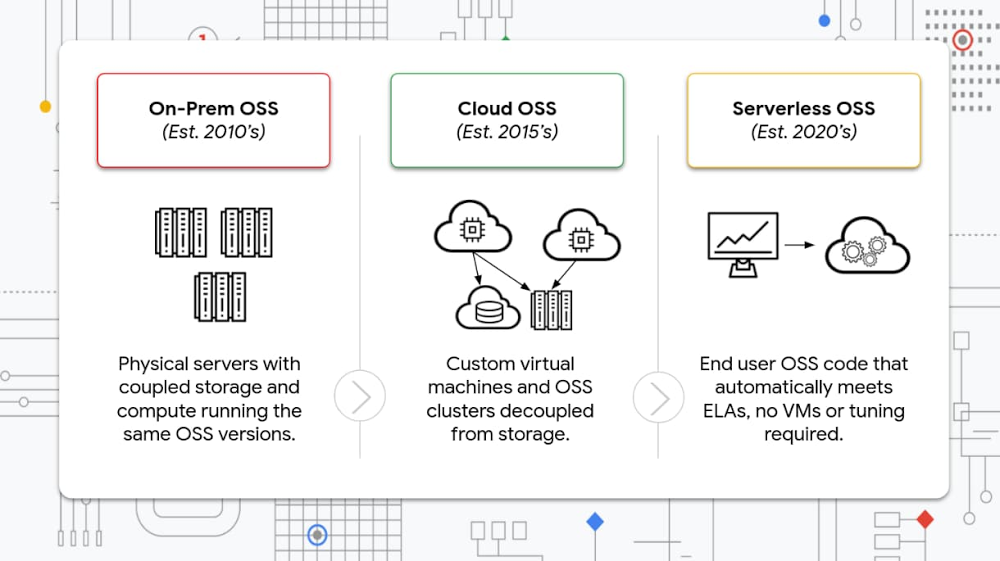
Big data open source software (OSS) like Apache Hadoop, Apache Spark, Presto, and others continue to become industry-standard in enterprise data lakes and big data architectures. As enterprises turn to on-prem OSS deployments to avoid vendor lock-in, lower costs, and harness the power of community innovation, they struggle to balance the requirements of the enterprise (security, SLAs, etc.) with the needs of the business. We’re at a moment of change in this industry, and our Dataproc platform offers a way forward to manage, analyze and take full advantage of your data and the OSS systems you’re already using. It all started with on-prem deployments of Apache Hadoop in 2010, which left much to be desired as big data architects had to work with rigid machines that couldn’t scale independently, and required significant tuning and testing. They couldn’t tell if the next spike in data or the next OSS release would break pipelines or queries. Then the cloud came along and solved many of these issues. With the launch of Google Cloud’s Dataproc in 2015, enterprises could now decouple compute from storage and allow custom OSS clusters to be built with custom machines. Automating the cluster build and scaling avoided common on-prem challenges and helped set our customers up for the next massive transition in OSS: serverless. Before we examine the serverless future, let’s first discuss where the industry started and where we are today.On-prem OSS: Where we started and the challenges Big data open source software started with a mission to simplify the hardware setups for clusters in the data center and minimize the impact of hardware failures on data applications. Big data OSS also delivers cost optimizations by simplifying management and efficiently utilizing all available resources, while also taking advantage of innovation across the open source community. These strategies must be used cautiously so you don’t prohibit developers’ freedom in leveraging underlying hardware any way they see fit without data center reconfiguration.Instead of the traditional approach of bringing the data to the processing, early versions of big data analytics changed the processing paradigm by bringing the processing to the data. Other design simplifications allowed the data center team to focus on setting up interconnected racks of commodity servers running Linux. These racks were then handed over to big data developers so that they could configure and optimize their data application processing environments. Hadoop, a key big data open source component, implemented a distributed file system and processing framework (MapReduce) that simplified the execution of the data applications and gracefully handled any hardware failures. All of this meant that a small team of data center engineers could now manage thousands of machines. Although there was separation of processing and data, application developers paid special attention to data proximity. They still relied on physical servers’ locations to give the necessary I/O bandwidth required for their data processing applications. As a result, these processing environments’ configuration required detailed understanding of how the processing environment was laid out (physical server configuration, connected storage and network links within the rack and across racks). Developers also designed software to take full advantage of the underlying physical environment, such as the available memory, I/O characteristics, storage, and compute.These environments did come with their own challenges, however. On-prem OSS challengesCapital investment and lead times: Setting up on-prem infrastructure requires upfront investments and lengthy lead times. Building data centers takes multiple years, upgrading power and cooling capacity takes multiple quarters, and installing new servers requires many months just to configure. All of these additions require significant planning and execution that most data developers cannot do.Selecting hardware configurations to meet all needs: Careful experimentation with multiple machine configurations for various workloads is necessary to finalize hardware configurations. Most of the open source software relies on standardization, and making changes to hardware configuration to support new business needs is disruptive. Refreshing the hardware to take advantage of the new technologies also requires careful planning to minimize disruption to the user ecosystem.Data center constraint management: Data center planning requires optimization of power, cooling, and physical space to maximize utilization.Migration: Relocating a data center is a hassle, as the cost to move the data across the network is non-trivial. To avoid the cost and effort of relocating the data and applications, users have sometimes resorted to manually migrating the hardware on trucks.Disaster planning: Disaster recovery planning is problematic, as multiple data center locations need enough network bandwidth to minimize network latency while ensuring successful recovery from failures. Of course, takeover needs to be designed and validated prior to the actual events.Cloud-based OSSInnovation in virtualization technologies erased some of on-prem environments’ design constraints, such as available I/O bandwidth, virtualization penalty, and storage performance. Cloud computing also enabled quick access to storage and compute capacity, allowing the data developers to take advantage of on-demand scaling. Cloud computing lets data developers select custom environments for their processing needs, allowing them to focus more on their data applications and less on the underlying infrastructure. All of these capabilities have resulted in a surge in popularity of cloud-based data analytics environments. Developers can now focus more on the high-level application configurations and can design software to take advantage of these new cloud economics. Cloud-based OSS challengesInfrastructure configuration: Although cloud infrastructure as a service eliminated the need for logistics planning for the data center, the complex task of cluster configuration continues to be a challenge. Users need to understand the specific cloud infrastructure challenges and the constraints when configuring their data processing environments. Processing environment configuration: The cloud provides an easy way to configure complex processing environments. Cloud users still find optimizing the processing environments requires a detailed understanding of the data and workload characteristics. Sometimes changes to the data or the processing algorithms carry over to the environment, such as changes to data organization, storage format, and location. Cost optimization: Configuration settings to minimize the total cost of the execution environment require continuous monitoring and management of data and workloads.Latency optimization: As workloads evolve over time, the need for managing SLOs is critical and requires constant monitoring and fine tuning. In extreme cases, a redesign of the storage format or processing paradigm is necessary to maintain SLOs. Dataproc is helping alleviate OSS cloud challenges today, while preparing us for a serverless futureDataproc is an easy-to-use, fully managed cloud service for running managed open source, such as Apache Spark, Apache Presto, and Apache Hadoop clusters, in a simpler, more cost-efficient way. We hear that enterprises are migrating their big data workloads to the cloud to gain cost advantages with per-second pricing, idle cluster deletion, autoscaling, and more. Dataproc recently launched these preview capabilities to simplify management of the open analytics environment:Personal cluster authentication: Allows interactive workloads on the cluster to securely run as your end-user identity. As a Cloud IAM Notebook user, your workloads will run and perform data access as the user. This allows for improved identity access controls and logging, thereby allowing administrators to effectively manage the security of their environments while simplifying user access management. Flex mode: Dataproc supports Preemptible VMs (PVMs) and Autoscaling, which allows right-sizing the cluster based on demand to ensure that you are using your budget wisely. Flex mode feature allows you to further optimize cluster operations costs while reducing job failures. You can leverage Flex mode to save all intermediate Spark data on primary worker nodes, allowing you to set aggressive autoscaling policies and/or take more advantage of preemptible VMs for secondary nodes. Intermediate shuffle data is stored outside of “workers” (mappers in MapReduce and executors in Spark) such that job progress is not lost during scale-down events following the removal (or preemption) of worker machines during a job.Persistent history server: You can now view job logs and cluster configurations even when the cluster is offline. Offline implies either an ephemeral cluster is currently not running or the cluster has been deleted. You have to configure the clusters to persist their job logs to Cloud Storage and then configure the Persistent History Server to view the logs from a set of Cloud Storage locations. A single Persistent History Server can be configured to aggregate logs from multiple clusters, simplifying manageability and debuggability of your workflows and data applications. Dataproc allows enterprises to quickly test new OSS, develop code, deploy pipelines and models, and automate processes so that the business focuses more on building and less on maintaining. As Dataproc continues to provide enhancements to your OSS test/dev, deploy, and automate development cycle, we will continue to build intelligence into our service so that we are prepared for the serverless future. The next phase: serverless OSS The complexity of tuning/configuring data analytics platforms (processing and storage) due to the plethora of choices available to customers add to the complexity of selecting an ideal platform over the life of the data application as the usage and use case evolves. Serverless OSS will change that. In the future, serverless concepts will focus on taking complexities and challenges away from you, enabling you to focus more on quality of service (QoS) while the platforms underneath make intelligent choices. This can be intimidating; however, it can be solved in multiple steps. There are three major aspects that can be selected when delivering on QoS:Cluster: Selection of the appropriate cluster to run the workload for the desired QoS.Interface: Selection of the appropriate interface for the workload (Hive, SparkSQL, Presto, Flink and many more) Data: Selection of the location, format, and data organization.In the serverless world, you focus on your workloads and not on the infrastructure. We will do the automatic configuration and management of the cluster and job to optimize around metrics that matter to you, such as cost or performanceServerless is not new to Google Cloud. We have been developing our serverless capabilities for years and even launched BigQuery, the first serverless data warehouse. Now it’s time for OSS to have its turn. This next phase of big data OSS will help our customers accelerate time to market, automate optimizations for latency and cost, and reduce investments in the application development cycle so that they can focus more on building and less on maintaining. Check out Dataproc, let us know what you think, and help us build the serverless generation of OSS.
Quelle: Google Cloud Platform
Mercari: Faster and more efficient development with the help of Google Cloud

A key part of launching and running services on a cloud platform is the support of experts that fully understand a customer’s unique challenges. At Google Cloud, we do this through Premium Support and Technical Account Management (TAM), which pairs Google engineers with customers to design effective cloud strategies and provide long-term support during implementation. In October 2018, Japanese ecommerce company Mercari Group began building and operationalizing the infrastructure for its Mercari marketplace app and Merpay smartphone payment service. Although they’d adopted a microservice architecture for system infrastructure using Google Kubernetes Engine (GKE) in 2016, by 2018 they realized they’d need to run multiple services, like Merpay, on the same infrastructure. As a result, they turned to Google Cloud’s TAM.Working with TAM to launch Merpay“Around the time of the Merpay release we were holding weekly meetings with people from Google, and they worked closely with us and provided support for things such as capacity planning and security,” says Junichiro Takagi of Mercari’s SRE Team. “We also had meetings set up for us about Google Cloud products with the product managers, and it was great to be able to directly convey our requests.”“Since the cause of many problems simply can’t be understood from the outside, having TAM and working with Google Cloud technical experts to identify the cause is very helpful,” says Shingo Ishimura of the Solutions Team. “For feature requests as well, working with TAM has made a big difference. We appreciate the information sharing ability that TAM has, which incorporates a product-like approach and provides information such as whether or not there have been any similar requests from other companies, whether there are any workarounds, and how the product manager reacted to the issue.”TAM has helped Mercari in ways the team didn’t even expect. “We once put a request on GitHub about the default delay time for the Cloud Spanner client library being too long,” says Ishimura, “and after we did that, TAM actually set up an opportunity for us to speak directly with the relevant staff members at Google Cloud about it.” The result of this interaction was a reduction of the original two-second delay time down to 20 milliseconds, and the TAM team also caught requests the Mercari team elevated to support cases.After the launch of Merpay in 2019, TAM also implemented capacity planning that took into account the significant increase in traffic that results from large-scale campaigns, TV commercials, and similar events. By sharing Merpay’s architecture with the support team in advance, it also put in place a structure to swiftly deal with any problems that occur, and as a result, the service has not experienced any significant failures since it was launched.Getting a helping hand with troubleshooting from Google Cloud Premium SupportTo guarantee a stable service environment, Mercari has also taken advantage of Google Cloud’s Premium Support in addition to TAM. This means they can rely on a swift response to a failure, should one occur.“Our system has a range of layers comprising multiple applications, GKE and networks, and Cloud Spanner, so in some cases it’s difficult to identify the cause of a problem,” says Takagi. “In such cases we isolate the problem with Google Cloud support engineers, but in cases with low reproducibility this can sometimes drag on for a long time. With Google Cloud, support engineers from Google in Japan form the main point of contact when this happens, and we’re able to jump on a meeting with them, which is very helpful. TAM also coordinates any misunderstandings in the communication, which is very reassuring.”How using TAM has benefitted Mercari globallyTAM is also contributing greatly to the creation of microservice architecture that Mercari is undertaking at a global level.“Something that TAM did for us that was amazing was facilitate an exchange of information between us and a certain global company that had used Google Cloud to achieve a microservice architecture. We were really grateful for the opportunity to meet directly with engineers from this company and get very practical information from them,” says Taichi Nakashima of Mercari’s Microservices Platform Team. “We were also given the opportunity to talk to the engineers who actually develop GKE. It was really nice to have Tim Hockin, one of the engineers leading the development of Kubernetes, attend a meeting with us and give his advice.”Similar meetings were set up proactively not only in Japan but overseas as well, says Mercari US Director of Engineering Naoki Shimizu. “For example, TAM provided support by connecting us with the Enterprise Team for reCAPTCHA, which is used for authentication, and thanks to this, we were able to learn about reCAPTCHA’s latest products and the best practice for them. Furthermore, when we subsequently found a technical problem with the reCAPTCHA Enterprise SDK, TAM escalated it to them and we were able to obtain an updated SDK within a week.”Shimizu says the global presence of TAM, with its holistic perspective of Mercari’s business and solutions in both Japan and the US, will deliver new value to the business by facilitating the sharing of solutions and practical information between the two countries.Nakashima and the Microservice Platform Team are now working on a project to migrate the monolithic system that is still on premises entirely over to Google Cloud. “And in these circumstances,” says Nakashima, “I think there will be quite a few problems that we won’t be able to deal with by ourselves, which is why we’re so grateful for the support from TAM.”Mercari was founded with the mission to make it easy to sell, or buy, almost anything. With Google Cloud, Mercari is also simplifying how it builds the technical foundation for its business.Learn more about Google Cloud Premium Support and Technical Account ManagementRelated ArticleAnnouncing the launch of Premium Support for your enterprise and mission-critical needsNew support tiers from Google Cloud offer even more tailored support for your enterprise-class, mission-critical workloads.Read Article
Quelle: Google Cloud Platform

A giant list of Google Cloud resources

The growth of Google Cloud has been staggering.  If you’re a technical person that is trying to get plugged in, it can be hard tracking down all of the available online resources. I decided to invest some time in building you a comprehensive list. Even I was surprised at how long this list became by the time I finished! Hope you find it as valuable as I do. Google Cloud resourcesGoogle Cloud home pageGoogle Cloud developer advocates Twitter listAll 200+ Google Cloud product described in <=4 wordsgcloud command-line tool cheat sheet (PDF brochure)Google Cloud blogGoogle Cloud blog – developers & practitioners topicGoogle Cloud open sourceGoogle Cloud Medium publicationApigee blogFirebase blogGoogle Workspace developers blogGoogle Workspace GitHubGoogle Workspace TwitterGoogle Workspace solutions galleryGoogle Cloud certificationsGoogle Cloud system statusGoogle Cloud trainingGoogle developers blogGoogle maps platform blogGoogle open source blogGoogle security blogKaggle home PageKubernetes blogRegions and network MapGoogle Cloud solutions libraryGoogle Cloud support hubGCP pricingGCP pricing calculatorQwiklabs home pageCodelabs home pageYouTube channelsGoogle Cloud YouTube channelGoogle Cloud technical YouTube channelGoogle Workspace YouTube channelGoogle developers YouTube channelFirebase YouTube channelPodcastsGoogle Cloud podcastKubernetes podcastReddit/r/googlecloud/r/AppEngine/r/bigquery/r/dataflow/r/firebase/r/GoogleAppsScriptProduct comparisonsBig data / data analytics product comparisonsCompute product comparisonsDatabase product comparisonsNetworking product comparisonsStorage product comparisonsGCP foundational open source projectsApache Beam: Batch/streaming data processingGo: High concurrency programming languagegRPC: RPC frameworkgVisor: Secure container runtimeIstio: Connect and secure servicesKnative: Serverless framework for KubernetesKubeflow: ML toolkit for KubernetesKubernetes: Management of containerized applicationsOpenCensus: Cloud native observability frameworkTensorFlow: ML frameworkGoogle Cloud comparisons with other platformsGoogle Cloud Platform for AWS ProfessionalsGoogle Cloud Platform for Azure ProfessionalsGoogle Cloud Platform for Data Center ProfessionalsGoogle Cloud Platform for OpenStack UsersLanguage specific documentationApps ScriptJavaNode.jsPythonGoRubyPHP.NET/C#If we’re missing something, DM me on Twitter @gregsramblingsRelated ArticleBigQuery explained: Blog seriesFind links to all posts in the BigQuery Explained series.Read Article
Quelle: Google Cloud Platform

Docker Hub Image Retention Policy Delayed, Subscription Updates

Today we are announcing that we are pausing enforcement of the changes to image retention until mid 2021. Two months ago, we announced a change to Docker image retention policies to reduce overall resource consumption. As originally stated, this change, which was set to take effect on November 1, 2020, would result in the deletion of images for free Docker account users after six months of inactivity. After this announcement, we heard feedback from many members of the Docker community about challenges this posed, in terms of adjusting to the policy without visibility as well as tooling needed to manage an organization’s Docker Hub images. Today’s announcement means Docker will not enforce image expiration enforcement on November 1. Instead, Docker is focusing on consumption-based subscriptions that meet the needs of all of our customers. In this model, as the needs of a developer grow, they can upgrade to a subscription that meets their requirements without limits.

This change means that developers will get a base level of consumption to start, and can extend their subscriptions as their needs grow and evolve, only paying for what is actually needed. The community of 6.7 million registered Docker developers is incredibly diverse–the requirements of someone getting started with containers is different than the needs of an OSS project organizer which are also different for a 40,000 person software development team. Our new model gives each individual developer or organization the opportunity to scale their usage and consumption along the dimensions that make most sense to them. 

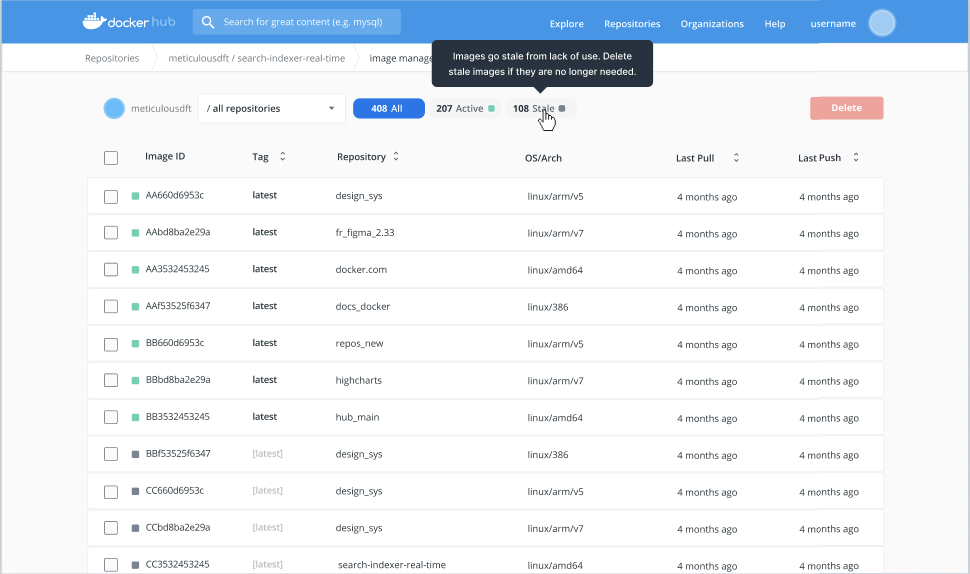
As we make this move to consumption-based subscriptions, we are also creating new capabilities to help users understand and manage their usage of various resources on the Docker platform. As an example of this, for image storage on Docker Hub we will soon release an experimental Hub CLI tool, a Hub Dashboard and new APIs. Our goal is to give developers the insights required to effectively understand and manage their image storage in Docker Hub. We will be delivering the first tools in the coming weeks, and will announce the timeline for new image retention policies early in 2021.

Reminder: Image pull consumption tiers

Continuing with our move towards consumption-based limits, customers will see the new rate limits for Docker pulls of container images at each tier of Docker subscriptions starting from November 1, 2020. Anonymous free users will be limited to 100 pulls per six hours, and authenticated free users will be limited to 200 pulls per six hours. Docker Pro and Team subscribers can pull container images from Docker Hub without restriction as long as the quantities are not excessive or abusive. We want our Docker Pro subscription to be the best way for individual developers to work with Docker and our Team subscription to continue to add value for teams to come together as they scale their usage with tools like CI/CD. The levels for what is abusive/excessive will be managed with these two goals in mind. 

Excessive usage/abuse of Pro and Team limits will be initially managed through a process where a customer will be informed about the usage overage through email as well as the ability to get usage information in response headers from Docker Hub. Continued abuse may be followed with hard restriction in usage. Details about Docker subscription levels and differentiators are available on the Docker Pricing Page. 

Going forward you will see this model extended to other capabilities available from Docker in order to provide maximum flexibility for developers. With millions of developers pulling billions of images per month, any change we make to the system has to be considered with our community in mind. We appreciate the feedback and suggestions from the Docker community, and we are excited to share more new features with you in the coming weeks and months.
The post Docker Hub Image Retention Policy Delayed, Subscription Updates appeared first on Docker Blog.
Quelle: https://blog.docker.com/feed/




