Aluminiumguss: Model Y mit einteiligem Heckrahmen
Tesla hat die Produktion des Model Y umgestellt. Statt 70 Metallteilen in der hinteren Bodengruppe wird ein massives, einteiliges Stück gegossen. (Elektroauto, Technologie)
Quelle: Golem

Tesla hat die Produktion des Model Y umgestellt. Statt 70 Metallteilen in der hinteren Bodengruppe wird ein massives, einteiliges Stück gegossen. (Elektroauto, Technologie)
Quelle: Golem

Die Kommentarfunktion unter den Youtube-Videos von Donald Trump bleibt auf unbestimmte Zeit abgeschaltet. (Donald Trump, Google)
Quelle: Golem

NIU hat mit dem MQi GT einen E-Roller vorgestellt, der eine Geschwindigkeit von 70 km/h erreicht und so auch auf der Landstraße gefahren werden kann. (Elektroroller, Technologie)
Quelle: Golem

Neben dem Solarauto hat das Münchner Startup einen Solaranhänger gezeigt. Von Werner Pluta (CES 2021, Technologie)
Quelle: Golem

Mit diesem Schritt will Netflix stärker als bisher auch als Produzent von Spielfilmen wahrgenommen werden. (Netflix, Streaming)
Quelle: Golem
itnext.io – This article is an update of my previous benchmark (2018 and 2019), now running Kubernetes 1.19 and Ubuntu 18.04 with CNI version up-to-date in August 2020. TL;DR : For those in a hurry, please check…
Quelle: news.kubernauts.io
medium.com – This post will collect the links to the blog posts that I’m going to write as a preparation guide for CKS. Also, I’m going to cover other security-related topics that not necessarily appear in the…
Quelle: news.kubernauts.io
itnext.io – The idea is to create an ImagePolicyWebhook Admission-Controller-Plugin which prevents all Pod creation, because the external service which should allow/deny is not reachable. This will be enough to…
Quelle: news.kubernauts.io
medium.com – Kubernetes clusters often use the NGINX Ingress Controller. This provides a nice solution when hosting many websites. Yet all contents is retrieved from the back-end pods at every request. Would it…
Quelle: news.kubernauts.io
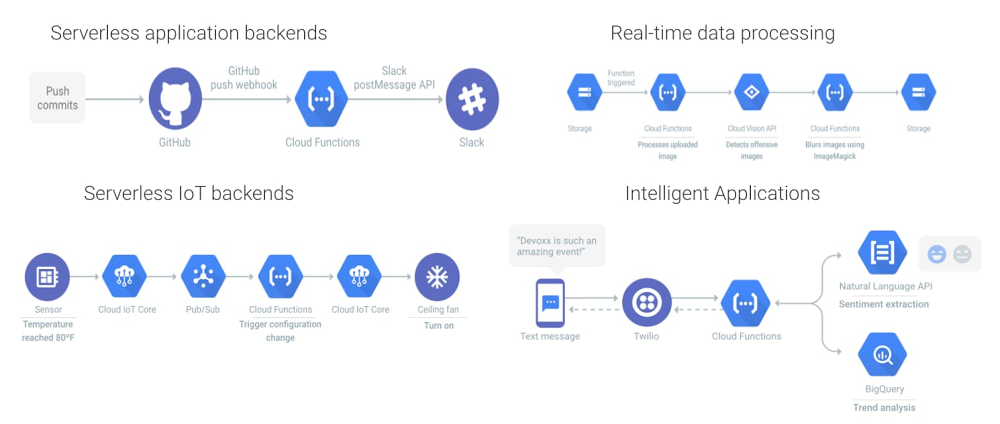
Cloud Functions, Google Cloud’s Function as a Service (FaaS) offering, is a lightweight compute platform for creating single-purpose, stand-alone functions that respond to events, without having to manage a server or runtime environment. Cloud functions are a great fit for serverless, application, mobile or IoT backends, real-time data processing systems, video, image and sentiment analysis and even things like chatbots, or virtual assistants.Today we’re bringing support for Ruby, a popular, general-purpose programming language, to Cloud Functions. With the Functions Framework for Ruby, you can write idiomatic Ruby functions to build business-critical applications and integration layers. And with Cloud Functions for Ruby, now in Preview, you can deploy functions in a fully managed Ruby 2.6 or Ruby 2.7 environment, complete with access to resources in a private VPC network. Ruby functions scale automatically based on your load. You can write HTTP functions to respond to HTTP events, and CloudEvent functions to process events sourced from various cloud and Google Cloud services including Pub/Sub, Cloud Storage and Firestore.You can develop functions using the Functions Framework for Ruby, an open source functions-as-a-service framework for writing portable Ruby functions. With Functions Framework you develop, test, and run your functions locally, then deploy them to Cloud Functions, or to another Ruby environment.Writing Ruby functionsThe Functions Framework for Ruby supports HTTP functions and CloudEvent functions. A HTTP cloud function is very easy to write in idiomatic Ruby. Below, you’ll find a simple HTTP function for Webhook/HTTP use cases.CloudEvent functions on the Ruby runtime can also respond to industry standard CNCF CloudEvents. These events can be from various Google Cloud services, such as Pub/Sub, Cloud Storage and Firestore.Here is a simple CloudEvent function working with Pub/Sub.The Ruby Functions Framework fits comfortably with popular Ruby development processes and tools. In addition to writing functions, you can test functions in isolation using Ruby test frameworks such as Minitest and RSpec, without needing to spin up or mock a web server. Here is a simple RSpec example:Try Cloud Functions for Ruby todayCloud Functions for Ruby is ready for you to try today. Read the Quickstart guide, learn how to write your first functions, and try it out with a Google Cloud free trial. If you want to dive a little bit deeper into the technical aspects, you can also read our Ruby Functions Framework documentation. If you’re interested in the open-source Functions Framework for Ruby, please don’t hesitate to have a look at the project and potentially even contribute. We’re looking forward to seeing all the Ruby functions you write!Related ArticleNew in Cloud Functions: languages, availability, portability, and moreCloud Functions includes a wealth of new capabilities that make it a robust platform on which to build your applicationsRead Article
Quelle: Google Cloud Platform






