Cloud Bigtable + Cloud Memorystore: faster together

TLDR: Improve your application’s performance by using Memcached for frequently queried data like this:Databases are designed for specific schemas, queries, and throughput, but if you have data that gets queried more frequently for a period of time, you may want to reduce the load on your database by introducing a cache layer. In this post, we’ll look at the horizontally scalable Google Cloud Bigtable, which is great for high-throughput reads and writes. Performance can be optimized by ensuring rows are queried somewhat uniformly across the database. If we introduce a cache for more frequently queried rows, we speed up our application in two ways: we are reducing the load on hotspotted rows and speeding up responses by regionally colocating the cache and computing. Memcached is an in-memory key-value store for small chunks of arbitrary data, and I’m going to use the scalable, fully managed Memorystore for Memcached, since it is well integrated with the Google Cloud ecosystem.SetupCreate a new Google Cloud project or use an existing project and database of your choice. The examples here will show Cloud Bigtable, but Spanner or Firestore would be good options too.I’ll provide gcloud commands for most of the steps, but you can do most of this in the Google Cloud Console if you prefer.Create a Cloud Bigtable instance and a table with one row using these commands:cbt createinstance bt-cache “Bigtable with cache” bt-cache-c1 us-central1-b 1 SSD &&  cbt -instance=bt-cache createtable mobile-time-series “families=stats_summary” &&  cbt -instance=bt-cache set mobile-time-series phone#4c410523#20190501 stats_summary:os_build=PQ2A.190405.003 stats_summary:os_name=android &&  cbt -instance=bt-cache read mobile-time-seriesThe codeThe generic logic for a cache can be defined in the following steps: Pick a row key to query.If row key is in cacheReturn the value.     3. OtherwiseLook up the row in Cloud Bigtable.Add the value to the cache with an expiration.Return the value.For Cloud Bigtable, your code might look like this (full code on GitHub):I chose to make the cache key be row_key:column_family:column_qualifier to easily access column values. Here are some potential cache key/value pairs you could use:rowkey: encoded rowstart_row_key-end_row_key: array of encoded rowsSQL queries: resultsrow prefix: array of encoded rowsWhen creating your cache, determine the setup based on your use case. Note that Bigtable rowkeys have a size limit of 4KB, whereas Memcached keys have a size limit of 250 bytes, so your rowkey could potentially be too large.Create a Memorystore for Memcached instanceI’ll create a Memorystore for Memcached instance, but you can install and run a local Memcached instance to try this out or for testing. These steps can be done with the Memorystore Cloud Console if you prefer.1. Enable the Memorystore for Memcached API.2. Create a Memorystore for Memcached instance with the smallest size on the default network. Use a region that is appropriate for your application.3. Get the Memcached instance details and get the discoveryEndpoint IP address (you may have to wait a few minutes for the instance to finish creation).Set up machine within networkWe need to create a place to run code on the same network as our Memcached instance. You can use a serverless option such as Cloud Functions, but a Compute VM requires less configuration.Create a compute instance on the default network with enabled API scopes for Cloud Bigtable data. Note that the zone must be in the same region as your Memcached instance.2. SSH into your new VM.Optionally connect to Memcached via TelnetThe Memorystore for Memcached documentation contains more information about this process, but you can just run the commands below to set and get a value in the cache. Run the codeNow we are ready to put our code on the machine. You can clone the repo directly onto the VM and run it from there. If you want to customize the code, check out my article on rsyncing code to Compute Engine or use the gcloud scp command to copy your code from your local machine to your VM.2. Install maven3. Set environment variables for your configuration.4. Run the program once to get the value from the database, then run it again and you’ll see that the value is fetched from the cache.CleanupIf you followed along with this blog post, delete your VM, Cloud Bigtable Instance, and Memcached instance with these commands to prevent getting billed for resources:Next steps Now you should understand the core concepts for putting a cache layer in front of your database and can integrate it into your existing application. Head to the Google Cloud console where you can try this with Cloud Bigtable and Cloud Memorystore.Related ArticleGo faster and cheaper with Memorystore for Memcached, now GALearn about fully managed Memorystore for Memcached, which is compatible with open-source Memcached protocol and can save database costs …Read Article
Quelle: Google Cloud Platform
Serving up data from Cloud Storage

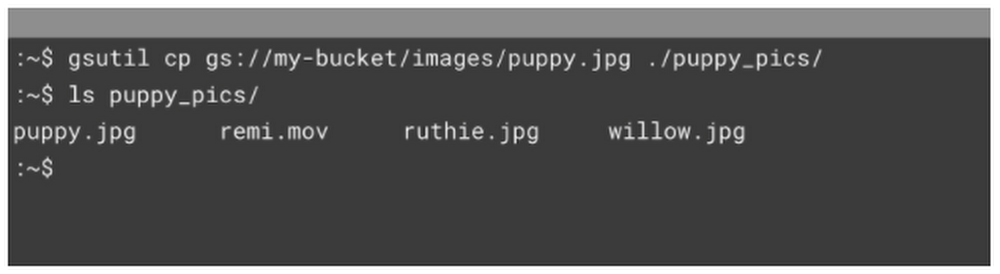
Prefer to listen rather than read? Check out this post on the podcast!When it comes to the cloud, there’s more than one way to serve a file. In this post, we’ll walk you through all the ways to serve data from Cloud Storage—so you can determine the best fit for your needs!You can use Cloud Storage to serve assets to your customers, and depending on your application, there are a variety of methods you might use to get that data out of a Cloud Storage bucket. In this post, we’ll cover four ways to serve those assets, but feel free to read more in the documentation, or for general, conceptual information on uploads and downloads, read this. Here we go!Client LibrariesFirst, we’ve got Client Libraries. If you need to download assets directly into your existing application, this is something for you to explore!And trust me when I say…we speak your language. With code samples in C++, C#, Go, Java, Node.js, PHP, Python, and Ruby—we’ve got you covered. Check out the documentation for more. Here’s an example of downloading from your Cloud Storage bucket using Python:gsutilUp next, you have the gsutil application. gsutil is a Python application that lets you access Cloud Storage from the command line. For our purposes, the cp command allows you to upload files from your local machine to google cloud. For example, running this command will download from a Cloud Storage bucket to a local path on your device.Additionally, gsutil comes with a plethora of options to configure to your specific use case; like the -m command, which allows for copy options to occur in parallel.REST APIsYou can also directly go to the REST APIS, using other programs like cURL to fetch your files directly and allowing the user to log in with OAuth. More on that here.Cloud ConsoleFinally, you can always access your objects right from the Cloud Console. Simply select the desired bucket, or object, and click “Download” in the handy “more actions” drop down menu. This is a great way to grab individual files when you’re debugging or going through things manually.Note: For some object types, selecting “Download” opens the object in the browser. To download these objects to your local computer, right-click on “Download” and select “Save Link As.”What’s Next?Retrieving files is really just the start, and you’ll want to make sure you’ve got a handle on controlling access – You know we’ve got another post for that, so stay tuned!Learn more about your storage options in Cloud Storage Bytes, or check out the documentationfor more information, including tutorials.Related Article5-ish ways to get your data into Cloud StorageSo you’ve created your buckets, and now you want to use the power of the cloud to serve your content. With a can-do attitude and the deta…Read Article
Quelle: Google Cloud Platform

Ankündigung der allgemeinen Verfügbarkeit von Amazon Redshift Data Sharing

Amazon Redshift Data Sharing, eine sichere und einfache Möglichkeit, Live-Daten über Redshift-Cluster hinweg zu teilen, ist jetzt allgemein verfügbar. Die gemeinsame Nutzung von Daten ermöglicht einen sofortigen, granularen und hochleistungsfähigen Datenzugriff über Amazon Redshift-Cluster innerhalb eines AWS-Kontos, ohne dass Daten kopiert oder verschoben werden müssen. Die gemeinsame Nutzung von Daten bietet einen Live-Zugriff auf die Daten, so dass Ihre Benutzer immer die aktuellsten und konsistentesten Informationen sehen, sobald diese im Data Warehouse aktualisiert werden. Die gemeinsame Nutzung von Daten kann auf Ihren Amazon Redshift RA3-Clustern ohne zusätzliche Kosten verwendet werden.
Quelle: aws.amazon.com

Ankündigung der allgemeinen Verfügbarkeit von datenbankübergreifenden Amazon Redshift-Abfragen

Amazon Redshift-Datenbankübergreifende Abfragen bieten die Möglichkeit, Abfragen über Datenbanken in einem Redshift-Cluster hinweg durchzuführen. Diese Funktion ist jetzt generell in allen Regionen verfügbar, in denen Amazon Redshift RA3-Knotentypen verfügbar sind. Mit datenbankübergreifenden Abfragen können Sie nahtlos Daten aus jeder Datenbank im Cluster abfragen, unabhängig davon, mit welcher Datenbank Sie verbunden sind. Datenbankübergreifende Abfragen können Datenexemplare eliminieren und Ihre Datenorganisation vereinfachen, um mehrere Geschäftsgruppen auf demselben Cluster zu unterstützen. Datenbankübergreifende Abfragen können ohne zusätzliche Kosten auf Ihren RA3-Clustern verwendet werden.
Quelle: aws.amazon.com

Einführung von kostengünstigeren Speicherklassen für Amazon Elastic File System

Amazon Elastic File System (Amazon EFS) unterstützt jetzt einzelne Availability Zone (AZ)-Speicherklassen (One Zone), wodurch die Speicherkosten im Vergleich zu Amazon EFS Standard-Speicherklassen um 47 % gesenkt werden, während die von den Kunden geschätzten EFS-Funktionen erhalten bleiben. Mit dieser Einführung können Sie einen effektiven Speicherpreis von 0,043 USD/GB-Monat erreichen.[1]
Quelle: aws.amazon.com

Amazon RDS for Oracle unterstützt Oracle Management Agent (OMA) Version 13.4. for Oracle Enterprise Manager Cloud Control 13cR4

Amazon RDS for Oracle unterstützt jetzt Oracle Management Agent (OMA) Version 13.4. for Oracle Enterprise Manager (OEM) Cloud Control 13c Version 4 Update 9. OEM 13c bietet webbasierte Tools zur Überwachung und Verwaltung Ihrer Oracle-Datenbanken. Amazon RDS for Oracle installiert OMA, das daraufhin mit Ihrem Oracle Management Service (OMS) kommuniziert, um Überwachungsinformationen bereitzustellen. Kunden mit OMS 13.4 können nun Datenbanken durch die Installation von OMA 13.4 verwalten.
Quelle: aws.amazon.com

Amazon Transcribe unterstützt Vertrauenswerte auf Wortebene für das Streaming von Transkriptionen

Amazon Transcribe ist ein automatischer Spracherkennungsservice (ASR), der es Entwicklern leicht macht, ihren sprachfähigen Anwendungen die Sprache-zu-Text-Funktionen hinzuzufügen. Bisher hat Amazon Transcribe Vertrauenswerte für jedes Wort in seiner Transkriptionsausgabe für seine Batch-API (asynchron) angeboten. Ab heute wird Amazon Transcribe auch für seine Streaming-API (synchrone Transkription) Vertrauenswerte auf Wortebene anzeigen.
Quelle: aws.amazon.com

Using RHEL with your no-cost Red Hat Developer Subscription for Individuals with KVM

In January 2021, Red Hat announced simplifications to our existing, no-cost individual developer subscription which includes Red Hat Enterprise Linux (RHEL). Since the announcement about the updated Red Hat Developer Subscription for Individuals, I’ve seen some confusion among people who are new to the Red Hat ecosystem. This includes questions about subscriptions and subscription-manager.
Quelle: CloudForms

Casa dos Ventos advances sustainability mission with SAP S/4HANA on Google Cloud

Over a 12-month period, Casa dos Ventos migrated 90% of its processing workloads and fully implemented SAP S/4HANA on Google Cloud. When the migration was complete, data-processing operations became more agile, allowing the company’s IT team to dramatically reduce the time they needed to process and analyze data as well as to respond to customers and regulatory authorities.Sustainability is a key concern for global organizations, and Casa dos Ventos, one of the largest suppliers of wind energy in Brazil, makes sustainability part of its mission: promoting the “environmentally responsible development” of Brazil.In Brazil, wind is the second-largest source of power in the country’s energy matrix, according to the Brazilian Wind Power Association (ABEEolica). Since its founding in 2007, Casa dos Ventos has been on a path of steady growth—the company now represents about 30% of all wind farms in operation or under construction in Brazil. Combined, these projects will generate approximately 10% of all energy produced in that country.But growth on this scale generates more than energy: It produces vast amounts of data that needs to be processed and analyzed consistently to study wind behavior, control turbines, and forecast power production and climate, to name just a few examples. These tasks are mission-critical to ensure the efficient operation of Casa dos Ventos’ wind farms.With the company’s continued expansion, it became clear that its on-premises infrastructure no longer had the capacity to process, orchestrate, and analyze such massive amounts of data. Instead of helping to solve business issues, the IT team was spending much of its time maintaining servers and managing databases and systems. According to Roberto Oikawa, CIO of Casa dos Ventos, it was taking 15 days to calculate the amount of energy generated by just one wind farm using in-house servers.An urgent need to streamline dataTo keep pace with its growing number of projects, the company needed a solution that would centralize its workflows while providing scalability and flexibility. “We needed a platform capable of loading tons of data, with streamlined support for resources used to process this data,” Oikawa says, “and allowing us to create prediction models and run machine learning processes quickly and reliably.” After 12 years in business, the company realized it was clearly time to move its data operations to the cloud.Casa dos Ventos had already been using Google Workspace for collaboration and communication, and had adopted SAP as a business-management solution. These were decisive factors in selecting Google Cloud to host its SAP S/4HANA environment.“We opted for Google Cloud because we were seeking a strategic, long-term partnership,” says Oikawa. “This isn’t just service delivery. Google Cloud brings its solid knowledge about SAP, which gave us peace of mind for decision-making.” The team ultimately decided on a hybrid environment with a cloud-first strategy that includes using physical servers for simpler, less time-sensitive tasks.More time to focus on business growthOver a 12-month period, the company migrated 90% of its processing workloads and fully implemented SAP S/4HANA on Google Cloud. When the migration was complete, data-processing operations became more agile, allowing the company’s IT team to dramatically reduce the time they needed to process and analyze data as well as to respond to customers and regulatory authorities. The time needed to predict the amount of energy generated by a specific project went from 15 days to just one day. Thanks to the new cloud infrastructure and scalable services, the company was also able to process 20 years of data in less than two hours during its weekly data processes. In addition, the company has been able to optimize wind-farm operations using Google Cloudsolutions, including AI Platform, and BigQuery for assessing costs for each project. These changes mean that Casa dos Ventos’ IT staff can spend more time working with engineering teams on high-value business issues and less time dealing with infrastructure problems.Looking ahead, Casa dos Ventos is on track to generate 1.5GW in wind power over the next year or two, an achievement that is being supported by the company’s transformation to cloud technology. “When looking at the business side, Google Cloud improved our results in terms of timing, reliability, and innovation,” Oikawa says, “Our new Energy Trading unit was conceived as a digital unit from its inception.” Lucas Araripe, Casa dos Ventos’ head of projects and new business, says that innovation, in fact, is the main purpose of his company’s work: “We always want to be ahead of others in terms of knowledge, innovation, and technology. Our partnership with Google Cloud is part of that.” Learn more about Casa dos Ventos’ SAP deployment on Google Cloud as well as other SAP customer deployments on our YouTube channel.
Quelle: Google Cloud Platform





