Announcing Microsoft Discovery general availability and Microsoft Discovery app preview

In this article

How Microsoft Discovery supports R&D workflows at scaleExpanding access with the Microsoft Discovery app previewApplying Microsoft Discovery across R&D

Breakthroughs in science and engineering rarely come from a single insight. They emerge through cycles of hypothesis, experimentation, refinement, and review across teams, tools, and data.

Today at Microsoft Build, we are announcing that Microsoft Discovery is now generally available for all organizations, providing a comprehensive platform for building and governing agentic AI workflows across scientific and engineering disciplines. We are also introducing the Microsoft Discovery app in preview, a local desktop experience that helps researchers, students, and scientific teams begin working with Microsoft Discovery today.

Explore Microsoft Discovery features

Since introducing Microsoft Discovery in private preview at Microsoft Build last year, we have worked closely with organizations applying AI to complex research and development (R&D) workflows. Their feedback helped reinforce where agentic AI needs to go beyond individual assistance, like supporting the iterative loops, evidence preservation, and tool coordination that define scientific work.

The most challenging problems in R&D require more than just a prompt interface or a single model response. Scientific workflows require:

Integration with institutional knowledge and domain expertise.

Access to specialized modeling, simulation, and analysis tools.

Connection to experimental evidence and validation data.

Support for review processes that shape research decisions.

A materials scientist may need to evaluate performance, safety, and cost alongside manufacturability and regulatory constraints. A semiconductor team may need to explore a larger design space without losing physical fidelity or traceability. A life sciences researcher may need to connect literature and experimental data with models and cohort-level evidence before deciding what to validate next.

Microsoft Discovery is designed to work within these existing R&D environments, not replace them. The platform helps experts understand the reasoning path behind outputs and keeps human judgment at the center of scientific and engineering decisions. The general availability of Microsoft Discovery marks a significant milestone in turning these requirements into a production-ready platform for R&D environments with governance and transparency built in.

Figure 1: The Microsoft Discovery workspace welcome experience.

How Microsoft Discovery supports R&D workflows at scale

Microsoft Discovery enables organizations to define agentic workflows around their own R&D programs. Teams can create and coordinate specialized agents, connect those agents to institutional knowledge and external scientific information, and orchestrate work across modeling, simulation, analysis, and validation tools.

At the center of the platform is the Microsoft Discovery Engine, which supports the core loop of scientific work by helping teams move from evidence to hypotheses, through execution and analysis, and into the next iteration. This loop allows teams to move beyond isolated analysis toward repeatable, evidence-driven exploration, where they can compare tradeoffs, question assumptions, and narrow a search space in a way that can be reviewed and repeated.

Figure 2: The Microsoft Discovery Engine task creation and status overview.

As we continued product development, we focused on what it takes to bring agentic AI into production R&D environments:

Workflows need to remain reproducible.

Outputs must be reviewable.

Proprietary knowledge must be connected and governed appropriately.

Agentic systems need to fit into the operating model of R&D organizations.

Those considerations, along with continued customer feedback, helped shape the general availability release and the platform capabilities behind it.

Figure 3: The Microsoft Discovery Engine output with confidence scoring and cited research findings.

Expanding access with the Microsoft Discovery app preview

An important goal for Microsoft is to make advanced AI and computing capabilities more accessible to the people working on some of today’s most difficult scientific and engineering challenges. Alongside the general availability of Microsoft Discovery, we are introducing the Microsoft Discovery app available in preview today.

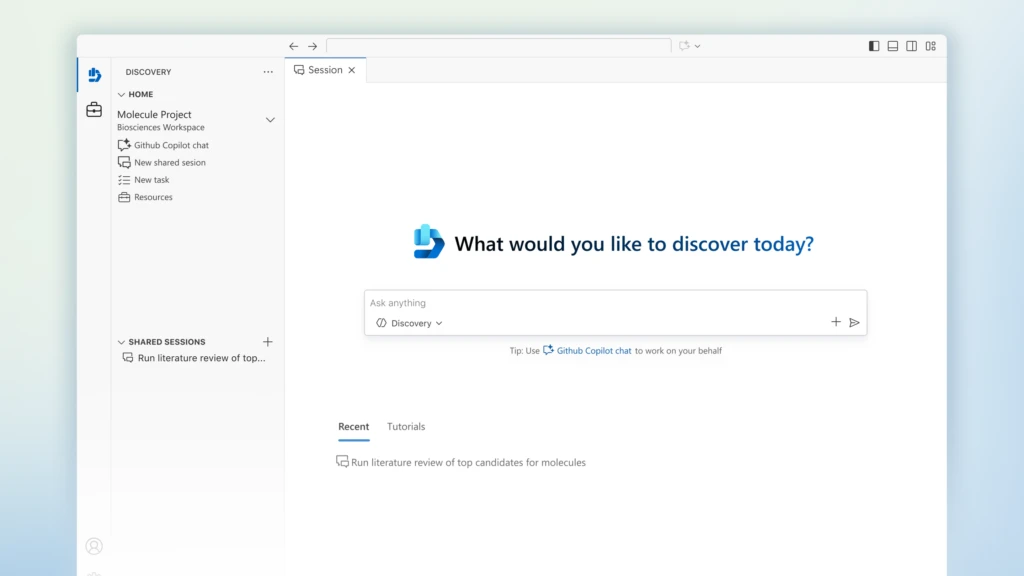
The Microsoft Discovery app is a localized experience that gives researchers, students, academic labs, and scientific teams a simpler way to begin using Microsoft Discovery capabilities without starting with a full enterprise deployment. It is available for download on the Microsoft Discovery GitHub and users can get started with a GitHub Copilot account.

This preview extends Microsoft Discovery to earlier stages of exploration, where research ideas begin as small-team projects, academic work, or individual investigation. The Microsoft Discovery app is designed to lower the barrier to hands-on exploration, with a practical entry point for literature exploration, hypothesis generation, scientific reasoning, and iterative experimentation.

The app lets researchers explore Microsoft Discovery capabilities using their own working environment. As projects mature and complexity increases, researchers and teams can bring work developed locally into Microsoft Discovery platform to support more advanced R&D programs.

Figure 4: The Microsoft Discovery app welcome screen.

Applying Microsoft Discovery across R&D

During preview, organizations helped shape the path to general availability by sharing feedback on how they were using Microsoft Discovery to explore advanced R&D workflows grounded in domain-specific data, established research methods, and expert review.

Partners are contributing domain expertise and solution depth that can help organizations adapt Microsoft Discovery to the tools, data, and processes already central to their R&D work. Together, this work offers an early view into how Microsoft Discovery is being used across domains and how a growing ecosystem can help make complex R&D workflows more systematic, transparent, and repeatable.

Yale Engineering

A collaboration across Professor David Kwabi’s group at Yale Engineering and researchers from Microsoft used the Discovery Engine to advance the frontier of agentic small molecule design for grid-scale aqueous organic redox flow batteries (ORFBs).

ORFBs are promising, leading candidates for sustainable, environmentally friendly, long-duration energy storage, but challenging to optimize. Electrolytes must balance complex molecular properties like redox potential, aqueous solubility, synthetic tractability, and electrochemical reversibility. The Discovery Engine, building on our cognitive loop via in-situ optimization research, enables long-horizon scientific reasoning while ensuring trust in the entire process.

With these capabilities, the team used the agentic loop to drive in-silico exploration and convergence of candidates, interpret experimental results, and propose diagnostic experiments. Experts at Yale Engineering led all experimental characterization, verified results interpretation, and evaluated the practical applicability of the designs. The research is available here.

This work introduces a powerful new framework for advancing battery science with AI. By endowing an agent with the ability to reason from and adapt to experiments, we combine the strengths of human-led experimentation with AI’s capacity to explore vast chemical design spaces – and we’re only beginning to see what it can do.
—David Kwabi, Associate Professor, Yale

Read more about the Yale and Microsoft collaboration

Georgia Institute of Technology

Georgia Tech is exploring how an agentic AI system can re-evaluate the prebiotic plausibility of histidine, a biochemically important amino acid whose emergence under plausible prebiotic conditions remains unclear despite its ubiquity in biology. Classical machine learning and AI approaches have struggled in this domain due to the lack of standardized datasets and the inherently multimodal nature of the data.

The proposed scenario requires a multi-agent AI system composed of specialized AI ‘scientists’ for distinct data modalities, including mass spectrometry analysis, literature extraction, planetary mission data retrieval, and chemical reaction pathway modeling.

These agents will collaborate through a central reasoning coordinator to integrate diverse and heterogeneous datasets, aiming to move from “absence-of-evidence” to a robust, evidence-based assessment of histidine’s prebiotic viability. The framework developed can also be repurposed to investigate other contested biosignatures, building a scalable pipeline for origins-of-life inquiry.

Our collaboration with the Microsoft Discovery team through the Georgia Tech AI for Research program has been highly valuable, both scientifically and operationally. Working together on agentic AI systems to probe questions about the origins of life has given us early exposure to the state of the art embodied in the Discovery platform, while also enabling genuinely close technical collaboration. This hands-on partnership has enabled meaningful bidirectional learning.
—Dr. Amirali Aghazadeh, Assistant Professor, School of Electrical and Computer Engineering, Georgia Tech

Pacific Northwest National Laboratory

Microsoft and Pacific Northwest National Laboratory (PNNL) are rewriting the rules of scientific discovery, unleashing AI that doesn’t just assist researchers but orchestrates the entire discovery journey from new hypotheses to real-world experiments.

Powered by Microsoft Discovery, cutting-edge robotics and AI agents work like a virtual research team: imagining experiments, reasoning across mountains of scientific data, designing brand-new molecules, and learning on the fly from live laboratory results at PNNL.

In energy storage, this collaboration is fast-tracking the hunt for next-generation organic redox flow battery materials—breakthroughs that could slash our reliance on critical minerals like vanadium while providing cheaper, more scalable energy storage technologies that make our power grid tougher than ever.

In biosystems engineering, Microsoft Discovery is plugging directly into PNNL’s laboratory automation infrastructure to launch self-driving scientific workflows that autonomously design, run, and fine-tune biological experiments in real time.

Together, Microsoft and PNNL are pioneering a new model for science, where robotics and autonomous laboratories fuse with AI and cloud infrastructure into one intelligent, closed-loop discovery engine that dramatically reduces the timeline from ideas to breakthroughs and opens the door to a new era of innovation in energy, biology, and material synthesis.
—Robert Runkle, Physicist and Lead for Autonomous Discovery Strategy, Pacific Northwest National Laboratory

Ginkgo Bioworks

Ginkgo Bioworks and Microsoft are collaborating to bring agentic AI into biological discovery. Specialized agents can analyze biological datasets, generate hypotheses, and design experiments to execute on an autonomous lab. Soon, researchers will be able to scope and plan experiments in Microsoft Discovery and run them directly on Ginkgo Cloud Lab—no in-house automation required.

Together, agentic AI and autonomous labs will change every part of the scientific process. Iteration cycles will get faster, experiments will require less manual hands-on time, and computational analyses will become more systematic and exhaustive. By making both easier to use, Microsoft and Ginkgo aim to bring greater speed, scale and reproducibility to pre-clinical research.
—Jason Kelly, CEO, Ginkgo Bioworks, Inc.

Causaly

Causaly provides agentic solutions that compound the world’s biomedical evidence with an organization’s proprietary knowledge to deliver confident, traceable, cited decisions at every stage, from discovery through launch.

Drug discovery does not suffer from a lack of data. It suffers from a lack of trustworthy interpretation. Microsoft Discovery brings scientific computation over enterprise data, and Causaly brings the prior knowledge, mechanistic reasoning, and provenance needed to turn those signals into decisions. Together, we can help researchers move from raw data to evidence-backed judgment much faster and with greater confidence.
—Yiannis Kiachopoulos, Co-Founder and CEO, Causaly

Cambridge Consultants

With Microsoft Discovery, Cambridge Consultants is helping demonstrate how AI agents, simulation, and physical lab systems can work together in a closed-loop discovery process.

These autonomous, AI-powered cycles can turn months of experimental work into days or hours. The result is a more connected model for R&D, one designed to accelerate candidate generation, experimental planning, and real-world validation.

Microsoft Discovery has the potential to help researchers move faster from promising ideas to real-world results. We see this as an important step toward more scalable, integrated, and intelligent R&D.
—Joe Corrigan, Chief Technology Officer, Cambridge Consultants

Wiley

At every stage of the research and development process, life sciences and pharmaceutical teams need fast access to the most current, credible evidence available. Wiley Research Agent: Life Sciences delivers a continuously updated index of more than one million authoritative, high-quality, and trusted articles with hybrid search capabilities to support advanced scientific reasoning.

The agent searches, retrieves, and synthesizes relevant findings into a coherent, evidence-based response to queries. It can operate as a stand-alone research service, or in orchestration with other Microsoft Discovery agents, fitting naturally into the broader scientific reasoning workflows that Discovery enables. The Wiley Life Sciences Research Agent will be the first of several Wiley agents offered commercially on the Microsoft Discovery platform over time.

Scientific discovery depends on connecting trusted evidence with increasingly powerful AI systems. By bringing Wiley’s authoritative life sciences research into Microsoft Discovery, we can help life sciences and pharmaceutical teams accelerate hypothesis generation, experimentation, and results interpretation across a continuous scientific reasoning loop.
—Josh Jarrett, Senior Vice President and General Manager of Applied Research Intelligence at Wiley

BHP

BHP, the largest mining company in the world, is using Microsoft Discovery to accelerate discovery of advanced copper leaching solutions—in a matter of months instead of years.

As copper demand grows and new deposits become harder to find and more expensive to develop, improving recovery from existing ores is a critical lever to help meet future supply needs. This partnership has given our technical experts the tools they need to narrow an almost infinite field of possibilities down to a small number of options that could one day be deployed in our global copper operations. We are testing against the realities of our ore bodies and operating constraints, so we are solving for what can actually work in practice. This shows how technology and human expertise can be applied together to solve complex, real-world challenges.
—Jessica Farrell, Vice President Innovation, BHP

Syensqo

Syensqo is a global science company developing groundbreaking solutions that enhance the way we live, work, travel, and play. The company is currently leveraging Microsoft Discovery to scale agentic AI that accelerates discovery, improves decision-making, and unlocks measurable business impact, particularly in the development of next-generation heat transfer fluids for semiconductor manufacturing.

We are now entering a new phase of our partnership with Microsoft, focused on scaling AI agents across research, sales and marketing to drive near-term growth. By connecting customer demand to scientific development and back-to-market execution, agentic AI is enabling faster cycles, sharper prioritization, and tangible impact on revenue growth and business performance.
—Mike Radossich, CEO of Syensqo

GSK

GSK, the global biopharma, is working to accelerate the discovery, development, and delivery of medicines and vaccines to patients.

Working with partners like Microsoft Discovery, we see the opportunity to rapidly iterate on candidate molecules, potentially accelerating decision-making via rapid data generation and analysis.
—Christopher Austin, Senior Vice President, R&D Technologies, GSK

Figure 5: Microsoft Discovery has an expanding ecosystem of partners offering integrated tools and specialized expertise.

Get started today with Microsoft Discovery
Microsoft Discovery is now generally available for organizations ready to bring agentic AI into R&D workflows.

Review documentation

Microsoft Discovery is generally available. The Microsoft Discovery app is available in preview. Preview features and capabilities are subject to change.
The post Announcing Microsoft Discovery general availability and Microsoft Discovery app preview appeared first on Microsoft Azure Blog.
Quelle: Azure

AI alone won’t change your business. The system running it will.

AI has arrived in the enterprise, and the shift is happening all at once. Every function, every role, every workflow is being reshaped. At the same time, a new class of organizations is emerging, one that will look fundamentally different from the companies that defined the last era of business. The winners won’t be those with the most demos, but those that turn AI into a governed, continuously improving system for running real work.

This isn’t just about chatbots, either. Those experiences are useful, but they don’t transform how large organizations operate. The real opportunity is teams of agents executing long running work across functions like software delivery, support, finance, HR, and operations — with the identity, context, policy, and human oversight required to trust them in production.

To make this possible, enterprises need more than access to a powerful AI model or scalable compute. What determines success is the system around the AI: how agents are built and deployed by engineering teams, how they’re contextualized in the enterprise, how they’re governed and observed in production, and how they improve safely over time. Without that system, AI remains fragmented, fragile, and difficult to trust at scale.

We’re taking a fundamentally different approach. We are building a comprehensive agent platform: one that supports many models, is open, and gives you choice and flexibility at every layer of the stack. And we are purposefully designing it with developers at the center. Today, the next pieces of that platform are clicking into place.

Building a system for the agentic enterpriseTo succeed in this new era, an agent platform must meet a higher bar. It must run real production workloads, map real organizational complexity, and manage real business responsibility.

We’re building around three key principles:

First, it must be a single, integrated system, with support for a wide range of models.Enterprises can’t afford to assemble their agent strategy one piece at a time. Disconnected tools stitched together after the fact can slow teams down and introduce unnecessary risk. Building, contextualizing, running, governing, and improving agents should happen within one coherent system. That’s why we’re bringing together Azure, GitHub, Microsoft IQ, Fabric, Foundry, Windows, Microsoft Security, and Microsoft 365 to operate as a single system you can use to deploy agents at enterprise scale. Enterprises also need the flexibility to choose the right model for the task, balancing quality, speed, and cost — including Microsoft models, partner models, and open models.

Second, it must be secured and governed by design.Governance is easy to claim and much harder to deliver. Making it real means starting with a single stack that spans development through production, built on the identity, access, compliance, and security foundations enterprises already trust. By extending Entra, Purview, Defender, Agent 365, and the broader Microsoft Security stack, governance becomes native to the system rather than bolted on later, supporting the ambitions of an AI first enterprise without compromising control.

Third, it must improve continuously.Enterprise AI systems can’t be static. Agent behavior, outcomes, and human feedback must flow back into the system, so it can improve safely over time under human oversight. As the system runs, models, workflows, and agents become more capable and more specific to an enterprise’s unique business processes. The result is a system that compounds in value the longer it’s in use.

These properties are becoming must-haves, and enterprises that align their AI ambitions with these three principles will pull ahead in quarters, not years.

So how does a system like this actually take shape inside a real enterprise? It starts where work begins, with how agents are built. Let’s walk through what that looks like on the platform we’ve built.

A diagram of the Microsoft agent platform, with a box at the top with the line: One enterprise system. Six boxes below the top box, all in one line, labeled from left to right: 01 Build GitHub; 02 Contextualize Microsoft IQ; 03 Run Microsoft Foundry; 04 Govern Agent 365; 05 Improve Foundry optimization; 06 Surface Teams | Microsoft 365.

Build in GitHub

GitHub is where your developers already work. It’s where your dependencies live, where your application and code context is kept, where you collaborate with the open source community you depend on, and where you drive innovation. Building agents anywhere else means leaving all that behind.

Agents should be built the same way production software is built. You write code with GitHub Copilot to move faster. You bring together the assets that matter most: codebases, work items, agent skills, and tools. And because agents aren’t just code, you bring your evals and observability assets alongside them, all versioned the way any production system should be.

Agents must follow a lifecycle: source, test, deploy, observe, and improve. GitHub sets up that lifecycle and provides the necessary controls from day one. The result is a workflow designed for building agents with the right guardrails from the start. And you can do all this in one place, in a new app built for this system.

Contextualize with Microsoft IQ

Code is only part of an agent. To be useful, an agent also has to understand your business: your customers, your products, your contracts, your processes. Without enterprise context and intelligence you can trust, even the most capable model is guessing.

Enterprises require a wide variety of models and the ability to match the right model to the right job, but model choice alone is not enough. Microsoft IQ grounds agents in enterprise context by connecting to your business data wherever it lives, across Microsoft 365, your core business systems (such as customer and revenue data), and other systems your enterprise already relies on, like knowledge bases and your website. With Web IQ, the latest addition to the IQ platform, agents can also incorporate relevant information from the web when appropriate.

Contextualizing agents in enterprise data isn’t just about access. Pointing AI at raw information is inefficient and brittle. Microsoft IQ organizes, secures, and surfaces the right information in forms agents can actually use, so they can reach accurate insight without drowning in noise or hallucinating answers.

Once agents are grounded in the right context, enterprises can go further. With Frontier Tuning, you don’t just call AI models. You improve how they behave using your data and real-world workflows.

That includes Microsoft’s seven new MAI models, spanning image, voice, transcription, coding, and reasoning. Together, this model family is designed to work across the kinds of tasks that matter in the real world, and critically, these models are not static endpoints. They’re built to learn from how work actually gets done in your business.

Our reinforcement learning environments allow our models to be reinforced through actual outcomes in your environment. Think of them as training gyms for AI. Here the agent learns your very specific processes, standards, and way of working. It becomes specialized and adapted to you, delivering a measurable and better ROI.

Moreover, your custom or post-trained models all stay in your environment. Your intellectual property, your proprietary data, and the way work actually gets done become part of how your agents reason and act. The resulting intelligence runs in your environment, under your control, and the learning stays yours.

Without context and Frontier Tuning, agents are capable generalists. With it, they become a customized partner that understands the business they’re operating in.

Run in Foundry

Once agents are built and contextualized, they need a place to run. Not as an experiment. In production.

Agents and teams of agents place very different demands on a runtime than traditional applications do. They need to reason, act, call tools, coordinate with other agents, and adapt over time, all while operating under enterprise controls. Foundry is the runtime designed for that reality.

The largest collection of models: Different agents need to be good at different things at different price points. Whatever the task, whatever the cost profile, Foundry provides access to the right model, and an optimized model router helps you balance quality, speed, and cost for each agent.Optimized performance for open models: With Fireworks AI on Foundry, enterprises get faster, more efficient inference directly into the platform.Support for any agent, including those not built on our stack: Bring in agents built on the Microsoft Agent Framework, LangGraph, GitHub Copilot SDK, Claude Agent SDK, or a custom harness.Tools and actions: Agents act on enterprise systems through MCP, connectors, APIs, and workflows, with safe execution by default.Evals and traces: Observability and traces make agent behavior measurable. If you can’t measure it, you can’t improve it.Continuous optimization: Foundry enables tuning of models, harnesses, IQs, tools, and actions over time, improving performance as agents operate in your world.A trust, security, and policy rail wraps the entire runtime. Policy applies consistently across context access, tool calls, optimization updates, traces, and response delivery. The agent doesn’t just work. It works the way your enterprise requires.

This is where your agent stops being a project and starts becoming a production system.

Govern with Agent 365

Now multiply that agent by hundreds. Then thousands. That’s what happens as different teams build agents across an enterprise. Some are well designed. Some aren’t. Some have access they shouldn’t. Others are doing valuable work that no one else in the organization benefits from.

Enterprise governance isn’t optional. Enterprises need a way to see what’s running, understand what it can access, monitor task adherence, and enforce policies across their entire agent estate.

Agent 365, along with Entra, Purview, Defender, and the broader Microsoft Security stack, come together to do just this. And if you’re interested in AI for security in addition to securing your AI, there’s “MDASH.”

Every agent in your organization shows up in a single catalog, whether it was built in Foundry or elsewhere. IT sees who deployed an agent, what data and tools it can access, how it’s behaving, and what it costs. They can enforce policy or take action when required.

One place. Full visibility. Real control over what your agents do and don’t do.

Improve continuously

Agents can’t be static. Every agent action generates signal: trajectories, outcomes, feedback. The system captures it, refines it, and feeds it back. Observe. Evaluate. Improve. Roll out safely. Repeat.

This learning loop runs continuously, in production.

Most gains start with eval-driven improvements to the agent itself: prompts, context, skills, and tools. As clear patterns emerge, learning can extend into model routing across multiple models, fine-tuning, or reinforcement learning. But it all stays anchored in evaluation, improving agent quality and ROI to the level the business requires.

The loop is governed, not closed. Enterprises need to audit it, correct it, and control how to roll out changes. The system becomes more capable over time, guided by human oversight and increasingly autonomous, but never beyond your reach.

This is the hill-climbing model in action: system-level improvement, happening continuously while the system runs.

Surface where people work, and scale on Azure

Of course, none of this matters if it doesn’t reach the people doing the work.

Agents surface directly in the flow of work, in Teams, across Microsoft 365, and inside your own applications and experiences. Identity, security, and compliance are built in from the start, so the agents that your teams rely on day to day inherit the same trust model as the rest of your environment.

We support multiple platforms, but your agents can be developed and run in an optimized and secure way on Windows. You can run models both in the cloud and locally on your machine, and best-in-class sandboxing lets you run always-on agents safely.

When you need compute optimized for AI, global and sovereign infrastructure, or a route to market, the system scales on Azure, the same enterprise foundation customers have trusted for decades.

The system compoundsEvery leading enterprise will converge on this model: a central AI platform that orchestrates work across the business, bringing together data, models, agents, and human judgment into a continuously improving and secure system.

As that system runs, its value compounds. Velocity increases and the bottleneck shifts from effort to human creativity and coordination. People are able to do more work independently, guided by shared context and fewer handoffs, while the business moves faster without adding friction.

We’re in a time of profound disruption. The enterprises that lead in this moment will be those that adapt as conditions change, simplify how work is coordinated across the business, and consistently turn intelligence into real outcomes. Microsoft’s agent platform is designed to do exactly that: it unlocks the ability to build, contextualize, run, govern, and improve agents as a single, integrated system.

At that point, the platform becomes more than a build layer. It becomes the operating system for enterprise AI at scale, where intelligence and trust are built in by design.
The post AI alone won’t change your business. The system running it will. appeared first on Microsoft Azure Blog.
Quelle: Azure

Claude Fable 5 available today in Microsoft Foundry: Powering the next era of autonomous agents

Claude Fable 5, Anthropic’s latest frontier model, is available today in Microsoft Foundry, powering agents in GitHub Copilot and Foundry Agent Service. Claude Fable 5 makes Mythos-level capabilities available to all customers, with strong safeguards designed to make it safe for general use.

See what’s new in Claude Fable 5

Fable 5 is designed for long-running, multi-stage, and asynchronous tasks like complex code refactoring, deep research synthesis, and document-heavy workflows. This elevated level of autonomy changes what teams can ask AI to do. Enterprises can now delegate sophisticated multi-turn projects to agents, enabling them to reason over your organization’s data to solve real problems.

For enterprises, this frontier capability is only part of the equation. To turn autonomy into real business impact, organizations need a platform to evaluate, ground, govern, deploy, and scale these systems in production.

That is where Microsoft Foundry comes in. Foundry brings Anthropic’s next generation of intelligence into the broader Microsoft agent platform, helping enterprises build ambitious, high-impact AI solutions on Azure with the security, governance, reliability, and operational controls required for real business workflows.

Combined with Microsoft IQ, Fable 5 can reason over your team, your knowledge, and your data across Power BI, your applications, and the web, with a continuously updating view that learns as usage grows.

The next generation of frontier intelligence

According to Anthropic, Claude Fable 5 is the next generation of intelligence for the hardest knowledge work and coding problems. It can handle tasks previous models couldn’t sustain and represents a step change in what teams can hand off to Claude.

Claude Fable 5 can plan its approach, check progress against the goal, and refine its work as it goes, instead of waiting for the next instruction. This makes it well suited for complex coding tasks, research workflows, and long-running knowledge work where the model needs to reason across multiple steps.

With improved vision capabilities, Claude Fable 5 is also a strong fit for multimodal projects involving documents, PDFs, diagrams, charts, and dense tables. It does not just read the words on a page; it can interpret the meaning carried by visual and structured information. When critical context is embedded in a chart, schematic, or complex table, Claude Fable 5 can take it in and reason over it, helping finance, legal, analytics, and architecture teams work through material that is often reviewed manually today.

Claude Fable 5 real-world enterprise use cases

For business leaders, Claude Fable 5 changes how knowledge work is accomplished across the organization. Fable 5 is a frontier general-purpose model designed to help support complex, cross-functional tasks that span reasoning, creation, and execution.

Key enterprise use cases include:

Software development: Supporting demanding coding and system-level builds that stretch across days and stages, by carrying context from analysis through implementation and review.

Financial services: Building investment research, working through earnings, weighing credit and risk, and supporting compliance workflows—including the numbers locked inside long filings and their exhibits.

Legal: Marking up and reviewing contracts, streamlining due diligence, digging through case law, and producing first-pass motions and memos.

Beyond these, Claude Fable 5 also carries professional work across marketing, sales, and analytics, shaping strategy, drawing out insight, and turning it into decision-ready output as part of connected, end-to-end workflows.

Built with safeguards for responsible use

According to Anthropic, Claude Fable 5 is being introduced with additional safeguards that reflect the company’s approach to responsible AI development. Because the model has advanced capabilities in sensitive domains such as cybersecurity, biology, and chemistry, Anthropic has placed limits on how far the broadly available version will go in those areas. Beyond the model’s built-in safeguards, Microsoft Foundry provides developers with advanced guardrails and controls, as well as robust observability and security capabilities in Foundry Control Plane. Last week at Build, we announced guided guardrail setup, which walks developers through a few questions about an agent’s users, data, tools, and actions, then recommends and applies the right controls at the right intervention points, tailored to each agent’s scenario. These enterprise grade responsible AI features help developers govern, monitor, and manage AI systems and agent fleets.

For a small set of select users, including participants in Project Glasswing, Anthropic is also offering Claude Mythos 5. Mythos 5 is a version of the same model intended for internal, defensive use with those domain restrictions removed. This approach allows Anthropic to make most of Claude Fable 5’s frontier capabilities broadly available while continuing to refine safeguards for higher-risk use cases.

For enterprise customers, this means access to advanced autonomous capabilities with a clearer safety posture, which is an important consideration when deploying AI systems in real business environments.

Why Microsoft Foundry?

Access to a powerful model like Claude Fable 5 is only the starting point. The real challenge for enterprises is operationalizing autonomous AI securely, reliably, and in alignment with organizational policies.

As Jay Parikh, Executive Vice President of CoreAI at Microsoft, recently said:

The winners won’t be those with the most demos, but those that turn AI into a governed, continuously improving system for running real work.

That is why platform matters. Microsoft’s agent platform spanning GitHub, Microsoft IQ, Foundry, Agent 365, Azure, and Microsoft 365, gives organizations the foundation to build, ground, govern, and improve AI systems at scale.

Microsoft IQ plays a critical role by connecting agents to enterprise context across Microsoft 365, business systems, and knowledge bases, so models like Claude Fable 5 can reason with the right organizational context instead of operating in isolation.

With Microsoft Foundry, customers can turn frontier models into enterprise-ready solutions. They can evaluate and deploy Claude Fable 5 alongside other Claude models, apply platform-level security and governance controls, integrate AI into existing workflows, and scale from pilot to production with identity, access management, and operational controls built in.

Pricing

ModelInput/1M TokensOutput/1M TokensClaude Fable 5$10$50

Moving from experimentation to impact

Claude Fable 5’s arrival on Microsoft Foundry marks a milestone for enterprises ready to tackle more ambitious problems, streamline complex workflows, and enhance productivity across the organization. By bringing Claude Fable 5 to Foundry, Azure enables organizations to move faster, from experimentation to real, accelerated business impact without compromising on trust or control.

Ready to explore what autonomous AI can do for your organization? Access Claude Fable 5 today in Foundry Models, Foundry Agent Service, and GitHub Copilot.

Claude Fable 5
Unlock advanced agent capabilities for long-running tasks, enterprise workflows, and AI-driven productivity.

View model

The post Claude Fable 5 available today in Microsoft Foundry: Powering the next era of autonomous agents appeared first on Microsoft Azure Blog.
Quelle: Azure

AWS Backup support for Amazon EKS is now available in the AWS European Sovereign Cloud (Germany) Region

AWS Backup support for Amazon Elastic Kubernetes Service (EKS) is now available in the AWS European Sovereign Cloud (Germany) Region. This expansion brings fully-managed, policy-based data protection and recovery to your Amazon EKS clusters in this newly supported Region — including automated scheduling, retention management, immutable vaults, and cross-Region and cross-account copies.
You can use AWS Backup for Amazon EKS to protect entire EKS clusters, specific namespaces, or individual persistent volumes using a centralized, agent-free solution that replaces custom scripts or third-party tools. Use AWS Backup to protect your clusters for disaster recovery, compliance requirements, or before EKS cluster upgrades.
To get started, visit the AWS Backup console, refer to the AWS Backup documentation, or read the AWS News Blog.
Quelle: aws.amazon.com

Amazon S3 Access Grants are now available in the AWS European Sovereign Cloud (Germany) Region

You can now create Amazon S3 Access Grants in the AWS European Sovereign Cloud (Germany) Region.
Amazon S3 Access Grants map identities in directories such as Microsoft Entra ID, or AWS Identity and Access Management (IAM) principals, to datasets in S3. This helps you manage data permissions at scale by automatically granting S3 access to end users based on their corporate identity.
Visit the AWS Region Table for complete regional availability information. To learn more about Amazon S3 Access Grants, visit our product page.
Quelle: aws.amazon.com

Amazon SageMaker Unified Studio Notebooks now support EMR Serverless

Amazon SageMaker Unified Studio Notebooks now support Amazon EMR Serverless with Apache Spark Connect, giving data engineers and analysts more flexibility in choosing their Spark runtime for interactive analytics and data engineering workloads. In addition to Amazon Athena Spark, users can now leverage Amazon EMR Serverless as their Spark runtime, selecting the optimal engine based on their requirements.
With this launch, you can run PySpark and Spark SQL on an EMR Serverless Spark Application in Notebook cells. Users can select their Spark runtime from the Notebook side panel, and the selected runtime applies to both Python and SQL cells. Additionally, users can leverage SageMaker Data Agent, the built-in AI assistant, to generate code and execution plans from natural language prompts, accelerating Spark development workflows with EMR Serverless. Organizations can leverage pre-initialized capacity to improve session start times, while benefiting from unified Spark UI monitoring across all supported engines for consistent visibility into job execution and performance. Additionally, EMR Serverless provides VPC connectivity support for workloads requiring network isolation.
This feature is available in all AWS Regions where Amazon SageMaker Unified Studio is available, supporting both SageMaker Unified Studio notebooks and JupyterLab IDE environments. To get started, see Amazon SageMaker Unified Studio User Guide.
Quelle: aws.amazon.com