Cloud TPU v4 records fastest training times on five MLPerf 2.0 benchmarks

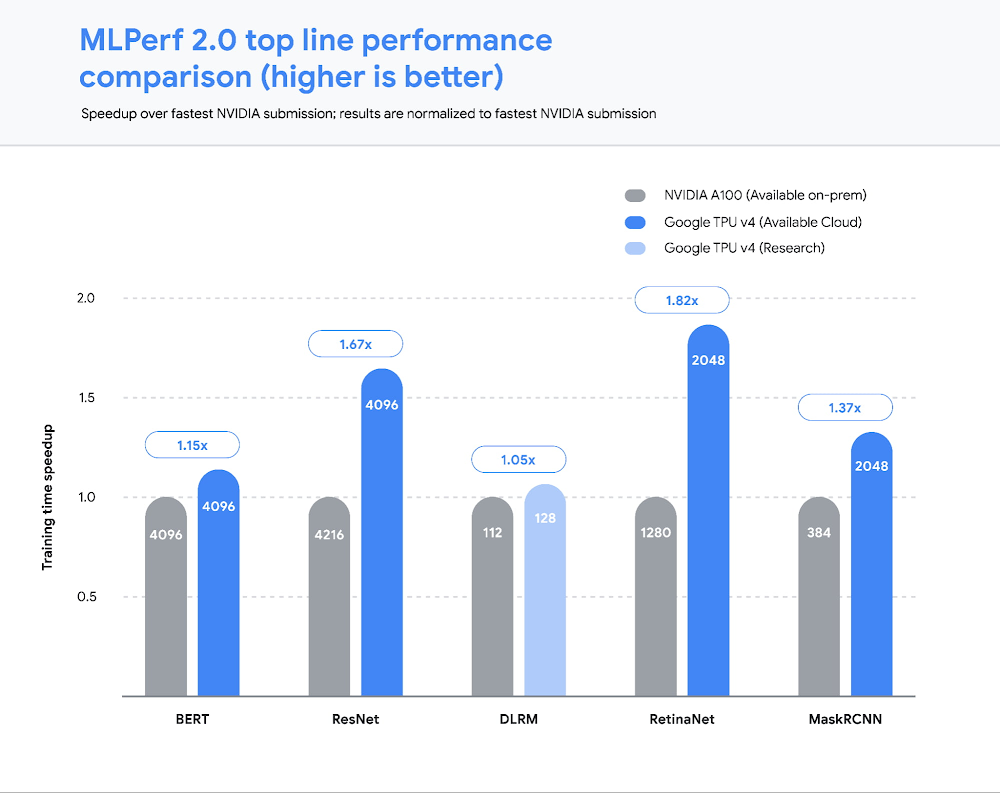
Today, ML-driven innovation is fundamentally transforming computing, enabling entirely new classes of internet services. For example, recent state-of-the-art lage models such as PaLM and Chinchilla herald a coming paradigm shift where ML services will augment human creativity. All indications are that we are still in the early stages of what will be the next qualitative step function in computing. Realizing this transformation will require democratized and affordable access through cloud computing where the best of compute, networking, storage, and ML can be brought to bear seamlessly on ever larger-scale problem domains.  Today’s release of MLPerf™ 2.0 results from the MLCommons® Association highlights the public availability of the most powerful and efficient ML infrastructure anywhere. Google’s TPU v4 ML supercomputers set performance records on five benchmarks, with an average speedup of 1.42x over the next fastest non-Google submission, and 1.5x vs our MLPerf 1.0 submission. Even more compelling — four of these record runs were conducted on the publicly available Google Cloud ML hub that we announced at Google I/O. ML Hub runs out of our Oklahoma data center, which uses over 90% carbon-free energy. Let’s take a closer look at the results.Figure 1: TPUs demonstrated significant speedup in all five published benchmarks over the fastest non-Google submission (NVIDIA on-premises). Taller bars are better.Performance at scale…and in the public cloudOur 2.0 submissions1, all running on TensorFlow, demonstrated leading performance across all five benchmarks. We scaled two of our submissions to run on full TPU v4 Pods. Each Cloud TPU v4 Pod consists of 4096 chips connected together via an ultra-fast interconnect network with an industry-leading 6 terabits per second (Tbps) of bandwidth per host, enabling rapid training for the largest models.Hardware aside, these benchmark results were made possible in no small part by our work to improve the TPU software stack. Scalability and performance optimizations in the TPU compiler and runtime, including faster embedding lookups and improved model weight distribution across the TPU pod, enabled much of these improvements, and are now widely available to TPU users. For example, we made a number of performance improvements to the virtualization stack to fully utilize the compute power of both CPU hosts and TPU chips to achieve peak performance on image and recommendation models. These optimizations reflect lessons from Google’s cutting-edge internal ML use cases across Search, YouTube, and more. We are excited to bring the benefits of this work to all Google Cloud users as well.Figure 2: Our 2.0 submissions make use of advances in our compiler infrastructure to achieve a larger scale and better per-chip performance across the board than previously possible, averaging 1.5x speedup over our 1.0 submissions2Translating MLPerf wins to customer winsCloud TPU’s industry-leading performance at scale also translates to cost savings for customers. Based on our analysis summarized in Figure 3, Cloud TPUs on Google Cloud provide ~35-50% savings vs A100 on Microsoft Azure (see Figure 3). We employed the following methodology to calculate this result:2We compared the end-to-end times of the largest-scale MLPerf submissions, namely ResNet and BERT, from Google and NVIDIA. These submissions make use of a similar number of chips — upwards of 4000 TPU and GPU chips. Since performance does not scale linearly with chip count, we compared two submissions with roughly the same number of chips.To simplify the 4216-chip A100 comparison for ResNet vs our 4096-chip TPU submission, we made an assumption in favor of GPUs that 4096 A100 chips would deliver the same performance as 4216 chips.For pricing, we compared our publicly available Cloud TPU v4 on-demand prices ($3.22 per chip-hour) to Azure’s on-demand prices for A1003 ($4.1 per chip-hour). This once again favors the A100s since we assume zero virtualization overhead in moving from on-prem (NVIDIA’s results) to Azure Cloud.The savings are especially meaningful given that real-world models such as GPT-3 and PaLM are much larger than the BERT and ResNet models used in the MLPerf benchmark: PaLM is a 540 billion parameter model, while the BERT model used in the MLPerf benchmark has only 340 million parameters — a 1000x difference in scale. Based on our experience, the benefits of TPUs will grow significantly with scale and make the case all the more compelling for training on Cloud TPU v4.Figure 3: For the BERT model, using Cloud TPU v4 provides ~35% savings over A100, and ~50% savings for ResNet.4Have your cake and eat it too — a continued focus on sustainabilityPerformance at scale must take environmental concerns as a primary constraint and optimization target. The Cloud TPU v4 pods powering our MLPerf results run with 90% carbon-free energy and a Power Usage Efficiency of 1.10, meaning that less than 10% of the power delivered to the data center is lost through conversion, heat, or other sources of inefficiency. The TPU v4 chip delivers 3x the peak FLOPs per watt relative to the v3 generation. This combination of carbon-free energy and extraordinary power delivery and computation efficiency makes Cloud TPUs among the most efficient in the world.4Making the switch to Cloud TPUsThere has never been a better time for customers to adopt Cloud TPUs. Significant performance and cost savings at scale as well as a deep-rooted focus on sustainability are why customers such as Cohere, LG AI Research, Innersight Labs, and Allen Institute have made the switch. If you are ready to begin using Cloud TPUs for your workloads, please fill out this form. We are excited to partner with ML practitioners around the world to further accelerate the incredible rate of ML breakthroughs and innovation with Google Cloud’s TPU offerings.1 Innersight Labs.jpg2 Allen Institute.jpg3 Cohere.jpg4 LG AI Research.jpg1. MLPerf™ v2.0 Training Closed. Retrieved from https://mlcommons.org/en/training-normal-20/ 29 June 2022, results 2.0-2010, 2.0-2012, 2.0-2098, 2.0-2099, 2.0-2103, 2.0-2106, 2.0-2107, 2.0-2120. The MLPerf name and logo are trademarks of MLCommons Association in the United States and other countries. All rights reserved. Unauthorized use is strictly prohibited. See www.mlcommons.org for more information.2. MLPerf v1.0 and v2.0 Training Closed. Retrieved from https://mlcommons.org/en/training-normal-20/ 29 June 2022, results 1.0-1088, 1.0-1090, 1.0-1092, 2.0-2010, 2.0-2012, 2.0-2120.3. ND96amsr A100 v4 Azure VMs, powered by eight 80 GB NVIDIA Ampere A100 GPUs (Azure’s flagship Deep Learning and Tightly Coupled HPC GPU offering with CentOS or Ubuntu Linux) is used for this benchmarking4. Cost to train is not an official MLPerf metric and is not verified by MLCommons Association. Azure performance is a favorable estimate as described in the text, not an MLPerf result. Computations are based on results from MLPerf v2.0 Training Closed. Retrieved from https://mlcommons.org/en/training-normal-20/ 29 June 2022, results 2.0-2012, 2.0-2106, 2.0-2107.Related ArticleGoogle demonstrates leading performance in latest MLPerf BenchmarksTPU v4 Pods will soon be available on Google Cloud, providing the most powerful publicly available computing platform for machine learnin…Read Article
Quelle: Google Cloud Platform


Key Insights from Stack Overflow’s 2022 Developer Survey

Continually taking the pulse of the development community is key to understanding development trends. Less than a week ago, Stack Overflow published the results of its 2022 Developer Survey. We eagerly reviewed these findings to discover how tech trends have changed over the past year.
While a lot of the players in the top 10 spots have remained consistent from last year, some trends spoke volumes. It’s clear that application development demands flexibility, agility, and tools that let you bring your own tech stack. Here’s why.
No Single Language Rules Them All
Nothing is certain but death, taxes…and JavaScript. The language has claimed the top spot among popular programming, scripting, and markup languages for the 10th year running. There’s also similar stability near the top of the rankings — where the usual suspects like HTML/CSS, SQL, and Python reign supreme. We’ve discussed the leaders, but what about the remaining languages?
2022’s top languages. Data courtesy of Stack Overflow.
 
Overall, the sheer variety of languages used has grown substantially in the past five years. While Stack Overflow tracked the popularity of 25 different technologies in 2017, this year’s most popular technologies list featured 42!
Given that hundreds of programming languages alone exist today — with roughly 50 considered “most popular” overall — it’s interesting to see such representation. There’s truly something out there for every imaginable use case. We love variety because it encourages innovation. However, it’s also worth noting that variety can represent added complexity for developers.
Diversity in Databases and Frameworks
Similar things can be said for databases and web frameworks, where no single technology claims 50% or greater usage. Developers demand flexible tools that let them innovate, since so many technologies are highly popular:
2022’s top database technologies. Data courtesy of Stack Overflow.
 
2022’s top web frameworks and technologies. Data courtesy of Stack Overflow.
 
Stack’s findings also underscore a key element of current development. Developers are using innumerable combinations of languages, frameworks, tools — and even OSes — during the development lifecycle. There’s no widespread consensus across these categories. Tech stacks are also increasingly use case driven, and not the other way around. Developers are also trying to reach even wider audiences.
The growing complexities stemming from these trends are major paint points. Therefore, having a consistent environment where you can universally build and deploy with any of your preferred technologies is incredibly valuable.
Cross-Platform Development Is Essential
Even if Windows holds the majority in personal use, there’s no clear OS winner. Developers are creating applications across a wide variety of platforms, which means that a consistent environment must be able to build and package cross-platform applications.


Our users have shared that tools like Docker Desktop, Docker Hub, and others have noticeably simplified and accelerated their cross platform development projects. It’s much easier to package all application code, dependencies, and essential components together when deploying atop varied operating systems and CPU architectures.
For experienced developers and even container newcomers, Docker CLI commands are both plentiful and usable. Alternatively, you can start, stop, and manage your containers using Docker Desktop’s Dashboard UI. Volume management and image management options are also included. Our goal is to equip all developers with the tools they need to get more done, faster — while enjoying themselves in the process.
Containers Are Going Strong
Gartner believes that 70% of organizations will be running multiple containerized apps by 2023. Momentum has definitely grown, and it’s led us to some very humbling discoveries in 2022: Docker is the #1 most loved development tool, and remains the #1 most-wanted tool.
 
Data courtesy of Stack Overflow.
 
Data courtesy of Stack Overflow.
 
Over 75% of devs who’ve regularly used Docker in the past year want to keep using it. More developers (37% vs. 30% in 2021) who haven’t yet used Docker are now interested. Additionally, professional developers currently view Docker as the most fundamental tool, jumping 14 percentage points since last year.
First and foremost, this couldn’t have been possible without countless contributions from our developer community. Your continual feedback across all of our products and tools has helped drive development forward — and improve developer experiences. Most new features have stemmed directly from community engagement and contributions to our public roadmap. Your collective input has been so impactful.
We also know how increasingly saturated the tooling market is becoming every day, which makes us feel even luckier to have a strong following. Thank you so much for your support, and for letting us streamline your critical daily workflows! If you’re considering using Docker for the first time, check out our Orientation documentation and Shy Ruparel’s “Getting Started with Docker” workshop:
 

Developers Value Flexibility, Ease, and Stability
We’ve noticed some main themes from Stack Overflow’s 2022 Developer Survey. Firstly, there’s a massive variety of technologies currently used across the industry. Second, developers are using these technologies both because they’re essential and because they love them so much. Third, containers are becoming even more popular as teams better understand their benefits.
Docker maintains a number of tools that make development easier. Beyond our container technology, each tool supports rapid development and deployment across highly-diverse environments. You can harness your favorite tech stack without encountering hiccups.
We think this can benefit millions upon millions of developers, and we couldn’t be happier that you agree. And if you haven’t given Docker a try, remember to download Docker Desktop. Here’s looking forward to another successful year!
Hungry for more data? You can view Stack Overflow’s complete survey results here, or read the official summary here.
Quelle: https://blog.docker.com/feed/

June 2022 Newsletter

The latest and greatest content for developers.

Introducing Dear Moby
Moby has accrued a “whaleth” of knowledge over the years, and as it turns out, can’t wait to share his advice and best practices with you — the Docker community. Submit your questions for the opportunity to be featured in our Dear Moby column or videos!

Learn More

News you can use and monthly highlights:
Serving Machine Learning Models With Docker: 5 Mistakes You Should Avoid – Here are a few quick tips on what to do and what not to do when serving your machine learning models with Docker.
Efficient Python Docker Image from any Poetry Project – Need to pack your python project into a Docker container? Using Poetry as a package manager? Check out how this Dockerfile can be a starting point for creating a small, efficient image out of your Poetry project, with no additional operations to perform.
NestJS and Postgres local development with Docker Compose – Modern applications demand high-performing frameworks that allow developers to build efficient and scalable server-side apps. Learn how you can use Docker Compose to build a local development environment for Nest.js and Postgresql with hot reloading.
Building a live chart with Deno, WebSockets, Chart.js, and Materialize – Here’s a quick step-by-step guide that helps you to build a simple live dashboard app that displays real-time data from a Deno Web Socket server in a real-time chart using Chart.js powered with Docker Compose.

Supporting the LGBTQ+ Community
Happy Pride! We’re always proud to swim alongside our LGBTQ+ community, colleagues, family, and friends. Learn more about eight organizations supporting the LGBTQ+ tech community.

Learn More

The latest tips and tricks from the community:

Merge+Diff: Building DAGs More Efficiently and Elegantly
Docker Technology Enables the Next Generation of Desktop as a Service
Kickstart Your Spring Boot Application Development
Building Your First Dockerized MERN Stack Web App
NestJS and Postgres local development with Docker Compose
9 Tips for Containerizing Your Spring Boot Code
How to Build and Deploy a Django-based URL Shortener App from Scratch

Creating Flappy Dock
The feedback from our community has been overwhelmingly positive for our latest feature releases, including Docker Extensions. To demonstrate the limitless potential of the SDK, our team had a little fun and created a game: Flappy Dock. See how we built it and try it for yourself.

Learn More

Educational content created by the experts at Docker:

Deploying Web Applications Quicker and Easier with Caddy 2
JumpStart Your Node.js Development
6 Development Tool Features that Backend Developers Need
Build Your First Docker Extension
Simplify Your Deployments Using the Rust Official Image
Cross Compiling Rust Code for Multiple Architectures
From Edge to Mainstream: Scaling to 100K+ IoT Devices
How to Quickly Build, Deploy, and Serve Your HTML5 Game
Connecting Decentralized Storage Solutions to Your Web 3.0 Applications

Docker Captain: Damian Naprawa
This month we’re welcoming a new Captain into our crew: Damian Naprawa. Damian started writing blogs for the Polish Docker Community to share his knowledge. His favorite command is docker sbom and he’s very interested in improving developer’s productivity.

Meet the Captain

See what the Docker team has been up to:

Dockerfiles now Support Multiple Build Contexts
Dockershim not needed: Docker Desktop with Kubernetes 1.24+
Introducing Registry Access Management for Docker Business
New Extensions and Container Interface Enhancements in Docker Desktop 4.9
Securing the Software Supply Chain: Atomist Joins Docker
Docker advances container isolation and workloads with acquisition of Nestybox
Welcome Tilt: Fixing the pains of microservice development for Kubernetes

DockerCon 2022 On-Demand
With over 50 sessions for developers by developers, watch the latest developer news, trends, and announcements from DockerCon 2022. From the keynote to product demos to technical breakout sessions, hacks, and tips & tricks, there’s something for everyone.

Watch On-Demand

Quelle: https://blog.docker.com/feed/

Amazon QuickSight führt Überwachung mit CloudWatch-Metriken ein

Amazon QuickSight unterstützt jetzt die Überwachung von QuickSight-Assets durch das Senden von Metriken an Amazon CloudWatch. Entwickler und Administratoren von QuickSight können diese Metriken verwenden, um die Verfügbarkeit und Leistung Ihres QuickSight-Ökosystems nahezu in Echtzeit zu beobachten und zu reagieren. Sie können Datensatzerfassungen, Dashboards und Grafikelemente überwachen, um Leser mit einer konsistenten, leistungsstarken und ununterbrochenen Erfahrung auf QuickSight zu versorgen. Weitere Informationen finden Sie hier.
Quelle: aws.amazon.com

Virtual Private Cloud (VPC)-Unterstützung ist nun allgemein für SageMaker Ground Truth verfügbar

Amazon SageMaker Ground Truth unterstützt Sie beim Aufbau von hochwertigen Trainingsdatensätzen für Ihre Machine-Learning-Modelle (ML). Mit SageMaker Ground Truth können Sie Arbeiter von Amazon Mechanical Turk, einem Zuliefererunternehmen Ihrer Wahl oder Ihre private Belegschaft einsetzen, um gekennzeichnete Datensätze für das Training von ML-Modellen zu erstellen.
Quelle: aws.amazon.com






