Claude Opus 4.6: Anthropic’s powerful model for coding, agents, and enterprise workflows is now available in Microsoft Foundry

At Microsoft we believe that intelligence and trust are the core requirements of agentic AI at scale. Built on Azure, Microsoft Foundry brings these capabilities together on a secure, scalable cloud foundation for enterprise AI. Today, with the launch of Claude Opus 4.6 in Microsoft Foundry, we bring even more capability to agents that increasingly learn from and act on business systems.

Explore Claude in Microsoft Foundry today

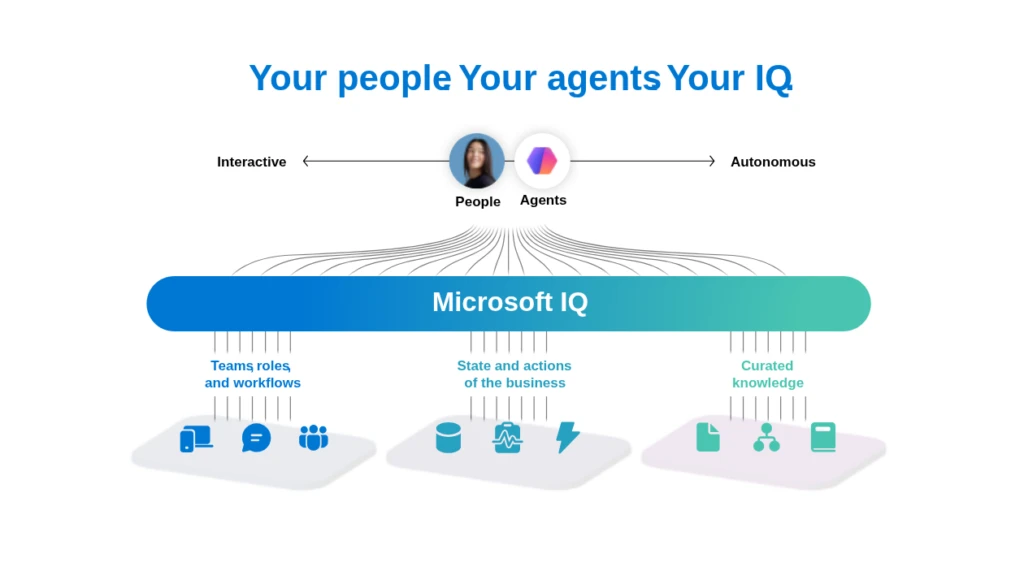
Claude Opus 4.6 brings Anthropic’s most advanced reasoning capabilities into Microsoft Foundry, our interoperable platform where intelligence and trust come together to enable autonomous work. In Foundry, Opus 4.6 can activate knowledge from everywhere: leveraging Foundry IQ to access data from M365 Work IQ, Fabric IQ, and the web. The model is best applied to complex tasks across coding, knowledge work, and agent-driven workflows, supporting deeper reasoning while offering superior instruction following for reliability.

Developers can now delegate their most complex work to AI systems for full-lifecycle development from, requirements gathering to implementation and maintenance. Business users can generate documents, perform research, and draft copy with professional polish and domain awareness.

At Adobe, we’re continuously evaluating new AI capabilities that can help us deliver more powerful, responsible, and intuitive experiences for our customers. We’ve been testing Claude models in Microsoft Foundry and are excited about the direction of Anthropic’s model roadmap. Foundry gives us a flexible, enterprise-ready environment to explore frontier models while maintaining the trust, governance, and scale that are critical for Adobe.
—Michael Marth, VP Engineering for Experience Manager and LLM Optimizer, Adobe

Introducing Opus 4.6: Frontier intelligence, built for real work

Claude Opus 4.6 is the latest version of Anthropic’s most intelligent model, and is considered the best Opus model for coding, enterprise agents, and professional work. With a 1M token context window (beta) and 128K max output, Opus 4.6 is ideal for:

Production code

Sophisticated agents

Office tasks

Financial analysis

Cybersecurity

Computer use

By combining Anthropic’s most advanced model with Foundry’s end-to-end tooling, customers can move from experimentation to production faster, without stitching together infrastructure.

1. Autonomous coding at a new level

Opus 4.6 handles large codebases well and is particularly effective at long-running tasks like refactoring, bug detection, and complex implementations.

This allows senior engineers to delegate work that previously took days, covering everything from requirements gathering to implementation and maintenance, while staying focused on reviews and decision-making.

With Foundry’s managed infrastructure and operational controls, teams can compress development timelines from days into hours, while maintaining the rigor required for real-world production systems.

Macroscope has relied on Anthropic’s frontier models to push what’s possible in AI code review, helping us catch the bugs that matter most to customers before they ever reach production. We’re incredibly excited to deepen this partnership by scaling on Azure infrastructure and delivering our product to teams around the world.
—Kayvon Beykpour, CEO & Co-Founder, Macroscope

2. Better knowledge work across the enterprise

Opus 4.6 delivers a step-change in how enterprises approach knowledge work, which Anthropic defines across three pillars: search, analyze, and create. In Microsoft Foundry, these capabilities can be applied directly to enterprise data, workflows, and agent-driven applications.

Opus 4.6 understands the conventions and norms of professional domains, producing documents, spreadsheets, and presentations that look and read like expert-created work. Combined with Foundry’s governance and access controls, this makes Opus 4.6 a great fit for finance, legal, and other precision-critical industries where quality, context, and compliance matter.

At Dentons, we are scaling generative AI across drafting, review, and research workflows across our global teams. Claude in Microsoft Foundry brings the frontier reasoning strength we need for legal work, backed by the governance and operational controls required in an enterprise environment. Better model reasoning reduces rework and improves consistency, so our lawyers can focus on higher value judgment.
—Matej Jambrich, CTO, Dentons Europe

High context financial analysis

Opus 4.6 excels at connecting insights across regulatory filings, market reports, and internal enterprise data, surfacing conclusions that would traditionally take analysts days to compile.

Its advanced reasoning capabilities allow it to:

Navigate nuanced financial and regulatory contexts

Generate compliance-sensitive outputs

Maintain consistency and traceability across complex analytical workflows

When deployed through Microsoft Foundry, these workflows benefit from Azure’s security, compliance, and auditability, helping organizations apply frontier AI to high-stakes analysis with confidence.

3. Advancing agentic and computer use capabilities

According to Anthropic, Opus 4.6 delivers major gains in computer use, with strong performance on industry benchmarks for visual understanding and multi-step navigation. Opus 4.6 sets a new standard for computer use. Claude can now operate computers more accurately, handle more complex tasks, and work across multiple applications seamlessly.

It can interact with software, navigate interfaces, complete forms, and move data across applications. When deployed in Microsoft Foundry, these actions can run as secure, governed agents, enabling automation of workflows that span legacy systems, document processing, and operational tools.

Opus 4.6 can manage complex, multi-tool workflows with less oversight—an essential requirement for teams operating AI systems at scale.

Anthropic on Azure provides Momentic with the reliability guarantees needed to process millions of tokens per hour on state-of-the-art models like Opus 4.5. Azure’s platform works seamlessly with Anthropic’s SDK, even supporting beta features such as reasoning effort out of the box.
—Jeff Ann, CTO & Co-Founder, Momentic AI

4. Agents, security, and high-stakes reasoning

Opus 4.6 is also best suited for agentic workflows, reliably orchestrating complex tasks across dozens of tools. It can proactively spin up sub-agents, parallelize work, and drive tasks forward with minimal oversight.

For security workflows, Opus 4.6 delivers deep reasoning, enabling teams to identify subtle patterns and complex attack vectors with high accuracy.

Anthropic is a trusted partner for governments and companies alike. Their speed, accuracy, and toolkit are already helping Everstar make fast, safe nuclear energy deployments a reality. I’m excited to see these capabilities integrated natively on Azure for secure deployments for our government and nuclear customers.
—Kevin Kong, Founder & CEO, Everstar

New API capabilities co-launching with Opus 4.6

Alongside Opus 4.6, Anthropic is introducing new API capabilities, available through Microsoft Foundry—that give developers greater control, scalability, and efficiency:

Adaptive thinking: Allows Claude to dynamically decide when and how much reasoning is required, optimizing performance and speed on simpler tasks, while allowing Claude to think harder on complex tasks.

Context Compaction (beta): Supports long-running conversations and agentic workflows by summarizing older context as token limits are reached.

1M Context Window (beta): Support for up to 1M tokens, with premium pricing applied beyond 200K tokens.

Max effort control: A new max effort level joins high, medium, and low, offering finer control over token allocation across thinking, tools, and output.

128K Output Tokens: Enables richer, more comprehensive outputs in a single response.

Claude Opus 4.6 in Microsoft Foundry

As AI systems move from assistance to autonomy, success depends on more than frontier intelligence, it requires intelligence that can be trusted to operate in real-world environments. Claude Opus 4.6 brings advanced reasoning and long-horizon execution, and Microsoft Foundry provides the system context where that intelligence can be applied responsibly, at scale.

Together, Claude in Foundry enables organizations to move beyond isolated experiments and toward intelligent, agent-driven systems that deliver real business impact—grounded in trust, governance, and operational rigor.

Opus 4.6 is also available through Microsoft Copilot Studio, enabling organizations to quickly build, orchestrate, and deploy advanced AI agents without custom code.

Explore Claude Opus 4.6 in Microsoft Foundry
Explore how Claude Opus 4.6 can power trusted, autonomous work in Microsoft Foundry.

Discover Opus 4.6

The post Claude Opus 4.6: Anthropic’s powerful model for coding, agents, and enterprise workflows is now available in Microsoft Foundry appeared first on Microsoft Azure Blog.
Quelle: Azure
Five Reasons to attend SQLCon

The SQL community is gathering in Atlanta this March for the first‑ever SQLCon, co‑located with FabCon, the Microsoft Fabric Community Conference, March 16-20. One registration unlocks both events, giving you access to deep SQL expertise and the latest in Fabric, Power BI, data engineering, real‑time intelligence, and AI. Whether you’re a DBA, developer, data engineer, architect, or a leader building data‑driven team, this is your chance to learn, connect, and shape what’s next.

One pass, two conferences—double the valueRegister once, benefit twice. With SQLCon and FabCon under the same roof, you can mix a deep SQL session in the morning with a Fabric or AI talk in the afternoon, then drop into the shared expo and community lounge. It’s a seamless, high‑impact week that lets specialists go deep while cross‑functional teams build a common language across data, analytics, and AI.

Dive Deep with Interactive Sessions and Hands-On WorkshopsThere are 50 SQL sessions at SQLCon. Fifty! The program is designed for momentum. Across the week, you’ll find practical content on SQL Server, Azure SQL, SQL database in Fabric, performance tuning, security and governance, migration and modernization, and building AI‑powered experiences with SQL. Monday and Tuesday are hands‑on workshop days—bring your laptop and leave with repeatable scripts, patterns, and demos you can apply immediately. Wednesday through Friday, you’ll stack conference sessions to round out your plan for the year.

Experience Atlanta: The Perfect Setting for SQLConSQLCon + FabCon take place at the Georgia World Congress Center, in the heart of a walkable downtown that’s tailor‑made for a great conference week. You’ll be just a short walk from Centennial Olympic Park, near State Farm Arena—home to major keynote events—and amid lively dining and music options. The attendee party is at the Georgia Aquarium, an unforgettable after‑hours experience with spectacular exhibits and a perfect setting for relaxed conversations with peers and product teams. Want a quick vibe check on the city and the conference energy? Watch the short video of Guy in a Cube and me:

Announcements on roadmap, engineering insights, and live updatesIf you want to understand where SQL Server, Azure SQL, and SQL database in Fabric are heading, this is the place. Expect direct updates from engineering (we’re sending over 30 members from the SQL product team); first‑look announcements; and live demos of upcoming capabilities across SQL tooling and drivers, SSMS/VS Code extensions, Copilot integrations, and Fabric SQL experiences. You’ll leave with clarity on what’s coming, how it impacts your environment, and where to invest next.

The SQL Community: Revitalized and EngagedSQLCon goes beyond a conference—it’s a gathering where the lounge hosts meetups and active conversations. Ask‑the‑Experts sessions connect you with engineers, MVPs, and product teams. Shared keynotes bring everyone together, and the city makes it easy to extend conversations into the evening. Bring your toughest questions, real-world challenges, and bold goals—you’ll leave with practical solutions, valuable connections, and new inspiration.

Bonus: make the budget workDepending on timing, look for early‑bird pricing, team discounts, or buy‑one‑get‑one offers on the registration page. These deals move fast, so check what’s live when you register. You can always use SQLCMTY200 for $200 off!

Wrap‑up: build the next chapter of your data strategy at SQLConSQLCon + FabCon is the highest‑leverage week of the year to sharpen your technical skills, understand SQL’s next chapter, accelerate modernization and performance, and build meaningful connections across the global community. If SQL plays any role in your data estate, this is the one event you shouldn’t miss.

See you in Atlanta!
The post Five Reasons to attend SQLCon appeared first on Microsoft Azure Blog.
Quelle: Azure
Can high-temperature superconductors transform the power infrastructure of datacenters?

As the demand for AI and data-intensive computing is on the rise, the need for efficient and reliable power delivery is critical. Enter high-temperature superconductors (HTS), a game-changing technology that can improve energy efficiency by reducing transmission losses. Microsoft is investigating HTS technology to understand how our datacenters can meet the growing demand for power and how to improve our operational sustainability. Superconductors offer a ‘lossless’ advantage, making power transmission more efficient.

See here how Microsoft datacenters support cloud around the globe

Superconductors let electricity flow with no resistance. This means we can move power more efficiently and increase capacity more quickly. Microsoft is exploring how this technology could make electrical grids stronger and reduce the impact datacenters have on nearby communities. Because superconductors take up less space to move large amounts of power, they could help us build cleaner, more compact systems.

Using this technology could change how power moves through the cloud and support AI and other demanding workloads. To make this possible, we need to rethink traditional power designs and how datacenters move electricity today. By working with superconducting technology partners and system integrators, we aim to turn this advanced science into real solutions that help our customers and communities.

Judy Priest, corporate vice president and chief technical officer of Cloud Operations and Innovation at Microsoft, and Erhan Karaca, Chief Technology Officer at VEIR, during factory test of 3MW superconducting cable.

How superconductors boost datacenter performance and efficiency

Reduction of datacenter impact through HTS capabilities.

Copper and aluminum are good conductors and are used today in most cloud infrastructure wiring and power lines. But HTS cables can do even better because they carry electricity with zero resistance. They are also smaller and lighter, and they don’t produce heat or introduce voltage drops as electricity travels through them. At the center of the technology are scalable high-availability cooling systems, maintaining HTS cables at cryogenic temperatures required to support the operational excellence of Microsoft’s datacenters. In copper, electrical current encounters resistance at every step, losing efficiency, generating heat, and limiting how much current we can move. Superconducting materials behave differently: once cooled, they create a pathway for current to move with zero resistance, eliminating losses, heat buildup, and removing limitations on how far the power can travel.

Why does this matter for datacenters specifically?

HTS is not new and has been researched for decades across energy, transportation, and advanced science. Only recently the economics and manufacturing aspects of this technology made it viable at Microsoft’s cloud scale. Datacenters can benefit from HTS because they concentrate massive electrical loads in compact footprints. Traditional conductors force operators to choose between expanding substations, adding more feeders, reducing deployment densities or curtailing growth. Superconductors break this tradeoff: they increase electrical density without expanding the physical footprint, allowing modern facilities to support AI-era power requirements within the same or even smaller physical constraints.

Inside the datacenters, more power delivered directly to the racks supports high-density, high-performance workloads with improved efficiency. HTS cables are lighter than copper and can carry current over longer distances, enabling further optimization of power distribution across racks and pods and reducing potential bottlenecks. We shared our vision for these novel architectures at OCP 2025 Summit.

In practice, HTS has already demonstrated the potential to reduce the size of the power cables by an order of magnitude when delivering power directly to a server rack—opening new possibilities for how power is distributed within a datacenter.

Ruslan Nagimov, principal infrastructure engineer for Cloud Operations and Innovation at Microsoft, near world’s first HTS-powered rack-prototype (superconducting line seen above the rack).

Increasing capacity with next‑gen power infrastructure

HTS technology also supports Microsoft’s long-term cloud plans. As our AI systems grow, power is still the biggest limit we face. By updating out power systems with superconductors, we can build electrical infrastructure that grows more easily with the rising demand for cloud services. This could even allow us to design new kinds of datacenter facilities in the future.

We need modern power systems that allow electrical capacity to scale dynamically without requiring entirely new power infrastructure. Next-gen superconducting transmission lines deliver an order of magnitude higher capacity than conventional lines at the same voltage level. In turn, they can accelerate the expansion and interconnection of datacenter sites, speeding up compute deployment to meet the growing global demand for cloud services. Superconductors represent a foundational shift for datacenters and the electrical grid, but unlocking their full potential will require reexamining traditional power system assumptions and rethinking today’s approaches to power transmission and datacenter design.

Superconductors are a category defining technology poised to transform how power is moved across the electricity value chain, stretching from generation to datacenter chips. At VEIR, we build complete power delivery solutions that take advantage of these remarkable materials, enabling customers to overcome critical bottlenecks in energy infrastructure, unlock new datacenter capacity faster, and achieve higher power and compute density.
Tim Heidel, CEO at VEIR (a Microsoft Climate Innovation Fund portfolio company)

Reduced impact on the grid and local communities

HTS systems reduce energy loss and require significantly less physical space for power delivery. From a grid perspective, they minimize voltage drop along transmission lines and can be used to introduce fault-current limiting capabilities, with the potential to enhance overall grid stability for high-demand facilities such as datacenters, but also for nearby homes, schools, hospitals and businesses.

Superconducting cables require smaller trenches and reduce the need for intrusive overhead power lines [Source: AMSC, LIPA Superconductor Project].

More importantly, this technology reduces the physical and social footprint of the power infrastructure, reducing the impact on local communities. Furthermore, expanding the electricity supply typically requires a complex effort that includes increasing electrical generation capacity and improving transmission and substation systems. Unlike traditional power lines, which rely on wider corridors and heavier, more visible infrastructure (tall overhead lines and expansive substations), HTS supports smaller, quieter, and far less intrusive systems. HTS transmission lines can transfer the same amount of power as conventional systems at lower voltage, reducing the setbacks and required right-of-ways. This translates to a better use of space, which reduces construction impact, shortens build timelines, and lowers pressure on surrounding communities.

Superconductors enabled ComEd to interconnect electrical grid substations in Chicago without disrupting local businesses or communities. Our proprietary solution uniquely increases grid resilience.
Daniel McGahn, CEO at American Superconductor Corporation (AMSC)

We are striving to accelerate indoor and outdoor applications of advanced power technologies like superconductors for faster and effective deployments of real-world datacenter infrastructure systems. Alongside breakthroughs in networking and cooling technologies like hollow-core fiber and microfluidics, high-temperature superconductors complete a strategic triad of power, network, and thermal innovation in our datacenters. You may never see the power lines, but HTS technology could be working behind the scenes to keep power, capacity, and AI infrastructure efficient, resilient, and future-ready, so our customers focus on what matters most: building and running their cloud infrastructure workloads.

Explore the future of datacenters

HTS is just one of the new technologies shaping the future of datacenters. As the cloud continues to grow, many other innovations—from advanced cooling systems to cleaner power solutions—are helping us build faster, smarter, and more sustainable facilities. Learn more about some of the other projects driving the next generation of datacenter design.

Learn more about Microfluidics cooling: Cooling at the micro level for Microsoft’s datacenters.

Learn more about how Microsoft Azure scales Hollow Core Fiber (HCF) production through outsourced manufacturing.

Learn more about building community-first AI infrastructure.

Get started with Azure today with a free account.

The post Can high-temperature superconductors transform the power infrastructure of datacenters? appeared first on Microsoft Azure Blog.
Quelle: Azure
Agentic cloud operations: A new way to run the cloud

Cloud operations have reached an inflection point. For more than a decade, the industry has focused on scale—more infrastructure, more data, more services, more dashboards to build and manage both infrastructure and applications. While today’s cloud delivers extraordinary flexibility, the rapid growth of modern applications and AI workloads has introduced levels of scale and complexity that traditional operations were not designed for.

See how you can run agents with Azure Copilot

As modern applications and AI workloads expand in scale, speed, and interconnectedness, operational demands are evolving just as quickly. Organizations are now looking for an operating model that builds on their existing practices—one that brings intelligence into the flow of work and translates the constant stream of signals into coordinated action across the cloud lifecycle.

A new operating model for a dynamic cloud

Macro trends are pointing towards major shifts in operations. In the era of AI, workloads can move from experimentation to full production in weeks, making constant change the new norm. Infrastructure and applications are continuously updated, scaled, and reconfigured. Telemetry now streams from every layer—health, configuration, cost, performance, and security—while programmable infrastructure enables action at machine speed. At the same time, AI agents are emerging as practical operational partners—able to correlate signals, understand context, and take action within defined guardrails. Together, these shifts are driving the need for a new operating model—one where operations are dynamic, context-aware, and continuously optimized rather than reactive and manual.

Introducing agentic cloud operations

Agentic cloud operations brings this model to life by enabling teams to harness AI-powered agents that infuse contextual intelligence into everyday workflow. These agents help accelerate development, migration, and optimization by connecting operational signals directly to coordinated action across the lifecycle. They bring people, tools, and data together, so insights don’t stay passive—they become execution. The result is faster performance, reduced risk, and cloud operations that improve over time instead of falling behind as complexity grows.

Azure Copilot: The agentic interface

Azure Copilot brings agentic cloud operations to life as the agentic interface for Azure. Rather than adding yet another dashboard, it delivers a unified, immersive experience grounded in a customer’s real environment—subscriptions, resources, policies, and operational history. Teams can work through natural language, chat, console, or CLI, invoking agents directly within their workflows. A centralized management environment brings observability, configuration, resiliency, optimization, and security together—enabling operators to move seamlessly from insight to action in one place.

Full-lifecycle agents, working in context

At Ignite, we unveiled the agentic capabilities of Azure Copilot. These capabilities span key operational domains—migration, deployment, optimization, observability, resiliency, and troubleshooting—each designed to bring contextual intelligence into the flow of work. Azure Copilot correlates signals, understands operational context, and takes governed action where it matters. Rather than functioning as discrete bots, they operate as a coordinated, context-aware system that continuously strengthens cloud operations.

Plan and prepare

Azure Copilot and agents helps teams start with clarity and confidence. Copilot migration agent can assist with discovering existing environments, mapping application and infrastructure dependencies, and identifying modernization paths before workloads move. Deployment agent then guides well-architected design and generate infrastructure as code artifacts that set strong operational patterns from the outset. In parallel, resiliency agent identifies gaps across availability, recovery, backup, and continuity—so reliability is designed in, not pathed later.

Deploy and launch

When teams are ready to go live, Copilot deployment agent support governed, repeatable deployment workflows that validate both infrastructure and application rollout. Observability agent establishes baseline health from the moment production traffic hits, while troubleshooting agent accelerates early-life issue resolution by diagnosing root causes, recommending fixes, and initiating support actions if needed. Throughout this phase, resiliency agent verifies that recovery and failover configurations hold up under real world conditions.

Operate, optimize, and evolve

In ongoing operations, Azure Copilot’s agentic capabilities deliver compounding value. Observability agent provides continuous, full stack visibility and diagnosis across applications and infrastructure. Optimization agent identify and execute improvements across cost, performance, and sustainability—often comparing financial and carbon impact in real time. Resiliency agent moves from validation to proactive posture management, continuously strengthening protection against emerging risks such as ransomware. Troubleshooting agent helps make the shift from reactive firefighting to rapid, context aware incident resolution. Last but not least, migration agent reenters the lifecycle to identify new opportunities to refactor or evolve workloads—not as a onetime event, but as continuous modernization.

In ongoing operations, Azure Copilot’s agentic capabilities deliver compounding value. Observability agent provides continuous, full stack visibility and diagnosis across applications and infrastructure. Optimization agent identifies and executes improvements across cost, performance, and sustainability—often comparing financial and carbon impact in real time. Resiliency agent moves from validation to proactive posture management, continuously strengthening protection against emerging risks such as ransomware. Troubleshooting agent helps make the shift from reactive firefighting to rapid, context aware incident resolution. Last but not least, migration agent reenters the lifecycle to identify new opportunities to refactor or evolve workloads—not as a onetime event, but as continuous modernization.

A connected system, not disparate tools

These capabilities don’t operate as isolated bots. They work within connected, context-aware workflows—correlating real time signals, understanding operational context, and taking governed action where it matters most. This allows teams to anticipate issues earlier, resolve them faster, and continuously improve their cloud posture across development, migration, and operations. The outcome isn’t fewer tools—it’s better flow, where people, data, and automation operate as a unified system.

Governance and human oversight by design

Agentic cloud operations are built for mission-critical systems, where governance and control are nonnegotiable. Azure Copilot embeds governance at every layer, allowing enterprises to define boundaries, apply policies consistently, and maintain clear oversight. Features such as Bring Your Own Storage (BYOS) for conversation history give customers even greater control—keeping operational data within their own Azure environment to ensure sovereignty, compliance, and visibility on their terms. All of this is grounded in Microsoft’s Responsible AI principles, ensuring autonomy and safety advance together. Every agent-initiated action honors existing policy, security, and RBAC controls. Actions are always reviewable, traceable, and auditable, ensuring human oversight remains central to automated workflows—not removed from them.

Operating with confidence as the cloud evolves

As cloud environments grow more dynamic and complex, operational models must evolve to match them. With Azure Copilot and agentic cloud operations, Microsoft is enabling organizations to operate mission-critical environments with greater speed, clarity, and control—providing the confidence to move forward as the cloud continues to change.

Explore more resources to deepen your understanding of agentic cloud operations

Access white paper on Intelligent Operations: How Agentic AI Is Aiming to Reshape IT.

Find resources, use cases, and get started with Azure Copilot.

From cloud to edge, see how Azure Copilot can help
Gain new insights, discover more benefits of the cloud, and orchestrate data across both the cloud and the edge.

Start here

The post Agentic cloud operations: A new way to run the cloud appeared first on Microsoft Azure Blog.
Quelle: Azure
PostgreSQL on Azure supercharged for AI

We are almost a century removed from when a group of computer scientists at Dartmouth College coined the term “Artificial Intelligence.” In the 75-year span, AI has become common vernacular, making inroads from imagined to mainstream. Today, we see entire industries being disrupted and entire ecosystems revolutionized by AI. To keep up, the way developers work and the tools they use have had to evolve. Every developer now needs to be an AI developer, and every system—from compute and storage to the data layer—now needs to be AI ready.

The database reimagined

New AI applications require databases that are not only reliable, extensible, and secure, but also AI-ready. In parallel, the way developers build software is being reshaped by AI. 1Most developers—more than 80%—now use AI tools in their workflow. This has led to notable productivity gains and it’s changing expectations for developer experience.

PostgreSQL has emerged as a top choice among developers and is becoming the default starting point for many new applications and projects. Favored by developers for its reliability, extensibility, and rapid innovation, 2PostgreSQL is chosen by 78.6% of developers that are building AI and real-time applications.

PostgreSQL on Azure meets the moment

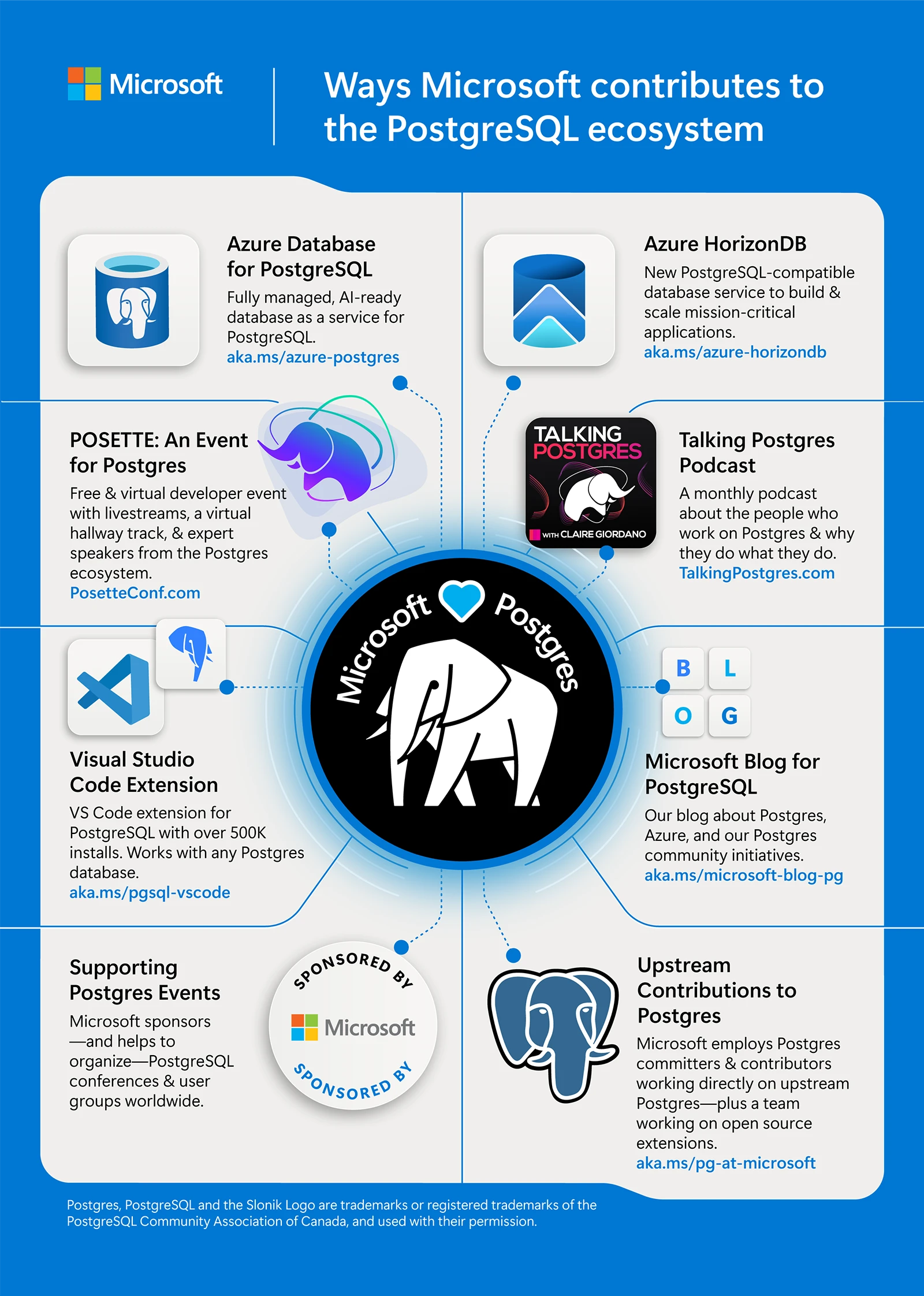
Selecting the right ecosystem is critical to support your AI and agentic aspirations, and we’ve made great strides in bolstering our PostgreSQL managed services to meet the needs of today’s developer. At Microsoft, we’ve embraced PostgreSQL not just as a product, but as a community. We’re proud to be one of the top contributors to the PostgreSQL open-source project, with more than 500 commits in the latest release. We are continuously innovating to make PostgreSQL the best database for building intelligent applications, and Azure the best place to run them.

Learn about Azure Database for PostgreSQL

The existing Azure Database for PostgreSQL continues to cater to lift-and-shift and new open-source workloads with improved performance and experience, while the new Azure HorizonDB, introduced at Ignite, targets the future by offering a PostgreSQL-compatible cloud service built for scale-out and ultra-low latency. Together, they position Azure to support developers building everything from small apps and agents to AI-powered, mission-critical systems, and anything in between.

A frictionless and intelligent developer experience

Building intelligent applications should feel intuitive, not intimidating. The Microsoft team has invested in making Azure Database for PostgreSQL a frictionless experience, especially for those building AI apps and agents. From provisioning to AI integration and scale, we’ve reimagined the developer experience to remove friction at every step.

Start in the IDE you love

The journey begins in Visual Studio Code—the leader in integrated development environments (IDEs) among developers—by a mile. With our PostgreSQL extension for Visual Studio Code, developers can now provision secure, fully managed PostgreSQL instances on Azure directly from the IDE. No portal hopping or manual setup. Just a few clicks, and your database is ready to go with built-in support for Entra ID authentication and Azure Monitor.

From there, GitHub Copilot becomes your intelligent assistant. It understands your PostgreSQL schema and helps you write, optimize, and debug SQL queries using natural language. Whether you’re joining tables, creating indexes, or exploring performance issues, Copilot is right there with you offering expert-level guidance to save time and improve performance.

Access in-database intelligence for smarter, faster apps

Once your database is live, you’re just a query away from infusing AI into your application. Azure Database for PostgreSQL now supports seamless integration with Microsoft Foundry, enabling developers to invoke pre-provisioned large language models (LLMs) in SQL. You can generate embeddings, classify text, or perform semantic search without leaving the database.

For applications that rely on relevance and speed, our DiskANN vector indexing delivers high-performance similarity search. Combined with semantic ranking, your queries return more accurate results, faster. This is ideal for powering intelligent agents, recommendations, and natural language interfaces.

Build intelligent agents with Microsoft Foundry

When you’re ready to build AI agents, Microsoft Foundry’s native PostgreSQL integration makes it easy. Using the new Model Context Protocol (MCP) server for PostgreSQL, developers can connect PostgreSQL directly to Foundry’s agent framework with a few clicks and permissions. This allows agents to reason over your data, invoke LLMs, and act on insights. And, of course, this is all backed by Azure’s enterprise-grade security and governance.

It’s a powerful combination: PostgreSQL’s structured data, Foundry’s orchestration, and Azure’s AI models working together to deliver intelligent, context-aware applications.

Leverage zero extract, transform, load (ETL) real-time analytics

Intelligent applications thrive on fresh insights. With Azure Database for PostgreSQL, you can mirror your operational data into Microsoft Fabric for real-time analytics without impacting performance. Alternatively, we’ve also enabled support for Parquet via the Azure Storage Extension, letting customers directly read from and write to Parquet files stored in Azure Storage from their Postgres databases, using SQL commands.

This means faster time to insight, fewer moving parts, and more time spent building.

Performance and scale that grows with you

All this intelligence is meaningless if the database isn’t secure and performant. As such, we’ve continued to innovate to unlock better performance and scale to meet the needs of even the most demanding, hypergrowth AI workloads. With PostgreSQL 18 now generally available on Azure, you get faster I/O, improved vacuuming, and smarter query planning. Our new V6 compute SKUs deliver higher throughput and lower latency, while Elastic Clusters enable horizontal scaling for multi-tenant and high-volume workloads.

Whether you’re building a startup MVP or scaling a global AI platform, Azure Database for PostgreSQL is ready to grow with you. Our customers have already been utilizing these new capabilities to build competitive advantage in industries from pharma to finance.

Real-world AI on Azure: How Nasdaq reinvented governance with PostgreSQL

When people think of Nasdaq, they picture trading floors and financial data moving at lightning speed. But behind the scenes, Nasdaq also manages board governance for thousands of organizations, including nearly half of the Fortune 500. At Ignite, Nasdaq shared how they modernized their Boardvantage platform using Azure Database for PostgreSQL and Microsoft Foundry.   Their goal: introduce AI to help directors navigate 500-page board packets and extract insights, without compromising security or compliance.The result? A governance platform that uses AI to summarize meeting minutes, flag anomalies, and surface relevant decisions while keeping each customer’s data isolated and protected.

Looking ahead: Azure HorizonDB and the future of intelligent apps

At Ignite, we also introduced Azure HorizonDB, a new, fully managed PostgreSQL-compatible service built for AI-native workloads. With scale-out compute, sub-millisecond latency, and built-in AI features, Azure HorizonDB represents the future of cloud databases. While the service is currently in private preview, it’s a glimpse of what’s coming.

Explore Azure HorizonDB

The future is open, intelligent, and built on Azure

At Microsoft, our mission is to offer customers databases equipped for next-generation development, whether they be SQL, NoSQL, relational, or open source. As PostgreSQL continues to stand out as a platform for innovation, it’s now primed for intelligent applications and agents due to Microsoft’s continued support and service enhancements. Whether you’re a startup building your first AI feature or an enterprise modernizing mission-critical systems, Azure gives you the tools to move faster, build smarter, and scale confidently.

The future of intelligent applications will be written in Postgres, and we’re thrilled to build it together with you on Azure.

Start today

Try the PostgreSQL extension for VS Code

Learn how to build AI agents with Azure Database for PostgreSQL

1Most developers—more than 80%—now use AI tools in their workflow.

2PostgreSQL is chosen by 78.6% of developers that are building AI and real-time applications.
The post PostgreSQL on Azure supercharged for AI appeared first on Microsoft Azure Blog.
Quelle: Azure
Maia 200: The AI accelerator built for inference

Today, we’re proud to introduce Maia 200, a breakthrough inference accelerator engineered to dramatically improve the economics of AI token generation. Maia 200 is an AI inference powerhouse: an accelerator built on TSMC’s 3nm process with native FP8/FP4 tensor cores, a redesigned memory system with 216GB HBM3e at 7 TB/s and 272MB of on-chip SRAM, plus data movement engines that keep massive models fed, fast and highly utilized. This makes Maia 200 the most performant, first-party silicon from any hyperscaler, with three times the FP4 performance of the third generation Amazon Trainium, and FP8 performance above Google’s seventh generation TPU. Maia 200 is also the most efficient inference system Microsoft has ever deployed, with 30% better performance per dollar than the latest generation hardware in our fleet today.

Maia 200 is part of our heterogenous AI infrastructure and will serve multiple models, including the latest GPT-5.2 models from OpenAI, bringing performance per dollar advantage to Microsoft Foundry and Microsoft 365 Copilot. The Microsoft Superintelligence team will use Maia 200 for synthetic data generation and reinforcement learning to improve next-generation in-house models. For synthetic data pipeline use cases, Maia 200’s unique design helps accelerate the rate at which high-quality, domain-specific data can be generated and filtered, feeding downstream training with fresher, more targeted signals.

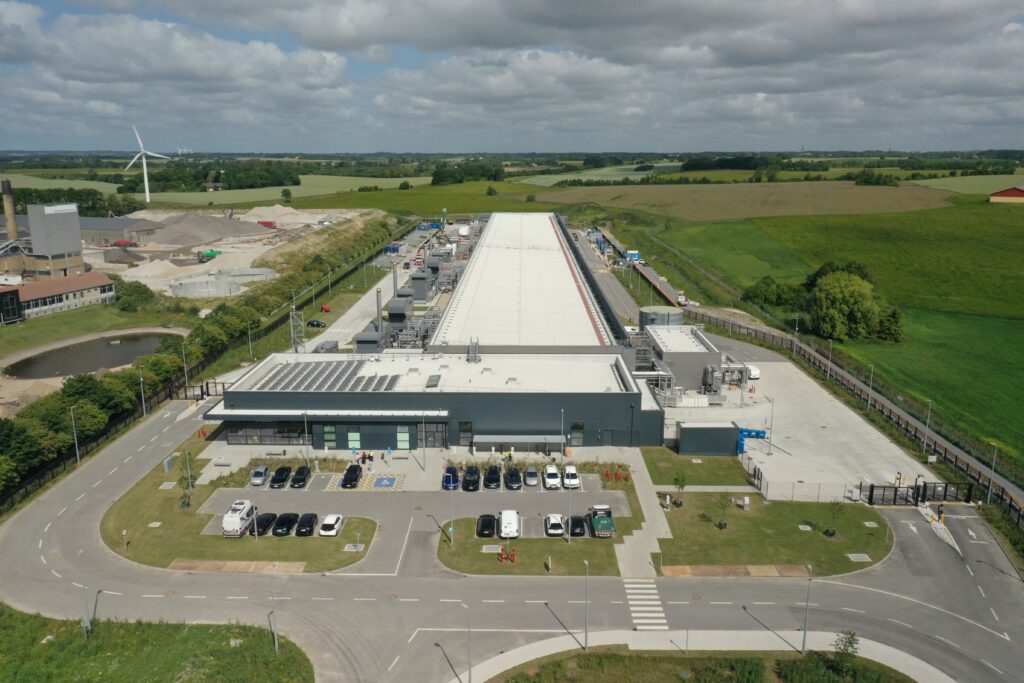
Maia 200 is deployed in our US Central datacenter region near Des Moines, Iowa, with the US West 3 datacenter region near Phoenix, Arizona, coming next and future regions to follow. Maia 200 integrates seamlessly with Azure, and we are previewing the Maia SDK with a complete set of tools to build and optimize models for Maia 200. It includes a full set of capabilities, including PyTorch integration, a Triton compiler and optimized kernel library, and access to Maia’s low-level programming language. This gives developers fine-grained control when needed while enabling easy model porting across heterogeneous hardware accelerators.

YouTube Video

Engineered for AI inferenceFabricated on TSMC’s cutting-edge 3-nanometer process, each Maia 200 chip contains over 140 billion transistors and is tailored for large-scale AI workloads while also delivering efficient performance per dollar. On both fronts, Maia 200 is built to excel. It is designed for the latest models using low-precision compute, with each Maia 200 chip delivering over 10 petaFLOPS in 4-bit precision (FP4) and over 5 petaFLOPS of 8-bit (FP8) performance, all within a 750W SoC TDP envelope. In practical terms, Maia 200 can effortlessly run today’s largest models, with plenty of headroom for even bigger models in the future.

A close-up of the Maia 200 AI accelerator chip.

Crucially, FLOPS aren’t the only ingredient for faster AI. Feeding data is equally important. Maia 200 attacks this bottleneck with a redesigned memory subsystem. The Maia 200 memory subsystem is centered on narrow-precision datatypes, a specialized DMA engine, on-die SRAM and a specialized NoC fabric for high‑bandwidth data movement, increasing token throughput.

A table with the title “Industry-leading capability” shows peak specifications for Azure Maia 200, AWS Trainium 3 and Google TPU v7.

Optimized AI systemsAt the systems level, Maia 200 introduces a novel, two-tier scale-up network design built on standard Ethernet. A custom transport layer and tightly integrated NIC unlocks performance, strong reliability and significant cost advantages without relying on proprietary fabrics.

Each accelerator exposes:

2.8 TB/s of bidirectional, dedicated scaleup bandwidthPredictable, high-performance collective operations across clusters of up to 6,144 acceleratorsThis architecture delivers scalable performance for dense inference clusters while reducing power usage and overall TCO across Azure’s global fleet.

Within each tray, four Maia accelerators are fully connected with direct, non‑switched links, keeping high‑bandwidth communication local for optimal inference efficiency. The same communication protocols are used for intra-rack and inter-rack networking using the Maia AI transport protocol, enabling seamless scaling across nodes, racks and clusters of accelerators with minimal network hops. This unified fabric simplifies programming, improves workload flexibility and reduces stranded capacity while maintaining consistent performance and cost efficiency at cloud scale.

A top-down view of the Maia 200 server blade.

A cloud-native development approachA core principle of Microsoft’s silicon development programs is to validate as much of the end-to-end system as possible ahead of final silicon availability.

A sophisticated pre-silicon environment guided the Maia 200 architecture from its earliest stages, modeling the computation and communication patterns of LLMs with high fidelity. This early co-development environment enabled us to optimize silicon, networking and system software as a unified whole, long before first silicon.

We also designed Maia 200 for fast, seamless availability in the datacenter from the beginning, building out early validation of some of the most complex system elements, including the backend network and our second-generation, closed loop, liquid cooling Heat Exchanger Unit. Native integration with the Azure control plane delivers security, telemetry, diagnostics and management capabilities at both the chip and rack levels, maximizing reliability and uptime for production-critical AI workloads.

As a result of these investments, AI models were running on Maia 200 silicon within days of first packaged part arrival. Time from first silicon to first datacenter rack deployment was reduced to less than half that of comparable AI infrastructure programs. And this end-to-end approach, from chip to software to datacenter, translates directly into higher utilization, faster time to production and sustained improvements in performance per dollar and per watt at cloud scale.

A view of the Maia 200 rack and the HXU cooling unit.

Sign up for the Maia SDK previewThe era of large-scale AI is just beginning, and infrastructure will define what’s possible. Our Maia AI accelerator program is designed to be multi-generational. As we deploy Maia 200 across our global infrastructure, we are already designing for future generations and expect each generation will continually set new benchmarks for what’s possible and deliver ever better performance and efficiency for the most important AI workloads.

Today, we’re inviting developers, AI startups and academics to begin exploring early model and workload optimization with the new Maia 200 software development kit (SDK). The SDK includes a Triton Compiler, support for PyTorch, low-level programming in NPL and a Maia simulator and cost calculator to optimize for efficiencies earlier in the code lifecycle. Sign up for the preview here.

Get more photos, video and resources on our Maia 200 site and read more details.

Scott Guthrie is responsible for hyperscale cloud computing solutions and services including Azure, Microsoft’s cloud computing platform, generative AI solutions, data platforms and information and cybersecurity. These platforms and services help organizations worldwide solve urgent challenges and drive long-term transformation.
The post Maia 200: The AI accelerator built for inference appeared first on Microsoft Azure Blog.
Quelle: Azure

Beyond boundaries: The future of Azure Storage in 2026

2025 was a pivotal year in Azure Storage, and we’re heading into 2026 with a clear focus on helping customers turn AI into real impact. As outlined in last December’s Azure Storage innovations: Unlocking the future of data, Azure Storage is evolving as a unified intelligent platform that supports the full AI lifecycle at enterprise scale with the performance modern workloads demand.

What is Azure Storage?

Looking ahead to 2026, our investments span the full breadth of that lifecycle as AI becomes foundational across every industry. We are advancing storage performance for frontier model training, delivering purpose‑built solutions for large‑scale AI inferencing and emerging agentic applications, and empowering cloud‑native applications to operate at agentic scale. In parallel, we are simplifying adoption for mission‑critical workloads, lowering TCO, and deepening partnerships to co‑engineer AI‑optimized solutions with our customers.

We’re grateful to our customers and partners for their trust and collaboration, and excited to shape the next chapter of Azure Storage together in the year ahead.

Extending from training to inference

AI workloads extend from large, centralized model training to inference at scale, where models are applied continuously across products, workflows, and real-world decision making. LLM training continues to run on Azure, and we’re investing to stay ahead by expanding scale, improving throughput, and optimizing how model files, checkpoints, and training datasets flow through storage.

Innovations that helped OpenAI to operate at unprecedented scale are now available for all enterprises. Blob scaled accounts allow storage to scale across hundreds of scale units within a region, handling millions of objects required to enable enterprise data to be used as training and tuning datasets for applied AI. Our partnership with NVIDIA DGX on Azure shows that scale translates into real-world inference. DGX cloud was co-engineered to run on Azure, pairing accelerated compute with high-performance storage, Azure Managed Lustre (AMLFS), to support LLM research, automotive, and robotics applications. AMLFS provides the best price-performance for keeping GPU fleets continuously fed. We recently released Preview support for 25 PiB namespaces and up to 512 GBps of throughput, making AMLFS best in class managed Lustre deployment on Cloud.

As we look ahead, we’re deepening integration across popular first and third-party AI frameworks such as Microsoft Foundry, Ray, Anyscale, and LangChain, enabling seamless connections to Azure Storage out of box. Our native Azure Blob Storage integration within Foundry enables enterprise data consolidation into Foundry IQ, making blob storage the foundational layer for grounding enterprise knowledge, fine-tuning models, and serving low-latency context to inference, all under the tenant’s security and governance controls.

From training through full-scale inferencing, Azure Storage supports the entire agent lifecycle: from distributing large model files efficiently, storing and retrieving long-lived context, to serving data from RAG vector stores. By optimizing for each pattern end-to-end, Azure Storage has performant solutions for every stage of AI inference.

Evolving cloud native applications for agentic scale

As inference becomes the dominant AI workload, autonomous agents are reshaping how cloud native applications interact with data. Unlike human-driven systems with predictable query patterns, agents operate continuously, issuing an order of magnitude more queries than traditional users ever did. This surge in concurrency stresses databases and storage layers, pushing enterprises to rethink how they architect new cloud native applications.

Azure Storage is building with SaaS leaders like ServiceNow, Databricks, and Elastic to optimize for agentic scale leveraging our block storage portfolio. Looking forward, Elastic SAN becomes a core building block for these cloud native workloads, starting with transforming Microsoft’s own database solutions. It offers fully managed block storage pools for different workloads to share provisioned resources with guardrails for hosting multi-tenant data. We’re pushing the boundaries on max scale units to enable denser packing and capabilities for SaaS providers to manage agentic traffic patterns.

As cloud native workloads adopt Kubernetes to scale rapidly, we are simplifying the development of stateful applications through our Kubernetes native storage orchestrator, Azure Container Storage (ACStor) alongside CSI drivers. Our recent ACStor release signals two directional changes that will guide upcoming investments: adopting the Kubernetes operator model to perform more complex orchestration and open sourcing the code base to collaborate and innovate with the broader Kubernetes community.

Together, these investments establish a strong foundation for the next generation of cloud native applications where storage must scale seamlessly and deliver high efficiency to serve as the data platform for agentic scale systems.

Breaking price performance barriers for mission critical workloads

In addition to evolving AI workloads, enterprises continue to grow their mission critical workloads on Azure.

SAP and Microsoft are partnering together to expand core SAP performance while introducing AI-driven agents like Joule that enrich Microsoft 365 Copilot with enterprise context. Azure’s latest M-series advancements add substantial scale-up headroom for SAP HANA, pushing disk storage performance to ~780k IOPS and 16 GB/s throughput. For shared storage, Azure NetApp Files (ANF) and Azure Premium Files deliver the high throughput NFS/SMB foundations SAP landscapes rely on, while optimizing TCO with ANF Flexible Service Level and Azure Files Provisioned v2. Coming soon, we will introduce Elastic ZRS storage service level in ANF, bringing zone‑redundant high availability and consistent performance through synchronous replication across availability zones leveraging Azure’s ZRS architecture, without added operational complexity.

Similarly, Ultra Disks have become foundational to platforms like BlackRock’s Aladdin, which must react instantly to market shifts and sustain high-performance under heavy load. With average latency well under 500 microseconds, support for 400K IOPS, and 10 GB/s throughput, Ultra Disks enable faster risk calculation, more agile portfolio management, and resilient performance on BlackRock’s highest-volume trading days. When paired with Ebsv6 VMs, Ultra Disks can reach 800K IOPS and 14 GB/s for the most demanding mission critical workloads. And with flexible provisioning, customers can tune performance precisely to their needs while optimizing TCO.

These combined investments give enterprises a more resilient, scalable, and cost-efficient platform for their most critical workloads.

Designing for new realities of power and supply

The global AI surge is straining power grids and hardware supply chains. Rising energy costs, tight datacenter budgets, and industry-wide HDD/SSD shortages mean organizations can’t scale infrastructure simply by adding more hardware. Storage must become more efficient and intelligent by design.

We’re streamlining the entire stack to maximize hardware performance with minimal overhead. Combined with intelligent load balancing and cost-effective tiering, we are uniquely positioned to help customers scale storage sustainably even as power and hardware availability become strategic constraints. With continued innovations on Azure Boost Data Processing Units (DPUs), we expect step function gains in storage speed and feeds at even lower per unit energy consumption.

AI pipelines can span on-premises estates, neo cloud GPU clusters, and cloud, yet many of these environments are limited by power capacity or storage supply. When these limits become a bottleneck, we make it easy to shift workloads to Azure. We’re investing in integrations that make external datasets first class citizens in Azure, enabling seamless access to training, finetuning, and inference data wherever it lives. As cloud storage evolves into AI-ready datasets, Azure Storage is introducing curated, pipeline optimized experiences to simplify how customers feed data into downstream AI services.

Accelerating innovations through the storage partner ecosystem

We can’t do this alone. Azure Storage partners closely with strategic partners to push inference performance to the next level. In addition to the self-publishing capabilities available in Azure Marketplace, we go a step further by devoting resources with expertise to co-engineer solutions with partners to build highly optimized and deeply integrated services.

In 2026, you will see more co-engineered solutions like Commvault Cloud for Azure, Dell PowerScale, Azure Native Qumulo, Pure Storage Cloud, Rubrik Cloud Vault, and Veeam Data Cloud. We will focus on hybrid solutions with partners like VAST Data and Komprise to enable data movement that unlocks the power of Azure AI services and infrastructure—fueling impactful customer AI Agent and Application initiatives.

To an exciting new year with Azure Storage

As we move into 2026, our vision remains simple: help every customer unlock more value from their data with storage that is faster, smarter, and built for the future. Whether powering AI, scaling cloud native applications, or supporting mission critical workloads, Azure Storage is here to help you innovate with confidence in the year ahead.

What are the benefits of using Azure Storage?
Azure Storage services are durable, secure, and scalable. Review your options and check out our sample of scenarios.

Explore Azure Storage

The post Beyond boundaries: The future of Azure Storage in 2026 appeared first on Microsoft Azure Blog.
Quelle: Azure
Microsoft named a Leader in IDC MarketScape for Unified AI Governance Platforms

As organizations rapidly embrace generative and agentic AI, ensuring robust, unified governance has never been more critical. That’s why Microsoft is honored to be named a Leader in the 2025-2026 IDC MarketScape for Worldwide Unified AI Governance Platforms (Vendor Assessment (#US53514825, December 2025). We believe this recognition highlights our commitment to making AI innovation safe, responsible, and enterprise-ready—so you can move fast without compromising trust or compliance.

Read the IDC MarketScape for Unified AI Governance Platforms reportA graphic showing Microsoft’s position in the Leaders section of the IDC report.Figure 1. IDC MarketScape vendor analysis model is designed to provide an overview of the competitive fitness of technology and suppliers in a given market. The research methodology utilizes a rigorous scoring methodology based on both qualitative and quantitative criteria that results in a single graphical illustration of each supplier’s position within a given market. The Capabilities score measures supplier product, go-to-market and business execution in the short term. The Strategy score measures alignment of supplier strategies with customer requirements in a three- to five-year timeframe. Supplier market share is represented by the size of the icons.The urgency for a unified AI governance strategy is being driven by stricter regulatory demands, the sheer complexity of managing AI systems across multiple AI platforms and multicloud and hybrid environments, and leadership concerns for risk related to negative brand impact. Centralized, end-to-end governance platforms help organizations reduce compliance bottlenecks, lower operational risks, and turn governance into a strategic driver for responsible AI innovation. In today’s landscape, unified AI governance is not just a compliance obligation—it is critical infrastructure for trust, transparency, and sustainable business transformation.

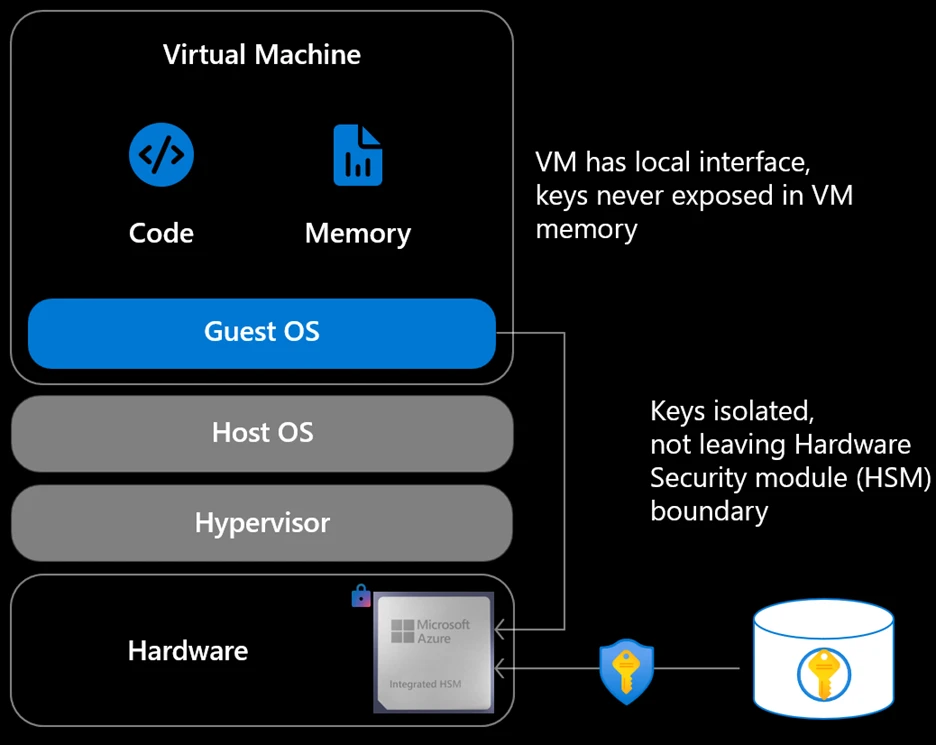
Our own approach to AI is anchored to Microsoft’s Responsible AI standard, backed by a dedicated Office of Responsible AI. Drawing from our internal experience in building, securing, and governing AI systems, we translate these learnings directly into our AI management tools and security platform. As a result, customers benefit from features such as transparency notes, fairness analysis, explainability tools, safety guardrails, regulatory compliance assessments, agent identity, data security, vulnerability identification, and protection against cyberthreats like prompt-injection attacks. These tools enable them to develop, secure, and govern AI that aligns with ethical principles and is built to help support compliance with regulatory requirements. By integrating these capabilities, we empower organizations to make ethical decisions and safeguard their business processes throughout the entire AI lifecycle.

Microsoft’s AI Governance capabilities aim to provide integrated and centralized control for observability, management, and security across IT, developer, and security teams, ensuring integrated governance within their existing tools. Microsoft Foundry acts as our main control point for model development, evaluation, deployment, and monitoring, featuring a curated model catalog, machine learning oeprations, robust evaluation, and embedded content safety guardrails. Microsoft Agent 365, which was not yet available at the time of the IDC publication, provides a centralized control plane for IT, helping teams confidently deploy, manage, and secure their agentic AI published through Microsoft 365 Copilot, Microsoft Copilot Studio, and Microsoft Foundry.

Deeply embedded security systems are integral to Microsoft’s AI governance solution. Integrations with Microsoft Purview provide real-time data security, compliance, and governance tools, while Microsoft Entra provides agent identity and controls to manage agent sprawl and prevent unauthorized access to confidential resources. Microsoft Defender offers AI-specific posture management, threat detection, and runtime protection. Microsoft Purview Compliance Manager automates adherence to more than 100 regulatory frameworks. Granular audit logging and automated documentation bolster regulatory and forensic capabilities, enabling organizations in regulated industries to innovate with AI while maintaining oversight, secure collaboration, and consistent policy enforcement.

Guidance for security and governance leaders and CISOsTo empower organizations in advancing their AI transformation initiatives, it is crucial to focus on the following priorities for establishing a secure, well-governed, and scalable AI framework. The guidance below provides Microsoft’s recommendations for fulfilling these best practices:

CISO guidance What it means How Microsoft deliversAdopt a unified, end‑to‑end governance platform Establish a comprehensive, integrated governance system covering traditional machine learning, generative AI, and agentic AI. Ensure unified oversight from development through deployment and monitoring. Microsoft enables observability and governance at every layer across IT, developer, and security teams to provide an integrated and cohesive governance platform that enables teams to play their part from within the tools they use. Microsoft Foundry acts as the developer control plane, connecting model development, evaluation, security controls, and continuous monitoring. Microsoft Agent 365 is the control plane for IT, enabling discovery, security, deployment, and observability for agentic AI in the enterprise. Microsoft Purview, Entra, and Defender integrate to deliver consistent full-stack governance across data, identity, threat protection, and compliance.Industry‑leading responsible AI infrastructure Implement responsible AI practices as a foundational part of engineering and operations, with transparency and fairness built in. Microsoft embeds its Responsible AI Standards into our engineering processes, supported by the Office of Responsible AI. Automatic generation of model cards and built-in fairness mechanisms set Microsoft apart as a strategic differentiator, pairing technical controls with mature governance processes. Microsoft’s Responsible AI Transparency Report provides visibility to how we develop and deploy AI models and systems responsibility and provides a model for customers to emulate our best practices.Advanced security and real‑time protection Provide robust, real-time defense against emerging AI security threats, especially for regulated industries. Microsoft’s platform features real-time jailbreak detection, encrypted agent-to-agent communication, tamper-evident audit logs for model and agent actions, and deep integration with Defender to provide AI-specific threat detection, security posture management, and automated incident response capabilities. These capabilities are especially critical for regulated sectors.Automated compliance at scale Automate compliance processes, enable policy enforcement throughout the AI lifecycle, and support audit readiness across hybrid and multicloud environments. Microsoft Purview streamlines compliance adherence for regulatory requirements and provides comprehensive support for hybrid and multicloud deployments—giving customers repeatable and auditable governance processes.We believe we are differentiated in the AI governance space by delivering a unified, end-to-end platform that embeds responsible AI principles and robust security at every layer—from agents and applications to underlying infrastructure. Through native integration of Microsoft Foundry, Microsoft Agent 365, Purview, Entra, and Defender, organizations benefit from centralized oversight and observability across the layers of the organization with consistent protection and operationalized compliance across the AI lifecycle. Our comprehensive approach removes disparate and disconnected tooling, enabling organizations to build trustworthy, transparent, and secure AI solutions that can start secure and stay secure. We believe this approach uniquely differentiates Microsoft as a leader in operationalizing responsible, secure, and auditable AI at scale.

Strengthen your security strategy with Microsoft AI governance solutionsAgentic and generative AI are reshaping business processes, creating a new frontier for security and governance. Organizations that act early and prioritize governance best practices—unified governance platforms, build-in responsible AI tooling, and integrated security—will be best positioned to innovate confidently and maintain trust.

Microsoft approaches AI governance with a commitment to embedding responsible practices and robust security at every layer of the AI ecosystem. Our AI governance and security solutions empower customers with built-in transparency, fairness, and compliance tools throughout engineering and operations. We believe this approach allows organizations to benefit from centralized oversight, enforce policies consistently across the entire AI lifecycle, and achieve audit readiness—even in the rapidly changing landscape of generative and agentic AI.

Explore moreRead the IDC MarketScape excerpt.Learn more about AI Security, Governance and Compliance.Read our latest Security for AI blog to learn more about our latest capabilitiesTo learn more about Microsoft Security solutions, visit our website. Bookmark the Security blog to keep up with our expert coverage on security matters. Also, follow us on LinkedIn (Microsoft Security) and X (@MSFTSecurity) for the latest news and updates on cybersecurity.
The post Microsoft named a Leader in IDC MarketScape for Unified AI Governance Platforms appeared first on Microsoft Azure Blog.
Quelle: Azure
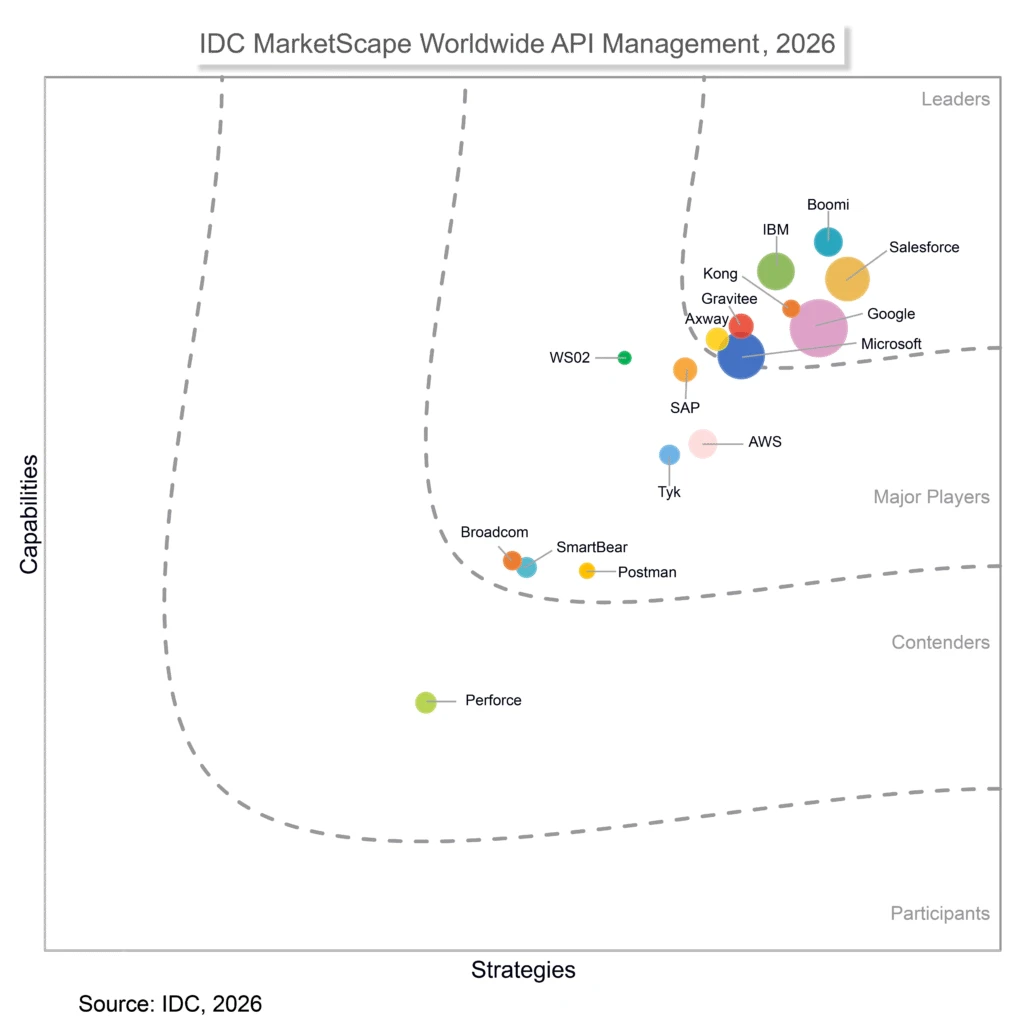
Chart your AI and agent strategy with Microsoft Marketplace

A new category of organization is emerging that embeds AI across every layer of their operations—accelerating delivery, scaling efficiently, and unlocking new business potential. These companies are leading Frontier Firm transformation, not simply adopting AI but rebuilding around it to set the pace for the next decade of innovation. Successfully adopting AI requires choosing the right strategy with tradeoffs between time-to-market and time-to-value. There is no one-size-fits-all approach—some organizations will build from scratch, buy off-the-shelf, or choose a hybrid option of custom components with ready-made tools.

Find cloud solutions with Microsoft Marketplace

Regardless of approach, Microsoft Marketplace—with the largest catalog of AI apps and agents in the industry—is the primary destination for organizations adopting AI quickly and responsibly. Thousands of pre-vetted solutions are available from Microsoft partners that seamlessly integrate with your existing Microsoft stack for faster time-to-value.

Marketplace has a single catalog that meets you where you are. Solutions can be contextually surfaced within the products employees use every day—like agents in Microsoft 365 Copilot and models in Microsoft Foundry. Additionally, with capabilities that help you balance agility and oversight, Marketplace is accelerating how organizations move from concept to production while prioritizing cloud cost and optimizing performance.

Build custom AI applications with models and apps from Marketplace

Microsoft Marketplace provides access to more than 11,000 prepackaged models, as well as over 4,000 AI apps and agents, to help you build a custom AI solution. Whether you’re doing pro-code work with programming languages, frameworks, and APIs or a low-code method with pre-built components and minimal coding, Marketplace and Microsoft products support your development.

Pro-code builds give you complete control with custom logic, custom data handling, and governance by design. You can also own your IP, which can be essential in industries like financial services or advanced manufacturing.

Marketplace provides access to thousands of models, including leading models from Anthropic, Cohere, Meta, OpenAI, and NVIDIA, that can ground custom agents with high-quality building blocks, dramatically reducing development time while preserving full ownership of logic and data. Prepackaged models available through Marketplace can accelerate building your solution with faster deployment because teams don’t have to build their stack. You can set up a specialized graphics processing unit (GPU) server, install drivers and AI runtimes, find and download the right models, and fine tune for compatibility and performance. Models are accessible in the Marketplace storefront as well as in the Azure portal and Microsoft Foundry, so teams can do what they need in the flow of work and deploy models securely in their Azure environment.

const currentTheme =
localStorage.getItem(‘msxcmCurrentTheme’) ||
(window.matchMedia(‘(prefers-color-scheme: dark)’).matches ? ‘dark’ : ‘light’);

// Modify player theme based on localStorage value.
let options = {“autoplay”:false,”hideControls”:null,”language”:”en-us”,”loop”:false,”partnerName”:”cloud-blogs”,”poster”:”https://azure.microsoft.com/en-us/blog/wp-content/uploads/2026/01/Screenshot-2026-01-12-123116.png”,”title”:””,”sources”:[{“src”:”https://cdn-dynmedia-1.microsoft.com/is/content/microsoftcorp/849800-HowtodeployamodelthroughMicrosoftFoundry-0x1080-6439k”,”type”:”video/mp4″,”quality”:”HQ”},{“src”:”https://cdn-dynmedia-1.microsoft.com/is/content/microsoftcorp/849800-HowtodeployamodelthroughMicrosoftFoundry-0x720-3266k”,”type”:”video/mp4″,”quality”:”HD”},{“src”:”https://cdn-dynmedia-1.microsoft.com/is/content/microsoftcorp/849800-HowtodeployamodelthroughMicrosoftFoundry-0x540-2160k”,”type”:”video/mp4″,”quality”:”SD”},{“src”:”https://cdn-dynmedia-1.microsoft.com/is/content/microsoftcorp/849800-HowtodeployamodelthroughMicrosoftFoundry-0x360-958k”,”type”:”video/mp4″,”quality”:”LO”}]};

if (currentTheme) {
options.playButtonTheme = currentTheme;
}

document.addEventListener(‘DOMContentLoaded’, () => {
ump(“ump-6969bcfc295a2″, options);
});

Alternatively, low-code builds can be done quickly and benefit from tight platform integration and standardization. As your organization seeks to maximize impact with Microsoft Copilot, team members can use Microsoft Copilot Studio to design, extend, and govern custom AI copilots with responses securely grounded in your company’s data. With Copilot Studio, you can build with a low-code platform using models from Anthropic and OpenAI to create agents that support orchestration, chat, and deep reasoning.

Buy ready-made solutions through Marketplace 

Buying your AI application or agent becomes the pragmatic choice when the solution you need already exists with proven value and capabilities. For many organizations, buying is the fastest path to production—especially if resourcing constraints make custom builds unrealistic.

Microsoft is helping organizations in the shift to agentic AI whether you’re looking for singular agents that integrate into Microsoft 365 Copilot or fully autonomous multi-agent systems. Marketplace, as an extension of the Microsoft Cloud, gives you confidence in selecting AI apps and agents from discovery through deployment.

Filter by product, category, or industry in the storefront to find the right solution for your specific needs. Then, Marketplace supports try-before-you-buy with trials or proof-of-concepts within your Microsoft environment so you can ensure the solution is right for your business.

Once you’ve made your decision, Marketplace offerings align to your existing Microsoft investments, so there is seamless provisioning for administrators in a familiar and trusted experience, whether it’s a SaaS application in Azure or an agent in Microsoft 365 Copilot. In addition, if your organization has an Azure consumption commitment, eligible solutions count toward your contract—dollar-for-dollar, no limit.

Customize your AI strategy: a blended approach

Many organizations will land somewhere in the middle of building from scratch and buying a finished AI application. A blended strategy allows you to extend partner solutions with your own IP, customize layers that drive differentiation, and leverage pre-built components to reduce engineering effort. 

For example, a common scenario in the financial services industry is modernizing fraud and anti-money laundering detection systems that identify suspicious transactions or spot unusual customer behavior. Rebuilding these systems requires large rules engines and manual effort which can generate high false-positive rates and compliance fatigue.

With Marketplace, firms can deploy pre-built fraud and machine learning (ML) models and risk-scoring engines with compliant APIs in minutes—all running inside their Azure tenant using Managed Identity, so sensitive data stays secure. Once deployed, teams can immediately begin blending the models with their existing workflows, data pipelines, and case management systems. Instead of recertifying every new model or scenario, organizations can test, compare, and iterate rapidly without reopening full compliance reviews each time. This allows them to improve ML and fraud detection at a fraction of the cost and time required to rebuild systems internally, accelerating their journey to become Frontier.

Start discovering with Microsoft Marketplace

As your organization moves through Frontier Firm transformation, Microsoft Marketplace provides a unified, governed, and trusted ecosystem to innovate, while streamlining discovery, purchase, and deployment. A growing catalog of AI apps, agents, and models is available in the storefront and contextually surfaced in the Microsoft products you use every day. Whether you are building bespoke agents, deploying proven partner solutions, or blending both approaches, Marketplace helps AI practitioners and technology leaders focus on delivering measurable business impact at scale.

Start searching the Marketplace catalog

Explore Marketplace benefits with access to demos, case studies, and guides

Watch the webinar on “Charting your agent strategy with Marketplace”

Discover cloud-based solutions with Microsoft Marketplace
Your trusted source for cloud solutions, AI apps, and agents. Check out our featured solutions, featured industries, and customer stories.

See all products here

The post Chart your AI and agent strategy with Microsoft Marketplace appeared first on Microsoft Azure Blog.
Quelle: Azure

Bridging the gap between AI and medicine: Claude in Microsoft Foundry advances capabilities for healthcare and life sciences customers

Healthcare and life sciences organizations are navigating an era of unprecedented complexity. Administrative burden continues to rise, clinical workflows remain fragmented, and scientific discovery is advancing faster than traditional systems can support. At the same time, trust, safety, and regulatory compliance remain non-negotiable.

From clearing prior authorization backlogs to accelerating clinical research and regulatory submissions, organizations need AI that does more than generate text. They need AI that understands medical and scientific complexity, reasons across multi-step workflows, and can be deployed responsibly at enterprise scale.

Today, we’re excited to announce Claude for Healthcare and Life Sciences, now available in Microsoft Foundry bringing advanced reasoning, agentic workflows, and life sciences–tuned capabilities to some of the industry’s most demanding real-world use cases. Built on Azure’s secure, enterprise-grade foundation, Foundry ensures these capabilities scale responsibly while integrating with familiar Azure services for data, compliance, and workflow automation.

See what Claude Sonnet on Microsoft Foundry can do for your business

From general intelligence to domain expertise

Claude for Healthcare A complementary set of tools and resources that enable healthcare providers, payers, and organizations to use Claude for medical and operational workflows, while meeting the highest standards for trust, privacy, and compliance.

Claude for Life Sciences New components that accelerate every stage of the research and development (R&D) lifecycle connecting Claude to more scientific platforms and enabling it to generate more consistent, high-quality experimental and clinical protocols.

Together, these capabilities build on major recent advances in Claude’s general intelligence bringing domain-aware AI into the workflows that matter most.

Built for regulated, real-world workflows

Claude for Healthcare and Life Sciences enables organizations to deploy vertical-specific AI agents tailored to healthcare and life sciences use cases. These agents combine:

Advanced model capabilities optimized for healthcare and scientific reasoning.

Enterprise-grade deployment paths aligned to industry requirements.

Domain-specific connectors, model context protocols (MCPs), and skills to complete specialized tasks.

All within the trusted, unified Microsoft Foundry platform.

Transforming healthcare from insight to action

Healthcare teams are often constrained by administrative burden, fragmented systems, and time-intensive workflows. Claude on Microsoft Foundry helps address these challenges by supporting use cases such as:

Prior authorization: Streamlining documentation review and decision support.

Insurance claims appeal processing: Accelerating appeals with structured reasoning and evidence synthesis.

Care coordination and patient message triage: Helping clinicians prioritize and respond more effectively.

Why it matters

Trusted: Deployed on HIPAA-ready infrastructure through Claude for Enterprise.

Powerful: Frontier-level reasoning across clinical, operational, and coding-related tasks.

Tailored: Purpose-built for healthcare workflows with healthcare-specific MCPs.

Committed: Designed for long-term evolution alongside healthcare organizations.

Accelerating life sciences from discovery to translation

In life sciences, speed and scientific rigor are critical, whether in early discovery or regulatory submission. Claude for Life Sciences supports end-to-end workflows across research, development, and operations.

Key life sciences use cases

Preclinical R&D acceleration

Bioinformatics analysis

Protocol and experimental design

Literature synthesis and hypothesis generation

Clinical trial operations and data management

Regulatory affairs and submission preparation

Life sciences–tuned capabilities

Advanced research and protocol design agents

Code interpreter workflows for bioinformatics

Models trained to support:

Experimental protocol design

Next-hypothesis generation

Plasmid and molecular design tasks

Why it matters

Trusted: Life sciences–specific capabilities built with biosafety guardrails.

Powerful: Frontier AI for bioinformatics, experimental design, and synthesis.

Tailored: Deep integrations with scientific databases and lab platforms.

Committed: Co-developed alongside pharma and research leaders.

Powered by the latest advances in Claude intelligence

These domain-specific capabilities build on major improvements in Claude’s underlying models. According to Anthropic, when assessed on detailed simulations of real-world medical and scientific tasks, Claude Opus 4.5 substantially outperforms earlier releases across benchmarks such as:

PubMed-based medical question answering

Clinical reasoning simulations

Agent-based medical task benchmarks

Combined with ongoing investments in safety, low hallucination rates, and responsible AI, these advances make Claude dramatically more useful for real-world healthcare and life sciences workflows including prior authorization, care coordination, and regulatory submissions.

One platform. Many models. Built for trust.

With Microsoft Foundry, customers can choose from a growing catalog of industry-leading models—including Claude—while benefiting from a unified platform for governance, observability, deployment, and compliance.

Claude for Healthcare and Life Sciences adds another powerful option for organizations that need:

Domain-aware reasoning

Enterprise-grade controls

Flexible deployment across regulated environments

Get started

Claude for Healthcare and Life Sciences is available today in Microsoft Foundry. To learn more, explore the model catalog or connect with your Microsoft account team to understand how Claude can support your healthcare or life sciences workloads.

Explore Claude Sonnet on Microsoft Foundry

The post Bridging the gap between AI and medicine: Claude in Microsoft Foundry advances capabilities for healthcare and life sciences customers appeared first on Microsoft Azure Blog.
Quelle: Azure





