News to build on: 122+ announcements from Google Cloud Next ‘19

We hope you enjoyed Next ’19 as much as we did! The past few days brought our Google Cloud community together to learn about lots of new technologies and see how customers and partners are pushing their ideas and businesses forward with the cloud. It was a lot to digest, but we’ve boiled it down here into all the announcements from the week across infrastructure, application development, data management, analytics and AI, productivity, partnerships, and more.Infrastructure1. We announced two new regions in Seoul, South Korea and Salt Lake City, Utah to expand our global footprint and to support our growing customers around the world.Hybrid Cloud2. Anthos (the new name for Cloud Services Platform) is now generally available on Google Kubernetes Engine (GKE) and GKE On-Prem, so you can deploy, run and manage your applications on-premises or in the cloud. Coming soon, we’ll extend that flexibility to third-party clouds like AWS and Azure. And Anthos is launching with the support of more than 30 hardware, software and system integration partners so you can get up and running fast.3. With Anthos Migrate, powered by Velostrata’s migration technology, you can auto-migrate VMs from on-premises or other clouds directly into containers in GKE with minimal effort.4. Anthos Config Management lets you create multi-cluster policies out of the box that set and enforce role-based access controls, resource quotas, and namespaces—all from a single source of truth.Serverless5. Cloud Run, our fully managed serverless execution environment, offers serverless agility for containerized apps.6. Cloud Run on GKE brings the serverless developer experience and workload portability to your GKE cluster.7. Knative, the open API and runtime environment, brings a serverless developer experience and workload portability to your existing Kubernetes cluster anywhere.8. We’re also making new investments in our Cloud Functions and App Engine platforms with new second generation runtimes, a new open-sourced Functions Framework, and additional core capabilities, including connectivity to private GCP resources.DevOps/SRE9. The new Cloud Code makes it easy to develop and deploy cloud-native applications on Kubernetes, by extending your favorite local Integrated Development Environments (IDE) IntelliJ and Visual Studio Code.API Management10. Apigee hybrid (beta) is a new deployment option for the Apigee API management platform that lets you host your runtime anywhere—in your data center or the public cloud of your choice.11. Apigee security reporting (beta) offers visibility into the security status of your APIs.12. Now you can consume a variety of Google Cloud services directly from the Apigee API Management platform, including Cloud Functions (secured by IAM), Cloud Data Loss Prevention (templates support), Cloud ML Engine, and BigQuery. See the full list of extensions here.Data ManagementDatabases13. Coming soon to Google Cloud: bring your existing SQL Server workloads to GCP and run them in a fully managed database service.14. CloudSQL for PostgreSQL now supports version 11, with useful new features like partitioning improvements, stored procedures, and more parallelism.15. Cloud Bigtable multi-region replication is now generally available, giving you the flexibility to make your data available across a region or worldwide as demanded by your app.Storage16. A new low-cost archive class for Cloud Storage will offer the same consistent API as other classes of Cloud Storage and millisecond latency to access your content.17. Cloud Filestore, our managed file storage system, is now generally available for high-performance storage needs.18. Regional Persistent Disks will be generally available next week, providing active-active disk replication across two zones in the same region.19. Bucket Policy Only is now in beta for Google Cloud Storage, so you can enforce Cloud IAM policies at the bucket level for consistent and uniform access control for your Cloud Storage buckets.20. V4 signatures are now available in beta for Google Cloud Storage to provide improved security and let you access multiple object stores using the same application code. In addition to HMAC keys, V4 signed requests are also supported for Google RSA keys.21. Cloud IAM roles are now available for Transfer Service, allowing security and IT administrators to use Cloud IAM permissions for creating, reading, updating, and deleting transfer jobs.Networking22. Traffic Director delivers configuration and traffic control intelligence to sidecar service proxies, providing global resiliency for your services by allowing you to deploy application instances in multiple Google Cloud regions.23. High Availability VPN, soon in beta, lets you connect your on-premises deployment to GCP Virtual Private Cloud (VPC) with an industry-leading SLA of 99.99% service availability at general availability.24. 100 Gbps Cloud Interconnect connects your hybrid and multi-cloud deployments.25. Private Google Access from on-premises to the cloud is now generally available, allowing you to securely use Google services like Cloud Storage and BigQuery as well as third-party SaaS through Cloud Interconnect or VPN.26. With Network Service Tiers, Google Cloud customers can customize their network for performance or price on a per-workload basis by selecting Premium or Standard Tier.Security and identitySecurity27. Access Approval (beta) is a first-of-its-kind capability that allows you to explicitly approve access to your data or configurations on GCP before it happens.28. Data Loss Prevention (DLP) user interface (beta) lets you run DLP scans with just a few clicks—no code required, and no hardware or VMs to manage.29. Virtual Private Cloud (VPC) Service Controls (GA) go beyond your VPC and let you define a security perimeter around specific GCP resources such as Cloud Storage buckets, Bigtable instances, and BigQuery datasets to help mitigate data exfiltration risks.30. Cloud Security Command Center, a comprehensive security management and data risk platform for GCP,  is now generally available,31. Event Threat Detection in Cloud Security Command Center leverages Google-proprietary intelligence models to quickly detect damaging threats such as malware, crypto mining, and outgoing DDoS attacks. Sign up for the beta program.32. Security Health Analytics in Cloud Security Command Center automatically scans your GCP infrastructure to help surface configuration issues with public storage buckets, open firewall ports, stale encryption keys, deactivated security logging, and much more. Sign up for the alpha program.33. Cloud Security Scanner detects vulnerabilities such as cross-site-scripting (XSS), use of clear-text passwords, and outdated libraries in your GCP applications and displays results in Cloud Cloud Security Command Center. It’s GA for App Engine and now available in beta for GKE and Compute Engine.34. Security partner integrations with Capsule8, Cavirin, Chef, McAfee, Redlock, Stackrox, Tenable.io, and Twistlock consolidate findings and speed up response. Find them on GCP Marketplace.35. Stackdriver Incident Response and Management (coming soon to beta) in Cloud Security Command Center helps you respond to threats and remediate findings.36. Container Registry vulnerability scanning (GA) identifies package vulnerabilities for Ubuntu, Debian, and Alpine Linux, so you can find vulnerabilities before your containers are deployed.37. Binary Authorization (GA) is a deploy-time security control that integrates with your CI/CD system, gating images that do not meet your requirements from being deployed.38. GKE Sandbox (beta), based on the open-source gVisor project, provides additional isolation for multi-tenant workloads, helping to prevent container escapes, and increasing workload security.39. Managed SSL Certificates for GKE (beta) give you full lifecycle management (provisioning, deployment, renewal and deletion) of your GKE ingress certificates.40. Shielded VMs (GA) provide verifiable integrity of your Compute Engine VM instances so you can be confident they haven’t been compromised.41. Policy Intelligence (alpha) uses ML to help you understand and manage your policies and reduce risk.42. With Phishing Protection (beta), you can quickly report unsafe URLs to Google Safe Browsing and view status in Cloud Security Command Center.43. reCAPTCHA Enterprise (beta) helps you defend your website against fraudulent activity like scraping, credential stuffing, and automated account creation and help prevent costly exploits from automated software.Identity and access management44. Context-aware access enhancements, including the launch of BeyondCorp Alliance, to help you define and enforce granular access to apps and infrastructure based on a user’s identity and the context of their request.45. Android phone’s built-in security key—the strongest defense against phishing—is now available on your phone.46. Cloud Identity enhancements, including single sign-on to thousands of additional apps and integration with human resource management systems (HRMS).47. General availability of Identity Platform, which you can use to add identity management functionality to your own apps and services.Smart AnalyticsData analytics48. Data Fusion (beta) is a fully managed and cloud-native data integration service that helps you easily ingest and integrate data from various sources into BigQuery.49. BigQuery DTS now supports 100+ SaaS apps, enabling you to lay the foundation for a data warehouse without writing a single line of code.50. Cloud Dataflow SQL (public alpha) lets you build pipelines using familiar Standard SQL for unified batch and stream data processing.51. Dataflow Flexible Resource Scheduling (FlexRS), in beta, helps you flexibly schedule batch processing jobs for cost savings.52. Cloud Dataproc autoscaling (beta) removes the user burden associated with provisioning and decommissioning Hadoop and Spark clusters on Google Cloud Platform, providing you the same serverless convenience that you find in the rest of our data analytics platform.53. Dataproc Presto job type (beta) helps you write simpler ad hoc Presto queries against disparate data sources like Cloud Storage and Hive metastore. Now both queries and scripts run as part of the native Dataproc API.54. Dataproc Kerberos TLC (beta) enables Hadoop secure mode on Dataproc through thorough API support for Kerberos. This new integration gives you cross-realm trust, RPC and SSL encryption, and KDC administrator configuration capabilities.55. BigQuery BI Engine, in beta, is an in-memory analysis service that lets interact with large or complex data almost immediately, for optional visual analysis with partner tools..56. Connected sheets are a new type of spreadsheet that combines the simplicity of a spreadsheet interface with the power of BigQuery. With a few clicks, you can access BigQuery data in Sheets and securely share it with anyone in your organization.57. BigQuery ML is now generally available with new model types you can call with SQL queries.58. BigQuery: k-means clustering ML (beta) helps you establish groupings of data points based on axes or attributes that you specify, straight from Standard SQL in BigQuery.59. BigQuery: import TensorFlow models (alpha) lets you import your TensorFlow models and call them straight from BigQuery to create classifier and predictive models right from BigQuery.60. BigQuery: TensorFlow DNN classifier helps you classify your data, based on a large number of features or signals. You can train and deploy a DNN model of your choosing straight from BigQuery’s Standard SQL interface.61. BigQuery: TensorFlow DNN regressor lets you design a regression in TensorFlow and then call it to generate a trend line for your data in BigQuery.62. Cloud Data Catalog (beta), a fully managed metadata discovery and management platform, helps organizations quickly discover, manage, secure, and understand their data assets.63. Cloud Composer (generally available) helps you orchestrate your workloads across multiple clouds with a managed Apache Airflow service.AI and machine learning64. AI Platform, in beta, helps teams prepare, build, run, and manage ML projects via the same shared interface.65. AutoML Natural Language custom entity extraction and sentiment analysis (beta) lets you identify and isolate custom fields from input text and also train and serve industry-specific sentiment analysis models on your unstructured data.66. AutoML Tables (beta) helps you turn your structured data into predictive insights. You can ingest your data for modeling from BigQuery, Cloud Storage, and other sources.67. AutoML Vision object detection (beta) now helps you detect multiple objects in images, providing bounding boxes to identify object locations.68. AutoML Vision Edge (beta) helps you deploy fast, high accuracy models at the edge, and trigger real-time actions based on local data.69. AutoML Video Intelligence (beta) lets you upload your own video footage and custom tags, in order to train models that are specific to your business needs for tagging and retrieving video with custom attributes.70. Document Understanding AI, in beta, offers a scalable, serverless platform to automatically classify, extract, and digitize data within your scanned or digital documents.71. Vision Product Search, now generally available, lets you build visual search functionality into mobile apps so customers can photograph an item and get a list of similar products from a retailer’s catalog.72. Cloud Vision API—bundled enhancements (beta) lets you perform batch prediction, and document text detection now supports online annotation of PDFs, as well as files that contain a mix of scanned (raster) and rendered text.73. Cloud Natural Language API—bundled enhancements (beta) now includes support for Russian and Japanese languages, as well as built in entity-extraction for receipts and invoices.74. Our new V3 Translation API lets you define the vocabulary and terminology you want to override within translations as well as easily integrate your added brand-specific terms into your translation workflows.75. Video Intelligence API—bundled enhancements (beta) lets content creators search for tagged aspects of their video footage. The API now supports optical character recognition (generally available), object tracking (also generally available), and new streaming video annotation capability (in beta).76. Recommendations AI, in beta, helps retailers provide personalized 1:1 recommendations to drive customer engagement and growth.77. Contact Center AI is now in beta, helping businesses build modern, intuitive customer care experiences with the help of Cloud AI.Windows workloads on GCP78. For your Microsoft workloads, in addition to purchasing on-demand licenses from Google Cloud, you now have the flexibility to bring your existing licenses to GCP.79. Velostrata 4.2, our streaming migration tool, will soon give you the ability to specifically tag Microsoft workloads that require sole tenancy, and to automatically apply existing licenses.80. Coming soon, you’ll be able to use Managed Service for Microsoft Active Directory (AD), a highly available, hardened Google Cloud service running actual Microsoft AD, to manage your cloud-based AD-dependent workloads, automate AD server maintenance and security configuration, and extend your on-premises AD domain to the cloud.81. We’ve expanded Cloud SQL, our fully managed relational database server, to support Microsoft SQL Server, and we’ll be extending Anthos for hybrid deployments to Microsoft environments.Productivity & CollaborationG Suite82. Google Assistant is integrating with Calendar, available in beta, to help you know when and where your next meeting is, and stay on top of scheduling changes.83. G Suite Add-ons, coming soon to beta, offer a way for people to access their favorite workplace apps in the G Suite side panel to complete tasks, instead of toggling between multiple apps and tabs.84. Third-party Cloud Search, now generally available for eligible customers, can help employees search—and find—digital assets and people in their company.85. Drive metadata, available in beta, lets G Suite admins, and their delegates, create metadata categories and taxonomies to make content more discoverable in search.86. Hangouts Meet updates, including automatic live captions (generally available), the ability to make live streams “public” (coming soon), and up to 250 people can join a single meeting (coming soon).87. Google Voice for G Suite, generally available, gives businesses a phone number that works from anywhere, on any device, that can also transcribe voicemails and block spam calls with the help of Google AI.88. Hangouts Chat into Gmail, available in beta, lets team communications be accessed in one place on your desktop—the lower left section of Gmail which also highlights people, rooms, and bots.89. Office editing in Google Docs, Sheets and Slides, generally available, lets you work on Office files straight from G Suite without having to worry about converting file types.90. Visitor sharing in Google Drive, available in beta, provides a simple way for you to invite others outside of your organization to collaborate on files in G Suite using pincodes.91. Currents (the new name for the enterprise version of Google+), available in beta, helps employees share ideas and engage in meaningful discussions with others across their organization, regardless of title or geography.92. Access Transparency, generally available for G Suite Enterprise customers, to provide granular visibility into data that’s accessed by Google Cloud employees for support purposes.93. We enhanced our data regions to provide coverage for backups.94. Advanced phishing and malware protection, available in beta, help admins protect against anomalous attachments and inbound emails spoofing your domain in Google Groups.95. Updates to the security center and alert center for G Suite provide integrated remediation so admins can take action against threats.Chrome Enterprise96. Chrome Browser Cloud Management lives within the Google Admin console, and it allows you to manage browsers in your Windows, Mac and Linux environments from a single location. You can see your enrolled browsers, and set and apply policies across them from the same place. We’ve opened up Chrome Browser Cloud Management to all enterprises, even if they aren’t using other Google products in their enterprise yet.Customers97. Hot off the presses: our 2019 Customer Voices book offers perspectives from 40 Google Cloud customers across 7 major industries.98. Australia Post detailed how it delivers online and in-person for customers with the help of Google Cloud.99. Baker Hughes is using Google Cloud to build advanced analytics products that solve complex industrial problems. 100. Colgate-Pamolive shared how it is using G Suite, and now GCP to transform its business, taking advantage of data analytics and  migrating its SAP workloads to Google Cloud.101. Kohl’s described how it is moving most of its apps to the cloud in the next three years.102. McKesson, a Fortune 6 company, shared its aim is to deliver more value to its customers and the healthcare industry through common platforms and resources.103. Procter & Gamble shared how it is using Google Cloud to store, analyze, and activate its data.104. ScotiaBank is migrating 40 percent of its applications globally to Google Cloud and how it’s using data for advanced analytics that aid them in tasks like meeting customer needs and detecting fraud.105. Unilever used Google Cloud AI tools such as translation, visual analytics, and natural language processing (NLP) to generate insights faster and gain a deeper understanding of customer needs.106. UPS described how it uses analytics on Google Cloud to gather and analyze more than a billion data points every day.107. Viacom shared why it chose Google Cloud to perform automated content tagging, discovery and intelligence for more than 65 petabytes of content.108. Whirlpool is using G Suite to completely transform the way its workforce collaborates.Partnerships109. Partners such as Cisco, Dell EMC, HPE, and Lenovo have committed to delivering Anthos on their own hyperconverged infrastructure for their customers. By validating Anthos on their solution stacks, our mutual customers can choose hardware based on their storage, memory, and performance needs.110. Intel announced it will publish a production design for developers, OEMs and system integrators to offer Intel Verified hardware and channel marketing programs to accelerate Anthos deployment for enterprise customers.111. VMware and Google Cloud announced a collaboration for SD-WAN and Service Mesh integrations with support for Anthos.112. Our strategic open-source partnerships with Confluent, MongoDB, Elastic, Neo4j, Redis Labs, InfluxData, and DataStax tightly integrate their open source-centric technologies into GCP, providing a seamless user experience across management, billing and support.113. Accenture announced an expanded strategic collaboration with new enterprise solutions in customer experience transformation.114. Deloitte announced transformative solutions for the healthcare, finance, and retail sectors.115. Atos and CloudBees announced a partnership to provide customers with a complete DevOps solution running on GCP.116. Salesforce is bringing Contact Center AI to its Salesforce Service Cloud and Dialogflow Enterprise Edition to the Salesforce Einstein Platform.117. A new integration with G Suite and Dropbox lets you create, save and share G Suite files—like Google Docs, Sheets and Slides—right from Dropbox.118. Docusign introduced 3 new innovations to expand integration with GSuite119. We made a number of partner announcements around AI and machine learning, including Avaya, Genesys, Mitel, NVIDIA, Taulia, and UiPath.120. We announced that 21 of our partners achieved specializations in our three newest specialization areas—with many more to come.121. Our list of qualified MSPs is growing, and we introduced an MSP Initiative badge for qualified partners at Next ‘19, making it easier for our joint customers to discover partners who can help them to accelerate their Google Cloud journey.122. We were thrilled to announce our 2018 partner award winners. You can find the full list here.Add to this list our 123rd announcement: Google Cloud Next ‘20 will be happening from April 6-8 2020 back at Moscone in San Francisco. We hope to see you there!
Quelle: Google Cloud Platform

All 29 AI announcements from Google Next ‘19: the smartest laundry list

With AI helping to solve so many business challenges, we think it’s important to give you a comprehensive wrap-up of all 29 announcements we made this year involving AI and machine learning at Google Next ‘19. We hope you can put some or many of these developments to use to help improve some of your business’s processes.Here’s what happened:Cloud AI solutions1. Document Understanding AIIf your business requires any manual paperwork processing, you can use Document Understanding AI to classify documents, extract crucial information from scanned images, and apply industry-specific, custom analysis to automate your processing needs.2. Contact Center AIAfter announcing Contact Center AI at Google Next ‘18, today we’re making it available in beta, and announcing integrations provided by Cisco, Five9, Genesys, Mitel, Twilio, and Vonage.3. Recommendations AIIf yours is a retail-oriented business, Recommendations AI helps you deliver highly personalized product recommendations to your customers at scale. A fully managed service, Recommendations AI puts all of your data to work to deliver high-quality, relevant, recommended products.4. Visual Product SearchIf you’re looking to deliver relevant products to your customers, Visual Product Search helps you match customer-generated images with images from your product catalog. These results reduce purchasing friction for your customers by prompting them with products based on their interests.Cloud AutoML5. AutoML Natural Language custom entity extraction and sentiment analysis (beta)*These additions to AutoML Natural Language let you identify and isolate custom fields from input text and also train and serve industry-specific sentiment analysis models on your unstructured data, including customer feedback.6. AutoML Tables (beta)If you’re looking for a way to train models without coding, AutoML Tables lets you turn your structured data into predictive insights. You can ingest your data for modeling from BigQuery, Cloud Storage, and other sources.7. AutoML Vision object detection (beta)Surpassing its prior image classification abilities, AutoML Vision now helps you detect multiple objects in images, providing bounding boxes to identify object locations.8. AutoML Vision Edge (beta)If your business needs to run classifier models on edge devices, AutoML Vision Edge helps you deploy fast, high accuracy models at the edge, and trigger real-time actions based on local data. AutoML Video Edge supports a variety of edge devices where low latency is critical, including Edge TPUs for fast inference.9. AutoML Video (beta)For those who need custom video classification models with custom labels capabilities beyond the Video Intelligence API, AutoML Video now lets you upload your own video footage and custom tags, in order to train models that are specific to your business needs for tagging and retrieving video with custom attributes.BigQuery ML10. BigQuery Insights: BigQuery ML core (GA)After releasing BigQuery ML in beta at Google Next ‘18, BigQuery ML is now generally available, and you can even call new model types with SQL code.11. BigQuery: k-means clustering ML (beta)K-means clustering helps you establish groupings of data points based on axes or attributes that you specify, and now you can establish groupings for your data via convergence, straight from Standard SQL in BigQuery.12. BigQuery: Import TensorFlow Models (alpha)A much-requested feature: you can now import your TensorFlow models and call them straight from BigQuery to create classifier and predictive models right from BigQuery.13. BigQuery: TensorFlow DNN classifierDeep neural networks (DNNs) can help you classify your data on a large number of features or signals. You can train and deploy a DNN model of your choosing straight from BigQuery’s Standard SQL interface.14. BigQuery: TensorFlow DNN regressorIf a regression is more useful to fit your data than a classifier, you can design a regression in TensorFlow and then call it to analyze your data in BigQuery.Data science platform15. AI Platform—notebooks, data labeling, SDKs, and console interface (beta)AI Platform, available in beta, provides a single location from which to select models, or train you own models and set them up to serve in production, whether you’re a data scientist or a software engineer. This includes a development environment, Jupyter notebooks, pre-built algorithms, customer containers, custom user code support for prediction, and 4-core support for prediction.16. AI Platform Notebooks (beta)If you’re eager to test out models and hyperparameter configurations in an interactive and shared environment, you can deploy JupyterLab iPython notebooks on a semi-managed service.17. Cloud AI Data Labeling Service (beta)Cloud AI now provides you with a paid service to request labelers to classify your uploaded business data for use in training models, or use automated tools that let you efficiently label your data at scale.18. Hybrid SDK (alpha)This is the underlying technology that helps users move their ML code from their on-premise cluster running on Kubeflow to GCP with almost no code changes.19. AI Platform Online Prediction: User Code Support (beta)AI Platform’s online prediction functionality now supports user-supplied custom code, which helps you pre-process your data in the way of your choosing, both at training time and at serving time.20. AI Hub (beta)AI Hub, available in beta, provides a single location from which your team can test out and share APIs, Google-provided models, third-party models, learning content, and data science notebooks, as you experiment and iterate your machine learning models.21. Kubeflow 0.5Kubeflow helps you orchestrate your machine learning training pipelines across on-prem and cloud-based resources. As a cloud-native platform that integrates Kubernetes with TensorFlow, you can now containerize your training and serving infrastructure.Pre-trained machine learning API updates22. Cloud Vision API—bundled enhancements (beta)The Vision API can now operate on batches of images through batch prediction, and document text detection now supports online annotation of PDFs, as well as files that contain a mix of scanned (raster) and rendered text.23. Cloud Natural Language API—bundled enhancements (beta)Cloud Natural Language now includes support for Russian and Japanese languages, as well as built in entity-extraction for receipts and invoices.24. Cloud Translation API V3 (beta)*Our third revision of the Translation API helps you to maintain and control your brand by defining the vocabulary and terminology you want to override within translations. You can then easily integrate your added brand-specific terms into your translation workflows.25. Video Intelligence API—bundled enhancements (beta)The Video Intelligence API lets content creators search for tagged aspects of their video footage. The API now supports optical character recognition (generally available), object tracking (also generally available), and new streaming video annotation capability (in beta).Compute infrastructure26. Cloud TPU v3 (GA)Our third-generation, liquid-cooled Tensor Processing Units provide some of the fastest training times when used at scale. These Compute Engine resources are now generally available to help you train your machine learning models faster.27. NVIDIA Tesla T4 GPU for Compute Engine (GA)NVIDIA’s Tensor Core-enabled GPU, the Tesla T4, is now generally available on Compute Engine. This GPU is primarily designed for runtime inference, but also enables lower-cost ML training, and visualization with new ray-tracing accelerations.These GPUs are now available in eight regions.Dialogflow for the enterprise28. Sentiment Analysis (GA) for Dialogflow Enterprise Edition*Sentiment analysis is now seamlessly integrated, and generally available in Dialogflow Enterprise Edition, which lets you model chat-oriented conversations and responses, to assist you as you build interactive chatbots.29. Text-to-Speech (GA) for Dialogflow Enterprise Edition*Text-to-Speech is now also integrated and generally available in Dialogflow Enterprise Edition, letting your chatbots trigger synthesized speech for more natural user interaction.Products denoted with an asterisk * are newly HIPAA compliant.Wow, that was a lot! As you can see, we’re constantly making updates to our APIs to better support developers, and we’re also launching new solutions to meet an ever growing breadth of business and industry needs. These changes can help you, especially if  you’re looking to build off existing reference architectures rather than to re-invent how you integrate AI into your business from the ground up. Please also check out our recorded sessions, in case there was anything at Google Next ‘19 that you missed.
Quelle: Google Cloud Platform

Day 3 at Next ‘19: A look back at an amazing week

30,000+ attendees. 500+ sessions. 400+ customer speakers. And many thousands of conversations, new ideas, and cloud tips learned. We were thrilled to host the biggest Next yet with all of you. Before we close out Next ‘19, let’s take a final look at everything that happened this week.Next ’19 in picturesGoogle Next 2019_Day1-7207.jpgClick the left and right arrows to view photos from Next ’19GOOGLENEXT_2019_0410_170231-5294_ALIVECOVERAGE.jpgClick the left and right arrows to view photos from Next ’19GOOGLENEXT_2019_0409_165316-1365_ALIVECOVERAGE.jpgClick the left and right arrows to view photos from Next ’19GOOGLENEXT_2019_0409_165243-3387_ALIVECOVERAGE.jpgClick the left and right arrows to view photos from Next ’19GOOGLENEXT_2019_0409_154018-1634_ALIVECOVERAGE.jpgClick the left and right arrows to view photos from Next ’19GOOGLENEXT_2019_0409_121907-7736_ALIVECOVERAGE.jpgClick the left and right arrows to view photos from Next ’19GOOGLENEXT_2019_0409_115822-2068_ALIVECOVERAGE.jpgClick the left and right arrows to view photos from Next ’19GOOGLENEXT_2019_0409_113132-0313_ALIVECOVERAGE.jpgClick the left and right arrows to view photos from Next ’19GOOGLENEXT_2019_0409_102622-6406_ALIVECOVERAGE.jpgClick the left and right arrows to view photos from Next ’19Google Next 2019_Day1-7191.jpgClick the left and right arrows to view photos from Next ’19What we learned this weekWith more than 500 spotlights, breakout sessions, panels, and bootcamps, we covered everything from inclusive design to predicting outcomes in NCAA March Madness—and you can already find recordings of many of our sessions online right now.More session recordings can be found on Next OnAir, or you can check out our Google Cloud, GCP, and G Suite YouTube channels for the latest. And be sure to check back in with the Google Cloud blog in the coming weeks for more in-depth coverage of our sessions.Building the cloud communityWe heard from so many customers about all the innovative, interesting ways that they’re using with Google Cloud. Banks, retailers, healthcare organizations and more are building new apps and moving legacy servers to cloud, all with the goal of serving users better and faster. Here’s what we heard during the conference.”We gather and analyze more than a billion data points every day, including package weight, shape, the size of our packages, as well as the location, the facility capacity we have across the network, and customer data. Google technology allows us to perform analytics on this massive data set while providing the platform and the capability to run different machine learning models across all of this data. The outcome for us is really critical—it helps us make more targeted operational adjustments, minimizing the forecast uncertainty that comes with the unforgiving demands of e-commerce. The more real-time data we can get about the state of a package, the better visibility we can get into potential challenges, and ultimately, the better we can serve you, our customers.” —Juan Perez, CIO, UPS“The beauty of G Suite is there are no revisions. When you see an error, you fix it. When you’re operating on those platforms, when you’re done, you’re done. When you can collaborate that way and share in that fashion, you really increase the speed at which you can get things to market.” —Mike Heim, Corp VP & CIO, Whirlpool“Google came to the table and made us rethink everything we knew, and brought a software engineering mindset to the table that really made us rethink. Google has been around for a long period of time now, it’s not a startup anymore, but they still move at speed and move with an agility mindset. And that really made us start to think that we can do different things. The work approach that Google brought was really a shift in our culture.” —Andrew Zitney, SVP & CTO, McKesson TechnologyWhat’s Next?Next ‘19 in San Francisco is a wrap, but it’s coming soon in other parts of the world. Keep an eye out for more on Next in Tokyo from Jul 31-Aug 1 and in London from Nov 19-21. We hope to see you there.
Quelle: Google Cloud Platform

Simplifying identity and access management of your employees, partners, and customers

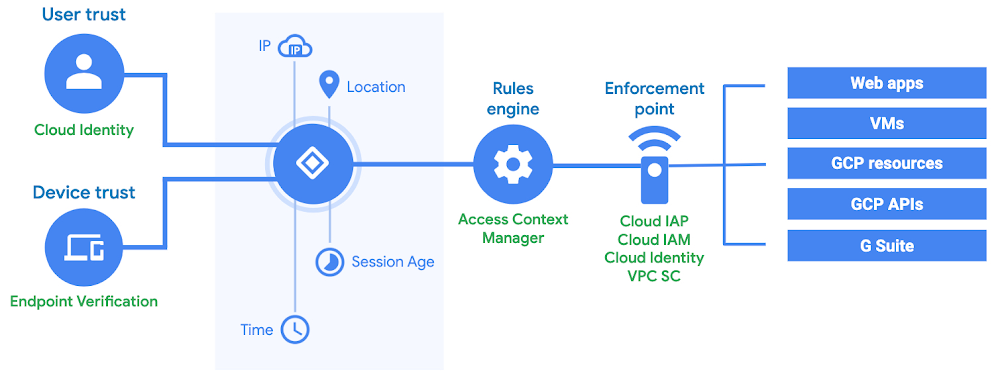
Identity and access management (IAM) is a cornerstone of the modern enterprise, helping you manage and secure employee, customer, and other identities, and their access to apps and data, both in the cloud and on-premises. In the past few months, we helped you simplify access to traditional LDAP apps, control access to web apps and VMs without a VPN, and add identity management to your own apps and services.Today, we’re announcing five new ways to help you adopt the BeyondCorp security model and improve IT, developer, and end-user efficiency:Context-aware access enhancements, including the launch of BeyondCorp Alliance.Security key built into your Android phone—one of the strongest defenses against phishing now available through the convenience of your phone.Cloud Identity enhancements, including single sign-on to thousands of additional apps and integration with human resource management systems (HRMS).General availability of Identity Platform, which you can use to add identity management functionality to your own apps and services.Availability of Managed Service for Microsoft Active Directory for select customers.Context-aware access: your path to BeyondCorpAs the number and amount of Internet-facing apps and infrastructure increases, it becomes harder to secure access to your data using traditional network-based approaches. In 2011, we introduced the BeyondCorp security model to protect our internal resources, and now you can adopt the same model with context-aware access.Over the past few months, we added context-aware access capabilities in beta to Cloud Identity-Aware Proxy (IAP) and VPC Service Controls to help protect web apps, VMs, and Google Cloud Platform (GCP) APIs. Today, we are making these capabilities generally available in Cloud IAP, as well as extending them in beta to Cloud Identity, to help you protect access to G Suite apps.Context-aware access high-level architectureContext-aware access allows you to define and enforce granular access to apps and infrastructure based on a user’s identity and the context of their request. This can help increase your organization’s security posture while giving users an easy way to more securely access apps or infrastructure resources, from virtually any device, anywhere. With today’s general availability of context-aware access in Cloud IAP, you can now enforce access to cloud-based and on-premises web apps. Veolia, a global water, waste and energy management company, has expanded the use of Cloud IAP, leveraging context in access decisions for their apps:”Veolia provides water, waste and energy services to industry, cities, and citizens around the world. To keep our data protected, we are using context-aware access capabilities in Cloud IAP to ensure that our support team members can access applications only from trusted locations and devices.” —Antoine Castex, Product Manager & Cloud Developer, VeoliaWe’re also launching context-aware access capabilities in Cloud Identity and G Suite in beta, to help you enforce access to G Suite apps, including Gmail, Drive, Docs, Sheets, Slides, Forms, Calendar, and Keep. Essence, a global data and measurement-driven media agency, has already been using this capability along with Endpoint Verification for desktop devices to help secure access to G Suite:“Context-aware access is a natural expansion of the MDM we’ve had in place on Android and iOS devices since 2014. It allows us to place manageable controls on how client G Suite data is accessed, and it does so in a way that does not inhibit the end user while ensuring security compliance.” —Colin McCarthy, VP Global IT, EssenceCloud Identity admin experience to create a context-aware access policyIf you’re like a lot of organizations, you already have endpoint security solutions that help you assess the security posture of your devices. Today, we are excited to announce BeyondCorp Alliance, a group of endpoint security and management partners with whom we are working to feed device posture data to our context-aware access engine. Initially, we are working with Check Point, Lookout, Palo Alto Networks, Symantec, and VMware, and will make this capability available to joint customers in the coming months.Using context-aware access to protect access to GCP workloads (web apps, VMs, APIs) is available at no additional charge with Cloud IAP, Cloud IAM, and VPC Service Controls. Context-aware access for G Suite apps is available in beta for customers using Cloud Identity Premium, G Suite Enterprise, and G Suite Enterprise for Education. To get started, sign up for a free trial of Cloud Identity, watch a webinar, and check out our website for how-to guides.Security key: one of the strongest defenses against phishing, now built into your Android phoneStrong user security paves the way for context-aware access and safer online experiences. Attackers, however, are always looking for new ways to compromise user accounts and access sensitive data, using techniques such as stealing passwords, phishing, and pretexting. Google automatically blocks the overwhelming majority of malicious sign-in attempts (even if an attacker has your username or password)—but you can boost your security even more with two-factor authentication (2FA).We consider security keys based on FIDO standards, such as Google’s Titan Security Key, to be the strongest, most phishing-resistant method of 2FA on the market today, and now, launching in beta, you have an additional choice to use a security key that is built into your Android phone.User experience on Pixel 3Security keys use a protocol based on standard public key cryptography and provide stronger phishing and account takeover protection in comparison to traditional 2FA methods such as SMS, code, or push notification, which sophisticated attacks can skirt around. Last year, we stated that we had no reported or confirmed account takeovers since implementing security keys for Google employees.Now in beta, we are making security keys available built-in on phones running Android 7.0+ (Nougat) at no additional cost. This means you can use your existing phone as your primary 2FA method for your work (G Suite, Cloud Identity, and GCP) and personal Google accounts to sign in on a Bluetooth-enabled Chrome OS, macOS X, or Windows 10 devices with a Chrome browser. This gives you a stronger 2FA method with the convenience of a phone that’s always in your pocket, making it easier for you to implement phishing-resistant 2FA in your organization while keeping user training and overall costs to a minimum. Leading the effort to protect against cyber threats in New York City, NYC Cyber Command started to use this technology to further improve their defenses against phishing and other identity attacks. And for Deputy CISO at NYC Cyber Command, Colin Ahern, this capability means he’s able to better protect New York City.To try this out and protect your own Google Account, follow these simple steps to activate the security key on your phone today. Then, you can enforce the use of security keysfor your users in G Suite, Cloud Identity, and GCP, letting them choose between using a physical FIDO security key, their Android phone, or both.Cloud Identity: simplify identity, app, and device managementCloud Identity can help unify identity, app, and device management for your employees and other users accessing company data, including enforcing the use of security keys. Last year, we made a number of enhancements in Cloud Identity, including the ability to manage access to traditional LDAP-based apps and infrastructure that are hosted on-premises or in the cloud.Today, we’re excited to announce the upcoming availability of single sign-on (SSO) to thousands of additional apps with password vaulting, an enhanced end-user portal, and integration with popular human resource management systems (HRMS) to simplify and automate user lifecycle management.Cloud Identity admin experience to enable SSOWhile Cloud Identity supports a large catalog of SAML and OpenID Connect (OIDC) apps for SSO, you might prefer to use credential-based authentication for some apps. With the support of password vaulted apps, your employees can have one-click access to thousands of additional apps. With this capability, Cloud Identity will have one of the largest SSO app catalogs, giving you a single system to manage access for all your apps.Dashboard for end-usersThe upcoming password vaulting release also includes Dashboard, a unified hub where employees can see and access all of their apps with single sign-on. Dashboard will replace Apps User Hub to provide an improved user experience, so your employees can efficiently and quickly launch and log in to their work apps.And finally, we’re tackling the challenge of user lifecycle management—automating user account and access management as employees join a company, change roles or move within the org, and eventually leave. To that end, we’re working with leading HRIS/HRMS providers such as ADP, BambooHR, Namely, and Ultimate Software, to integrate with Cloud Identity. This functionality will let you sync employee information directly from your HR system to Cloud Identity, automatically provisioning and deprovisioning user accounts and access throughout the employee lifecycle, resulting in enhanced productivity for both IT and end users and a greater ROI on existing investments.Automated employee lifecycle management, password vaulting, and Dashboard will be generally available in the coming months. To get started with Cloud Identity today, sign up for a free trial, watch a webinar, and check out our documentation for how-to guides.Identity Platform: identity management for your apps and servicesModern businesses also need to manage the identities of customers, partners, and Things (IoT). Last year, we launched the beta of Cloud Identity for Customers and Partners (CICP) to help you add Google-grade identity and access management functionality to your apps, protect user accounts, and scale with confidence. Our customers are already using the service to add authentication and identity management to apps for their customers, build a data intelligence platform, enhance a device management service, and issue tokens for Things. Today, we are making the service generally available and renaming it to Identity Platform.We work hard to keep Identity Platform up-to-date with evolving authentication requirements, helping you keep identities more secure in the face of sophisticated threats and quickly scale when the demand for your app or service grows. Identity Platform provides a drop-in, customizable authentication service that manages the UI flows for user sign-up and sign-in, supports multiple authentication methods, client and server SDKs, and is integrated with Google’s intelligence and threat signals to help detect compromised user accounts.Identity Platform admin experienceLightspeed, a commerce solutions provider, is using Identity Platform to upgrade a home-grown authentication solution:“Identity Platform offers solid features that allow us to build a great solution knowing that the foundations are trustworthy.” —Alexandre Vallières-Lagacé, Team Lead, API Platform, LightspeedTo get started with Identity Platform, enable it in GCP Marketplace, watch a webinar, and check out the quickstart for how-to guides.Managed Service for Microsoft Active Directory: simplify AD managementIdentity-as-a-service (IDaaS) solutions such as Cloud Identity continue to grow in popularity, but many organizations still rely on Microsoft Active Directory (AD) to manage users and access to traditional applications. While you can deploy a fault-tolerant AD environment in GCP on your own, you are still responsible for its maintenance and security.Today, we are announcing Managed Service for Microsoft Active Directory (AD), a highly available, hardened Google Cloud service running Microsoft AD, to help you manage cloud-based AD-dependent workloads, automate AD server maintenance and security configuration, and connect your on-premises AD domain to the managed service.Managed Service for Microsoft AD admin experienceAs more AD-dependent apps and servers move to the cloud, it becomes harder for IT and security teams to maintain latency and security requirements, on top of typical maintenance required to configure and secure AD domain controllers. Managed Service for Microsoft AD can help you address these issues by automating common tasks and allowing the IT and security teams to focus on higher-value projects.Google Cloud partner itopia has already integrated their Cloud Automation Stack (CAS) solution with this new service:“Our platform has supported hybrid AD environments and deep integration with Google Cloud APIs for years now. Since Managed Service for Microsoft AD runs real AD domain controllers, it was natural to add integration and offer even more value to our customers.” —Jonathan Lieberman, CEO, itopia.Sign up to express interest in trying Managed Service for Microsoft AD early and to be notified when it becomes available in beta.More to comeWe have been hard at work building enterprise-ready IAM services for our customers and partners. We’re excited to continue delivering innovative ways to enhance end-user experiences and protect user accounts to help you gain peace of mind. Check out our security announcements focused on increased control and visibility in the cloud, and visit our security and compliance webpage to learn more.
Quelle: Google Cloud Platform

Announcing Cloud Code—accelerating cloud-native application development

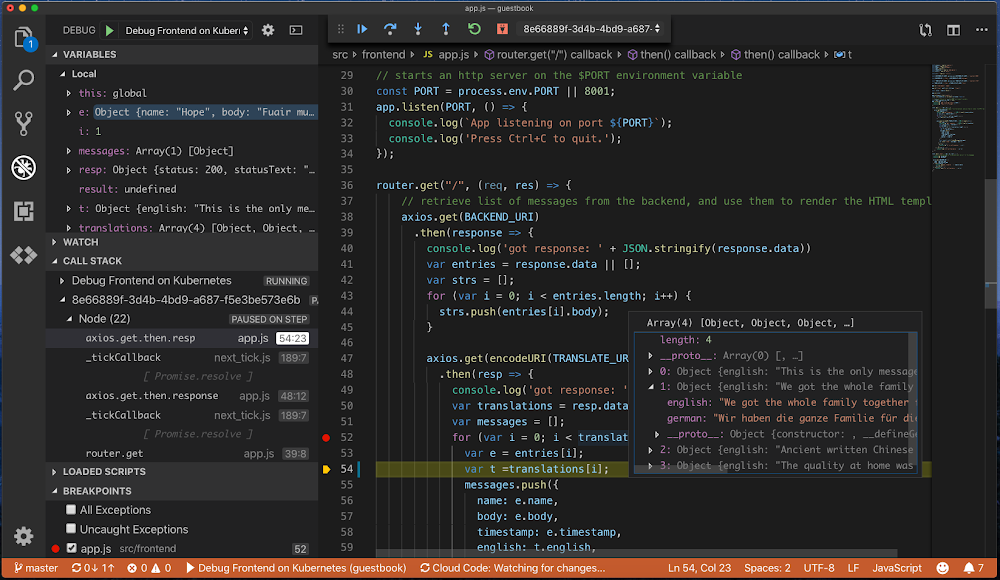
As more enterprises move to Google Cloud, developers and operators need to evolve how they build and manage applications. Moving to the cloud isn’t just about getting rid of data centers—it’s also about going faster (without sacrificing reliability and security).Today, we’re excited to introduce Cloud Code, a new set of plug-ins for IntelliJ and VS Code that brings automation and assistance to every phase of the software development lifecycle, using the tools you already have.The central tool of software development is the Integrated Development Environment (IDE). IDEs like IntelliJ and Visual Studio Code help developers stay productive while editing, compiling, and debugging code, but they work best with local applications. That can lead to challenges when developing applications for the cloud, as the local and cloud environments differ, which can cause errors to be caught late in the development cycle.Cloud Code for VS Code has the debugger attached to a running Kubernetes cluster.With this first release of Cloud Code we have focused on making it easier to develop applications that run on Kubernetes, including Google Kubernetes Engine (GKE). Cloud Code extends VS Code and IntelliJ to bring all the power and convenience of IDEs to developing cloud-native Kubernetes applications. With Google’s command-line container tools like Skaffold, Jib and Kubectl under the hood, Cloud Code gives you continuous feedback on your project as you build it, extending the local edit-compile-debug loop to any local or remote Kubernetes environment. Support for deployment profiles lets you define different deployment targets, like local development, shared development, test, or production, so you can easily test and debug on your workstation or in the cloud.Cloud Code for IntelliJ continuously deploying an application to Kubernetes via a Run Configuration. Deployments support profiles, and can be run locally or via Cloud Build. Log file streaming is supported, as seen in the output window.Cloud Code also makes it easy to integrate Google APIs into your application. For instance, within IntelliJ we offer an integrated library manager that adds the required dependencies to your application, enables the API automatically for your project and manages any required secrets.Cloud Code for IntelliJ’s library manager makes it easy to find libraries, related samples and documentation and then integrate them with your existing code base.To get an application up and running in Kubernetes there are a lot of concepts you need to understand. Cloud Code also helps you when you’re getting started, with an updated set of Kubernetes samples that come pre-configured for debugging, build and deployment. These let you focus on developing your app instead of on initial set-up and configuration.We built Cloud Code to easily integrate with existing DevOps tools and services including Cloud Build and Stackdriver. For example, once your code is ready to deploy, simply do a pull request or commit, which triggers Cloud Build to automatically build, test, and deploy your application.Ops is made easier too with Cloud Code. A core tenet of DevOps is to use “infrastructure as code” in which all environment configurations are managed as source code in a repo. This makes environments reproducible and helps find errors sooner. Cloud Code and Cloud Build make editing, reviewing, testing, and applying changes to a Kubernetes config easy and convenient. Cloud Code provides templates, linting and error highlighting for Kubernetes yaml files. Of course Cloud Code also supports logging, so you can view application logs from any environment directly in your IDE.Cloud Code for VS Code leverages the full power of the IDE when working with configuration files—colorization, error checking, suggestions, snippets and more. Here you see a referenced secret from the live app running in GKE which was created 21 hours ago, the developer is ‘peeking’ the definition of the secret and ‘hovering’ over it decodes the Base64 encoded string.Anevia, a leading OTT and IPTV software provider, uses Cloud Code to monitor their Kubernetes clusters right within their IDE of choice.”With Cloud Code and its integrated cluster explorer, I have a quick overview of what is running on my different Kubernetes clusters, what works well and what needs to be fixed. The logs and status of all the objects are accessible with a single click. No need to access my terminal anymore.” – Phillippe Martin, Anevia, Software EngineerWith Cloud Code, we want to make it easy to create applications for the cloud from the comfort of your favorite development tools. Get started developing for the cloud with Cloud Code today.
Quelle: Google Cloud Platform

Day 2 at Next ‘19: Working smarter, better, and more securely in the cloud

At this week’s Google Cloud Next ’19, we’re joining partners and customers to learn together and make connections. Yesterday, we talked about the ways we’re helping you modernize—on premises, in the cloud, or a combination of both. Today is all about what’s possible once you’re in the cloud, whether that’s moving legacy servers easily to cloud, improving contact center experiences with AI, connecting colleagues with email and chat, or optimizing transportation routes.Here’s a look at our broad range of announcements spanning security and identity, productivity and collaboration, data management, analytics, and AI.Expanding our identity and security offeringsSecurity is at the core of everything we do, and it continues to be a major focus of Google Cloud. Today’s announcements are all designed to bring you more visibility and more control over your security environment and help you adopt the BeyondCorp security model to improve IT, developer, and end-user efficiency.What we announced: securityAccess Transparency (new GA and beta services, GA for G Suite) and Access Approval (beta) give you meaningful oversight over provider operations.Data Loss Prevention (DLP) user interface (beta) and Virtual Private Cloud (VPC) Service Controls (GA) help you prevent data exfiltration and risk.Cloud Security Command Center (GA) with new Event Threat Detection (beta), Security Health Analytics (alpha), Cloud Security Scanner (new beta integrations) and Stackdriver Incident Response and Management (coming soon to beta) help you centralize security management.Apigee security reporting (beta) offers visibility into the security status of your APIs.Container Registry vulnerability scanning (GA), Binary Authorization (GA), GKE Sandbox (beta), Managed SSL Certificates for GKE (beta), and Shielded VMs (GA) help you secure your software supply chain.Control and protect G Suite data with G Suite data regions enhancements (GA), enhanced advanced phishing and malware protections (beta), security sandbox (beta), security center, and alert center admin collaboration and automation (beta).Policy Intelligence (alpha) helps you gain meaningful security insights using ML.Phishing Protection (beta) and reCAPTCHA Enterprise (beta) help businesses stay safe on the web.What we announced: identity and access managementContext-aware access enhancements, including the launch of BeyondCorp Alliance, to help you define and enforce granular access to apps and infrastructure based on a user’s identity and the context of their request.Android phone’s built-in security key—the strongest defense against phishing—is now available on your phone.Cloud Identity enhancements include single sign-on to thousands of additional apps and integration with human resource management systems (HRMS).General availability of Identity Platform, which you can use to add identity management functionality to your own apps and services.Helping you focus on data, not infrastructure, with managed servicesAn organization’s ability to manage data scalably, reliably, and securely is critical to its success. GCP offers a broad set of capabilities to help you manage data for the most widely used workloads today, both analytical and operational, so you can make your data work for you and deliver great customer experiences.What we announced: databasesComing soon to Google Cloud: bring your existing SQL Server workloads to GCP and run them in a fully managed database service.CloudSQL for PostgreSQL now supports version 11, with useful new features like partitioning improvements, stored procedures, and more parallelism.Cloud Bigtable multi-region replication is now generally available, giving you the flexibility to make your data available across a region or worldwide as demanded by your app.What we announced: storageA new low-cost archive class for Cloud Storage offers the same consistent API as other classes of Cloud Storage and millisecond latency to access your content.Cloud Filestore, our managed file storage system, is now generally available for high-performance storage needs.Regional Persistent Disks will be generally available next week, providing active-active disk replication across two zones in the same region.Bucket Policy Only is now in beta for Google Cloud Storage, so you can enforce Cloud IAM policies at the bucket level for consistent and uniform access control for your Cloud Storage buckets.V4 signatures are now available in beta for Google Cloud Storage to provide improved security and let you access multiple object stores using the same application code. In addition to HMAC keys, V4 signed requests are also supported for Google RSA keys.Cloud IAM roles are now available for Transfer Service, allowing security and IT administrators to use Cloud IAM permissions for creating, reading, updating, and deleting transfer jobs.What we announced: networkingTraffic Director delivers configuration and traffic control intelligence to sidecar service proxies, providing global resiliency for your services by allowing you to deploy application instances in multiple Google Cloud regions.High Availability VPN and 100 Gbps Cloud Interconnect lets you connect your on-premises deployment to GCP VPC with an industry-leading SLA of 99.99% service availability at general availability.Private Google Access from on-premises to the cloud is now generally available, allowing you to securely use Google services like Cloud Storage and BigQuery as well as third-party SaaS through Cloud Interconnect or VPN.With Network Service Tiers, you can customize your network for performance or price on a per-workload basis by selecting Premium or Standard Tier.Delivering insights through smart analytics and AIWe want to make it easier for businesses to find meaningful insights from data, so we’re radically simplifying how you move data into the cloud, expanding our data warehouse capabilities, and expanding the tools you can use to apply AI and machine learning.What we announced: data analyticsData Fusion (beta) is a fully managed and cloud-native data integration service so you can easily ingest and integrate data from various sources into BigQuery.BigQuery DTS now supports 100+ SaaS apps, enabling you to lay the foundation for a data warehouse without writing a single line of code.Cloud Dataflow SQL (public alpha) lets you build pipelines using familiar SQL for unified batch and stream data processing.Dataflow Flexible Resource Scheduling (FlexRS), in beta, lets you schedule batch processing jobs with flexibility for cost savings.BigQuery BI Engine, in beta, is an in-memory analysis service that lets you visually analyze and interact with large or complex data almost immediately.Connected Sheets are a new type of spreadsheet that combine the simplicity of a spreadsheet interface with the power of BigQuery. With a few clicks, you can visualize data as a dashboard in Sheets and securely share it with anyone in your organization.BigQuery ML will soon be generally available, with support for additional models to build customer segmentations and product recommendations.AutoML Tables, in beta, lets you build and deploy state-of-the-art machine learning models on structured data in just a few clicks, without writing a single line of code.Cloud Data Catalog (beta), a fully managed metadata discovery and management platform, helps organizations quickly discover, manage, secure, and understand their data assets.What we announced: AI and machine learningAI Platform, in beta, helps teams prepare, build, run, and manage ML projects via the same shared interface.AutoML updates—including AutoML Tables (beta), AutoML Video Intelligence (beta), AutoML Vision Edge (beta) and object detection (beta), and AutoML Natural Language custom entity extraction (beta)—offer developers with minimal ML expertise more ways to train and deploy high-quality custom machine learning models.Document Understanding AI, in beta, offers a scalable, serverless platform to automatically classify, extract, and digitize data within your scanned or digital documents.Contact Center AI is now in beta, helping businesses build modern, intuitive customer care experiences with the help of Google AI.Retail-oriented solutions, including Vision Product Search (GA) and Recommendations AI (beta), help retailers take advantage of AI for their unique business cases.Build better APIs, tooDevelopers don’t just create applications, they create APIs to expose services to other developers. To help them, we’re excited to announce new capabilities that let enterprise IT teams accelerate API development by making it easy to consume a variety of Google Cloud services directly from the Apigee API Management platform. New supported services include:Cloud Functions (secured by IAM)Cloud Data Loss Prevention (templates support)Cloud Machine Learning EngineBigQueryBy leveraging these Google Cloud technologies with Apigee, developers can speed the time to market for their API products while promoting maximum security and scalability. See the full list of extensions here.Transforming the way businesses work and collaborateOur updates to G Suite bring together everyone at work, no matter where they are, what device they’re using, or in what context, aided by the benefits of Google AI.What we announced: G SuiteGoogle Assistant is integrating with Calendar, in beta, to help you know when and where your next meeting is, and stay on top of scheduling changes.G Suite Add-ons, coming soon to beta, let you access your favorite workplace apps in the G Suite side panel to complete tasks, instead of toggling between multiple apps and tabs.Third-party Cloud Search is now generally available for eligible customers to help employees search—and find—digital assets and people in their company. Learn more.Drive metadata, in beta, lets G Suite admins and their delegates create metadata categories and taxonomies to make content more discoverable in search.Hangouts Meet updates, including automatic live captions in Google Slides which displays a presenter’s words in real-time at the bottom of the screen (generally available), as well as the ability to make live streaming in Meet “public” and for up to 250 people to join a single meeting (both coming soon). Learn more.Google Voice for G Suite, now generally available, is a cloud telephony service that gives you a phone number that works from anywhere on any device. Learn more.We’re bringing Hangouts Chat into Gmail (beta) so your team communications can easily be accessed in one place on your desktop.Microsoft Office editing in Google Docs, Slides and Sheets, now generally available, lets you work on Office files straight from G Suite without having to worry about converting file types. Learn more in our Help Center article.Visitor sharing in Google Drive, in beta, provides a simple way for you to invite others outside of your organization to collaborate on files in G Suite using PIN codes. Learn more.Currents (beta), the new name for the enterprise version of Google+, helps employees share ideas and engage in meaningful discussions with others across their organization. Read more or visit our website for details.Broadening our coverage for Windows ecosystem usersWe’re offering new features and services to help those of you running Windows workloads take advantage of GCP’s leading infrastructure, data analytics and open-source innovations.What we announced: Windows ecosystemFor your Microsoft workloads, in addition to purchasing on-demand licenses from Google Cloud, you now have the flexibility to bring your existing licenses to GCP.Velostrata 4.2, our streaming migration tool, will soon give you the ability to specifically tag Microsoft workloads that require sole tenancy, and to automatically apply existing licenses.Coming soon, you’ll be able to use Managed Service for Microsoft Active Directory (AD), a highly available, hardened Google Cloud service running actual Microsoft AD, to manage your cloud-based AD-dependent workloads, automate AD server maintenance and security configuration, and extend your on-premises AD domain to the cloud.We’ve expanded Cloud SQL, our fully managed relational database server, to support Microsoft SQL Server, and we’ll be extending Anthos for hybrid deployments to Microsoft environments.New tools for doing DevOps and SREAs more enterprises move to the cloud, developers and operators have to adjust how they develop and manage applications. Google’s DevOps-inspired tools and services, and our Site Reliability Engineering (SRE) practices, help you bring automation to every phase of the software development lifecycle and to the tools you’re already using.What we announced: DevOps/SRECloud Code extends VS Code and IntelliJ to bring all the power and convenience of Integrated Development Environments (IDEs) to creating cloud-native Kubernetes applications.We’re most of the way through Next, but there’s still so much to learn, discover, and share. We’re looking forward to an outstanding day three!
Quelle: Google Cloud Platform

Expanding Google Cloud AI to make it easier for developers to build and deploy AI

Every year, more and more businesses look to AI to help them solve complex business challenges. Whether they’re using AI to anticipate demand, predict when equipment will need routine maintenance, or deliver better customer experiences, they all have one thing in common: they need a workforce that can help them do it.Our goal has always been to make AI simpler, faster, and more useful for businesses. This means easy-to-use AI solutions that make it simple for enterprises to adopt them. But it also means making it simpler for developers, data scientists, and data engineers to build and deploy machine learning models.Today we’re announcing a number of new ways we’re doing exactly that—from introducing an integrated platform of AI services that helps you build AI capabilities, then run them in the cloud or on premises, to expanding our AutoML offerings to make it easier for businesses to build and deploy their own custom ML models.Here’s a selection of what’s new:AI Platform (beta)AutoML updates, including:AutoML Tables (beta)AutoML Video Intelligence (beta)AutoML VisionAutoML Vision Edge (beta)Object detection (beta)AutoML Natural LanguageCustom entity extraction (beta)Custom sentiment analysis (beta)Introducing AI Platform: build AI applications, then run them in the cloud or on premisesWhen approaching AI projects, businesses grapple with a variety of problems—from unstructured data to siloed teams to complex deployments. They need a place that brings all these things together in a way that makes ML easier and more collaborative.Today, we’re announcing AI Platform in beta, a comprehensive, end-to-end development platform that helps teams prepare, build, run, and manage ML projects via the same shared interface. Whether you’re a developer, data scientist, or data engineer, you can collaborate on model sharing, training, and scaling workloads from the same dashboard within Cloud Console.With AI Platform, you can ingest streaming or batch data, and use a built-in labeling service to easily label training data—like images, videos, audio, and text—by applying classification, object detection, entity extraction, and other processes. You can import your data directly into AutoML, or use Cloud Machine Learning Engine, now part of AI Platform, to train and serve your own custom-built ML models on GCP. AI Platform complements AI Hub, so developers can discover ML pipelines, notebooks, and other instructional content, and because AI Platform supports Kubeflow, Google’s open-source platform, you can build portable ML pipelines that you can then run on premises or in the cloud with almost no code changes.Learn more about AI Platform on our website.Making AI more accessible with updates to Cloud AutoMLWhen we first introduced Cloud AutoML, our goal was to help developers with limited ML expertise train high-quality custom machine learning models and deploy them in their business. Today, we’re excited to announce new and enhanced AutoML solutions that will further our mission of making it easy, fast, and useful for all developers and enterprises to use AI.AutoML Tables: easily create ML models from datasets with no coding necessaryEnterprises are generating more structured data than ever, and tools that help them easily turn all that data into actionable predictive insights can be a huge help. AutoML Tables, now available in beta, lets you build and deploy state-of-the-art machine learning models on structured tabular datasets with zero code. With just a few clicks, you can ingest data from BigQuery and other GCP storage services into AutoML Tables and build and deploy ML models in just days versus weeks. The codeless interface guides you through the full end-to-end machine learning lifecycle, making it easy for anyone on your team—whether data scientist, analyst, or developer—to build models and reliably incorporate them into broader applications.For an ever deeper look at AutoML Tables, read our data analytics blog post.Extending AutoML Vision to the edgeOptimizing machine learning models to run on edge devices, like connected sensors or cameras, can be challenging because these devices often grapple with latency and unreliable connectivity. Last year, we announced AutoML Vision to make it easier for developers to create custom ML models for image recognition. Today we’re announcing AutoML Vision Edge to simplify training and deployment of high-accuracy, low-latency custom ML models for (on premises or remote) edge devices. AutoML Vision Edge supports a variety of devices and can take advantage of Edge TPUs for faster inference. For example, LG CNS is using AutoML Vision Edge to create manufacturing intelligence solutions that detect defects in everything from LCD screens to optical films to automotive fabrics on the assembly line.Enabling powerful content discovery and engaging experiences with AutoML VideoAnalyzing volumes of video footage to identify specific moments, prepare special cuts, or better classify visual data can be a difficult and time-consuming process. Today, we’re announcing AutoML Video, in beta, so that developers can easily create custom models that automatically classify video content with labels they define. Companies that deal with mountains of diverse video data can instantly discover content according to their own taxonomy. This means media and entertainment businesses can simplify tasks like automatically removing commercials or creating highlight reels, and other industries can apply it to their own specific video analysis needs—for example, better understanding traffic patterns or overseeing manufacturing processes.In addition to these three entirely new AutoML solutions, we are continuing to improve the core functionality of AutoML Vision and AutoML Natural Language. AutoML Vision object detection (beta) can identify the position of objects within an image, and in context with one another, for example, a pedestrian walking in a crosswalk. AutoML Natural Language custom entity extraction (beta) helps you automatically identify entities—such as medical terms or contractual clauses—within documents and label them based on company-specific keywords and phrases. And AutoML Natural Language custom sentiment analysis (beta) helps you apply machine learning to better understand the overall opinion, feeling or attitude expressed in a block of text, tuned to your organization’s own domain-specific sentiment scores.Continuing to make machine learning faster with the latest acceleratorsWe continue to invest in the infrastructure that makes machine learning possible for you. Our Cloud TPUs, custom-built to quickly train ML models, lets you iterate at scale to achieve higher classification accuracy, at a lower cost. Our third generation liquid-cooled TPUs are now generally available, and all Cloud TPUs are also generally available in Google Kubernetes Engine (GKE), which is a new and flexible way to run your containerized ML workloads, giving you the flexibility to switch between on-prem and cloud-based training. GCP is also the first cloud provider to offer the new NVIDIA Tesla T4, now generally available across eight regions.A fully-featured, user-centric ecosystem for machine learningAs part of today’s announcements, we’re also working with numerous partners—including Accenture, Atos, Cisco, Gigster, Intel, NVIDIA, Pluto 7, SpringML, and UiPath—to build Kubeflow pipelines to grow and extend AI Hub. It takes a robust partner ecosystem to build a successful platform, and we’re grateful to all of our partners who enable our customers to train and serve machine learning pipelines on the infrastructure of their choosing.To learn more about our AI solutions for businesses and industries, read this blog post. And to learn more about AI on Google Cloud, visit our website.
Quelle: Google Cloud Platform

What’s cooler than being cool? Ice cold archive storage

Storage provides the foundation for enterprise infrastructures, and that’s particularly true with cloud, where readily available data storage that’s cost-efficient is a must. At Google Cloud, we think you should have a range of straightforward options to store your data and reliably access it when and how you need it, with the performance you need.However, moving your data to the cloud isn’t a one-size-fits-all process. We develop storage tools for flexibility, so you can make moving to cloud as seamless as possible. Here’s what we’re announcing:Introducing a new archive class for Cloud Storage (coming soon)Making Cloud Filestore generally available with higher throughputRegional Persistent Disks generally available next weekBucket Policy Only and V4 signature support for Cloud Storage are now in betaCloud IAM roles now generally available for Cloud Storage Transfer ServiceStorage that’s optimized for your businessHaving the right storage for all your types of data can add efficiency and performance, plus save your business money. We’re pleased to announce some new options for your data storage needs to grow with you over time.Introducing a new class of storage for data that’s ice cold  We will be rolling out an entirely new archive class of Cloud Storage designed for long-term data retention. Available later this year at price points starting from $0.0012 per GB per month ($1.23 per TB per month), the archive class is intended for data that would probably otherwise be stored in tape archives. Unlike tape and other glacially slow equivalents, we have taken an approach that eliminates the need for a separate retrieval process and provides immediate, low-latency access to your content. Access and management are performed via the same consistent set of APIs used by our other storage classes, with full integration into object lifecycle management so that you can tier cold objects down to optimize your total cost of ownership. Data in Cloud Storage is always redundantly stored across availability zones with 11 9’s annual durability. As with other storage classes, your data stored in the archive class in multi-regional locations is stored geo-redundantly to maximize durability and availability. Contact sales to plan your archive migrations.Making Cloud Filestore generally available with higher throughputMany traditional applications require shared file storage. We’re pleased to announce the general availability of Cloud Filestore, our managed file storage system that’s built for high performance. Cloud Filestore’s premium instances will now provide increased read performance up to 1.2 GB/s throughput and 60k IOPS. Customers have been using Cloud Filestore when they need to collaborate on shared files, or need a high-performance cache, or have to move an application that uses file semantics to the cloud. Create a file share now and learn more in the documentation.Regional Persistent Disks are generally available next weekRegional Persistent Disk provides active-active disk replication across two zones in the same region. Regional Persistent Disks deliver durable storage that is synchronously replicated across zones and are a great option for high-performance databases and enterprise applications that also require high availability. You don’t have to worry about manually replicating your data across different zones in a region. Learn more in the documentation.Of course, a primary benefit of moving to the cloud is the performance improvement. You can add control and protection over your cloud workloads and get the performance improvement benefits. We’ve increased the throughput limits per instance for Google Persistent Disk Standard to 240 MB/s for writes, and 240 MB/s for reads. If you’re running throughput-driven workloads on GCP, you can now benefit from 33 percent higher per-instance throughput limits for Persistent Disk Standard. Learn more in the documentation.The number of Persistent Disks that can be attached to a VM has increased to 128. Now, all machine types with at least one vCPU will be allowed to attach up to 128 Persistent Disks. Shared-core and burst machine types will be limited to 16. Learn more in the documentation.Adding more safeguards for cloud data storageWe protect cloud data throughout its lifecycle, and we’re always working to add even more safeguards to cloud storage.   Bucket Policy Only for Cloud StorageHaving the right set of controls for the cloud also means adding security controls at the right level to help carry policies and governance into your cloud infrastructure. You can now manage permissions centrally and uniformly. Bucket Policy Only for Cloud Storage (now in beta) lets you enforce Cloud Identity and Access Management (IAM) policies at the bucket level for consistent and uniform access control for your Cloud Storage buckets. Administrators can also ensure that all newly created buckets utilize Bucket Policy Only through a new organization policy setting. Enforcing uniform Cloud IAM policies at the bucket level can help prevent accidental public exposures of your organization’s objects. Learn more in the documentation.V4 signature support for Cloud StorageV4 signatures (now in beta) provides improved security and enables customers to access multiple object stores using the same application code. In addition to the obvious security gains, this also greatly simplifies multi-cloud and hybrid cloud deployment and adoption for our customers. In addition to HMAC keys, V4 signed requests are also supported for Google RSA keys. Learn more in the documentation.  Cloud IAM roles now available for Cloud Storage Transfer ServiceIn addition, Custom Cloud IAM roles and permissions in Cloud Storage Transfer Service are now generally available. This allows security and IT administrators to use Cloud IAM permissions for creating, reading, updating, and deleting transfer jobs. These permissions can be assigned directly to individual users or to specific roles.Whatever your workload, from backing up an image archive to crunching a genome, we’ve got you covered with cloud storage tools and services that make it easy to migrate and run on GCP.
Quelle: Google Cloud Platform

Enterprise databases, managed for you

Moving to the cloud doesn’t have to mean starting over. At Google Cloud, we’re committed to giving our customers choices in how you run your enterprise workloads. No matter where your users are and how much data you have, it should be easy and straightforward to manage, move and access that data when you need it.Whether it’s transactional, operational or analytical, the data your business gathers and stores can create new opportunities. And when you’re running your workloads with managed database services, you can focus your attention on what that data can do for your business, not the underlying infrastructure.We’re pleased to announce some new products and features to help you manage enterprise workloads in the ways you’re used to, and make your data work for you. These are in addition to our newly announced open-source partnerships to bring you the options you want.Here’s what we’re announcing today:Cloud SQL for Microsoft SQL Server (sneak preview)CloudSQL for PostgreSQL, now with version 11 supportCloud Bigtable multi-region replication now availableIntroducing Cloud SQL for Microsoft SQL ServerMicrosoft SQL Server is ubiquitous for many enterprises, and later this year you’ll be able to bring your existing SQL Server workloads to GCP and run them in a fully managed database service. We’re making it easier for everything you use today on-prem to just work as expected when you move to the cloud. With this new option, you will be able to run fully managed SQL Server without worrying about VM operations or tedious tasks such as backups, replication, patches, and updates. Enterprise customers will be able to lift and shift existing SQL Server workloads without changing apps and use that data with a variety of services that GCP offers, like BigQuery for analytics, AI, and machine learning. Now, in addition to being able to deploy SQL Server on Google Compute Engine(bring your own license or buy licenses from Google), you’ll have the option to use fully managed SQL Server on GCP.  Cloud SQL for PostgreSQL now supports PostgreSQL version 11Cloud SQL for PostgreSQL became one of the fastest-growing databases on GCP after it became generally available last year. We’ve heard you want the latest version, so we are pleased to announce PostgreSQL version 11 support, which includes useful new features like partitioning improvements, stored procedures, and more parallelism.Bringing Cloud Bigtable multi-region replication to general availabilityWhen you’re running workloads in the cloud, you want the flexibility to make your data available across a region or worldwide as demanded by your app. Cloud Bigtable is our NoSQL key-value and wide-column database service that can scale up to handle petabyte-size enterprise workloads. Generally available replication features in Cloud Bigtable now make it easy to globally distribute data, so you can:Serve global audiences with lower latency by bringing data that’s generated in any region, such as personalized recommendations, closer to the users wherever they areAggregate data ingested from worldwide sources (such as IoT sensor data) to a single location for analytics and machine learningIncrease the availability and durability of your data beyond the scope of a single regionIsolate batch and serving workloadsEvery cluster in a replicated instance accepts both reads and writes, providing multi-primary replication with eventual consistency. You can set up replication automatically by adding one or more Cloud Bigtable clusters, whether on the same continent or halfway around the world. Check out the overview for more information.Managed cloud database services can make it easier for you to operate your business and focus on data, not infrastructure. Find more about GCP databases here.
Quelle: Google Cloud Platform

Unlocking the power of AI with solutions designed for every enterprise

Many enterprises see the value in applying AI and machine learning to their business challenges, but not all have the necessary resources to do it. Where should your organization begin if you don’t already have a team of data scientists, or if your team is fully committed to other tasks? Businesses need a quick and easy way to bring AI to their organizations.From the beginning, our goal has been to make AI accessible to as many businesses as possible. For example, last year we introduced Cloud AutoML to help businesses with limited ML expertise start building their own high-quality custom models. We also introduced BigQuery ML, which put the power of predictive analytics in reach of millions of users—even those without a data science background. And we’ve seen some amazing growth in demand for these services.Today, we’re excited to announce a number of new solutions that provide an easy way to use AI to address common business challenges—such as analyzing documents, forecasting inventory and demand, or managing multiple customer service touchpoints such as chatbots, phone, and e-mail.Here’s what’s new:Document Understanding AI (beta)Contact Center AI (beta)Google Cloud for Retail:Vision Product Search (GA)Recommendations AI (beta)AutoML Tables (beta)Unlock insights from documents with Document Understanding AI—now in betaMost companies have billions of documents—and moving that information into digital or cloud-native solutions where it can be easily accessed and analyzed can involve many hours of manual entry. These businesses need a way to automate this work as well as archive documents from multiple content sources into one cloud-based system.Today we’re announcing Document Understanding AI, in beta, offering a scalable, serverless platform to automatically classify, extract, and enrich data within your scanned or digital documents. By turning your documents into structured data, Document Understanding AI can help automate document processing workflows. This means you can take advantage of the facts, insights, relationships and knowledge hidden in your unstructured documents and start making data-driven business decisions faster and more accurately. For instance, customers that use custom document classification have achieved up to 96% accuracy. Document Understanding AI easily integrates with technology stacks from partners and third parties—Iron Mountain, Box, DocuSign, Egnyte, Taulia, UiPath, and Accenture are already using it today.”As the world’s leading information management provider, Iron Mountain scans over 627 million pages every year as part of our digital transformation solutions. Google Cloud’s Document Understanding AI helps us identify form fields, text passage, tables and graphs, as well as customer-specific keyword matching, for customized workloads,” says Jim O’Dorisio, Senior Vice President for Emerging Commercial Solutions, Iron Mountain. “Document Understanding AI provides a foundation to help us deliver a far more valuable set of services to our customers—assisting them in automated data understanding, enabling compliance, business value, and delivering peace of mind.”Improve customer care with Contact Center AI—now in betaLast year we introduced our first AI solution, Contact Center AI to help businesses build modern, intuitive customer care experiences with the help of AI. Since then, Google Cloud customers have chosen to run substantial customer service workloads on Contact Center AI implementations built by partners like Cisco, Five9, Genesys, Mitel, Twilio, and Vonage.Today, we’re announcing that Contact Center AI is now in beta. Contact Center AI builds on Dialogflow Enterprise Edition and provides key capabilities for your Contact Center—Virtual Agent, Agent Assist, and Topic Modeler—which are also available today in beta. The updates to our voice models, for example, make it easier for customers to have conversations with virtual agents. We’ve also made improvements to Agent Assist to quickly help surface useful content for live agents as they assist customers.We’re also thrilled to welcome new partners to the Contact Center AI program including 8×8, Avaya, Salesforce, and Accenture. Together, we’ll integrate these partner services with Google’s world-class speech recognition, synthesis, natural language understanding, and agent assist to improve the contact center experience.Chris McGugan, Avaya’s Senior Vice President, Solutions and Technology explains, “We continue to expand our AI-enabled solutions as well as our cloud offerings for customers ranging from small-medium business to the largest global enterprises, and our ongoing collaboration with Google Cloud is providing additional capabilities to augment the innovation. By bringing these innovations to market for Avaya customers and partners, we enable them to make every customer interaction more meaningful and insightful, and more productive for their businesses. Avaya is also very encouraged by the enthusiastic response we have received from customers, analysts, and industry partners alike.”Helping more retailers take advantage of AIWhether they need to predict demand or provide automated product recommendations, retailers often have business challenges that can benefit greatly from AI. Google Cloud for Retailenables retailers to quickly take advantage of AI for retail-specific specific use cases.And Vision Product Search, now generally available, makes it possible for retailers to build visual search functionality into their mobile apps, allowing customers to photograph an item and get a list of similar products from the retailer’s catalog. Recommendations AI, in beta, helps retailers provide personalized 1:1 recommendations to drive customer engagement and growth. It has generated up to 40 percent increases in recommendation-driven revenue and up to 5 percent increases in total revenue per session. Lastly, AutoML Tables, in beta, makes it possible for retailers to automatically build and deploy state-of-the-art machine learning models on structured data, reducing the total time required for modeling from weeks to days. This means they can easily leverage their enterprise data to predict outcomes that can help maximize their revenue, optimize their product portfolios, and better understand their customers.To learn more, read our retail solutions blog post.Continuing to bring AI to everyoneToday’s announcements build on our goal of making AI accessible to every business, wherever they may be in their AI journey. As applied machine learning serves more industries, our goal is to provide more packaged solutions as well as the best-in-class AI tools you need to deploy and customize solutions to suit your business or industry. To learn more about the full breadth of machine learning on Google Cloud, visit our website.
Quelle: Google Cloud Platform