Digital-Only Network Cheddar Comes To TV Via Deal With Fusion

Cheddar

Cheddar, a digital-only financial news network that bills itself as “the leading post-cable network,” is coming to traditional TV. The company signed a deal with Fusion to air two hours of daily weekday programming on Fusion’s cable television channel starting later this month, making it available via major distributors including Dish, DirecTV, and Verizon Fios.

The move is intriguing since Cheddar’s mission, until this point, has been to cater to people without cable boxes. The network has streamed free on Facebook, Twitter, Cheddar.com, and other streaming services. And last year it added a paid option for extra hours of programming. This new push into traditional television may be viewed by critics as an admission that the current slew of digital platforms aren’t big enough to support Cheddar’s $83 million valuation.

But Cheddar CEO Jon Steinberg (a former BuzzFeed Executive) told BuzzFeed News he was willing to break with his digital orthodoxy for an opportunity that could increase the reach and awareness of his network, especially since Fusion won’t require exclusive content. “I’m the king of strong opinions loosely held,” Steinberg said. “It’s a great network. It caters to a young audience. It’s on all these systems. They were excited to work with me. I’m excited to work with them. Why not?”

Cheddar, which programs live financial news geared to millennials, will air from 11 a.m. to 1 p.m. eastern on Fusion, giving it an entryway into the 60 million homes Fusion reaches with its channel, and a number of digital authenticated services like DirecTV Now and Sling. “It’s a fully distributed cable network,” Steinberg said. The companies will work together for three months and then evaluate the partnership.

Going to TV isn’t a necessity for Cheddar, since it’s doing quite well playing on digital platforms alone. It registers 1 to 1.5 million live views daily on Twitter and Facebook, and hundreds of thousands of others through digital streaming packages. Since its debut in January 2016, it’s ramped up to 8 hours of programming each weekday, and it’s on track for $8 to $10 million in revenue this year after making $2.5 million last year, Steinberg said.

But Cheddar’s quick success provides a window into how hungry the big digital platforms are for quality live video programming. The emergence of Facebook Live, Twitter’s 24/7 live video push and digital TV subscription packages like YouTube TV have made the market for digital live video incredibly competitive. Quality live video is very difficult to produce, so those who can do it well are in high demand. Cheddar is working this competition to its advantage, and now it’s seeing some traction outside the niche it set out to conquer. It's quick growth suggests there's opportunities for others who might follow the same playbook. BTIG analyst Rich Greenfield recently suggested ESPN would be smart to learn from Cheddar and push its content across multiple platforms.

Steinberg said Cheddar is not paying Fusion to carry its programming. He declined to specify whether Fusion is paying Cheddar.

Quelle: <a href="Digital-Only Network Cheddar Comes To TV Via Deal With Fusion“>BuzzFeed

Twitter's Pro-Trump Bot Crisis Is Really A Human Crisis

BuzzFeed News / Getty Images

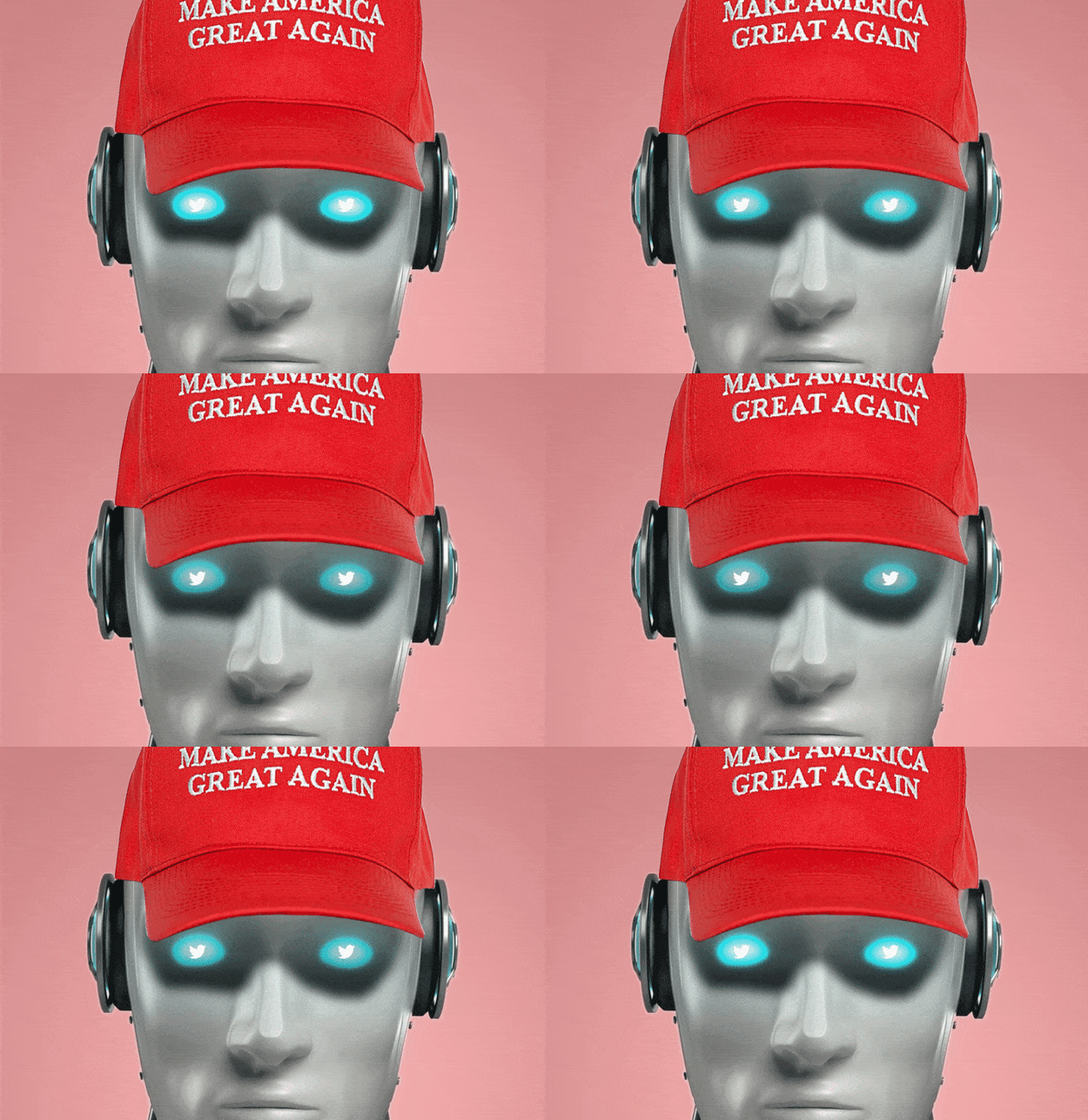
On May 30th, Empty Lighthouse Magazine published an article with an alarming headline: “Why Did Trump Get Millions Of Twitter Bots To Follow Him This Week?” The story — which was picked up by dozens of publications including Newsweek, Mashable, Perez Hilton, and Fortune, claimed that the President’s personal account gained 5 million followers in just a few days — many of them fake, automated accounts, or bots. The article argued that Donald Trump’s followers were rife with fakes — roughly half, according to Twitteraudit.com, a site that uses dubious methodology to identify fake followers. And while some light follower fraud might undermine Trump’s popularity, the article suggested something more nefarious at play. “We know that Russia has used fake Twitter followers in the past as a way to spread disinformation,” the article said. “Trump's war room team may be using the additional bot followers to trick the Twitter algorithm into trending/promoting Trump's messages.”

It’s a compelling conspiracy theory, but one that was quickly debunked. Trump’s account did indeed see an uptick — 2.4 million over the course of the month, with a huge spike of 166K followers on May 25th, according to the analytics firm Socialbakers. Big, but commensurate with being both President and one of the biggest accounts on Twitter. Similarly, Trump’s account is inundated with fake followers and automated bots, but that’s also standard for huge Twitter accounts. President Obama’s account as well as celebrities from Katy Perry to Justin Bieber have similarly high percentages of egg followers.

Still, there’s a desire to believe the more insidious narrative: that Twitter is overrun by wildly powerful and influential propaganda bots, perhaps purchased or orchestrated by governments foreign and domestic. The Great Bot Crisis is a theory bandied about by Russia conspiracy theorists like former British MP Louise Mensch and scholars who suggest that Trump voters are disproportionately swayed by ill-intentioned accounts disseminating pro-Trump or anti-liberal fake news. On Saturday the New York Daily News suggested that “Trump Twitter bots, numbering in millions, could be used for evil” and last week even Hillary Clinton cited the debunked fake Trump followers story, suggesting the bot scourge was a product of bad actors “sitting in Moscow, or Macedonia, or the White House.”

In a recent New York Times column, Farhad Manjoo laid out a reasoned argument detailing “How Twitter Is Being Gamed to Feed Misinformation.” Quoting numerous researchers in the botosphere, Manjoo said that “the more I spoke to experts, the more convinced I became that propaganda bots on Twitter might be a growing and terrifying scourge on democracy.”

Twitter is certainly clogged with bots — a number of which are designed to elegantly spread information that’s far from credible and push narratives. Scholars at Oxford suggest bots accounted for 18 percent of Twitter’s traffic related to the 2016 election and that roughly one-third of pro-Trump tweets came from bots.

Yet while the numbers sound substantial, the true effect these bots have on political discourse is still incredibly hard to quantify. And focusing on Twitter’s bot scourge is an enticing but partial explanation for a far more difficult problem. It’s also ignorant of the very real, very human media machine bent on pushing a pro-Trump narrative and trolling its opponents at all costs, for whom bots are just one of many tools.

Take the recent Seth Rich conspiracy theory that a murdered DNC staffer was the true source of the hacked DNC emails, rather than Russia. The story was re-ignited by a now-debunked Washington D.C. Fox affiliate report using a bogus quote from a private investigator. The man who facilitated the investigation was also a Fox News contributor with links to both White House senior advisor Steve Bannon and the billionaire conservative donor family, the Mercers.

Once the story was out, it spread across social media with the full power of pro-Trump Twitter personalities like Mike Cernovich, Paul Joseph Watson, Jack Posobiec, and Jim Hoft — all of whom have hundreds of thousands of Twitter followers. It was picked up by Fox News and then Fox News pundits like Sean Hannity, who has more than 3 million followers. From there, it hit Breitbart News and in a few short hours made its way to the front page of the Drudge Report, where it would be funneled to hundreds of conservative blogs and outlets.

The Rich conspiracy bled across Twitter using the hashtag #SethRich. There’s little doubt that bots were used to amplify the hashtag and push it into trending status quickly. But the Rich conspiracy theory didn’t spread because of a number of zombified ‘egg’ accounts or even cleverly constructed and sophisticated bots that look, sound, and behave just like real human beings. These accounts tend to have a few hundred or thousand followers at most and are almost never verified. And while they’re great at tricking a trending algorithm into thinking something is more important than it really is, they’re less effective at whole-cloth convincing otherwise skeptical people of an explosive conspiracy theory.

What’s far more impactful, however, is the pro-Trump media’s relentless spin and willingness to obfuscate any and all inconvenient facts to construct a compelling narrative. And when it comes to building a case, the pro-Trump media is wildly effective. Personalities like Cernovich, Watson, Posobiec, and Hannity aren’t just well-followed, they’re adored and trusted by those looking for pro-Trump news. Across the right fringes of Twitter, they’re seen less as omniscient Cronkite-esque voices of truth and more as vaunted teammates — officers among the lower ranks in a greater information war. And they are savvy builders of spurious narratives.

Within minutes of the Fox affiliate report, pro-Trump messageboards on 4chan, 8chan, and Reddit launched vigilante investigations into finding more information about Rich — probing to try and access his social media and email accounts. They offered their own — unconfirmed and anonymously sourced — theories that the DNC was melting down.

Some pro-Trump media outlets like The Gateway Pundit ran with these theories, printing them with breathless headlines, suggesting there was conclusive “bombshell” evidence to support the theory (there wasn’t). In each of these echo chambers, real #MAGA men and women swarmed the topic and encouraged all users to take to Twitter and spread the story. In 24 hours, the conspiracy theory was a full-fledged news story across the mainstream media — no matter that most of the coverage consisted of the theory being debunked, starting with Twitter, the pro-Trump media conjured a news cycle out of thin air.

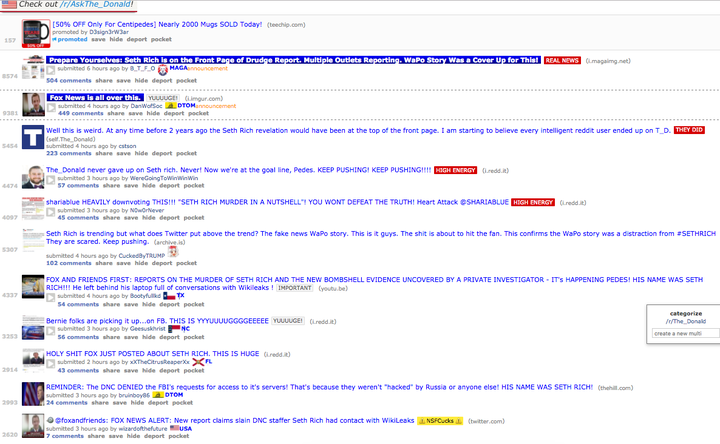
The front page of the pro-Trump subreddit, The_Donald the morning after the Seth Rich story broke mid May.

Granted, the pro-Trump cohort isn’t afraid to use sophisticated bot networks. As BuzzFeed News has reported, some people like Microchip, “a notorious pro-Trump Twitter ringleader” orchestrate automated networks of Twitter accounts to help push trending topics and advance narratives. In one instance, after a story Mike Cernovich published about Obama National Security Advisor Susan Rice requesting the “unmasking” of Americans connected to the Trump campaign, MicroChip “tweeted or retweeted more than 300 times about Rice.”

Microchip has assembled dozens of channels to orchestrate retweets on major trending initiatives. Microchip told BuzzFeed News in April that that all the accounts that orchestrate his retweets are real but even if a reasonable percentage are bots, it’s beside the point. The sophisticated networks — like the narratives and even the verified reporting from someone like Cernovich — are all the result of painstaking work from very real people. Like other major social movements born on the social web, the most influential and consequential campaigns are authentic and powered by humans.

As Manjoo notes in his piece, bots do play a very important role in distorting reality. “In a more pernicious way, bots give us an easy way to doubt everything we see online,” he argues. That’s true, given that fake follower audits are unreliable at best. We know only that the bots are out there, and that they’re malicious and, as Manjoo put it, “if that’s the case, why believe anything?”

But the pro-Trump media universe is, unquestionably, made up of real people, not bots, who understand the power they wield to gin up outrage, frame conversations across the internet and mainstream media, and attempt to win the battle of the narrative. And the network supporting these voices is boundlessly enthusiastic and relentless in its output.

Last week, as Twitter lit up with outrage — much of it bipartisan — over the Kathy Griffin beheading photoshoot, a pro-Trump message board regular direct messaged me, giddy that a liberal comedian had provided the #MAGA meme army with powerful ammunition — no bots necessary.

“This is awesome,” the person wrote. “We will put this on every 2018 mid[term] meme. This is Persuasion self-kill shit. We will meme Kathy's face out and replace with every D[emocrat] we can find. This is hilarious.”

Perhaps the only certainty of the 2018 elections is that those memes will show up. Some, maybe even many, will be spread by bots. And that's surely a problem — one that Twitter would be good to continue to combat. But the Great Bot Crisis is only a partial explanation — one that takes a complicated ideological problem and offers a technical solution: destroy the bots. It belies a deeper truth: that the political internet is hopelessly polarized and populated by fringes on both sides who'll stop at nothing to win. All that misinformation we're so worried about? It's man-made.

Quelle: <a href="Twitter's Pro-Trump Bot Crisis Is Really A Human Crisis“>BuzzFeed

Are Those Color Block Facebook Posts Terrible Or Great?

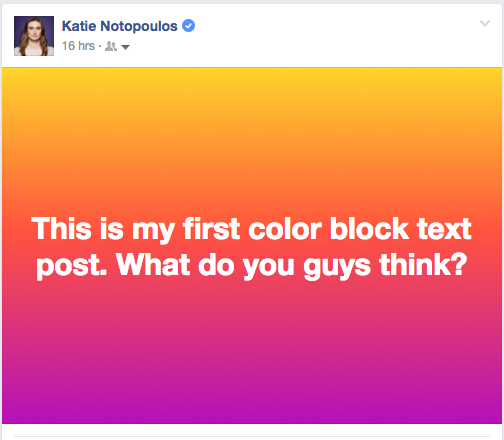
Hello, I'm Katie, and I find those new color block Facebook text post thingees very annoying. My boss, Mat, loves them.

I’m talking about these things, btw:

I'm talking about these things, btw:

We decided to discuss the issue over email. Please vote at the end to help us settle this debate.

Dear Katie,

Recently, in our tech news Slack room, you lobbed an accusation at me. You said that you thought that I “have been abusing the color block fb post.” This was a reference to those colored backgrounds Facebook now lets people put in their status updates. They started off as, I think, simple colors. Then came gradients. Now, there are bold patterns and prints that you can write text over.

While I'll admit to using these a lot recently, it's because I find them delightful! They visually segment and break up the news feed nicely, and I suspect they are having the effect of getting people to post more status updates, more frequently. (Which was probably the entire intent.) And besides, I've noticed that when I do a colorful status update, more people ~engage~ with my posts. Which in turn makes me want to do more of them! What's the harm?

Concernedly,

Mat

Hi Mat,

Well, here's the thing. It's partly the Facebook color blocks, but it's also partly you. You have been abusing them. I agree with you that they are probably designed to make people use them more, and it's a great way to make your post standout if someone is scrolling through their news feed which might be full of photos and videos that are much more eye-catching than a standard text status. But that's precisely your problem. You are abusing the potent power of the eye-popping, scroll-stopping color blocks. These should be reserved for important updates.

Allow me to remind you what your most recent color block updates are:

May 10: “Oh, wow, fucking hell.”

May 12: “Eventually i'm going to buy one of these Quip toothbrushes just to make the damn ads go away.”

May 16: “Can you believe the latest news about Trump?”

May 17: “Omg, can you believe the latest news about Trump?”

May 19: “Ugh. I think Twitter is down.”

May 19: “Wow… can you believe the most recent news about Trump?”

May 24: “Ugh.”

I think anyone would agree with me here that you are NOT using these for important statuses only. You're using it like the worst possible Twitter feed of all time.

Please do not fire me,

Katie

Dear Katie,

You missed this one from May 30: “So, Katie Notopoulos says I'm over-using these colorful new Facebook posts. I disagree. How do you feel?”

Anyway. If I take your meaning, you think these colorful backgrounds should be reserved for only important life updates, rather than the banalities of our day-to-day existence.

(Speaking of banalities, you also missed this one from a few hours ago.)

First of all, who are you to tell me what is and is not important about my life!?! But more broadly, these updates make Facebook a safe space for the mundane and banal again. That's kind of great, right? Why should Twitter get all of that juice?

They're like Instagram filters from 2010. They take your boring life and class it up! I feel like that's the whole idea, and if it is, how could I be abusing them?

Your colleague,

Mat

Mat,

So I decided to try it out for myself and post a color block post.

And guess what? You were right – it got lots of engagement. Way more than any of your posts, btw. I guess like… I dunno, people like me a lot more? My friends actually care about me and think it's fun to chat about stuff with me? I'm wondering what it must feel like for you to be constantly sending out these hideous neon pleas for human interaction and coming up short. How lonely you must be. Now I feel sort of sorry for you. I realize what I thought was your “trolling” by overusing the color blocks is actually just your grasp at a social life.

Btw I still say the color blocks are “bad.”

Your friend,

Katie

Quelle: <a href="Are Those Color Block Facebook Posts Terrible Or Great?“>BuzzFeed

You're Going To Talk To All Your Gadgets. And They're Going To Talk Back.

It’s a familiar scene: a crowd of people poking slabs of illuminated glass, completely enraptured by their pocketable computers. They tap, tap, swipe while waiting for the bus, walking down the street, or slouched on a couch at a party made boring by all that inattention. Ever since the introduction of the iPhone a decade ago, touchscreens have kept our eyes cast downward instead of on the world around us.

Today, there are some 2 billion devices running Android, and another 700 million or so iPhones are in use based on analyst estimates. A generation of people, especially in markets like India and China, have come online with smartphones, bypassing mouse and keyboard–based desktop PCs altogether. Tap, tap, swipe is now more ubiquitous than type, type, click ever was.

That kind of growth has left device manufacturers anxious for another hit. But so far the touchscreen smartphone has proved too neat a trick to repeat. No matter what Next Big Thing comes its way — Google Glass, Apple Watch, Oculus Rift — people just seem to keep their heads down. Swipe, tap, poke, pinch.

But while we were paying attention to the things on our wrists and (ugh) faces, another major technological shift took hold. And this new interface, just now becoming mainstream, is the next era of computing, just as surely as the punch card, command line, mouse-and-keyboard graphical interface, and touch interface that came before it. It’s also the oldest interface in the world, our first method to communicate with each other, and even with other animals — one that predates letters or language itself.

It’s your voice. And it’s the biggest shift in human-computer interaction since the smartphone.

It was hard to see, initially, just how transformative the portable touchscreen computer was, precisely because it lacked a keyboard. But it was the ability to hold the world’s information in our hand, in a visually accessible way that we could manipulate with our fingers, that turned out to be so powerful. Pinch to zoom, pull to refresh, press and hold to record and share.

Voice-based computing will be everywhere, listening to what we say, learning from what we ask.

Right now, something similar is underway with voice. When voice-powered devices come up, the conversation often turns to what’s missing: the screen. Especially because for most of us, our first experience with a voice-based interface took place on a touchscreen phone. (Hey, Siri!)

But when you take away the keyboard, something very interesting happens, and computing becomes more personal than it ever has been. Soon, human-computer interaction will be defined by input methods that require little know-how: speaking, pointing, gesturing, turning your head to look at something, even the very expressions on your face. If computers can reliably translate these methods of person-to-person communications, they can understand not just what we say in a literal sense, but what we mean and, ultimately, what we are thinking.

In the not-too-distant future between now and Black Mirror, voice-based computing will be everywhere — in cars, furniture, immersion blenders, subway ticket counters — listening to what we say, learning from what we ask. Advanced supercomputers will hide under the guise of everyday objects. You’ll ask your router, “Hey Wi-Fi, what the hell is wrong with you?” Or your fridge, “What’s a recipe that uses all of the vegetables about to go bad?” Or just, to the room, aloud, “Do I need a jacket?”

Best of all, most people will be able to use this new species of gadgets, not just those with technological proficiency. Proxy devices, like keyboards and mice, require training and practice. But in this vision of the future, you’ll be able to use natural language — the kind of speech you’d use with a date, your kids, your colleagues — to access the same functions, the same information that typing and tapping can.

Make no mistake: The touchscreen isn’t going anywhere. But increasingly we’re going to live in a world that’s defined by cameras and screens, microphones and speakers — all powered by cloud services, that are with us everywhere we go, interpreting all our intents, be they spoken, gestured, or input via a touchscreen keypad.

Welcome to the age of ubiquitous computing, or the ability to access an omnipresent, highly knowledgeable, looking, listening, talking, joke-making computer at any time, from anywhere, in any format. In many ways, we’re already living with it, and it all starts with your voice.

The Rise of Alexa

Photo Illustration by BuzzFeed News; Images courtesy Amazon, MGM

Dotsy lives in Palm Beach, Florida, and she won’t tell me exactly how old she is. “You can google that!” she says, laughing. “It frightens me to say it out loud.”

The octogenarian is Really Cool. About a month ago, she picked up a new instrument — the drums — and recently “jammed” at a friend’s “crib” (her words). She’s an avid reader who tries to keep her schedule open and in flux. But there’s one thing she needs a little help with: seeing.

Dotsy owns not one but two of Amazon’s Echo devices: She keeps a smaller Dot in her bedroom (her daily alarm) and the larger flagship Echo speaker on the porch (where its AI personal assistant, Alexa, reads her Kindle books aloud). Alexa’s primary role in Dotsy’s life, though, is providing information that her eyes have trouble discerning. “I find it mostly helpful for telling the time! I don’t see very well, so it’s a nuisance for me to find out what time it is.”

Her vision isn’t good enough for her to use a smartphone (though she wishes she could) and she doesn’t use a computer. But Dotsy loves being able to ask Alexa questions, or have it read her books.

Overall, “I think it’s wonderful!” Dotsy proclaims. She sometimes even thanks Alexa after a particularly good response, which prompts the AI bot to say, “It was my pleasure” — a nice, human touch.

It turns out that the internet-connected, artificially intelligent Echo is more accessible and more powerful than a mobile device or laptop for someone who touchscreens have left behind.

Alexa and the Echo have lots of room for improvement. Dotsy still can’t add new “skills” on her own, for example, because that requires the Alexa mobile or web app. (“Skills” is Amazon's term for capabilities developers can add to Alexa, like summoning an Uber or announcing what time the next bus will arrive.) But what Amazon showed with the Echo is where voice computing is best positioned to prevail: your private spaces.

Google and Apple had voice assistants long before Alexa came along, but those were tied to your phone. Not only does that mean you have to pull it out of your pocket to use it, but it’s also prone to running out of battery, or being left behind (even if behind is just the other room). The Echo, on the other hand, is plugged into a wall, always on, always at attention, always listening. It responds only to queries that begin with one of its so-called wake words such as “Alexa” or “Computer,” and is designed to perform simple tasks while you’re busy with your own. So when your hands are tied up with chopping vegetables, folding laundry, or getting dressed in the morning, you can play a podcast, set a timer, turn on the lights, even order a car.

“A lot of personal technology today involves friction,” said Toni Reid Thomelin, VP of Alexa experience and Echo devices. “We envision a future where that friction goes away, the technology disappears into the background, and customers can be more present in their daily lives.”

Amazon’s Alexa-powered speaker was a sleeper hit. The company, which rarely issues public numbers, won’t say officially how many Echo speakers are active or have been sold (just that it receives “several millions of queries every day” from “millions” of customers). A recent survey shows that sales have more than doubled since the product first launched in late 2014 and estimates that around 10.7 million customers own an Echo device, but that number, which doesn’t account for those with multiple devices, likely does not reflect how many Echoes have actually been sold.

“A lot of personal technology involves friction…We envision a future where that friction goes away, the technology disappears into the background, and customers can be more present in their daily lives.”

The Echo’s sales are still small compared with Siri and Google Assistant’s reach, but the device has garnered mainstream popularity (even the Kardashians have one) and legions of superfans in a way that other assistants simply haven’t. The flagship Echo has over 29,000 reviews on Amazon from “verified purchases” (people who actually bought their Echo through Amazon) and among those, nearly 24,000 are positive. The most telling numbers, though, are the ones on Reddit. The number of /r/amazonecho subreddit subscriptions (about 37,000) eclipses that of Google Assistant’s subreddit (280) and Siri’s (1,502). It’s also worth noting that there are even more (3,800) on /r/SiriFail.

The Echo is, for many of its highly satisfied users, the ideal at-home smart device. It’s so easy to use that toddlers who can’t read yet, and seniors who have never used a smartphone, can immediately pick up a conversation with Amazon’s AI-powered robot.

For years, the online bookstore turned e-commerce giant had been unintentionally working on the infrastructure for a voice-enabled AI bot. “We were using machine-learning algorithms internally at Amazon for a long period of time,” said Thomelin, who has been with the company for nearly two decades. “Mostly in the early days, for our Amazon.com recommendations engines. And seeing the success of our recommendations engines, we thought, How could you use those similar techniques in other areas throughout Amazon? That was a big piece of what helped bring the Echo to life.”

Leaps in cloud computing — or the ability to process data on a remote, internet-hosted server instead of a local computer — were also crucial to the Echo’s development. “About five years ago,” Thomelin said, “we saw internally how fast cloud computing was growing with AWS…so we wanted to capitalize on all that computing power being in our own backyard and bring it into a new device category like Echo.” (AWS, or Amazon Web Services, is a platform originally built to run Amazon’s own website, but now handles the traffic for some of the biggest internet companies in the world, including Netflix, Spotify, and Instagram.) When people talk about the cloud what they really mean is a bunch of Amazon server farms. It’s those machines that host Alexa’s knowledge and instantly sling its responses to millions of Echo devices simultaneously.

But the magic of the Echo isn’t that it’s particularly smart — it’s that it is an exceptionally good listener. The Echo can hear a command from across a room, even with a TV or side conversation running in the background. Alexa has a far better ear than anything that has come before, and stands out among all those other “Sorry, I didn’t catch that” assistants.

Rohit Prasad, VP of Alexa machine learning, said that a voice-first user interface was a far-fetched idea when the team began developing the technology. “Most people, including industry experts, were skeptical that state-of-the-art speech recognition could deliver high enough accuracy for conversational AI,” Prasad said. There are a lot of challenges when it comes to recognizing that “far-field” (or faraway) speech, and a particular one for the Echo is being able to hear the wake word, “Alexa,” while the device is playing music loudly. Advancements in highly technical areas — such as deep learning for modeling noisy speech and a uniquely designed seven-microphone array — made that far-field voice recognition possible.

And Amazon is now handing out that technology — that special sauce. For free! To anyone who wants to build it into a device of their own! One of Amazon’s priorities is getting its assistant in as many places as possible, and it is doing that by providing an API and a number of reference designs to developers, so that the Echo is just one of the many places Alexa can be found.

Amazon is moving fast, with thousands of people in the Alexa organization alone (up from one thousand at this time last year). The company is also investing huge sums of money in companies interested in building Alexa into their products, like the smart thermostat maker Ecobee, which got $35 million in a funding round led by Amazon. In April, Steve Rabuchin, VP of Alexa voice services, told me the team is focused on integrating the voice assistant with a breadth of devices, including wearables, automobiles, and appliances, in addition to smart home products. Amazon wants to make sure that users can ask, demand, and (most importantly) buy things from Alexa from anywhere, at any time.

This massive, almost desperate effort isn’t surprising. Amazon at last made the AI assistant people love to talk to. But it had a late start compared to Google, Apple, and even Microsoft. And what’s more, a big hurdle still stands in Alexa’s way to becoming the go-to assistant we access from anywhere, anytime. Because there’s already a device we carry with us everywhere, all the time: the smartphone.

Advantage Apple
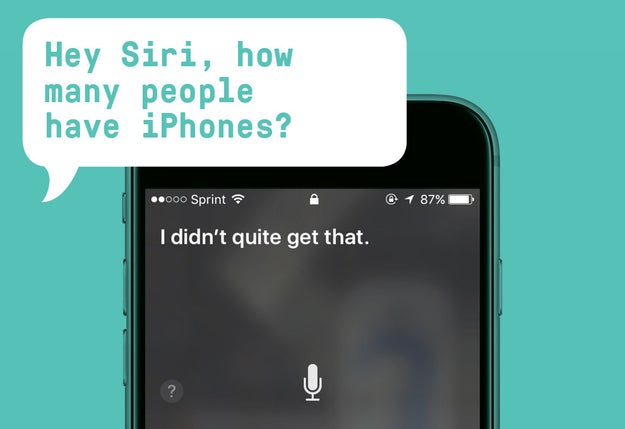
Photo Illustration by BuzzFeed News; Image courtesy Apple

At the end of 2016, Apple beat out Samsung to become the number one smartphone maker in the world, with 78.3 million iPhones sold that holiday quarter alone, compared with 77.5 million Samsung handsets in the same period. It’s a massive device advantage over not just Samsung but everyone. And what’s more, every one of those devices shipped with Siri.

Apple acquired Siri, a voice-command app company, in 2010 and introduced an assistant with the same name built into the iPhone 4S in 2011. When Siri hit the market, it instantly became the first widely used voice assistant. Google Now, the predecessor to Google Assistant, wouldn’t ship for another year, and Alexa and Microsoft Cortana for another four.

The only problem? It sucked.

The voice assistant’s high error rate at launch has plagued Siri’s perception to this day, even though its recognition capability has improved significantly (by a factor of two, thanks to deep learning and hardware optimization).

After the fifth anniversary of Siri’s launch last October, app developer Julian Lepinski nailed why users can’t get into the assistant: because they just can’t trust it. “Apple doesn’t seem to be factoring in the cost of a failed query, which erodes a user’s confidence in the system (and makes them less likely to ask another complex question),” Lepinski writes. Instead of asking clarifying questions or requesting more context, “Apple has a bias towards failing silently when errors occur, which can be effective when the error rate is low.”

Siri is by far the most widely deployed assistant, with a global reach that spans 21 different languages in 34 countries. Google Assistant supports seven languages, while Alexa supports just two. Still, Siri usage isn’t what it could be. Apple says that it receives 2 billion non-accidental requests a week, which means that — if the 700 million active iPhones estimate is correct — that’s only 2–3 queries per phone, every seven days.

Meanwhile, it’s under assault on its own devices. There are now multiple options for assistants on the iPhone, all vying to be the AI of choice for iOS users: Amazon baked Alexa into its main shopping app for iPhone and Google launched an iOS version of Assistant this year.

Of course, neither are as as deeply integrated or accessible on the iPhone as Siri. So Google and Amazon are racing to prove that their assistants are worth the extra taps. They’re also trying to do end runs around the phone altogether, by releasing tools that let developers build their assistants into all the devices we surround ourselves with. It starts with speakers, but cars and thermostats and all manner of other things are on deck.

Apple, meanwhile, has been trying to change Siri’s image — so that no matter what’s around you, you’ll say “Siri” and not “Alexa” or “Okay, Google.” In an August 2016 interview with the Washington Post, CEO Tim Cook was asked whether Apple can catch up with Facebook, Google, and Amazon’s AI capabilities, to which Cook responded, “Let me take exception to your question. Your question seems to imply that we’re behind.”

Siri is under assault on Apple's own devices.

Quelle: <a href="You're Going To Talk To All Your Gadgets. And They're Going To Talk Back.“>BuzzFeed
Uber Rival Waymo Is Testing Self-Driving Trucks Too

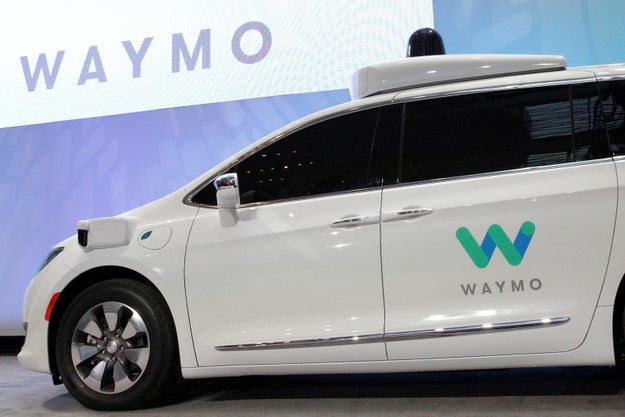
A self-driving Chrysler Pacifica minivan that Waymo unveiled on January 8, 2017.

Brendan Mcdermid / Reuters

Alphabet’s autonomous car company Waymo is exploring self-driving trucking, BuzzFeed News has learned.

“Self-driving technology can transport people and things much more safely than we do today and reduce the thousands of trucking-related deaths each year. We’re taking our eight years of experience in building self-driving hardware and software and conducting a technical exploration into how our technology can integrate into a truck,” a Waymo spokesperson told BuzzFeed.

BuzzFeed News first learned of Waymo’s self-driving trucking efforts via a photograph. Waymo subsequently confirmed that it was in fact testing a truck, and said it was manually driving the semi on a public road for data collection purposes. The Waymo spokesperson confirmed that the company is currently testing just one truck.

Google began working on self-driving cars in 2009. It spun out its self-driving car program into a new company called Waymo in 2016, and earlier this year it announced it had been developing its own autonomous driving hardware. Earlier this year, the company launched a pilot program in Phoenix for people to take rides in their cars. The company had not previously announced trucking efforts.

Uber is also working on autonomous trucking. Last year, the ride-hail juggernaut purchased an automated trucking startup called Otto, whose founder Anthony Levandowski – a former Google employee – is now at the center of a lawsuit from Waymo. Waymo sued Uber in February, alleging Levandowski stole the company’s self-driving trade secrets before decamping to start Otto and join Uber. Waymo’s lawsuit alleges that Uber has benefitted from that information, and its lawyers have argued Otto was simply a ruse created so Uber would acquire it and obtain Waymo’s secrets.

Trucking has been predicted to be one of the major applications of self-driving technology. Uber performed its first self-driving trucking delivery in October 2016: a 120-mile beer haul for Anheuser-Busch. The company performed that delivery after completing five consecutive tests along its Colorado route, BuzzFeed News reported in March, with state patrol troopers surrounding the vehicle in motorcade fashion.

Another startup called Embark is also working on self-driving trucks.

Quelle: <a href="Uber Rival Waymo Is Testing Self-Driving Trucks Too“>BuzzFeed

Read Apple CEO Tim Cook's Email To Employees About Trump Pulling Out Of The Paris Accord

This afternoon Apple CEO Tim Cook added his name to an ever-lengthening list of CEOs voicing their disappointment over President Trump's decision to withdraw the United States from the Paris climate accord. “I spoke with President Trump on Tuesday and tried to persuade him to keep the U.S. in the agreement,” Cook wrote in a memo obtained by BuzzFeed News. “But it wasn’t enough.”

Cook subsequently followed up his internal note to employees with a pointed tweet.

Here's Cook's memo in full:

Team,

I know many of you share my disappointment with the White House’s decision to withdraw the United States from the Paris climate agreement. I spoke with President Trump on Tuesday and tried to persuade him to keep the U.S. in the agreement. But it wasn’t enough.

Climate change is real and we all share a responsibility to fight it. I want to reassure you that today’s developments will have no impact on Apple’s efforts to protect the environment. We power nearly all of our operations with renewable energy, which we believe is an example of something that’s good for our planet and makes good business sense as well.

We will keep working toward the ambitious goals of a closed-loop supply chain, and to eventually stop mining new materials altogether. Of course, we’re going to keep working with our suppliers to help them do more to power their businesses with clean energy. And we will keep challenging ourselves to do even more. Knowing the good work that we and countless others around the world are doing, there are plenty of reasons to be optimistic about our planet’s future.

Our mission has always been to leave the world better than we found it. We will never waver, because we know that future generations depend on us.

Your work is as important today as it has ever been. Thank you for your commitment to making a difference every single day.

Tim

Quelle: <a href="Read Apple CEO Tim Cook's Email To Employees About Trump Pulling Out Of The Paris Accord“>BuzzFeed

Blue Apron Just Filed For An IPO

Blue Apron, the company that ships meal kits to customers' homes, filed for an IPO on Thursday.

According to the filing, the company brought in $77.8 million in 2014, $340.8 million in 2015, and $795.4 million in 2016. In the first three months of this year, the company has already generated $244.8 million in net revenue. For context, the restaurant chain White Castle took in about $691.3 million in sales in US sales, according to 2015 data from QSR magazine.

But as the company grows, it loses more money each year — $30.8 million in 2014, then $47 million in 2015, and $54.9 million in 2016.

The rate of growth the company has experienced in recent years is impressive, but its effort to rapidly scale had consequences for some of the workers in Blue Apron's food processing facilities, in addition to financial losses. At the end of last year, Blue Apron put its plans for an IPO on hold, Bloomberg reported at the time.

In the filing, Blue Apron commented on its relationship with workers. “As of April 30, 2017, we had 5,137 full-time employees, of which more than 85% were engaged in fulfillment operations. None of our employees is represented by a labor union or covered by a collective bargaining agreement. We have not experienced any work stoppages, and we consider our relations with our employees to be good.”

Recently, a California food workers union introduced legislation in hopes of regulating workplace safety at companies like Blue Apron that package unprocessed food.

Blue Apron's filing also includes interesting information about how the company thinks about, and markets, itself. In 2016, 18% of the company's expenses went to marketing.

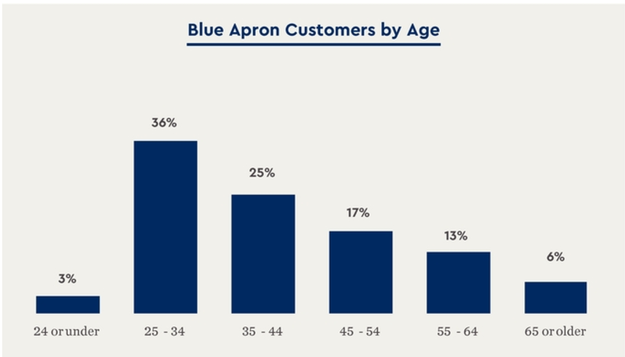
According to the chart below included in the filing, a little more than a third of Blue Apron's customers are between ages 25 and 34, aka millennials. About a quarter are between 35 and 44.

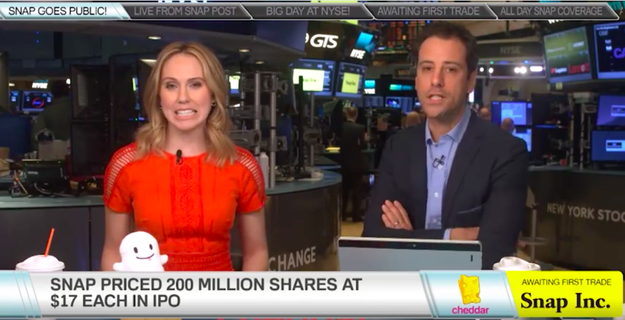
Despite a boom in smartphone usage and online shopping in the US and across the world, few consumer-facing internet companies have gone public in recent years, with the exception of Snapchat’s parent company in February. Tech startups like Uber and Airbnb have been able to raise hundreds of millions — in many cases, billions — of dollars in venture capital, reducing the need to seek cash from public markets.

Blue Apron, which is as much a food and logistics company as a technology company, stands out in contrast to that trend.

Venessa Wong contributed reporting to this story.

Quelle: <a href="Blue Apron Just Filed For An IPO“>BuzzFeed