Inside The Chaotic Battle To Be The Top Reply To A Trump Tweet

Adam Best is always ready for a new tweet from President Trump. The Austin-based entrepreneur — and founder of the site Fansided —has set his phone is set to notify him the second the President hits “send”; since it’s his only Twitter notification, he rarely misses it.

“There’ve been times I’ve been in bed and I’ll hear the alert and roll out of bed and start firing back,” Best told BuzzFeed News. Sometimes he’ll mock up a series of tweets on a subject in advance — say, the congressional investigation into the Trump administration’s ties to Russia — so he can copy them into an instant tweetstorm. For Best, a self-identified member of the anti-Trump #resistance, it’s a form of catharsis and a chance to “fight back” during what he calls a “particularly depressing time” in politics.

“Trump’s very predictable so sometimes it’s just like ‘BOOM!’ Two minutes after the Trump’s tweet I have a seven-part response that’s topical and engaging.”

Best is far from the only person racing to reply to a Trump tweet. Thanks to Twitter’s weighted reply algorithm, you don’t even have to be the first to hit “send” — though it certainly helps. So seconds after the president sounds off to his 31-plus million followers, he’s is bombarded with replies — almost all of them extreme. There are: breathless condemnations of Trump policy; cries for his speedy impeachment; furious demands for his administration to admit its role in any number of global and political conspiracies; #Resist-ers; #TrumpTrain conductors and passengers; impassioned defenses of his character; praise for Trump as chessmaster-in-chief, 10 steps ahead and constantly outwitting enemies. There are comedians, actors, doctors, scientists, admirers, goons, politicos, activists, journalists, and trolls. And within seconds they’re all just a few pixels below the President’s missive — yelling, arguing, and looking to be the one Donald Trump sees when he checks his Twitter feed.
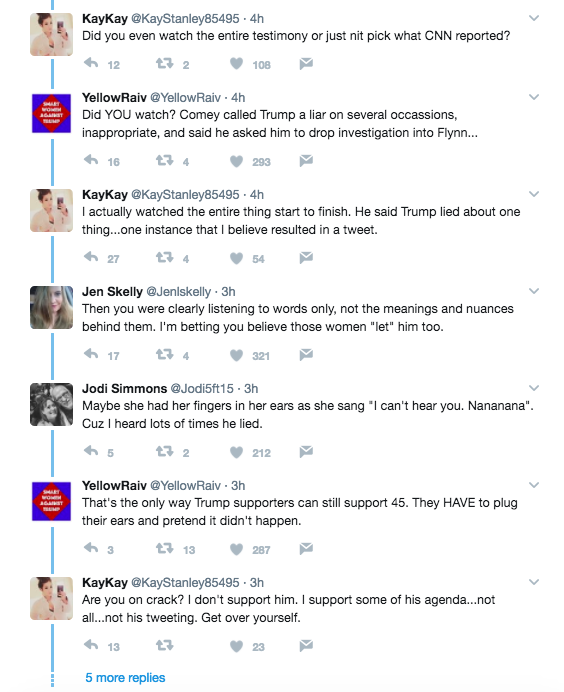
A standard argument — one of tens of thousands — in a Trump tweet reply chain.

Even if Trump himself never sees it, there’s a chance it will show up in the news, embedded in countless articles or projected across cable news as a producer scrolls down through a @realdonaldtrump tweetstorm.

Engaging with the President of the United States is Twitter’s weirdest growth hack.

Most importantly, the top reply to a Trump tweet is guaranteed to get in front of hundreds of thousands of eyes. That’s likes and retweets, not to mention profile views, replies, and new followers. In January, Mike Elgan, a technology writer, replied to a Trump tweet within ten seconds and watched the tweet rack up 800,000 impressions and 24,000 engagements in just a few hours. Within 24 hours, Elgan’s account grew by 300 followers — proof that mere proximity to a 6:00 A.M. presidential diatribe is among the most reliable ways to boost one’s Twitter account. Engaging with the President of the United States is Twitter’s weirdest growth hack.

On four separate occasions last May, New Right blogger and pro-Trump Twitter personality Mike Cernovich beat out the thousands of other replies to be the top response to a Trump tweet. As a screenshot sent to BuzzFeed News shows, each tweet brought in at least 300,000 impressions to the tweet.
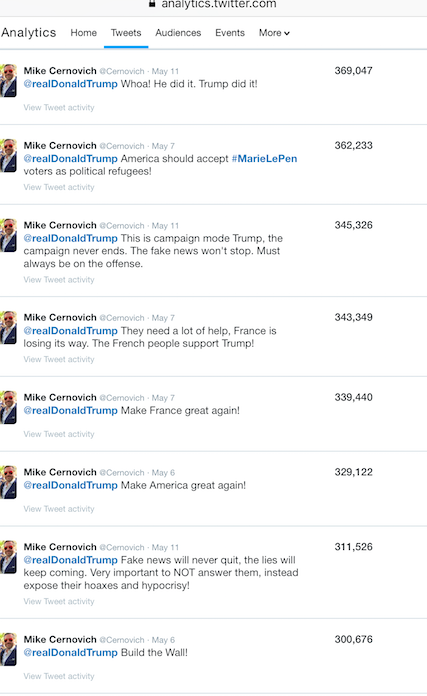
Cernovich says he’s done trying to game Trump’s replies, but argues that it’s a key tactic for budding political Twitter personalities. “If you get that top spot for five or six tweets each day, then that’s about 2 million impressions,” he said. “And it’s an effective way for people who might be considered trolls by some people to get their message out and to build their brand. That’s why there’s fierce competition for top spot.”

On the opposite side of the political spectrum, the strategy is much the same. William Legate, a 22-year-old entrepreneur and Thiel Fellow who’s become an active member of the anti-Trump online resistance since January, took his Twitter account from a few hundred followers to more than 100,000 in mere months, due in no small part to nabbing the top reply. For the last few months, Legate has jumped on Trump tweets within minutes, threading antagonistic tweets at the President that question policy, or point out inaccuracies.

“Honestly, it’s just using Trump’s strategy against him,” Legate said. “I studied the strategies Trump uses. He uses all kinds of psychological techniques — it appears he's read The Art Of War. I understand and use these techniques back. It's controlled chaos.”

Legate won’t detail his strategy for rising up in the reply algorithm, but assured BuzzFeed News he’s not a bot nor does he use any automated bots to cheat the system. He’s frequently accused by those in pro-Trump circles of having a clandestine deal with Twitter to rig the top reply in his favor. He insists that’s not true. “I don’t have deal with Twitter. Believe me, I wish I had some kind of deal,” he said.

And while Legate appears to be just one man, there’s precedent for fears that the game in Trump’s replies is rigged. In the months leading up to the 2016 election, Trump’s replies were dominated by a number of sophisticated bots with names like @keksec__org, @NeilTurner_ and @WhiteGenocideTM. As New York reported in the summer of 2016, these bots were almost always the first responses to Trump’s tweets, coughing up image- and link-heavy replies at inhuman speeds — often within two or three seconds. That speed was rewarded at different points during the campaign when, on at least three occasions, Trump retweeted each of the accounts.

But just being first doesn’t assure you a top spot in Trump’s replies, thanks to Twitter’s algorithmic “conversation ranking.” Until November 2016, when Twitter revamped its replies on mobile, Twitter replies were largely ranked by who was first to respond. Now, according to Twitter, “Replies are grouped by sub-conversations” that are ranked differently for each user by “factors such as if the original Tweet author has replied, or if a reply is from someone you follow.” Ostensibly this means that different people will see different top replies, but on Trump tweets, a select few still dominate.

Even though Twitter’s reply ranking algorithm is largely a mystery — when asked, Twitter did not provide any concrete explanation of how it weights tweets in large reply chains — those who’ve managed to beat the algorithm suggest there are a few tried and true strategies. Speed is important, but so is being a verified Twitter user — almost all the top replies to Trump tweets come from verified users, which Twitter argues improves the quality of the top replies .

If you can’t get there first, top repliers suggested it’s better to reply to the top reply, instead of to Trump: A “conversation” between two verified users often results in high placement. Threading tweets into a longer tweetstorm helps, too, others said — especially when they’re laden with images or videos. Two different top repliers offered that Twitter aggregates the likes and retweets of an entire thread when ranking replies, meaning that a tweetstorm is seen as more engaging than a lone tweet, increasing the odds it’ll be shown higher up in the stream.

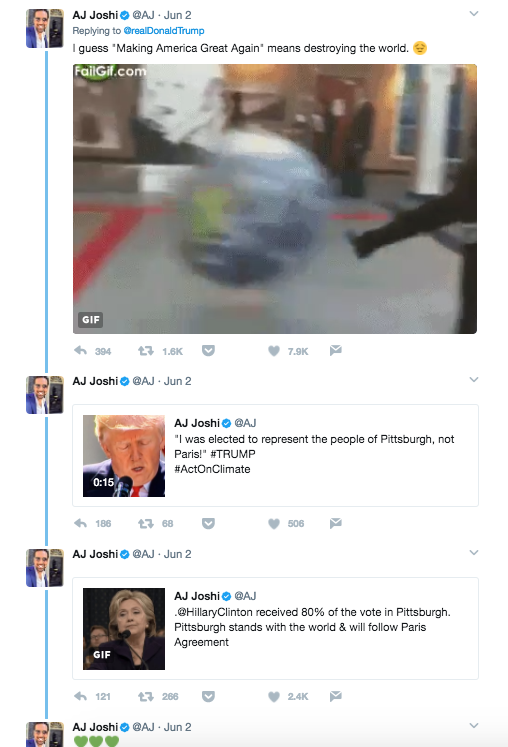
As a result of all this, even the most innocuous @realdonaldtrump tweets instantly descend into madness with one small scroll downward into the replies. Like on June 1 when Trump dashed off a throwaway tweet — a simple, all caps “MAKE AMERICA GREAT AGAIN!” that brought in 60,000 replies. The first replies came from AJ Joshi, an entrepreneur with nearly 400,000 followers, who offered up an eight tweet thread accusing Trump of destroying the planet (394 replies, 1,599 retweets, 7,883 likes on just the first tweet)
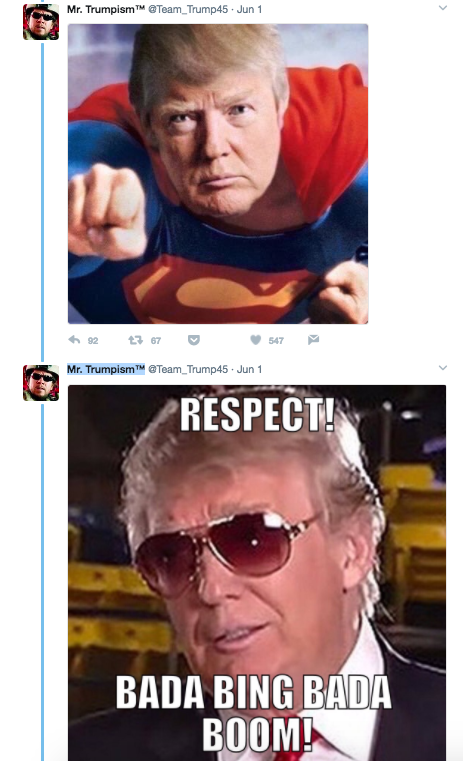
This was countered by a nine-tweet image thread from a pro-Trump account with the display name “Mr. Trumpism™” (350 replies, 236 retweets, 963 likes on just the first tweet).
From there, the thread devolves into a toxic mix of partisan bickering and trolling from verified and non-verified users alike with accusations of transphobia, treason, and “daddy issues”. There also plenty of heavy-handed pleas — for Trump to resign as well as for him to implement safer football pads for America’s athletes. It goes on and on and on…for 60,000 tweets.

These novel-sized threads highlight just how contentious and important an outlet Twitter has become for venting at and defending the President. And — given that the President has chosen it as his go-to outlet for communicating White House policy — the space beneath a Trump tweet has raised unique legal questions. This week, lawyers representing Twitter users blocked by Trump urged the President to unblock them on the grounds that being blocked was a violation of the First Amendment. Under this argument, Trump’s replies are a “designated public forum,” meaning that the President is barred from banning people because they disagree with his views.

Nik Lentz, a featherweight MMA fighter who is an active defender of the President in Trump’s replies, told BuzzFeed News he sees Trump’s replies as an opportunity to have a “direct feed to the SJW matrix” that allows him to “troll these moron Soros bots.”

Lentz was first drawn to Trump’s replies after seeing that they were dominated by liberal-leaning, verified accounts castigating Trump. For Lentz, replying to the haters offered a bit of agency — and the fun of adding in some chaos. “Posting a few gifs of Trump dancing does many things,” Lentz said. “It shows the ridiculousness of trying to become famous off talking about make-believe Russian stories to virtue signal to the world that you matter on the Prez’ twitter post. And you get to see those same people lose their minds over a simple gif.”

“It really is almost like an SEO strategy now.”

In recent months, Trump’s replies have only grown more intense. And some publications are even getting involved. The Tylt, a startup media company inside Advance Publications (which is owned by Conde Nast), recently began mixing it up in the replies to Trump’s tweets as a content strategy. “We noticed that individuals were threading replies to Trump and saw a natural opportunity to jump in and pose questions using Twitter’s native polls,” Adrian Arizmendi, The Tylt’s Creative Manager told BuzzFeed News.

Arizmendi began peppering in in-house videos and embedded media into the threaded tweets and watched as engagement exploded — with a single thread generating 2 million impressions and half a million engagements. In the middle of May, Arizmendi claims that, thanks to Trump’s tweets, The Tylt’s account was generating more raw social engagements than Vice, Mic and Fusion combined.

“It really is almost like an SEO strategy now,” Philip Lewis, an editor at the Huffington Post and prolific tweeter said. “If you can get that prime real estate it's worth millions of views.” Lewis generally stays away from replying to Trump tweets, but occasionally uses a similar strategy to win the top reply on other big accounts. “You gotta have a good eye for the tweets that go viral, Lewis said. “I only do it when I can add a little value, otherwise it’s just leeching off another account. But that doesn’t stop plenty of people from doing it.”

And as Trump continues to tweet, there’s indications the gaming is only going to continue.

“I absolutely plan to expand this sort of threaded reply beyond just Trump,” Arizmendi said. “So don’t be surprised if you see more of us out there in the future posing questions of other public figures/companies/entities.” ●

Quelle: <a href="Inside The Chaotic Battle To Be The Top Reply To A Trump Tweet“>BuzzFeed

Ola, Uber's Largest Rival In India, Just Called The Company "Despicable" And "Low On Morality"

Indian police escort Uber taxi driver and accused rapist Shiv Kumar Yadav © following his court appearance in New Delhi on December 8, 2014. Delhi's government on December 8 banned Uber from operating in the Indian capital after a passenger accused one of its drivers of rape.

Chandan Khanna / AFP / Getty Images

Uber's largest rival in India, Ola, has come out with a statement, which says that the ride-hailing giant is “low on morality.”

Ola issued the statement after a Recode report revealed that Eric Alexander, Uber's president of business in the Asia Pacific region who has since been fired, obtained the medical records of a passenger who was raped by an Uber driver in New Delhi, India, in December 2014. Sources told Recode that Uber did not believe the victim's story and thought that it was an attempt by Ola to hurt Uber's brand in India.

Ola's statement reads:

“It is a shame that the privacy and morals of a woman have to be questioned in an attempt to trivialise a horrific crime. It is despicable that anyone can even conceive an attempt to malign competition using this as an opportunity. If this report were to be even remotely true, this is an all time low on morality and a reflection of the very character of an organisation.”

Uber declined to comment to BuzzFeed News about Ola's statement. Amit Jain, the company's India President, said: “Uber responded by working closely with law enforcement and the prosecution to support their investigation and see the perpetrator brought to justice.”

Alexander’s departure came on the heels of Uber's Tuesday announcement in which the company said that it had fired 20 people after internally investigating over 200 claims of discrimination and harassment. Alexander's handling of the New Delhi rape case was one of the claims that was part of Uber's internal investigation.

Twitter: @Uber_Comms

Quelle: <a href="Ola, Uber's Largest Rival In India, Just Called The Company "Despicable" And "Low On Morality"“>BuzzFeed

The iPhone Will Soon Allow You To Screen Record And People Are Both Excited And Scared

“This is taking dragging culture to a whole new level. Tea and receipts have been upgraded.”

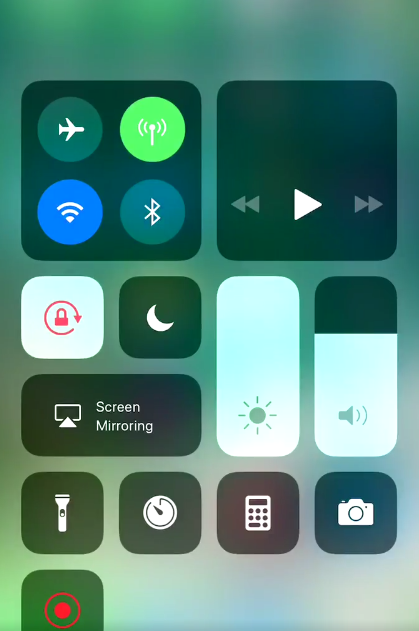
On Monday, Apple announced a laundry list of cool and nifty updates and features to the iPhone. But perhaps the coolest, niftiest, and most adapting feature is the fact that iOS 11 will allow you to screen record your phone. (!!!!)

On Monday, Apple announced a laundry list of cool and nifty updates and features to the iPhone. But perhaps the coolest, niftiest, and most adapting feature is the fact that iOS 11 will allow you to screen record your phone. (!!!!)

Faiz Shakir / Apple

New York resident Faiz Shakir, 20, whose tweet and video showing this function has gone viral, told BuzzFeed News he was excited to try it out as soon as he learned about it. “I was shocked because you could be recorded while on FaceTime or Snapchat without your knowing,” he said.

New York resident Faiz Shakir, 20, whose tweet and video showing this function has gone viral, told BuzzFeed News he was excited to try it out as soon as he learned about it. "I was shocked because you could be recorded while on FaceTime or Snapchat without your knowing," he said.

“I think there’s multiple benefits,” Shakir said. “It’d be easier to show people who may need help with their phone exactly how to do something, i.e. my grandparents always ask me for help with their iPhone and now I can send a how to video via iMessage.”

Note: Shakir was able to upgrade to iOS 11 with a beta version, as he's part of a developer program with Apple. The upgrade will not roll out to the public until the fall.

Faix Shakir


View Entire List ›

Quelle: <a href="The iPhone Will Soon Allow You To Screen Record And People Are Both Excited And Scared“>BuzzFeed

The Trump Administration Just Did McDonald's And Uber A Big Favor

Win Mcnamee / Getty Images

The Trump administration has withdrawn Obama-era legal interpretations that said millions of American workers, from McDonalds cooks to Uber drivers, should be treated as employees of the corporations they work for.

One of the interpretations, written by the Department of Labor in 2015, said workers should be considered employees of a company if they are “economically dependent” on it — a definition that would include the independent contractors that power the gig economy. Another said fast food workers hired by franchise owners should be considered jointly employed by the food giants themselves.

Today, after announcing their withdrawal, the Labor Department removed the text of each guidance from its website. They're still available online here and here.

When the Obama Labor Department first released the new definition of employees, it was seen as an attempt to rein in the trend towards classifying workers as independent contractors — a practice popular among startups like Uber, Lyft, Instacart and Postmates.

Christine Owens, the executive director of the National Employment Law Project, said in a statement that the change reflects the Trump Administration’s “willingness to take symbolic steps to attack workers – here, at the expense of additional clarity for all parties.”

Palak Shah, the director of social innovation at The National Domestic Workers Alliance, echoed the idea that the Department of Labor's withdrawal muddies interpretation of employment law. “It makes it harder for employers to follow the law, harder for workers to thrive in this economy, and harder for the government to enforce the law,” she said.

Robert Galbraith / Reuters

The Obama-era guidance on classification poked holes in arguments put forth by gig economy companies, which classify the people working on their platforms as contractors, according to Harvard Law professor Ben Sachs. But, he said, based on today’s withdrawal, it seems “the new DOL may pursue a difference course.”

The “joint employer” guidance has also been deleted. The fast food industry celebrated the change on Wednesday, with the the International Franchise Association, a major industry group, calling the joint-employer guidance “one of the most costly and burdensome regulations impacting the franchise business model.”

“While uncertainty surrounding the new joint employer standard has made it harder for America’s 733,000 franchise owners to grow and create new jobs, we are pleased the DOL is taking first steps to undue this costly regulation,” Matt Haller, the IFA’s Vice President of Public Affairs, in a statement.

While there are few immediate consequences of the change, it will almost certainly affect the outcome of cases now before the National Labor Relations Board, which concern whether parent companies like McDonald's are responsible for labor conditions at franchise locations, and what rights and benefits companies like Uber owe their drivers.

Alex Passantino, former Acting Administrator of the Labor Department’s Wage and Hour Division, said that the shift will likely result in “the Department of Labor pursuing fewer cases at the national level, and more cases ending at the local level, without efforts to pursue up-chain to a corporate franchisor or upper tier contractor.”

He said that it signaled that the department under Trump will likely “give more respect to traditional business relationships than the previous administration.”

The National Retail Federation, which represents the interests of companies that rely on contractors, was also pleased, calling the change “an important first step in reversing one of the most onerous regulations imposed by the previous administration on businesses.”

“Drastically expanding joint employer liability to hold one business responsible for the actions of another independent business, such as a subcontractor or franchisee, did nothing to protect employees and only created uncertainty that led to more growth-chilling litigation,” said NRF President and CEO Matthew Shay in a statement. “Retailers hope Congress will build on this progress and put the issue to rest once and for all with clear, fair legislation defining joint employers.”

Caroline O'Donovan contributed reporting to this story.

Quelle: <a href="The Trump Administration Just Did McDonald's And Uber A Big Favor“>BuzzFeed

Apple Is Sharing Its Secret iPhone Screen Repair Machine

If you cracked your iPhone screen and were dreading the wait to get it fixed, things might be looking up.

By the end of the year, Apple will nearly double the locations around the world that use its closely guarded screen fixing technology, according to Reuters.

The iPhone maker will sell 400 of its proprietary screen repair machines to third-party authorized service providers, which include chains like Best Buy and smaller independent shops, in 25 countries. Reuters reports that the machines, which Apple calls “Horizon Machines,” are “gray metal boxes the size of a microwave with a swing-out windowed door” and that they take between 10 and 12 minutes to repair a cracked screen without much human involvement.

Distributing these repair machines to third-party shops is a shift in strategy: Apple has largely controlled the processes and technology involved in repairing iPhones. If you brought your phone to one of Apple's authorized third-party service providers in the past, the shop didn't actually repair it themselves. Until now, these third party stores would mail iPhones to Apple stores or repair centers for certain repairs, including screens.

Apple is initially rolling out 200 machines to some of Apple's 4,800 authorized third-party service providers in Miami, the San Francisco Bay Area, London, Shanghai, Singapore, and other places.

There are currently about 500 screen fixing machines in the wild, almost all of them operating behind the scenes at Apple's own retail stores or the company's mail-in repair centers, according to Reuters.

The motivation for the distribution, Apple told BuzzFeed News, is twofold: meeting increasing demand for same-day repairs, especially in places without Apple stores, and relieving pressure on Apple stores, which are facing rising wait times as more people buy iPhones.

Estimates peg phone repair as a $4 billion business worldwide. Apple previously charged $99 for a screen repair if you had Apple Care (which cost $99 or $129 per year, depending on the size of your phone); now the price for a screen repair if you pay for Apple Care has dropped to $29.

Some independent, unauthorized repair shops say they'll fix a phone for as little as $10. But you'll void your warranty and Apple Care if these unapproved smartphone mechanics damage your device in any way. Apple also told Reuters that the Horizon Machine is the only thing that can fix a phone that needs more complex repairs, like if its touch sensor needs replacing.

The announcement comes as eight states are considering “right to repair” bills.

The legislation would require tech companies to make individual parts, diagnostic tests, and repair manuals to consumers and third-party retailers, something Apple has refused to do since the iPhone debuted a decade ago. iPhones aren't the only target of the bills though: Farming equipment is high on the list, too.

Apple has lobbied against the bills, saying that these laws would open up the nearly one billion iPhones worldwide to hacking and that it won't be able to ensure that third-party repairs meet quality standards. The company wouldn't comment on whether it will continue to lobby against these bills.

Apple told Reuters that the legislation — introduced in New York, Massachusetts, Tennessee, Illinois, Minnesota, Nebraska, Kansas and Wyoming — had nothing to do with the timing of its plan to give third party repair shops the ability to repair iPhone screens on their own.

Quelle: <a href="Apple Is Sharing Its Secret iPhone Screen Repair Machine“>BuzzFeed

Judge Rejects Uber's Bid To Pause Self-Driving Car Lawsuit

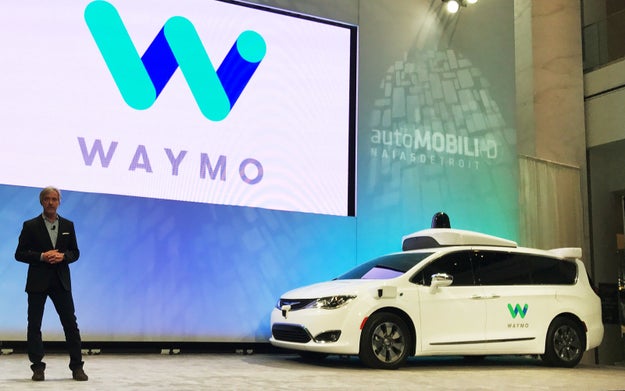
Waymo CEO John Krafcik unveils a Chrysler Pacifica Minivan equipped with a self-driving system developed by the Alphabet Inc unit at the North American International Auto Show in Detroit, Michigan, U.S., January 8, 2017.

Joe White / Reuters

A federal judge on Wednesday denied Uber's attempt to pause legal proceedings in the trade secrets lawsuit brought against it by self-driving car rival Waymo.

Uber has been working hard to push the lawsuit out of court and into arbitration. US District Judge William Alsup denied its request to do so in May. Uber then asked an appeals court to reconsider that decision, and asked Alsup to pause proceedings in the meantime. The judge declined.

“We can, in the meantime, go ahead as if this is going to go to trial on October 2,” Alsup said, ruling from the bench. “Waymo has made a showing that deserves an answer.”

Uber has not yet responded to a request for comment.

Waymo sued Uber in February, alleging that Anthony Levandowski — its former employee — stole its self-driving car trade secrets and brought them to the ride-hail giant. Uber maintains its self-driving car technology is “fundamentally different” from Waymo’s, but its lawyers have also argued that they “don’t have any basis for disputing” whether or not Levandowski stole the secrets at issue in the case. Meanwhile, Levandowski has pleaded the 5th Amendment to avoid self-incrimination should the case become a criminal matter. Uber fired him last week for refusing to comply with its investigation into the lawsuit's allegations. Alsup referred the case to federal prosecutors in May to investigate potential theft of trade secrets.

Quelle: <a href="Judge Rejects Uber's Bid To Pause Self-Driving Car Lawsuit“>BuzzFeed

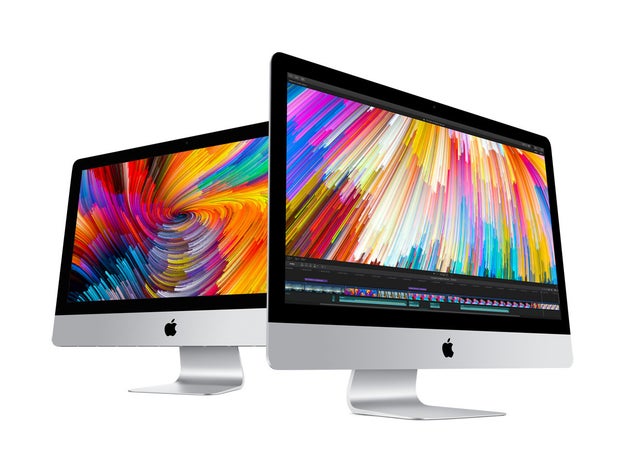
The First iMac Update In Two Years Ships Today

Apple

The last update to the iMac was all the way back in October 2015. Then, earlier this week, Apple announced it was finally refreshing its desktop computer line with the newest processors (Intel’s seventh generation Kaby Lake chips) and faster storage and graphics, too.

I’ve only spent a day with the new 2017 iMac with a 4k Retina display — and that’s not enough time to take in one of the most powerful computers Apple has to offer. But here’s what I know for sure:

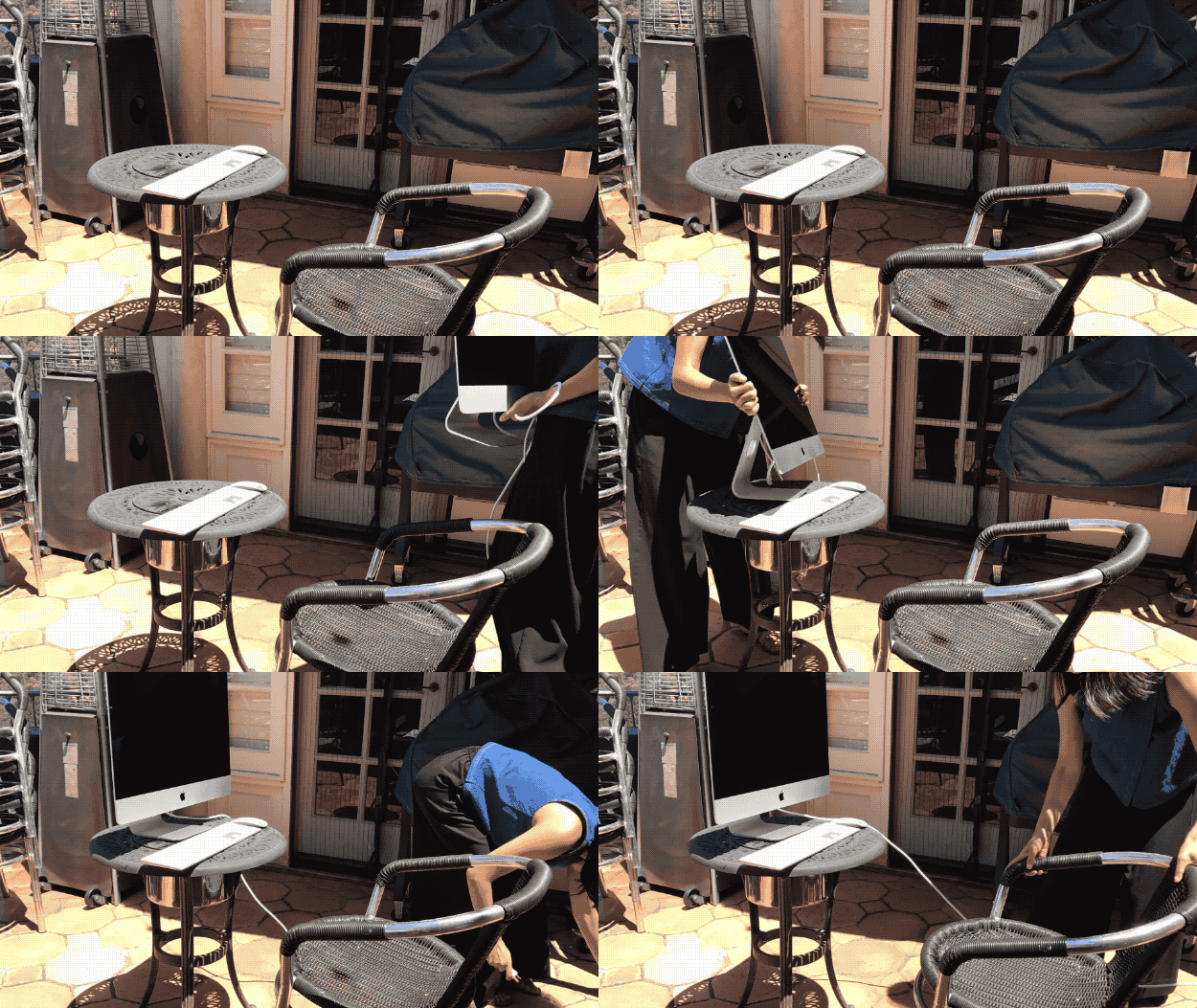
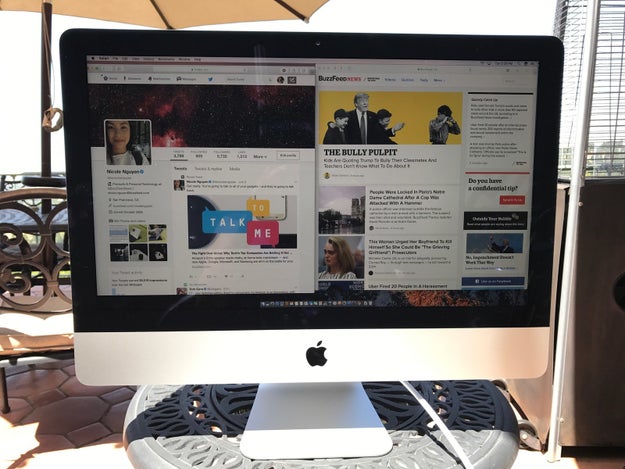
The iMac is bright enough to take outside.

The iMac is bright enough to take outside.

Nicole Nguyen / BuzzFeed News

I know, because I tried. (Do you not also dream of working on a high performance desktop computer in the open air?) And, though I wouldn’t recommend it (because heat, the elements, etc.), the new iMac’s screen is finally bright enough to work in direct sunlight. Window seats, rejoice!

It’s 500 nits bright, the same as last year’s MacBook Pro and MacBook with Retina displays. Apple says that’s 43% brighter than the October 2015 model.

Nicole Nguyen / BuzzFeed News

The iMac's design hasn't changed.

There’s a vent in the back, and two new Thunderbolt 3/USB-C ports, which, compared to Thunderbolt 2, offer twice as fast data transfer and display bandwidth. That means you can connect the iMac to two 4k displays or one 5k display. But the essential design, meaning the silver hardware and the thick bezel around the display, remains the same.

You can now stuff even more memory into the computer.

The 21.5-inch model can go up to 32 GB, and the 27-inch can go up to 64 GB.

The verdict on everything else is still out.

The truth is: the iMac’s new innards are where its real updates live. Because I only got a day with it, over the next few weeks, I’ll use the new iMac as it’s meant to be used – cutting videos, editing photos, watching 4k movies, playing games. Then I’ll publish an update to this first impressions review.

Until then, here’s a look at what’s new inside of the 2017 iMac. There are a lot of configurations, so hang on tight. To be clear, there are three iMac base models: a non-Retina 25-inch iMac ($1,099+), a 4k Retina iMac ($1,299+), and a 5k Retina 27-inch iMac ($1,799). After picking the base model, you can choose a unique cocktail of specifications based on what kind of performance you need, including processor (i5 or i7), memory (8, 16, 32, or 64GB), and storage capacity (1, 2, or 3 terabyte Fusion Drive, or 256GB, 512GB, or 1TB solid state drive).

The iMacs now have the latest Intel processors, and all Retina iMacs ship with quad-core chips. The 27-inch models now offer Turbo Boost (which kicks your computer into overdrive when you’re running especially processor-intensive applications) up to 4.5GHz, while the 21.5-inch Retina 4k model goes up to 4.2 GHz.

Graphics are improving all around, too. The non-Retina, entry-level iMac gets an Intel Iris Plus 640 GPU, and the 21.5-inch with 4K offers the Radeon Pro 555 and 560 graphics cards. The 27-inch 5k can be configured with Radeon Pro 570, 575, and 580 graphics.

Stay tuned for what the heck this spec salad actually means!

Quelle: <a href="The First iMac Update In Two Years Ships Today“>BuzzFeed

The New MacBook Is Almost Perfect

Nicole Nguyen / BuzzFeed News

When it comes to laptops, most people don’t need much space. A lot of our stuff – apps, photos, documents – can now be put on The Cloud. Most people don’t need serious computing power either, unless they’re editing videos or playing games. Many people don’t even need a touchscreen, a notorious battery zapper and finger grease magnet. If you’re a Netflix-watching, web-browsing, email-checking, and word-processing kind of human, all you really need is a keyboard and a nice screen, with a decent processor powering it all.

And that’s what makes the MacBook so good. It has a stunning, high-resolution display with a full-sized keyboard. It doesn’t have the umph of a Pro – but what it lacks in performance, it makes up for in outta-this-world lightness and thinness, making it an ideal laptop for someone who’s always moving around. Plus, unlike an iPad, it can run desktop apps, like the full version of Photoshop, and it's much better for multi-tasking. On top of all that, it comes in rose gold (as well as gold, silver, and space gray, but my stance is clear). It’s the most indulgent, design-y, Apple-y computer on the market – and it’s *this* close to being perfect.

During Monday’s WWDC keynote, Apple announced that it was giving its 12-inch MacBook lineup, which arrives in stores today, a little boost.

The new 2017 MacBooks don’t look any different on the outside, but on the inside, they’re getting the next generation of Intel processors (Kaby Lake), faster drives (50% faster), support for twice as much memory (16 GB of RAM, though it’ll cost ya), and, most exciting of all, an updated keyboard.

These upgrades address the last-generation MacBook’s two biggest problems: that it 1) sacrificed performance for lighter weight (it was only 2.03 pounds) and 2) had a horrible, sticky keyboard that made it hard to type. The 2017 MacBook is the same weight, but it’s zippier (Apple claims by 20%) than before, and it has bouncier keys that won’t totally destroy your fingers the way its old shallow keyboard did.

Nicole Nguyen / BuzzFeed News

After a day and a half with the new model, it definitely feels like an upgrade.

The keys are more comfortable than the original. To make the MacBook as thin as it is, Apple developed a space-saving “butterfly mechanism” underneath big, flat keys that were less bouncy and took some getting used to. This year’s MacBook features the second generation of this mechanism – the same one that the 2016 MacBook Pro has – but somehow it feels a little stickier in this model.

It’s fast enough for running Slack and 19 tabs in Chrome simultaneously, before the system started slowing down (last year's Macbook could handle about 10 tabs before hiccup-ing). And I'm reviewing the base 1.2GHz Core m3 model with 8GB on board. I did some Photoshop editing and the laptop handled that quite well, without any hiccups. But only time will tell if those speeds keep up.

In my testing, which was primarily with the energy-hogging Chrome browser, the Macbook’s battery performance clocked in at around eight hours, with brightness set between three and four clicks from the top. Apple gets 10 hours in its web browsing battery tests, which includes browsing 25 different sites at 75% brightness (four clicks from the top), but that’s on Safari, which is much more battery efficient. But that’s not a deal breaker. Eight hours is enough to cover most of my day.

Here’s the MacBook’s sore spot, though: It still only has one USB-C port.

Even just two, like in the 13-inch MacBook Pro, would be a *significant* improvement. The USB-C standard is supposed to be very versatile. A single USB-C cable, like the one on this LG external display can both power and connect the laptop to the monitor. But, in many cases, like when you’re on the road, one port just means a tangle of hubs, dongles, and adapters when you need to do something as simple as charge your laptop and back up your phone simultaneously. If only Apple slapped on another input, the MacBook would my Perfect Laptop. Until then, it’s just short of that.

And before you @ me with all the reasons why the MacBook sucks, let me start off by saying that it’s not the Perfect Laptop For Everyone. The MacBook starts at $1,300, another ding on near perfect marks everywhere else. That's puzzlingly the same price as the 13-inch MacBook Pro base model (without a Touch Bar or Touch ID), which comes with more processing power (2.3GHz Core i5).

If you want to spend less money on Mac, you can get an Air with a lower resolution screen for $1k. If you use demanding software and need power, get a Pro or iMac. But if you’re always on the go (and can sink over $1k into a new computer), the MacBook is a great choice.

The MacBook is still what a lot of people are looking for.

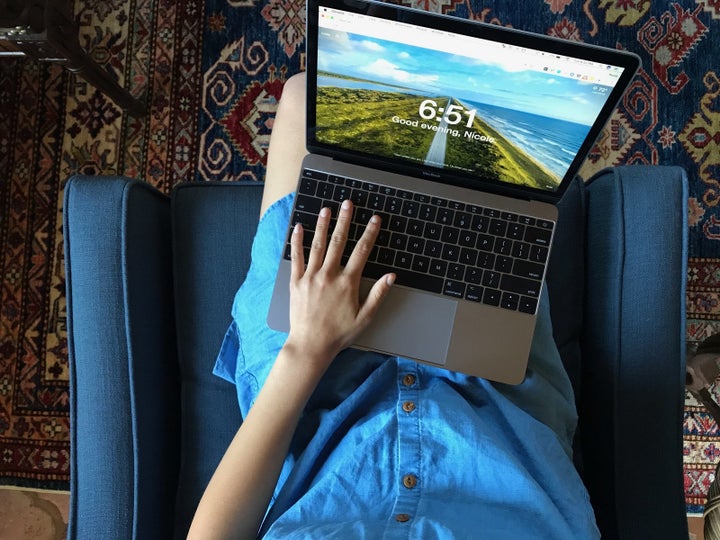
I’ve been using a MacBook for over a year. Not the original MacBook, which most reviewers complained was too laggy for any amount of stress, but the updated 2016 model, which got a bitty speed bump (thanks to a new Intel Core M chip and graphics card). For someone who is constantly traveling, posting updates and tweeting from events, and needing to stream The Handmaid’s Tale, like, ASAP on Wednesday nights, the MacBook has met all of my needs and then some. I can get serious writing and inbox clearing done on this machine (my main computing tasks), plus make GIFs and edit images in Photoshop when I need to.

The MacBook is actually light enough to hold in one hand without feeling like your wrist is going to snap, and to have on your lap while you’re messaging galfriends during The Bachelorette or while you poop or whatever it is you need to do sitting down. The pencil-thin hardware means zero bulk when I throw it in a tote or backpack. I also live in a studio apartment where space is precious and footprint matters! I love the MacBook’s form factor. Hard stop.

I’ve tried other super-portable computers, but nothing compared to the MacBook. Chromebooks didn’t quite make the cut. On the software side, they’re a little too shallow, even though 80% of my work is done in the Chrome browser. I need full desktop Adobe apps and am too attached to my Mac menu bar regulars, like f.lux (Twilight was too buggy) for not ruining my eyes before bed and BetterSnapTool for resizing windows. Ultrabooks running Windows (I tried the XPS 13) were fine for a while, but …Windows. To each her own (truly, I think it’s more personal preference), but I find Mac OS’s interface more accessible and easier to use. Also, I have an iPhone, and being able to Airdrop links/photos/videos quickly from my phone to my laptop and text people from my Mac, is pretty great.

A word of advice if you are considering the MacBook, in its almost perfect state: Because it’s not upgradeable after you buy it, I’d suggest bumping up the model to the core i5 processor (+$100). If you *really* want to future-proof your laptop and make it an investment, 16GB of RAM (+$200) will ensure that your MacBook will last, and help with giant Excel spreadsheets or big Photoshop files – but 8GB should be sufficient for most people. The entry-level MacBook Pro offers more power (2.3GHz Core i5 vs. the MacBook’s 1.2GHz Core m3), but the battery life isn’t as great and, if you lug around your laptop a lot, that extra pound will make a difference.

You’re paying for portability. And if you were already in the market for an Apple laptop, you’re probably prepared to do that.

Quelle: <a href="The New MacBook Is Almost Perfect“>BuzzFeed

Now You Can Get Discounted Amazon Prime If You're On Government Assistance

Stephen Lam / Reuters

Today Amazon launched a discounted Amazon Prime membership for people on government assistance. The monthly price for Prime will drop from $10.99 to $5.99, and subscribers will have access to the full benefits of the subscription service, including free two-day shipping, the ability to purchase Amazon's discounted basics, unlimited cloud photo storage, and unlimited access to a range of streaming media.

In order to qualify for the discount, subscribers must have valid Electronic Benefit Transfer cards. EBT cards are an integral part of the distribution of benefits for Temporary Assistance for Needy Families (TANF), the Supplemental Nutrition Assistance Program (SNAP), the Women, Infants, Children Nutrition Program (WIC), and cash welfare payments. In its most recent report on government benefits, the US Census Bureau reported that 23.1% of Americans, roughly 52.2 million people, were on some kind of government assistance, a 5% increase from 2009.

People with an EBT card can sign up for a free 30-day trial of the program at amazon.com/qualify; after the free month, customers can choose whether they'll be automatically billed or not. A discounted subscriber can only qualify for four years of reduced-price Prime. People have to reapply every year, and they can cancel and restart their membership any time without losing the discount. According to the Census Bureau, the majority of TANF participants were in the program between one and 12 months. The largest share of SNAP recipients, 38.6%, received benefits for 37 to 48 months.

We're hoping to introduce Prime to customers who may have felt there were barriers to online shopping before,” said Julie Law, an Amazon Prime spokesperson. “It’s not all altruism. We hope that when they’re not in those states of need that they do become lifelong members of Prime. That’s the other logic to the program.”

The USDA estimated it spent around $102 billion on food and nutrition assistance programs in fiscal year 2016, making for a sizable market. It's spent $41.7 billion on the programs so far in fiscal year 2017. High-income families — with household incomes of $112,000 or more — make up Prime's biggest subscriber base, according to TechCrunch. That's the top 20% of US earners.

Amazon said in a statement that it will add other ways for people on government assistance to access its services in the future without EBT, though it did not specify how or what programs.

Amazon Basics offers cheap versions of ubiquitous products like batteries, diapers, towels, charging cords, and pencils. Many of the Basics products are aimed at families with children and include a 20% discount on regular subscriptions to baby wipes and diapers. Amazon's extensive content library includes streaming TV shows, movies, music, and audiobooks via Audible.com.

Registration for the EBT discount does not require a credit or debit card because of the Amazon Cash program, which allows people to add cash to their Amazon accounts via designated brick-and-mortar retailers, such as CVS and Speedway.

An EBT card can't be used to pay for the membership itself or for any items on Amazon yet, though Amazon, along with other online retailers, will pilot a program that will allow SNAP users to buy food from its grocery services in 2018.

Quelle: <a href="Now You Can Get Discounted Amazon Prime If You're On Government Assistance“>BuzzFeed

The Pro-Trump Internet And The Alt-Right Is Turning On Breitbart

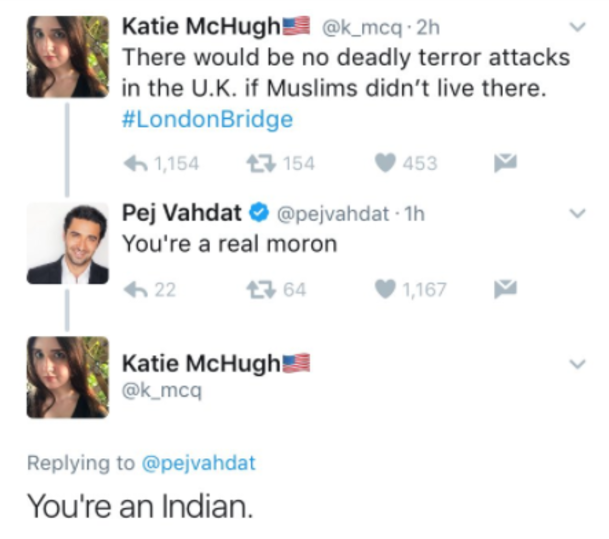
On Monday morning, Breitbart News fired staffer Katie McHugh, following a series of incendiary weekend tweets broadcast in the wake of the London Bridge terror attack. On Saturday evening, as word of the incidents spread across social media, McHugh tweeted that “there would be no deadly terror attacks in the U.K. if Muslims didn't live there.” Her comments reportedly offended a number of Breitbart staffers, according to a story published by CNN.

After McHugh's firing, she took to Twitter again to condemn the publication for what she views as censorship. “Breitbart News fired me for telling the truth about Islam and Muslim immigration,” she wrote.

Across the pro-Trump internet, McHugh's firing was widely decried as a sign of weakness by Breitbart and an attempt by the site — once led by now-Senior White House Advisor Stephen Bannon — to pivot toward a more moderate editorial strategy. McHugh, meanwhile, set up a donations page on the far-right crowdfunding site, Wesearchr, run by Chuck Johnson.

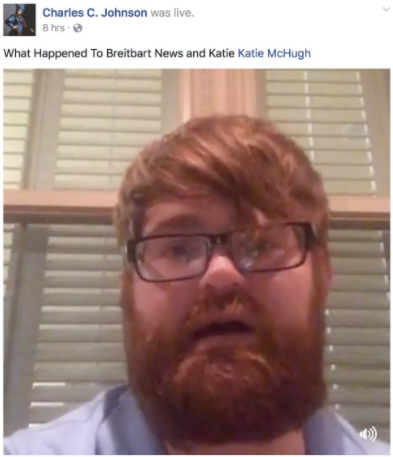
And early Tuesday morning, Johnson — a former Daily Caller freelancer known for his trolling and informal advising of the Trump transition team — echoed McHugh's frustrations in a Facebook post. “I suspect we are seeing the end of Breitbart,” Johnson wrote. “It's basically a shell of it's former self. It's not that interesting anymore.” Johnson called Breitbart a “click-baity property” and “a poor man’s right-wing Huffington Post.”

In a follow up email to BuzzFeed News, Johnson responded unequivocally: “Breitbart is over.”

Another pro-Trump supporter and member of the MAGAsphere on Twitter suggested that the site has lost its edge after Steve Bannon left to run Donald Trump's campaign. “We read (past-tense) [Breitbart] because their news cycle was stuff we were interested in reading, and it seems Bannon was the person driving that vehicle,” this person who wished to remain anonymous said. “With him unable to do that in his job with POTUS, BB just doesn't have the stories that interest us anymore.”

Jack Posobiec — a pro-Trump Twitter personality — echoed that sentiment. “People in MAGA world don't really look to [Breitbart] for breaking news as much as they used to, Its more like the Hill or Roll Call,” he said.

In pro-Trump circles, that perceived pivot may prove to be enough to turn away devoted readers. New Right blogger Mike Cernovich noted that “the media market has no need right now for another Hill,” he said. “We need more sites like what Breitbart was and what the Daily Caller is doing. It's a massive mistake to try to pivot to the mainstream, especially if you're on the right.”

Such testimonials from the pro-Trump internet are largely anecdotal. That said, there is some data to suggest Breitbart's momentum has slowed from the halcyon months leading up to the 2016 election. In May, Vanity Fair cited Alexa web traffic results that appear to indicate “an unusually steep decline in Breitbart’s traffic.” And today, Digiday reported that ad tracking platform MediaRadar found just “26 brands appearing on Breitbart in May, down from a high of 242 in March.”

Multiple conversations with pro-Trump media personalities suggest the resignation of Breitbart Tech Editor Milo Yiannoplous in February after the discovery of video of him allegedly endorsing pedophilia was a turning point for the site. According to reports Yiannopolous' resignation was the result of internal pressure from Breitbart employees. For some in the pro-Trump media, it was a sign that the publication's management was caving to the pressure from the mainstream media.

… and that some are heading toward sites like The Daily Caller

... and that some are heading toward sites like The Daily Caller

Quelle: <a href="The Pro-Trump Internet And The Alt-Right Is Turning On Breitbart“>BuzzFeed